Expanding

            5
            Belinda works for an
            advertising company that
            produces billboard
            advertising. The cost of a
            billboard is based on the
            area of the sign and is $50
            per square metre. If we
            increase the length of the
            sign by 2 m and the height
            of the sign by 3 m, can you
            write a rule for the
            increase in the cost of the
            billboard?
               This chapter shows you
            how to manipulate
            algebraic terms and
            expressions to place them
            in the most useful form.
144   Maths Quest 9 for Victoria


Expanding single
brackets
       In the previous chapter on introductory
       algebra, we learned that algebra is a type of
       language.
          In this chapter we can take the idea fur-
       ther and look at some of the ‘advanced
       features’ of this language. At first we will
       rely on using common numerical examples
       to illustrate the techniques, but after a
       while, when your confidence has increased,
       the techniques will become easier to under-
       stand using algebra only.

       What is expanding?
       Consider the English word: won’t. It really
       stands for will not. In going from won’t to
       will not we have expanded the word, but
       the meaning remains unchanged. It is the
       same with expanding in algebra; we go
       from a more compact form (won’t) to an
       expanded form (will not). Consider the
       following example with numbers.
                  3(4 + 5)
          How can we find its value?
          We know from our work on order of operations in chapter 1 that we do brackets first,
       so that:
                  3(4 + 5)
                     = 3(9)
          Now the brackets mean multiply, so:
                  3(4 + 5)
                     = 3(9)
                     = 27
          Consider now an alternative way of expanding the original expression, temporarily
       ‘ignoring’ order of operations.
                  3(4 + 5)
                     = 3(4) + 3(5)
          This may seem unusual, or even incorrect, but it isn’t. (It is not!)
                  3(4 + 5)
                     = 3(4) + 3(5)
                     = 12 + 15
                     = 27
          You can try this with any numbers you like, but the result is the same. This expan-
       sion is valid and correct.
       Expansion means to multiply everything inside the brackets by what is directly
       outside the brackets.
Chapter 5 Expanding       145
    WORKED Example 1
Expand the following expressions.
a 5(4 + 3)      b 5(x + 3)        c 5(x − y)              d −a(x − y)
THINK                                                           WRITE
a 1 Write the expression.                                       a 5(4 + 3)
   2 Expand the brackets.                                             = 5(4) + 5(3)
   3 Multiply out the brackets.                                       = 20 + 15
                                                                      = 35
    4   Check that the result is valid by simplifying the          5(4 + 3)
        brackets in the original expression first.                     = 5(7)
                                                                      = 35, so it is indeed valid.
b   1   Write the expression.                                   b 5(x + 3)
    2   Expand the brackets.                                          = 5(x) + 5(3)
    3   Multiply out the brackets.                                    = 5x + 15
c   1   Write the expression.                                   c 5(x − y)
    2   Expand the brackets.                                          = 5(x) + 5(−y)
    3   Multiply out the brackets.                                    = 5x − 5y
        (Remember that a positive term multiplied
        by a negative term makes a negative term.)
d   1   Write the expression.                                   d −a(x − y)
    2   Expand the brackets.                                          = −a(x) − a(−y)
    3   Multiply out the brackets.                                    = −ax + ay
        (Remember that a negative term multiplied
        by a negative term makes a positive term.)


            Note: It doesn’t matter what is immediately outside the brackets. It may be a number or
            a pronumeral or both. The following expansions are a little more complex.


    WORKED Example 2
Expand each of the following.
a 5x(6y − 7z)        b −4y(2x + 3w)        c x(2x + 3y)
THINK                                                           WRITE
a 1 Write the expression.                                       a 5x(6y − 7z)
   2 Expand the brackets.                                           = 5x(6y) + 5x(−7z)
   3 Multiply out the brackets.                                     = 30xy − 35xz
     (Multiply number parts and pronumeral parts
     separately and write pronumerals for each term
     in alphabetical order.)
b 1 Write the expression.                                       b −4y(2x + 3w)
   2 Expand the brackets.                                           = −4y(2x) − 4y(3w)
   3 Multiply out the brackets.                                     = −8xy − 12wy
c 1 Write the expression.                                       c x(2x + 3y)
   2 Expand the brackets.                                           = x(2x) + x(3y)
   3 Multiply out the brackets.                                     = 2x2 + 3xy
     (Remember that x multiplied by itself gives x2.)
146       Maths Quest 9 for Victoria


                                       Expanding and collecting like terms
                                       With more complicated expansions, like terms may need to be collected after the
                                       expansion of the bracketed part. Remember that like terms contain the same
                                       pronumeral parts. You first expand the brackets, then collect the like terms.


                              WORKED Example 3
                            Expand and simplify by collecting like terms.
                            a 4(x − 4) + 5        b x(y − 2) + 5x        c x(y − z) + 5x      d 7x + 6(y − 2x)
                            THINK                                                      WRITE
                            a 1 Write the expression.                                  a 4(x − 4) + 5
                               2 Expand the brackets.                                      = 4(x) + 4(−4) + 5
                               3 Multiply out the brackets.                                = 4x − 16 + 5
                               4 Collect any like terms.                                   = 4x − 11
                            b 1 Write the expression.                                  b x(y − 2) + 5x
                               2 Expand the brackets.                                      = x(y) + x(−2) + 5x
                               3  Multiply out the brackets.                               = xy − 2x + 5x
                               4  Collect any like terms.                                  = xy + 3x
                            c 1 Write the expression.                                  c x(y − z) + 5x
                               2 Expand the brackets.                                      = x(y) + x(−z) + 5x
                               3 Multiply out the brackets.                                = xy − xz + 5x
                               4 Collect any like terms. There are no like terms.
                            d 1 Write the expression.                                  d 7x + 6(y − 2x)
                               2 Expand the brackets.                                      = 7x + 6(y) + 6(−2x)
                               3  Multiply out the brackets.                               = 7x + 6y − 12x
                               4  Collect any like terms.                                  = −5x + 6y


                                        remember
                                      remember
                                         1. Expansion means to multiply everything inside the brackets by what is directly
                                            outside the brackets.
                                         2. After expanding brackets, simplify by collecting any like terms.


        reads
    L Sp he                                           5A             Expanding single brackets
                et
EXCE


         Expanding
         single    WORKED            1 Expand the following expressions.
         brackets Example
                        1
                                       a 3(x + 2)          b 4(x + 3)              c   5(m + 4)          d   2(p + 5)
       d
    hca                                e 4(x + 1)          f 7(x − 1)              g   −4(y + 6)         h   −5(a + 1)
Mat


               Expanding
                                       i −3(p − 2)         j −(x − 1)              k   −(x + 3)          l   −(x − 2)
               single                  m 3(2b − 4)         n 8(3m − 2)             o   −6(5m − 4)        p   −3(9p − 5)
               brackets
                           WORKED  2 Expand each of the following.
                           Example
       ogram                         a x(x + 2)          b y(y + 3)                c   a(a + 5)          d   c(c + 4)
                                 2
GC pr


                                     e x(4 + x)          f y(5 + y)                g   m(7 − m)          h   q(8 − q)
               Expanding
                                     i 2x(y + 2)         j 5p(q + 4)               k   −3y(x + 4)        l   −10p(q + 9)
                                     m −b(3 − a)         n −7m(5 − n)              o   −6a(5 − 3a)       p   −4x(7 − 4x)
Chapter 5 Expanding       147
WORKED  3 Expand and simplify by collecting like terms.                                                         5.1
Example
          a 2(p − 3) + 4                b 5(x − 5) + 8                 c   −7(p + 2) − 3                 HEET


                                                                                                    SkillS
      3
          d −4(3p − 1) − 1              e 6x(x − 3) − 2x               f   2m(m + 5) − 3m
          g 3x(p + 2) − 5               h 4y(y − 1) + 7                i   −4p(p − 2) + 5p
          j 5(x − 2y) − 3y − x          k 2m(m − 5) + 2m − 4           l   −3p(p − 2q) + 4pq − 1
          m −7a(5 − 2b) + 5a − 4ab      n 4c(2d − 3c) − cd − 5c        o    6p + 3 − 4(2p + 5)
          p 5 − 9m + 2(3m − 1)


                                  Oops! Any errors?
             Here are 6 expressions that someone has simplified. Have any errors been made?
             a 5(x − 1) = 5x − 1
             b 3x + 6x = 9 + x
             c 4(3x) = 12x
             d 8x − 3x = 5
             e −2(x − 7) = −2x −14
             f x(x + 5) = 2x + 5x
             1 Which expressions have been simplified correctly?
             2 Explain why someone might make the errors you have found.
             3 Correct any errors you find by rewriting the expression on the right-hand side of
               the equals sign.
             4 Choose 2 values for x and evaluate the left- and right-hand sides to check
               whether they are now equivalent.


                                   The Bagels game
             In the game of Bagels, a player is to determine a 3-digit number (no digit repeated)
             by making educated guesses. After each guess, a clue is given about the guess.
             Here are the clues.
                 bagels: no digit correct
                 pico:     one digit is correct but in the wrong position
                 fermi:    one digit is correct and in the correct position
             1 In each of the problems below, a number of guesses have been made with the
                clue for each guess shown to its right. From the given set of guesses and clues,
                determine the 3-digit number.
                 a 123 bagels                       b 908 bagels
                    456 pico                            134 pico
                    789 pico                            387 pico fermi
                    075 pico fermi                      256 fermi
                    087 pico                            237 pico pico
                    ???                                 ???
             2 Now try this game with a partner. One person is to decide on a 3-digit number
                and provide clues to the other person who is guessing what the 3-digit number is.
148   Maths Quest 9 for Victoria


What is a metre?
          metre?
                                                                                  Expand the brackets in the
                                                                              expressions given to find the puzzle’s
                                                                                          answer code.


         e – 2ae      6e – 3 e 2     e – 2ae   a 2e – ae 2 5e – 10 8 – 4e        –4a – 6 e – 2ae 2ae – 3e 8 – 4e 5e – 10 6a – 2 a 2e – ae 2 6a – 2


           6e – 3e 2 8 – 4e 2ae – 3e a 2 – ae e – 2ae e 2 + e e 2 + e e – 2ae                  a 2 – 4a 2ae – 3e 6e – 3e 2 3a + ae a 2 – 4a – 4a – 6

                                                                                                                          2      2
        6e – 3e 2 3a + ae 8 – 4e 5e – 10 e – 2ae a 2e – ae 2 6e – 3e 2 6a – 2 2ae – 3e 6 – 3a 8 – 4e –4a – 6 2ae – 2ae 2 a – 4a a – ae


         6e – 3 e 2     3a + ae       8 – 4e        2ae – 3e    a 2 – 4a   2ae – 2ae 2   6e – 3 e 2      3a + ae     3ae + 6e    a 2 – 4a    e2 + e      8 – 4e

           6e – 3 e 2     a 2 – 4a     6e – 3 e 2     3a + ae     8 – 4e    8 – 4e   5a – 10ae        4 a 2 – 4a   6a – 2   6e – 3 e 2 a 2 – 4 a   2ae – 2ae 2


                                                                                                          = – a (e – a )
                                                                                                          =
                      = 2(3 a – 1)
                      =                                                                                   = – e (–2 a + 3)
                                                                                                          =
                      = 3(2 – a )
                      =                                                                                   = – a (4 – a )
                                                                                                          =
                      = 5(e – 2)
                      =                                                                                   = 3 e (a + 2)
                                                                                                          =
                      = –4(e – 2)
                      =                                                                                   = 5 a (1 – 2 e )
                                                                                                          =
                      = –2(2 a + 3)
                      =                                                                                   = –2 ae (e – 1)
                                                                                                          =
                      = a (3 + e )
                      =                                                                                   = ae (a – e )
                                                                                                          =
                      = e (1 – 2 a )
                      =                                                                                   = 3 e (2 – e )
                                                                                                          =
                      = e (e + 1)
                      =
                                                                                                          = –4 a (– a + 1)
                                                                                                          =
Chapter 5 Expanding     149
Expanding two brackets
            When expanding an expression that contains two (or more) brackets, the steps are the
            same as before.
            Step 1 Expand each bracket (working from left to right).
            Step 2 Collect any like terms.


    WORKED Example 4
Expand and simplify the following expressions.
a 5(x + 2y) + 6(x − 3y)                     b −5x(y − 2) + y(x + 3)
c 7y(x − 2y) + y2(x + 5)                    d −5xy(1 + 2y) + 6x(y + 4x)
THINK                                           WRITE
a   1   Write the expression.                   a 5(x + 2y) + 6(x − 3y)
    2   Expand each bracket.                         = 5(x) + 5(2y) + 6(x) + 6(−3y)
    3   Multiply out the brackets.                   = 5x + 10y + 6x − 18y
    4   Collect any like terms.                      = 11x − 8y
b   1   Write the expression.                   b −5x(y − 2) + y(x + 3)
    2   Expand each bracket.                         = −5x(y) − 5x(−2) + y(x) + y(3)
    3   Multiply out the brackets.                   = −5xy + 10x + xy + 3y
    4   Collect any like terms.                      = −4xy + 10x + 3y
c   1   Write the expression.                   c 7y(x − 2y) + y2(x + 5)
    2   Expand each bracket.                         = 7y(x) + 7y(−2y) + y2(x) + y2(5)
    3   Multiply out the brackets.                   = 7xy − 14y2 + xy2 + 5y2
    4   Collect any like terms.                      = 7xy − 9y2 + xy2
d   1   Write the expression.                   d −5xy(1 + 2y) + 6x(y + 4x)
    2   Expand each bracket.                         = −5xy(1) − 5xy(2y) + 6x(y) + 6x(4x)
    3   Multiply out the brackets.                   = −5xy −10xy2 + 6xy + 24x2
    4   Collect any like terms.                      = xy − 10xy2 + 24x2


            As you can see, there is really no difference between the questions in this section and
            the previous section; just a little more complex ‘bookkeeping’ is required. Be careful
            when collecting like terms which may only appear to be like. For example, 4x2y and
            4xy2 are not like terms at all.


             remember
           remember
              To expand an expression:
              1. expand each bracket (working from left to right)
              2. collect any like terms.
150               Maths Quest 9 for Victoria


                                                               5B            Expanding two brackets

              5.2         WORKED          1 Expand and simplify the following expressions.
      HEET                Example
                                            a 2(x + 2y) + 3(2x − y)                    b     4(2p + 3q) + 2(p − 2q)
SkillS


                                       4a
                                            c 7(2a + 3b) + 4(a + 2b)                   d     5(3c + 4d) + 2(2c + d)
                                            e −4(m + 2n) + 3(2m − n)                   f     −3(2x + y) + 4(3x − 2y)
       d
                                            g −2(3x + 2y) + 3(5x + 3y)                 h     −5(4p + 2q) + 2(3p + q)
    hca
                                            i 6(a − 2b) − 5(2a − 3b)                   j     5(2x − y) − 2(3x − 2y)
Mat


              Expanding                     k 4(2p − 4q) − 3(p − 2q)                   l     2(c − 3d) − 5(2c − 3d)
              two                           m 7(2x − 3y) − (x − 2y)                    n     −5(p − 2q) − (2p − q)
              brackets                      o −3(a − 2b) − (2a + 3b)                   p     4(3c + d) − (4c + 3d)
      ogram               WORKED 2 Expand and simplify the following expressions.
                          Example
GC pr


                                   a a(b + 2) + b(a − 3)                      b              x(y + 4) + y(x − 2)
              Expanding 4b, c, d   c c(d − 2) + c(d + 5)                      d              p(q − 5) + p(q + 3)
                                   e 3c(d − 2) + c(2d − 5)                    f              7a(b − 3) − b(2a + 3)
                                   g 2m(n + 3) − m(2n + 1)                    h              4c(d − 5) + 2c(d − 8)
                                   i 3m(2m + 4) − 2(3m + 5)                   j              5c(2d − 1) − (3c + cd)
                                   k −3a(5a + b) + 2b(b − 3a)                 l              −4c(2c − 6d) + d(3d − 2c)
                                   m 6m(2m − 3) − (2m + 4)                    n              2p(p − 4) + 3(5p − 2)
                                   o 7x(5 − x) + 6(x − 1)                     p              −2y(5y − 1) − 4(2y + 3)
                                           3 multiple choice
                                             a What is the equivalent of 3(a + 2b) + 2(2a − b)?
                                               A 5a + 6b       B 7a + 4b        C 5(3a + b)     D 7a + 8b        E 12a − 12b
                                             b What is the equivalent of −3(x − 2y) − (x − 5y)?
                                               A −4x + 11y B −4x − 11y C 4x + 11y               D 4x + 7y        E 3x + 30y
                                             c What is the equivalent of 2m(n + 4) + m(3n − 2)?
                                               A 3m + 4n − 8 B 5mn + 4m C 5mn + 10m D 5mn + 6m                   E 6mn − 16m


                                       QUEST
                                   S
                          M AT H


                                                   GE


                                                        1 Find the next 3 terms of this algebraic sequence.
                                               EN


                                                          x + 3y, 2x + y, 3x + 4y, 5x + 5y, 8x + 9y, 13x + 14y, ….
                                   CH          L        2 Mind-reading tricks often use algebra as a base. Try the following
                                         AL               mind-reading trick. Use algebra to explain why the trick works.
                                                            Double the number of the month in which you were born. Subtract
                                                          16 from your answer. Subtract 20 from your result, then multiply by 10.
                                                          Finally, add the day of the month in which you were born to your
                                                          answer. The number you end up with shows the month and day you
                                                          were born. For example, if you were born on June 17, your answer will
                                                          be 617.
                                                            Try this trick on another person. ‘Read’ the person’s mind by stating
                                                          the month and day they were born from the number they tell you at the
                                                          end of the calculation.
Chapter 5 Expanding      151
Expanding pairs of brackets
           In the previous section we expanded expressions with two brackets which were separated
           by a + or − sign, such as 5(x + 2y) + 6(x − 3y). In this section we begin to look at
           expressions where there are two brackets being multiplied together, such as (x + 2y)
           (x − 3y). These require a more careful analysis and technique.
              Let us again refer to a numerical example:
                      (2 + 6)(7 − 3)
              The ‘traditional’ approach, using order of operations from chapter 1, results in:
                      (2 + 6)(7 − 3)
                           = (8)(4)
                           = 32
              Consider the ‘alternative’ approach. First multiply the 2 by the second bracket and
           then the 6 by the second bracket.
                      (2 + 6)(7 − 3)
                           = 2(7 − 3) + 6(7 − 3)
                           = 2(7) + 2(−3) + 6(7) + 6(−3)
                           = 14 − 6 + 42 − 18
                           = 32
              Again, we end up with identical results, no matter which method is used. It may
           appear unnecessarily long for numeric examples (and, indeed, it is) but it works well
           for algebraic expressions.
           When multiplying expressions within brackets, multiply each term in the first
           bracket by each term in the second bracket.


   WORKED Example 5
 Expand and simplify each of the following expressions.
 a (6 − 5)(15 + 3)        b (x − 5)(x + 3)     c (x + 2)(x + 3)         d (2x + 2)(2x + 3)
 THINK                                        WRITE
 a 1 Write the expression.                    a (6 − 5)(15 + 3)
    2 Expand by multiplying each of the            = 6(15 + 3) − 5(15 + 3)
       terms in the first bracket by each of
       the terms in the second bracket.
    3  Expand each of the remaining brackets.      = 6(15) + 6(3) − 5(15) − 5(3)
    4  Simplify.                                   = 90 + 18 − 75 − 15
                                                   = 18
    5 Check the results using the order of      (6 − 5)(15 + 3)
       operations method.                          = (1)(18)
                                                   = 18
 b 1 Write the expression.                    b (x − 5)(x + 3)
    2 Expand by multiplying each of the            = x(x + 3) − 5(x + 3)
       terms in the first bracket by each of
       the terms in the second bracket.
    3 Expand each of the remaining                 = (x)(x) + x(3) − 5(x) − 5(3)
       brackets.                                   = x2 + 3x − 5x − 15
    4 Collect like terms.                          = x2 − 2x − 15     Continued over page
152       Maths Quest 9 for Victoria


THINK                                                   WRITE
c 1 Write the expression.                               c (x + 2)(x + 3)
  2 Expand by multiplying each of the terms in the first      = x(x + 3) + 2(x + 3)
    bracket by each of the terms in the second bracket.
  3 Expand each of the remaining brackets.                   = x(x) + x(3) + 2(x) + 2(3)
                                                             = x2 + 3x + 2x + 6
  4 Collect like terms.                                      = x2 + 5x + 6
d 1 Write the expression.                               d (2x + 2)(2x + 3)
  2 Expand by multiplying each of the terms in the first      = 2x(2x + 3) + 2(2x + 3)
    bracket by each of the terms in the second bracket.
  3 Expand each of the remaining brackets.                   = 2x(2x) + 2x(3) + 2(2x) + 2(3)
                                                             = 4x2 + 6x + 4x + 6
  4 Collect like terms.                                      = 4x2 + 10x + 6


            Note: The last step in each question (collection of like terms), is most important, and
            often forgotten. Without completing this step, the expansion is not fully correct.

            An alternative method
            Part of the problem in expanding pairs of brackets is a bookkeeping one — keeping
            track of which terms have been multiplied by which. An alternative approach uses a
            diagram to keep track of the various multiplication operations.


     WORKED Example 6
 Use a diagrammatic technique to expand (2x + 3y)(4x − 5z).
 THINK                                                    WRITE
 1 Write the expression and add 4 curved lines                 2
    connecting each term, according to the pattern shown.
                                                             1
 2 Number each of the curved lines.
                                                            (2x + 3y)(4x – 5z)
                                                                     3
                                                                       4
 3   Perform each of the multiplications, in order of the 1: 2x(4x) = 8x2
     numbers on the lines.                                   2: 2x(−5z) = −10xz
                                                             3: 3y(4x) = 12xy
                                                             4: 3y(−5z) = −15yz
 4   Write the expression and its expansion by placing the (2x + 3y)(4x − 5z)
     terms on a single line.                                    = 8x2 − 10xz + 12xy − 15yz
 5   Collect like terms if necessary (none in this example).

            There is nothing magical or special about this method, but it forces you to keep track of
            the 4 multiplications required in the expansion.
              This method is often given the name FOIL, where the letters stand for:           O
            First — multiply the first term in each bracket.                                  F
            Outer — multiply the 2 outer terms.                                        (a + b) (c + d)
            Inner — multiply the 2 inner terms.                                                I
                                                                                                 L
            Last — multiply the last term of each bracket.
Chapter 5 Expanding         153
                   remember
                 remember
                     1. When multiplying expressions within pairs of brackets, multiply each term in
                        the first bracket by each term in the second bracket, then collect the like terms.
                     2. You can use a ‘diagrammatic method’ (or FOIL) to help you keep track of
                        which terms are to be multiplied together.


                                     5C             Expanding pairs of brackets

WORKED         1 Expand and simplify each of the following expressions.                                                    Math
Example
                 a (a + 2)(a + 3)              b (x + 4)(x + 3)                  c   (y + 3)(y + 2)


                                                                                                                              cad
             5
                 d (m + 4)(m + 5)              e (b + 2)(b + 1)                  f   (p + 1)(p + 4)          Expanding
                                                                                                               pairs of
                 g (a − 2)(a + 3)              h (x − 4)(x + 5)                  i   (m + 3)(m − 4)            brackets
                 j (y + 5)(y − 3)              k (y − 6)(y + 2)                  l   (x − 3)(x + 1)
                 m (x − 3)(x − 4)              n (p − 2)(p − 3)                  o   (x − 3)(x − 1)
WORKED         2 Use a diagrammatic technique to expand the following.                                                  GC pro
Example
                 a (2a + 3)(a + 2)            b (3m + 1)(m + 2)                      (6x + 4)(x + 1)


                                                                                                                             gram
             6
                                                                                 c
                 d (c − 6)(4c − 7)            e (7 − 2t)(5 − t)                  f   (1 − x)(9 − 2x)         Expanding
                 g (2 + 3t)(5 − 2t)           h (7 − 5x)(2 − 3x)                 i   (5x − 2)(5x − 2)
                3 Expand and simplify each of the following.
                  a (x + y)(z + 1)              b (p + q)(r + 3)                 c   (2x + y)(z + 4)
                  d (3p + q)(r + 1)             e (a + 2b)(a + b)                f   (2c + d)(c − 3d)
                  g (x + y)(2x − 3y)            h (4p − 3q)(p + q)               i   (3y + z)(x + z)
                  j (a + 2b)(b + c)             k (3p − 2q)(1 − 3r)              l   (7c − 2d)(d − 5)
                  m (4x − y)(3x − y)            n (p − q)(2p − r)                o   (5 − 2j)(3k + 1)
                                                                                                                          GAME
                4 multiple choice


                                                                                                                             time
                  a The equivalent of (x + 7)(x − 2) is:                                   Expanding
                    A x2 + 5x − 14 B 2x + 5 C x2 − 5x − 14 D x2 + 5x + 14 E x2 − 5x + 14 — 001
                  b What is the equivalent of (4 − y)(7 + y)?
                    A 28 − y2 B 28 − 3y + y2 C 28 − 3y − y2 D 11 − 2y E 28 + 3y − y2            SHE 5.1
                                                                                                   ET
                                                                                                                 Work
                  c The equivalent of (2p + 1)(p − 5) is:
                    A 2p2 − 5 B 2p2 − 11p − 5 C 2p2 − 9p − 5 D 2p2 − 6p − 5 E 2p2 + 9p − 5


             QUEST
         S
M AT H


                         GE


                              1 Xavier left for school in the morning. One quarter of the way to school,
                                he passed a post office. The clock on the outside of the post office
                     EN


                                showed 7.44 am. Halfway to school, he passed a convenience store. The
         CH          L          time shown there was 7.53 am. If Xavier continues walking at the same
               AL
                                speed, at what time will he get to school?
                              2 The human heart beats about 105 times each day. Approximately how
                                many times does the heart beat in an 80-year lifetime?
                              3 There are 12 people trying out for a tennis team. Five of them are girls. What
                                percentage of the possible doubles teams could be mixed double teams?
154   Maths Quest 9 for Victoria


                  What has area got to do with
                          expanding?
           1 Draw a square of side length x.                       x            3
           2 What is the area of this square?
          Consider the rectangle at right which has          x
          a length 3 units longer and a width 2 units
          wider than the square you have just drawn.
          Notice that it has been divided up into
          4 regions.
           3 Find the area of each of the 4 regions.         2
           4 What is the total area of the rectangle?
           5 Write an expression for the length of
               the rectangle.
           6 Write an expression for the width of the rectangle.
           7 Using the relationship, area = length × width and your answers to parts 5 and
               6, write an expression for the area of the rectangle.
           8 Relate your answers to parts 4 and 7. What have you noticed?
           9 Show, using a diagram and areas of 4 regions, how to obtain the expanded
               expression for (x + 5)(x + 7).
          10 Show, using a diagram and areas of 4 regions, how to obtain the expanded
               expression for (a + b)(c + d).
          11 Challenge: Show, using a diagram and areas of 4 regions, how to obtain the
               expanded expression for (x − 2)(x + 3).


                                                  1
       1 Expand 5(x + 3).
       2 Expand z(3 − 7z).
       3 Expand 2(p − 7q) + 3p − 5q and simplify by collecting like terms.
       4 Expand and simplify 5(a + 2b) + 2(3a + b).
       5 Expand and simplify m(n + 1) + n(m − 4).
       6 multiple choice
         If K(a − 3b) − (a + 10b) = 3a − 22b, then the missing number is:
         A 1              B 2             C 3             D 4             E 5
       7 Expand and simplify (a + 1)(a + 4).
       8 Expand and simplify (p − 7)(6p − 3).
       9 Expand and simplify (4 − 3j)(4k + 2).
      10 True or false? (x + 4)(x + 10) = x2 + 14x + 40
Chapter 5 Expanding       155
Expansion patterns
           Although the techniques learned in the previous section are perfectly adequate for all
           expansions of pairs of brackets, there are some ‘special’ cases where the expansion is
           particularly simple and can be done very quickly if you recognise the pattern. After
           comparing the result with that obtained using previous methods, perhaps you will adopt
           these ‘short cuts’.

           Difference of two squares rule
           The first pattern we will examine is obtained as a result of expanding a pair of brackets
           to produce a ‘difference of two squares’.
              That is, we produce two terms which are perfect squares (can be expressed as a
           number and/or a pronumeral squared) where one term is subtracted from the other.
              Consider expanding (x + 3)(x − 3).
                (x + 3)(x − 3) = x(x − 3) + 3(x − 3)
                               = x(x) + x(−3) + 3(x) + 3(−3)
                               = x2 − 3x + 3x − 9
                               = x2 − 9
              Notice how the ‘middle terms’, −3x + 3x cancel each other out. This is the key to the
           pattern and will always happen. (Can you prove this?) Note: The terms left over are the
           squares of each of the original terms.
              In other words, (x + 3)(x − 3) = x2 − 32.
              Notice the pattern of terms in the pair of brackets which produce the difference of
           two squares.
              Here are some more examples.
                (x + 5)(x − 5)     (x + 4)(x − 4)       (x + h)(x − h)    (2x + 7)(2x − 7)
                   = x2 − 52          = x2 − 42            = x2 − h2         = (2x)2 − 72
                   = x2 − 25          = x2 − 16                              = 4x2 − 49
              Therefore, when we recognise this pattern we merely have to write the squares of
           each of the two terms and place a minus sign between them.
                                           (a + b)(a − b) = a2 − b2


   WORKED Example 7
 Use the difference of two squares rule, if possible, to expand and simplify each of the
 following.
 a (x + 8)(x − 8)         b (6 − x)(6 + x)      c (2x − 3)(2x + 3)      d (5 + 3x)(5 − 3x)
 THINK                                         WRITE
 a 1 Write the expression.                     a (x + 8)(x − 8)
     2 Check that the expression can be
       written as the difference of two
       squares by comparing it with
       (a + b)(a − b). It can.
     3 Write the answer as the difference of         = x2 − 82
       two squares using the formula                 = x2 − 64
       (a + b)(a − b) = a − b , where a = x
                          2    2
                                                                      Continued over page
       and b = 8.
156      Maths Quest 9 for Victoria


THINK                                                         WRITE
b 1 Write the expression.                                     b (6 − x)(6 + x)
  2 Check that the difference of two squares rule can be
    used. It can, because (6 − x)(6 + x) means the same
    as (6 + x)(6 − x).
  3 Write the answer as the difference of two squares              = 62 − x2
    using the formula                                              = 36 − x2
    (a + b)(a − b) = a2 − b2, where a = 6 and b = x.
c 1 Write the expression.                                     c (2x − 3)(2x + 3)
  2 Check that the difference of two squares rule can be
    used. It can.
  3 Write the answer as the difference of two squares              = (2x)2 − 32
    using the formula                                              = 4x2 − 9
    (a + b)(a − b) = a2 − b2, where a = 2x and b = 3.
d 1 Write the expression.                                     d (5 + 3x)(5 − 3x)
  2 Check that the difference of two squares rule can be
    used. It can.
  3 Write the answer as the difference of two squares              = 52 − (3x)2
    using the formula                                              = 25 − 9x2
    (a + b)(a − b) = a2 − b2, where a = 5 and b = 3x.


          Expanding identical brackets (perfect squares)
          The next pattern worth examining is the expansion of identical brackets. That is, each
          bracket is the same, such as (x + 3)(x + 3), which can be written as (x + 3)2. Again, we
          can express this using the two symbols a and b. So a perfect square could be written in
          the form (a + b)(a + b).
             Let us try this with a set of numbers first; using the pair of brackets (3 + 4)(3 + 4)
          which equals 49.
               (3 + 4)(3 + 4) = 3(3 + 4) + 4(3 + 4)
                               = 3(3) + 3(4) + 4(3) + 4(4) (Can you see a pattern here?)
                               = 9 + 12 + 12 + 16
                               = 49
          Now let’s try it with pronumerals.
                (x + 3)(x + 3) = x(x + 3) + 3(x + 3)
                               = x(x) + x(3) + 3(x) + 3(3)
                               = x2 + 3x + 3x + 9
                               = x2 + 6x + 9
          There is a pattern in these expansions, fairly similar to the one we just learned.
                                         (a + b)(a + b) = a2 + 2ab + b2
             There is an additional result that occurs when there is a minus sign instead of a plus
          sign:
                                         (a − b)(a − b) = a2 − 2ab + b2
             The difference between the two patterns is quite small: the minus sign in the brackets
          results in a single minus sign in the ‘middle term’, −2ab.
             This pattern can also be described in words.
          Square the first term, add the square of the last term, then add (or subtract) twice
          their product.
Chapter 5 Expanding   157
    WORKED Example 8
Use the identical brackets (perfect squares) technique to expand and simplify the
following.
a (x + 1)(x + 1)       b (x − 2)2       c (2x + 5)2        d (4x − 5y)2
THINK                                             WRITE
a   1   Write the expression.                     a (x + 1)(x + 1)
    2   Recognise the pattern of identical            (x)(x) = x2
        brackets: square the first term.
    3   Square the last term.                          (1)(1) = 1
    4   Add (because of the + sign in the             2(x)(1) = 2x
        bracket) twice the product.
    5   Apply the formula:                            (x + 1)(x + 1) = x2 + 2x + 1
        (a + b)(a + b) = a2 + 2ab + b2.
b   1   Write the expression and express it       b    (x − 2)2 = (x − 2)(x − 2)
        as a pair of brackets.
    2   Recognise the pattern of identical               (x)(x) = x2
        brackets: square the first term.
    3   Square the last term.                         (−2)(−2) = 4
    4   Subtract (because of the − sign in the        −2(x)(2) = −4x
        bracket) twice the product.
    5   Apply the formula:                             (x − 2)2 = x2 − 4x + 4
        (a − b)(a − b) = a2 − 2ab + b2.
c   1   Write the expression and express it       c (2x + 5)2
        as a pair of brackets.                        = (2x + 5)(2x + 5)
    2   Recognise the pattern of identical           (2x)(2x) = 4x2
        brackets: square the first term.
    3   Square the last term.                            (5)(5) = 25
    4   Add twice the product.                         2(2x)(5) = 20x
    5   Apply the formula:                            (2x + 5)2 = 4x2 + 20x + 25
        (a + b)(a + b) = a2 + 2ab + b2.
d   1   Write the expression and express it       d (4x − 5y)2
        as a pair of brackets.                        = (4x − 5y)(4x − 5y)
    2   Recognise the pattern of identical            (4x)(4x) = 16x2
        brackets: square the first term.
    3   Square the last term.                         (−5y)(−5y) = 25y2
    4   Subtract twice the product.                   −2(4x)(5y) = −40xy
    5   Apply the formula:                             (4x − 5y)2 = 16x2 − 40xy + 25y2
        (a − b)(a − b) = a2 − 2ab + b2.


             remember
           remember
               1. The difference of two squares rule is: (a + b)(a − b) = a2 − b2.
               2. The identical brackets (perfect squares) rules are:
                       (a + b)(a + b) = a2 + 2ab + b2
                       (a − b)(a − b) = a2 − 2ab + b2.
158       Maths Quest 9 for Victoria


                                                   5D              Expansion patterns

       reads
   L Sp he
                      WORKED     1 Use the difference of two squares rule, if possible, to expand and simplify each of the
                      Example
            et
EXCE


                                   following.
                           7a, b
          Expanding                a (x + 2)(x − 2)              b (y + 3)(y − 3)              c (m + 5)(m − 5)
          (ax + b)(ax – b)         d (a + 7)(a − 7)              e (x + 6)(x − 6)              f (p − 12)(p + 12)
                                   g (a + 10)(a − 10)            h (m − 11)(m + 11)            i (p − q)(p + q)
   hca
      d               WORKED   2 Use the difference of two squares rule, if possible, to expand and simplify each of the
                      Example
Mat


                                 following.
                         7c, d
          Expansion              a (2x + 3)(2x − 3)            b (3y − 1)(3y + 1)            c (5d − 2)(5d + 2)
          patterns               d (7c + 3)(7c − 3)            e (2 + 3p)(2 − 3p)            f (1 − 9x)(1 + 9x)
                                 g (5 − 12a)(5 + 12a)          h (3 + 10y)(3 − 10y)          i (2b − 5c)(2b + 5c)
                      WORKED  3 Use the identical brackets (perfect squares) rules to expand and simplify each of the
                      Example
                                following.
                        8a, b
                                a (x + 2)(x + 2)               b (a + 3)(a + 3)            c (b + 7)(b + 7)
                                d (c + 9)(c + 9)               e (m + 12)2                 f (n + 10)2
                                g (x − 6)2                     h (y − 5)2                  i (9 − c)2
                                j (8 + e)  2
                                                               k (x + y) 2
                                                                                           l (u − v)2
       reads
   L Sp he
                      WORKED   4 Use the identical brackets (perfect squares) rules to expand and simplify each of the
                      Example
            et
EXCE


                                 following.
                         8c, d
          Expanding              a (2a + 3)2          b (3x + 1)2             c (2m − 5)2         d (4x − 3)2
          (ax + b)2              e (5a − 1) 2
                                                      f (7p + 4)  2
                                                                              g (9x + 2)  2
                                                                                                  h (4c − 6)2
                                 i (3 + 2a) 2
                                                      j (5 + 3p)  2
                                                                              k (2 − 5x)  2
                                                                                                  l (7 − 3a)2
                                 m (9x − 4y)  2
                                                      n (8x − 3y)   2
                                                                              o (9x − 2y)   2
                                                                                                  p (7x − 4y)2


                                      Using expanding formulas to square
                                                large numbers
                                    Can you evaluate 9972 without a calculator and in less than 90 seconds? We would be
                                    able to evaluate this using long multiplication, but it would take a fair amount of time
                                    and effort. Mathematicians are always looking for quick and simple ways of solving
                                    problems.
                                       What if we consider the expanding formula which produces the difference of two
                                    squares?
                                    (a + b)(a − b) = a2 − b2
                                       Adding b2 to both sides gives (a + b)(a − b) + b2 = a2 − b2 + b2.
                                       Simplifying and swapping sides gives a2 = (a + b)(a − b) + b2.
                                       We can use this new formula and the fact that multiplying by 1000 is an easy
                                    operation to evaluate 9972.
                                    1 If a = 997, what should we make the value of b become so that (a + b) equals 1000?
                                    2 Substitute these a and b values into the formula to evaluate 9972.
                                    3 Try this method to evaluate the following.
                                       a 9952          b 9902         c 992          d 99912         e 99 9982
                                    4 Can you use the expanding formulas (a + b) = a + 2ab + b2 or
                                                                                      2      2

                                       (a − b)2 = a2 − 2ab + b2 to evaluate 9972? Explain your method for this.
                                    5 List three examples of your own and show how you were able to evaluate them
                                       using the method from part 4.
Chapter 5 Expanding        159
More complicated expansions
            Although we have covered many expansion problems and patterns, these represent only
            a small proportion of the possible algebraic expressions that can be expanded. Never-
            theless, the techniques we have learned so far are very useful — more complicated
            expansions just require more ‘bookkeeping’. The most important of these bookkeeping
            functions is the collection of like terms after expansion.
            Expanding more than two brackets
            There are several possible combinations, such as expanding 3 brackets, 4 brackets, and so on.

   WORKED Example 9
 Expand and simplify each of the following expressions.
 a (x + 3)(x + 4) + 4(x − 2)                        b (x − 2)(x + 3) − (x − 1)(x + 2)
 c (x + 2)(x − 2) − (x + 2)(x + 2)                  d 2(x + 3)(x − 4) + (x − 2)2
 THINK                                                    WRITE
 a 1 Write the expression.                                a (x + 3)(x + 4) + 4(x − 2)
    2 Expand and simplify the first pair of                   (x + 3)(x + 4)
       brackets.                                                = x2 + 4x + 3x + 12
                                                                = x2 + 7x + 12
    3 Expand the last bracket.                               4(x − 2)
                                                                = 4x − 8
    4 Add the two results.                                   (x + 3)(x + 4) + 4(x − 2)
                                                                = x2 + 7x + 12 + 4x − 8
    5 Collect like terms.                                       = x2 + 11x + 4
 b 1 Write the expression.                                 b (x − 2)(x + 3) − (x − 1)(x + 2)
    2 Expand and simplify the first pair of                   (x − 2)(x + 3)
       brackets.                                                = x2 + 3x − 2x − 6
                                                                = x2 + x − 6
    3 Expand and simplify the second pair of                 (x − 1)(x + 2)
       brackets.                                                = x2 + 2x − x − 2
                                                                = x2 + x − 2
    4 Subtract all of the second result from the first        (x − 2)(x + 3) − (x − 1)(x + 2)
       result. (So, place the second result in a bracket.)      = x2 + x − 6 − (x2 + x − 2)
       Remember that −(x + x − 2) = −1(x + x − 2).
                            2                 2

    5 Collect like terms.                                       = x2 + x − 6 − x2 − x + 2
                                                                = −4
 c 1 Write the expression.                                 c (x + 2)(x − 2) − (x + 2)(x + 2)
    2 Expand the first pair of brackets. It is a              (x + 2)(x − 2)
       difference of two squares expansion.                     = x2 − 4
    3 Expand the second pair of brackets. It is an           (x + 2)(x + 2)
       identical bracket expansion.                             = x2 + 4x + 4
    4 Subtract the two results.                              (x + 2)(x − 2) − (x + 2)(x + 2)
                                                                = x2 − 4 − (x2 + 4x + 4)
    5 Collect like terms.                                       = x2 − 4 − x2 − 4x − 4
                                                                = −4x − 8
                                                                           Continued over page
160             Maths Quest 9 for Victoria


                            THINK                                                 WRITE

                            d   1       Write the expression.                     d 2(x + 3)(x − 4) + (x − 2)2
                                2       Expand and simplify the first pair of        2(x + 3)(x − 4)
                                        brackets. Then multiply by the                 = 2(x2 − 4x + 3x − 12)
                                        coefficient of 2 outside the pair.              = 2(x2 − x − 12)
                                                                                       = 2x2 − 2x − 24
                                3       Expand the second pair of brackets.         (x − 2)2
                                        It is an identical bracket expansion.          = x2 − 4x + 4
                                4       Add the two results.                        2(x + 3)(x − 4) + (x − 2)2
                                                                                       = 2x2 − 2x − 24 + (x2 − 4x + 4)
                                5       Collect like terms.                            = 2x2 − 2x − 24 + x2 − 4x + 4
                                                                                       = 3x2 − 6x − 20


                                             remember
                                           remember
                                               1. Brackets or pairs of brackets that are added or subtracted must be expanded
                                                  separately.
                                               2. Always collect any like terms following an expansion.


                                                                                More complicated
                                                              5E                expansions

      HEET
              5.3         WORKED
                          Example
                                            Expand and simplify each of the following expressions.
                                              1 (x + 3)(x + 5) + (x + 2)(x + 3)             2 (x + 4)(x + 2) + (x + 3)(x + 4)
SkillS


                                    9
                                              3 (x + 5)(x + 4) + (x + 3)(x + 2)             4 (x + 1)(x + 3) + (x + 2)(x + 4)
                                              5 (p − 3)(p + 5) + (p + 1)(p − 6)             6 (a + 4)(a − 2) + (a − 3)(a − 4)
      HEET
              5.4
                                              7 (p − 2)(p + 2) + (p + 4)(p − 5)             8 (x − 4)(x + 4) + (x − 1)(x + 20)
SkillS


                                              9 (y − 1)(y + 3) + (y − 2)(y + 2)           10 (d + 7)(d + 1) + (d + 3)(d − 3)
                                            11 (x + 2)(x + 3) + (x − 4)(x − 1)            12 (y + 6)(y − 1) + (y − 2)(y − 3)
    hca
       d
                                            13 (x + 2) + (x − 5)(x − 3)
                                                       2
                                                                                          14 (y − 1)2 + (y + 2)(y − 4)
Mat


              More                          15 (p + 2)(p + 7) + (p − 3)2                  16 (m − 6)(m − 1) + (m + 5)2
              complicated                   17 (x + 3)(x + 5) − (x + 2)(x + 5)            18 (x + 5)(x + 2) − (x + 1)(x + 2)
              expansions
                                            19 (x + 3)(x + 2) − (x + 4)(x + 3)            20 (m − 2)(m + 3) − (m + 2)(m − 4)
      ogram
                                            21 (b + 4)(b − 6) − (b − 1)(b + 2)            22 (y − 2)(y − 5) − (y + 2)(y + 6)
GC pr


              Expanding                     23 (p − 1)(p + 4) − (p − 2)(p − 3)            24 (x + 7)(x + 2) − (x − 3)(x − 4)
                                            25 (c − 2)(c − 1) − (c + 6)(c + 7)            26 ( f − 7)( f + 2) − ( f + 4)( f + 5)
                                            27 (m + 3) − (m + 4)(m − 2)
                                                        2
                                                                                          28 (a − 6)2 − (a − 2)(a − 3)
                                            29 (p − 3)(p + 1) − (p + 2)2                  30 (x + 5)(x − 4) − (x − 1)2
Chapter 5 Expanding                   161
Why
Why does the giraffe have a long neck?
             giraffe hav

                                            Expand and simplify the expressions
                                                to find the puzzle’s answer.

                                                               = (x – 4)(x + 3) – (x + 5)(x – 3)

                                                               =
                 = 2(x + 3) + 3(x – 1)                                                                           = 2x(x – 3) + 3x(6 – x)

                 =                                                                                               =
                                                                   = 5(x 2 + 3x + 2) – 4(x 2 + 3x)

                 = (x – 3)(x + 2) + 6                              =
                                                                                                                 = 5x(2 – x) – 3(3x + 1)

                 =                                                                                               =
                                                                   = (x – 1)(x + 6) + 3(x – 4)

                 = x (x – 4) + 2(2x + 1)                           =
                                                                                                                 = 3(x 2 – x + 1) – 2(x + 2)

                 =                                                                                               =
                                                                   = (x + 2) 2 + 3(x – 2)

                                                                   =
                 = (x + 5)(x – 2) + 2(x + 4)                                                                    = (x – 5)(x + 5) – (x + 4)(x – 4)

                 =                                                                                              =
                                                                   = –3(x + 7) – (x + 5)(x – 8)

                                                                   =
                 = (x – 3)(x + 3) – x (x – 2)                                                                   = 5(x – 7) + 2(x 2 – 3x + 18)

                 =                                                                                              =
                                                                   = (x – 6)(x – 7) + 2(7x – 21)

                                                                   =                                            = (x – 2)2 – (x + 1)2
                 = 5(x + 1) – 2(x – 2)

                 =                                                                                              =
                                                                   = (2x – 3)(3x – 2) – 6

                                                                   =
         = (x + 2)(x – 2) + (x + 3)(x – 4)                                                                      = (2 + x)(3 – x) + (x + 1)(x + 4)

         =                                                                                                      =
                                                                   = 7(2 – 3x) + 5(4x – 3)

                                                                   =
             = 2(x – 7)(x + 5) + 5(x + 14)                                                                      = –3(x 2 + x – 2) + 5(x – 1)

             =                                                                                                  =
                                                                   = 4(2x – 6) – 3(x – 8)

                                                                   =
                 = –2( x 2 + 3x – 6) – 12                                                                       = (x + 2)(x – 2) – (x – 1)(x + 1)

                 =                                                                                              =
                                                               = 2(x 2 + 3x – 7) – 2(x 2 + 7x – 7)

                                                               =


        –x – 1 x 2 + x    x 2 – x 5x + 3 –8x    ’   –3x 2 + 2x + 1 x 2 + 8x – 18   –5x 2 + x – 3 –x 2 + 19 –3x + 3 x 2 + 2 –6x + 3 3x + 9    –3


     –x 2 + 12x –2x 2 – 6x 3x 2 – 5x – 1 2x 2 + x 5x x 2 + 3x + 10 2x – 9 – 9 2x 2 – x – 16 2x 2 – x + 1 6x 2 – 13x x 2 + 5x – 2 6x + 10 x 2 + 7x – 2
162   Maths Quest 9 for Victoria


                                      Higher order expansions and
                                            Pascal’s triangle
                             Pascal’s triangle, as shown in the figure
                             below, is a special arrangement of numbers
                             in a triangular shape. Any number is the
                             sum of the two numbers immediately above
                             it, with 1s running down the sides. The
                             triangle was named after Blaise Pascal
                             (1623–62), a French mathematician who
                             wrote about the triangle in 1653. However,
                             earlier mathematicians knew about the
                             ‘magic’ of this triangle. Chu Shih-Chieh,
                             a Chinese mathematician, included an
                             illustration of the triangle in a book in 1303.
                                 There are many patterns to observe
                             with Pascal’s triangle.                       1
                                 Let’s look at one of these.            1    1
                                                                       1         2        1
                                                                  1         3         3        1
                                                              1       4         6         4        1
                                                          1       5        10        10        5       1
                                                      1       6       15        20        15       6       1
                             1 a Expand (x + 1) . 2

                               b Which line of Pascal’s triangle links to your answer for part 1a? Describe the
                                 pattern you have observed.
                             2 a Expand (x + 1)3. This means expand (x + 1)(x + 1)(x + 1). Hint: First expand
                                 (x + 1)2 then multiply this expansion by (x + 1).
                               b Which line of Pascal’s triangle links to your answer for part 2a?
                             3 Use the pattern you can observe to show that (x + 1)4 = x4 + 4x3 + 6x2 + 4x + 1.
       reads
   L Sp he                   4 Use Pascal’s triangle to expand each of the following.
                               a (x + 1)5 b (x + 1)6 c (x + 1)7 d (x + 1)8 e (x + 1)9 f (x + 1)10
           et
EXCE


        Expanding              (You may need to copy the diagram above and add more lines to Pascal’s triangle.)
        (x + a)n
                             Let’s look at what happens when we have a minus sign in the brackets.
                             5 Expand (x − 1)2, (x − 1)3 and (x − 1)4 by multiplying terms.
                             6 Describe what effect the minus sign has on the expansions.
                             7 Use Pascal’s triangle and your observations from question 6 to expand each of
                               the following.
                               a (x − 1)5 b (x − 1)6 c (x − 1)7 d (x − 1)8 e (x − 1)9 f (x − 1)10

                             Extension
                             Can you work out how to use Pascal’s triangle to expand each of the following?
                             Clearly explain how you are able to do this.
                             a (x + 2)3, (x + 2)4, . . . (x + 2)10     b (x + y)3, (x + y)4, . . . (x + y)10
                             c (2x + 3) , (2x + 3) , . . . (2x + 3)
                                         3         4               10
                                                                       d (2x − 3y)3, (2x − 3y)4, . . . (2x − 3y)10
Chapter 5 Expanding        163
Simplifying algebraic fractions —
addition and subtraction
             In chapter 3 we spent some time simplifying algebraic fractions. This section is effec-
             tively a continuation of that topic with more complicated fractions, requiring use of the
             expansion techniques we have learned in this chapter.

             Pronumerals in the numerator only
             This type of problem is very similar to those in chapter 3.


     WORKED Example 10
 Simplify the following.
    y+3 y–4                                           y+2 y–3
 a ----------- + -----------
             -             -                       b ----------- – -----------
                                                               -             -
        2             5                                   7             3

 THINK                                            WRITE

                                                    y+3 y–4
 a   1   Write the fractions.                     a ----------- + -----------
                                                              -
                                                         2            5
                                                             5( y + 3) 2( y – 4)
     2   Find the lowest common denominator                = ------------------- + -------------------
                                                                               -                     -
                                                                    10                    10
         (LCD). The lowest common multiple
         (LCM) of 2 and 5 is 10.
                                                             5( y + 3) + 2( y – 4)
     3   Express as a single fraction.                     = ---------------------------------------------
                                                                                                         -
                                                                                 10
                                                             5y + 15 + 2y – 8
     4   Simplify the numerator by expanding               = ---------------------------------------
                                                                                                   -
                                                                              10
         brackets and collecting like terms.
                                                             7y + 7
                                                           = --------------
                                                                          -
                                                                  10
                                                    y+2 y–3
 b   1   Write the fractions.                     b ----------- – -----------
                                                              -
                                                         7            3
                                                             3( y + 2) 7( y – 3)
     2   Find the lowest common denominator                = ------------------- – -------------------
                                                                               -                     -
                                                                    21                    21
         (LCD). The lowest common multiple
         (LCM) of 7 and 3 is 21.
                                                             3( y + 2) – 7( y – 3)
     3   Express as a single fraction.                     = ---------------------------------------------
                                                                                                         -
                                                                                 21
                                                             3y + 6 – 7y + 21
     4   Simplify the numerator by expanding               = ---------------------------------------
                                                                              21
         brackets and collecting like terms.
                                                             – 4y + 27
                                                           = ----------------------
                                                                     21
164             Maths Quest 9 for Victoria


                   Pronumerals in the denominator
                   In the case where there are pronumerals in the denominator, the common denominator
                   is taken to be the product of each of the denominators. Then, proceed as in previous
                   cases.


    WORKED Example 11
Simplify the following.
       7             7                                           7                3
a ----------- + -----------
            -             -                              b -------------- – --------------
                                                                        -                -
  a+2 a–1                                                  2b – 5 4b + 1

THINK                                                 WRITE

                                                             7             7
a     1    Write the fractions.                       a ----------- + -----------
                                                                  -             -
                                                        a+2 a–1
                                                                        7(a – 1)                            7(a + 2)
      2    Find the LCD. The LCM of (a + 2)                    = --------------------------------- + ---------------------------------
                                                                                                 -                                   -
                                                                 (a + 2)(a – 1) (a + 2)(a – 1)
           and (a − 1) is (a + 2)(a − 1).
                                                                 7(a – 1) + 7(a + 2)
      3    Express as a single fraction.                       = ----------------------------------------------
                                                                                                              -
                                                                       (a + 2)(a – 1)
                                                                 7a – 7 + 7a + 14
     4     Simplify the numerator by expanding                 = ---------------------------------------
                                                                                                       -
                                                                    (a + 2)(a – 1)
           brackets and collecting like terms.
                                                                         14a + 7
                                                               = ---------------------------------
                                                                                                 -
                                                                 (a + 2)(a – 1)
                                                              7                3
b     1    Write the fractions.                       b -------------- − --------------
                                                                     -                -
                                                        2b – 5           4b + 1

           Find the LCD. The LCM of (2b − 5)                              7 ( 4b + 1 )                               3 ( 2b – 5 )
      2                                                        = ---------------------------------------- − ----------------------------------------
                                                                                                        -                                          -
           and (4b + 1) is (2b − 5)(4b + 1).                     ( 2b – 5 ) ( 4b + 1 ) ( 2b – 5 ) ( 4b + 1 )

                                                                 7 ( 4b + 1 ) – 3 ( 2b – 5 )
      3    Express as a single fraction.                       = ----------------------------------------------------
                                                                                                                    -
                                                                       ( 2b – 5 ) ( 4b + 1 )
                                                                 28b + 7 – 6b + 15
     4     Simplify the numerator by expanding                 = ------------------------------------------
                                                                                                          -
                                                                  ( 2b – 5 ) ( 4b + 1 )
           brackets and collecting like terms.
                                                                           22b + 22
                                                               = ----------------------------------------
                                                                 ( 2b – 5 ) ( 4b – 1 )


                   It is customary to leave the denominator as brackets, without expanding them.

                   Pairs of brackets in the denominator
                   Although it is possible to have two different pairs of brackets in the denominator of
                   each fraction, in this section we will consider the case where one of each pair is an
                   identical bracket. The common denominator will consist of each bracket that appears in
                   the question; the repeated bracket needs to appear only once.
Chapter 5 Expanding                                        165
      WORKED Example 12
 Simplify.
                 4                                    1
 ---------------------------------- + ----------------------------------
                                  -
 ( x + 2)( x + 3) ( x – 4)( x + 3)

 THINK                                                                            WRITE

                                                                                                   4                                   1
  1      Write the fractions.                                                      --------------------------------- + ---------------------------------
                                                                                                                   -                                   -
                                                                                   ( x + 2)( x + 3) ( x – 4)( x + 3)
                                                                                                         4( x – 4)                                            1( x + 2)
  2      Find the LCD. The LCM of (x + 2)(x + 3)                                       = -------------------------------------------------- + --------------------------------------------------
                                                                                                                                          -                                                    -
                                                                                         ( x + 2)( x + 3)( x – 4) ( x + 2)( x + 3)( x – 4)
         and (x − 4)(x + 3) is (x + 2)(x + 3)(x − 4).
                                                                                           4( x – 4) + 1( x + 2)
  3      Express as a single fraction.                                                 = --------------------------------------------------
                                                                                                                                          -
                                                                                         ( x + 2)( x + 3)( x – 4)
                                                                                                4x – 16 + x + 2
  4      Simplify the numerator by expanding                                           = --------------------------------------------------
                                                                                                                                          -
                                                                                         ( x + 2)( x + 3)( x – 4)
         brackets and collecting like terms.
                                                                                                          5x – 14
                                                                                       = --------------------------------------------------
                                                                                                                                          -
                                                                                         ( x + 2)( x + 3)( x – 4)


                        remember
                      remember
                              1. When adding or subtracting algebraic fractions, you must first find a common
                                 denominator.
                              2. Pronumerals can appear in either the numerators or the denominators.
                              3. If the pronumerals are in the denominator, the common denominator is usually
                                 the product of the individual denominators.


                                                                           Simplifying algebraic
                                                               5F          fractions — addition and
                                                                           subtraction
WORKED      1 Simplify each of the following.                                                                                                                                                                     5.5
Example                                                                                                                                                                                                    HEET
                 x+1 x+3                       m+1 m+2                                                                                        x+2 x+5
                                                                                                                                                                                                      SkillS


         10   a ----------- + -----------
                          -             -    b ------------ + ------------
                                                          -              -                                                          c         ----------- + -----------
                                                                                                                                                        -             -
                     2             4                6              2                                                                               4             3
                            x–1 x+2                                            y–3 y+1                                                        a+6 a–2
                          d ----------- + -----------
                                                    -                      e   ----------- + -----------
                                                                                                       -                            f         ----------- + -----------
                                                                                                                                                        -             -
                                2              3                                   5              2                                                5             6                                                Math
                                                                                                                                                                                                                     cad


                            p+2 p–3                                            x–4 x+1                                                        5x + 2 2x + 1
                          g ----------- + -----------
                                      -             -                      h   ----------- + -----------
                                                                                                       -                            i         -------------- + --------------
                                                                                                                                                           -                -                      Adding and
                               10              5                                   3              5                                                 5               15                             subtracting
                                  m + 6 2m + 1                                 2p – 3 p + 2                                                   2x – 1 2x – 3                                          algebraic
                          j       ------------ + ----------------
                                             -                  -          k   --------------- + -----------
                                                                                                           -                        l         -------------- + --------------
                                                                                                                                                           -                -                         fractions
                                       5                2                            6                3                                             3                2
                            4x + 3 3x – 1                                      2x – 1 4x – 5                                          2x – 1 x – 1
                          m -------------- + --------------
                                         -                -                n   -------------- + --------------
                                                                                            -                -                      o -------------- + -----------
                                                                                                                                                   -
                                  4                2                                 2                3                                     2              4
166       Maths Quest 9 for Victoria


          2 Simplify each of the following.
               m+2 m+1                                         x+4 x+5                                      p–3 p+3
            a ------------ – ------------
                          -              -    b                ----------- + -----------
                                                                         -             -                  c ----------- + -----------
                                                                                                                      -              -
                   3               4                                2             7                              2              3
               y–4 y+2                                         x+5 x+1                                      a+3 a–6
            d ----------- + -----------
                                      -       e                ----------- + -----------
                                                                         -             -                  f ----------- + -----------
                                                                                                                      -              -
                  3              5                                  2             3                              2             5
               m–1 m+3                                         p+2 p–3                                      x–3 x–2
            g ------------ – ------------
                         -               -    h                ----------- – -----------
                                                                          -             -                 i ----------- – -----------
                   8               4                              15               5                            4             3
               y–2 y–5                                         x–3 x–1                                      4p + 1 2p + 2
            j ----------- – -----------       k                ----------- – -----------                  l --------------- – ---------------
                                                                                                                          -                 -
                  7             3                                  2             4                                 3                 9
               5y + 3 3y – 2                                   3a – 2 2a – 1                                2x – 1 3x + 1
            m -------------- – --------------
                           -                - n                -------------- – --------------
                                                                            -                -            o -------------- – --------------
                                                                                                                         -                 -
                    3               12                               3               10                           5               15
          3 multiple choice
                                                  a+2 a+3
            a What is the equivalent of ----------- + ----------- ?
                                                         -       -
                                                      3       4
                2a + 5              7a + 17                     12a + 72                           7a + 17                      2a + 5
              A ---------------   B -----------------
                                                    -        C --------------------
                                                                                  -              D -----------------
                                                                                                                   -          E --------------
                                                                                                                                             -
                      7                     7                          12                                12                          12
                                                  2x + 1 x – 3
            b What is the equivalent of -------------- + ----------- ?
                                                           -
                                                       8       4
                4x     2+6          4x – 5                      5x – 5                             4x + 7                       3x – 4
              A ----------------- B --------------
                                                 -           C --------------
                                                                            -                    D --------------
                                                                                                                -             E --------------
                                                                                                                                             -
                       8                  8                          4                                   8                           12
                                    x+3 x+2
            c The equivalent of ----------- – ----------- is:
                                          -             -
                                     3                6
                 x+4                 3x + 8                        3x – 4                          5                            2x + 1
              A -----------
                          -        B ---------------          C --------------
                                                                             -                   D --
                                                                                                    -                         E --------------
                                                                                                                                             -
                     6                     6                          6                            3                                  9
                                    5m – 1 m – 2
            d The equivalent of --------------- – ------------ is:
                                               -             -
                                       2                3
                 13m – 7             4m + 1                        13m + 1                         13m – 1                      4m – 1
              A ------------------
                                 - B ----------------
                                                    -         C -------------------
                                                                                  -              D ------------------
                                                                                                                    -         E ---------------
                                                                                                                                              -
                        6                   5                            6                                 6                           6
WORKED  4 Simplify the following.
Example
     11          2          1                                   4         3                                 7            2
          a ------------ + ---
                       - -                               b ----------- + --
                                                                     - -                                  c -- + -----------
                                                                                                             -              -
             m+3 m                                         x+2 x                                            a a+4
             9           5                                 3            2                                    4            5
          d -- + -----------
             -             -                             e -- + ----------
                                                            -             -                               f --- + ------------
                                                                                                              -               -
             b b+3                                         c c–1                                            m m–3
                 7         2                                    2         4                                      4         2
          g ----------- + --
                      - -                                h ----------- + --
                                                                     - -                                  i ----------- + --
                                                                                                                      - -
             p–8 p                                         p–5 p                                            a–6 a
                 6         4                                    1             2                                  2             1
          j ----------- + --
                      - -                                k ----------- + -----------
                                                                     -             -                      l ----------- + -----------
                                                                                                                      -             -
             q–1 q                                         a+1 a+2                                          b+3 b+2
                 3             1                                4               2                                 1              3
          m ----------- + -----------
                      -             -                    n ------------ + ------------
                                                                      -              -                    o ----------- + -----------
                                                                                                                       -              -
             x+2 x+3                                       m+1 m+3                                            p–1 p+4
          5 Simplify the following.
                7            2                               6           2                                         9          1
            a ------ – ------------
                    -             -                      b ----- – -----------
                                                               -             -                            c      ----- – -----------
                                                                                                                     -             -
               2m m + 1                                    2x x + 3                                              4x x + 5
                   4          2                                 7          3                                          5        2
            d ------------ – ---
                         - -                             e ------------ – ---
                                                                      - -                                 f      ----------- – --
                                                                                                                           - -
               m+5 m                                       m+3 m                                                 p–3 p
Chapter 5 Expanding                                      167
                         6        3                                                    9           2                                         7           4
                  g ----------- – --
                              - -                                               h      -- – -----------
                                                                                        -             -                                    i -- – ----------
                                                                                                                                              -            -
                    a–7 a                                                              b b–3                                                 r r–5
                      8           3                                                         5             2                                       7             3
                  j ----- – -----------
                        -             -                                         k      ----------- – -----------
                                                                                                 -             -                           l ----------- – -----------
                                                                                                                                                       -             -
                    3x x + 2                                                           x+1 x+3                                               p+3 p+1
                         6              4                                                   4             2                                        8            3
                  m ------------ – ------------
                               -              -                                 n      ----------- – -----------
                                                                                                 -              -                          o ----------- – -----------
                                                                                                                                                                     -
                    m+7 m+3                                                            p+2 p+1                                                 x–1 x+2
WORKED  6 Simplify the following.                                                                                                                                                                          5.6
Example
                                                                                                                                                                                                    HEET
     12                     2                                   3                                                                    4                                   2


                                                                                                                                                                                             SkillS
          a --------------------------------- + ---------------------------------
                                            -                                    -                           b       --------------------------------- + ---------------------------------
                                                                                                                                                     -                                   -
             ( x + 1)( x + 2) ( x + 2)( x + 3)                                                                       ( x + 3)( x + 1) ( x + 1)( x + 4)
                            3                                   4                                                                    7                                   2
          c --------------------------------- + ---------------------------------
                                            -                                   -                            d       --------------------------------- + ---------------------------------
                                                                                                                                                     -                                   -
             ( x + 1)( x + 2) ( x + 2)( x – 3)                                                                       ( x + 4)( x – 3) ( x + 1)( x – 3)
                            5                                   3                                                                   9                                    3
          e --------------------------------- + --------------------------------
                                            -                                   -                            f       -------------------------------- + ---------------------------------
                                                                                                                                                     -                                   -
             ( x + 7)( x – 4) ( x – 2)( x – 4)                                                                       ( x – 2)( x – 3) ( x – 2)( x + 1)
                           7                                   2                                                                     4                                   1
          g -------------------------------- + --------------------------------
                                            -                                   -                            h       --------------------------------- + ---------------------------------
                                                                                                                                                     -                                   -
             ( x – 6)( x – 4) ( x – 6)( x – 1)                                                                       ( x + 2)( x – 3) ( x + 1)( x – 3)
                            5                                   2                                                                    6                                   2
          i --------------------------------- – ---------------------------------
                                            -                                   -                            j       --------------------------------- – ---------------------------------
                                                                                                                                                     -                                   -
             ( x + 1)( x + 3) ( x + 3)( x + 2)                                                                       ( x + 4)( x + 1) ( x + 3)( x + 1)
                            5                                  2                                                                     4                                   3
          k --------------------------------- – --------------------------------
                                            -                                   -                            l       --------------------------------- – ---------------------------------
                                                                                                                                                     -                                   -
             ( x – 6)( x + 2) ( x – 1)( x – 6)                                                                       ( x + 7)( x + 2) ( x + 7)( x – 3)
                            2                                   1                                                                  11                                    4
          m --------------------------------- – ---------------------------------
                                            -                                   -                            n       --------------------------------- – ---------------------------------
                                                                                                                                                     -                                   -
             ( x + 5)( x – 6) ( x + 1)( x – 6)                                                                       ( x + 1)( x + 4) ( x + 1)( x – 6)
                            7                                   2                                                                    9                                   5
          o --------------------------------- – ---------------------------------
                                            -                                   -                            p       --------------------------------- – ---------------------------------
                                                                                                                                                     -                                   -
             ( x – 6)( x + 2) ( x + 2)( x – 3)                                                                       ( x + 5)( x – 2) ( x + 5)( x – 4)
             7 multiple choice
                                                                              4         3
                  a What is the equivalent of ----------- + -- ?                         -
                                                                           x–2 x
                            7                                    7x – 6                       12x – 6                            7x – 6                          7x + 6
                    A --------------
                                   -                 B -------------------              C -------------------              D --------------
                                                                                                                                          -           E -------------------
                       2x – 2                                  x( x – 2)                      x( x – 2)                          2x – 2                        x( x – 2)
                                                                             3          2
                  b What is the equivalent of ------ – ------------ ?          -            -
                                                                           2m m + 5
                         –m + 15                                   m + 15                                1                       –12m + 15                        –m – 15
                    A ------------------------- B ------------------------- C ------------------------- D ------------------------- E -------------------------
                                               -                                   -                                 -                          -                                     -
                       2m ( m + 5 )                            2m ( m + 5 )                   2m ( m + 5 )                       2m ( m + 5 )                  2m ( m + 5 )
                                                                3                1
                  c The equivalent of -------------- – ----------- is: -
                                                          2x + 1 x – 1
                           2                                                               –x + 5                                              –6x + 6
                    A -----------
                                -                                             B ------------------------------------
                                                                                                                   -              C ------------------------------------
                                                                                                                                                                       -
                       x+2                                                           ( 2x + 1 ) ( x – 1 )                                 ( 2x + 1 ) ( x – 1 )
                                   x–5                                                       x–4
                    D ------------------------------------
                                                         -                    E ------------------------------------
                                                                                                                   -                                                                               GAME
                       ( 2x + 1 ) ( x – 1 )                                          ( 2x + 1 ) ( x – 1 )
                                                                                                                                                                                                            time


                                                                                      1                                  3                                                              Expanding
                  d What is the equivalent of --------------------------------- + --------------------------------- ?
                                                                                                   -                               -                                                     — 002
                                                                           ( x + 1)( x – 2) ( x + 1)( x + 3)
                                               4                                                 4x – 18                                              4x – 3
                    A ----------------------------------------------------- B -------------------------------------------------- C --------------------------------------------------
                                                                                                                               -                                                    -
                                                                                     ( x + 1)( x – 2)( x + 3)                             ( x + 1)( x – 2)( x + 3)                           SHE 5.2
                       ( x + 1 )2( x – 2 )( x + 3 )                                                                                                                                             ET
                                                                                                                                                                                             Work


                                          3x 2 – 18                                                  4x – 3
                         D --------------------------------------------------
                                                                            -   E -----------------------------------------------------
                           ( x + 1)( x – 2)( x + 3)                               ( x + 1)         2( x – 2)( x + 3)
168           Maths Quest 9 for Victoria


                                                                                              2
               1 Expand and simplify −4(x − 5).
               2 Expand and simplify 3(4x − 2y) + 2(5x + y).
               3 Expand and simplify (x + 5)(x + 9).
               4 Find the missing term if (y + K)(y − 4) = y2 − 16.
               5 Expand (6 + q)2.
               6 Expand and simplify (x + 2)(x + 1) + (x + 3)(x + 1).
               7 Expand and simplify (x + 6)(x − 5) − (x − 3)2.
                                      x+2 x+5                             7x + 26
              8 True or false? ----------- + ----------- = -----------------
                                                -             -                           -
                                          4                 3                   12
                               6                    4
              9 Simplify ------------- + -------------- .
                                      -                    -
                          3z – 2 4z + 1
                                         4                                   4
             10 Simplify --------------------------------- – --------------------------------- .
                                                         -                                   -
                          ( x + 4)( x – 3) ( x + 6)( x – 3)


Simplifying algebraic fractions —
multiplication and division
                  This section is an extension of the work you did in chapter 3, Introductory algebra on
                  the multiplication and division of algebraic fractions.

                  Cancelling bracketed expressions in multiplication
                  If a bracketed expression, or in fact any pronumeral, appears in the numerator of one
                  term and the denominator of another, then they may be cancelled.


     WORKED Example 13
 Simplify each of the following.
        4        x+3            y–2               –4 y                                      ( z – 3)( z – 4) ( z + 1)( z – 1)
 a ----------- × -----------
             -             - b ----------- × -------------------
                                         -                     -                          c -------------------------------- × --------------------------------
                                                                                                                           -                                  -
   x+3                5           2y         3( y – 2)                                      ( z – 5)( z + 1) ( z + 3)( z – 3)
 THINK                                                                              WRITE
                                                                                           4        x+3
 a    1   Write the fractions.                                                      a ----------- × -----------
                                                                                                -             -
                                                                                      x+3                5
                                                                                                 4 1
      2   Cancel (x + 3) and replace with a 1,                                             = -- × --
                                                                                                 -       -
                                                                                                 1 5
          since it appears in the first
          denominator and second numerator.
                                                                                               4
      3   Simplify by multiplying the remaining                                              = --
                                                                                                -
                                                                                               5
          numerators and denominators.
Chapter 5 Expanding                               169
THINK                                                                WRITE
                                                                       y–2                – 4y
b    1   Write the fractions.                                        b ----------- × -------------------
                                                                                                       -
                                                                          2y         3( y – 2)
                                                                                    1            –4 × 1
     2   Cancel (y − 2) and replace with a 1, since it                      = ----------- × --------------
                                                                                        -                -
                                                                                  2×1 3×1
         appears in the first numerator and second
                                                                                  1          4
         denominator. Cancel y and replace with a 1,                        = -- × − --
                                                                                  -           -
         since it appears in the first denominator and                             2          3
         second numerator.
                                                                                    4
     3   Multiply the remaining numerators and                                  = − --
                                                                                     -
                                                                                    6
         denominators and simplify the resultant
                                                                                    2
         fraction.                                                              = − --
                                                                                     -
                                                                                    3
                                                                       (z – 3)(z – 4) (z + 1)(z – 1)
c    1   Write down the expression.                                  c -------------------------------- × --------------------------------
                                                                                                      -                                  -
                                                                       (z – 5)(z + 1) (z + 3)(z – 3)
                                                                                  1 × (z – 4) 1 × (z – 1)
     2   Cancel (z − 3) and replace with a 1, since it                      = ------------------------ × -------------------------
                                                                                                        -
                                                                                  (z – 5) × 1 (z + 3) × 1
         appears in the first numerator and second
         denominator. Cancel (z + 1) and replace with
         a 1, since it appears in the first denominator
         and second numerator.
                                                                                  (z – 4)(z – 1)
     3   Simplify the resultant fraction.                                       = --------------------------------
                                                                                                                 -
                                                                                  (z – 5)(z + 3)


               As before, it is customary to leave bracketed expressions intact without expanding any
               further.
               Cancelling bracketed expressions in division
               When dividing fractions, we first turn the second fraction ‘upside down’ and change the
               division sign to a multiplication sign (times and tip). We then proceed as for multi-
               plication.


    WORKED Example 14
Simplify the following.
       1             3         –3 y            5y           ( z + 2)( z – 3) z – 3
a ----------- ÷ -----------
            -             - b ----------- ÷ -----------
                                        -             -   c -------------------------------- ÷ ----------
                                                                                           -            -
  x–3 x–3                      y–2 y–2                               ( z – 4)                  z–4
THINK                                                     WRITE
                                                                1             3
a    1   Write the fractions.                             a ----------- ÷ -----------
                                                            x–3 x–3
                                                                          1         x–3
     2   Convert to a multiplication problem by                     = ----------- × -----------
         turning the second fraction upside down.                     x–3               3
                                                                      1 1
     3   Cancel (x − 3) and replace with a 1.                       = -- × --
                                                                       -    -
                                                                      1 3
                                                                      1
    4    Simplify the resultant fraction.                           = --
                                                                       -                                  Continued over page
                                                                      3
170         Maths Quest 9 for Victoria


                   THINK                                                   WRITE

                                                                              – 3y            5y
                   b   1    Write the fractions.                           b ----------- ÷ -----------
                                                                             y–2 y–2
                                                                                        – 3y y – 2
                       2    Convert to a multiplication problem by                   = ----------- × -----------
                                                                                       y–2              5y
                            turning the second fraction upside down.
                                                                                       –3 × 1                1
                       3    Cancel (y − 2) and replace with a 1.                     = -------------- × -----------
                                                                                                    -             -
                                                                                             1          5×1
                            Cancel y and replace with a 1.
                                                                                          3 1
                                                                                     = − -- × --
                                                                                           -          -
                                                                                          1 5
                                                                                         3
                       4    Simplify the resultant fraction.                         = − --
                                                                                          -
                                                                                         5
                                                                             (z + 2)(z – 3) z – 3
                   c   1    Write the fractions.                           c -------------------------------- ÷ ----------
                                                                                                            -            -
                                                                                     (z – 4)                    z–4
                                                                                       (z + 2)(z – 3) (z – 4)
                       2    Convert to a multiplication problem by                   = -------------------------------- × ---------------
                                                                                                                      -                 -
                                                                                               (z – 4)                    (z – 3)
                            turning the second fraction upside down.
                                                                                       (z + 2) × 1 1
                       3    Cancel (z − 3) and replace with a 1.                     = ------------------------- × --
                                                                                                                    -
                                                                                                  1                1
                            Cancel (z − 4) and replace with a 1.
                                                                                       z+2
                       4    Simplify the resultant fraction.                         = ----------
                                                                                                -
                                                                                           1
                                                                                     =z+2


                                    So, division of fractions is the same as multiplication with an additional first step.


                                 remember
                               remember
                                   1. If a bracketed expression appears in the numerator of one term and the
                                      denominator of another, they can be cancelled when multiplying.
                                   2. When dividing fractions, take the second fraction, turn it ‘upside down’ and
                                      change the division sign to a multiplication sign (times and tip).


                                                                    Simplifying algebraic
                                                         5G         fractions — multiplication
                                                                    and division
            5.7   WORKED  1 Simplify the following.
                  Example
     HEET
                       13      x+1               1                y–1               2                                         p–2                4
SkillS


                            a ----------- × -----------
                                        -             -         b ----------- × -----------                           c       ----------- × -----------
                                                                                                                                        -             -
                                   2        x+1                       3         y–1                                                4        p–2
                                  b+5                9                m+4                 m                                      3p         p–6
                                d ----------- × -----------
                                            -             -     e     ------------ × ------------
                                                                                 -              -                     f       ----------- × -----------
                                                                                                                                        -             -
                                       3        b+5                        m         m+4                                      p–6                p
Chapter 5 Expanding                                    171
              y–7                y                                                    4a         a–2                                           p – 3 5( p + 3)
            g ----------- × -----------                                 h          ----------- × -----------
                                                                                             -             -                          i       ----------- × --------------------
                                                                                                                                                        -
                 4y         y–7                                                    a–2              2a                                        p+3                p–2
                   ( x + 2)( x – 7) x + 1                                          (b – 2)(b + 3) b – 4                                       x – 3 ( x + 2)( x + 1)
            j      --------------------------------- × -----------
                                                   -             -      k          --------------------------------- × -----------
                                                                                                                   -             -    l       ----------- × ---------------------------------
                                                                                                                                                        -                                   -
                              x+1                      x–7                         (b + 5)(b – 4) b – 2                                       x + 2 ( x – 6)( x – 3)

WORKED    2 Simplify the following.                                                                                                                                                                                 5.8
Example
                                                                                                                                                                                                             HEET
     14       x+2 x+2


                                                                                                                                                                                                        SkillS
                                                                          m–3 m–3                                                                 5            10
            a ----------- ÷ -----------
                        -             -                                 b ------------ ÷ ------------
                                                                                     -              -                                 c       ----------- ÷ -----------
                   3             x                                             4              8                                               x–3 x–3
                 12              4                                                      m              m                                      p+2 p–2
            d ----------- ÷ -----------
                        -             -                                 e          ------------ ÷ ------------
                                                                                              -              -                        f       ----------- ÷ -----------
                                                                                                                                                        -             -
              a+2 a+2                                                              m–6 m–6                                                     p–1 p–1
                  s–6                    s                                         (a + 1)(a – 3) a + 1                                                      8m                         2m
            g ------------------- ÷ ----------
                                             -                          h          --------------------------------- ÷ -----------
                                                                                                                   -             -    i       ------------------------------------ ÷ ------------
                                                                                                                                                                                 -              -
              3(s + 1) s + 1                                                                  a+2                      a+2                    (m + 2)(m – 5) m – 5
                   (a + 2)(a – 3) a + 2                                                   m(m – 2)                             m                   p                p( p – 4)
            j      --------------------------------- ÷ -----------
                                                   -             -      k          ------------------------------------ ÷ ------------ l
                                                                                                                      -              -        ----------- ÷ ----------------------------------
                                                                                                                                                        -                                    -
                   (a – 5)(a + 4) a + 4                                            (m + 1)(m + 5) m + 1                                       p + 7 ( p + 2)( p + 7)

          3 Simplify the following.                                                                                                                                                                                 Math


                                                                                                                                                                                                                       cad
              ( y – 3)( y + 3)                         y        y+3                                           ( x + 6)( x – 2)                       6x         x–2
            a --------------------------------- × ----------- ÷ -----------
                                              -                           -                                 b --------------------------------- × ----------- ÷ -----------
                                                                                                                                              -             -                                         Multiplying
                     y( y + 1)                    y–3                3                                             2x ( x + 3 )                   x+6               2                               and dividing
                                                                                                                                                                                                       algebraic
                      4m              12m ( m – 3 )                           9                               b + 7 (b – 6)(b + 7)                                 2b
            c      ------------ ÷ ------------------------------------ × ------------
                              -                                      -              -                       d ----------- ÷ --------------------------------- × -----------
                                                                                                                        -                                   -             -                             fractions
                   m – 7 (m + 2)(m – 7) m + 1                                                                    2b              10 ( b + 2 )                   b–2
                   d–8               15d ( d – 6 )                      12                                             12s          ( s – 2 ) ( s – 11 )                        30
            e      ----------- × --------------------------------- ÷ -----------
                             -                                   -             -                            f       ------------- × ---------------------------------- ÷ ------------------
                                                                                                                                -                                    -                    -
                      5d         (d – 7)(d – 8) d – 7                                                               s – 11                 2s ( s + 6 )                  s(s + 6)

          4 multiple choice
                                         m+3                 8
            a Which is the equivalent of ------------ × ------------ ?
                                                    -              -
                                              4         m+3
                                                                                                                                     1
                  A 2                                 B 4                                 C 2(m + 3)2                         D      --
                                                                                                                                     2
                                                                                                                                      -                         E 32

                                    1         x–3
            b The equivalent of ----------- × ----------- is:
                                x–3               9

                  A       1
                                                                                          C       1                             ( x – 3 )2                            9
                          --
                          3
                           -                          B 9                                         --
                                                                                                  9
                                                                                                   -                          D ------------------
                                                                                                                                                 -              E -----------
                                                                                                                                        9                         x–3
                                            m–8 m–8
            c     What is the equivalent of ------------ ÷ ------------ ?
                                                       -              -
                                                 3              m
                     3                                  ( m – 8 )2                                                              m                                   1
                  A ---
                      -                               B -------------------
                                                                          -               C 3m                                D ---
                                                                                                                                  -                             E ------
                                                                                                                                                                       -
                    m                                         3m                                                                 3                                3m
                                         (a + 2)(a – 1) a + 2
            d Which is the equivalent of --------------------------------- ÷ ----------- ?
                                                                         -             -
                                                    a+3                      a+3
                                                        1                                                                                    a–1
              A a−1                       B -----------      -                                                                             C -----------
                                                                                                                                                       -
                                                   a–1                                                                                       a+3
                    ( a + 2 )2( a – 1 )                                       a+3
                  D ------------------------------------                    E -----------
                                                                                        -
                             ( a + 3 )2                                       a–1
172        Maths Quest 9 for Victoria


Applications
             There are many problems in algebra where the expansion of brackets is a key com-
             ponent in finding a solution. A most important skill is to be able to convert a word, or
             ‘real-life’ problem into an algebra ‘sentence’ or expression.


     WORKED Example 15
 A rectangular swimming pool measures 30 m by 20 m.
 A path around the edge of the pool is x m wide on each side.
 a Find the area of the pool.
 b Find an expression for the area of the pool plus the path.
 c Find an expression for the area of the path.
 d If the path is 1.5 m wide, calculate the area of the path.
                                                  20 m

                                                                             30 m


 THINK                                             WRITE
 a   1   Construct a drawing of the pool.          a               x

                                                         x 20 m          x
                                                                  30 m
                                                                   x
     2   Calculate the area of the pool.             Area = 20 × 30
                                                          = 600 m2
 b   1   Write expressions for the total length    b Length = 30 + x + x
         and width.                                          = 30 + 2x
                                                      Width = 20 + x + x
                                                             = 20 + 2x
     2   Find an expression for the area using       Area = length × width
         the formula:                                     = (30 + 2x)(20 + 2x)
         Area = length × width.                           = 30(20) + 30(2x) + 2x(20) + 2x(2x)
                                                          = 600 + 60x + 40x + 4x2
                                                          = (600 + 100x + 4x2) m2
 c Find an expression for the area of the          c Area of path = total area − area of pool
   path by subtracting the area of the pool                       = 600 + 100x + 4x2 − 600
   from the total area.                                           = (100x + 4x2) m2
 d Substitute 1.5 for x in the expression          d     When x = 1.5,
   found for the area of the path.                   Area of path = 100(1.5) + 4(1.5)2
                                                                  = 159 m2


             The algebraic expression found in part c of worked example 15 allows us to calculate
             the area of the path for any given width, x.
Chapter 5 Expanding                    173
    WORKED Example 16
Suppose that the page of a typical textbook is 24 cm high by 16 cm
wide.
  The page has margins at the top and bottom of x cm and on
the left and right of y cm.
a Write an expression for the height of the page that is ‘inside’
   the margins.
b Write an expression for the width of the page that is ‘inside’
   the margins.
c Write an expression for the area of the page that is ‘inside’
                                                                                ANTHONY GRAY • SANDRA KENMAN
   the margins.
d Show that if the margins on the left and right are doubled, then the area available to be
   printed is reduced by (48y − 4xy) cm.
THINK                                         WRITE
a   1   Construct a drawing, showing          a        16 cm
        the key dimensions.                              x


                                                   y           y   24 cm


                                                         x

    2 The real height (24 cm) is                  Height = 24 − x − x
      effectively reduced by x cm at                     = 24 − 2x
      the top and x cm at the bottom.
b Similarly the width (16 cm) is              b Width = 16 − y − y
  reduced by y on the left and y on                   = 16 − 2y
  the right.
c The ‘effective’ area of the page is         c  Area = (24 − 2x)(16 − 2y)
  the width times the height.                         = 24(16) + 24(−2y) − 2x(16) − 2x(−2y)
                                                      = 384 − 48y − 32x + 4xy
d   1   If the left and right margins are     d Width = 16 − 2y − 2y
        doubled, they become 2y and 2y                = 16 − 4y
        respectively. Determine the new
        expression for the width of the
        page.
    2   Determine the new expression              Area = (24 − 2x)(16 − 4y)
        for the area.                             = 24(16) + 24(−4y) − 2x(16) − 2x(−4y)
                                                  = 384 − 96y − 32x + 8xy
    3   Determine the difference in               Difference in area
        area by subtracting this from             = 384 − 48y − 32x + 4xy − (384 − 96y − 32x + 8xy)
        the first result for the ‘effective’       = 384 − 48y − 32x + 4xy − 384 + 96y + 32x − 8xy
        area.                                     = 48y − 4xy
                                                  So the amount by which the area is reduced is
                                                  (48y − 4xy) cm.
174       Maths Quest 9 for Victoria


             remember
           remember
                1. When working on worded problems try to convert English ‘sentences’ into
                   algebraic ones.
                2. Drawing a diagram is an excellent aid in problem solving.


                             5H            Applications

          1 Answer the following for each shape.
               i Find an expression for the perimeter.
              ii Find the perimeter when x = 5.
             iii Find an expression for the area and simplify by expanding if necessary.
             iv Find the area when x = 5.
            a                     b                       c                    d      4x

                            3x                  x+2                    4x – 1                x


            e      3x + 1         f    5x + 2            g           3x + 5

                            2x                  x–3
                                                             6x


                                                                     x+4

WORKED  2 A rectangular swimming pool measures 50 m by 25 m.                  3x
Example
     15
          A path around the edge of the pool is x m wide on each side.
          a Find the area of the pool.
          b Find an expression for the area of the pool plus the path.
          c Find an expression for the area of the path.
          d If the path is 2.3 m wide, calculate the area of the path.
Chapter 5 Expanding       175
WORKED  3 The page of a book is 20 cm high by 15 cm wide.
Example
     16
          The page has margins at the top and bottom of the page
          of x cm, and on the left and right of the page of y cm.
          a Write an expression for the height of the page that
              is ‘inside’ the margins.
          b Write an expression for the width of the page that
              is ‘inside’ the margins.
          c Write an expression for the area of the page that is
              ‘inside’ the margins.
          d Show that if the margins on the left and right are
              doubled, then the area available to be printed on is
              reduced by (40y − 4xy) cm.
          4 A rectangular book cover is 8 cm long and 5 cm wide.
            a Find the area of the book cover.
            b     i If the length of the book cover is increased by v cm, write an expression for its
                    new length.
                 ii If the width of the book cover is increased by v cm, write an expression for its
                    new width.
                iii Write an expression for the new area of the book cover and expand.
                iv Find the area of the book cover if v = 2 cm.
            c     i If the length of the book cover is decreased by d cm, write an expression for its
                    new length.
                 ii If the width of the book cover is decreased by d cm, write an expression for its
                    new width.
                iii Write an expression for the new area of the rectangle and expand.
                iv Find the area of the book cover if d = 2 cm.
            d     i If the length of the book cover is made x times as long, write an expression for
                    its new length.
                 ii If the width of the book cover is increased by x cm, write an expression for its
                    new width.
                iii Write an expression for the new area of the book cover and expand.
                iv Find the area of the book cover if x = 5 cm.
          5 A square has dimensions of 5x metres.
            a Write an expression for its perimeter.
            b Write an expression for its area.
            c    i If its length is decreased by 2 m, write an expression for its new length.
                ii If its width is decreased by 3 m, write an expression for its new width.
               iii Write an expression for its new area and expand.
               iv Find its area when x = 6 m.
          6 A rectangular sign has a length of 2x cm                                 2x
            and a width of x cm.
            a Write an expression for its perimeter.
            b Write an expression for its area.
            c     i If its length is increased by y cm,
                    find an expression for its new length.
                 ii If its width is decreased by y cm,                                                  x
                    find an expression for its new width.
                iii Write an expression for its new area
                    and expand.
                iv Find its area when x = 4 cm and
                    y = 3 cm.
176   Maths Quest 9 for Victoria


                       7 A square has a side length of x cm.
                         a Write an expression for its perimeter.
                         b Write an expression for its area.
                         c    i If its side length is increased by y cm, write an expression for its new side
                                length.
                             ii Write an expression for its new perimeter and expand.
                            iii Find the perimeter when x = 5 cm and y = 9 cm.
                            iv Write an expression for its new area and expand.
                         d Find the area when x = 3.2 cm and y = 4.6 cm.
                       8 A swimming pool with length 4p + 2 metres and
                         width 3p metres is surrounded by a path of width                       4p + 2
                         p metres.
                                                                                                          3p
                         Find the following in expanded form.
                         a An expression for the perimeter of the pool.
                                                                                                                   p
                         b An expression for the area of the pool.
                         c An expression for the length of the pool and path.
                         d An expression for the width of the pool and path.
                         e An expression for the perimeter of the pool and path.
   SHE
      ET   5.3           f An expression for the area of the pool and path.
Work


                         g An expression for the area of the path.
                         h The area of the path when p = 2 m.


                                                    Billboard costs
                                                 At the beginning of this chapter we were looking at the
                                                 increased cost of a billboard if the length and height are
                                                 increased by 2 metres and 3 metres respectively. Does the
                                                 increase in cost depend on the initial size of the billboard?
                                                 1 Let the length of the billboard be l and the height be h.
                                                   (Both l and h are in metres.) Write an expression for the
                                                   area of the billboard.
                                                 2 What is the cost of this billboard at a rate of $50 per
                                                   square metre?
                                                 3 If the length of the billboard is increased by 2 metres,
                                                   write an expression for the new length.
                                                 4 If the height of the billboard is increased by 3 metres,
                                                   write an expression for the new height.
                                                 5 Use your answers to parts 3 and 4 to find an expression
                                                   for the new area.
                                                 6 What is the new cost of the billboard?
                                                 7 Subtract the original cost of the billboard to find the
                                                   increase in the cost. Is this cost constant or does it depend
                                                   on the original length and height?
Chapter 5 Expanding        177

summary
      Copy the sentences below. Fill in the gaps by choosing the correct word or
      expression from the word list that follows.
  1   Expansion, in algebra, means to multiply everything                       the
      brackets by what is outside.
  2   After expanding an expression you should always look to                 .
  3   The expansion of 6(x + 3) − 4(3 − x) is               .
  4   When multiplying two expressions within brackets                        each
      term in the first bracket by each term in the second bracket.
  5   The expansion of (4 + x)(4 − x) is an example of a pattern called
                   .
  6   The expansion of (7 − x)(7 + x) is              . This follows the rule
      (a + b)(a − b) =              .
  7   The identical bracket expansions or                 rules are:
      (a + b)(a + b) = a2 + 2ab + b2
      (a − b)(a − b) = a2 − 2ab + b2.
  8   When adding algebraic fractions, the first step is to find the                .
                                                                           4        1
  9   The   common      denominator     used   when    subtracting    ----------- – --
                                                                                - -      is
                                                                      x–2 x
                   .
 10   Division of fractions is done by turning the problem into a
      problem.
 11   The               fraction is turned             when dividing fractions.
 12   Brackets can be left in the              of the answer when working with
      algebraic fractions.
 13   When working on                    , you are trying to convert English
      ‘sentences’ into algebraic ones.
 14   Drawing a diagram is an excellent aid in              solving.


WORD             LIST
denominator        inside               10x + 6              multiplication
multiply           problem              perfect squares      x(x − 2)
common             collect like terms   difference of two    a2 − b2
  denominator      word problems          squares
upside down        49 − x2              second
178            Maths Quest 9 for Victoria


                CHAPTER
                      review
                  1 Expand these expressions.
   5A               a 5(x + 3)                  b −(y + 5)                     c −x(3 − 2x)              d −4m(2m + 1)
                  2 Expand and simplify by collecting like terms.
   5A               a 3(x − 2) + 9               b −2(5m − 1) − 3                      c 4m(m − 3) + 3m − 5                d 7p − 2 − (3p + 4)
                  3 Expand and simplify the following expressions.
     5B             a 3(a + 2b) + 2(3a + b)                      b −4(2x + 3y) + 3(x − 2y) c 2m(n + 6) − m(3n + 1)
                    d −2x(3 − 2x) − (4x − 3)
                  4 Expand and simplify these expressions.
    5C              a (x + 4)(x + 5)              b (m − 2)(m + 1)                      c (3m − 2)(m − 5)               d (2a + b)(a − 3b)
                  5 Expand and simplify these expressions.
   5D               a (x + 4)(x − 4)              b (9 − m)(9 + m)                      c (x + y)(x − y)              d (1 − 2a)(1 + 2a)
                  6 Expand and simplify these expressions.
   5D               a (x + 5)2                  b (m − 3)2                     c (4x + 1)2               d (2 − 3y)2
                  7 Expand and simplify these expressions.
     5E             a (x + 2)(x + 1) + (x + 3)(x + 2)                                          b (m + 7)(m − 2) + (m + 3)2
                    c (x + 6)(x + 2) − (x + 3)(x − 1)                                          d (b − 7)2 − (b − 3)(b − 4)
                  8 Simplify the following.
      5F               x+2 x+1                      3m + 1 2m – 3                            a+6 a+3                       2y + 5 3y – 4
                    a ----------- + -----------
                                -             -   b ---------------- + ---------------
                                                                   -                 -    c ----------- – -----------
                                                                                                      -             -   d -------------- – --------------
                                                                                                                                       -                -
                           5             2                 8                  4                  2             7                4               12
                 9 Simplify the following.
      5F                  1               2                                                                                          5             3
                   a ------------ + ---
                                 - -                                                                                    b ------------ + ------------
                                                                                                                                       -                  -
                      m+4 m                                                                                                    m+1 m–2
                       7              1                                                                                              4                2
                   c ----- – -----------
                         -                  -                                                                           d -------------- – --------------
                                                                                                                                        -                    -
                      3x x + 2                                                                                                 2y + 1 3y – 2
                                     3                                   2                                                                 4                                      1
                   e --------------------------------- + ---------------------------------
                                                     -                                   -                              f ------------------------------------ – ------------------------------------
                                                                                                                                                             -                                      -
                      ( x + 1)( x + 2) ( x + 1)( x + 4)                                                                        ( 3x – 1 ) ( x + 2 ) ( x + 2 ) ( 2x + 3 )
                10 Simplify the following.
  5G                  x+3                   1                                             p+3            3p                                        a+7 a+7
                   a ----------- × -----------
                               -                  -                              b ----------- × -----------
                                                                                              -                  -                       c ----------- ÷ -----------
                                                                                                                                                             -             -
                          4             x+3                                                p           p+3                                         a–3 a–3
                      (b – 6)(b + 2) b + 2                                                        3m                      m+2                      p – 3 ( p – 3)( p + 4)
                   d --------------------------------- ÷ -----------
                                                     -             -             e ------------------------------------ × ------------ f ----------- ÷ ----------------------------------
                                                                                                                      -              -                       -                                    -
                      (b + 5)(b – 3) b + 5                                               (m + 2)(m + 3)                        9                      10                       2p
                11 A rectangular table top has a length of 3x cm and a width of x cm.
   5H              a Write an expression for its perimeter.
                   b Write an expression for its area.
                   c     i If its side length is increased by y cm, write an
                           expression for its new side length.
                        ii Write an expression for its new perimeter and expand.
test
yourself               iii Find the perimeter when x = 90 cm and y = 30 cm.
 CHAPTER


                       iv Write an expression for its new area and expand.
           5            v Find the area when x = 90 cm and y = 30 cm.

Ch 05

  • 1.
    Expanding 5 Belinda works for an advertising company that produces billboard advertising. The cost of a billboard is based on the area of the sign and is $50 per square metre. If we increase the length of the sign by 2 m and the height of the sign by 3 m, can you write a rule for the increase in the cost of the billboard? This chapter shows you how to manipulate algebraic terms and expressions to place them in the most useful form.
  • 2.
    144 Maths Quest 9 for Victoria Expanding single brackets In the previous chapter on introductory algebra, we learned that algebra is a type of language. In this chapter we can take the idea fur- ther and look at some of the ‘advanced features’ of this language. At first we will rely on using common numerical examples to illustrate the techniques, but after a while, when your confidence has increased, the techniques will become easier to under- stand using algebra only. What is expanding? Consider the English word: won’t. It really stands for will not. In going from won’t to will not we have expanded the word, but the meaning remains unchanged. It is the same with expanding in algebra; we go from a more compact form (won’t) to an expanded form (will not). Consider the following example with numbers. 3(4 + 5) How can we find its value? We know from our work on order of operations in chapter 1 that we do brackets first, so that: 3(4 + 5) = 3(9) Now the brackets mean multiply, so: 3(4 + 5) = 3(9) = 27 Consider now an alternative way of expanding the original expression, temporarily ‘ignoring’ order of operations. 3(4 + 5) = 3(4) + 3(5) This may seem unusual, or even incorrect, but it isn’t. (It is not!) 3(4 + 5) = 3(4) + 3(5) = 12 + 15 = 27 You can try this with any numbers you like, but the result is the same. This expan- sion is valid and correct. Expansion means to multiply everything inside the brackets by what is directly outside the brackets.
  • 3.
    Chapter 5 Expanding 145 WORKED Example 1 Expand the following expressions. a 5(4 + 3) b 5(x + 3) c 5(x − y) d −a(x − y) THINK WRITE a 1 Write the expression. a 5(4 + 3) 2 Expand the brackets. = 5(4) + 5(3) 3 Multiply out the brackets. = 20 + 15 = 35 4 Check that the result is valid by simplifying the 5(4 + 3) brackets in the original expression first. = 5(7) = 35, so it is indeed valid. b 1 Write the expression. b 5(x + 3) 2 Expand the brackets. = 5(x) + 5(3) 3 Multiply out the brackets. = 5x + 15 c 1 Write the expression. c 5(x − y) 2 Expand the brackets. = 5(x) + 5(−y) 3 Multiply out the brackets. = 5x − 5y (Remember that a positive term multiplied by a negative term makes a negative term.) d 1 Write the expression. d −a(x − y) 2 Expand the brackets. = −a(x) − a(−y) 3 Multiply out the brackets. = −ax + ay (Remember that a negative term multiplied by a negative term makes a positive term.) Note: It doesn’t matter what is immediately outside the brackets. It may be a number or a pronumeral or both. The following expansions are a little more complex. WORKED Example 2 Expand each of the following. a 5x(6y − 7z) b −4y(2x + 3w) c x(2x + 3y) THINK WRITE a 1 Write the expression. a 5x(6y − 7z) 2 Expand the brackets. = 5x(6y) + 5x(−7z) 3 Multiply out the brackets. = 30xy − 35xz (Multiply number parts and pronumeral parts separately and write pronumerals for each term in alphabetical order.) b 1 Write the expression. b −4y(2x + 3w) 2 Expand the brackets. = −4y(2x) − 4y(3w) 3 Multiply out the brackets. = −8xy − 12wy c 1 Write the expression. c x(2x + 3y) 2 Expand the brackets. = x(2x) + x(3y) 3 Multiply out the brackets. = 2x2 + 3xy (Remember that x multiplied by itself gives x2.)
  • 4.
    146 Maths Quest 9 for Victoria Expanding and collecting like terms With more complicated expansions, like terms may need to be collected after the expansion of the bracketed part. Remember that like terms contain the same pronumeral parts. You first expand the brackets, then collect the like terms. WORKED Example 3 Expand and simplify by collecting like terms. a 4(x − 4) + 5 b x(y − 2) + 5x c x(y − z) + 5x d 7x + 6(y − 2x) THINK WRITE a 1 Write the expression. a 4(x − 4) + 5 2 Expand the brackets. = 4(x) + 4(−4) + 5 3 Multiply out the brackets. = 4x − 16 + 5 4 Collect any like terms. = 4x − 11 b 1 Write the expression. b x(y − 2) + 5x 2 Expand the brackets. = x(y) + x(−2) + 5x 3 Multiply out the brackets. = xy − 2x + 5x 4 Collect any like terms. = xy + 3x c 1 Write the expression. c x(y − z) + 5x 2 Expand the brackets. = x(y) + x(−z) + 5x 3 Multiply out the brackets. = xy − xz + 5x 4 Collect any like terms. There are no like terms. d 1 Write the expression. d 7x + 6(y − 2x) 2 Expand the brackets. = 7x + 6(y) + 6(−2x) 3 Multiply out the brackets. = 7x + 6y − 12x 4 Collect any like terms. = −5x + 6y remember remember 1. Expansion means to multiply everything inside the brackets by what is directly outside the brackets. 2. After expanding brackets, simplify by collecting any like terms. reads L Sp he 5A Expanding single brackets et EXCE Expanding single WORKED 1 Expand the following expressions. brackets Example 1 a 3(x + 2) b 4(x + 3) c 5(m + 4) d 2(p + 5) d hca e 4(x + 1) f 7(x − 1) g −4(y + 6) h −5(a + 1) Mat Expanding i −3(p − 2) j −(x − 1) k −(x + 3) l −(x − 2) single m 3(2b − 4) n 8(3m − 2) o −6(5m − 4) p −3(9p − 5) brackets WORKED 2 Expand each of the following. Example ogram a x(x + 2) b y(y + 3) c a(a + 5) d c(c + 4) 2 GC pr e x(4 + x) f y(5 + y) g m(7 − m) h q(8 − q) Expanding i 2x(y + 2) j 5p(q + 4) k −3y(x + 4) l −10p(q + 9) m −b(3 − a) n −7m(5 − n) o −6a(5 − 3a) p −4x(7 − 4x)
  • 5.
    Chapter 5 Expanding 147 WORKED 3 Expand and simplify by collecting like terms. 5.1 Example a 2(p − 3) + 4 b 5(x − 5) + 8 c −7(p + 2) − 3 HEET SkillS 3 d −4(3p − 1) − 1 e 6x(x − 3) − 2x f 2m(m + 5) − 3m g 3x(p + 2) − 5 h 4y(y − 1) + 7 i −4p(p − 2) + 5p j 5(x − 2y) − 3y − x k 2m(m − 5) + 2m − 4 l −3p(p − 2q) + 4pq − 1 m −7a(5 − 2b) + 5a − 4ab n 4c(2d − 3c) − cd − 5c o 6p + 3 − 4(2p + 5) p 5 − 9m + 2(3m − 1) Oops! Any errors? Here are 6 expressions that someone has simplified. Have any errors been made? a 5(x − 1) = 5x − 1 b 3x + 6x = 9 + x c 4(3x) = 12x d 8x − 3x = 5 e −2(x − 7) = −2x −14 f x(x + 5) = 2x + 5x 1 Which expressions have been simplified correctly? 2 Explain why someone might make the errors you have found. 3 Correct any errors you find by rewriting the expression on the right-hand side of the equals sign. 4 Choose 2 values for x and evaluate the left- and right-hand sides to check whether they are now equivalent. The Bagels game In the game of Bagels, a player is to determine a 3-digit number (no digit repeated) by making educated guesses. After each guess, a clue is given about the guess. Here are the clues. bagels: no digit correct pico: one digit is correct but in the wrong position fermi: one digit is correct and in the correct position 1 In each of the problems below, a number of guesses have been made with the clue for each guess shown to its right. From the given set of guesses and clues, determine the 3-digit number. a 123 bagels b 908 bagels 456 pico 134 pico 789 pico 387 pico fermi 075 pico fermi 256 fermi 087 pico 237 pico pico ??? ??? 2 Now try this game with a partner. One person is to decide on a 3-digit number and provide clues to the other person who is guessing what the 3-digit number is.
  • 6.
    148 Maths Quest 9 for Victoria What is a metre? metre? Expand the brackets in the expressions given to find the puzzle’s answer code. e – 2ae 6e – 3 e 2 e – 2ae a 2e – ae 2 5e – 10 8 – 4e –4a – 6 e – 2ae 2ae – 3e 8 – 4e 5e – 10 6a – 2 a 2e – ae 2 6a – 2 6e – 3e 2 8 – 4e 2ae – 3e a 2 – ae e – 2ae e 2 + e e 2 + e e – 2ae a 2 – 4a 2ae – 3e 6e – 3e 2 3a + ae a 2 – 4a – 4a – 6 2 2 6e – 3e 2 3a + ae 8 – 4e 5e – 10 e – 2ae a 2e – ae 2 6e – 3e 2 6a – 2 2ae – 3e 6 – 3a 8 – 4e –4a – 6 2ae – 2ae 2 a – 4a a – ae 6e – 3 e 2 3a + ae 8 – 4e 2ae – 3e a 2 – 4a 2ae – 2ae 2 6e – 3 e 2 3a + ae 3ae + 6e a 2 – 4a e2 + e 8 – 4e 6e – 3 e 2 a 2 – 4a 6e – 3 e 2 3a + ae 8 – 4e 8 – 4e 5a – 10ae 4 a 2 – 4a 6a – 2 6e – 3 e 2 a 2 – 4 a 2ae – 2ae 2 = – a (e – a ) = = 2(3 a – 1) = = – e (–2 a + 3) = = 3(2 – a ) = = – a (4 – a ) = = 5(e – 2) = = 3 e (a + 2) = = –4(e – 2) = = 5 a (1 – 2 e ) = = –2(2 a + 3) = = –2 ae (e – 1) = = a (3 + e ) = = ae (a – e ) = = e (1 – 2 a ) = = 3 e (2 – e ) = = e (e + 1) = = –4 a (– a + 1) =
  • 7.
    Chapter 5 Expanding 149 Expanding two brackets When expanding an expression that contains two (or more) brackets, the steps are the same as before. Step 1 Expand each bracket (working from left to right). Step 2 Collect any like terms. WORKED Example 4 Expand and simplify the following expressions. a 5(x + 2y) + 6(x − 3y) b −5x(y − 2) + y(x + 3) c 7y(x − 2y) + y2(x + 5) d −5xy(1 + 2y) + 6x(y + 4x) THINK WRITE a 1 Write the expression. a 5(x + 2y) + 6(x − 3y) 2 Expand each bracket. = 5(x) + 5(2y) + 6(x) + 6(−3y) 3 Multiply out the brackets. = 5x + 10y + 6x − 18y 4 Collect any like terms. = 11x − 8y b 1 Write the expression. b −5x(y − 2) + y(x + 3) 2 Expand each bracket. = −5x(y) − 5x(−2) + y(x) + y(3) 3 Multiply out the brackets. = −5xy + 10x + xy + 3y 4 Collect any like terms. = −4xy + 10x + 3y c 1 Write the expression. c 7y(x − 2y) + y2(x + 5) 2 Expand each bracket. = 7y(x) + 7y(−2y) + y2(x) + y2(5) 3 Multiply out the brackets. = 7xy − 14y2 + xy2 + 5y2 4 Collect any like terms. = 7xy − 9y2 + xy2 d 1 Write the expression. d −5xy(1 + 2y) + 6x(y + 4x) 2 Expand each bracket. = −5xy(1) − 5xy(2y) + 6x(y) + 6x(4x) 3 Multiply out the brackets. = −5xy −10xy2 + 6xy + 24x2 4 Collect any like terms. = xy − 10xy2 + 24x2 As you can see, there is really no difference between the questions in this section and the previous section; just a little more complex ‘bookkeeping’ is required. Be careful when collecting like terms which may only appear to be like. For example, 4x2y and 4xy2 are not like terms at all. remember remember To expand an expression: 1. expand each bracket (working from left to right) 2. collect any like terms.
  • 8.
    150 Maths Quest 9 for Victoria 5B Expanding two brackets 5.2 WORKED 1 Expand and simplify the following expressions. HEET Example a 2(x + 2y) + 3(2x − y) b 4(2p + 3q) + 2(p − 2q) SkillS 4a c 7(2a + 3b) + 4(a + 2b) d 5(3c + 4d) + 2(2c + d) e −4(m + 2n) + 3(2m − n) f −3(2x + y) + 4(3x − 2y) d g −2(3x + 2y) + 3(5x + 3y) h −5(4p + 2q) + 2(3p + q) hca i 6(a − 2b) − 5(2a − 3b) j 5(2x − y) − 2(3x − 2y) Mat Expanding k 4(2p − 4q) − 3(p − 2q) l 2(c − 3d) − 5(2c − 3d) two m 7(2x − 3y) − (x − 2y) n −5(p − 2q) − (2p − q) brackets o −3(a − 2b) − (2a + 3b) p 4(3c + d) − (4c + 3d) ogram WORKED 2 Expand and simplify the following expressions. Example GC pr a a(b + 2) + b(a − 3) b x(y + 4) + y(x − 2) Expanding 4b, c, d c c(d − 2) + c(d + 5) d p(q − 5) + p(q + 3) e 3c(d − 2) + c(2d − 5) f 7a(b − 3) − b(2a + 3) g 2m(n + 3) − m(2n + 1) h 4c(d − 5) + 2c(d − 8) i 3m(2m + 4) − 2(3m + 5) j 5c(2d − 1) − (3c + cd) k −3a(5a + b) + 2b(b − 3a) l −4c(2c − 6d) + d(3d − 2c) m 6m(2m − 3) − (2m + 4) n 2p(p − 4) + 3(5p − 2) o 7x(5 − x) + 6(x − 1) p −2y(5y − 1) − 4(2y + 3) 3 multiple choice a What is the equivalent of 3(a + 2b) + 2(2a − b)? A 5a + 6b B 7a + 4b C 5(3a + b) D 7a + 8b E 12a − 12b b What is the equivalent of −3(x − 2y) − (x − 5y)? A −4x + 11y B −4x − 11y C 4x + 11y D 4x + 7y E 3x + 30y c What is the equivalent of 2m(n + 4) + m(3n − 2)? A 3m + 4n − 8 B 5mn + 4m C 5mn + 10m D 5mn + 6m E 6mn − 16m QUEST S M AT H GE 1 Find the next 3 terms of this algebraic sequence. EN x + 3y, 2x + y, 3x + 4y, 5x + 5y, 8x + 9y, 13x + 14y, …. CH L 2 Mind-reading tricks often use algebra as a base. Try the following AL mind-reading trick. Use algebra to explain why the trick works. Double the number of the month in which you were born. Subtract 16 from your answer. Subtract 20 from your result, then multiply by 10. Finally, add the day of the month in which you were born to your answer. The number you end up with shows the month and day you were born. For example, if you were born on June 17, your answer will be 617. Try this trick on another person. ‘Read’ the person’s mind by stating the month and day they were born from the number they tell you at the end of the calculation.
  • 9.
    Chapter 5 Expanding 151 Expanding pairs of brackets In the previous section we expanded expressions with two brackets which were separated by a + or − sign, such as 5(x + 2y) + 6(x − 3y). In this section we begin to look at expressions where there are two brackets being multiplied together, such as (x + 2y) (x − 3y). These require a more careful analysis and technique. Let us again refer to a numerical example: (2 + 6)(7 − 3) The ‘traditional’ approach, using order of operations from chapter 1, results in: (2 + 6)(7 − 3) = (8)(4) = 32 Consider the ‘alternative’ approach. First multiply the 2 by the second bracket and then the 6 by the second bracket. (2 + 6)(7 − 3) = 2(7 − 3) + 6(7 − 3) = 2(7) + 2(−3) + 6(7) + 6(−3) = 14 − 6 + 42 − 18 = 32 Again, we end up with identical results, no matter which method is used. It may appear unnecessarily long for numeric examples (and, indeed, it is) but it works well for algebraic expressions. When multiplying expressions within brackets, multiply each term in the first bracket by each term in the second bracket. WORKED Example 5 Expand and simplify each of the following expressions. a (6 − 5)(15 + 3) b (x − 5)(x + 3) c (x + 2)(x + 3) d (2x + 2)(2x + 3) THINK WRITE a 1 Write the expression. a (6 − 5)(15 + 3) 2 Expand by multiplying each of the = 6(15 + 3) − 5(15 + 3) terms in the first bracket by each of the terms in the second bracket. 3 Expand each of the remaining brackets. = 6(15) + 6(3) − 5(15) − 5(3) 4 Simplify. = 90 + 18 − 75 − 15 = 18 5 Check the results using the order of (6 − 5)(15 + 3) operations method. = (1)(18) = 18 b 1 Write the expression. b (x − 5)(x + 3) 2 Expand by multiplying each of the = x(x + 3) − 5(x + 3) terms in the first bracket by each of the terms in the second bracket. 3 Expand each of the remaining = (x)(x) + x(3) − 5(x) − 5(3) brackets. = x2 + 3x − 5x − 15 4 Collect like terms. = x2 − 2x − 15 Continued over page
  • 10.
    152 Maths Quest 9 for Victoria THINK WRITE c 1 Write the expression. c (x + 2)(x + 3) 2 Expand by multiplying each of the terms in the first = x(x + 3) + 2(x + 3) bracket by each of the terms in the second bracket. 3 Expand each of the remaining brackets. = x(x) + x(3) + 2(x) + 2(3) = x2 + 3x + 2x + 6 4 Collect like terms. = x2 + 5x + 6 d 1 Write the expression. d (2x + 2)(2x + 3) 2 Expand by multiplying each of the terms in the first = 2x(2x + 3) + 2(2x + 3) bracket by each of the terms in the second bracket. 3 Expand each of the remaining brackets. = 2x(2x) + 2x(3) + 2(2x) + 2(3) = 4x2 + 6x + 4x + 6 4 Collect like terms. = 4x2 + 10x + 6 Note: The last step in each question (collection of like terms), is most important, and often forgotten. Without completing this step, the expansion is not fully correct. An alternative method Part of the problem in expanding pairs of brackets is a bookkeeping one — keeping track of which terms have been multiplied by which. An alternative approach uses a diagram to keep track of the various multiplication operations. WORKED Example 6 Use a diagrammatic technique to expand (2x + 3y)(4x − 5z). THINK WRITE 1 Write the expression and add 4 curved lines 2 connecting each term, according to the pattern shown. 1 2 Number each of the curved lines. (2x + 3y)(4x – 5z) 3 4 3 Perform each of the multiplications, in order of the 1: 2x(4x) = 8x2 numbers on the lines. 2: 2x(−5z) = −10xz 3: 3y(4x) = 12xy 4: 3y(−5z) = −15yz 4 Write the expression and its expansion by placing the (2x + 3y)(4x − 5z) terms on a single line. = 8x2 − 10xz + 12xy − 15yz 5 Collect like terms if necessary (none in this example). There is nothing magical or special about this method, but it forces you to keep track of the 4 multiplications required in the expansion. This method is often given the name FOIL, where the letters stand for: O First — multiply the first term in each bracket. F Outer — multiply the 2 outer terms. (a + b) (c + d) Inner — multiply the 2 inner terms. I L Last — multiply the last term of each bracket.
  • 11.
    Chapter 5 Expanding 153 remember remember 1. When multiplying expressions within pairs of brackets, multiply each term in the first bracket by each term in the second bracket, then collect the like terms. 2. You can use a ‘diagrammatic method’ (or FOIL) to help you keep track of which terms are to be multiplied together. 5C Expanding pairs of brackets WORKED 1 Expand and simplify each of the following expressions. Math Example a (a + 2)(a + 3) b (x + 4)(x + 3) c (y + 3)(y + 2) cad 5 d (m + 4)(m + 5) e (b + 2)(b + 1) f (p + 1)(p + 4) Expanding pairs of g (a − 2)(a + 3) h (x − 4)(x + 5) i (m + 3)(m − 4) brackets j (y + 5)(y − 3) k (y − 6)(y + 2) l (x − 3)(x + 1) m (x − 3)(x − 4) n (p − 2)(p − 3) o (x − 3)(x − 1) WORKED 2 Use a diagrammatic technique to expand the following. GC pro Example a (2a + 3)(a + 2) b (3m + 1)(m + 2) (6x + 4)(x + 1) gram 6 c d (c − 6)(4c − 7) e (7 − 2t)(5 − t) f (1 − x)(9 − 2x) Expanding g (2 + 3t)(5 − 2t) h (7 − 5x)(2 − 3x) i (5x − 2)(5x − 2) 3 Expand and simplify each of the following. a (x + y)(z + 1) b (p + q)(r + 3) c (2x + y)(z + 4) d (3p + q)(r + 1) e (a + 2b)(a + b) f (2c + d)(c − 3d) g (x + y)(2x − 3y) h (4p − 3q)(p + q) i (3y + z)(x + z) j (a + 2b)(b + c) k (3p − 2q)(1 − 3r) l (7c − 2d)(d − 5) m (4x − y)(3x − y) n (p − q)(2p − r) o (5 − 2j)(3k + 1) GAME 4 multiple choice time a The equivalent of (x + 7)(x − 2) is: Expanding A x2 + 5x − 14 B 2x + 5 C x2 − 5x − 14 D x2 + 5x + 14 E x2 − 5x + 14 — 001 b What is the equivalent of (4 − y)(7 + y)? A 28 − y2 B 28 − 3y + y2 C 28 − 3y − y2 D 11 − 2y E 28 + 3y − y2 SHE 5.1 ET Work c The equivalent of (2p + 1)(p − 5) is: A 2p2 − 5 B 2p2 − 11p − 5 C 2p2 − 9p − 5 D 2p2 − 6p − 5 E 2p2 + 9p − 5 QUEST S M AT H GE 1 Xavier left for school in the morning. One quarter of the way to school, he passed a post office. The clock on the outside of the post office EN showed 7.44 am. Halfway to school, he passed a convenience store. The CH L time shown there was 7.53 am. If Xavier continues walking at the same AL speed, at what time will he get to school? 2 The human heart beats about 105 times each day. Approximately how many times does the heart beat in an 80-year lifetime? 3 There are 12 people trying out for a tennis team. Five of them are girls. What percentage of the possible doubles teams could be mixed double teams?
  • 12.
    154 Maths Quest 9 for Victoria What has area got to do with expanding? 1 Draw a square of side length x. x 3 2 What is the area of this square? Consider the rectangle at right which has x a length 3 units longer and a width 2 units wider than the square you have just drawn. Notice that it has been divided up into 4 regions. 3 Find the area of each of the 4 regions. 2 4 What is the total area of the rectangle? 5 Write an expression for the length of the rectangle. 6 Write an expression for the width of the rectangle. 7 Using the relationship, area = length × width and your answers to parts 5 and 6, write an expression for the area of the rectangle. 8 Relate your answers to parts 4 and 7. What have you noticed? 9 Show, using a diagram and areas of 4 regions, how to obtain the expanded expression for (x + 5)(x + 7). 10 Show, using a diagram and areas of 4 regions, how to obtain the expanded expression for (a + b)(c + d). 11 Challenge: Show, using a diagram and areas of 4 regions, how to obtain the expanded expression for (x − 2)(x + 3). 1 1 Expand 5(x + 3). 2 Expand z(3 − 7z). 3 Expand 2(p − 7q) + 3p − 5q and simplify by collecting like terms. 4 Expand and simplify 5(a + 2b) + 2(3a + b). 5 Expand and simplify m(n + 1) + n(m − 4). 6 multiple choice If K(a − 3b) − (a + 10b) = 3a − 22b, then the missing number is: A 1 B 2 C 3 D 4 E 5 7 Expand and simplify (a + 1)(a + 4). 8 Expand and simplify (p − 7)(6p − 3). 9 Expand and simplify (4 − 3j)(4k + 2). 10 True or false? (x + 4)(x + 10) = x2 + 14x + 40
  • 13.
    Chapter 5 Expanding 155 Expansion patterns Although the techniques learned in the previous section are perfectly adequate for all expansions of pairs of brackets, there are some ‘special’ cases where the expansion is particularly simple and can be done very quickly if you recognise the pattern. After comparing the result with that obtained using previous methods, perhaps you will adopt these ‘short cuts’. Difference of two squares rule The first pattern we will examine is obtained as a result of expanding a pair of brackets to produce a ‘difference of two squares’. That is, we produce two terms which are perfect squares (can be expressed as a number and/or a pronumeral squared) where one term is subtracted from the other. Consider expanding (x + 3)(x − 3). (x + 3)(x − 3) = x(x − 3) + 3(x − 3) = x(x) + x(−3) + 3(x) + 3(−3) = x2 − 3x + 3x − 9 = x2 − 9 Notice how the ‘middle terms’, −3x + 3x cancel each other out. This is the key to the pattern and will always happen. (Can you prove this?) Note: The terms left over are the squares of each of the original terms. In other words, (x + 3)(x − 3) = x2 − 32. Notice the pattern of terms in the pair of brackets which produce the difference of two squares. Here are some more examples. (x + 5)(x − 5) (x + 4)(x − 4) (x + h)(x − h) (2x + 7)(2x − 7) = x2 − 52 = x2 − 42 = x2 − h2 = (2x)2 − 72 = x2 − 25 = x2 − 16 = 4x2 − 49 Therefore, when we recognise this pattern we merely have to write the squares of each of the two terms and place a minus sign between them. (a + b)(a − b) = a2 − b2 WORKED Example 7 Use the difference of two squares rule, if possible, to expand and simplify each of the following. a (x + 8)(x − 8) b (6 − x)(6 + x) c (2x − 3)(2x + 3) d (5 + 3x)(5 − 3x) THINK WRITE a 1 Write the expression. a (x + 8)(x − 8) 2 Check that the expression can be written as the difference of two squares by comparing it with (a + b)(a − b). It can. 3 Write the answer as the difference of = x2 − 82 two squares using the formula = x2 − 64 (a + b)(a − b) = a − b , where a = x 2 2 Continued over page and b = 8.
  • 14.
    156 Maths Quest 9 for Victoria THINK WRITE b 1 Write the expression. b (6 − x)(6 + x) 2 Check that the difference of two squares rule can be used. It can, because (6 − x)(6 + x) means the same as (6 + x)(6 − x). 3 Write the answer as the difference of two squares = 62 − x2 using the formula = 36 − x2 (a + b)(a − b) = a2 − b2, where a = 6 and b = x. c 1 Write the expression. c (2x − 3)(2x + 3) 2 Check that the difference of two squares rule can be used. It can. 3 Write the answer as the difference of two squares = (2x)2 − 32 using the formula = 4x2 − 9 (a + b)(a − b) = a2 − b2, where a = 2x and b = 3. d 1 Write the expression. d (5 + 3x)(5 − 3x) 2 Check that the difference of two squares rule can be used. It can. 3 Write the answer as the difference of two squares = 52 − (3x)2 using the formula = 25 − 9x2 (a + b)(a − b) = a2 − b2, where a = 5 and b = 3x. Expanding identical brackets (perfect squares) The next pattern worth examining is the expansion of identical brackets. That is, each bracket is the same, such as (x + 3)(x + 3), which can be written as (x + 3)2. Again, we can express this using the two symbols a and b. So a perfect square could be written in the form (a + b)(a + b). Let us try this with a set of numbers first; using the pair of brackets (3 + 4)(3 + 4) which equals 49. (3 + 4)(3 + 4) = 3(3 + 4) + 4(3 + 4) = 3(3) + 3(4) + 4(3) + 4(4) (Can you see a pattern here?) = 9 + 12 + 12 + 16 = 49 Now let’s try it with pronumerals. (x + 3)(x + 3) = x(x + 3) + 3(x + 3) = x(x) + x(3) + 3(x) + 3(3) = x2 + 3x + 3x + 9 = x2 + 6x + 9 There is a pattern in these expansions, fairly similar to the one we just learned. (a + b)(a + b) = a2 + 2ab + b2 There is an additional result that occurs when there is a minus sign instead of a plus sign: (a − b)(a − b) = a2 − 2ab + b2 The difference between the two patterns is quite small: the minus sign in the brackets results in a single minus sign in the ‘middle term’, −2ab. This pattern can also be described in words. Square the first term, add the square of the last term, then add (or subtract) twice their product.
  • 15.
    Chapter 5 Expanding 157 WORKED Example 8 Use the identical brackets (perfect squares) technique to expand and simplify the following. a (x + 1)(x + 1) b (x − 2)2 c (2x + 5)2 d (4x − 5y)2 THINK WRITE a 1 Write the expression. a (x + 1)(x + 1) 2 Recognise the pattern of identical (x)(x) = x2 brackets: square the first term. 3 Square the last term. (1)(1) = 1 4 Add (because of the + sign in the 2(x)(1) = 2x bracket) twice the product. 5 Apply the formula: (x + 1)(x + 1) = x2 + 2x + 1 (a + b)(a + b) = a2 + 2ab + b2. b 1 Write the expression and express it b (x − 2)2 = (x − 2)(x − 2) as a pair of brackets. 2 Recognise the pattern of identical (x)(x) = x2 brackets: square the first term. 3 Square the last term. (−2)(−2) = 4 4 Subtract (because of the − sign in the −2(x)(2) = −4x bracket) twice the product. 5 Apply the formula: (x − 2)2 = x2 − 4x + 4 (a − b)(a − b) = a2 − 2ab + b2. c 1 Write the expression and express it c (2x + 5)2 as a pair of brackets. = (2x + 5)(2x + 5) 2 Recognise the pattern of identical (2x)(2x) = 4x2 brackets: square the first term. 3 Square the last term. (5)(5) = 25 4 Add twice the product. 2(2x)(5) = 20x 5 Apply the formula: (2x + 5)2 = 4x2 + 20x + 25 (a + b)(a + b) = a2 + 2ab + b2. d 1 Write the expression and express it d (4x − 5y)2 as a pair of brackets. = (4x − 5y)(4x − 5y) 2 Recognise the pattern of identical (4x)(4x) = 16x2 brackets: square the first term. 3 Square the last term. (−5y)(−5y) = 25y2 4 Subtract twice the product. −2(4x)(5y) = −40xy 5 Apply the formula: (4x − 5y)2 = 16x2 − 40xy + 25y2 (a − b)(a − b) = a2 − 2ab + b2. remember remember 1. The difference of two squares rule is: (a + b)(a − b) = a2 − b2. 2. The identical brackets (perfect squares) rules are: (a + b)(a + b) = a2 + 2ab + b2 (a − b)(a − b) = a2 − 2ab + b2.
  • 16.
    158 Maths Quest 9 for Victoria 5D Expansion patterns reads L Sp he WORKED 1 Use the difference of two squares rule, if possible, to expand and simplify each of the Example et EXCE following. 7a, b Expanding a (x + 2)(x − 2) b (y + 3)(y − 3) c (m + 5)(m − 5) (ax + b)(ax – b) d (a + 7)(a − 7) e (x + 6)(x − 6) f (p − 12)(p + 12) g (a + 10)(a − 10) h (m − 11)(m + 11) i (p − q)(p + q) hca d WORKED 2 Use the difference of two squares rule, if possible, to expand and simplify each of the Example Mat following. 7c, d Expansion a (2x + 3)(2x − 3) b (3y − 1)(3y + 1) c (5d − 2)(5d + 2) patterns d (7c + 3)(7c − 3) e (2 + 3p)(2 − 3p) f (1 − 9x)(1 + 9x) g (5 − 12a)(5 + 12a) h (3 + 10y)(3 − 10y) i (2b − 5c)(2b + 5c) WORKED 3 Use the identical brackets (perfect squares) rules to expand and simplify each of the Example following. 8a, b a (x + 2)(x + 2) b (a + 3)(a + 3) c (b + 7)(b + 7) d (c + 9)(c + 9) e (m + 12)2 f (n + 10)2 g (x − 6)2 h (y − 5)2 i (9 − c)2 j (8 + e) 2 k (x + y) 2 l (u − v)2 reads L Sp he WORKED 4 Use the identical brackets (perfect squares) rules to expand and simplify each of the Example et EXCE following. 8c, d Expanding a (2a + 3)2 b (3x + 1)2 c (2m − 5)2 d (4x − 3)2 (ax + b)2 e (5a − 1) 2 f (7p + 4) 2 g (9x + 2) 2 h (4c − 6)2 i (3 + 2a) 2 j (5 + 3p) 2 k (2 − 5x) 2 l (7 − 3a)2 m (9x − 4y) 2 n (8x − 3y) 2 o (9x − 2y) 2 p (7x − 4y)2 Using expanding formulas to square large numbers Can you evaluate 9972 without a calculator and in less than 90 seconds? We would be able to evaluate this using long multiplication, but it would take a fair amount of time and effort. Mathematicians are always looking for quick and simple ways of solving problems. What if we consider the expanding formula which produces the difference of two squares? (a + b)(a − b) = a2 − b2 Adding b2 to both sides gives (a + b)(a − b) + b2 = a2 − b2 + b2. Simplifying and swapping sides gives a2 = (a + b)(a − b) + b2. We can use this new formula and the fact that multiplying by 1000 is an easy operation to evaluate 9972. 1 If a = 997, what should we make the value of b become so that (a + b) equals 1000? 2 Substitute these a and b values into the formula to evaluate 9972. 3 Try this method to evaluate the following. a 9952 b 9902 c 992 d 99912 e 99 9982 4 Can you use the expanding formulas (a + b) = a + 2ab + b2 or 2 2 (a − b)2 = a2 − 2ab + b2 to evaluate 9972? Explain your method for this. 5 List three examples of your own and show how you were able to evaluate them using the method from part 4.
  • 17.
    Chapter 5 Expanding 159 More complicated expansions Although we have covered many expansion problems and patterns, these represent only a small proportion of the possible algebraic expressions that can be expanded. Never- theless, the techniques we have learned so far are very useful — more complicated expansions just require more ‘bookkeeping’. The most important of these bookkeeping functions is the collection of like terms after expansion. Expanding more than two brackets There are several possible combinations, such as expanding 3 brackets, 4 brackets, and so on. WORKED Example 9 Expand and simplify each of the following expressions. a (x + 3)(x + 4) + 4(x − 2) b (x − 2)(x + 3) − (x − 1)(x + 2) c (x + 2)(x − 2) − (x + 2)(x + 2) d 2(x + 3)(x − 4) + (x − 2)2 THINK WRITE a 1 Write the expression. a (x + 3)(x + 4) + 4(x − 2) 2 Expand and simplify the first pair of (x + 3)(x + 4) brackets. = x2 + 4x + 3x + 12 = x2 + 7x + 12 3 Expand the last bracket. 4(x − 2) = 4x − 8 4 Add the two results. (x + 3)(x + 4) + 4(x − 2) = x2 + 7x + 12 + 4x − 8 5 Collect like terms. = x2 + 11x + 4 b 1 Write the expression. b (x − 2)(x + 3) − (x − 1)(x + 2) 2 Expand and simplify the first pair of (x − 2)(x + 3) brackets. = x2 + 3x − 2x − 6 = x2 + x − 6 3 Expand and simplify the second pair of (x − 1)(x + 2) brackets. = x2 + 2x − x − 2 = x2 + x − 2 4 Subtract all of the second result from the first (x − 2)(x + 3) − (x − 1)(x + 2) result. (So, place the second result in a bracket.) = x2 + x − 6 − (x2 + x − 2) Remember that −(x + x − 2) = −1(x + x − 2). 2 2 5 Collect like terms. = x2 + x − 6 − x2 − x + 2 = −4 c 1 Write the expression. c (x + 2)(x − 2) − (x + 2)(x + 2) 2 Expand the first pair of brackets. It is a (x + 2)(x − 2) difference of two squares expansion. = x2 − 4 3 Expand the second pair of brackets. It is an (x + 2)(x + 2) identical bracket expansion. = x2 + 4x + 4 4 Subtract the two results. (x + 2)(x − 2) − (x + 2)(x + 2) = x2 − 4 − (x2 + 4x + 4) 5 Collect like terms. = x2 − 4 − x2 − 4x − 4 = −4x − 8 Continued over page
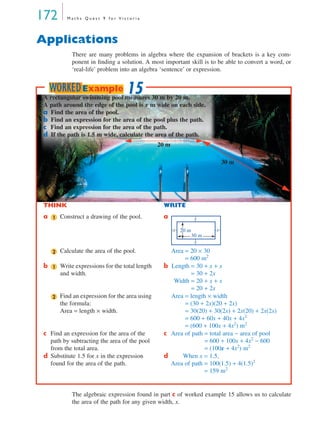
  • 18.
    160 Maths Quest 9 for Victoria THINK WRITE d 1 Write the expression. d 2(x + 3)(x − 4) + (x − 2)2 2 Expand and simplify the first pair of 2(x + 3)(x − 4) brackets. Then multiply by the = 2(x2 − 4x + 3x − 12) coefficient of 2 outside the pair. = 2(x2 − x − 12) = 2x2 − 2x − 24 3 Expand the second pair of brackets. (x − 2)2 It is an identical bracket expansion. = x2 − 4x + 4 4 Add the two results. 2(x + 3)(x − 4) + (x − 2)2 = 2x2 − 2x − 24 + (x2 − 4x + 4) 5 Collect like terms. = 2x2 − 2x − 24 + x2 − 4x + 4 = 3x2 − 6x − 20 remember remember 1. Brackets or pairs of brackets that are added or subtracted must be expanded separately. 2. Always collect any like terms following an expansion. More complicated 5E expansions HEET 5.3 WORKED Example Expand and simplify each of the following expressions. 1 (x + 3)(x + 5) + (x + 2)(x + 3) 2 (x + 4)(x + 2) + (x + 3)(x + 4) SkillS 9 3 (x + 5)(x + 4) + (x + 3)(x + 2) 4 (x + 1)(x + 3) + (x + 2)(x + 4) 5 (p − 3)(p + 5) + (p + 1)(p − 6) 6 (a + 4)(a − 2) + (a − 3)(a − 4) HEET 5.4 7 (p − 2)(p + 2) + (p + 4)(p − 5) 8 (x − 4)(x + 4) + (x − 1)(x + 20) SkillS 9 (y − 1)(y + 3) + (y − 2)(y + 2) 10 (d + 7)(d + 1) + (d + 3)(d − 3) 11 (x + 2)(x + 3) + (x − 4)(x − 1) 12 (y + 6)(y − 1) + (y − 2)(y − 3) hca d 13 (x + 2) + (x − 5)(x − 3) 2 14 (y − 1)2 + (y + 2)(y − 4) Mat More 15 (p + 2)(p + 7) + (p − 3)2 16 (m − 6)(m − 1) + (m + 5)2 complicated 17 (x + 3)(x + 5) − (x + 2)(x + 5) 18 (x + 5)(x + 2) − (x + 1)(x + 2) expansions 19 (x + 3)(x + 2) − (x + 4)(x + 3) 20 (m − 2)(m + 3) − (m + 2)(m − 4) ogram 21 (b + 4)(b − 6) − (b − 1)(b + 2) 22 (y − 2)(y − 5) − (y + 2)(y + 6) GC pr Expanding 23 (p − 1)(p + 4) − (p − 2)(p − 3) 24 (x + 7)(x + 2) − (x − 3)(x − 4) 25 (c − 2)(c − 1) − (c + 6)(c + 7) 26 ( f − 7)( f + 2) − ( f + 4)( f + 5) 27 (m + 3) − (m + 4)(m − 2) 2 28 (a − 6)2 − (a − 2)(a − 3) 29 (p − 3)(p + 1) − (p + 2)2 30 (x + 5)(x − 4) − (x − 1)2
  • 19.
    Chapter 5 Expanding 161 Why Why does the giraffe have a long neck? giraffe hav Expand and simplify the expressions to find the puzzle’s answer. = (x – 4)(x + 3) – (x + 5)(x – 3) = = 2(x + 3) + 3(x – 1) = 2x(x – 3) + 3x(6 – x) = = = 5(x 2 + 3x + 2) – 4(x 2 + 3x) = (x – 3)(x + 2) + 6 = = 5x(2 – x) – 3(3x + 1) = = = (x – 1)(x + 6) + 3(x – 4) = x (x – 4) + 2(2x + 1) = = 3(x 2 – x + 1) – 2(x + 2) = = = (x + 2) 2 + 3(x – 2) = = (x + 5)(x – 2) + 2(x + 4) = (x – 5)(x + 5) – (x + 4)(x – 4) = = = –3(x + 7) – (x + 5)(x – 8) = = (x – 3)(x + 3) – x (x – 2) = 5(x – 7) + 2(x 2 – 3x + 18) = = = (x – 6)(x – 7) + 2(7x – 21) = = (x – 2)2 – (x + 1)2 = 5(x + 1) – 2(x – 2) = = = (2x – 3)(3x – 2) – 6 = = (x + 2)(x – 2) + (x + 3)(x – 4) = (2 + x)(3 – x) + (x + 1)(x + 4) = = = 7(2 – 3x) + 5(4x – 3) = = 2(x – 7)(x + 5) + 5(x + 14) = –3(x 2 + x – 2) + 5(x – 1) = = = 4(2x – 6) – 3(x – 8) = = –2( x 2 + 3x – 6) – 12 = (x + 2)(x – 2) – (x – 1)(x + 1) = = = 2(x 2 + 3x – 7) – 2(x 2 + 7x – 7) = –x – 1 x 2 + x x 2 – x 5x + 3 –8x ’ –3x 2 + 2x + 1 x 2 + 8x – 18 –5x 2 + x – 3 –x 2 + 19 –3x + 3 x 2 + 2 –6x + 3 3x + 9 –3 –x 2 + 12x –2x 2 – 6x 3x 2 – 5x – 1 2x 2 + x 5x x 2 + 3x + 10 2x – 9 – 9 2x 2 – x – 16 2x 2 – x + 1 6x 2 – 13x x 2 + 5x – 2 6x + 10 x 2 + 7x – 2
  • 20.
    162 Maths Quest 9 for Victoria Higher order expansions and Pascal’s triangle Pascal’s triangle, as shown in the figure below, is a special arrangement of numbers in a triangular shape. Any number is the sum of the two numbers immediately above it, with 1s running down the sides. The triangle was named after Blaise Pascal (1623–62), a French mathematician who wrote about the triangle in 1653. However, earlier mathematicians knew about the ‘magic’ of this triangle. Chu Shih-Chieh, a Chinese mathematician, included an illustration of the triangle in a book in 1303. There are many patterns to observe with Pascal’s triangle. 1 Let’s look at one of these. 1 1 1 2 1 1 3 3 1 1 4 6 4 1 1 5 10 10 5 1 1 6 15 20 15 6 1 1 a Expand (x + 1) . 2 b Which line of Pascal’s triangle links to your answer for part 1a? Describe the pattern you have observed. 2 a Expand (x + 1)3. This means expand (x + 1)(x + 1)(x + 1). Hint: First expand (x + 1)2 then multiply this expansion by (x + 1). b Which line of Pascal’s triangle links to your answer for part 2a? 3 Use the pattern you can observe to show that (x + 1)4 = x4 + 4x3 + 6x2 + 4x + 1. reads L Sp he 4 Use Pascal’s triangle to expand each of the following. a (x + 1)5 b (x + 1)6 c (x + 1)7 d (x + 1)8 e (x + 1)9 f (x + 1)10 et EXCE Expanding (You may need to copy the diagram above and add more lines to Pascal’s triangle.) (x + a)n Let’s look at what happens when we have a minus sign in the brackets. 5 Expand (x − 1)2, (x − 1)3 and (x − 1)4 by multiplying terms. 6 Describe what effect the minus sign has on the expansions. 7 Use Pascal’s triangle and your observations from question 6 to expand each of the following. a (x − 1)5 b (x − 1)6 c (x − 1)7 d (x − 1)8 e (x − 1)9 f (x − 1)10 Extension Can you work out how to use Pascal’s triangle to expand each of the following? Clearly explain how you are able to do this. a (x + 2)3, (x + 2)4, . . . (x + 2)10 b (x + y)3, (x + y)4, . . . (x + y)10 c (2x + 3) , (2x + 3) , . . . (2x + 3) 3 4 10 d (2x − 3y)3, (2x − 3y)4, . . . (2x − 3y)10
  • 21.
    Chapter 5 Expanding 163 Simplifying algebraic fractions — addition and subtraction In chapter 3 we spent some time simplifying algebraic fractions. This section is effec- tively a continuation of that topic with more complicated fractions, requiring use of the expansion techniques we have learned in this chapter. Pronumerals in the numerator only This type of problem is very similar to those in chapter 3. WORKED Example 10 Simplify the following. y+3 y–4 y+2 y–3 a ----------- + ----------- - - b ----------- – ----------- - - 2 5 7 3 THINK WRITE y+3 y–4 a 1 Write the fractions. a ----------- + ----------- - 2 5 5( y + 3) 2( y – 4) 2 Find the lowest common denominator = ------------------- + ------------------- - - 10 10 (LCD). The lowest common multiple (LCM) of 2 and 5 is 10. 5( y + 3) + 2( y – 4) 3 Express as a single fraction. = --------------------------------------------- - 10 5y + 15 + 2y – 8 4 Simplify the numerator by expanding = --------------------------------------- - 10 brackets and collecting like terms. 7y + 7 = -------------- - 10 y+2 y–3 b 1 Write the fractions. b ----------- – ----------- - 7 3 3( y + 2) 7( y – 3) 2 Find the lowest common denominator = ------------------- – ------------------- - - 21 21 (LCD). The lowest common multiple (LCM) of 7 and 3 is 21. 3( y + 2) – 7( y – 3) 3 Express as a single fraction. = --------------------------------------------- - 21 3y + 6 – 7y + 21 4 Simplify the numerator by expanding = --------------------------------------- 21 brackets and collecting like terms. – 4y + 27 = ---------------------- 21
  • 22.
    164 Maths Quest 9 for Victoria Pronumerals in the denominator In the case where there are pronumerals in the denominator, the common denominator is taken to be the product of each of the denominators. Then, proceed as in previous cases. WORKED Example 11 Simplify the following. 7 7 7 3 a ----------- + ----------- - - b -------------- – -------------- - - a+2 a–1 2b – 5 4b + 1 THINK WRITE 7 7 a 1 Write the fractions. a ----------- + ----------- - - a+2 a–1 7(a – 1) 7(a + 2) 2 Find the LCD. The LCM of (a + 2) = --------------------------------- + --------------------------------- - - (a + 2)(a – 1) (a + 2)(a – 1) and (a − 1) is (a + 2)(a − 1). 7(a – 1) + 7(a + 2) 3 Express as a single fraction. = ---------------------------------------------- - (a + 2)(a – 1) 7a – 7 + 7a + 14 4 Simplify the numerator by expanding = --------------------------------------- - (a + 2)(a – 1) brackets and collecting like terms. 14a + 7 = --------------------------------- - (a + 2)(a – 1) 7 3 b 1 Write the fractions. b -------------- − -------------- - - 2b – 5 4b + 1 Find the LCD. The LCM of (2b − 5) 7 ( 4b + 1 ) 3 ( 2b – 5 ) 2 = ---------------------------------------- − ---------------------------------------- - - and (4b + 1) is (2b − 5)(4b + 1). ( 2b – 5 ) ( 4b + 1 ) ( 2b – 5 ) ( 4b + 1 ) 7 ( 4b + 1 ) – 3 ( 2b – 5 ) 3 Express as a single fraction. = ---------------------------------------------------- - ( 2b – 5 ) ( 4b + 1 ) 28b + 7 – 6b + 15 4 Simplify the numerator by expanding = ------------------------------------------ - ( 2b – 5 ) ( 4b + 1 ) brackets and collecting like terms. 22b + 22 = ---------------------------------------- ( 2b – 5 ) ( 4b – 1 ) It is customary to leave the denominator as brackets, without expanding them. Pairs of brackets in the denominator Although it is possible to have two different pairs of brackets in the denominator of each fraction, in this section we will consider the case where one of each pair is an identical bracket. The common denominator will consist of each bracket that appears in the question; the repeated bracket needs to appear only once.
  • 23.
    Chapter 5 Expanding 165 WORKED Example 12 Simplify. 4 1 ---------------------------------- + ---------------------------------- - ( x + 2)( x + 3) ( x – 4)( x + 3) THINK WRITE 4 1 1 Write the fractions. --------------------------------- + --------------------------------- - - ( x + 2)( x + 3) ( x – 4)( x + 3) 4( x – 4) 1( x + 2) 2 Find the LCD. The LCM of (x + 2)(x + 3) = -------------------------------------------------- + -------------------------------------------------- - - ( x + 2)( x + 3)( x – 4) ( x + 2)( x + 3)( x – 4) and (x − 4)(x + 3) is (x + 2)(x + 3)(x − 4). 4( x – 4) + 1( x + 2) 3 Express as a single fraction. = -------------------------------------------------- - ( x + 2)( x + 3)( x – 4) 4x – 16 + x + 2 4 Simplify the numerator by expanding = -------------------------------------------------- - ( x + 2)( x + 3)( x – 4) brackets and collecting like terms. 5x – 14 = -------------------------------------------------- - ( x + 2)( x + 3)( x – 4) remember remember 1. When adding or subtracting algebraic fractions, you must first find a common denominator. 2. Pronumerals can appear in either the numerators or the denominators. 3. If the pronumerals are in the denominator, the common denominator is usually the product of the individual denominators. Simplifying algebraic 5F fractions — addition and subtraction WORKED 1 Simplify each of the following. 5.5 Example HEET x+1 x+3 m+1 m+2 x+2 x+5 SkillS 10 a ----------- + ----------- - - b ------------ + ------------ - - c ----------- + ----------- - - 2 4 6 2 4 3 x–1 x+2 y–3 y+1 a+6 a–2 d ----------- + ----------- - e ----------- + ----------- - f ----------- + ----------- - - 2 3 5 2 5 6 Math cad p+2 p–3 x–4 x+1 5x + 2 2x + 1 g ----------- + ----------- - - h ----------- + ----------- - i -------------- + -------------- - - Adding and 10 5 3 5 5 15 subtracting m + 6 2m + 1 2p – 3 p + 2 2x – 1 2x – 3 algebraic j ------------ + ---------------- - - k --------------- + ----------- - l -------------- + -------------- - - fractions 5 2 6 3 3 2 4x + 3 3x – 1 2x – 1 4x – 5 2x – 1 x – 1 m -------------- + -------------- - - n -------------- + -------------- - - o -------------- + ----------- - 4 2 2 3 2 4
  • 24.
    166 Maths Quest 9 for Victoria 2 Simplify each of the following. m+2 m+1 x+4 x+5 p–3 p+3 a ------------ – ------------ - - b ----------- + ----------- - - c ----------- + ----------- - - 3 4 2 7 2 3 y–4 y+2 x+5 x+1 a+3 a–6 d ----------- + ----------- - e ----------- + ----------- - - f ----------- + ----------- - - 3 5 2 3 2 5 m–1 m+3 p+2 p–3 x–3 x–2 g ------------ – ------------ - - h ----------- – ----------- - - i ----------- – ----------- 8 4 15 5 4 3 y–2 y–5 x–3 x–1 4p + 1 2p + 2 j ----------- – ----------- k ----------- – ----------- l --------------- – --------------- - - 7 3 2 4 3 9 5y + 3 3y – 2 3a – 2 2a – 1 2x – 1 3x + 1 m -------------- – -------------- - - n -------------- – -------------- - - o -------------- – -------------- - - 3 12 3 10 5 15 3 multiple choice a+2 a+3 a What is the equivalent of ----------- + ----------- ? - - 3 4 2a + 5 7a + 17 12a + 72 7a + 17 2a + 5 A --------------- B ----------------- - C -------------------- - D ----------------- - E -------------- - 7 7 12 12 12 2x + 1 x – 3 b What is the equivalent of -------------- + ----------- ? - 8 4 4x 2+6 4x – 5 5x – 5 4x + 7 3x – 4 A ----------------- B -------------- - C -------------- - D -------------- - E -------------- - 8 8 4 8 12 x+3 x+2 c The equivalent of ----------- – ----------- is: - - 3 6 x+4 3x + 8 3x – 4 5 2x + 1 A ----------- - B --------------- C -------------- - D -- - E -------------- - 6 6 6 3 9 5m – 1 m – 2 d The equivalent of --------------- – ------------ is: - - 2 3 13m – 7 4m + 1 13m + 1 13m – 1 4m – 1 A ------------------ - B ---------------- - C ------------------- - D ------------------ - E --------------- - 6 5 6 6 6 WORKED 4 Simplify the following. Example 11 2 1 4 3 7 2 a ------------ + --- - - b ----------- + -- - - c -- + ----------- - - m+3 m x+2 x a a+4 9 5 3 2 4 5 d -- + ----------- - - e -- + ---------- - - f --- + ------------ - - b b+3 c c–1 m m–3 7 2 2 4 4 2 g ----------- + -- - - h ----------- + -- - - i ----------- + -- - - p–8 p p–5 p a–6 a 6 4 1 2 2 1 j ----------- + -- - - k ----------- + ----------- - - l ----------- + ----------- - - q–1 q a+1 a+2 b+3 b+2 3 1 4 2 1 3 m ----------- + ----------- - - n ------------ + ------------ - - o ----------- + ----------- - - x+2 x+3 m+1 m+3 p–1 p+4 5 Simplify the following. 7 2 6 2 9 1 a ------ – ------------ - - b ----- – ----------- - - c ----- – ----------- - - 2m m + 1 2x x + 3 4x x + 5 4 2 7 3 5 2 d ------------ – --- - - e ------------ – --- - - f ----------- – -- - - m+5 m m+3 m p–3 p
  • 25.
    Chapter 5 Expanding 167 6 3 9 2 7 4 g ----------- – -- - - h -- – ----------- - - i -- – ---------- - - a–7 a b b–3 r r–5 8 3 5 2 7 3 j ----- – ----------- - - k ----------- – ----------- - - l ----------- – ----------- - - 3x x + 2 x+1 x+3 p+3 p+1 6 4 4 2 8 3 m ------------ – ------------ - - n ----------- – ----------- - - o ----------- – ----------- - m+7 m+3 p+2 p+1 x–1 x+2 WORKED 6 Simplify the following. 5.6 Example HEET 12 2 3 4 2 SkillS a --------------------------------- + --------------------------------- - - b --------------------------------- + --------------------------------- - - ( x + 1)( x + 2) ( x + 2)( x + 3) ( x + 3)( x + 1) ( x + 1)( x + 4) 3 4 7 2 c --------------------------------- + --------------------------------- - - d --------------------------------- + --------------------------------- - - ( x + 1)( x + 2) ( x + 2)( x – 3) ( x + 4)( x – 3) ( x + 1)( x – 3) 5 3 9 3 e --------------------------------- + -------------------------------- - - f -------------------------------- + --------------------------------- - - ( x + 7)( x – 4) ( x – 2)( x – 4) ( x – 2)( x – 3) ( x – 2)( x + 1) 7 2 4 1 g -------------------------------- + -------------------------------- - - h --------------------------------- + --------------------------------- - - ( x – 6)( x – 4) ( x – 6)( x – 1) ( x + 2)( x – 3) ( x + 1)( x – 3) 5 2 6 2 i --------------------------------- – --------------------------------- - - j --------------------------------- – --------------------------------- - - ( x + 1)( x + 3) ( x + 3)( x + 2) ( x + 4)( x + 1) ( x + 3)( x + 1) 5 2 4 3 k --------------------------------- – -------------------------------- - - l --------------------------------- – --------------------------------- - - ( x – 6)( x + 2) ( x – 1)( x – 6) ( x + 7)( x + 2) ( x + 7)( x – 3) 2 1 11 4 m --------------------------------- – --------------------------------- - - n --------------------------------- – --------------------------------- - - ( x + 5)( x – 6) ( x + 1)( x – 6) ( x + 1)( x + 4) ( x + 1)( x – 6) 7 2 9 5 o --------------------------------- – --------------------------------- - - p --------------------------------- – --------------------------------- - - ( x – 6)( x + 2) ( x + 2)( x – 3) ( x + 5)( x – 2) ( x + 5)( x – 4) 7 multiple choice 4 3 a What is the equivalent of ----------- + -- ? - x–2 x 7 7x – 6 12x – 6 7x – 6 7x + 6 A -------------- - B ------------------- C ------------------- D -------------- - E ------------------- 2x – 2 x( x – 2) x( x – 2) 2x – 2 x( x – 2) 3 2 b What is the equivalent of ------ – ------------ ? - - 2m m + 5 –m + 15 m + 15 1 –12m + 15 –m – 15 A ------------------------- B ------------------------- C ------------------------- D ------------------------- E ------------------------- - - - - - 2m ( m + 5 ) 2m ( m + 5 ) 2m ( m + 5 ) 2m ( m + 5 ) 2m ( m + 5 ) 3 1 c The equivalent of -------------- – ----------- is: - 2x + 1 x – 1 2 –x + 5 –6x + 6 A ----------- - B ------------------------------------ - C ------------------------------------ - x+2 ( 2x + 1 ) ( x – 1 ) ( 2x + 1 ) ( x – 1 ) x–5 x–4 D ------------------------------------ - E ------------------------------------ - GAME ( 2x + 1 ) ( x – 1 ) ( 2x + 1 ) ( x – 1 ) time 1 3 Expanding d What is the equivalent of --------------------------------- + --------------------------------- ? - - — 002 ( x + 1)( x – 2) ( x + 1)( x + 3) 4 4x – 18 4x – 3 A ----------------------------------------------------- B -------------------------------------------------- C -------------------------------------------------- - - ( x + 1)( x – 2)( x + 3) ( x + 1)( x – 2)( x + 3) SHE 5.2 ( x + 1 )2( x – 2 )( x + 3 ) ET Work 3x 2 – 18 4x – 3 D -------------------------------------------------- - E ----------------------------------------------------- ( x + 1)( x – 2)( x + 3) ( x + 1) 2( x – 2)( x + 3)
  • 26.
    168 Maths Quest 9 for Victoria 2 1 Expand and simplify −4(x − 5). 2 Expand and simplify 3(4x − 2y) + 2(5x + y). 3 Expand and simplify (x + 5)(x + 9). 4 Find the missing term if (y + K)(y − 4) = y2 − 16. 5 Expand (6 + q)2. 6 Expand and simplify (x + 2)(x + 1) + (x + 3)(x + 1). 7 Expand and simplify (x + 6)(x − 5) − (x − 3)2. x+2 x+5 7x + 26 8 True or false? ----------- + ----------- = ----------------- - - - 4 3 12 6 4 9 Simplify ------------- + -------------- . - - 3z – 2 4z + 1 4 4 10 Simplify --------------------------------- – --------------------------------- . - - ( x + 4)( x – 3) ( x + 6)( x – 3) Simplifying algebraic fractions — multiplication and division This section is an extension of the work you did in chapter 3, Introductory algebra on the multiplication and division of algebraic fractions. Cancelling bracketed expressions in multiplication If a bracketed expression, or in fact any pronumeral, appears in the numerator of one term and the denominator of another, then they may be cancelled. WORKED Example 13 Simplify each of the following. 4 x+3 y–2 –4 y ( z – 3)( z – 4) ( z + 1)( z – 1) a ----------- × ----------- - - b ----------- × ------------------- - - c -------------------------------- × -------------------------------- - - x+3 5 2y 3( y – 2) ( z – 5)( z + 1) ( z + 3)( z – 3) THINK WRITE 4 x+3 a 1 Write the fractions. a ----------- × ----------- - - x+3 5 4 1 2 Cancel (x + 3) and replace with a 1, = -- × -- - - 1 5 since it appears in the first denominator and second numerator. 4 3 Simplify by multiplying the remaining = -- - 5 numerators and denominators.
  • 27.
    Chapter 5 Expanding 169 THINK WRITE y–2 – 4y b 1 Write the fractions. b ----------- × ------------------- - 2y 3( y – 2) 1 –4 × 1 2 Cancel (y − 2) and replace with a 1, since it = ----------- × -------------- - - 2×1 3×1 appears in the first numerator and second 1 4 denominator. Cancel y and replace with a 1, = -- × − -- - - since it appears in the first denominator and 2 3 second numerator. 4 3 Multiply the remaining numerators and = − -- - 6 denominators and simplify the resultant 2 fraction. = − -- - 3 (z – 3)(z – 4) (z + 1)(z – 1) c 1 Write down the expression. c -------------------------------- × -------------------------------- - - (z – 5)(z + 1) (z + 3)(z – 3) 1 × (z – 4) 1 × (z – 1) 2 Cancel (z − 3) and replace with a 1, since it = ------------------------ × ------------------------- - (z – 5) × 1 (z + 3) × 1 appears in the first numerator and second denominator. Cancel (z + 1) and replace with a 1, since it appears in the first denominator and second numerator. (z – 4)(z – 1) 3 Simplify the resultant fraction. = -------------------------------- - (z – 5)(z + 3) As before, it is customary to leave bracketed expressions intact without expanding any further. Cancelling bracketed expressions in division When dividing fractions, we first turn the second fraction ‘upside down’ and change the division sign to a multiplication sign (times and tip). We then proceed as for multi- plication. WORKED Example 14 Simplify the following. 1 3 –3 y 5y ( z + 2)( z – 3) z – 3 a ----------- ÷ ----------- - - b ----------- ÷ ----------- - - c -------------------------------- ÷ ---------- - - x–3 x–3 y–2 y–2 ( z – 4) z–4 THINK WRITE 1 3 a 1 Write the fractions. a ----------- ÷ ----------- x–3 x–3 1 x–3 2 Convert to a multiplication problem by = ----------- × ----------- turning the second fraction upside down. x–3 3 1 1 3 Cancel (x − 3) and replace with a 1. = -- × -- - - 1 3 1 4 Simplify the resultant fraction. = -- - Continued over page 3
  • 28.
    170 Maths Quest 9 for Victoria THINK WRITE – 3y 5y b 1 Write the fractions. b ----------- ÷ ----------- y–2 y–2 – 3y y – 2 2 Convert to a multiplication problem by = ----------- × ----------- y–2 5y turning the second fraction upside down. –3 × 1 1 3 Cancel (y − 2) and replace with a 1. = -------------- × ----------- - - 1 5×1 Cancel y and replace with a 1. 3 1 = − -- × -- - - 1 5 3 4 Simplify the resultant fraction. = − -- - 5 (z + 2)(z – 3) z – 3 c 1 Write the fractions. c -------------------------------- ÷ ---------- - - (z – 4) z–4 (z + 2)(z – 3) (z – 4) 2 Convert to a multiplication problem by = -------------------------------- × --------------- - - (z – 4) (z – 3) turning the second fraction upside down. (z + 2) × 1 1 3 Cancel (z − 3) and replace with a 1. = ------------------------- × -- - 1 1 Cancel (z − 4) and replace with a 1. z+2 4 Simplify the resultant fraction. = ---------- - 1 =z+2 So, division of fractions is the same as multiplication with an additional first step. remember remember 1. If a bracketed expression appears in the numerator of one term and the denominator of another, they can be cancelled when multiplying. 2. When dividing fractions, take the second fraction, turn it ‘upside down’ and change the division sign to a multiplication sign (times and tip). Simplifying algebraic 5G fractions — multiplication and division 5.7 WORKED 1 Simplify the following. Example HEET 13 x+1 1 y–1 2 p–2 4 SkillS a ----------- × ----------- - - b ----------- × ----------- c ----------- × ----------- - - 2 x+1 3 y–1 4 p–2 b+5 9 m+4 m 3p p–6 d ----------- × ----------- - - e ------------ × ------------ - - f ----------- × ----------- - - 3 b+5 m m+4 p–6 p
  • 29.
    Chapter 5 Expanding 171 y–7 y 4a a–2 p – 3 5( p + 3) g ----------- × ----------- h ----------- × ----------- - - i ----------- × -------------------- - 4y y–7 a–2 2a p+3 p–2 ( x + 2)( x – 7) x + 1 (b – 2)(b + 3) b – 4 x – 3 ( x + 2)( x + 1) j --------------------------------- × ----------- - - k --------------------------------- × ----------- - - l ----------- × --------------------------------- - - x+1 x–7 (b + 5)(b – 4) b – 2 x + 2 ( x – 6)( x – 3) WORKED 2 Simplify the following. 5.8 Example HEET 14 x+2 x+2 SkillS m–3 m–3 5 10 a ----------- ÷ ----------- - - b ------------ ÷ ------------ - - c ----------- ÷ ----------- 3 x 4 8 x–3 x–3 12 4 m m p+2 p–2 d ----------- ÷ ----------- - - e ------------ ÷ ------------ - - f ----------- ÷ ----------- - - a+2 a+2 m–6 m–6 p–1 p–1 s–6 s (a + 1)(a – 3) a + 1 8m 2m g ------------------- ÷ ---------- - h --------------------------------- ÷ ----------- - - i ------------------------------------ ÷ ------------ - - 3(s + 1) s + 1 a+2 a+2 (m + 2)(m – 5) m – 5 (a + 2)(a – 3) a + 2 m(m – 2) m p p( p – 4) j --------------------------------- ÷ ----------- - - k ------------------------------------ ÷ ------------ l - - ----------- ÷ ---------------------------------- - - (a – 5)(a + 4) a + 4 (m + 1)(m + 5) m + 1 p + 7 ( p + 2)( p + 7) 3 Simplify the following. Math cad ( y – 3)( y + 3) y y+3 ( x + 6)( x – 2) 6x x–2 a --------------------------------- × ----------- ÷ ----------- - - b --------------------------------- × ----------- ÷ ----------- - - Multiplying y( y + 1) y–3 3 2x ( x + 3 ) x+6 2 and dividing algebraic 4m 12m ( m – 3 ) 9 b + 7 (b – 6)(b + 7) 2b c ------------ ÷ ------------------------------------ × ------------ - - - d ----------- ÷ --------------------------------- × ----------- - - - fractions m – 7 (m + 2)(m – 7) m + 1 2b 10 ( b + 2 ) b–2 d–8 15d ( d – 6 ) 12 12s ( s – 2 ) ( s – 11 ) 30 e ----------- × --------------------------------- ÷ ----------- - - - f ------------- × ---------------------------------- ÷ ------------------ - - - 5d (d – 7)(d – 8) d – 7 s – 11 2s ( s + 6 ) s(s + 6) 4 multiple choice m+3 8 a Which is the equivalent of ------------ × ------------ ? - - 4 m+3 1 A 2 B 4 C 2(m + 3)2 D -- 2 - E 32 1 x–3 b The equivalent of ----------- × ----------- is: x–3 9 A 1 C 1 ( x – 3 )2 9 -- 3 - B 9 -- 9 - D ------------------ - E ----------- 9 x–3 m–8 m–8 c What is the equivalent of ------------ ÷ ------------ ? - - 3 m 3 ( m – 8 )2 m 1 A --- - B ------------------- - C 3m D --- - E ------ - m 3m 3 3m (a + 2)(a – 1) a + 2 d Which is the equivalent of --------------------------------- ÷ ----------- ? - - a+3 a+3 1 a–1 A a−1 B ----------- - C ----------- - a–1 a+3 ( a + 2 )2( a – 1 ) a+3 D ------------------------------------ E ----------- - ( a + 3 )2 a–1
  • 30.
    172 Maths Quest 9 for Victoria Applications There are many problems in algebra where the expansion of brackets is a key com- ponent in finding a solution. A most important skill is to be able to convert a word, or ‘real-life’ problem into an algebra ‘sentence’ or expression. WORKED Example 15 A rectangular swimming pool measures 30 m by 20 m. A path around the edge of the pool is x m wide on each side. a Find the area of the pool. b Find an expression for the area of the pool plus the path. c Find an expression for the area of the path. d If the path is 1.5 m wide, calculate the area of the path. 20 m 30 m THINK WRITE a 1 Construct a drawing of the pool. a x x 20 m x 30 m x 2 Calculate the area of the pool. Area = 20 × 30 = 600 m2 b 1 Write expressions for the total length b Length = 30 + x + x and width. = 30 + 2x Width = 20 + x + x = 20 + 2x 2 Find an expression for the area using Area = length × width the formula: = (30 + 2x)(20 + 2x) Area = length × width. = 30(20) + 30(2x) + 2x(20) + 2x(2x) = 600 + 60x + 40x + 4x2 = (600 + 100x + 4x2) m2 c Find an expression for the area of the c Area of path = total area − area of pool path by subtracting the area of the pool = 600 + 100x + 4x2 − 600 from the total area. = (100x + 4x2) m2 d Substitute 1.5 for x in the expression d When x = 1.5, found for the area of the path. Area of path = 100(1.5) + 4(1.5)2 = 159 m2 The algebraic expression found in part c of worked example 15 allows us to calculate the area of the path for any given width, x.
  • 31.
    Chapter 5 Expanding 173 WORKED Example 16 Suppose that the page of a typical textbook is 24 cm high by 16 cm wide. The page has margins at the top and bottom of x cm and on the left and right of y cm. a Write an expression for the height of the page that is ‘inside’ the margins. b Write an expression for the width of the page that is ‘inside’ the margins. c Write an expression for the area of the page that is ‘inside’ ANTHONY GRAY • SANDRA KENMAN the margins. d Show that if the margins on the left and right are doubled, then the area available to be printed is reduced by (48y − 4xy) cm. THINK WRITE a 1 Construct a drawing, showing a 16 cm the key dimensions. x y y 24 cm x 2 The real height (24 cm) is Height = 24 − x − x effectively reduced by x cm at = 24 − 2x the top and x cm at the bottom. b Similarly the width (16 cm) is b Width = 16 − y − y reduced by y on the left and y on = 16 − 2y the right. c The ‘effective’ area of the page is c Area = (24 − 2x)(16 − 2y) the width times the height. = 24(16) + 24(−2y) − 2x(16) − 2x(−2y) = 384 − 48y − 32x + 4xy d 1 If the left and right margins are d Width = 16 − 2y − 2y doubled, they become 2y and 2y = 16 − 4y respectively. Determine the new expression for the width of the page. 2 Determine the new expression Area = (24 − 2x)(16 − 4y) for the area. = 24(16) + 24(−4y) − 2x(16) − 2x(−4y) = 384 − 96y − 32x + 8xy 3 Determine the difference in Difference in area area by subtracting this from = 384 − 48y − 32x + 4xy − (384 − 96y − 32x + 8xy) the first result for the ‘effective’ = 384 − 48y − 32x + 4xy − 384 + 96y + 32x − 8xy area. = 48y − 4xy So the amount by which the area is reduced is (48y − 4xy) cm.
  • 32.
    174 Maths Quest 9 for Victoria remember remember 1. When working on worded problems try to convert English ‘sentences’ into algebraic ones. 2. Drawing a diagram is an excellent aid in problem solving. 5H Applications 1 Answer the following for each shape. i Find an expression for the perimeter. ii Find the perimeter when x = 5. iii Find an expression for the area and simplify by expanding if necessary. iv Find the area when x = 5. a b c d 4x 3x x+2 4x – 1 x e 3x + 1 f 5x + 2 g 3x + 5 2x x–3 6x x+4 WORKED 2 A rectangular swimming pool measures 50 m by 25 m. 3x Example 15 A path around the edge of the pool is x m wide on each side. a Find the area of the pool. b Find an expression for the area of the pool plus the path. c Find an expression for the area of the path. d If the path is 2.3 m wide, calculate the area of the path.
  • 33.
    Chapter 5 Expanding 175 WORKED 3 The page of a book is 20 cm high by 15 cm wide. Example 16 The page has margins at the top and bottom of the page of x cm, and on the left and right of the page of y cm. a Write an expression for the height of the page that is ‘inside’ the margins. b Write an expression for the width of the page that is ‘inside’ the margins. c Write an expression for the area of the page that is ‘inside’ the margins. d Show that if the margins on the left and right are doubled, then the area available to be printed on is reduced by (40y − 4xy) cm. 4 A rectangular book cover is 8 cm long and 5 cm wide. a Find the area of the book cover. b i If the length of the book cover is increased by v cm, write an expression for its new length. ii If the width of the book cover is increased by v cm, write an expression for its new width. iii Write an expression for the new area of the book cover and expand. iv Find the area of the book cover if v = 2 cm. c i If the length of the book cover is decreased by d cm, write an expression for its new length. ii If the width of the book cover is decreased by d cm, write an expression for its new width. iii Write an expression for the new area of the rectangle and expand. iv Find the area of the book cover if d = 2 cm. d i If the length of the book cover is made x times as long, write an expression for its new length. ii If the width of the book cover is increased by x cm, write an expression for its new width. iii Write an expression for the new area of the book cover and expand. iv Find the area of the book cover if x = 5 cm. 5 A square has dimensions of 5x metres. a Write an expression for its perimeter. b Write an expression for its area. c i If its length is decreased by 2 m, write an expression for its new length. ii If its width is decreased by 3 m, write an expression for its new width. iii Write an expression for its new area and expand. iv Find its area when x = 6 m. 6 A rectangular sign has a length of 2x cm 2x and a width of x cm. a Write an expression for its perimeter. b Write an expression for its area. c i If its length is increased by y cm, find an expression for its new length. ii If its width is decreased by y cm, x find an expression for its new width. iii Write an expression for its new area and expand. iv Find its area when x = 4 cm and y = 3 cm.
  • 34.
    176 Maths Quest 9 for Victoria 7 A square has a side length of x cm. a Write an expression for its perimeter. b Write an expression for its area. c i If its side length is increased by y cm, write an expression for its new side length. ii Write an expression for its new perimeter and expand. iii Find the perimeter when x = 5 cm and y = 9 cm. iv Write an expression for its new area and expand. d Find the area when x = 3.2 cm and y = 4.6 cm. 8 A swimming pool with length 4p + 2 metres and width 3p metres is surrounded by a path of width 4p + 2 p metres. 3p Find the following in expanded form. a An expression for the perimeter of the pool. p b An expression for the area of the pool. c An expression for the length of the pool and path. d An expression for the width of the pool and path. e An expression for the perimeter of the pool and path. SHE ET 5.3 f An expression for the area of the pool and path. Work g An expression for the area of the path. h The area of the path when p = 2 m. Billboard costs At the beginning of this chapter we were looking at the increased cost of a billboard if the length and height are increased by 2 metres and 3 metres respectively. Does the increase in cost depend on the initial size of the billboard? 1 Let the length of the billboard be l and the height be h. (Both l and h are in metres.) Write an expression for the area of the billboard. 2 What is the cost of this billboard at a rate of $50 per square metre? 3 If the length of the billboard is increased by 2 metres, write an expression for the new length. 4 If the height of the billboard is increased by 3 metres, write an expression for the new height. 5 Use your answers to parts 3 and 4 to find an expression for the new area. 6 What is the new cost of the billboard? 7 Subtract the original cost of the billboard to find the increase in the cost. Is this cost constant or does it depend on the original length and height?
  • 35.
    Chapter 5 Expanding 177 summary Copy the sentences below. Fill in the gaps by choosing the correct word or expression from the word list that follows. 1 Expansion, in algebra, means to multiply everything the brackets by what is outside. 2 After expanding an expression you should always look to . 3 The expansion of 6(x + 3) − 4(3 − x) is . 4 When multiplying two expressions within brackets each term in the first bracket by each term in the second bracket. 5 The expansion of (4 + x)(4 − x) is an example of a pattern called . 6 The expansion of (7 − x)(7 + x) is . This follows the rule (a + b)(a − b) = . 7 The identical bracket expansions or rules are: (a + b)(a + b) = a2 + 2ab + b2 (a − b)(a − b) = a2 − 2ab + b2. 8 When adding algebraic fractions, the first step is to find the . 4 1 9 The common denominator used when subtracting ----------- – -- - - is x–2 x . 10 Division of fractions is done by turning the problem into a problem. 11 The fraction is turned when dividing fractions. 12 Brackets can be left in the of the answer when working with algebraic fractions. 13 When working on , you are trying to convert English ‘sentences’ into algebraic ones. 14 Drawing a diagram is an excellent aid in solving. WORD LIST denominator inside 10x + 6 multiplication multiply problem perfect squares x(x − 2) common collect like terms difference of two a2 − b2 denominator word problems squares upside down 49 − x2 second
  • 36.
    178 Maths Quest 9 for Victoria CHAPTER review 1 Expand these expressions. 5A a 5(x + 3) b −(y + 5) c −x(3 − 2x) d −4m(2m + 1) 2 Expand and simplify by collecting like terms. 5A a 3(x − 2) + 9 b −2(5m − 1) − 3 c 4m(m − 3) + 3m − 5 d 7p − 2 − (3p + 4) 3 Expand and simplify the following expressions. 5B a 3(a + 2b) + 2(3a + b) b −4(2x + 3y) + 3(x − 2y) c 2m(n + 6) − m(3n + 1) d −2x(3 − 2x) − (4x − 3) 4 Expand and simplify these expressions. 5C a (x + 4)(x + 5) b (m − 2)(m + 1) c (3m − 2)(m − 5) d (2a + b)(a − 3b) 5 Expand and simplify these expressions. 5D a (x + 4)(x − 4) b (9 − m)(9 + m) c (x + y)(x − y) d (1 − 2a)(1 + 2a) 6 Expand and simplify these expressions. 5D a (x + 5)2 b (m − 3)2 c (4x + 1)2 d (2 − 3y)2 7 Expand and simplify these expressions. 5E a (x + 2)(x + 1) + (x + 3)(x + 2) b (m + 7)(m − 2) + (m + 3)2 c (x + 6)(x + 2) − (x + 3)(x − 1) d (b − 7)2 − (b − 3)(b − 4) 8 Simplify the following. 5F x+2 x+1 3m + 1 2m – 3 a+6 a+3 2y + 5 3y – 4 a ----------- + ----------- - - b ---------------- + --------------- - - c ----------- – ----------- - - d -------------- – -------------- - - 5 2 8 4 2 7 4 12 9 Simplify the following. 5F 1 2 5 3 a ------------ + --- - - b ------------ + ------------ - - m+4 m m+1 m–2 7 1 4 2 c ----- – ----------- - - d -------------- – -------------- - - 3x x + 2 2y + 1 3y – 2 3 2 4 1 e --------------------------------- + --------------------------------- - - f ------------------------------------ – ------------------------------------ - - ( x + 1)( x + 2) ( x + 1)( x + 4) ( 3x – 1 ) ( x + 2 ) ( x + 2 ) ( 2x + 3 ) 10 Simplify the following. 5G x+3 1 p+3 3p a+7 a+7 a ----------- × ----------- - - b ----------- × ----------- - - c ----------- ÷ ----------- - - 4 x+3 p p+3 a–3 a–3 (b – 6)(b + 2) b + 2 3m m+2 p – 3 ( p – 3)( p + 4) d --------------------------------- ÷ ----------- - - e ------------------------------------ × ------------ f ----------- ÷ ---------------------------------- - - - - (b + 5)(b – 3) b + 5 (m + 2)(m + 3) 9 10 2p 11 A rectangular table top has a length of 3x cm and a width of x cm. 5H a Write an expression for its perimeter. b Write an expression for its area. c i If its side length is increased by y cm, write an expression for its new side length. ii Write an expression for its new perimeter and expand. test yourself iii Find the perimeter when x = 90 cm and y = 30 cm. CHAPTER iv Write an expression for its new area and expand. 5 v Find the area when x = 90 cm and y = 30 cm.