Alcohol intoxification
Ethanol toxicity 
Ethanol is a 2-carbon–chain alcohol; the 
chemical formula is CH2 CH3 OH. It is 
ubiquitous throughout the world and is a 
leading cause of morbidity across cultures. 
It is one of the most commonly abused drugs.
Phatrmacokinetics 
The primary route of absorption is oral, 
although it can be absorbed by inhalation and 
even percutaneously. 
Ethanol is rapidly absorbed, and peak serum 
concentrations typically occur 30-60 minutes 
after ingestion. Its absorption into the body 
starts in the oral mucosa and continues in the 
stomach and intestine. Both high and low 
concentrations of ethanol are slowly absorbed; 
the co-ingestion of food also slows absorption.
Ethanol has a volume of distribution (0.6 L/kg) 
and is readily distributed throughout the body. 
Ethanol is primarily metabolized in the liver. 
Approximately 90% of an ethanol load is 
broken down in the liver; the remainder is 
eliminated by the kidneys and lungs. 
 In children, ethanol is cleared by the liver at 
the rate of approximately 30 mg/dL/h, which is 
more rapid than the clearance rate in adults. 
In the liver, ethanol is broken down into 
acetaldehyde by alcohol dehydrogenase 
(ADH). Then, it is further broken down to 
acetic acid by acetaldehyde dehydrogenase.
Acetic acid is fed into the Krebs cycle and is 
ultimately broken down into carbon dioxide 
and water. Also, a gastric isozyme of ADH 
breaks down a significant amount of ethanol 
before it can be absorbed; sex differences in 
ADH may, in part, account for differences in 
ethanol effects per given quantity consumed 
between men and women. 
Disulfiram reduces the rate of oxidation of 
acetaldehyde by competing with the cofactor 
nicotinamide adenine dinucleotide (NAD) for 
binding sites on aldehyde dehydrogenase.
Pathophysiology 
Ethanol exerts its actions through several 
mechanisms. For instance, it binds directly to the 
gamma-aminobutyric acid (GABA) receptor in 
the CNS and causes sedative effects similar to 
those of benzodiazepine. 
 Furthermore, ethanol is also a glutamate 
antagonist in the CNS. 
Ethanol also has direct effects on cardiac muscle, 
thyroid tissue, and hepatic tissue. However, the 
exact molecular targets of ethanol and the 
mechanism of action are still the subjects of 
ongoing research
In young children, ethanol causes 
hypoglycemia and hypoglycemic seizures; 
these complications are not as common in 
older patients. 
Hypoglycemia occurs secondary to ethanol's 
inhibition of gluconeogenesis and secondary to 
the relatively smaller glycogen stores in the 
livers of young children. 
In toddlers who have not eaten for several 
hours, even small quantities of ethanol can 
cause hypoglycemia.
Ethanol use is also strongly linked to risk-taking 
behaviors that can lead to major trauma, 
minor trauma, illicit drug use, and teenage 
pregnancy. Especially trauma due to motor 
vehicle collisions or violent crimes 
The concomitant use of ethanol and other 
drugs is common, and combinations of ethanol 
with other sedative-hypnotics or opioids may 
potentiate the toxic effects. 
Young children commonly ingest ethanol 
when they drink a liquid not meant for 
consumption, such as perfume or cleaning 
agents.
Frequently, other chemicals in the ingested 
substance are more toxic than the ethanol. 
Therefore, a detailed physical examination is 
important to evaluate for any signs and 
symptoms caused by these other toxins. Also, 
give special attention to the examination of the 
oral cavity and airway because substances in 
cleaning agents can cause chemical burns to 
these areas. 

SIGNS AND SYMPTOMS 
Ethanol has a sedative effect, producing 
general CNS depression, respiratory 
depression, hypoxia and hypoglycemia. 
In children, the classic triad of signs of ethanol 
intoxication includes coma, hypoglycemia, and 
hypothermia. 
Mild vasodilatation leading to a modest 
decrease in blood pressure 
Flushed skin 
 tachycardia
Chronic ethanol use can lead to the following: 
Fetal alcohol syndrome 
Chronic pancreatitis 
Hepatic dysfunction 
Hematologic disorders 
Numerous electrolyte abnormalities 
Hypertension 
Cardiomyopathy 
Malnutrition 
Obesity
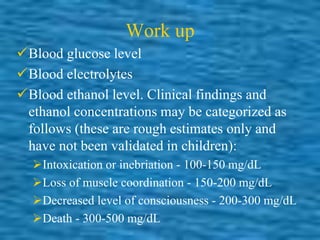
Work up 
Blood glucose level 
Blood electrolytes 
Blood ethanol level. Clinical findings and 
ethanol concentrations may be categorized as 
follows (these are rough estimates only and 
have not been validated in children): 
Intoxication or inebriation - 100-150 mg/dL 
Loss of muscle coordination - 150-200 mg/dL 
Decreased level of consciousness - 200-300 mg/dL 
Death - 300-500 mg/dL
Pregnancy Test 
Serum salicylate and acetaminophen levels: In 
intentional suicidal ingestions, the presence of 
other toxic substances must be determined. 
Urine drug levels: Older patients may have 
ingested recreational drugs such as cocaine, 
marijuana, benzodiazepines, amphetamines, 
and opiates. 
Methanol levels: These results can be helpful 
if an ingestion of combined substances is 
suspected. A positive methanol level can alert 
the physician to a co-ingestion.
Arterial blood gases: The pH can help in ruling 
out the co-ingestion of methanol and ethylene 
glycol, because significant academia is 
associated with those ingestions. 
Serum calcium and magnesium levels: High 
concentrations of ethanol and its chronic use 
can deplete these cations.
Management 
Maintain airways and respiration. 
Correct hypotension. 
Quickly correct hypoglycemia. In children, 2-4 
mL/kg of 25% dextrose solution is usually 
administered. A maintenance infusion of 
dextrose-containing IV fluids is often required. 
Correct any electrolyte abnormalities found with 
laboratory studies. Routine empiric electrolyte 
replacement is not helpful; only documented 
electrolytic abnormalities should be corrected.
If the ingestion occurred within 1 hour of 
presentation, placing a nasogastric tube and 
evacuating the stomach contents can be helpful. 
In patients with chronic ethanol abuse, 
administer thiamine 100 mg IV/intramuscularly 
to prevent neurologic injury. 
Additional care: If other substances have been 
co-ingested, initiate specific treatment for those 
substances, if available. For instance, naloxone 
can be used to reverse respiratory depression if 
opiate co-ingestion is suspected.
The administration of medications to cause 
emesis is not recommended because of the 
rapid onset of CNS depression and risk of 
aspiration. 
The administration of activated charcoal is not 
recommended for isolated alcohol ingestions 
because it does not bind hydrocarbons or 
alcohols. If the clinician suspects a 
concomitant ingestion of other toxic products, 
activated charcoal may be effective in 
absorbing these toxins.
Forced diuresis is not helpful because 90% of 
ethanol metabolism occurs in the liver, and 
only 10% of the ethanol load is secreted in the 
urine. 
GABA-receptor antagonists such as naloxone 
and flumazenil have little effect on the CNS or 
respiratory depression caused by ethanol; their 
use is not recommended in isolated ethanol 
intoxication. 
Patients who have impaired hepatic function 
may require dialysis to clear an ethanol load.
Isopropyl alcohol 
Isopropyl alcohol is commonly found as both a 
solvent as well as a disinfectant. It can be found in 
many mouthwashes, skin lotions, and rubbing 
alcohol. 
Because of its widespread availability, lack of 
purchasing restrictions, and profound intoxicating 
properties, it is commonly used as an ethanol 
substitute. 
Isopropanol is metabolized via alcohol 
dehydrogenase to acetone.
The peak concentration of acetone is not 
present until approximately 4 hours after 
ingestion. Both the CNS depressant effects and 
the fruity odor on the patient's breath are due 
to acetone. 
isopropanol is irritating to the GI tract. 
Therefore, abdominal pain, hemorrhagic 
gastritis, and vomiting can be observed.
Methanol 
Methanol is widely used as an industrial solvent 
and paint remover. It is also used in photocopying 
fluid, and windshield-washing fluids. 
Although toxicity primarily occurs from 
ingestion, it can also occur from prolonged 
inhalation or skin absorption. 
Methanol is primarily metabolized in the liver via 
alcohol dehydrogenase into formaldehyde. 
Formaldehyde is subsequently metabolized via 
aldehyde dehydrogenase into formic acid, which 
ultimately is metabolized to FOLATE.
 Formate is toxic because it inhibits mitochondrial 
cytochrome c oxidase, causing the symptoms of 
hypoxia at the cellular level, and also causing 
metabolic acidosis, among a variety of other 
metabolic disturbances 
metabolic acidosis is associated with 
hypoventilation, pancreatitis, nausea, and 
abdominal pain. 
It is mainly toxic to eyes and the patient usually 
complain of visual problem, hyperemia of the optic 
disc. Over several days, the red disc becomes pale, 
and the patient may become blind.
TREATMENT 
The primary antidotal treatment of methanol 
blocking alcohol dehydrogenase. This enzyme 
can be inhibited by either ethanol or fomepizole. 
Toxic alcohol levels are frequently not 
immediately available. Thus, ideally, if methanol 
poisoning is suspected, the patient should 
receive a loading dose of fomepizole while the 
levels are being obtained.
If ethanol is used, the recommended target 
serum concentration is 100-150 mg/dL. 
 Because ethanol inhibits gluconeogenesis, 
hypoglycemia is common in patients on an 
ethanol infusion. Thus, serum glucose levels 
must be checked frequently, at least every 2 
hours. 
In addition, because it is difficult to attain a 
steady serum concentration of ethanol, the 
ethanol level also must be checked frequently, 
and titrations made.
significant metabolic acidosis should be 
treated with sodium bicarbonate infusions. If 
methanol is suspected, folinic acid should be 
administered at a dose of 1 mg/kg, with a 
maximal dose of 50 mg. It should be repeated 
every 4 hours. If folinic acid is not 
immediately available, folic acid can be 
substituted at the same dose. 
Based on experimental studies, formate 
appears to be excreted in the kidneys at a much 
higher rate when the patient is not acidotic.
In addition, when the patient is not acidotic, formic 
acid dissociates to formate at lower rates so that 
less formate crosses the blood-brain barrier. Thus, 
in methanol intoxication, correcting the acidosis 
actually speeds up elimination of the toxic 
compound and decreases toxicity. 
Leucovorin (folinic acid) is active form of folate 
and may be substituted for folic acid may act as an 
adjunctive agent in methanol ingestion. It may 
enhance elimination of toxic metabolite formic acid 
produced when methanol is metabolized. Folic acid 
should be administered for several days to enhance 
folate-dependent metabolism of formic acid to 
carbon dioxide and water.
Hemodialysis is frequently required in patients 
with significant methanol ingestions.[13

Alcohol intoxification

  • 1.
  • 2.
    Ethanol toxicity Ethanolis a 2-carbon–chain alcohol; the chemical formula is CH2 CH3 OH. It is ubiquitous throughout the world and is a leading cause of morbidity across cultures. It is one of the most commonly abused drugs.
  • 3.
    Phatrmacokinetics The primaryroute of absorption is oral, although it can be absorbed by inhalation and even percutaneously. Ethanol is rapidly absorbed, and peak serum concentrations typically occur 30-60 minutes after ingestion. Its absorption into the body starts in the oral mucosa and continues in the stomach and intestine. Both high and low concentrations of ethanol are slowly absorbed; the co-ingestion of food also slows absorption.
  • 4.
    Ethanol has avolume of distribution (0.6 L/kg) and is readily distributed throughout the body. Ethanol is primarily metabolized in the liver. Approximately 90% of an ethanol load is broken down in the liver; the remainder is eliminated by the kidneys and lungs.  In children, ethanol is cleared by the liver at the rate of approximately 30 mg/dL/h, which is more rapid than the clearance rate in adults. In the liver, ethanol is broken down into acetaldehyde by alcohol dehydrogenase (ADH). Then, it is further broken down to acetic acid by acetaldehyde dehydrogenase.
  • 5.
    Acetic acid isfed into the Krebs cycle and is ultimately broken down into carbon dioxide and water. Also, a gastric isozyme of ADH breaks down a significant amount of ethanol before it can be absorbed; sex differences in ADH may, in part, account for differences in ethanol effects per given quantity consumed between men and women. Disulfiram reduces the rate of oxidation of acetaldehyde by competing with the cofactor nicotinamide adenine dinucleotide (NAD) for binding sites on aldehyde dehydrogenase.
  • 7.
    Pathophysiology Ethanol exertsits actions through several mechanisms. For instance, it binds directly to the gamma-aminobutyric acid (GABA) receptor in the CNS and causes sedative effects similar to those of benzodiazepine.  Furthermore, ethanol is also a glutamate antagonist in the CNS. Ethanol also has direct effects on cardiac muscle, thyroid tissue, and hepatic tissue. However, the exact molecular targets of ethanol and the mechanism of action are still the subjects of ongoing research
  • 8.
    In young children,ethanol causes hypoglycemia and hypoglycemic seizures; these complications are not as common in older patients. Hypoglycemia occurs secondary to ethanol's inhibition of gluconeogenesis and secondary to the relatively smaller glycogen stores in the livers of young children. In toddlers who have not eaten for several hours, even small quantities of ethanol can cause hypoglycemia.
  • 9.
    Ethanol use isalso strongly linked to risk-taking behaviors that can lead to major trauma, minor trauma, illicit drug use, and teenage pregnancy. Especially trauma due to motor vehicle collisions or violent crimes The concomitant use of ethanol and other drugs is common, and combinations of ethanol with other sedative-hypnotics or opioids may potentiate the toxic effects. Young children commonly ingest ethanol when they drink a liquid not meant for consumption, such as perfume or cleaning agents.
  • 10.
    Frequently, other chemicalsin the ingested substance are more toxic than the ethanol. Therefore, a detailed physical examination is important to evaluate for any signs and symptoms caused by these other toxins. Also, give special attention to the examination of the oral cavity and airway because substances in cleaning agents can cause chemical burns to these areas. 
  • 11.
    SIGNS AND SYMPTOMS Ethanol has a sedative effect, producing general CNS depression, respiratory depression, hypoxia and hypoglycemia. In children, the classic triad of signs of ethanol intoxication includes coma, hypoglycemia, and hypothermia. Mild vasodilatation leading to a modest decrease in blood pressure Flushed skin  tachycardia
  • 13.
    Chronic ethanol usecan lead to the following: Fetal alcohol syndrome Chronic pancreatitis Hepatic dysfunction Hematologic disorders Numerous electrolyte abnormalities Hypertension Cardiomyopathy Malnutrition Obesity
  • 14.
    Work up Bloodglucose level Blood electrolytes Blood ethanol level. Clinical findings and ethanol concentrations may be categorized as follows (these are rough estimates only and have not been validated in children): Intoxication or inebriation - 100-150 mg/dL Loss of muscle coordination - 150-200 mg/dL Decreased level of consciousness - 200-300 mg/dL Death - 300-500 mg/dL
  • 16.
    Pregnancy Test Serumsalicylate and acetaminophen levels: In intentional suicidal ingestions, the presence of other toxic substances must be determined. Urine drug levels: Older patients may have ingested recreational drugs such as cocaine, marijuana, benzodiazepines, amphetamines, and opiates. Methanol levels: These results can be helpful if an ingestion of combined substances is suspected. A positive methanol level can alert the physician to a co-ingestion.
  • 17.
    Arterial blood gases:The pH can help in ruling out the co-ingestion of methanol and ethylene glycol, because significant academia is associated with those ingestions. Serum calcium and magnesium levels: High concentrations of ethanol and its chronic use can deplete these cations.
  • 18.
    Management Maintain airwaysand respiration. Correct hypotension. Quickly correct hypoglycemia. In children, 2-4 mL/kg of 25% dextrose solution is usually administered. A maintenance infusion of dextrose-containing IV fluids is often required. Correct any electrolyte abnormalities found with laboratory studies. Routine empiric electrolyte replacement is not helpful; only documented electrolytic abnormalities should be corrected.
  • 19.
    If the ingestionoccurred within 1 hour of presentation, placing a nasogastric tube and evacuating the stomach contents can be helpful. In patients with chronic ethanol abuse, administer thiamine 100 mg IV/intramuscularly to prevent neurologic injury. Additional care: If other substances have been co-ingested, initiate specific treatment for those substances, if available. For instance, naloxone can be used to reverse respiratory depression if opiate co-ingestion is suspected.
  • 20.
    The administration ofmedications to cause emesis is not recommended because of the rapid onset of CNS depression and risk of aspiration. The administration of activated charcoal is not recommended for isolated alcohol ingestions because it does not bind hydrocarbons or alcohols. If the clinician suspects a concomitant ingestion of other toxic products, activated charcoal may be effective in absorbing these toxins.
  • 21.
    Forced diuresis isnot helpful because 90% of ethanol metabolism occurs in the liver, and only 10% of the ethanol load is secreted in the urine. GABA-receptor antagonists such as naloxone and flumazenil have little effect on the CNS or respiratory depression caused by ethanol; their use is not recommended in isolated ethanol intoxication. Patients who have impaired hepatic function may require dialysis to clear an ethanol load.
  • 22.
    Isopropyl alcohol Isopropylalcohol is commonly found as both a solvent as well as a disinfectant. It can be found in many mouthwashes, skin lotions, and rubbing alcohol. Because of its widespread availability, lack of purchasing restrictions, and profound intoxicating properties, it is commonly used as an ethanol substitute. Isopropanol is metabolized via alcohol dehydrogenase to acetone.
  • 23.
    The peak concentrationof acetone is not present until approximately 4 hours after ingestion. Both the CNS depressant effects and the fruity odor on the patient's breath are due to acetone. isopropanol is irritating to the GI tract. Therefore, abdominal pain, hemorrhagic gastritis, and vomiting can be observed.
  • 24.
    Methanol Methanol iswidely used as an industrial solvent and paint remover. It is also used in photocopying fluid, and windshield-washing fluids. Although toxicity primarily occurs from ingestion, it can also occur from prolonged inhalation or skin absorption. Methanol is primarily metabolized in the liver via alcohol dehydrogenase into formaldehyde. Formaldehyde is subsequently metabolized via aldehyde dehydrogenase into formic acid, which ultimately is metabolized to FOLATE.
  • 25.
     Formate istoxic because it inhibits mitochondrial cytochrome c oxidase, causing the symptoms of hypoxia at the cellular level, and also causing metabolic acidosis, among a variety of other metabolic disturbances metabolic acidosis is associated with hypoventilation, pancreatitis, nausea, and abdominal pain. It is mainly toxic to eyes and the patient usually complain of visual problem, hyperemia of the optic disc. Over several days, the red disc becomes pale, and the patient may become blind.
  • 26.
    TREATMENT The primaryantidotal treatment of methanol blocking alcohol dehydrogenase. This enzyme can be inhibited by either ethanol or fomepizole. Toxic alcohol levels are frequently not immediately available. Thus, ideally, if methanol poisoning is suspected, the patient should receive a loading dose of fomepizole while the levels are being obtained.
  • 27.
    If ethanol isused, the recommended target serum concentration is 100-150 mg/dL.  Because ethanol inhibits gluconeogenesis, hypoglycemia is common in patients on an ethanol infusion. Thus, serum glucose levels must be checked frequently, at least every 2 hours. In addition, because it is difficult to attain a steady serum concentration of ethanol, the ethanol level also must be checked frequently, and titrations made.
  • 28.
    significant metabolic acidosisshould be treated with sodium bicarbonate infusions. If methanol is suspected, folinic acid should be administered at a dose of 1 mg/kg, with a maximal dose of 50 mg. It should be repeated every 4 hours. If folinic acid is not immediately available, folic acid can be substituted at the same dose. Based on experimental studies, formate appears to be excreted in the kidneys at a much higher rate when the patient is not acidotic.
  • 29.
    In addition, whenthe patient is not acidotic, formic acid dissociates to formate at lower rates so that less formate crosses the blood-brain barrier. Thus, in methanol intoxication, correcting the acidosis actually speeds up elimination of the toxic compound and decreases toxicity. Leucovorin (folinic acid) is active form of folate and may be substituted for folic acid may act as an adjunctive agent in methanol ingestion. It may enhance elimination of toxic metabolite formic acid produced when methanol is metabolized. Folic acid should be administered for several days to enhance folate-dependent metabolism of formic acid to carbon dioxide and water.
  • 30.
    Hemodialysis is frequentlyrequired in patients with significant methanol ingestions.[13