Methanol toxicity
Dr. Hein Yarzar Aung
Consultant Physician
Medical Unit 1
Yangon General Hospital
Introduction
• Methanol (wood alcohol)
– a common ingredient in many solvents,
windshield-washing solutions, duplicating fluids,
and paint removers
– sometimes is used as an ethanol substitute by
alcoholics
– its metabolic products may cause
• metabolic acidosis, blindness, and death after a
characteristic latent period of 30 hours
Mechanism of toxicity
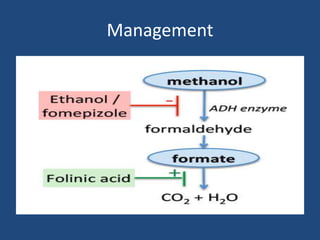
• slowly metabolized by alcohol dehydrogenase
to formaldehyde
• subsequently by aldehyde dehydrogenase to
formic acid (formate)
– systemic acidosis is caused by both formate and
lactate
– blindness is caused primarily by formate
Pharmacokinetics
• readily absorbed and quickly distributed to the
body water
• metabolized slowly by alcohol
• "half-life" ranges from 1 to 24 hours
• Only about 3% is excreted unchanged by the
kidneys, and less than 10-20% through the breath
• Formate: half-life ranges from 3-20 hours; during
dialysis the half-life decreases to 1-2.6 hours
Toxic dose
• The fatal oral dose of methanol is 30-240 mL
(20-150 g)
• The minimum toxic dose is approximately 100
mg/kg
Clinical presentation
• In the first few hours after ingestion
– inebriation and gastritis
– acidosis is not usually present (metabolism to
toxic products has not yet occurred)
• After a latent period of up to 30 hours
– severe anion gap metabolic acidosis
– visual disturbances ( may occur within 6 hours ),
blindness, seizures, coma, acute renal failure with
myoglobinuria, and death
– fundoscopic examination - optic disc hyperemia,
venous engorgement, peripapilledema, and retinal
or optic disc edema
– The latent period is longer when ethanol has been
ingested concurrently with methanol
Diagnosis
• usually is based on the history, symptoms
• stat methanol levels are rarely available
• Calculation of the osmolar and anion gaps
(see Serum osmolality and osmolar gap)
– A large anion gap not accounted for by elevated
lactate suggests possible methanol (or ethylene
glycol) poisoning, because the anion gap in these
cases is mostly nonlactate
• Specific levels
– 1. Serum methanol level
• higher than 20 mg/dL – toxic
• higher than 40 mg/dL - very serious
• After the latent period, a low or nondetectable
methanol level does not rule out serious intoxication in
a symptomatic patient because all the methanol may
already have been metabolized to formate
– 2. Elevated serum formate concentrations
• may confirm the diagnosis and are a better measure of
toxicity
• but formate levels are not widely available
– 3. Other useful laboratory studies
• include electrolytes (and anion gap), glucose, BUN,
creatinine, serum osmolality and osmolar gap, arterial
blood gases, ethanol level, and lactate level
Treatment
• Emergency and supportive measures
– 1. Maintain an open airway and assist ventilation
if necessary
– 2. Treat coma if they occur
– 3. Treat metabolic acidosis with intravenous
sodium bicarbonate
• Correction of acidosis should be guided by arterial
blood gases
Specific drugs and antidotes
• 1. Administer fomepizole or ethanol ( to saturate
the enzyme alcohol dehydrogenase and prevent
the formation of methanol's toxic metabolites )
• Indications
– a. A history of significant methanol ingestion when
methanol serum levels are not immediately available
– b. Metabolic acidosis (arterial pH < 7.3, serum
bicarbonate < 20 mEq/L) and an osmolar gap greater
than 10 mOsm/L not accounted for by ethanol
– c. methanol blood concentration greater than 20
mg/dL.
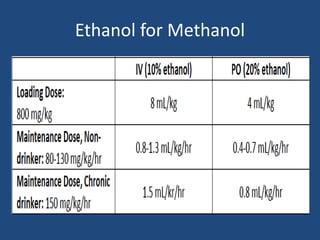
Ethanol for Methanol
• Ethanol
– 40%
– 120 ml stat
– 12 ml hrly for non – drinker
– 24 ml hrly for chronic drinker
– Until serum methanol level < 20 mg/dl
• 2. Folic or folinic acid
– may enhance the conversion of formate to carbon
dioxide and water
– 1 mg/kg (up to 50 mg) IV or PO every 4 hours
Management
• C. Decontamination
– Aspirate gastric contents if this can be performed
within 30-60 minutes of ingestion
– Activated charcoal is not likely to be useful
because the effective dose is very large and
methanol is absorbed rapidly from the GI tract
• D. Enhanced elimination
– Hemodialysis rapidly removes both methanol
(half-life reduced to 3-6 hours) and formate
– Indications
• a. Suspected methanol poisoning with significant
metabolic acidosis
• b. Visual abnormalities
• c. Renal failure
• d. An osmolar gap greater than 10 mOsm/L or a
measured serum methanol concentration greater than
50 mg/dL
• E. Endpoint of treatment
– Dialysis, fomepizole, or ethanol should be
continued until the methanol concentration is less
than 20 mg/dL
– and the osmolar and anion gaps are normalized
• Thank you!!

Methanol toxicity. h y aung

  • 1.
    Methanol toxicity Dr. HeinYarzar Aung Consultant Physician Medical Unit 1 Yangon General Hospital
  • 2.
    Introduction • Methanol (woodalcohol) – a common ingredient in many solvents, windshield-washing solutions, duplicating fluids, and paint removers – sometimes is used as an ethanol substitute by alcoholics – its metabolic products may cause • metabolic acidosis, blindness, and death after a characteristic latent period of 30 hours
  • 3.
    Mechanism of toxicity •slowly metabolized by alcohol dehydrogenase to formaldehyde • subsequently by aldehyde dehydrogenase to formic acid (formate) – systemic acidosis is caused by both formate and lactate – blindness is caused primarily by formate
  • 4.
    Pharmacokinetics • readily absorbedand quickly distributed to the body water • metabolized slowly by alcohol • "half-life" ranges from 1 to 24 hours • Only about 3% is excreted unchanged by the kidneys, and less than 10-20% through the breath • Formate: half-life ranges from 3-20 hours; during dialysis the half-life decreases to 1-2.6 hours
  • 5.
    Toxic dose • Thefatal oral dose of methanol is 30-240 mL (20-150 g) • The minimum toxic dose is approximately 100 mg/kg
  • 6.
    Clinical presentation • Inthe first few hours after ingestion – inebriation and gastritis – acidosis is not usually present (metabolism to toxic products has not yet occurred)
  • 7.
    • After alatent period of up to 30 hours – severe anion gap metabolic acidosis – visual disturbances ( may occur within 6 hours ), blindness, seizures, coma, acute renal failure with myoglobinuria, and death – fundoscopic examination - optic disc hyperemia, venous engorgement, peripapilledema, and retinal or optic disc edema – The latent period is longer when ethanol has been ingested concurrently with methanol
  • 8.
    Diagnosis • usually isbased on the history, symptoms • stat methanol levels are rarely available • Calculation of the osmolar and anion gaps (see Serum osmolality and osmolar gap) – A large anion gap not accounted for by elevated lactate suggests possible methanol (or ethylene glycol) poisoning, because the anion gap in these cases is mostly nonlactate
  • 9.
    • Specific levels –1. Serum methanol level • higher than 20 mg/dL – toxic • higher than 40 mg/dL - very serious • After the latent period, a low or nondetectable methanol level does not rule out serious intoxication in a symptomatic patient because all the methanol may already have been metabolized to formate
  • 10.
    – 2. Elevatedserum formate concentrations • may confirm the diagnosis and are a better measure of toxicity • but formate levels are not widely available
  • 11.
    – 3. Otheruseful laboratory studies • include electrolytes (and anion gap), glucose, BUN, creatinine, serum osmolality and osmolar gap, arterial blood gases, ethanol level, and lactate level
  • 12.
    Treatment • Emergency andsupportive measures – 1. Maintain an open airway and assist ventilation if necessary – 2. Treat coma if they occur – 3. Treat metabolic acidosis with intravenous sodium bicarbonate • Correction of acidosis should be guided by arterial blood gases
  • 13.
    Specific drugs andantidotes • 1. Administer fomepizole or ethanol ( to saturate the enzyme alcohol dehydrogenase and prevent the formation of methanol's toxic metabolites ) • Indications – a. A history of significant methanol ingestion when methanol serum levels are not immediately available – b. Metabolic acidosis (arterial pH < 7.3, serum bicarbonate < 20 mEq/L) and an osmolar gap greater than 10 mOsm/L not accounted for by ethanol – c. methanol blood concentration greater than 20 mg/dL.
  • 14.
  • 15.
    • Ethanol – 40% –120 ml stat – 12 ml hrly for non – drinker – 24 ml hrly for chronic drinker – Until serum methanol level < 20 mg/dl
  • 16.
    • 2. Folicor folinic acid – may enhance the conversion of formate to carbon dioxide and water – 1 mg/kg (up to 50 mg) IV or PO every 4 hours
  • 17.
  • 18.
    • C. Decontamination –Aspirate gastric contents if this can be performed within 30-60 minutes of ingestion – Activated charcoal is not likely to be useful because the effective dose is very large and methanol is absorbed rapidly from the GI tract
  • 19.
    • D. Enhancedelimination – Hemodialysis rapidly removes both methanol (half-life reduced to 3-6 hours) and formate – Indications • a. Suspected methanol poisoning with significant metabolic acidosis • b. Visual abnormalities • c. Renal failure • d. An osmolar gap greater than 10 mOsm/L or a measured serum methanol concentration greater than 50 mg/dL
  • 20.
    • E. Endpointof treatment – Dialysis, fomepizole, or ethanol should be continued until the methanol concentration is less than 20 mg/dL – and the osmolar and anion gaps are normalized
  • 21.