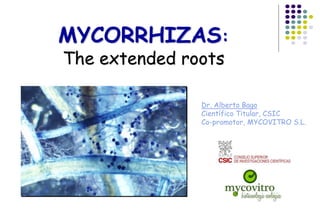


MYCORRHIZAS:
The extended roots
Dr. Alberto Bago
Científico Titular, CSIC
Co-promotor, MYCOVITRO S.L.
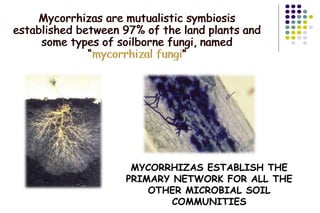
Mycorrhizas are mutualistic symbiosis
established between 97% of the land plants and
some types of soilborne fungi, named
“mycorrhizal fungi”
MYCORRHIZAS ESTABLISH THE
PRIMARY NETWORK FOR ALL THE
OTHER MICROBIAL SOIL
COMMUNITIES
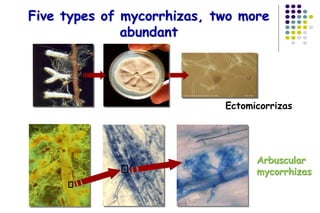
Ectomicorrizas
Arbuscular
mycorrhizas
Five types of mycorrhizas, two more
abundant
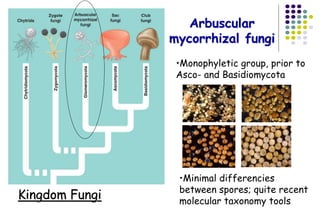
Arbuscular
mycorrhizas
Kingdom Fungi
•Monophyletic group, prior to
Asco- and Basidiomycota
•Minimal differencies
between spores; quite recent
molecular taxonomy tools
Arbuscular
mycorrhizal fungi
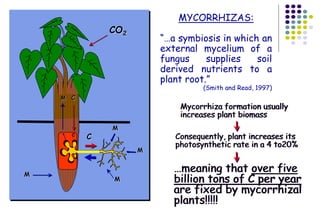
CO2
CM
M
M
C
M
M
M
C
MYCORRHIZAS:
“…a symbiosis in which an
external mycelium of a
fungus supplies soil
derived nutrients to a
plant root.”
(Smith and Read, 1997)
Mycorrhiza formation usually
increases plant biomass
Consequently, plant increases its
photosynthetic rate in a 4 to20%
…meaning that over five
billion tons of C per year
are fixed by mycorrhizal
plants!!!!!
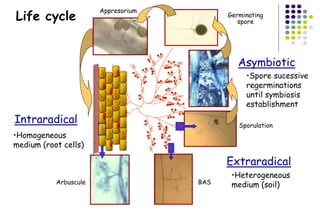
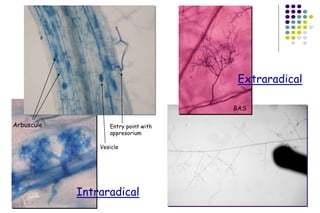
Intraradical
Extraradical
Arbuscule BAS
Sporulation
Appresorium
Germinating
spore
Asymbiotic
Life cycle
•Homogeneous
medium (root cells)
•Heterogeneous
medium (soil)
•Spore sucessive
regerminations
until symbiosis
establishment
Entry point with
appresorium
Arbuscule
BAS
Intraradical
Extraradical
Vesicle
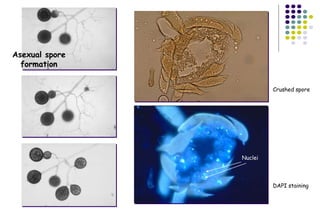
Asexual spore
formation
Crushed spore
DAPI staining
Nuclei
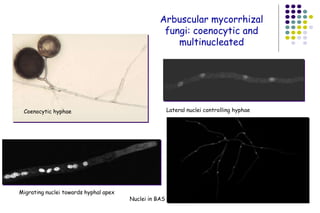
Coenocytic hyphae
Migrating nuclei towards hyphal apex
Lateral nuclei controlling hyphae
Arbuscular mycorrhizal
fungi: coenocytic and
multinucleated
Nuclei in BAS
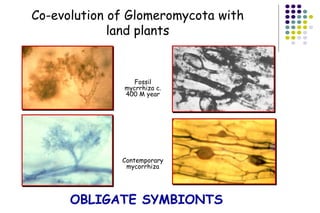
Fossil
mycrrhiza c.
400 M year
Contemporary
mycorrhiza
Co-evolution of Glomeromycota with
land plants
OBLIGATE SYMBIONTS
FAS
COOH
C=O
CH2
COOH
OAA
CoASC=O
CH3
Acetyl CoA
CH2OH
C=O
CH2OP
DHAP
HC=O
CHOH
CH2OP
3PGAD
TrioseP-
isomerase
COOH
C=O
CH3
Pyruvate
COOH
CHOH
CH2OP
3PGlycerate
Glucose
CH2OH
OH
OH
OH
OH
o
Fructose 1-6bisP
PO2HC
OH
OHOH
OH
CH2OPo
CoA
SH CO2
COOH
CH2
HOC-COOH
CH2
COOH
Citrate
CoASC=O
CH3
Acetyl CoA
COOH
CH2
HOC-COOH
CH2
COOH
Citrate
CoASC=O
CH2CH2CH2CH2CH2CH2CH2CH2CH2CH=CHCH2CH2CH2CH3
1
FA 16:1w5 cis
Krebs
Cycle
OLEOSOME
Citrate lyase
(cytopl.)
C
C
C
C
C
C
C
CH2OH
CHOH
CH2OH
13C1,3-GLYCEROL
C
C
C
C
C
C
CH2O-CO
CH2O-CO
CHO-CO
TRIACYLGLYCERIDE
x8
C
C
C
C3
1
CoASC=O
CH2CH2CH3
COOH
CH3
13C2-ACETATE
C
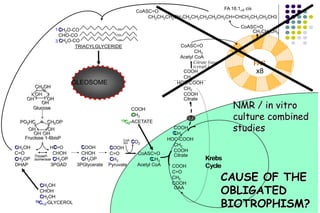
NMR / in vitro
culture combined
studies
CAUSE OF THE
OBLIGATED
BIOTROPHISM?
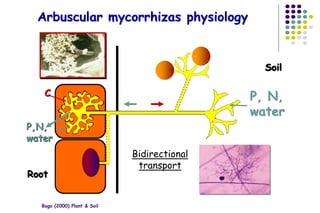
Arbuscular mycorrhizas physiology
Bago (2000) Plant & Soil
Root
Soil
Bidirectional
transport
P, N,
water
C
P,N,
water
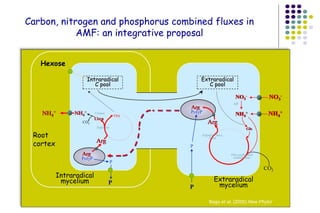
Carbon, nitrogen and phosphorus combined fluxes in
AMF: an integrative proposal
P
NH4
+
CO2
UreaseNH4
+
Hexose
Intraradical
C pool
Extraradical
C pool
Arg
CO2
Orn-carbamoil
transferasa
Arginino-Succ.
liasa
NO3
-
NH4
+
NO3
-
NH4
+
NR
Gln
Arg
PolyP
Intraradical
mycelium Extraradical
mycelium
P
PolyP
P
P
Arg
Arginase
Urea
Arg
Orn
Bago et al. (2000) New Phytol
Root
cortex
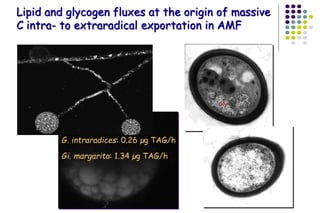
Lipid and glycogen fluxes at the origin of massive
C intra- to extraradical exportation in AMF
G. intraradices: 0.26 µg TAG/h
Gi. margarita: 1.34 µg TAG/h
Gly
Root
Soil
Soil
aggregates Soil
particles
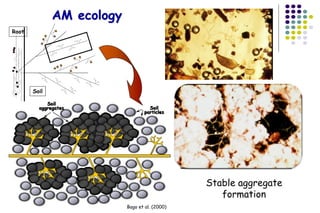
Bago et al. (2000)
Stable aggregate
formation
AM ecology
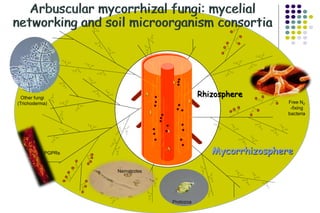
Arbuscular mycorrhizal fungi: mycelial
networking and soil microorganism consortia
A
A
V
V
I
I
Rhizosphere
Mycorrhizosphere
Protozoa
Nematodes
Free N2
-fixing
bacteria
Other fungi
(Trichoderma)
PGPRs
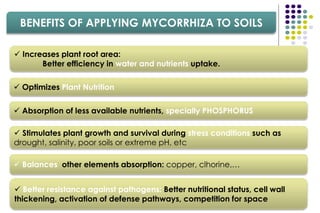
 Increases plant root area:
Better efficiency in water and nutrients uptake.
 Absorption of less available nutrients, specially PHOSPHORUS
 Balances other elements absorption: copper, clhorine,…
 Better resistance against pathogens: Better nutritional status, cell wall
thickening, activation of defense pathways, competition for space
 Stimulates plant growth and survival during stress conditions such as
drought, salinity, poor soils or extreme pH, etc
 Optimizes Plant Nutrition
BENEFITS OF APPLYING MYCORRHIZA TO SOILS
Because we didn’t know
so well and we didn’t
know how to use them
correctly
If Mycorrhizae are so good, why
we have not used them so far?
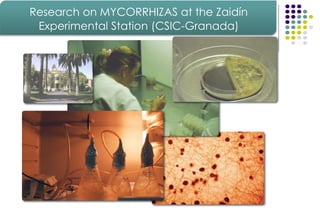
Research on MYCORRHIZAS at the Zaidín
Experimental Station (CSIC-Granada)
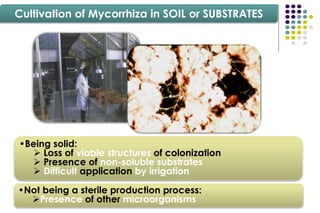
Cultivation of Mycorrhiza in SOIL or SUBSTRATES
•Being solid:
 Loss of viable structures of colonization
 Presence of non-soluble substrates
 Difficult application by irrigation
•Not being a sterile production process:
Presence of other microorganisms
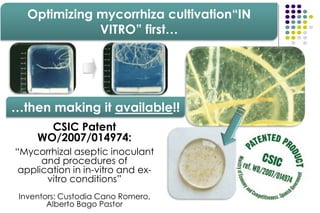
Optimizing mycorrhiza cultivation“IN
VITRO” first…
CSIC Patent
WO/2007/014974:
“Mycorrhizal aseptic inoculant
and procedures of
application in in-vitro and ex-
vitro conditions”
Inventors: Custodia Cano Romero,
Alberto Bago Pastor
…then making it available!!
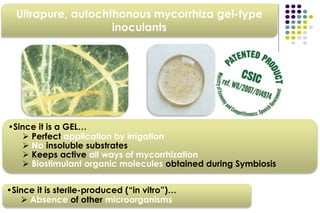
Ultrapure, autochthonous mycorrhiza gel-type
inoculants
•Since it is a GEL…
 Perfect application by irrigation
 No insoluble substrates
 Keeps active all ways of mycorrhization
 Biostimulant organic molecules obtained during Symbiosis
•Since it is sterile-produced (“in vitro”)…
 Absence of other microorganisms
Empresa spin-off del CSIC
Consejo Superior de Investigaciones Científicas
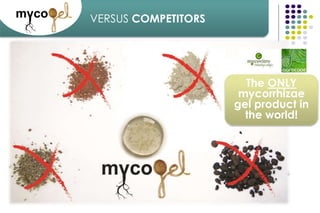
VERSUS COMPETITORS
The ONLY
mycorrhizae
gel product in
the world!
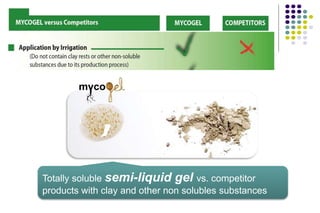
Totally soluble semi-liquid gel vs. competitor
products with clay and other non solubles substances
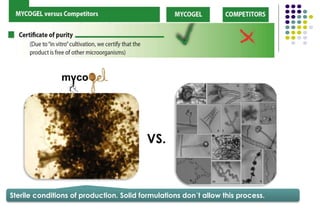
Sterile conditions of production. Solid formulations don´t allow this process.
VS.
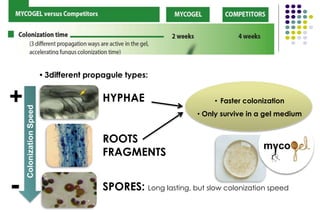
• 3different propagule types:
SPORES: Long lasting, but slow colonization speed
HYPHAE
ROOTS
FRAGMENTS
• Faster colonization
• Only survive in a gel medium
ColonizationSpeed
+
-
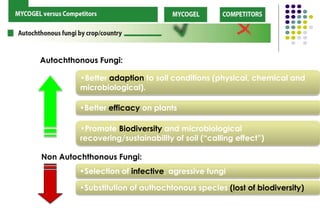
•Better adaption to soil conditions (physical, chemical and
microbiological).
•Better efficacy on plants
Non Autochthonous Fungi:
Autochthonous Fungi:
•Promote Biodiversity and microbiological
recovering/sustainability of soil (“calling effect”)
•Selection of infective, agressive fungi
•Substitution of authochtonous species (lost of biodiversity)
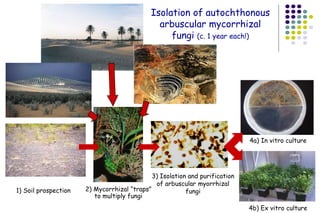
1) Soil prospection 2) Mycorrhizal “traps”
to multiply fungi
3) Isolation and purification
of arbuscular myorrhizal
fungi
4a) In vitro culture
4b) Ex vitro culture
Isolation of autochthonous
arbuscular mycorrhizal
fungi (c. 1 year each!)
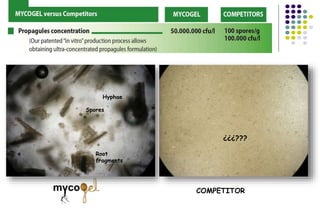
COMPETITOR
¿¿¿???
Spores
Root
fragments
Hyphae
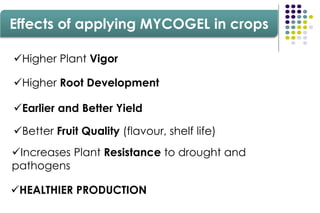
Effects of applying MYCOGEL in crops
Higher Root Development
Earlier and Better Yield
Better Fruit Quality (flavour, shelf life)
Higher Plant Vigor
Increases Plant Resistance to drought and
pathogens
HEALTHIER PRODUCTION
Trials and
Results
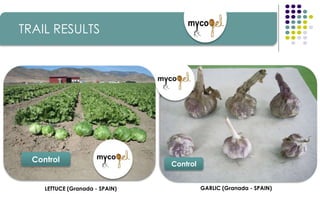
LETTUCE (Granada - SPAIN)
Control
TRAIL RESULTS
GARLIC (Granada - SPAIN)
Control
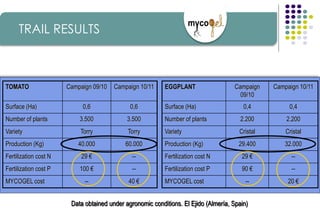
TOMATO Campaign 09/10 Campaign 10/11
Surface (Ha) 0,6 0,6
Number of plants 3.500 3.500
Variety Torry Torry
Production (Kg) 40.000 60.000
Fertilization cost N 29 € --
Fertilization cost P 100 € --
MYCOGEL cost -- 40 €
EGGPLANT Campaign
09/10
Campaign 10/11
Surface (Ha) 0,4 0,4
Number of plants 2.200 2.200
Variety Cristal Cristal
Production (Kg) 29.400 32.000
Fertilization cost N 29 € --
Fertilization cost P 90 € --
MYCOGEL cost -- 20 €
Data obtained under agronomic conditions. El Ejido (Almería, Spain)
TRAIL RESULTS
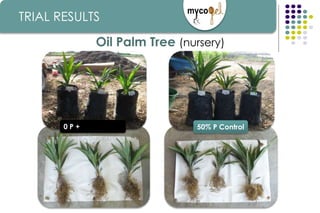
50% P Control
Oil Palm Tree (nursery)
TRIAL RESULTS
0 P + MYCOGEL®
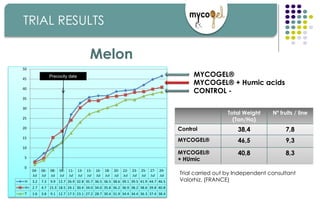
04-
Jul
06-
Jul
08-
Jul
09-
Jul
11-
Jul
13-
Jul
15-
Jul
16-
Jul
18-
Jul
20-
Jul
22-
Jul
23-
Jul
25-
Jul
27-
Jul
29-
Jul
H 3.2 7.3 9.9 12.7 26.9 32.8 35.7 36.5 36.5 38.6 39.1 39.5 41.9 44.7 46.5
H+ 2.7 4.7 15.3 18.5 24.1 30.4 34.0 34.0 35.8 36.2 36.9 38.2 38.6 39.8 40.8
T 1.6 3.8 9.1 12.7 17.5 23.1 27.2 28.7 30.4 31.9 34.4 34.4 36.3 37.4 38.4
0
5
10
15
20
25
30
35
40
45
50
Trial carried out by Independent consultant
Valorhiz, (FRANCE)
Melon
MYCOGEL®
MYCOGEL® + Humic acids
CONTROL -
Precocity date
Total Weight
(Ton/Ha)
Nº fruits / line
Control 38,4 7,8
MYCOGEL® 46,5 9,3
MYCOGEL®
+ HUmic
40,8 8,3
TRIAL RESULTS
TRIAL RESULTS
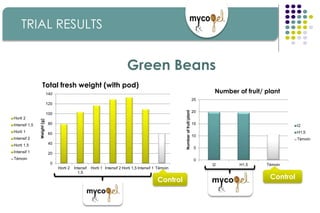
Green Beans
0
20
40
60
80
100
120
140
Horti 2 Intensif
1,5
Horti 1 Intensif 2 Horti 1,5 Intensif 1 Témoin
Weight(g)
Total fresh weight (with pod)
Horti 2
Intensif 1,5
Horti 1
Intensif 2
Horti 1,5
Intensif 1
Témoin
Control
0
5
10
15
20
25
I2 H1,5 Témoin
Numberoffruit/plant
Number of fruit/ plant
I2
H1,5
Témoin
Control
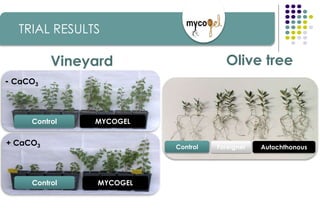
Olive tree
+ CaCO3
- CaCO3
Control MYCOGEL
Control MYCOGEL
ForeignerControl Autochthonous
Vineyard
TRIAL RESULTS
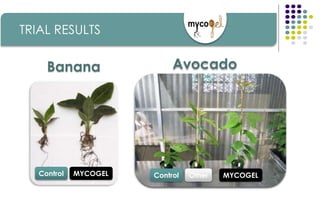
Banana
Control MYCOGEL
Avocado
Control MYCOGELOther
TRIAL RESULTS
¡GRACIAS!

Alberto Bago - Micorrizas. Una raíz extendida

  • 1.
    MYCORRHIZAS: The extended roots Dr.Alberto Bago Científico Titular, CSIC Co-promotor, MYCOVITRO S.L.
  • 2.
    Mycorrhizas are mutualisticsymbiosis established between 97% of the land plants and some types of soilborne fungi, named “mycorrhizal fungi” MYCORRHIZAS ESTABLISH THE PRIMARY NETWORK FOR ALL THE OTHER MICROBIAL SOIL COMMUNITIES
  • 3.
    Ectomicorrizas Arbuscular mycorrhizas Five types ofmycorrhizas, two more abundant Arbuscular mycorrhizas
  • 4.
    Kingdom Fungi •Monophyletic group,prior to Asco- and Basidiomycota •Minimal differencies between spores; quite recent molecular taxonomy tools Arbuscular mycorrhizal fungi
  • 5.
    CO2 CM M M C M M M C MYCORRHIZAS: “…a symbiosis inwhich an external mycelium of a fungus supplies soil derived nutrients to a plant root.” (Smith and Read, 1997) Mycorrhiza formation usually increases plant biomass Consequently, plant increases its photosynthetic rate in a 4 to20% …meaning that over five billion tons of C per year are fixed by mycorrhizal plants!!!!!
  • 6.
    Intraradical Extraradical Arbuscule BAS Sporulation Appresorium Germinating spore Asymbiotic Life cycle •Homogeneous medium(root cells) •Heterogeneous medium (soil) •Spore sucessive regerminations until symbiosis establishment
  • 7.
  • 8.
  • 9.
    Coenocytic hyphae Migrating nucleitowards hyphal apex Lateral nuclei controlling hyphae Arbuscular mycorrhizal fungi: coenocytic and multinucleated Nuclei in BAS
  • 10.
    Fossil mycrrhiza c. 400 Myear Contemporary mycorrhiza Co-evolution of Glomeromycota with land plants OBLIGATE SYMBIONTS
  • 11.
    FAS COOH C=O CH2 COOH OAA CoASC=O CH3 Acetyl CoA CH2OH C=O CH2OP DHAP HC=O CHOH CH2OP 3PGAD TrioseP- isomerase COOH C=O CH3 Pyruvate COOH CHOH CH2OP 3PGlycerate Glucose CH2OH OH OH OH OH o Fructose 1-6bisP PO2HC OH OHOH OH CH2OPo CoA SHCO2 COOH CH2 HOC-COOH CH2 COOH Citrate CoASC=O CH3 Acetyl CoA COOH CH2 HOC-COOH CH2 COOH Citrate CoASC=O CH2CH2CH2CH2CH2CH2CH2CH2CH2CH=CHCH2CH2CH2CH3 1 FA 16:1w5 cis Krebs Cycle OLEOSOME Citrate lyase (cytopl.) C C C C C C C CH2OH CHOH CH2OH 13C1,3-GLYCEROL C C C C C C CH2O-CO CH2O-CO CHO-CO TRIACYLGLYCERIDE x8 C C C C3 1 CoASC=O CH2CH2CH3 COOH CH3 13C2-ACETATE C NMR / in vitro culture combined studies CAUSE OF THE OBLIGATED BIOTROPHISM?
  • 12.
    Arbuscular mycorrhizas physiology Bago(2000) Plant & Soil Root Soil Bidirectional transport P, N, water C P,N, water
  • 13.
    Carbon, nitrogen andphosphorus combined fluxes in AMF: an integrative proposal P NH4 + CO2 UreaseNH4 + Hexose Intraradical C pool Extraradical C pool Arg CO2 Orn-carbamoil transferasa Arginino-Succ. liasa NO3 - NH4 + NO3 - NH4 + NR Gln Arg PolyP Intraradical mycelium Extraradical mycelium P PolyP P P Arg Arginase Urea Arg Orn Bago et al. (2000) New Phytol Root cortex
  • 14.
    Lipid and glycogenfluxes at the origin of massive C intra- to extraradical exportation in AMF G. intraradices: 0.26 µg TAG/h Gi. margarita: 1.34 µg TAG/h Gly
  • 15.
    Root Soil Soil aggregates Soil particles Bago etal. (2000) Stable aggregate formation AM ecology
  • 16.
    Arbuscular mycorrhizal fungi:mycelial networking and soil microorganism consortia A A V V I I Rhizosphere Mycorrhizosphere Protozoa Nematodes Free N2 -fixing bacteria Other fungi (Trichoderma) PGPRs
  • 17.
     Increases plantroot area: Better efficiency in water and nutrients uptake.  Absorption of less available nutrients, specially PHOSPHORUS  Balances other elements absorption: copper, clhorine,…  Better resistance against pathogens: Better nutritional status, cell wall thickening, activation of defense pathways, competition for space  Stimulates plant growth and survival during stress conditions such as drought, salinity, poor soils or extreme pH, etc  Optimizes Plant Nutrition BENEFITS OF APPLYING MYCORRHIZA TO SOILS
  • 18.
    Because we didn’tknow so well and we didn’t know how to use them correctly If Mycorrhizae are so good, why we have not used them so far?
  • 19.
    Research on MYCORRHIZASat the Zaidín Experimental Station (CSIC-Granada)
  • 20.
    Cultivation of Mycorrhizain SOIL or SUBSTRATES •Being solid:  Loss of viable structures of colonization  Presence of non-soluble substrates  Difficult application by irrigation •Not being a sterile production process: Presence of other microorganisms
  • 21.
    Optimizing mycorrhiza cultivation“IN VITRO”first… CSIC Patent WO/2007/014974: “Mycorrhizal aseptic inoculant and procedures of application in in-vitro and ex- vitro conditions” Inventors: Custodia Cano Romero, Alberto Bago Pastor …then making it available!!
  • 22.
    Ultrapure, autochthonous mycorrhizagel-type inoculants •Since it is a GEL…  Perfect application by irrigation  No insoluble substrates  Keeps active all ways of mycorrhization  Biostimulant organic molecules obtained during Symbiosis •Since it is sterile-produced (“in vitro”)…  Absence of other microorganisms
  • 23.
    Empresa spin-off delCSIC Consejo Superior de Investigaciones Científicas
  • 24.
  • 25.
    Totally soluble semi-liquidgel vs. competitor products with clay and other non solubles substances
  • 26.
    Sterile conditions ofproduction. Solid formulations don´t allow this process. VS.
  • 27.
    • 3different propaguletypes: SPORES: Long lasting, but slow colonization speed HYPHAE ROOTS FRAGMENTS • Faster colonization • Only survive in a gel medium ColonizationSpeed + -
  • 28.
    •Better adaption tosoil conditions (physical, chemical and microbiological). •Better efficacy on plants Non Autochthonous Fungi: Autochthonous Fungi: •Promote Biodiversity and microbiological recovering/sustainability of soil (“calling effect”) •Selection of infective, agressive fungi •Substitution of authochtonous species (lost of biodiversity)
  • 29.
    1) Soil prospection2) Mycorrhizal “traps” to multiply fungi 3) Isolation and purification of arbuscular myorrhizal fungi 4a) In vitro culture 4b) Ex vitro culture Isolation of autochthonous arbuscular mycorrhizal fungi (c. 1 year each!)
  • 30.
  • 31.
    Effects of applyingMYCOGEL in crops Higher Root Development Earlier and Better Yield Better Fruit Quality (flavour, shelf life) Higher Plant Vigor Increases Plant Resistance to drought and pathogens HEALTHIER PRODUCTION
  • 32.
  • 33.
    LETTUCE (Granada -SPAIN) Control TRAIL RESULTS GARLIC (Granada - SPAIN) Control
  • 34.
    TOMATO Campaign 09/10Campaign 10/11 Surface (Ha) 0,6 0,6 Number of plants 3.500 3.500 Variety Torry Torry Production (Kg) 40.000 60.000 Fertilization cost N 29 € -- Fertilization cost P 100 € -- MYCOGEL cost -- 40 € EGGPLANT Campaign 09/10 Campaign 10/11 Surface (Ha) 0,4 0,4 Number of plants 2.200 2.200 Variety Cristal Cristal Production (Kg) 29.400 32.000 Fertilization cost N 29 € -- Fertilization cost P 90 € -- MYCOGEL cost -- 20 € Data obtained under agronomic conditions. El Ejido (Almería, Spain) TRAIL RESULTS
  • 35.
    50% P Control OilPalm Tree (nursery) TRIAL RESULTS 0 P + MYCOGEL®
  • 36.
    04- Jul 06- Jul 08- Jul 09- Jul 11- Jul 13- Jul 15- Jul 16- Jul 18- Jul 20- Jul 22- Jul 23- Jul 25- Jul 27- Jul 29- Jul H 3.2 7.39.9 12.7 26.9 32.8 35.7 36.5 36.5 38.6 39.1 39.5 41.9 44.7 46.5 H+ 2.7 4.7 15.3 18.5 24.1 30.4 34.0 34.0 35.8 36.2 36.9 38.2 38.6 39.8 40.8 T 1.6 3.8 9.1 12.7 17.5 23.1 27.2 28.7 30.4 31.9 34.4 34.4 36.3 37.4 38.4 0 5 10 15 20 25 30 35 40 45 50 Trial carried out by Independent consultant Valorhiz, (FRANCE) Melon MYCOGEL® MYCOGEL® + Humic acids CONTROL - Precocity date Total Weight (Ton/Ha) Nº fruits / line Control 38,4 7,8 MYCOGEL® 46,5 9,3 MYCOGEL® + HUmic 40,8 8,3 TRIAL RESULTS
  • 37.
    TRIAL RESULTS Green Beans 0 20 40 60 80 100 120 140 Horti2 Intensif 1,5 Horti 1 Intensif 2 Horti 1,5 Intensif 1 Témoin Weight(g) Total fresh weight (with pod) Horti 2 Intensif 1,5 Horti 1 Intensif 2 Horti 1,5 Intensif 1 Témoin Control 0 5 10 15 20 25 I2 H1,5 Témoin Numberoffruit/plant Number of fruit/ plant I2 H1,5 Témoin Control
  • 38.
    Olive tree + CaCO3 -CaCO3 Control MYCOGEL Control MYCOGEL ForeignerControl Autochthonous Vineyard TRIAL RESULTS
  • 39.
  • 40.