Mushroom Production
Technology
Presented to:
Dr. Anshul Arya
Mushrooms- An
Overview
Presented By;
Kinshuk Sharma
181101048
Introduction
• fleshy, spore-bearing fruiting body of a fungus, typically produced above ground,
on soil, or on its food source.
• Mushrooms do not have chlorophyll.
• In the absence of chlorophyll, mushrooms cannot produce their own food and
depend on higher plants for food.
• Mushrooms obtain nutrients from organic materials like straw, dead wood,
manure, dung, etc
Parts of
Mushroom
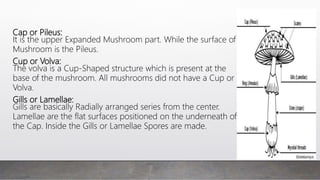
Mushroom Body consists of following structures:
• Pileus
• Volva
• Lamellae
• Annulus
• Mycelial threads
• Scale
• Stipe
Cap or Pileus:
It is the upper Expanded Mushroom part. While the surface of
Mushroom is the Pileus.
Cup or Volva:
The volva is a Cup-Shaped structure which is present at the
base of the mushroom. All mushrooms did not have a Cup or
Volva.
Gills or Lamellae:
Gills are basically Radially arranged series from the center.
Lamellae are the flat surfaces positioned on the underneath of
the Cap. Inside the Gills or Lamellae Spores are made.
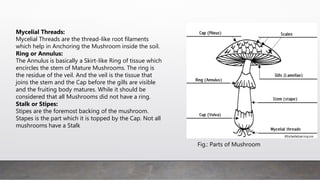
Fig.: Parts of Mushroom
Mycelial Threads:
Mycelial Threads are the thread-like root filaments
which help in Anchoring the Mushroom inside the soil.
Ring or Annulus:
The Annulus is basically a Skirt-like Ring of tissue which
encircles the stem of Mature Mushrooms. The ring is
the residue of the veil. And the veil is the tissue that
joins the stem and the Cap before the gills are visible
and the fruiting body matures. While it should be
considered that all Mushrooms did not have a ring.
Stalk or Stipes:
Stipes are the foremost backing of the mushroom.
Stapes is the part which it is topped by the Cap. Not all
mushrooms have a Stalk
History and
Present Status of
Mushroom
Cultivation
• Cultivated in China on wood logs more than a
thousand year ago .
• Button mushroom was cultivated in France about
four centuries ago.
• The scientific cultivation of mushrooms started in
the beginning of 20th century and in the initial
years button mushroom was the most commonly
cultivated mushroom.
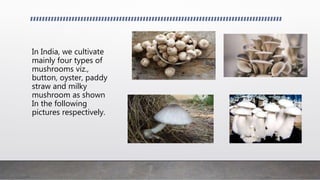
In India, we cultivate
mainly four types of
mushrooms viz.,
button, oyster, paddy
straw and milky
mushroom as shown
In the following
pictures respectively.
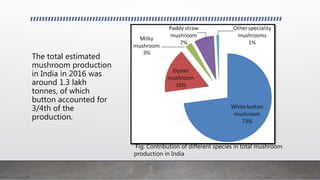
The total estimated
mushroom production
in India in 2016 was
around 1.3 lakh
tonnes, of which
button accounted for
3/4th of the
production.
Fig: Contribution of different species in total mushroom
production in India
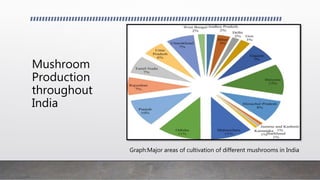
Mushroom
Production
throughout
India
Graph:Major areas of cultivation of different mushrooms in India
• Button mushroom is cultivated throughout the year by commercial units and also
during winter months by seasonal growers.
• The cultivation is more in Maharashtra, Gujarat, Goa, Haryana, Punjab,
Uttrakhand, and Himachal Pradesh.
• Cultivation of paddy straw mushroom is localized to Odisha
• Milky mushroom is more popular in southern part of India.
Reasons to grow Mushrooms
• Quality food
• Way of utilizing agricultural wastes and generating
wealth from the waste.
• The material left after growing mushrooms, commonly
referred as spent mushroom substrate (SMS), can be
processed into manure.
• Promotes sustainable manure based farming.
• It leads to employment generation and women
empowerment.
• Utilizes vertical space and requires minimal land making
it possible to promote mushrooms in peri-urban and
urban areas also.
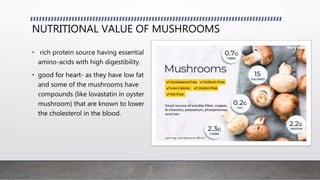
NUTRITIONAL VALUE OF MUSHROOMS
• rich protein source having essential
amino-acids with high digestibility.
• good for heart- as they have low fat
and some of the mushrooms have
compounds (like lovastatin in oyster
mushroom) that are known to lower
the cholesterol in the blood.
characterstics benefits
High quality protein Combats malnutrition
Low sodium high potassium Controls hypertension
No starch, low sugar Delight of diabetics
No cholesterol Healthy heart
Rich in fibre Improves digestion
Only vegetable with Vit. D Cures Ricketsia
Folic acid, Vit. B and minerals Improves health
Mushroom production technology

Mushroom production technology

  • 1.
  • 2.
  • 3.
    Introduction • fleshy, spore-bearingfruiting body of a fungus, typically produced above ground, on soil, or on its food source. • Mushrooms do not have chlorophyll. • In the absence of chlorophyll, mushrooms cannot produce their own food and depend on higher plants for food. • Mushrooms obtain nutrients from organic materials like straw, dead wood, manure, dung, etc
  • 4.
    Parts of Mushroom Mushroom Bodyconsists of following structures: • Pileus • Volva • Lamellae • Annulus • Mycelial threads • Scale • Stipe
  • 5.
    Cap or Pileus: Itis the upper Expanded Mushroom part. While the surface of Mushroom is the Pileus. Cup or Volva: The volva is a Cup-Shaped structure which is present at the base of the mushroom. All mushrooms did not have a Cup or Volva. Gills or Lamellae: Gills are basically Radially arranged series from the center. Lamellae are the flat surfaces positioned on the underneath of the Cap. Inside the Gills or Lamellae Spores are made.
  • 6.
    Fig.: Parts ofMushroom Mycelial Threads: Mycelial Threads are the thread-like root filaments which help in Anchoring the Mushroom inside the soil. Ring or Annulus: The Annulus is basically a Skirt-like Ring of tissue which encircles the stem of Mature Mushrooms. The ring is the residue of the veil. And the veil is the tissue that joins the stem and the Cap before the gills are visible and the fruiting body matures. While it should be considered that all Mushrooms did not have a ring. Stalk or Stipes: Stipes are the foremost backing of the mushroom. Stapes is the part which it is topped by the Cap. Not all mushrooms have a Stalk
  • 7.
    History and Present Statusof Mushroom Cultivation • Cultivated in China on wood logs more than a thousand year ago . • Button mushroom was cultivated in France about four centuries ago. • The scientific cultivation of mushrooms started in the beginning of 20th century and in the initial years button mushroom was the most commonly cultivated mushroom.
  • 8.
    In India, wecultivate mainly four types of mushrooms viz., button, oyster, paddy straw and milky mushroom as shown In the following pictures respectively.
  • 9.
    The total estimated mushroomproduction in India in 2016 was around 1.3 lakh tonnes, of which button accounted for 3/4th of the production. Fig: Contribution of different species in total mushroom production in India
  • 10.
    Mushroom Production throughout India Graph:Major areas ofcultivation of different mushrooms in India
  • 11.
    • Button mushroomis cultivated throughout the year by commercial units and also during winter months by seasonal growers. • The cultivation is more in Maharashtra, Gujarat, Goa, Haryana, Punjab, Uttrakhand, and Himachal Pradesh. • Cultivation of paddy straw mushroom is localized to Odisha • Milky mushroom is more popular in southern part of India.
  • 12.
    Reasons to growMushrooms • Quality food • Way of utilizing agricultural wastes and generating wealth from the waste. • The material left after growing mushrooms, commonly referred as spent mushroom substrate (SMS), can be processed into manure. • Promotes sustainable manure based farming. • It leads to employment generation and women empowerment. • Utilizes vertical space and requires minimal land making it possible to promote mushrooms in peri-urban and urban areas also.
  • 13.
    NUTRITIONAL VALUE OFMUSHROOMS • rich protein source having essential amino-acids with high digestibility. • good for heart- as they have low fat and some of the mushrooms have compounds (like lovastatin in oyster mushroom) that are known to lower the cholesterol in the blood.
  • 14.
    characterstics benefits High qualityprotein Combats malnutrition Low sodium high potassium Controls hypertension No starch, low sugar Delight of diabetics No cholesterol Healthy heart Rich in fibre Improves digestion Only vegetable with Vit. D Cures Ricketsia Folic acid, Vit. B and minerals Improves health