“Nursery and landscape professionals today are
faced with a bewildering array of conditions and treat-
ments. Propagate, aerate, irrigate, fertilize, mulch and
transplant are but a sampling of the activities utilized
by today's practicing industry professionals”(Amaran-
thus). Since the dawn of time plant species around the
world have survived without the help of man-made
environments and intensive cultural practices. These
early descendents of species known today were faced
with times of drought, disease pressures, depleted
soils and extreme environmental conditions. Over
time these species created an adaptation in order to
fend off these conditions and survive. The mycor-
rhizael relationship is an example of this adaptation,
allowing plants to trap mineral nutrients and water es-
sential to support plant growth needs.
Mycorrhizae:
Mycorrhizae is best known as a symbiotic relation-
ship between the naturally occurring fungi in the soil
and a host’s plants root system. Mycorrhizae fungi
can be found in about 99% of all living plants and
makes up one of the most important elements in a
healthy, complex soil food web. The fungi and host
form a mutualistic relationship with each other in
which both benefit simultaneously. The mycorrhizae
colonizes in the roots cortex forming an extension of
the root system and a fibrous network. This network
captures and assimilates nutrients and water allowing
soils to be more productive during stress periods. The
plant’s interaction with the fungi allows the plant to
provide energy to fungi while the fungi allow the
plant to take up phosphorus and other micronutrients
more efficiently.
Benefits:
• Plants receive minerals, nutrients, H2O, and
other growth promoting substances.
• Fungal threads formed by mycorrhizae encourage
roots to penetrate deeper in the soil in search for
raw materials.
• The fungi release powerful chemicals into the
soil that dissolve hard to capture elements such
as phosphorus and iron.
• Other chemicals produced by fungi include im-
portant enzymes that effectively break up organic
carbon and nitrogen sources.
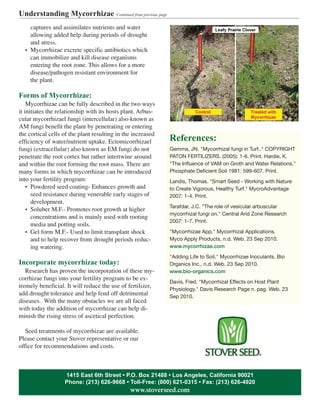
• A root/hyphae web is formed in the soil that
Understanding Mycorrhizae
By Marcus Coulombe,
Stover Seed Company
Continued on next page
PLANT CARE NEWSPLANT CARE NEWS
captures and assimilates nutrients and water
allowing added help during periods of drought
and stress.
• Mycorrhizae excrete specific antibiotics which
can immobilize and kill disease organisms
entering the root zone. This allows for a more
disease/pathogen resistant environment for
the plant.
Forms of Mycorrhizae:
Mycorrhizae can be fully described in the two ways
it initiates the relationship with its hosts plant. Arbus-
cular mycorrhizael fungi (intercellular) also known as
AM fungi benefit the plant by penetrating or entering
the cortical cells of the plant resulting in the increased
efficiency of water/nutrient uptake. Ectomicorrhizael
fungi (extracellular) also known as EM fungi do not
penetrate the root cortex but rather intertwine around
and within the root forming the root mass. There are
many forms in which mycorrhizae can be introduced
into your fertility program:
• Powdered seed coating- Enhances growth and
seed resistance during venerable early stages of
development.
• Soluber M.F.- Promotes root growth at higher
concentrations and is mainly used with rooting
media and potting soils.
• Gel form M.F.- Used to limit transplant shock
and to help recover from drought periods reduc-
ing watering.
Incorporate mycorrhizae today:
Research has proven the incorporation of these my-
corrhizae fungi into your fertility program to be ex-
tremely beneficial. It will reduce the use of fertilizer,
add drought tolerance and help fend off detrimental
diseases. With the many obstacles we are all faced
with today the addition of mycorrhizae can help di-
minish the rising stress of ascetical perfection.
Seed treatments of mycorrhizae are available.
Please contact your Stover representative or our
office for recommendations and costs.
References:
Gemma, JN. "Mycorrhizal fungi in Turf.." COPYRIGHT
PATON FERTILIZERS. (2005): 1-6. Print. Hardie, K.
"The Influence of VAM on Groth and Water Relations."
Phosphate Deficient Soil 1981: 599-607. Print.
Landis, Thomas. "Smart Seed - Working with Nature
to Create Vigorous, Healthy Turf." MycroAdvantage
2007: 1-4. Print.
Tarafdar, J.C. "The role of vesicular arbuscular
mycorrhizal fungi on." Central Arid Zone Research
2007: 1-7. Print.
"Mycorrhizae App." Mycorrhizal Applications.
Myco Apply Products, n.d. Web. 23 Sep 2010.
www.mycorrhizae.com
"Adding Life to Soil." Mycorrhizae Inoculants. Bio
Organics Inc., n.d. Web. 23 Sep 2010.
www.bio-organics.com
Davis, Fred. "Mycorrhizal Effects on Host Plant
Physiology." Davis Research Page n. pag. Web. 23
Sep 2010.
Understanding Mycorrhizae Continued from previous page
1415 East 6th Street • P.O. Box 21488 • Los Angeles, California 90021
Phone: (213) 626-9668 • Toll-Free: (800) 621-0315 • Fax: (213) 626-4920
www.stoverseed.com

Understanding Mycorrhizae by Stover Seed

  • 1.
    “Nursery and landscapeprofessionals today are faced with a bewildering array of conditions and treat- ments. Propagate, aerate, irrigate, fertilize, mulch and transplant are but a sampling of the activities utilized by today's practicing industry professionals”(Amaran- thus). Since the dawn of time plant species around the world have survived without the help of man-made environments and intensive cultural practices. These early descendents of species known today were faced with times of drought, disease pressures, depleted soils and extreme environmental conditions. Over time these species created an adaptation in order to fend off these conditions and survive. The mycor- rhizael relationship is an example of this adaptation, allowing plants to trap mineral nutrients and water es- sential to support plant growth needs. Mycorrhizae: Mycorrhizae is best known as a symbiotic relation- ship between the naturally occurring fungi in the soil and a host’s plants root system. Mycorrhizae fungi can be found in about 99% of all living plants and makes up one of the most important elements in a healthy, complex soil food web. The fungi and host form a mutualistic relationship with each other in which both benefit simultaneously. The mycorrhizae colonizes in the roots cortex forming an extension of the root system and a fibrous network. This network captures and assimilates nutrients and water allowing soils to be more productive during stress periods. The plant’s interaction with the fungi allows the plant to provide energy to fungi while the fungi allow the plant to take up phosphorus and other micronutrients more efficiently. Benefits: • Plants receive minerals, nutrients, H2O, and other growth promoting substances. • Fungal threads formed by mycorrhizae encourage roots to penetrate deeper in the soil in search for raw materials. • The fungi release powerful chemicals into the soil that dissolve hard to capture elements such as phosphorus and iron. • Other chemicals produced by fungi include im- portant enzymes that effectively break up organic carbon and nitrogen sources. • A root/hyphae web is formed in the soil that Understanding Mycorrhizae By Marcus Coulombe, Stover Seed Company Continued on next page PLANT CARE NEWSPLANT CARE NEWS
  • 2.
    captures and assimilatesnutrients and water allowing added help during periods of drought and stress. • Mycorrhizae excrete specific antibiotics which can immobilize and kill disease organisms entering the root zone. This allows for a more disease/pathogen resistant environment for the plant. Forms of Mycorrhizae: Mycorrhizae can be fully described in the two ways it initiates the relationship with its hosts plant. Arbus- cular mycorrhizael fungi (intercellular) also known as AM fungi benefit the plant by penetrating or entering the cortical cells of the plant resulting in the increased efficiency of water/nutrient uptake. Ectomicorrhizael fungi (extracellular) also known as EM fungi do not penetrate the root cortex but rather intertwine around and within the root forming the root mass. There are many forms in which mycorrhizae can be introduced into your fertility program: • Powdered seed coating- Enhances growth and seed resistance during venerable early stages of development. • Soluber M.F.- Promotes root growth at higher concentrations and is mainly used with rooting media and potting soils. • Gel form M.F.- Used to limit transplant shock and to help recover from drought periods reduc- ing watering. Incorporate mycorrhizae today: Research has proven the incorporation of these my- corrhizae fungi into your fertility program to be ex- tremely beneficial. It will reduce the use of fertilizer, add drought tolerance and help fend off detrimental diseases. With the many obstacles we are all faced with today the addition of mycorrhizae can help di- minish the rising stress of ascetical perfection. Seed treatments of mycorrhizae are available. Please contact your Stover representative or our office for recommendations and costs. References: Gemma, JN. "Mycorrhizal fungi in Turf.." COPYRIGHT PATON FERTILIZERS. (2005): 1-6. Print. Hardie, K. "The Influence of VAM on Groth and Water Relations." Phosphate Deficient Soil 1981: 599-607. Print. Landis, Thomas. "Smart Seed - Working with Nature to Create Vigorous, Healthy Turf." MycroAdvantage 2007: 1-4. Print. Tarafdar, J.C. "The role of vesicular arbuscular mycorrhizal fungi on." Central Arid Zone Research 2007: 1-7. Print. "Mycorrhizae App." Mycorrhizal Applications. Myco Apply Products, n.d. Web. 23 Sep 2010. www.mycorrhizae.com "Adding Life to Soil." Mycorrhizae Inoculants. Bio Organics Inc., n.d. Web. 23 Sep 2010. www.bio-organics.com Davis, Fred. "Mycorrhizal Effects on Host Plant Physiology." Davis Research Page n. pag. Web. 23 Sep 2010. Understanding Mycorrhizae Continued from previous page 1415 East 6th Street • P.O. Box 21488 • Los Angeles, California 90021 Phone: (213) 626-9668 • Toll-Free: (800) 621-0315 • Fax: (213) 626-4920 www.stoverseed.com