7.42 Outline the decline of Muslim 
rule in the Iberian Peninsula that 
culminated in the Reconquista, 
Inquisition, and the rise of Spanish 
and Portuguese kingdoms. 
I can outline the decline of Muslim 
rule in the Iberian Peninsula.
WWeellccoommee ttoo tthhee MMuusseeuumm ooff 
Museum Entrance 
Room One 
Room Two 
Room Four 
Room Three 
MMuusslliimm SSppaaiinn 
Curator’s 
Offices 
Room 
Five
modified by Jean Provine 
Curator’s Office 
moon_phase13@yahoo.com 
This presentation was created by So Yun 
Jhang and Kyllie Chang. 
There is a ton of information about 
Spain. Choose which exhibits you want 
to use.  
Other Resources: 
http://explorethemed.com/reconquista.asp?c=1 
http://www.eyewitnesstohistory.com/crusades.htm 
Place your picture 
here. 
Note: Virtual museums were first introduced by educators at Keith Valley Middle School in Horsham, 
Pennsylvania. This template was designed by Dr. Christy Keeler. View the Educational Virtual Museums 
website for more information on this instructional technique. 
Return to 
Entry
Room 1 
Return 
to 
Entry 
1 
RRoooomm 11
RRoooomm 22 
Room 2 
Return 
to 
Entry
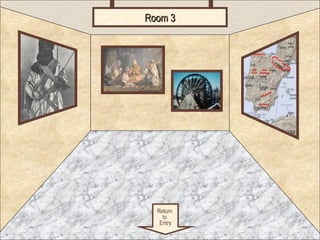
RRoooomm 33 
Room 3 
Return 
to 
Entry
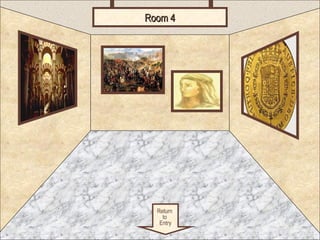
RRoooomm 44 
Room 4 
Return 
to 
Entry
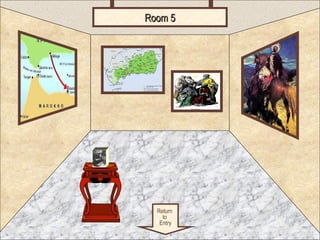
RRoooomm 55 
Room 5 
Return 
to 
Entry
http://www.bbc.co.uk/religion/religions/islam/history/spain_1.shtml 
A Muslim general from North Africa sent to 
invade the Iberian peninsula. Tariq bin Ziyad 
and his army landed at Gibraltar, which was 
named after him. He and his army defeated the 
Visigoths and the Muslims conquered most of 
the peninsula without much opposition. 
Return to 
Exhibit 
Tariq bin Ziyad
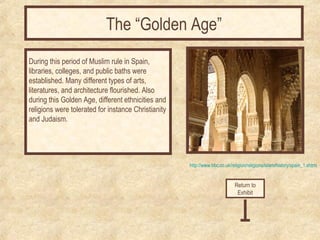
http://www.bbc.co.uk/religion/religions/islam/history/spain_1.shtml 
During this period of Muslim rule in Spain, 
libraries, colleges, and public baths were 
established. Many different types of arts, 
literatures, and architecture flourished. Also 
during this Golden Age, different ethnicities and 
religions were tolerated for instance Christianity 
and Judaism. 
Return to 
Exhibit 
The “Golden Age”
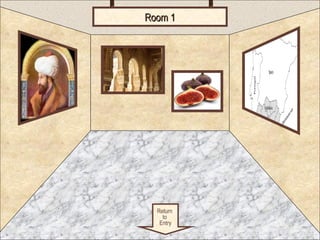
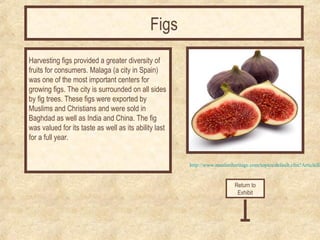
Harvesting figs provided a greater diversity of 
fruits for consumers. Malaga (a city in Spain) 
was one of the most important centers for 
growing figs. The city is surrounded on all sides 
by fig trees. These figs were exported by 
Muslims and Christians and were sold in 
Baghdad as well as India and China. The fig 
was valued for its taste as well as its ability last 
for a full year. 
http://www.muslimheritage.com/topics/default.cfm?ArticleID=Return to 
Exhibit 
Figs
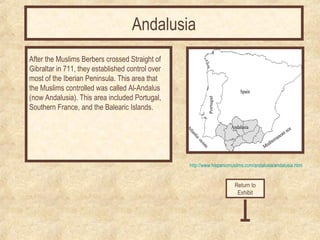
http://www.hispanicmuslims.com/andalusia/andalusia.html 
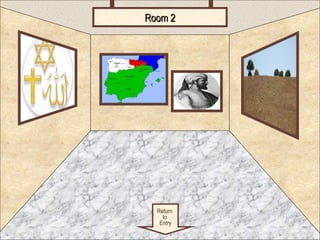
After the Muslims Berbers crossed Straight of 
Gibraltar in 711, they established control over 
most of the Iberian Peninsula. This area that 
the Muslims controlled was called Al-Andalus 
(now Andalusia). This area included Portugal, 
Southern France, and the Balearic Islands. 
Return to 
Exhibit 
Andalusia
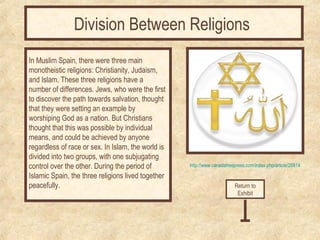
Division Between Religions 
In Muslim Spain, there were three main 
monotheistic religions: Christianity, Judaism, 
and Islam. These three religions have a 
number of differences. Jews, who were the first 
to discover the path towards salvation, thought 
that they were setting an example by 
worshiping God as a nation. But Christians 
thought that this was possible by individual 
means, and could be achieved by anyone 
regardless of race or sex. In Islam, the world is 
divided into two groups, with one subjugating 
control over the other. During the period of 
Islamic Spain, the three religions lived together 
peacefully. Return to 
http://www.canadafreepress.com/index.php/article/26814 
Exhibit
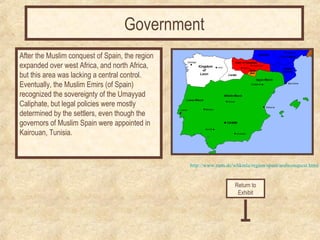
http://www.zum.de/whkmla/region/spain/arabconquest.html 
After the Muslim conquest of Spain, the region 
expanded over west Africa, and north Africa, 
but this area was lacking a central control. 
Eventually, the Muslim Emirs (of Spain) 
recognized the sovereignty of the Umayyad 
Caliphate, but legal policies were mostly 
determined by the settlers, even though the 
governors of Muslim Spain were appointed in 
Kairouan, Tunisia. 
Return to 
Exhibit 
Government
Emir Abd al-Rahman I 
http://www.metmuseum.org/toah/hd/sumay/hd_sumay.htm 
After the Umayyad caliphate of Damascus was 
overthrown in 750 by the Abbasids, the last 
surviving member of the Umayyad dynasty fled 
to Spain and named himself Emir Abd al- 
Rahman I. He then created the Umayyad 
emirate and made Cordoba the capital. He also 
took al-Andalus and established diplomatic ties 
with the northern Christian empires, the 
Byzantine empire, and North Africa. 
Return to 
Exhibit
http://www.sunnah.org/history/moors.htm 
The irrigation system that was imported from 
Syria and Arabia turned the dry plains of al- 
Andalus into very fertile land. Pomegranates, 
oranges, lemons, aubergines, artichokes, 
cumin, coriander, bananas, almonds, pans, 
hennas, woad, madder, saffron, sugar-cane, 
rice, cotton, figs, grapes, apricots, and peaches 
soon were added to the list of the foods grown 
there. Olives and wheat were native to al- 
Andalus, 
Return to 
Exhibit 
Plain of al-Andalus
http://www.sunnah.org/history/moors.htm 
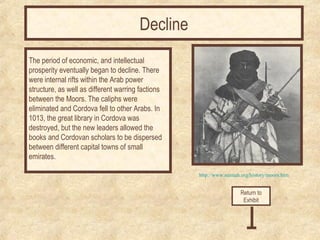
The period of economic, and intellectual 
prosperity eventually began to decline. There 
were internal rifts within the Arab power 
structure, as well as different warring factions 
between the Moors. The caliphs were 
eliminated and Cordova fell to other Arabs. In 
1013, the great library in Cordova was 
destroyed, but the new leaders allowed the 
books and Cordovan scholars to be dispersed 
between different capital towns of small 
emirates. 
Return to 
Exhibit 
Decline
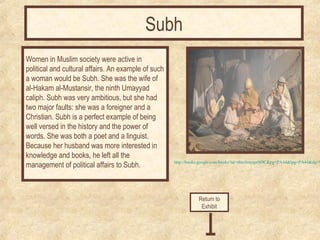
Women in Muslim society were active in 
http://books.google.com/books?id=t8toAmyqmN0C&pg=PA44&lpg=PA44&dq=Subh+-+political and cultural affairs. An example of such 
a woman would be Subh. She was the wife of 
al-Hakam al-Mustansir, the ninth Umayyad 
caliph. Subh was very ambitious, but she had 
two major faults: she was a foreigner and a 
Christian. Subh is a perfect example of being 
well versed in the history and the power of 
words. She was both a poet and a linguist. 
Because her husband was more interested in 
knowledge and books, he left all the 
management of political affairs to Subh. 
Return to 
Exhibit 
Subh
http://www.flowofhistory.com/units/asia/6/fc46b 
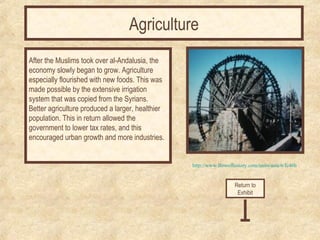
After the Muslims took over al-Andalusia, the 
economy slowly began to grow. Agriculture 
especially flourished with new foods. This was 
made possible by the extensive irrigation 
system that was copied from the Syrians. 
Better agriculture produced a larger, healthier 
population. This in return allowed the 
government to lower tax rates, and this 
encouraged urban growth and more industries. 
Return to 
Exhibit 
Agriculture
http://www.fanaticus.org/DBA/armies/dba104.html 
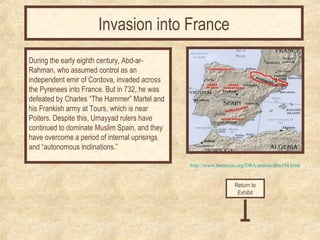
During the early eighth century, Abd-ar- 
Rahman, who assumed control as an 
independent emir of Cordova, invaded across 
the Pyrenees into France. But in 732, he was 
defeated by Charles “The Hammer” Martel and 
his Frankish army at Tours, which is near 
Poiters. Despite this, Umayyad rulers have 
continued to dominate Muslim Spain, and they 
have overcome a period of internal uprisings 
and “autonomous inclinations.” 
Return to 
Exhibit 
Invasion into France
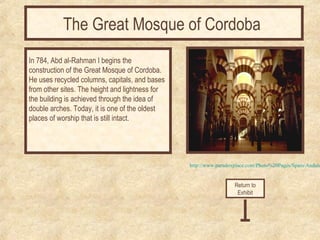
The Great Mosque of Cordoba 
In 784, Abd al-Rahman I begins the 
construction of the Great Mosque of Cordoba. 
He uses recycled columns, capitals, and bases 
from other sites. The height and lightness for 
the building is achieved through the idea of 
double arches. Today, it is one of the oldest 
places of worship that is still intact. 
http://www.paradoxplace.com/Photo%20Pages/Spain/Andalucia/Return to 
Exhibit
The Reconquista officially started in 722, after 
http://www.associatedcontent.com/article/332578/the_reconquista_the Battle of Covandonga. Because of the 
internal feuding between the Moors, the 
Spaniards (Christians in Spain) were able to 
repopulate their kingdoms and strengthen their 
borders for the campaign against the Moors. 
Eventually Taifas, independent Muslim-ruled 
principalities, formed because of the civil wars. 
The Reconquistadors were able to turn the 
Taifas against each other through a series of 
bribes. After 800 years of fighting, Spain was 
able to reunite, and the Muslims were finally 
expelled with the surrender of Abu ‘abd Allah 
Muhammad XII (Boabdil) in 1492. Return to 
Exhibit 
The Reconquista
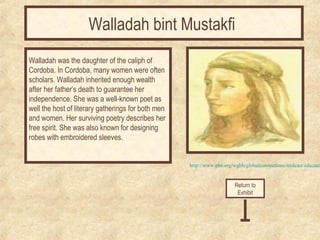
Walladah bint Mustakfi 
Walladah was the daughter of the caliph of 
Cordoba. In Cordoba, many women were often 
scholars. Walladah inherited enough wealth 
after her father’s death to guarantee her 
independence. She was a well-known poet as 
well the host of literary gatherings for both men 
and women. Her surviving poetry describes her 
free spirit. She was also known for designing 
robes with embroidered sleeves. 
http://www.pbs.org/wgbh/globalconnections/mideast/educators/Return to 
Exhibit
http://www.sispain.org/english/history/muslim.html 
The Andalusian economy was comprised of 
trade, manufacturing, and agriculture which 
was more efficient than the rest of Europe. The 
Caliphate had a currency-based economy and 
it played a role in its financial grandeur. The 
gold coin became the principle currency of this 
period. 
Return to 
Exhibit 
Economy
http://www.sispain.org/english/history/muslim.html 
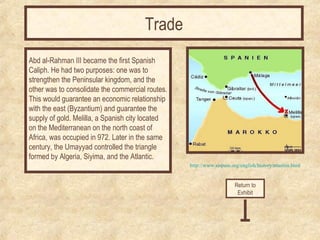
Abd al-Rahman III became the first Spanish 
Caliph. He had two purposes: one was to 
strengthen the Peninsular kingdom, and the 
other was to consolidate the commercial routes. 
This would guarantee an economic relationship 
with the east (Byzantium) and guarantee the 
supply of gold. Melilla, a Spanish city located 
on the Mediterranean on the north coast of 
Africa, was occupied in 972. Later in the same 
century, the Umayyad controlled the triangle 
formed by Algeria, Siyima, and the Atlantic. 
Return to 
Exhibit 
Trade
http://www.sispain.org/english/history/muslim.html 
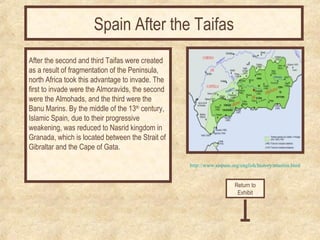
After the second and third Taifas were created 
as a result of fragmentation of the Peninsula, 
north Africa took this advantage to invade. The 
first to invade were the Almoravids, the second 
were the Almohads, and the third were the 
Banu Marins. By the middle of the 13th century, 
Islamic Spain, due to their progressive 
weakening, was reduced to Nasrid kingdom in 
Granada, which is located between the Strait of 
Gibraltar and the Cape of Gata. 
Return to 
Exhibit 
Spain After the Taifas
http://www.kalamullah.com/spain.html 
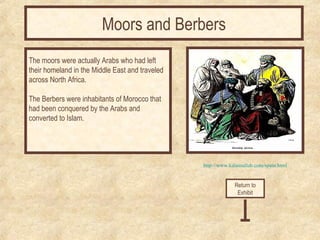
The moors were actually Arabs who had left 
their homeland in the Middle East and traveled 
across North Africa. 
The Berbers were inhabitants of Morocco that 
had been conquered by the Arabs and 
converted to Islam. 
Return to 
Exhibit 
Moors and Berbers
http://www.1911encyclopedia.org/Boabdil 
Boabdil was the last Moorish king of Granada. 
In 1482, he was proclaimed the king in place of 
his father who had been driven from the land. 
He invaded Castile in order to gain prestige, but 
was taken prisoner. He was only granted 
freedom if he held Granada as a tributary 
kingdom under King Ferdinand and Queen 
Isabella. In 1941, he was asked by the king and 
queen of Castile to hand over Granada, but 
because he refused, it was besieged by the 
Castilians. After about a year, Granada 
surrendered. This picture shows the last spot 
that Boabdil was said to have looked at 
Granada from and is known as the “last sigh of 
the Moor.” 
Return to 
Exhibit 
Boabdil
The Spanish Inquisition 
http://www.thenagain.info/webchron/westeurope/sp 
aninqui.html 
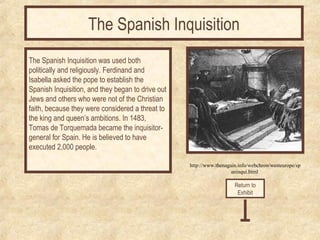
The Spanish Inquisition was used both 
politically and religiously. Ferdinand and 
Isabella asked the pope to establish the 
Spanish Inquisition, and they began to drive out 
Jews and others who were not of the Christian 
faith, because they were considered a threat to 
the king and queen’s ambitions. In 1483, 
Tomas de Torquemada became the inquisitor-general 
for Spain. He is believed to have 
executed 2,000 people. 
Return to 
Exhibit
http://www.inter-islam. 
org/Pastevents/andalus1.htm 
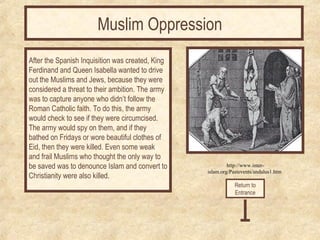
After the Spanish Inquisition was created, King 
Ferdinand and Queen Isabella wanted to drive 
out the Muslims and Jews, because they were 
considered a threat to their ambition. The army 
was to capture anyone who didn’t follow the 
Roman Catholic faith. To do this, the army 
would check to see if they were circumcised. 
The army would spy on them, and if they 
bathed on Fridays or wore beautiful clothes of 
Eid, then they were killed. Even some weak 
and frail Muslims who thought the only way to 
be saved was to denounce Islam and convert to 
Christianity were also killed. 
Return to 
Entrance 
Muslim Oppression
http://www.bbc.co.uk/religion/religions/islam/histo 
ry/spain_1.shtml 
Islamic Spain began in 711 after the invasion of 
the Iberian peninsula, and ended in 1492. It is a 
multi-cultural mix of the three greatest 
monotheistic religions: Christianity, Islam, and 
Judaism. Even though Christians and Jews had 
to live under restrictions (for instance they had 
to pay jizya), the religions managed to get 
along and benefit from one another. This 
brought a degree of civilization to Europe that 
was able to match that of the Roman Empire’s. 
Return to 
Entrance 
Islamic Spain
http://www.bbc.co.uk/religion/religions/islam/histo 
ry/spain_1.shtml 
http://www.orbilat.com/Encyclopaedia/M/Mozarab 
s.html 
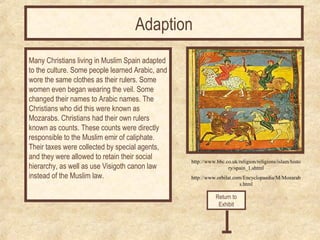
Many Christians living in Muslim Spain adapted 
to the culture. Some people learned Arabic, and 
wore the same clothes as their rulers. Some 
women even began wearing the veil. Some 
changed their names to Arabic names. The 
Christians who did this were known as 
Mozarabs. Christians had their own rulers 
known as counts. These counts were directly 
responsible to the Muslim emir of caliphate. 
Their taxes were collected by special agents, 
and they were allowed to retain their social 
hierarchy, as well as use Visigoth canon law 
instead of the Muslim law. 
Return to 
Exhibit 
Adaption

7.42 muslim spain

  • 1.
    7.42 Outline thedecline of Muslim rule in the Iberian Peninsula that culminated in the Reconquista, Inquisition, and the rise of Spanish and Portuguese kingdoms. I can outline the decline of Muslim rule in the Iberian Peninsula.
  • 2.
    WWeellccoommee ttoo tthheeMMuusseeuumm ooff Museum Entrance Room One Room Two Room Four Room Three MMuusslliimm SSppaaiinn Curator’s Offices Room Five
  • 3.
    modified by JeanProvine Curator’s Office moon_phase13@yahoo.com This presentation was created by So Yun Jhang and Kyllie Chang. There is a ton of information about Spain. Choose which exhibits you want to use.  Other Resources: http://explorethemed.com/reconquista.asp?c=1 http://www.eyewitnesstohistory.com/crusades.htm Place your picture here. Note: Virtual museums were first introduced by educators at Keith Valley Middle School in Horsham, Pennsylvania. This template was designed by Dr. Christy Keeler. View the Educational Virtual Museums website for more information on this instructional technique. Return to Entry
  • 4.
    Room 1 Return to Entry 1 RRoooomm 11
  • 5.
    RRoooomm 22 Room2 Return to Entry
  • 6.
    RRoooomm 33 Room3 Return to Entry
  • 7.
    RRoooomm 44 Room4 Return to Entry
  • 8.
    RRoooomm 55 Room5 Return to Entry
  • 9.
    http://www.bbc.co.uk/religion/religions/islam/history/spain_1.shtml A Muslimgeneral from North Africa sent to invade the Iberian peninsula. Tariq bin Ziyad and his army landed at Gibraltar, which was named after him. He and his army defeated the Visigoths and the Muslims conquered most of the peninsula without much opposition. Return to Exhibit Tariq bin Ziyad
  • 10.
    http://www.bbc.co.uk/religion/religions/islam/history/spain_1.shtml During thisperiod of Muslim rule in Spain, libraries, colleges, and public baths were established. Many different types of arts, literatures, and architecture flourished. Also during this Golden Age, different ethnicities and religions were tolerated for instance Christianity and Judaism. Return to Exhibit The “Golden Age”
  • 11.
    Harvesting figs provideda greater diversity of fruits for consumers. Malaga (a city in Spain) was one of the most important centers for growing figs. The city is surrounded on all sides by fig trees. These figs were exported by Muslims and Christians and were sold in Baghdad as well as India and China. The fig was valued for its taste as well as its ability last for a full year. http://www.muslimheritage.com/topics/default.cfm?ArticleID=Return to Exhibit Figs
  • 12.
    http://www.hispanicmuslims.com/andalusia/andalusia.html After theMuslims Berbers crossed Straight of Gibraltar in 711, they established control over most of the Iberian Peninsula. This area that the Muslims controlled was called Al-Andalus (now Andalusia). This area included Portugal, Southern France, and the Balearic Islands. Return to Exhibit Andalusia
  • 13.
    Division Between Religions In Muslim Spain, there were three main monotheistic religions: Christianity, Judaism, and Islam. These three religions have a number of differences. Jews, who were the first to discover the path towards salvation, thought that they were setting an example by worshiping God as a nation. But Christians thought that this was possible by individual means, and could be achieved by anyone regardless of race or sex. In Islam, the world is divided into two groups, with one subjugating control over the other. During the period of Islamic Spain, the three religions lived together peacefully. Return to http://www.canadafreepress.com/index.php/article/26814 Exhibit
  • 14.
    http://www.zum.de/whkmla/region/spain/arabconquest.html After theMuslim conquest of Spain, the region expanded over west Africa, and north Africa, but this area was lacking a central control. Eventually, the Muslim Emirs (of Spain) recognized the sovereignty of the Umayyad Caliphate, but legal policies were mostly determined by the settlers, even though the governors of Muslim Spain were appointed in Kairouan, Tunisia. Return to Exhibit Government
  • 15.
    Emir Abd al-RahmanI http://www.metmuseum.org/toah/hd/sumay/hd_sumay.htm After the Umayyad caliphate of Damascus was overthrown in 750 by the Abbasids, the last surviving member of the Umayyad dynasty fled to Spain and named himself Emir Abd al- Rahman I. He then created the Umayyad emirate and made Cordoba the capital. He also took al-Andalus and established diplomatic ties with the northern Christian empires, the Byzantine empire, and North Africa. Return to Exhibit
  • 16.
    http://www.sunnah.org/history/moors.htm The irrigationsystem that was imported from Syria and Arabia turned the dry plains of al- Andalus into very fertile land. Pomegranates, oranges, lemons, aubergines, artichokes, cumin, coriander, bananas, almonds, pans, hennas, woad, madder, saffron, sugar-cane, rice, cotton, figs, grapes, apricots, and peaches soon were added to the list of the foods grown there. Olives and wheat were native to al- Andalus, Return to Exhibit Plain of al-Andalus
  • 17.
    http://www.sunnah.org/history/moors.htm The periodof economic, and intellectual prosperity eventually began to decline. There were internal rifts within the Arab power structure, as well as different warring factions between the Moors. The caliphs were eliminated and Cordova fell to other Arabs. In 1013, the great library in Cordova was destroyed, but the new leaders allowed the books and Cordovan scholars to be dispersed between different capital towns of small emirates. Return to Exhibit Decline
  • 18.
    Women in Muslimsociety were active in http://books.google.com/books?id=t8toAmyqmN0C&pg=PA44&lpg=PA44&dq=Subh+-+political and cultural affairs. An example of such a woman would be Subh. She was the wife of al-Hakam al-Mustansir, the ninth Umayyad caliph. Subh was very ambitious, but she had two major faults: she was a foreigner and a Christian. Subh is a perfect example of being well versed in the history and the power of words. She was both a poet and a linguist. Because her husband was more interested in knowledge and books, he left all the management of political affairs to Subh. Return to Exhibit Subh
  • 19.
    http://www.flowofhistory.com/units/asia/6/fc46b After theMuslims took over al-Andalusia, the economy slowly began to grow. Agriculture especially flourished with new foods. This was made possible by the extensive irrigation system that was copied from the Syrians. Better agriculture produced a larger, healthier population. This in return allowed the government to lower tax rates, and this encouraged urban growth and more industries. Return to Exhibit Agriculture
  • 20.
    http://www.fanaticus.org/DBA/armies/dba104.html During theearly eighth century, Abd-ar- Rahman, who assumed control as an independent emir of Cordova, invaded across the Pyrenees into France. But in 732, he was defeated by Charles “The Hammer” Martel and his Frankish army at Tours, which is near Poiters. Despite this, Umayyad rulers have continued to dominate Muslim Spain, and they have overcome a period of internal uprisings and “autonomous inclinations.” Return to Exhibit Invasion into France
  • 21.
    The Great Mosqueof Cordoba In 784, Abd al-Rahman I begins the construction of the Great Mosque of Cordoba. He uses recycled columns, capitals, and bases from other sites. The height and lightness for the building is achieved through the idea of double arches. Today, it is one of the oldest places of worship that is still intact. http://www.paradoxplace.com/Photo%20Pages/Spain/Andalucia/Return to Exhibit
  • 22.
    The Reconquista officiallystarted in 722, after http://www.associatedcontent.com/article/332578/the_reconquista_the Battle of Covandonga. Because of the internal feuding between the Moors, the Spaniards (Christians in Spain) were able to repopulate their kingdoms and strengthen their borders for the campaign against the Moors. Eventually Taifas, independent Muslim-ruled principalities, formed because of the civil wars. The Reconquistadors were able to turn the Taifas against each other through a series of bribes. After 800 years of fighting, Spain was able to reunite, and the Muslims were finally expelled with the surrender of Abu ‘abd Allah Muhammad XII (Boabdil) in 1492. Return to Exhibit The Reconquista
  • 23.
    Walladah bint Mustakfi Walladah was the daughter of the caliph of Cordoba. In Cordoba, many women were often scholars. Walladah inherited enough wealth after her father’s death to guarantee her independence. She was a well-known poet as well the host of literary gatherings for both men and women. Her surviving poetry describes her free spirit. She was also known for designing robes with embroidered sleeves. http://www.pbs.org/wgbh/globalconnections/mideast/educators/Return to Exhibit
  • 24.
    http://www.sispain.org/english/history/muslim.html The Andalusianeconomy was comprised of trade, manufacturing, and agriculture which was more efficient than the rest of Europe. The Caliphate had a currency-based economy and it played a role in its financial grandeur. The gold coin became the principle currency of this period. Return to Exhibit Economy
  • 25.
    http://www.sispain.org/english/history/muslim.html Abd al-RahmanIII became the first Spanish Caliph. He had two purposes: one was to strengthen the Peninsular kingdom, and the other was to consolidate the commercial routes. This would guarantee an economic relationship with the east (Byzantium) and guarantee the supply of gold. Melilla, a Spanish city located on the Mediterranean on the north coast of Africa, was occupied in 972. Later in the same century, the Umayyad controlled the triangle formed by Algeria, Siyima, and the Atlantic. Return to Exhibit Trade
  • 26.
    http://www.sispain.org/english/history/muslim.html After thesecond and third Taifas were created as a result of fragmentation of the Peninsula, north Africa took this advantage to invade. The first to invade were the Almoravids, the second were the Almohads, and the third were the Banu Marins. By the middle of the 13th century, Islamic Spain, due to their progressive weakening, was reduced to Nasrid kingdom in Granada, which is located between the Strait of Gibraltar and the Cape of Gata. Return to Exhibit Spain After the Taifas
  • 27.
    http://www.kalamullah.com/spain.html The moorswere actually Arabs who had left their homeland in the Middle East and traveled across North Africa. The Berbers were inhabitants of Morocco that had been conquered by the Arabs and converted to Islam. Return to Exhibit Moors and Berbers
  • 28.
    http://www.1911encyclopedia.org/Boabdil Boabdil wasthe last Moorish king of Granada. In 1482, he was proclaimed the king in place of his father who had been driven from the land. He invaded Castile in order to gain prestige, but was taken prisoner. He was only granted freedom if he held Granada as a tributary kingdom under King Ferdinand and Queen Isabella. In 1941, he was asked by the king and queen of Castile to hand over Granada, but because he refused, it was besieged by the Castilians. After about a year, Granada surrendered. This picture shows the last spot that Boabdil was said to have looked at Granada from and is known as the “last sigh of the Moor.” Return to Exhibit Boabdil
  • 29.
    The Spanish Inquisition http://www.thenagain.info/webchron/westeurope/sp aninqui.html The Spanish Inquisition was used both politically and religiously. Ferdinand and Isabella asked the pope to establish the Spanish Inquisition, and they began to drive out Jews and others who were not of the Christian faith, because they were considered a threat to the king and queen’s ambitions. In 1483, Tomas de Torquemada became the inquisitor-general for Spain. He is believed to have executed 2,000 people. Return to Exhibit
  • 30.
    http://www.inter-islam. org/Pastevents/andalus1.htm Afterthe Spanish Inquisition was created, King Ferdinand and Queen Isabella wanted to drive out the Muslims and Jews, because they were considered a threat to their ambition. The army was to capture anyone who didn’t follow the Roman Catholic faith. To do this, the army would check to see if they were circumcised. The army would spy on them, and if they bathed on Fridays or wore beautiful clothes of Eid, then they were killed. Even some weak and frail Muslims who thought the only way to be saved was to denounce Islam and convert to Christianity were also killed. Return to Entrance Muslim Oppression
  • 31.
    http://www.bbc.co.uk/religion/religions/islam/histo ry/spain_1.shtml IslamicSpain began in 711 after the invasion of the Iberian peninsula, and ended in 1492. It is a multi-cultural mix of the three greatest monotheistic religions: Christianity, Islam, and Judaism. Even though Christians and Jews had to live under restrictions (for instance they had to pay jizya), the religions managed to get along and benefit from one another. This brought a degree of civilization to Europe that was able to match that of the Roman Empire’s. Return to Entrance Islamic Spain
  • 32.
    http://www.bbc.co.uk/religion/religions/islam/histo ry/spain_1.shtml http://www.orbilat.com/Encyclopaedia/M/Mozarab s.html Many Christians living in Muslim Spain adapted to the culture. Some people learned Arabic, and wore the same clothes as their rulers. Some women even began wearing the veil. Some changed their names to Arabic names. The Christians who did this were known as Mozarabs. Christians had their own rulers known as counts. These counts were directly responsible to the Muslim emir of caliphate. Their taxes were collected by special agents, and they were allowed to retain their social hierarchy, as well as use Visigoth canon law instead of the Muslim law. Return to Exhibit Adaption

Editor's Notes

  • #3 There is a ton of information about Spain. Choose which exhibits you want to use.
  • #4 So Yun Jhang and Kyllie Chang
  • #5 I changed the last picture on the right. I can’t format it to look this way. When you click it, it will go to the correct page but the picture will be different.
  • #7 Change 2nd pic
  • #25 http://www.spainthenandnow.com/spanish-history/al-andalus-economy/default_159.aspx
  • #29 http://www.mainlesson.com/display.php?author=morris&book=spanish&story=sigh