Summary:
The conquest of the iberian peninsula
By the early 8 century, the Muslims had
expended. In 711 they crossed over, to
the Iberian Peninsula.
-In part, the Muslims conquest of the
Iberian Paninsula across the
Mediterranean region.
- However it was also made possible by a
civil war between rival groups of the
Visgoth’s nobility.
The muslims called their new territory
Al-Andalus, and made Córdoba its
capital.
The Muslims defeated the
Visigoth King Roderic in the
Battle of Guadalete.
The Muslims never fully
conquered the mountanous
regions of the north west,
which had a very different
climate from the Mediterranean
environment that the Muslims
preferred.
The independent emirate of
córdoba (756-929)
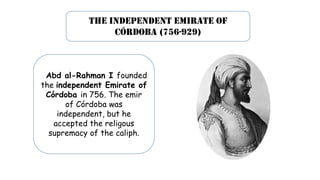
4rAbd al-Rahman I founded
the independent Emirate of
Córdoba in 756. The emir
of Córdoba was
independent, but he
accepted the religous
supremacy of the caliph.
characters
Roderic was a Visigothic king
between the years 710 and
711. He was defeated by the
Muslims in the Battle of
Guadalete, by a betrayal
between the visigoths
oponents of the own king. He
was born 688 and died in 711.
Abd al-Rahman I was a
prince of the Umayyad
dynasty who, in 756, after a
various events, became the
first independent emir of
Córdoba, founding the Umawi
dynasty there.
3eActivities
(pag 80 ex: 2,3,4.)
1. Which parts of the Iberian Peninsula where not conquered by
the Muslims?
2. Why do you think the Muslims chose Córdoba as their Capital?
Suggest several reasons.
3. Which territories belonged to the caliphate in the 10th
century?
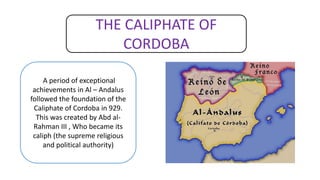
THE CALIPHATE OF
CORDOBA
A period of exceptional
achievements in Al – Andalus
followed the foundation of the
Caliphate of Cordoba in 929.
This was created by Abd al-
Rahman III , Who became its
caliph (the supreme religious
and political authority)
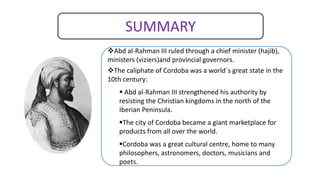
SUMMARY
Abd al-Rahman III ruled through a chief minister (hajib),
ministers (viziers)and provincial governors.
The caliphate of Cordoba was a world´s great state in the
10th century:
 Abd al-Rahman III strengthened his authority by
resisting the Christian kingdoms in the north of the
Iberian Peninsula.
The city of Cordoba became a giant marketplace for
products from all over the world.
Cordoba was a great cultural centre, home to many
philosophers, astronomers, doctors, musicians and
poets.
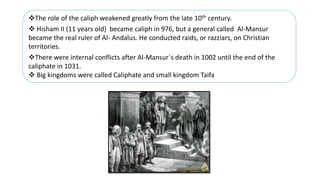
The role of the caliph weakened greatly from the late 10th century.
 Hisham II (11 years old) became caliph in 976, but a general called Al-Mansur
became the real ruler of Al- Andalus. He conducted raids, or razziars, on Christian
territories.
There were internal conflicts after Al-Mansur´s death in 1002 until the end of the
caliphate in 1031.
 Big kingdoms were called Caliphate and small kingdom Taifa
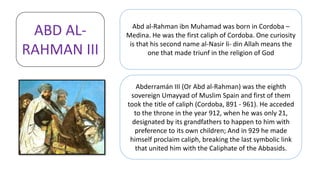
Abd al-Rahman ibn Muhamad was born in Cordoba –
Medina. He was the first caliph of Cordoba. One curiosity
is that his second name al-Nasir li- din Allah means the
one that made triunf in the religion of God
Abderramán III (Or Abd al-Rahman) was the eighth
sovereign Umayyad of Muslim Spain and first of them
took the title of caliph (Cordoba, 891 - 961). He acceded
to the throne in the year 912, when he was only 21,
designated by its grandfathers to happen to him with
preference to its own children; And in 929 he made
himself proclaim caliph, breaking the last symbolic link
that united him with the Caliphate of the Abbasids.
ABD AL-
RAHMAN III
EXERCISES
1. Explain the differences between this terms
and match them with the characters.
a)
•Razzias and parias
•Hajib and vizier
b)
•Abd al-Rahman III
•Al-Mansur
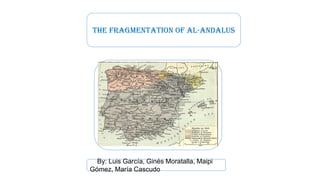
The Fragmentation of Al-Andalus
By: Luis García, Ginés Moratalla, Maipi
Gómez, María Cascudo
THE TAIFA STATE
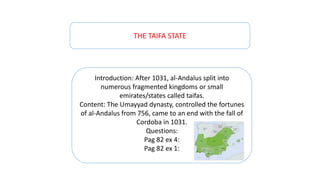
Introduction: After 1031, al-Andalus split into
numerous fragmented kingdoms or small
emirates/states called taifas.
Content: The Umayyad dynasty, controlled the fortunes
of al-Andalus from 756, came to an end with the fall of
Cordoba in 1031.
Questions:
Pag 82 ex 4:
Pag 82 ex 1:
THE ALMORAVIDS AND THE ALMOHADS
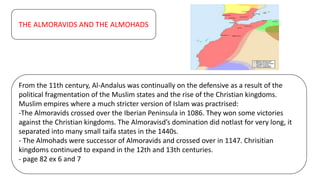
From the 11th century, Al-Andalus was continually on the defensive as a result of the
political fragmentation of the Muslim states and the rise of the Christian kingdoms.
Muslim empires where a much stricter version of Islam was practrised:
-The Almoravids crossed over the Iberian Peninsula in 1086. They won some victories
against the Christian kingdoms. The Almoravisd’s domination did notlast for very long, it
separated into many small taifa states in the 1440s.
- The Almohads were successor of Almoravids and crossed over in 1147. Chrisitian
kingdoms continued to expand in the 12th and 13th centuries.
- page 82 ex 6 and 7
The Nasrid Kingdom of
Granada
He Kingdom wasn´t military strong but was prosperous thanks to
Trade and agriculture. Granada was an independent state because Castille
allowed them. The Nasrid rulers paid Alhambra.
The Kingdom was weaked and finally conquered by Catholic Monarchs in
1492
Questions
What was the Last Muslim Kongdom? How did it end?
Apart from the conquest of Granada, what else happened in 1492?
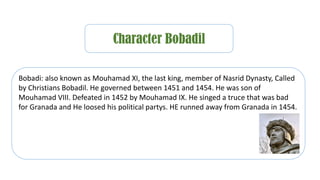
Character Bobadil
Bobadi: also known as Mouhamad XI, the last king, member of Nasrid Dynasty, Called
by Christians Bobadil. He governed between 1451 and 1454. He was son of
Mouhamad VIII. Defeated in 1452 by Mouhamad IX. He singed a truce that was bad
for Granada and He loosed his political partys. HE runned away from Granada in 1454.
Video
https://www.youtube.com/watch?v=tkUgK
T8302M
INTRODUCTION
•Life in Al-andalus
•A diverse society
•The Arabs
•The Berbers
•The Mozarbs
•The Jews
•Stages of Andalusi architecture
•Caliphate architecture
•Taifa architecture
•Almohad architecture
•The Giralda
•Nasrid architecture
Life in Al-Andalus
The conquerors and their descendants became the most powerful
groups in Andalusi society.
•The Arabs were the land-owning aristocracy.
•The Berbers helped to conquer the Iberian Peninsula.
Christians and Jews were allowed to practice their rerligion as long as
they paid taxes:
-The Mozarbs were Christians who did not convert to Islam.
-The Jews were merchants, artisans and scholars.
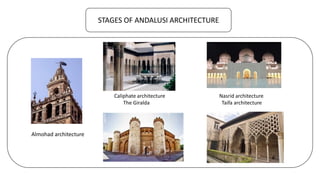
STAGES OF ANDALUSI ARCHITECTURE
Caliphate architecture Nasrid architecture
The Giralda Taifa architecture
Almohad architecture
Activities
1.Pag 85 ex 1.
2. Pag 85 ex 2.
3. Pag 85 ex 3.
THE ORIGINS OF
CHRISTIAN SPAIN
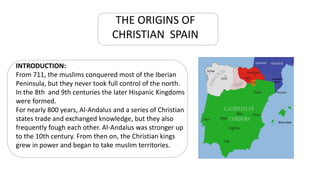
INTRODUCTION:
From 711, the muslims conquered most of the Iberian
Peninsula, but they never took full control of the north.
In the 8th and 9th centuries the later Hispanic Kingdoms
were formed.
For nearly 800 years, Al-Andalus and a series of Christian
states trade and exchanged knowledge, but they also
frequently fough each other. Al-Andalus was stronger up
to the 10th century. From then on, the Christian kings
grew in power and began to take muslim territories.
STAGES & CONTENTS
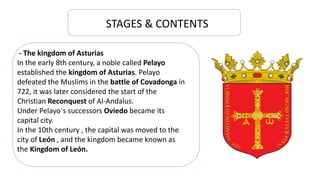
- The kingdom of Asturias
In the early 8th century, a noble called Pelayo
established the kingdom of Asturias. Pelayo
defeated the Muslims in the battle of Covadonga in
722, it was later considered the start of the
Christian Reconquest of Al-Andalus.
Under Pelayo´s successors Oviedo became its
capital city.
In the 10th century , the capital was moved to the
city of León , and the kingdom became known as
the Kingdom of León.
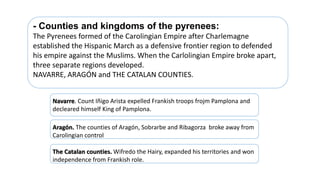
- Counties and kingdoms of the pyrenees:
The Pyrenees formed of the Carolingian Empire after Charlemagne
established the Hispanic March as a defensive frontier region to defended
his empire against the Muslims. When the Carlolingian Empire broke apart,
three separate regions developed.
NAVARRE, ARAGÓN and THE CATALAN COUNTIES.
Navarre. Count Iñigo Arista expelled Frankish troops frojm Pamplona and
decleared himself King of Pamplona.
Aragón. The counties of Aragón, Sobrarbe and Ribagorza broke away from
Carolingian control
The Catalan counties. Wifredo the Hairy, expanded his territories and won
independence from Frankish role.
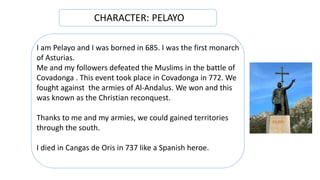
I am Pelayo and I was borned in 685. I was the first monarch
of Asturias.
Me and my followers defeated the Muslims in the battle of
Covadonga . This event took place in Covadonga in 772. We
fought against the armies of Al-Andalus. We won and this
was known as the Christian reconquest.
Thanks to me and my armies, we could gained territories
through the south.
I died in Cangas de Oris in 737 like a Spanish heroe.
CHARACTER: PELAYO
1- Describe the relationships between Al-
Andalus and the Christian territories.
2- Which Christian counties and Kingdoms exist
on the Iberian Peninsula in the 10th centuries?
3- What did the name of the kingdom of
Asturias changed to? Why?
ACTIVITIES
2. The emergence of the
Christian Kingdom
By : Alejandro Luque, Jara
García and Patricia
Hernández.
From the 12th century, Navarre was ruled by Jimena Dynasty. Sancho III, who
ruled Navarre, acquired the counties of Aragón, Castile and part of León.
However, after Sancho´s death in 1035 the kingdom was divided among his
sons:
•García Sanchez (1035-1054)= Navarre
•Fernando I (1035-1065)= Castile, which became an independent kingdom.
•Ramiro I (1035-1063) = Aragón
•Gonzalo (1035-1045) = Sobrarbe and Ribagorza.
The last king of the Jimena Dynasty was Sancho VII the Strong, who died
without descendents (1234).
In the 10th century, the County of Aragón became part of the kingdom
of Navarre. But when Sancho III died (1035) his son Ramiro become the
first king of Aragón until 1063.
Ramiro´s son, Sancho Ramírez, reunited kingdoms of Aragón and
Navarre, whiuch reminded toghether until 1134.
Ramón Berenguer IV married Petronilla of Aragón, who was 1 year old.
This united Aragón and the Catalan counties, they formed the crown of
Aragón.
THE KINGDOMS OF LEON AND CASTILE
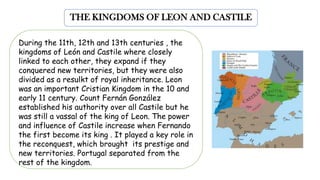
During the 11th, 12th and 13th centuries , the
kingdoms of León and Castile where closely
linked to each other, they expand if they
conquered new territories, but they were also
divided as a resulkt of royal inheritance. Leon
was an important Cristian Kingdom in the 10 and
early 11 century. Count Fernán González
established his authority over all Castile but he
was still a vassal of the king of Leon. The power
and influence of Castile increase when Fernando
the first become its king . It played a key role in
the reconquest, which brought its prestige and
new territories. Portugal separated from the
rest of the kingdom.
FERNANDO III
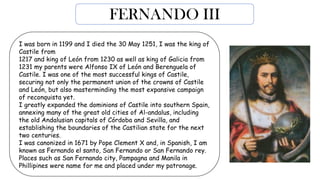
I was born in 1199 and I died the 30 May 1251, I was the king of
Castile from
1217 and king of León from 1230 as well as king of Galicia from
1231 my parents were Alfonso IX of León and Berenguela of
Castile. I was one of the most successful kings of Castile,
securing not only the permanent union of the crowns of Castile
and León, but also masterminding the most expansive campaign
of reconquista yet.
I greatly expanded the dominions of Castile into southern Spain,
annexing many of the great old cities of Al-andalus, including
the old Andalusian capitals of Córdoba and Sevilla, and
establishing the boundaries of the Castilian state for the next
two centuries.
I was canonized in 1671 by Pope Clement X and, in Spanish, I am
known as Fernando el santo, San Fernando or San Fernando rey.
Places such as San Fernando city, Pampagna and Manila in
Phillipines were name for me and placed under my patronage.
ACTIVITIES
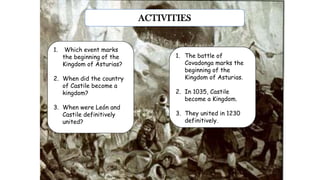
1. Which event marks
the beginning of the
Kingdom of Asturias?
2. When did the country
of Castile become a
kingdom?
3. When were León and
Castile definitively
united?
1. The battle of
Covadonga marks the
beginning of the
Kingdom of Asturias.
2. In 1035, Castile
become a Kingdom.
3. They united in 1230
definitively.
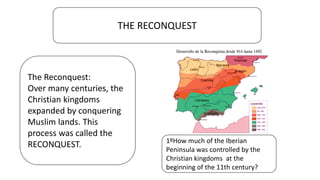
THE RECONQUEST
The Reconquest:
Over many centuries, the
Christian kingdoms
expanded by conquering
Muslim lands. This
process was called the
RECONQUEST. 1ºHow much of the Iberian
Peninsula was controlled by the
Christian kingdoms at the
beginning of the 11th century?
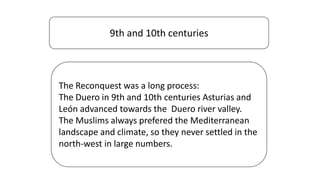
9th and 10th centuries
The Reconquest was a long process:
The Duero in 9th and 10th centuries Asturias and
León advanced towards the Duero river valley.
The Muslims always prefered the Mediterranean
landscape and climate, so they never settled in the
north-west in large numbers.
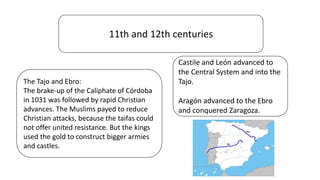
11th and 12th centuries
The Tajo and Ebro:
The brake-up of the Caliphate of Córdoba
in 1031 was followed by rapid Christian
advances. The Muslims payed to reduce
Christian attacks, because the taifas could
not offer united resistance. But the kings
used the gold to construct bigger armies
and castles.
Castile and León advanced to
the Central System and into the
Tajo.
Aragón advanced to the Ebro
and conquered Zaragoza.
13th centuries.
The Christian kingdoms united their forces and won a great
victory against the Muslims in the Battle of Las Navas de
Tolosa in 1212. The fall of Al-Andalus began.
Portugal conquered the Algarve.
Castile conquered Andalusia and Murcia.
Aragón conquered Valencia and the Balearic Islands.
In what century was the Reconquest completed?
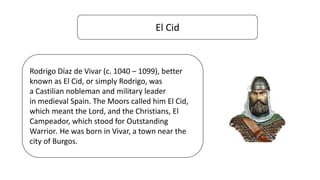
El Cid
Rodrigo Díaz de Vivar (c. 1040 – 1099), better
known as El Cid, or simply Rodrigo, was
a Castilian nobleman and military leader
in medieval Spain. The Moors called him El Cid,
which meant the Lord, and the Christians, El
Campeador, which stood for Outstanding
Warrior. He was born in Vivar, a town near the
city of Burgos.
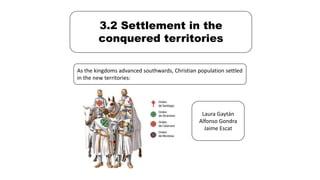
3.2 Settlement in the
conquered territories
As the kingdoms advanced southwards, Christian population settled
in the new territories:
Laura Gaytán
Alfonso Gondra
Jaime Escat
3.2.1. Repopulation
In the 9th and 10th centuries, the Christian
kingdoms occupied many uninhabited areas.
The king granted them privileged, such as
personal freedom and exception from taxes.
New towns were granted charters (or fuero)
which defined their rights and privileges.
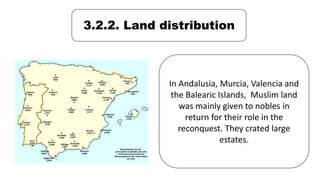
3.2.2. Land distribution
In Andalusia, Murcia, Valencia and
the Balearic Islands, Muslim land
was mainly given to nobles in
return for their role in the
reconquest. They crated large
estates.
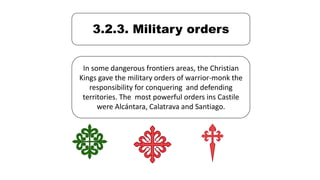
3.2.3. Military orders
In some dangerous frontiers areas, the Christian
Kings gave the military orders of warrior-monk the
responsibility for conquering and defending
territories. The most powerful orders ins Castile
were Alcántara, Calatrava and Santiago.
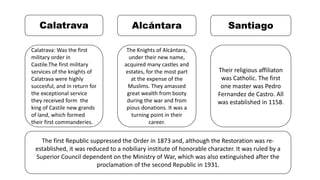
Calatrava
Calatrava: Was the first
military order in
Castile.The first military
services of the knights of
Calatrava were highly
succesful, and in return for
the exceptional service
they received form the
king of Castile new grands
of land, which formed
their first commanderies.
Alcántara
The Knights of Alcántara,
under their new name,
acquired many castles and
estates, for the most part
at the expense of the
Muslims. They amassed
great wealth from booty
during the war and from
pious donations. It was a
turning point in their
career.
The first Republic suppressed the Order in 1873 and, although the Restoration was re-
established, it was reduced to a nobiliary institute of honorable character. It was ruled by a
Superior Council dependent on the Ministry of War, which was also extinguished after the
proclamation of the second Republic in 1931.
Santiago
Their religious affiliaton
was Catholic. The first
one master was Pedro
Fernandez de Castro. All
was established in 1158.
Romanesque architecture spread through Europe in
the 11th century.
•The earliest Romanesque
buildings were small rural
churches, with thick walls,
small windows ,
semicircular arches.
The style reached the
Iberian peninsula through
the Pyrenees and extended
west along the pilgrimage
routes of Santiago de
Compostela
•In the 12th century, it
reached the new
territories conquered by
Christians on a larger
and grander scale,
buildings were reached
decorated with paintings
and reliefs
•Today, many
Romanesque structures
still survive along the Way
of Saint James, included
churches, hospitals,
bridges built for the
benefit of pilgrims.
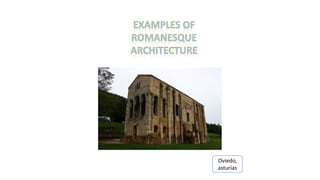
Oviedo,
asturias
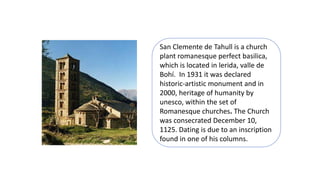
San Clemente de Tahull is a church
plant romanesque perfect basilica,
which is located in lerida, valle de
Bohí. In 1931 it was declared
historic-artistic monument and in
2000, heritage of humanity by
unesco, within the set of
Romanesque churches. The Church
was consecrated December 10,
1125. Dating is due to an inscription
found in one of his columns.

Al-Andalus & Christian Kingdoms 2º B

  • 1.
    Summary: The conquest ofthe iberian peninsula By the early 8 century, the Muslims had expended. In 711 they crossed over, to the Iberian Peninsula. -In part, the Muslims conquest of the Iberian Paninsula across the Mediterranean region. - However it was also made possible by a civil war between rival groups of the Visgoth’s nobility. The muslims called their new territory Al-Andalus, and made Córdoba its capital. The Muslims defeated the Visigoth King Roderic in the Battle of Guadalete. The Muslims never fully conquered the mountanous regions of the north west, which had a very different climate from the Mediterranean environment that the Muslims preferred.
  • 2.
    The independent emirateof córdoba (756-929) 4rAbd al-Rahman I founded the independent Emirate of Córdoba in 756. The emir of Córdoba was independent, but he accepted the religous supremacy of the caliph.
  • 3.
    characters Roderic was aVisigothic king between the years 710 and 711. He was defeated by the Muslims in the Battle of Guadalete, by a betrayal between the visigoths oponents of the own king. He was born 688 and died in 711. Abd al-Rahman I was a prince of the Umayyad dynasty who, in 756, after a various events, became the first independent emir of Córdoba, founding the Umawi dynasty there.
  • 4.
    3eActivities (pag 80 ex:2,3,4.) 1. Which parts of the Iberian Peninsula where not conquered by the Muslims? 2. Why do you think the Muslims chose Córdoba as their Capital? Suggest several reasons. 3. Which territories belonged to the caliphate in the 10th century?
  • 5.
    THE CALIPHATE OF CORDOBA Aperiod of exceptional achievements in Al – Andalus followed the foundation of the Caliphate of Cordoba in 929. This was created by Abd al- Rahman III , Who became its caliph (the supreme religious and political authority)
  • 6.
    SUMMARY Abd al-Rahman IIIruled through a chief minister (hajib), ministers (viziers)and provincial governors. The caliphate of Cordoba was a world´s great state in the 10th century:  Abd al-Rahman III strengthened his authority by resisting the Christian kingdoms in the north of the Iberian Peninsula. The city of Cordoba became a giant marketplace for products from all over the world. Cordoba was a great cultural centre, home to many philosophers, astronomers, doctors, musicians and poets.
  • 7.
    The role ofthe caliph weakened greatly from the late 10th century.  Hisham II (11 years old) became caliph in 976, but a general called Al-Mansur became the real ruler of Al- Andalus. He conducted raids, or razziars, on Christian territories. There were internal conflicts after Al-Mansur´s death in 1002 until the end of the caliphate in 1031.  Big kingdoms were called Caliphate and small kingdom Taifa
  • 8.
    Abd al-Rahman ibnMuhamad was born in Cordoba – Medina. He was the first caliph of Cordoba. One curiosity is that his second name al-Nasir li- din Allah means the one that made triunf in the religion of God Abderramán III (Or Abd al-Rahman) was the eighth sovereign Umayyad of Muslim Spain and first of them took the title of caliph (Cordoba, 891 - 961). He acceded to the throne in the year 912, when he was only 21, designated by its grandfathers to happen to him with preference to its own children; And in 929 he made himself proclaim caliph, breaking the last symbolic link that united him with the Caliphate of the Abbasids. ABD AL- RAHMAN III
  • 9.
    EXERCISES 1. Explain thedifferences between this terms and match them with the characters. a) •Razzias and parias •Hajib and vizier b) •Abd al-Rahman III •Al-Mansur
  • 10.
    The Fragmentation ofAl-Andalus By: Luis García, Ginés Moratalla, Maipi Gómez, María Cascudo
  • 11.
    THE TAIFA STATE Introduction:After 1031, al-Andalus split into numerous fragmented kingdoms or small emirates/states called taifas. Content: The Umayyad dynasty, controlled the fortunes of al-Andalus from 756, came to an end with the fall of Cordoba in 1031. Questions: Pag 82 ex 4: Pag 82 ex 1:
  • 12.
    THE ALMORAVIDS ANDTHE ALMOHADS From the 11th century, Al-Andalus was continually on the defensive as a result of the political fragmentation of the Muslim states and the rise of the Christian kingdoms. Muslim empires where a much stricter version of Islam was practrised: -The Almoravids crossed over the Iberian Peninsula in 1086. They won some victories against the Christian kingdoms. The Almoravisd’s domination did notlast for very long, it separated into many small taifa states in the 1440s. - The Almohads were successor of Almoravids and crossed over in 1147. Chrisitian kingdoms continued to expand in the 12th and 13th centuries. - page 82 ex 6 and 7
  • 13.
    The Nasrid Kingdomof Granada He Kingdom wasn´t military strong but was prosperous thanks to Trade and agriculture. Granada was an independent state because Castille allowed them. The Nasrid rulers paid Alhambra. The Kingdom was weaked and finally conquered by Catholic Monarchs in 1492 Questions What was the Last Muslim Kongdom? How did it end? Apart from the conquest of Granada, what else happened in 1492?
  • 14.
    Character Bobadil Bobadi: alsoknown as Mouhamad XI, the last king, member of Nasrid Dynasty, Called by Christians Bobadil. He governed between 1451 and 1454. He was son of Mouhamad VIII. Defeated in 1452 by Mouhamad IX. He singed a truce that was bad for Granada and He loosed his political partys. HE runned away from Granada in 1454.
  • 15.
  • 16.
    INTRODUCTION •Life in Al-andalus •Adiverse society •The Arabs •The Berbers •The Mozarbs •The Jews •Stages of Andalusi architecture •Caliphate architecture •Taifa architecture •Almohad architecture •The Giralda •Nasrid architecture
  • 17.
    Life in Al-Andalus Theconquerors and their descendants became the most powerful groups in Andalusi society. •The Arabs were the land-owning aristocracy. •The Berbers helped to conquer the Iberian Peninsula. Christians and Jews were allowed to practice their rerligion as long as they paid taxes: -The Mozarbs were Christians who did not convert to Islam. -The Jews were merchants, artisans and scholars.
  • 18.
    STAGES OF ANDALUSIARCHITECTURE Caliphate architecture Nasrid architecture The Giralda Taifa architecture Almohad architecture
  • 19.
    Activities 1.Pag 85 ex1. 2. Pag 85 ex 2. 3. Pag 85 ex 3.
  • 20.
    THE ORIGINS OF CHRISTIANSPAIN INTRODUCTION: From 711, the muslims conquered most of the Iberian Peninsula, but they never took full control of the north. In the 8th and 9th centuries the later Hispanic Kingdoms were formed. For nearly 800 years, Al-Andalus and a series of Christian states trade and exchanged knowledge, but they also frequently fough each other. Al-Andalus was stronger up to the 10th century. From then on, the Christian kings grew in power and began to take muslim territories.
  • 21.
    STAGES & CONTENTS -The kingdom of Asturias In the early 8th century, a noble called Pelayo established the kingdom of Asturias. Pelayo defeated the Muslims in the battle of Covadonga in 722, it was later considered the start of the Christian Reconquest of Al-Andalus. Under Pelayo´s successors Oviedo became its capital city. In the 10th century , the capital was moved to the city of León , and the kingdom became known as the Kingdom of León.
  • 22.
    - Counties andkingdoms of the pyrenees: The Pyrenees formed of the Carolingian Empire after Charlemagne established the Hispanic March as a defensive frontier region to defended his empire against the Muslims. When the Carlolingian Empire broke apart, three separate regions developed. NAVARRE, ARAGÓN and THE CATALAN COUNTIES. Navarre. Count Iñigo Arista expelled Frankish troops frojm Pamplona and decleared himself King of Pamplona. Aragón. The counties of Aragón, Sobrarbe and Ribagorza broke away from Carolingian control The Catalan counties. Wifredo the Hairy, expanded his territories and won independence from Frankish role.
  • 23.
    I am Pelayoand I was borned in 685. I was the first monarch of Asturias. Me and my followers defeated the Muslims in the battle of Covadonga . This event took place in Covadonga in 772. We fought against the armies of Al-Andalus. We won and this was known as the Christian reconquest. Thanks to me and my armies, we could gained territories through the south. I died in Cangas de Oris in 737 like a Spanish heroe. CHARACTER: PELAYO
  • 24.
    1- Describe therelationships between Al- Andalus and the Christian territories. 2- Which Christian counties and Kingdoms exist on the Iberian Peninsula in the 10th centuries? 3- What did the name of the kingdom of Asturias changed to? Why? ACTIVITIES
  • 25.
    2. The emergenceof the Christian Kingdom By : Alejandro Luque, Jara García and Patricia Hernández.
  • 26.
    From the 12thcentury, Navarre was ruled by Jimena Dynasty. Sancho III, who ruled Navarre, acquired the counties of Aragón, Castile and part of León. However, after Sancho´s death in 1035 the kingdom was divided among his sons: •García Sanchez (1035-1054)= Navarre •Fernando I (1035-1065)= Castile, which became an independent kingdom. •Ramiro I (1035-1063) = Aragón •Gonzalo (1035-1045) = Sobrarbe and Ribagorza. The last king of the Jimena Dynasty was Sancho VII the Strong, who died without descendents (1234).
  • 27.
    In the 10thcentury, the County of Aragón became part of the kingdom of Navarre. But when Sancho III died (1035) his son Ramiro become the first king of Aragón until 1063. Ramiro´s son, Sancho Ramírez, reunited kingdoms of Aragón and Navarre, whiuch reminded toghether until 1134. Ramón Berenguer IV married Petronilla of Aragón, who was 1 year old. This united Aragón and the Catalan counties, they formed the crown of Aragón.
  • 28.
    THE KINGDOMS OFLEON AND CASTILE During the 11th, 12th and 13th centuries , the kingdoms of León and Castile where closely linked to each other, they expand if they conquered new territories, but they were also divided as a resulkt of royal inheritance. Leon was an important Cristian Kingdom in the 10 and early 11 century. Count Fernán González established his authority over all Castile but he was still a vassal of the king of Leon. The power and influence of Castile increase when Fernando the first become its king . It played a key role in the reconquest, which brought its prestige and new territories. Portugal separated from the rest of the kingdom.
  • 29.
    FERNANDO III I wasborn in 1199 and I died the 30 May 1251, I was the king of Castile from 1217 and king of León from 1230 as well as king of Galicia from 1231 my parents were Alfonso IX of León and Berenguela of Castile. I was one of the most successful kings of Castile, securing not only the permanent union of the crowns of Castile and León, but also masterminding the most expansive campaign of reconquista yet. I greatly expanded the dominions of Castile into southern Spain, annexing many of the great old cities of Al-andalus, including the old Andalusian capitals of Córdoba and Sevilla, and establishing the boundaries of the Castilian state for the next two centuries. I was canonized in 1671 by Pope Clement X and, in Spanish, I am known as Fernando el santo, San Fernando or San Fernando rey. Places such as San Fernando city, Pampagna and Manila in Phillipines were name for me and placed under my patronage.
  • 30.
    ACTIVITIES 1. Which eventmarks the beginning of the Kingdom of Asturias? 2. When did the country of Castile become a kingdom? 3. When were León and Castile definitively united? 1. The battle of Covadonga marks the beginning of the Kingdom of Asturias. 2. In 1035, Castile become a Kingdom. 3. They united in 1230 definitively.
  • 31.
    THE RECONQUEST The Reconquest: Overmany centuries, the Christian kingdoms expanded by conquering Muslim lands. This process was called the RECONQUEST. 1ºHow much of the Iberian Peninsula was controlled by the Christian kingdoms at the beginning of the 11th century?
  • 32.
    9th and 10thcenturies The Reconquest was a long process: The Duero in 9th and 10th centuries Asturias and León advanced towards the Duero river valley. The Muslims always prefered the Mediterranean landscape and climate, so they never settled in the north-west in large numbers.
  • 33.
    11th and 12thcenturies The Tajo and Ebro: The brake-up of the Caliphate of Córdoba in 1031 was followed by rapid Christian advances. The Muslims payed to reduce Christian attacks, because the taifas could not offer united resistance. But the kings used the gold to construct bigger armies and castles. Castile and León advanced to the Central System and into the Tajo. Aragón advanced to the Ebro and conquered Zaragoza.
  • 34.
    13th centuries. The Christiankingdoms united their forces and won a great victory against the Muslims in the Battle of Las Navas de Tolosa in 1212. The fall of Al-Andalus began. Portugal conquered the Algarve. Castile conquered Andalusia and Murcia. Aragón conquered Valencia and the Balearic Islands. In what century was the Reconquest completed?
  • 35.
    El Cid Rodrigo Díazde Vivar (c. 1040 – 1099), better known as El Cid, or simply Rodrigo, was a Castilian nobleman and military leader in medieval Spain. The Moors called him El Cid, which meant the Lord, and the Christians, El Campeador, which stood for Outstanding Warrior. He was born in Vivar, a town near the city of Burgos.
  • 36.
    3.2 Settlement inthe conquered territories As the kingdoms advanced southwards, Christian population settled in the new territories: Laura Gaytán Alfonso Gondra Jaime Escat
  • 37.
    3.2.1. Repopulation In the9th and 10th centuries, the Christian kingdoms occupied many uninhabited areas. The king granted them privileged, such as personal freedom and exception from taxes. New towns were granted charters (or fuero) which defined their rights and privileges.
  • 38.
    3.2.2. Land distribution InAndalusia, Murcia, Valencia and the Balearic Islands, Muslim land was mainly given to nobles in return for their role in the reconquest. They crated large estates.
  • 39.
    3.2.3. Military orders Insome dangerous frontiers areas, the Christian Kings gave the military orders of warrior-monk the responsibility for conquering and defending territories. The most powerful orders ins Castile were Alcántara, Calatrava and Santiago.
  • 40.
    Calatrava Calatrava: Was thefirst military order in Castile.The first military services of the knights of Calatrava were highly succesful, and in return for the exceptional service they received form the king of Castile new grands of land, which formed their first commanderies. Alcántara The Knights of Alcántara, under their new name, acquired many castles and estates, for the most part at the expense of the Muslims. They amassed great wealth from booty during the war and from pious donations. It was a turning point in their career. The first Republic suppressed the Order in 1873 and, although the Restoration was re- established, it was reduced to a nobiliary institute of honorable character. It was ruled by a Superior Council dependent on the Ministry of War, which was also extinguished after the proclamation of the second Republic in 1931. Santiago Their religious affiliaton was Catholic. The first one master was Pedro Fernandez de Castro. All was established in 1158.
  • 41.
    Romanesque architecture spreadthrough Europe in the 11th century. •The earliest Romanesque buildings were small rural churches, with thick walls, small windows , semicircular arches. The style reached the Iberian peninsula through the Pyrenees and extended west along the pilgrimage routes of Santiago de Compostela •In the 12th century, it reached the new territories conquered by Christians on a larger and grander scale, buildings were reached decorated with paintings and reliefs •Today, many Romanesque structures still survive along the Way of Saint James, included churches, hospitals, bridges built for the benefit of pilgrims.
  • 42.
  • 43.
    San Clemente deTahull is a church plant romanesque perfect basilica, which is located in lerida, valle de Bohí. In 1931 it was declared historic-artistic monument and in 2000, heritage of humanity by unesco, within the set of Romanesque churches. The Church was consecrated December 10, 1125. Dating is due to an inscription found in one of his columns.