UNIT 2
THE ISLAM
AND
AL-ANDALUS
2nd graders
SOCIAL STUDIES DEPARTMENT
Almudena Corrales Marbán
Created by Cristina de la Vega
Lienhart.
1. THE ORIGIN AND
EXPANSION OF THE ISLAM
Islam originated on the Arabian
Peninsula, a huge desert land.
Its interior was inhabited by tribes of
polytheistic Arab nomads.
The main cities of this peninsula were:
Medina and Mecca, located in the western
part of the peninsula. Both were prosperous
cities.
These cities were a crossroad (encrucijada de
caminos) for the merchant caravans comming
from the Far East.
Almudena Corrales Marbán
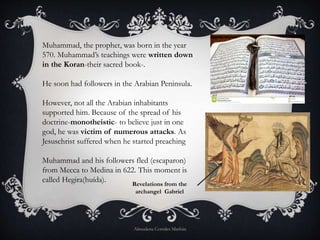
Muhammad, the prophet, was born in the year
570. Muhammad’s teachings were written down
in the Koran-their sacred book-.
He soon had followers in the Arabian Peninsula.
However, not all the Arabian inhabitants
supported him. Because of the spread of his
doctrine-monotheistic- to believe just in one
god, he was victim of numerous attacks. As
Jesuschrist suffered when he started preaching
Muhammad and his followers fled (escaparon)
from Mecca to Medina in 622. This moment is
called Hegira(huída). Revelations from the
archangel Gabriel
Almudena Corrales Marbán
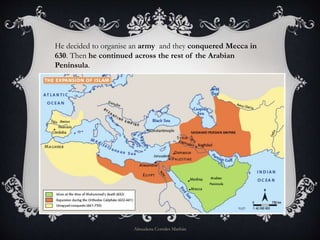
He decided to organise an army and they conquered Mecca in
630. Then he continued across the rest of the Arabian
Peninsula.
Almudena Corrales Marbán
2. ISLAMIC POLITICS
Muhammad’s successors continued to conquer territories. The caliphate
went through various stages:
1. THE ORTHODOX CALIPHATE (632-661): caliphs were people
close to Muhammad. (Califato Ortodoxo)
2. THE UMAYYAD CALIPHATE (661-750): power was in the
hands of the Umayyad dynasty, who established the capital in
Damascus (Syria). (Califato Omeya)
3. THE ABBASID CALIPHATE (750-1258): in the year 750, the
Abbasid family took control and transferred the capital city to
Baghdad (Irak). (Califato Abasida)
In 1258, Baghdad was conquered by the Mongolians.
Almudena Corrales Marbán
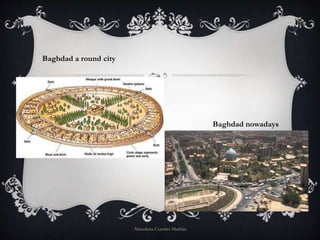
Baghdad a round city
Baghdad nowadays
Almudena Corrales Marbán
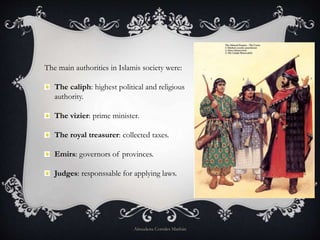
The main authorities in Islamis society were:
The caliph: highest political and religious
authority.
The vizier: prime minister.
The royal treasurer: collected taxes.
Emirs: governors of provinces.
Judges: responssable for applying laws.
Almudena Corrales Marbán
3. ECONOMY
3.1. AGRICULTURE
• Hardly any agriculture in the Arabian Peninsula.
• The Arabs needed to obtain water and used various techniques like
water-wheels and irrigation channels.
3.2. CRAFTWORK
• Practice in cities.
• Activities: tanning of hides, tapestries, carpets, cotton, silk, woolen fabrics,
jwellery, ivory, perfums and weapons.
3.3. TRADE
• One of the main sources of wealth (riqueza)
• City markets (souks) zocos.
• They used coins (dinar and dirham)
Almudena Corrales Marbán
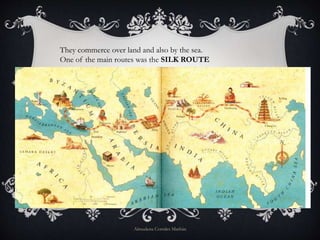
They commerce over land and also by the sea.
One of the main routes was the SILK ROUTE
Almudena Corrales Marbán
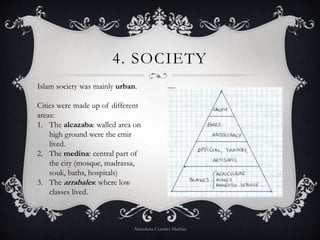
4. SOCIETY
Islam society was mainly urban.
Cities were made up of different
areas:
1. The alcazaba: walled area on
high ground were the emir
lived.
2. The medina: central part of
the city (mosque, madrassa,
souk, baths, hospitals)
3. The arrabales: where low
classes lived.
Almudena Corrales Marbán

Unit 2 the islam

  • 1.
    UNIT 2 THE ISLAM AND AL-ANDALUS 2ndgraders SOCIAL STUDIES DEPARTMENT Almudena Corrales Marbán Created by Cristina de la Vega Lienhart.
  • 2.
    1. THE ORIGINAND EXPANSION OF THE ISLAM Islam originated on the Arabian Peninsula, a huge desert land. Its interior was inhabited by tribes of polytheistic Arab nomads. The main cities of this peninsula were: Medina and Mecca, located in the western part of the peninsula. Both were prosperous cities. These cities were a crossroad (encrucijada de caminos) for the merchant caravans comming from the Far East. Almudena Corrales Marbán
  • 3.
    Muhammad, the prophet,was born in the year 570. Muhammad’s teachings were written down in the Koran-their sacred book-. He soon had followers in the Arabian Peninsula. However, not all the Arabian inhabitants supported him. Because of the spread of his doctrine-monotheistic- to believe just in one god, he was victim of numerous attacks. As Jesuschrist suffered when he started preaching Muhammad and his followers fled (escaparon) from Mecca to Medina in 622. This moment is called Hegira(huída). Revelations from the archangel Gabriel Almudena Corrales Marbán
  • 4.
    He decided toorganise an army and they conquered Mecca in 630. Then he continued across the rest of the Arabian Peninsula. Almudena Corrales Marbán
  • 5.
    2. ISLAMIC POLITICS Muhammad’ssuccessors continued to conquer territories. The caliphate went through various stages: 1. THE ORTHODOX CALIPHATE (632-661): caliphs were people close to Muhammad. (Califato Ortodoxo) 2. THE UMAYYAD CALIPHATE (661-750): power was in the hands of the Umayyad dynasty, who established the capital in Damascus (Syria). (Califato Omeya) 3. THE ABBASID CALIPHATE (750-1258): in the year 750, the Abbasid family took control and transferred the capital city to Baghdad (Irak). (Califato Abasida) In 1258, Baghdad was conquered by the Mongolians. Almudena Corrales Marbán
  • 6.
    Baghdad a roundcity Baghdad nowadays Almudena Corrales Marbán
  • 7.
    The main authoritiesin Islamis society were: The caliph: highest political and religious authority. The vizier: prime minister. The royal treasurer: collected taxes. Emirs: governors of provinces. Judges: responssable for applying laws. Almudena Corrales Marbán
  • 8.
    3. ECONOMY 3.1. AGRICULTURE •Hardly any agriculture in the Arabian Peninsula. • The Arabs needed to obtain water and used various techniques like water-wheels and irrigation channels. 3.2. CRAFTWORK • Practice in cities. • Activities: tanning of hides, tapestries, carpets, cotton, silk, woolen fabrics, jwellery, ivory, perfums and weapons. 3.3. TRADE • One of the main sources of wealth (riqueza) • City markets (souks) zocos. • They used coins (dinar and dirham) Almudena Corrales Marbán
  • 9.
    They commerce overland and also by the sea. One of the main routes was the SILK ROUTE Almudena Corrales Marbán
  • 10.
    4. SOCIETY Islam societywas mainly urban. Cities were made up of different areas: 1. The alcazaba: walled area on high ground were the emir lived. 2. The medina: central part of the city (mosque, madrassa, souk, baths, hospitals) 3. The arrabales: where low classes lived. Almudena Corrales Marbán