Unit 12
The rise of Spanish Empire
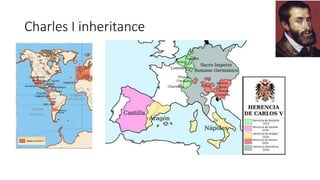
Charles I inheritance
Reign of Charles I (1516 – 1556) Internal policy
• Controversial beginning of reign:
• Came to Spain 1517, was educated in Flanders and hardly spoke Spanish
• Brought his advisers from Flanders and Burgundy, gave them government tasks
and increased taxes to pay wars in Europe.
• Spanish nobility distrust him, they called him the “foreign king” and revolted
against the king:
• In Castile the “Revolt of Comuneros” (1520 – 1521): Arose against the king and
his government, “Comuneros” demanded his mother Joanna as Queen of
Castile, but she refused. The royal army of Charles I defeated the Comuneros in
Villalar (Valladolid)
• In Aragon the “Revolt of the Germanias” (1521 – 1523): Uprising of artisans
and peasants against the nobility who monopolised rents and taxes. The king
supported the nobility and the Brotherhoods (Germanías) were defeated.
Charles I External policy
• In 1519 was proclaimed emperor of Germany (Charles V)
• France, England and some German States felt threatened by
the power of the Habsburgs, arising many confrontations
between them.
• Conflicts with France: For the control of the Italian peninsula. Brought
to a personal rivalry with the king of France, Francis I. In the battle of
Pavia in 1525, the army of Charles V defeated the Frenchs. He
obtained the control of Italy.
• Conflicts with Lutherans: Charles V wanted to erase Lutheranism in
his territories, despite some military victories (Mühlberg 1547) he
had to accept Protestantism in the German Empire signing the Peace
of Augsburg (1555)
• Turkish threat: Charles V wanted to stop the Muslim advance on the
Mediterranean Sea. His army occupied Tunisia in 1535, but he did not
stop the threat, in 1541 the Turks defeated Christian armies in Argel.
The “Spanish empire” of Phillip II
Charles V and Isabella of Portugal
legated a global empire to Phillip II
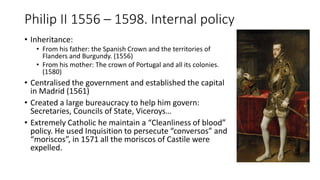
Philip II 1556 – 1598. Internal policy
• Inheritance:
• From his father: the Spanish Crown and the territories of
Flanders and Burgundy. (1556)
• From his mother: The crown of Portugal and all its colonies.
(1580)
• Centralised the government and established the capital
in Madrid (1561)
• Created a large bureaucracy to help him govern:
Secretaries, Councils of State, Viceroys…
• Extremely Catholic he maintain a “Cleanliness of blood”
policy. He used Inquisition to persecute “conversos” and
“moriscos”, in 1571 all the moriscos of Castile were
expelled.
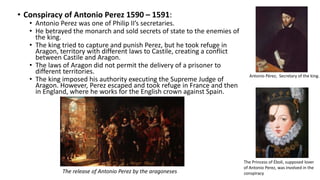
• Conspiracy of Antonio Perez 1590 – 1591:
• Antonio Perez was one of Philip II’s secretaries.
• He betrayed the monarch and sold secrets of state to the enemies of
the king.
• The king tried to capture and punish Perez, but he took refuge in
Aragon, territory with different laws to Castile, creating a conflict
between Castile and Aragon.
• The laws of Aragon did not permit the delivery of a prisoner to
different territories.
• The king imposed his authority executing the Supreme Judge of
Aragon. However, Perez escaped and took refuge in France and then
in England, where he works for the English crown against Spain.
The release of Antonio Perez by the aragoneses
Antonio Pérez, Secretary of the king.
The Princess of Éboli, supposed lover
of Antonio Perez, was involved in the
conspiracy
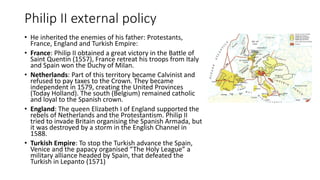
Philip II external policy
• He inherited the enemies of his father: Protestants,
France, England and Turkish Empire:
• France: Philip II obtained a great victory in the Battle of
Saint Quentin (1557), France retreat his troops from Italy
and Spain won the Duchy of Milan.
• Netherlands: Part of this territory became Calvinist and
refused to pay taxes to the Crown. They became
independent in 1579, creating the United Provinces
(Today Holland). The south (Belgium) remained catholic
and loyal to the Spanish crown.
• England: The queen Elizabeth I of England supported the
rebels of Netherlands and the Protestantism. Philip II
tried to invade Britain organising the Spanish Armada, but
it was destroyed by a storm in the English Channel in
1588.
• Turkish Empire: To stop the Turkish advance the Spain,
Venice and the papacy organised “The Holy League” a
military alliance headed by Spain, that defeated the
Turkish in Lepanto (1571)
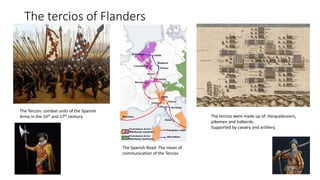
The tercios of Flanders
The Spanish Road: The mean of
communication of the Tercios
The Tercios: combat units of the Spanish
Army in the 16th and 17th century. The tercios were made up of: Harquebusiers,
pikemen and halberds.
Supported by cavalry and artillery.
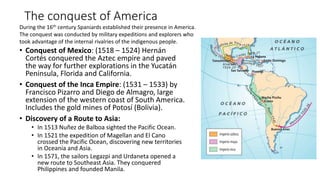
The conquest of America
• Conquest of Mexico: (1518 – 1524) Hernán
Cortés conquered the Aztec empire and paved
the way for further explorations in the Yucatán
Peninsula, Florida and California.
• Conquest of the Inca Empire: (1531 – 1533) by
Francisco Pizarro and Diego de Almagro, large
extension of the western coast of South America.
Includes the gold mines of Potosí (Bolivia).
• Discovery of a Route to Asia:
• In 1513 Nuñez de Balboa sighted the Pacific Ocean.
• In 1521 the expedition of Magellan and El Cano
crossed the Pacific Ocean, discovering new territories
in Oceania and Asia.
• In 1571, the sailors Legazpi and Urdaneta opened a
new route to Southeast Asia. They conquered
Philippines and founded Manila.
During the 16th century Spaniards established their presence in America.
The conquest was conducted by military expeditions and explorers who
took advantage of the internal rivalries of the indigenous people.
The conquest of America
• Organisation of the new territories:
• Were incorporated into the Crown of Castile.
• Castilian language, culture and laws were introduced in America
• The Evangelisation of the new territories was essential for the
Spanish Crown, many clerics and religious orders participated in
this duty.
• Government institutions:
• Council of Indies: Advised the king and created new laws for the
Spanish colonies. (Like a ministry nowadays)
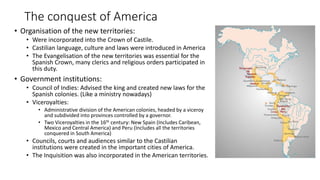
• Viceroyalties:
• Administrative division of the American colonies, headed by a viceroy
and subdivided into provinces controlled by a governor.
• Two Viceroyalties in the 16th century: New Spain (Includes Caribean,
Mexico and Central America) and Peru (Includes all the territories
conquered in South America)
• Councils, courts and audiences similar to the Castilian
institutions were created in the important cities of America.
• The Inquisition was also incorporated in the American territories.
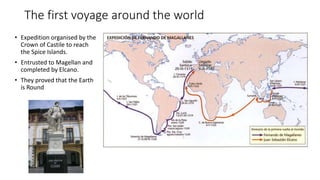
The first voyage around the world
• Expedition organised by the
Crown of Castile to reach
the Spice Islands.
• Entrusted to Magellan and
completed by Elcano.
• They proved that the Earth
is Round

Unit 12 spanish empire

  • 1.
    Unit 12 The riseof Spanish Empire
  • 2.
  • 3.
    Reign of CharlesI (1516 – 1556) Internal policy • Controversial beginning of reign: • Came to Spain 1517, was educated in Flanders and hardly spoke Spanish • Brought his advisers from Flanders and Burgundy, gave them government tasks and increased taxes to pay wars in Europe. • Spanish nobility distrust him, they called him the “foreign king” and revolted against the king: • In Castile the “Revolt of Comuneros” (1520 – 1521): Arose against the king and his government, “Comuneros” demanded his mother Joanna as Queen of Castile, but she refused. The royal army of Charles I defeated the Comuneros in Villalar (Valladolid) • In Aragon the “Revolt of the Germanias” (1521 – 1523): Uprising of artisans and peasants against the nobility who monopolised rents and taxes. The king supported the nobility and the Brotherhoods (Germanías) were defeated.
  • 4.
    Charles I Externalpolicy • In 1519 was proclaimed emperor of Germany (Charles V) • France, England and some German States felt threatened by the power of the Habsburgs, arising many confrontations between them. • Conflicts with France: For the control of the Italian peninsula. Brought to a personal rivalry with the king of France, Francis I. In the battle of Pavia in 1525, the army of Charles V defeated the Frenchs. He obtained the control of Italy. • Conflicts with Lutherans: Charles V wanted to erase Lutheranism in his territories, despite some military victories (Mühlberg 1547) he had to accept Protestantism in the German Empire signing the Peace of Augsburg (1555) • Turkish threat: Charles V wanted to stop the Muslim advance on the Mediterranean Sea. His army occupied Tunisia in 1535, but he did not stop the threat, in 1541 the Turks defeated Christian armies in Argel.
  • 5.
    The “Spanish empire”of Phillip II Charles V and Isabella of Portugal legated a global empire to Phillip II
  • 6.
    Philip II 1556– 1598. Internal policy • Inheritance: • From his father: the Spanish Crown and the territories of Flanders and Burgundy. (1556) • From his mother: The crown of Portugal and all its colonies. (1580) • Centralised the government and established the capital in Madrid (1561) • Created a large bureaucracy to help him govern: Secretaries, Councils of State, Viceroys… • Extremely Catholic he maintain a “Cleanliness of blood” policy. He used Inquisition to persecute “conversos” and “moriscos”, in 1571 all the moriscos of Castile were expelled.
  • 7.
    • Conspiracy ofAntonio Perez 1590 – 1591: • Antonio Perez was one of Philip II’s secretaries. • He betrayed the monarch and sold secrets of state to the enemies of the king. • The king tried to capture and punish Perez, but he took refuge in Aragon, territory with different laws to Castile, creating a conflict between Castile and Aragon. • The laws of Aragon did not permit the delivery of a prisoner to different territories. • The king imposed his authority executing the Supreme Judge of Aragon. However, Perez escaped and took refuge in France and then in England, where he works for the English crown against Spain. The release of Antonio Perez by the aragoneses Antonio Pérez, Secretary of the king. The Princess of Éboli, supposed lover of Antonio Perez, was involved in the conspiracy
  • 8.
    Philip II externalpolicy • He inherited the enemies of his father: Protestants, France, England and Turkish Empire: • France: Philip II obtained a great victory in the Battle of Saint Quentin (1557), France retreat his troops from Italy and Spain won the Duchy of Milan. • Netherlands: Part of this territory became Calvinist and refused to pay taxes to the Crown. They became independent in 1579, creating the United Provinces (Today Holland). The south (Belgium) remained catholic and loyal to the Spanish crown. • England: The queen Elizabeth I of England supported the rebels of Netherlands and the Protestantism. Philip II tried to invade Britain organising the Spanish Armada, but it was destroyed by a storm in the English Channel in 1588. • Turkish Empire: To stop the Turkish advance the Spain, Venice and the papacy organised “The Holy League” a military alliance headed by Spain, that defeated the Turkish in Lepanto (1571)
  • 9.
    The tercios ofFlanders The Spanish Road: The mean of communication of the Tercios The Tercios: combat units of the Spanish Army in the 16th and 17th century. The tercios were made up of: Harquebusiers, pikemen and halberds. Supported by cavalry and artillery.
  • 10.
    The conquest ofAmerica • Conquest of Mexico: (1518 – 1524) Hernán Cortés conquered the Aztec empire and paved the way for further explorations in the Yucatán Peninsula, Florida and California. • Conquest of the Inca Empire: (1531 – 1533) by Francisco Pizarro and Diego de Almagro, large extension of the western coast of South America. Includes the gold mines of Potosí (Bolivia). • Discovery of a Route to Asia: • In 1513 Nuñez de Balboa sighted the Pacific Ocean. • In 1521 the expedition of Magellan and El Cano crossed the Pacific Ocean, discovering new territories in Oceania and Asia. • In 1571, the sailors Legazpi and Urdaneta opened a new route to Southeast Asia. They conquered Philippines and founded Manila. During the 16th century Spaniards established their presence in America. The conquest was conducted by military expeditions and explorers who took advantage of the internal rivalries of the indigenous people.
  • 11.
    The conquest ofAmerica • Organisation of the new territories: • Were incorporated into the Crown of Castile. • Castilian language, culture and laws were introduced in America • The Evangelisation of the new territories was essential for the Spanish Crown, many clerics and religious orders participated in this duty. • Government institutions: • Council of Indies: Advised the king and created new laws for the Spanish colonies. (Like a ministry nowadays) • Viceroyalties: • Administrative division of the American colonies, headed by a viceroy and subdivided into provinces controlled by a governor. • Two Viceroyalties in the 16th century: New Spain (Includes Caribean, Mexico and Central America) and Peru (Includes all the territories conquered in South America) • Councils, courts and audiences similar to the Castilian institutions were created in the important cities of America. • The Inquisition was also incorporated in the American territories.
  • 12.
    The first voyagearound the world • Expedition organised by the Crown of Castile to reach the Spice Islands. • Entrusted to Magellan and completed by Elcano. • They proved that the Earth is Round