The Fall of Constantinople
SOCIAL STUDIES FOR 10TH EBG
TEACHER: MAURICIO TORRES
Contents
• Introduction
• The Byzantine Empire
• Ottoman Strength
• Byzantine Preparations
• The Siege
• Final Assault
• Constantinople Falls
• Aftermath
Introduction
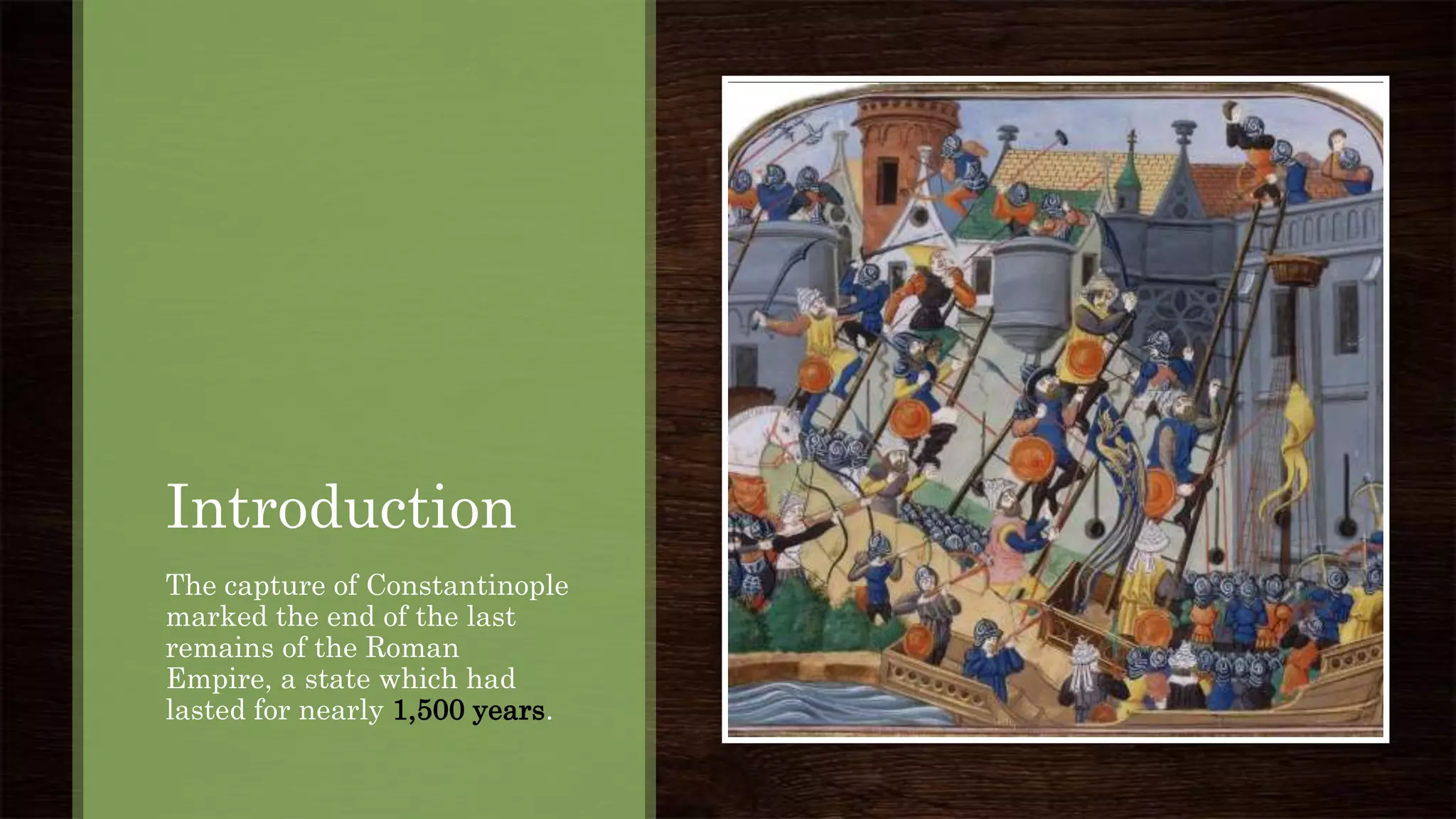
The capture of Constantinople
marked the end of the last
remains of the Roman
Empire, a state which had
lasted for nearly 1,500 years.
Byzantium
• Far from being in its heyday,
Constantinople was severely
depopulated as a result of the
general economic and
territorial decline of the
empire.
– Therefore, the city in 1453 was a
series of walled villages separated
by vast fields encircled by the
fifth-century Theodosian walls.
• By 1450 the empire was
exhausted, consisting of a few
square miles outside the city of
Constantinople itself
Ottoman Strength
• When Sultan Mehmed II succeeded his father in
1451 as head of the young Ottoman Empire, it ws
believed that the young Sultan would not pose a
threat to the Christians. But, beginning early in
1452 he built an Ottoman fortress, on the Bosporus;
this was done on the European side several miles
north of Constantinople, in order to block the great
capital.
• As part of the preparation for the siege and
invasion, the Ottomans had at their service a large
force:
– Studies point out that there were about 50,000-80,000
Ottoman soldiers including between 5,000 and 10,000
Janissaries, an elite infantry corps, and thousands of
Christian troops,
Byzantine Preparations
• Byzantine Emperor Constantine XI understood
Ottoman intentions, and turned to western Europe
for help:
– but now the fruits of centuries of enmity between the
eastern and western churches would be tolled. Help was
not sufficient.
– Some Western individuals, however, came to help defend
the city on their own account.
• Another strategy employed by the Byzantines was
the repair and fortification of the Land Wall
(Theodosian Walls).
Byzantine Strength
• The army defending Constantinople was
relatively small; it totaled about 7,000 men,
2,000 of whom were foreigners.
• At the onset of the siege probably 50,000 people
were living within the walls, including the
refugees from the surrounding area.
The Ottoman Siege
• Mehmed built a fleet to besiege the city from the sea. A modern
estimate predicts a fleet strength of 126 ships.
• Mehmed planned to attack the Theodosian Walls, the only part of the
city not surrounded by water. This would be done by weakening the
cities walls with artillery.
The Ottoman Siege
• The Ottomans first attacked the remaining
fortresses in the area. Then they began
firing at the walls with their artillery, which
did not prove to be an effective approach.
• Then, they set their fleet to block the
entrance of the Golden Horn, which was
blocked by the chain.
– To circumvent the chain, he ordered the
construction of a road of greased logs across
Galata to roll his ships across!
– This made the Byzantines man their walls on
the Horn, weakening the other walls.
• The Turks tried to build tunnels underneath
the walls, but they were discovered.
Battle Plans
• This is how the city
was sieged before the
final assault.
Final Assault
• Both sides prepared for battle and offered
prayers before the fight. The Ottomans were
preparing a full blown offensive against the
walls.
• The attack began, and the defenders fought
bravely, but against overwhelming odds it
was a matter of time before they all
collapsed.
– One by one, each post was taken by the Turks,
and they entered the city.
– The emperor, took off everything that
represented him, and fought along his soldiers in
the final charge, dying with them.
• Finally, the Turks reached Hagia Sophia,
were large numbers of civilians were hiding.
Constantinople Falls
• According to historians, Mehmed allowed
his troops to plunder the city.
• Many civilians were taken as slaves or were
killed on the spot.
• By the third day, Mehmed ordered all
looting to stop.
– Hagia Sophia as now turned into a Mosque.
• Many people fled the city towards many
Italian cities, taking with them their
knowledge of antiquity.
Aftermath
• The fall of Constantinople is considered by
many historians as the end of the Middle Ages.
• The fall of Constantinople and general
establishment of the Turks in that region also
severed the main overland trade link between
Europe and Asia
– as a result more Europeans began to seriously
consider the possibility of reaching Asia by sea.
• The migration waves of Byzantine scholars and
refugees in the period following the fall of
Constantinople in 1453, is considered by many
scholars key to the revival of Greek and Roman
studies that led to the development of the
Renaissance humanism and science.
• It is widely believed that the city was renamed
to "Istanbul" in the aftermath of the conquest.
Ask yourself
• Infer:
– Why did the Byzantines receive little help from the West?
• Recall:
– How was the Sultan able to enter the Golden Horn?
• Analyze:
– The Byzantines focused more on their land defenses and walls, why?
– After the Sultan had a fleet on the Golden Horn, how did this weaken the
Byzantine defenses?
• Explain:
– Why did the emperor choose to die in battle?
• Relate:
– In what way did the decayed state of the empire prove to be an incentive to the
Turks to invade?

The Fall of Constantinople

  • 1.
    The Fall ofConstantinople SOCIAL STUDIES FOR 10TH EBG TEACHER: MAURICIO TORRES
  • 2.
    Contents • Introduction • TheByzantine Empire • Ottoman Strength • Byzantine Preparations • The Siege • Final Assault • Constantinople Falls • Aftermath
  • 3.
    Introduction The capture ofConstantinople marked the end of the last remains of the Roman Empire, a state which had lasted for nearly 1,500 years.
  • 4.
    Byzantium • Far frombeing in its heyday, Constantinople was severely depopulated as a result of the general economic and territorial decline of the empire. – Therefore, the city in 1453 was a series of walled villages separated by vast fields encircled by the fifth-century Theodosian walls. • By 1450 the empire was exhausted, consisting of a few square miles outside the city of Constantinople itself
  • 5.
    Ottoman Strength • WhenSultan Mehmed II succeeded his father in 1451 as head of the young Ottoman Empire, it ws believed that the young Sultan would not pose a threat to the Christians. But, beginning early in 1452 he built an Ottoman fortress, on the Bosporus; this was done on the European side several miles north of Constantinople, in order to block the great capital. • As part of the preparation for the siege and invasion, the Ottomans had at their service a large force: – Studies point out that there were about 50,000-80,000 Ottoman soldiers including between 5,000 and 10,000 Janissaries, an elite infantry corps, and thousands of Christian troops,
  • 6.
    Byzantine Preparations • ByzantineEmperor Constantine XI understood Ottoman intentions, and turned to western Europe for help: – but now the fruits of centuries of enmity between the eastern and western churches would be tolled. Help was not sufficient. – Some Western individuals, however, came to help defend the city on their own account. • Another strategy employed by the Byzantines was the repair and fortification of the Land Wall (Theodosian Walls).
  • 7.
    Byzantine Strength • Thearmy defending Constantinople was relatively small; it totaled about 7,000 men, 2,000 of whom were foreigners. • At the onset of the siege probably 50,000 people were living within the walls, including the refugees from the surrounding area.
  • 8.
    The Ottoman Siege •Mehmed built a fleet to besiege the city from the sea. A modern estimate predicts a fleet strength of 126 ships. • Mehmed planned to attack the Theodosian Walls, the only part of the city not surrounded by water. This would be done by weakening the cities walls with artillery.
  • 9.
    The Ottoman Siege •The Ottomans first attacked the remaining fortresses in the area. Then they began firing at the walls with their artillery, which did not prove to be an effective approach. • Then, they set their fleet to block the entrance of the Golden Horn, which was blocked by the chain. – To circumvent the chain, he ordered the construction of a road of greased logs across Galata to roll his ships across! – This made the Byzantines man their walls on the Horn, weakening the other walls. • The Turks tried to build tunnels underneath the walls, but they were discovered.
  • 10.
    Battle Plans • Thisis how the city was sieged before the final assault.
  • 11.
    Final Assault • Bothsides prepared for battle and offered prayers before the fight. The Ottomans were preparing a full blown offensive against the walls. • The attack began, and the defenders fought bravely, but against overwhelming odds it was a matter of time before they all collapsed. – One by one, each post was taken by the Turks, and they entered the city. – The emperor, took off everything that represented him, and fought along his soldiers in the final charge, dying with them. • Finally, the Turks reached Hagia Sophia, were large numbers of civilians were hiding.
  • 12.
    Constantinople Falls • Accordingto historians, Mehmed allowed his troops to plunder the city. • Many civilians were taken as slaves or were killed on the spot. • By the third day, Mehmed ordered all looting to stop. – Hagia Sophia as now turned into a Mosque. • Many people fled the city towards many Italian cities, taking with them their knowledge of antiquity.
  • 13.
    Aftermath • The fallof Constantinople is considered by many historians as the end of the Middle Ages. • The fall of Constantinople and general establishment of the Turks in that region also severed the main overland trade link between Europe and Asia – as a result more Europeans began to seriously consider the possibility of reaching Asia by sea. • The migration waves of Byzantine scholars and refugees in the period following the fall of Constantinople in 1453, is considered by many scholars key to the revival of Greek and Roman studies that led to the development of the Renaissance humanism and science. • It is widely believed that the city was renamed to "Istanbul" in the aftermath of the conquest.
  • 14.
    Ask yourself • Infer: –Why did the Byzantines receive little help from the West? • Recall: – How was the Sultan able to enter the Golden Horn? • Analyze: – The Byzantines focused more on their land defenses and walls, why? – After the Sultan had a fleet on the Golden Horn, how did this weaken the Byzantine defenses? • Explain: – Why did the emperor choose to die in battle? • Relate: – In what way did the decayed state of the empire prove to be an incentive to the Turks to invade?