AIR POLLUTION AND
CONTROL
Prof.M.V.Sanas
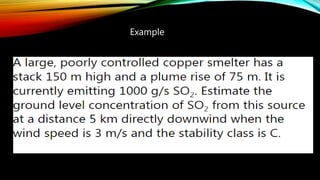
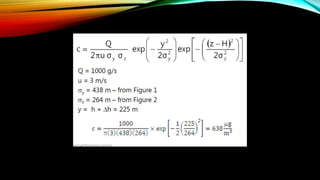
Example
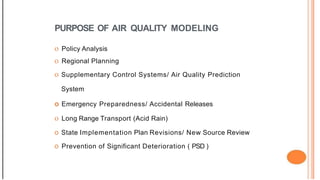
PURPOSE OF AIR QUALITY MODELING
o Policy Analysis
o Regional Planning
o Supplementary Control Systems/ Air Quality Prediction
System
o Emergency Preparedness/ Accidental Releases
o Long Range Transport (Acid Rain)
o State Implementation Plan Revisions/ New Source Review
o Prevention of Significant Deterioration ( PSD )
ATMOSPHERIC TRANSPORT
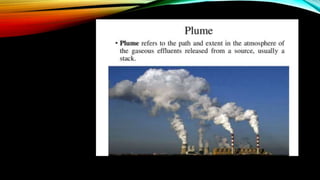
o Basic Mechanisms in the Movement of a Plume
• Advection
• Dispersion
o Treatment of Concentration Field
• Theoretical Approach
• Statistical theory
• Similarit y theory
• K-Theo ry Models
• Higher Order Closure Models
• Experimental Approach
Wind tunnel/ Water tank
• Field Studies (Expensive, Time Consuming & Limitation of Instrumentation )
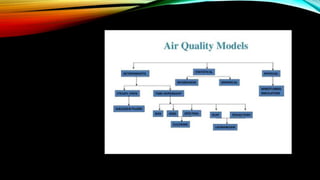
TYPES OF AIR QUALITY MODELS
o Types of air quality models
• Emission rate Modeling
• Ambient Air Concentration Modeling
o Types of ground level concentration models
• Physical Model/ Mathematical Model
• Historical Model
• Trend Model
• Prototype Model
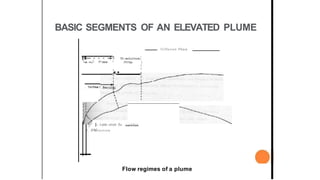
BASIC SEGMENTS OF AN ELEVATED PLUME
lliffusion Phasa
I
t.:nL. t1a1 ?h ase
,
.
' . I
!
1
o
1
l
!
.--- - - - ---l--1 Tl:anliition,
Pi111se I
I
I
, TbcTma.1
, '
_
-- [- ient- over Ju
•
_ .J1'ltfs e c t i o n
Flow regimes of a plume
BASIC SEGMENTS OF AN ELEVATED PLUME
o Initial phase
• Vertical Jet : Effluents are not deflected immediately upon entering the cross flow if
(Vs/ U> 4)
• Bent-Over Jet Section : Entrainment of the cross flow is rapid because by this time
appreciable growth of vortices has taken place.
• Thermal Section : Self generated turbulence causes mixing and determines the
growth of plume.
o Transition phase
• Plume's internal turbulence levels have dropped enough so that the atmospheric
eddies in the inertial sub range determines the plume's growth.
o Diffusion phase
• The plume's own turbulence has dropped and energy containing eddies of
atmospheric turbulence determine the growth of plume
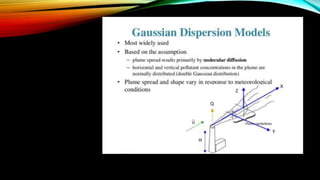
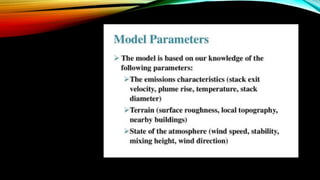
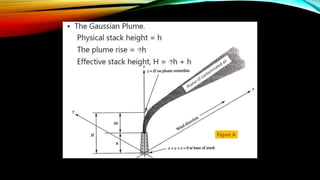
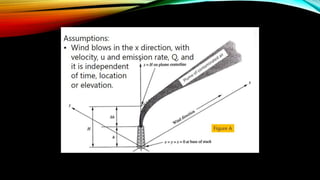
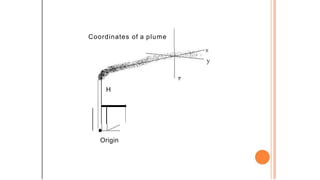
Coordinates of a plume
X
y
H
Origin
DISPERSION OF HEAVY GASES
o Initial Acceleration Phase
o Initial Dilution Phase
o Slumping Phase (internal buoyancy-dominated dispersion )
o Transition Phase
o Passive Phase ( atmospheric turbulence-dominated
dispersion )
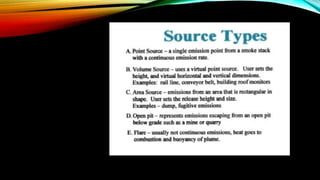
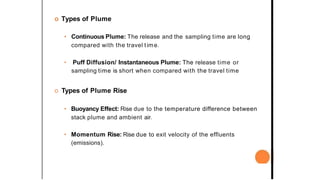
o Types of Plume
• Continuous Plume: The release and the sampling time are long
compared with the travel time.
• Puff Diffusion/ Instantaneous Plume: The release time or
sampling time is short when compared with the travel time
o Types of Plume Rise
• Buoyancy Effect: Rise due to the temperature difference between
stack plume and ambient air.
• Momentum Rise: Rise due to exit velocity of the effluents
(emissions).
CONCEPT OF PLUME PENETRATION
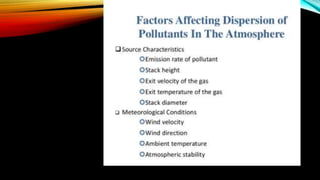
o Meteorology plays an important role in the dispersion of
effluents.
o Various meteorological factors affect the dispersion of
emission into the atmosphere in a variety of ways.
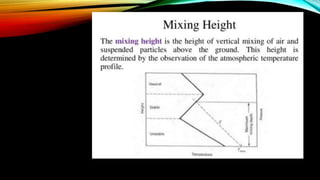
o Convective boundary layer (or mixing height) is one of
the most important meteorological variables responsible
for high ground level concentrations.
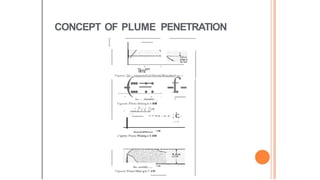
CONCEPT OF PLUME PENETRATION
I
T
ime"'°"'
II II
Figurea; Do-..,iopmeotoft.beThorma!BouudaryLay,,r
-
(
:::=
:: -f.-
J. ,
_ 1
J • .
-
I
Do.-.....DataDa! _.
Figureb: Plwne Miltingat 6 AM
. ..::
:.{
?i/i
i }
{
::
-
.·
•
:
,
···· --- ;l
c;
,1,13 4·1
J.'gorec: Plume Mimlgat 8 AM
Do.-awildO..-...
Figured: Plume Mixii:,gAt 9 AM
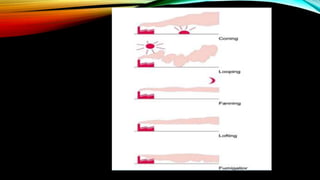
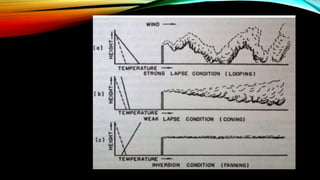
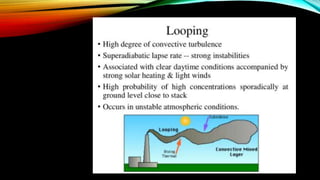
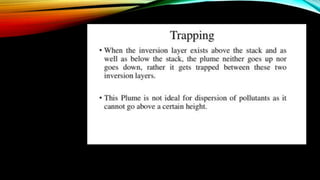
EFFECT OF TEMPERATURE PROFILE ON PLUME RISE
E N V I R O N M E N T AL L AP S E R A T E
A D I A B A T I C L A P S E R A T E
L O O P I N G
--- C O N I N G
§ f
·=
] ,_ .......;
..,,. _
'


T e r np. Te1:np.
F A N N I N G


L F I
N I N
T R A P P I N G
TcIDp . Te m p .
N o t e : F o llo w in g H e n r y a n d H c i n c k c ( 19 9 6 )
PLUME RISE MODELS
o Semi empirical equations based on heat flux
o Analytical solutions
o Numerical models
air pollution
air pollution
air pollution
air pollution
air pollution
air pollution
air pollution
air pollution
air pollution
air pollution
air pollution
air pollution
air pollution
air pollution

air pollution

  • 1.
  • 90.
  • 96.
    PURPOSE OF AIRQUALITY MODELING o Policy Analysis o Regional Planning o Supplementary Control Systems/ Air Quality Prediction System o Emergency Preparedness/ Accidental Releases o Long Range Transport (Acid Rain) o State Implementation Plan Revisions/ New Source Review o Prevention of Significant Deterioration ( PSD )
  • 97.
    ATMOSPHERIC TRANSPORT o BasicMechanisms in the Movement of a Plume • Advection • Dispersion o Treatment of Concentration Field • Theoretical Approach • Statistical theory • Similarit y theory • K-Theo ry Models • Higher Order Closure Models • Experimental Approach Wind tunnel/ Water tank • Field Studies (Expensive, Time Consuming & Limitation of Instrumentation )
  • 98.
    TYPES OF AIRQUALITY MODELS o Types of air quality models • Emission rate Modeling • Ambient Air Concentration Modeling o Types of ground level concentration models • Physical Model/ Mathematical Model • Historical Model • Trend Model • Prototype Model
  • 99.
    BASIC SEGMENTS OFAN ELEVATED PLUME lliffusion Phasa I t.:nL. t1a1 ?h ase , . ' . I ! 1 o 1 l ! .--- - - - ---l--1 Tl:anliition, Pi111se I I I , TbcTma.1 , ' _ -- [- ient- over Ju • _ .J1'ltfs e c t i o n Flow regimes of a plume
  • 100.
    BASIC SEGMENTS OFAN ELEVATED PLUME o Initial phase • Vertical Jet : Effluents are not deflected immediately upon entering the cross flow if (Vs/ U> 4) • Bent-Over Jet Section : Entrainment of the cross flow is rapid because by this time appreciable growth of vortices has taken place. • Thermal Section : Self generated turbulence causes mixing and determines the growth of plume. o Transition phase • Plume's internal turbulence levels have dropped enough so that the atmospheric eddies in the inertial sub range determines the plume's growth. o Diffusion phase • The plume's own turbulence has dropped and energy containing eddies of atmospheric turbulence determine the growth of plume
  • 101.
    Coordinates of aplume X y H Origin
  • 102.
    DISPERSION OF HEAVYGASES o Initial Acceleration Phase o Initial Dilution Phase o Slumping Phase (internal buoyancy-dominated dispersion ) o Transition Phase o Passive Phase ( atmospheric turbulence-dominated dispersion )
  • 103.
    o Types ofPlume • Continuous Plume: The release and the sampling time are long compared with the travel time. • Puff Diffusion/ Instantaneous Plume: The release time or sampling time is short when compared with the travel time o Types of Plume Rise • Buoyancy Effect: Rise due to the temperature difference between stack plume and ambient air. • Momentum Rise: Rise due to exit velocity of the effluents (emissions).
  • 104.
    CONCEPT OF PLUMEPENETRATION o Meteorology plays an important role in the dispersion of effluents. o Various meteorological factors affect the dispersion of emission into the atmosphere in a variety of ways. o Convective boundary layer (or mixing height) is one of the most important meteorological variables responsible for high ground level concentrations.
  • 105.
    CONCEPT OF PLUMEPENETRATION I T ime"'°"' II II Figurea; Do-..,iopmeotoft.beThorma!BouudaryLay,,r - ( :::= :: -f.- J. , _ 1 J • . - I Do.-.....DataDa! _. Figureb: Plwne Miltingat 6 AM . ..:: :.{ ?i/i i } { :: - .· • : , ···· --- ;l c; ,1,13 4·1 J.'gorec: Plume Mimlgat 8 AM Do.-awildO..-... Figured: Plume Mixii:,gAt 9 AM
  • 106.
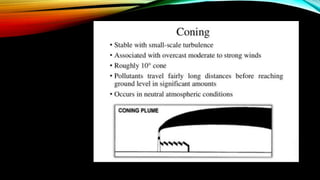
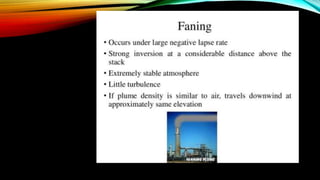
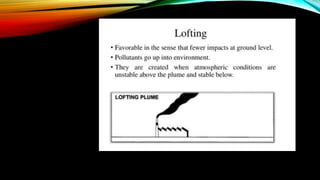
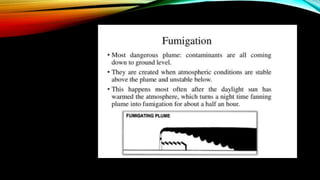
    EFFECT OF TEMPERATUREPROFILE ON PLUME RISE E N V I R O N M E N T AL L AP S E R A T E A D I A B A T I C L A P S E R A T E L O O P I N G --- C O N I N G § f ·= ] ,_ .......; ..,,. _ ' T e r np. Te1:np. F A N N I N G L F I N I N T R A P P I N G TcIDp . Te m p . N o t e : F o llo w in g H e n r y a n d H c i n c k c ( 19 9 6 )
  • 107.
    PLUME RISE MODELS oSemi empirical equations based on heat flux o Analytical solutions o Numerical models