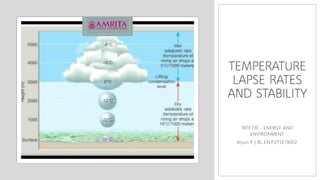
TEMPERATURE
LAPSE RATES
AND STABILITY
18TE710 - ENERGY AND
ENVIRONMENT
Arjun P | BL.EN.P2TSE19002
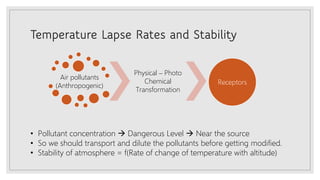
Temperature Lapse Rates and Stability
Air pollutants
(Anthropogenic)
Physical – Photo
Chemical
Transformation
Receptors
• Pollutant concentration → Dangerous Level → Near the source
• So we should transport and dilute the pollutants before getting modified.
• Stability of atmosphere = f(Rate of change of temperature with altitude)
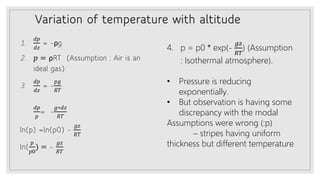
Variation of temperature with altitude
1.
𝑑𝑝
𝑑𝑧
= -ρg
2. 𝑝 = ρRT (Assumption : Air is an
ideal gas)
3.
𝑑𝑝
𝑑𝑧
= -
𝑝𝑔
𝑅𝑇
𝑑𝑝
𝑝
= -
𝑔∗𝑑𝑧
𝑅𝑇
ln(p) =ln(p0) -
𝑔𝑧
𝑅𝑇
ln(
𝑝
𝑝0
) = -
𝑔𝑧
𝑅𝑇
4. p = p0 * exp(-
𝑔𝑧
𝑅𝑇
) (Assumption
: Isothermal atmosphere).
• Pressure is reducing
exponentially.
• But observation is having some
discrepancy with the modal
Assumptions were wrong (:p)
– stripes having uniform
thickness but different temperature
Most general case : -Assume
polytropic atmosphere
1.
𝑑𝑝
𝑑𝑧
= -ρg
2. 𝑝 = ρRT (Assumption : Air is an ideal gas)
3.
𝑑𝑝
𝑑𝑧
= -
𝑝𝑔
𝑅𝑇
4. (
𝑇
𝑇𝑂
)
𝑛
𝑛−1 =
𝑝
𝑝𝑜
5. (𝑇)
𝑛
𝑛−1 = p* C
Substitute eqn (5) for p in eqn
(3)
𝑑
𝑑𝑧
( 𝑇
𝑛
𝑛−1 ) = -
𝑔
𝑅𝑇
∗ 𝑇
𝑛
𝑛−1
(
𝑛
𝑛−1
) 𝑇
𝑛
𝑛−1
−1
∗
𝑑𝑇
𝑑𝑧
= -
𝑔
𝑅
∗ 𝑇
𝑛
𝑛−1
−1
6.
𝒅𝑻
𝒅𝒛
= - (
𝒏
𝒏−𝟏
)*
𝒈
𝑹
➔ Temperature Lapse Rate.
Up to 10 km – Temperature variation is found to be linear = 6.5
degree Celsius per kilometre
6.5
1000
= (𝑛/(𝑛 − 1)) ∗ 𝑔/𝑅 ➔ n = 1.23
Occurs in lower atmosphere
At lower stratosphere iso thermal modal is valid.
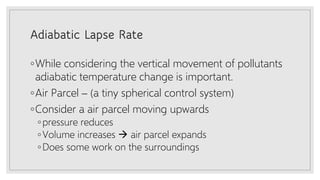
◦While considering the vertical movement of pollutants
adiabatic temperature change is important.
◦Air Parcel – (a tiny spherical control system)
◦Consider a air parcel moving upwards
◦pressure reduces
◦Volume increases → air parcel expands
◦Does some work on the surroundings
Adiabatic Lapse Rate
If air contains moisture
◦ In the presence of moisture in the atmosphere a rising air parcel may cool
until the partial pressure of water vapour becomes equal to saturation
pressure of water.
◦ If sufficient nucleation sites are present water will get condensed, and heat
will be liberated
𝑑𝑄 = − ⅆ𝑄 = −𝜆𝑚 ⅆ𝜔
𝜆 → latent heat per gram
m → mass of dry air in air
parcel in gram
𝜔→
𝑚𝑎𝑠𝑠 𝑜𝑓 𝑤𝑎𝑡𝑒𝑟 𝑣𝑎𝑝𝑜𝑢𝑟
𝑚𝑎𝑠𝑠 𝑜𝑓 𝑑𝑟𝑦 𝑎𝑖𝑟
Q -dW = dU
𝜆ⅆ𝜔 + pdv + CvdT = 0
𝜆ⅆ𝜔 + (Cv+ R)*dT = vdp
𝑑𝑇
𝑑𝑧
=
−𝑔
𝐶 𝑝
-
𝜆
𝐶 𝑝
𝑑𝜔
𝑑𝑧
- Wet adiabatic laps rate
◦
𝑑𝑇
𝑑𝑧
=
−𝑔
𝐶 𝑝
-
𝜆
𝐶 𝑝
𝑑𝜔
𝑑𝑧
◦ Condensing water is having negligible effect -
𝑑𝜔
𝑑𝑧
is +ve
◦ Last term of the equation is +ve
◦ Temperature drop of moist air will be less than that of dry air as the altitude
increases.
◦ Saturation vapour pressure of water increases rapidly with temperature →
𝑑𝜔
𝑑𝑧
depends on temperature → WALR is not a constant, and independent of
altitude.
◦ In warm tropical region the wet adiabatic laps rate is one third of dry
adiabatic laps rate.
Environmental and Adiabatic lapse rates
◦ The environmental lapse rate - temperature drop with altitude - in
the troposphere; that is the temperature of the environment at different
altitudes.
◦ It implies no air movement.
◦ Adiabatic lapse rate is associated only with ascending air, which cools by
expansion.
Atmospheric stability
◦ Dispersion of pollutants in the
atmosphere is a function of stability.
◦ Comparison between adiabatic and
environmental lapse rate → stability
◦ When both of them are equal air
parcel and its surroundings will be
having same pressure temperature
and density → no buoyant force →
neutrally stable.
◦ If environmental lapse rate > dry adiabatic lapse rate ➔ Super adiabatic
◦ Rising Air parcel will be hotter than surroundings → more buoyant force
→ moves further upwards → unstable.
◦ Instability increases ➔ vertical movement increases ➔ enhanced
mixing➔ reducing concentration ➔ Pollution intensity is reduced.
◦ If environmental lapse rate < dry adiabatic lapse rate ➔ Sub adiabatic
◦ Rising Air parcel will be cooler and dense than surroundings → tend to
fall back → unstable.
◦ Limited vertical mixing ➔ enhances the rate of pollution.
◦ Consider saturated atmosphere – stability and instability →
neutrally stable atmosphere.
◦ Absolute instability → environmental laps rate > dry adiabatic
laps rate
◦ Absolute stability → environmental laps rate < wet adiabatic laps
rate
◦ Conditional stability →WALR < ELR < DALR
◦ Inversion → extreme case of stability →
𝑑𝑇
𝑑𝑧
> 0 → negative lapse
rate
◦ Atmosphere → stable → no mixing
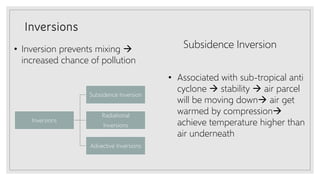
Inversions
• Inversion prevents mixing →
increased chance of pollution
Inversions
Subsidence Inversion
Radiational
Inversions
Advective Inversions
Subsidence Inversion
• Associated with sub-tropical anti
cyclone → stability → air parcel
will be moving down→ air get
warmed by compression→
achieve temperature higher than
air underneath
• If ΔT is sufficient → Inversion.
• Subsidence is caused by air flowing down to replace air which has
flowed out of the high pressure region
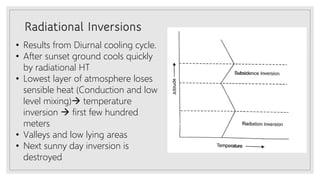
Radiational Inversions
• Results from Diurnal cooling cycle.
• After sunset ground cools quickly
by radiational HT
• Lowest layer of atmosphere loses
sensible heat (Conduction and low
level mixing)→ temperature
inversion → first few hundred
meters
• Valleys and low lying areas
• Next sunny day inversion is
destroyed
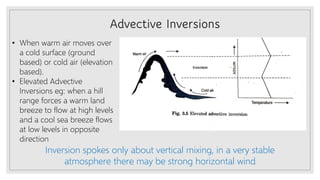
Advective Inversions
• When warm air moves over
a cold surface (ground
based) or cold air (elevation
based).
• Elevated Advective
Inversions eg: when a hill
range forces a warm land
breeze to flow at high levels
and a cool sea breeze flows
at low levels in opposite
direction
Inversion spokes only about vertical mixing, in a very stable
atmosphere there may be strong horizontal wind
Thank You

Temperature lapse rates

  • 1.
    TEMPERATURE LAPSE RATES AND STABILITY 18TE710- ENERGY AND ENVIRONMENT Arjun P | BL.EN.P2TSE19002
  • 2.
    Temperature Lapse Ratesand Stability Air pollutants (Anthropogenic) Physical – Photo Chemical Transformation Receptors • Pollutant concentration → Dangerous Level → Near the source • So we should transport and dilute the pollutants before getting modified. • Stability of atmosphere = f(Rate of change of temperature with altitude)
  • 3.
    Variation of temperaturewith altitude 1. 𝑑𝑝 𝑑𝑧 = -ρg 2. 𝑝 = ρRT (Assumption : Air is an ideal gas) 3. 𝑑𝑝 𝑑𝑧 = - 𝑝𝑔 𝑅𝑇 𝑑𝑝 𝑝 = - 𝑔∗𝑑𝑧 𝑅𝑇 ln(p) =ln(p0) - 𝑔𝑧 𝑅𝑇 ln( 𝑝 𝑝0 ) = - 𝑔𝑧 𝑅𝑇 4. p = p0 * exp(- 𝑔𝑧 𝑅𝑇 ) (Assumption : Isothermal atmosphere). • Pressure is reducing exponentially. • But observation is having some discrepancy with the modal Assumptions were wrong (:p) – stripes having uniform thickness but different temperature
  • 4.
    Most general case: -Assume polytropic atmosphere 1. 𝑑𝑝 𝑑𝑧 = -ρg 2. 𝑝 = ρRT (Assumption : Air is an ideal gas) 3. 𝑑𝑝 𝑑𝑧 = - 𝑝𝑔 𝑅𝑇 4. ( 𝑇 𝑇𝑂 ) 𝑛 𝑛−1 = 𝑝 𝑝𝑜 5. (𝑇) 𝑛 𝑛−1 = p* C Substitute eqn (5) for p in eqn (3) 𝑑 𝑑𝑧 ( 𝑇 𝑛 𝑛−1 ) = - 𝑔 𝑅𝑇 ∗ 𝑇 𝑛 𝑛−1 ( 𝑛 𝑛−1 ) 𝑇 𝑛 𝑛−1 −1 ∗ 𝑑𝑇 𝑑𝑧 = - 𝑔 𝑅 ∗ 𝑇 𝑛 𝑛−1 −1 6. 𝒅𝑻 𝒅𝒛 = - ( 𝒏 𝒏−𝟏 )* 𝒈 𝑹 ➔ Temperature Lapse Rate. Up to 10 km – Temperature variation is found to be linear = 6.5 degree Celsius per kilometre 6.5 1000 = (𝑛/(𝑛 − 1)) ∗ 𝑔/𝑅 ➔ n = 1.23 Occurs in lower atmosphere
  • 6.
    At lower stratosphereiso thermal modal is valid.
  • 7.
    ◦While considering thevertical movement of pollutants adiabatic temperature change is important. ◦Air Parcel – (a tiny spherical control system) ◦Consider a air parcel moving upwards ◦pressure reduces ◦Volume increases → air parcel expands ◦Does some work on the surroundings Adiabatic Lapse Rate
  • 9.
    If air containsmoisture ◦ In the presence of moisture in the atmosphere a rising air parcel may cool until the partial pressure of water vapour becomes equal to saturation pressure of water. ◦ If sufficient nucleation sites are present water will get condensed, and heat will be liberated 𝑑𝑄 = − ⅆ𝑄 = −𝜆𝑚 ⅆ𝜔 𝜆 → latent heat per gram m → mass of dry air in air parcel in gram 𝜔→ 𝑚𝑎𝑠𝑠 𝑜𝑓 𝑤𝑎𝑡𝑒𝑟 𝑣𝑎𝑝𝑜𝑢𝑟 𝑚𝑎𝑠𝑠 𝑜𝑓 𝑑𝑟𝑦 𝑎𝑖𝑟 Q -dW = dU 𝜆ⅆ𝜔 + pdv + CvdT = 0 𝜆ⅆ𝜔 + (Cv+ R)*dT = vdp 𝑑𝑇 𝑑𝑧 = −𝑔 𝐶 𝑝 - 𝜆 𝐶 𝑝 𝑑𝜔 𝑑𝑧 - Wet adiabatic laps rate
  • 10.
    ◦ 𝑑𝑇 𝑑𝑧 = −𝑔 𝐶 𝑝 - 𝜆 𝐶 𝑝 𝑑𝜔 𝑑𝑧 ◦Condensing water is having negligible effect - 𝑑𝜔 𝑑𝑧 is +ve ◦ Last term of the equation is +ve ◦ Temperature drop of moist air will be less than that of dry air as the altitude increases. ◦ Saturation vapour pressure of water increases rapidly with temperature → 𝑑𝜔 𝑑𝑧 depends on temperature → WALR is not a constant, and independent of altitude. ◦ In warm tropical region the wet adiabatic laps rate is one third of dry adiabatic laps rate.
  • 11.
    Environmental and Adiabaticlapse rates ◦ The environmental lapse rate - temperature drop with altitude - in the troposphere; that is the temperature of the environment at different altitudes. ◦ It implies no air movement. ◦ Adiabatic lapse rate is associated only with ascending air, which cools by expansion.
  • 12.
    Atmospheric stability ◦ Dispersionof pollutants in the atmosphere is a function of stability. ◦ Comparison between adiabatic and environmental lapse rate → stability ◦ When both of them are equal air parcel and its surroundings will be having same pressure temperature and density → no buoyant force → neutrally stable.
  • 13.
    ◦ If environmentallapse rate > dry adiabatic lapse rate ➔ Super adiabatic ◦ Rising Air parcel will be hotter than surroundings → more buoyant force → moves further upwards → unstable. ◦ Instability increases ➔ vertical movement increases ➔ enhanced mixing➔ reducing concentration ➔ Pollution intensity is reduced. ◦ If environmental lapse rate < dry adiabatic lapse rate ➔ Sub adiabatic ◦ Rising Air parcel will be cooler and dense than surroundings → tend to fall back → unstable. ◦ Limited vertical mixing ➔ enhances the rate of pollution.
  • 14.
    ◦ Consider saturatedatmosphere – stability and instability → neutrally stable atmosphere. ◦ Absolute instability → environmental laps rate > dry adiabatic laps rate ◦ Absolute stability → environmental laps rate < wet adiabatic laps rate ◦ Conditional stability →WALR < ELR < DALR ◦ Inversion → extreme case of stability → 𝑑𝑇 𝑑𝑧 > 0 → negative lapse rate ◦ Atmosphere → stable → no mixing
  • 15.
    Inversions • Inversion preventsmixing → increased chance of pollution Inversions Subsidence Inversion Radiational Inversions Advective Inversions Subsidence Inversion • Associated with sub-tropical anti cyclone → stability → air parcel will be moving down→ air get warmed by compression→ achieve temperature higher than air underneath
  • 16.
    • If ΔTis sufficient → Inversion. • Subsidence is caused by air flowing down to replace air which has flowed out of the high pressure region
  • 17.
    Radiational Inversions • Resultsfrom Diurnal cooling cycle. • After sunset ground cools quickly by radiational HT • Lowest layer of atmosphere loses sensible heat (Conduction and low level mixing)→ temperature inversion → first few hundred meters • Valleys and low lying areas • Next sunny day inversion is destroyed
  • 18.
    Advective Inversions • Whenwarm air moves over a cold surface (ground based) or cold air (elevation based). • Elevated Advective Inversions eg: when a hill range forces a warm land breeze to flow at high levels and a cool sea breeze flows at low levels in opposite direction Inversion spokes only about vertical mixing, in a very stable atmosphere there may be strong horizontal wind
  • 19.