Unit – 4
(CONTROL OF GASEOUS CONTAMINANTS)
Factors affecting Selection of Control Equipment – Working
principle, Design and performance equations of absorption,
Adsorption, condensation, Incineration, Bio scrubbers, Bio filters –
Process control and Monitoring – Operational Considerations.
GASEOUS CONTAMINANTS
• Gaseous criteria pollutants, as well as volatile organic compounds
(VOCs) and other gaseous air toxics, are controlled by means of three
basic techniques:
• Absorption
• Adsorption and
• Incineration (or combustion)
These techniques can be employed singly or in combination.
Factors affecting Selection of Control Equipment
• It includes the temperature, pressure, density, viscosity. Process
factors:
• It includes the flow variability
• Volumetric gas rate
• Particulate concentration rate and
• Allowable pressure drop
Absorption
• Absorption or gas absorption is a unit operation used in the chemical
industry to separate gases by washing or scrubbing a gas mixture with
a suitable liquid.
• The removal of one or more selected components from a gas mixture
by absorption is probably the most important operation in the control
of gaseous pollutant emissions.
• Absorption is a process in which a gaseous pollutant is dissolved in a
liquid.
• Water is the most commonly used absorbent liquid.
Principle
• The fundamental physical underlying the process of gas absorption are
the solubility of the absorbed gas and the rate of mass transfer.
• One or more of the constituents of the gas mixture dissolves or
absorbed in the liquid and can thus be removed from the mixture.
• In some systems, this gaseous constituent forms a physical solution
with the liquid or the solvent, and in other cases, it reacts with liquid
chemically.
Purpose of such scrubbing operations may be
any of the following:
• Gas purification (eg, removal of air pollutants from exhausts gases or
contaminants from gases that will be further processes),
• Product recovery, or production of solutions of gases for various
purposes.
• The absorber may be a packed column, plate column, spray column,
venture scrubber, bubble column, falling films, wet scrubbers, stirred
tanks.
• Gas absorption is usually carried out in vertical counter current
columns.
• The solvent is fed at the top of the absorber, whereas the gas mixture
enters from the bottom.
• The absorbed substance is washed out by the solvent and leaves the
absorber at the bottom as a liquid solution.
• The solvent us often recovered in subsequent stripping or desorption
operation. This second step is essentially the reverse of absorption and
involves counter current contacting of the liquid loaded with solute
using and inert gas or water vapor.
Factors
• Gas solubility (high, increasing the rate of absorption and decreasing
the quantity of solvent required).
• Volatility (solvent should have a low vapor pressure to reduce loss of
solvent in the gas leaving an absorption column)
• Corrosiveness (materials of construction required for the equipment
should not be unusual or expensive)
• Cost (materials of construction required for the equipment should not
be unusual or expensive)
• Viscosity (low – reasons of rapid absorption rates, low pressure drops
in pumping, and good heat transfer characteristics)
• The solvent should be non-toxic, non-flammable and chemically
stable.
Adsorption
Adsorption is used when
• The pollutant gas is incombustible or difficult to burn
• The pollutant is sufficiently valuable to warrant recovery
• The pollutant is in very dilute concentration in the exhaust system
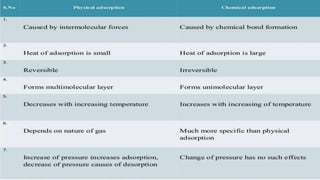
• There are two types of adsorption
• Physical and chemical
Adsorption Equilibrium
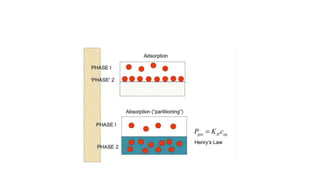
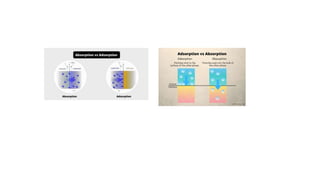
• Adsorption vs. Absorption
• Adsorption is accumulation of molecules on a surface (a surface layer
of molecules) in contact with an air or water phase
• Adsorption is dissolution of molecules within a phase, e.g., within an
organic phase in contact with an air or water phase.
• Adsorbate: material being adsorbed
• Adsorbent: material doing the absorbing. (examples are activated
carbon or ion exchange resin).
Factors influencing adsorption
Adsorption of gases by solids
• Adsorption and surface area (depends on the surface area)
• Nature of gas (amount of gas adsorbed by the solid depends on the
nature of the gas)
• Heats of adsorption
• Reversible character (physical adsorption is reversible process, by
which gas adsorbed onto a solid can be removed under reverse
conditions of temperature and pressure)
• Effect of temperature
• Effect of pressure (pressure leads to increase of adsorption and decrease
of pressure causes desorption)
• Thickness of adsorbed layer of gas
Absorption and biofiltration
• Gaseous contaminants that are soluble in aqueous liquids can be
removed in absorbers.
• This is one of the main mechanisms used for the removal of acid gas
compounds (e.g. sulphur dioxide, hydrogen chloride, and hydrogen
fluoride)
• Water soluble organic compounds (e.g. alcohols, aldehydes, organic
acids)
• The two fundamental process
• Simple dissolution systems
• Irreversible chemical reaction
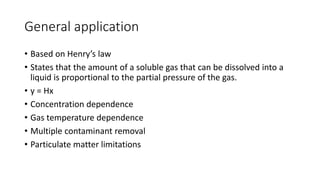
General application
• Based on Henry’s law
• States that the amount of a soluble gas that can be dissolved into a
liquid is proportional to the partial pressure of the gas.
• y = Hx
• Concentration dependence
• Gas temperature dependence
• Multiple contaminant removal
• Particulate matter limitations
Oxidation
• Oxidizers can be used for the destruction of a wide variety of organic
compounds
• Thermal oxidizers
• Catalytic oxidizers
• Flares (used primarily to treat emergency vent gases in synthetic
organic chemical plants and petroleum refiners)
Condensation
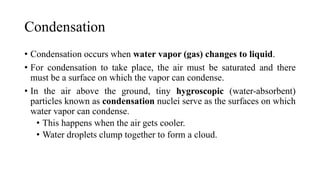
• Condensation occurs when water vapor (gas) changes to liquid.
• For condensation to take place, the air must be saturated and there
must be a surface on which the vapor can condense.
• In the air above the ground, tiny hygroscopic (water-absorbent)
particles known as condensation nuclei serve as the surfaces on which
water vapor can condense.
• This happens when the air gets cooler.
• Water droplets clump together to form a cloud.
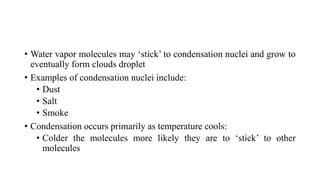
• Water vapor molecules may ‘stick’ to condensation nuclei and grow to
eventually form clouds droplet
• Examples of condensation nuclei include:
• Dust
• Salt
• Smoke
• Condensation occurs primarily as temperature cools:
• Colder the molecules more likely they are to ‘stick’ to other
molecules
• Condensation
• Process when water vapor goes from a gas to liquid.
• Cloud
• A collection of millions of tiny water droplets or ice crystals.
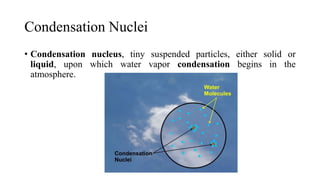
Condensation Nuclei
• Condensation nucleus, tiny suspended particles, either solid or
liquid, upon which water vapor condensation begins in the
atmosphere.
Combustion
• A chemical process in which a substance reacts with the oxygen of air
to give heat and light is called combustion.
• In many cases it is not possible to remove the required amount of
specific pollutant from an exhaust stream by techniques such as
absorption or adsorption.
• Combustion refers to rapid oxidation of substances (usually referred as
fuels) with evolution of heat.
Incineration
• A waste treatment technology, which includes the combustion of
waste for recovering energy, is called as “incineration”.
• Incineration coupled with high temperature waste treatments are
recognized as thermal treatments. Incineration of waste materials
converts the waste into ash, flue gas and heat.
• Incineration of waste materials concerts the waste into ash, flue gas
and heat.
Incineration objectives
• Volume reduction
• Stabilization of waste
• Recovery of energy from waste (EFW)
• Sterilization of waste

Unit 4.pptx

  • 1.
    Unit – 4 (CONTROLOF GASEOUS CONTAMINANTS) Factors affecting Selection of Control Equipment – Working principle, Design and performance equations of absorption, Adsorption, condensation, Incineration, Bio scrubbers, Bio filters – Process control and Monitoring – Operational Considerations.
  • 2.
    GASEOUS CONTAMINANTS • Gaseouscriteria pollutants, as well as volatile organic compounds (VOCs) and other gaseous air toxics, are controlled by means of three basic techniques: • Absorption • Adsorption and • Incineration (or combustion) These techniques can be employed singly or in combination.
  • 3.
    Factors affecting Selectionof Control Equipment • It includes the temperature, pressure, density, viscosity. Process factors: • It includes the flow variability • Volumetric gas rate • Particulate concentration rate and • Allowable pressure drop
  • 4.
    Absorption • Absorption orgas absorption is a unit operation used in the chemical industry to separate gases by washing or scrubbing a gas mixture with a suitable liquid. • The removal of one or more selected components from a gas mixture by absorption is probably the most important operation in the control of gaseous pollutant emissions. • Absorption is a process in which a gaseous pollutant is dissolved in a liquid. • Water is the most commonly used absorbent liquid.
  • 5.
    Principle • The fundamentalphysical underlying the process of gas absorption are the solubility of the absorbed gas and the rate of mass transfer. • One or more of the constituents of the gas mixture dissolves or absorbed in the liquid and can thus be removed from the mixture. • In some systems, this gaseous constituent forms a physical solution with the liquid or the solvent, and in other cases, it reacts with liquid chemically.
  • 6.
    Purpose of suchscrubbing operations may be any of the following: • Gas purification (eg, removal of air pollutants from exhausts gases or contaminants from gases that will be further processes), • Product recovery, or production of solutions of gases for various purposes. • The absorber may be a packed column, plate column, spray column, venture scrubber, bubble column, falling films, wet scrubbers, stirred tanks.
  • 7.
    • Gas absorptionis usually carried out in vertical counter current columns. • The solvent is fed at the top of the absorber, whereas the gas mixture enters from the bottom. • The absorbed substance is washed out by the solvent and leaves the absorber at the bottom as a liquid solution. • The solvent us often recovered in subsequent stripping or desorption operation. This second step is essentially the reverse of absorption and involves counter current contacting of the liquid loaded with solute using and inert gas or water vapor.
  • 8.
    Factors • Gas solubility(high, increasing the rate of absorption and decreasing the quantity of solvent required). • Volatility (solvent should have a low vapor pressure to reduce loss of solvent in the gas leaving an absorption column) • Corrosiveness (materials of construction required for the equipment should not be unusual or expensive) • Cost (materials of construction required for the equipment should not be unusual or expensive) • Viscosity (low – reasons of rapid absorption rates, low pressure drops in pumping, and good heat transfer characteristics) • The solvent should be non-toxic, non-flammable and chemically stable.
  • 9.
    Adsorption Adsorption is usedwhen • The pollutant gas is incombustible or difficult to burn • The pollutant is sufficiently valuable to warrant recovery • The pollutant is in very dilute concentration in the exhaust system • There are two types of adsorption • Physical and chemical
  • 10.
    Adsorption Equilibrium • Adsorptionvs. Absorption • Adsorption is accumulation of molecules on a surface (a surface layer of molecules) in contact with an air or water phase • Adsorption is dissolution of molecules within a phase, e.g., within an organic phase in contact with an air or water phase. • Adsorbate: material being adsorbed • Adsorbent: material doing the absorbing. (examples are activated carbon or ion exchange resin).
  • 13.
    Factors influencing adsorption Adsorptionof gases by solids • Adsorption and surface area (depends on the surface area) • Nature of gas (amount of gas adsorbed by the solid depends on the nature of the gas) • Heats of adsorption • Reversible character (physical adsorption is reversible process, by which gas adsorbed onto a solid can be removed under reverse conditions of temperature and pressure) • Effect of temperature • Effect of pressure (pressure leads to increase of adsorption and decrease of pressure causes desorption) • Thickness of adsorbed layer of gas
  • 14.
    Absorption and biofiltration •Gaseous contaminants that are soluble in aqueous liquids can be removed in absorbers. • This is one of the main mechanisms used for the removal of acid gas compounds (e.g. sulphur dioxide, hydrogen chloride, and hydrogen fluoride) • Water soluble organic compounds (e.g. alcohols, aldehydes, organic acids) • The two fundamental process • Simple dissolution systems • Irreversible chemical reaction
  • 15.
    General application • Basedon Henry’s law • States that the amount of a soluble gas that can be dissolved into a liquid is proportional to the partial pressure of the gas. • y = Hx • Concentration dependence • Gas temperature dependence • Multiple contaminant removal • Particulate matter limitations
  • 16.
    Oxidation • Oxidizers canbe used for the destruction of a wide variety of organic compounds • Thermal oxidizers • Catalytic oxidizers • Flares (used primarily to treat emergency vent gases in synthetic organic chemical plants and petroleum refiners)
  • 18.
    Condensation • Condensation occurswhen water vapor (gas) changes to liquid. • For condensation to take place, the air must be saturated and there must be a surface on which the vapor can condense. • In the air above the ground, tiny hygroscopic (water-absorbent) particles known as condensation nuclei serve as the surfaces on which water vapor can condense. • This happens when the air gets cooler. • Water droplets clump together to form a cloud.
  • 19.
    • Water vapormolecules may ‘stick’ to condensation nuclei and grow to eventually form clouds droplet • Examples of condensation nuclei include: • Dust • Salt • Smoke • Condensation occurs primarily as temperature cools: • Colder the molecules more likely they are to ‘stick’ to other molecules
  • 20.
    • Condensation • Processwhen water vapor goes from a gas to liquid. • Cloud • A collection of millions of tiny water droplets or ice crystals.
  • 21.
    Condensation Nuclei • Condensationnucleus, tiny suspended particles, either solid or liquid, upon which water vapor condensation begins in the atmosphere.
  • 22.
    Combustion • A chemicalprocess in which a substance reacts with the oxygen of air to give heat and light is called combustion. • In many cases it is not possible to remove the required amount of specific pollutant from an exhaust stream by techniques such as absorption or adsorption. • Combustion refers to rapid oxidation of substances (usually referred as fuels) with evolution of heat.
  • 23.
    Incineration • A wastetreatment technology, which includes the combustion of waste for recovering energy, is called as “incineration”. • Incineration coupled with high temperature waste treatments are recognized as thermal treatments. Incineration of waste materials converts the waste into ash, flue gas and heat. • Incineration of waste materials concerts the waste into ash, flue gas and heat.
  • 24.
    Incineration objectives • Volumereduction • Stabilization of waste • Recovery of energy from waste (EFW) • Sterilization of waste