A SEMINAR
ON
AIR POLLUTION AND ITS CONTROL THROUGH
BIOTECHNOLOGY
BY-
MISS. HUMA NAZ SIDDIQU
(ASST. PROF.)
G.D. RUNGTA COLLEGE OF SCIENCE AND TECHNOLOGY
KOHKA KURUD ROAD BHILAI, 490023
1
AIR POLLUTION AND ITS CONTROL
S
Y
N
O
P
S
I
S
INTRODUCTION
AIR POLLUTANTS
METHOD FOR ESTIMATION OF POLLUTANTS
METHOD USED FOR AIR POLLUTION CONTROL
THROUGH BIOTECHNOLOGY
BIOTECHNOLOGY METHODS FOR MANAGEMENT
OF POLLUTION
SUMMARY
CONCLUSION
REFERENCE 2
AIR POLLUTION AND ITS CONTROL
I
N
T
R
O
D
U
C
T
I
O
N
What is air pollution?
Air pollution is the introduction of particulates, biological
molecules or other harmful materials into the earth’s
atmosphere, possibly causing disease, death to humans,
damage to other living organisms such as food crop, or the
natural or built environment.
•Air monitoring-The harmful effects of air pollution can be
assessed only on the basis of adequate data
collected at properly selected sampling
stations using:-
 Well defined sampling procedures
Analytical techniques
Physiochemical
Biological monitoring
3
AIR POLLUTION AND ITS CONTROL
A
I
R
P
O
L
L
U
T
A
N
T
S 4
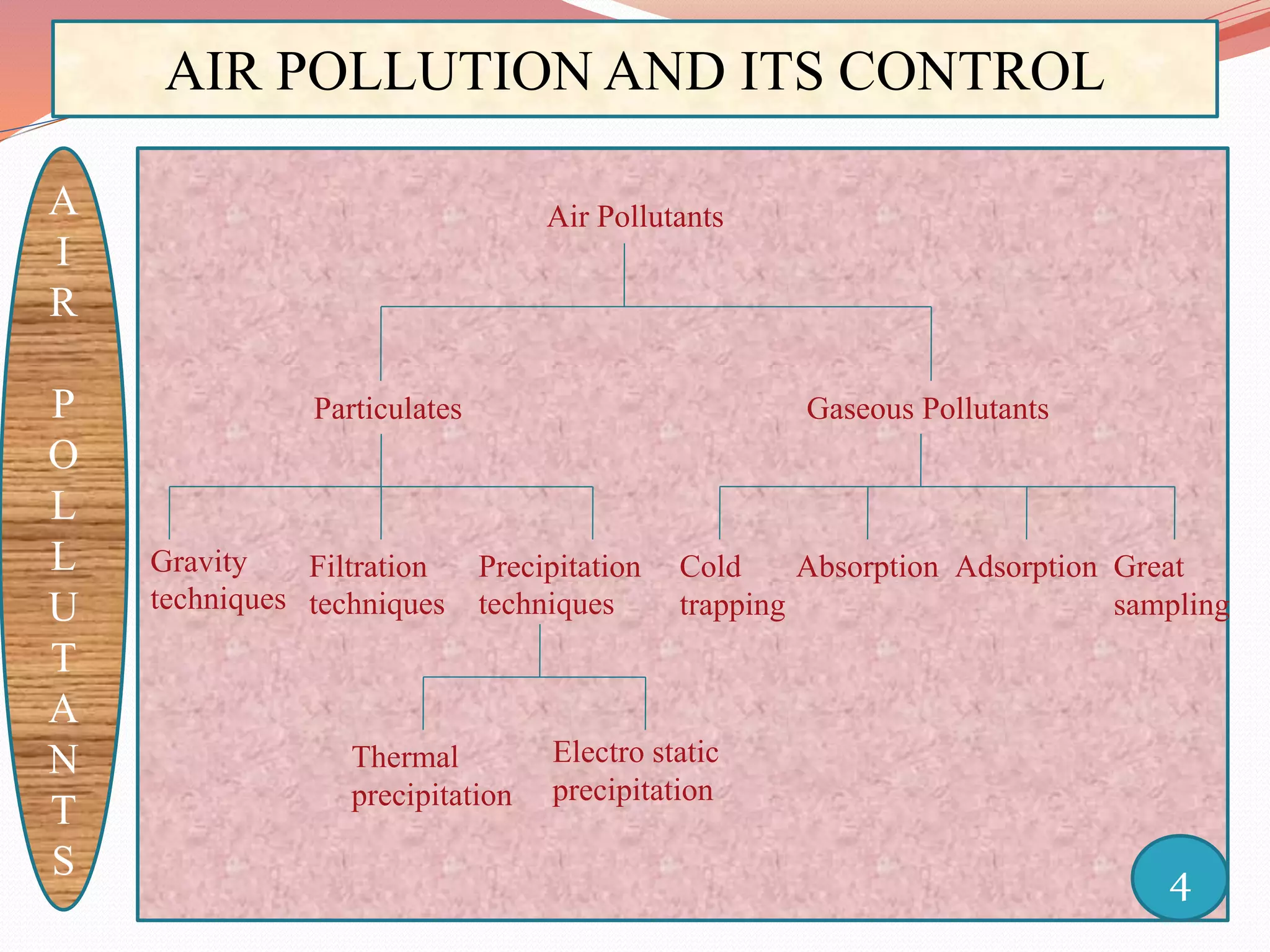
Gravity
techniques
Great
sampling
Particulates Gaseous Pollutants
Filtration
techniques
Precipitation
techniques
Cold
trapping
Absorption Adsorption
Thermal
precipitation
Electro static
precipitation
Air Pollutants
AIR POLLUTION AND ITS CONTROL
A
I
R
P
O
L
L
U
T
A
N
T
S
Particulates- They are tiny pieces of solid or liquid matter
associated with the earth’s atmosphere.
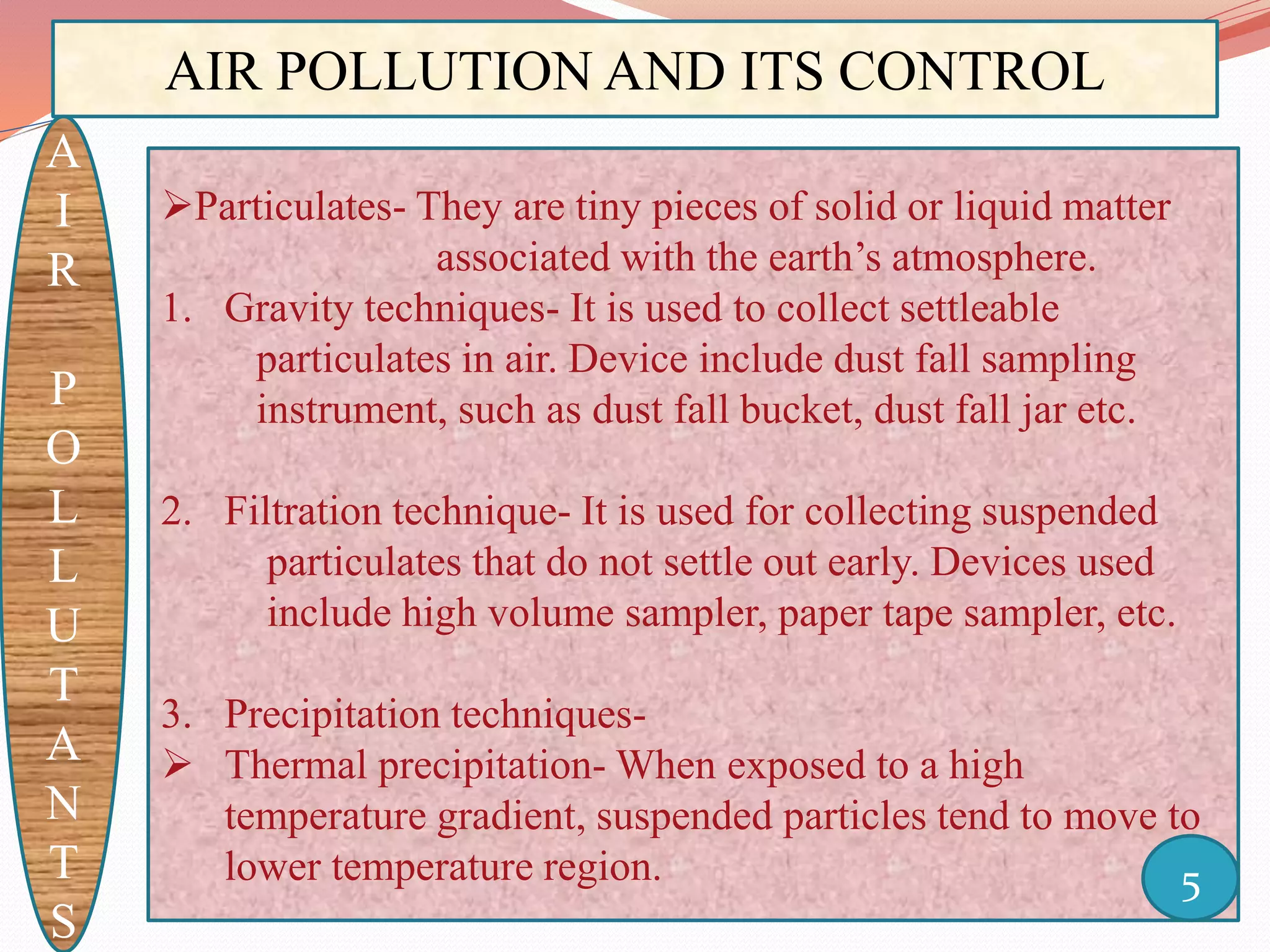
1. Gravity techniques- It is used to collect settleable
particulates in air. Device include dust fall sampling
instrument, such as dust fall bucket, dust fall jar etc.
2. Filtration technique- It is used for collecting suspended
particulates that do not settle out early. Devices used
include high volume sampler, paper tape sampler, etc.
3. Precipitation techniques-
 Thermal precipitation- When exposed to a high
temperature gradient, suspended particles tend to move to
lower temperature region. 5
AIR POLLUTION AND ITS CONTROL
A
I
R
P
O
L
L
U
T
A
N
T
S
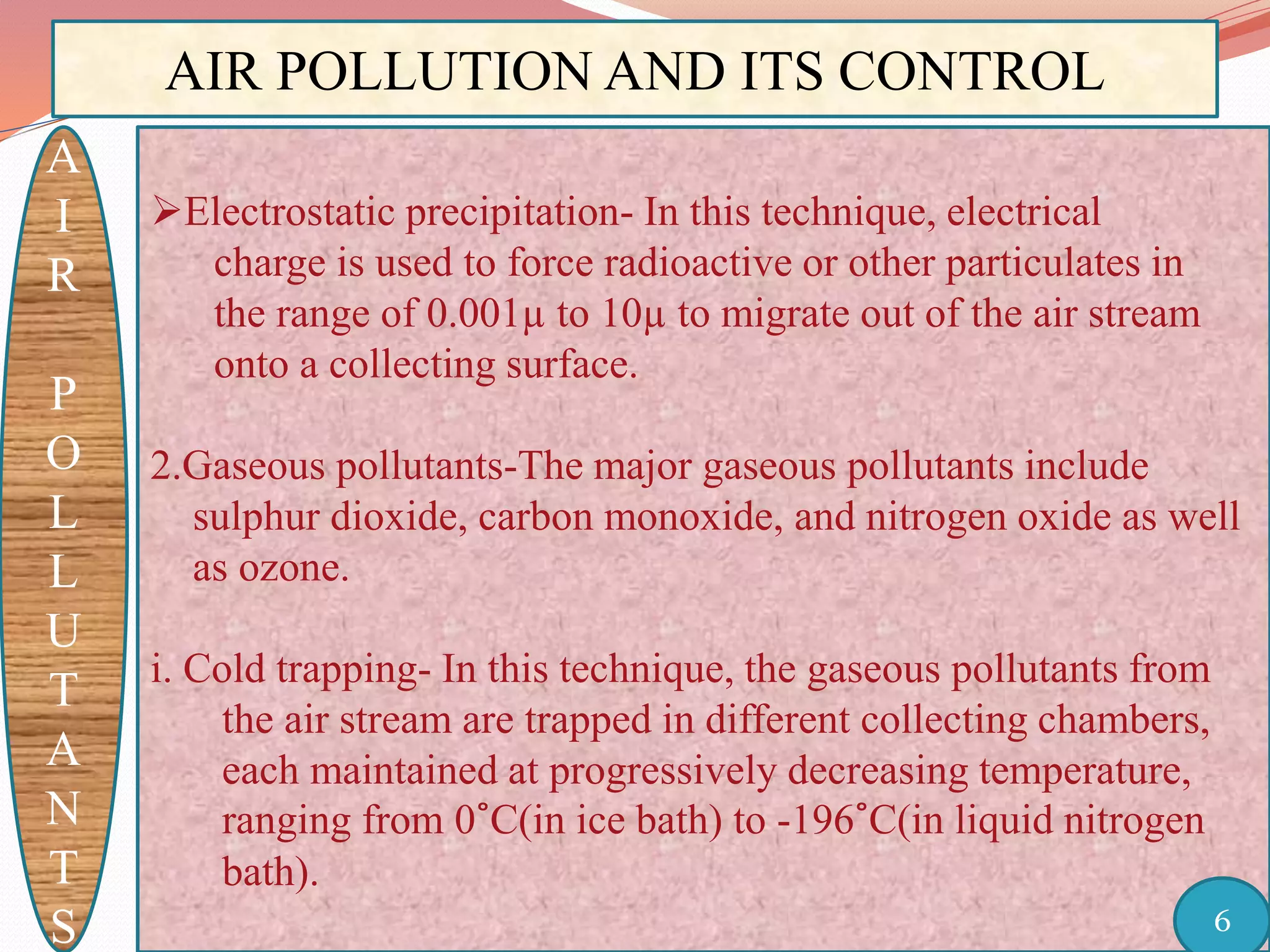
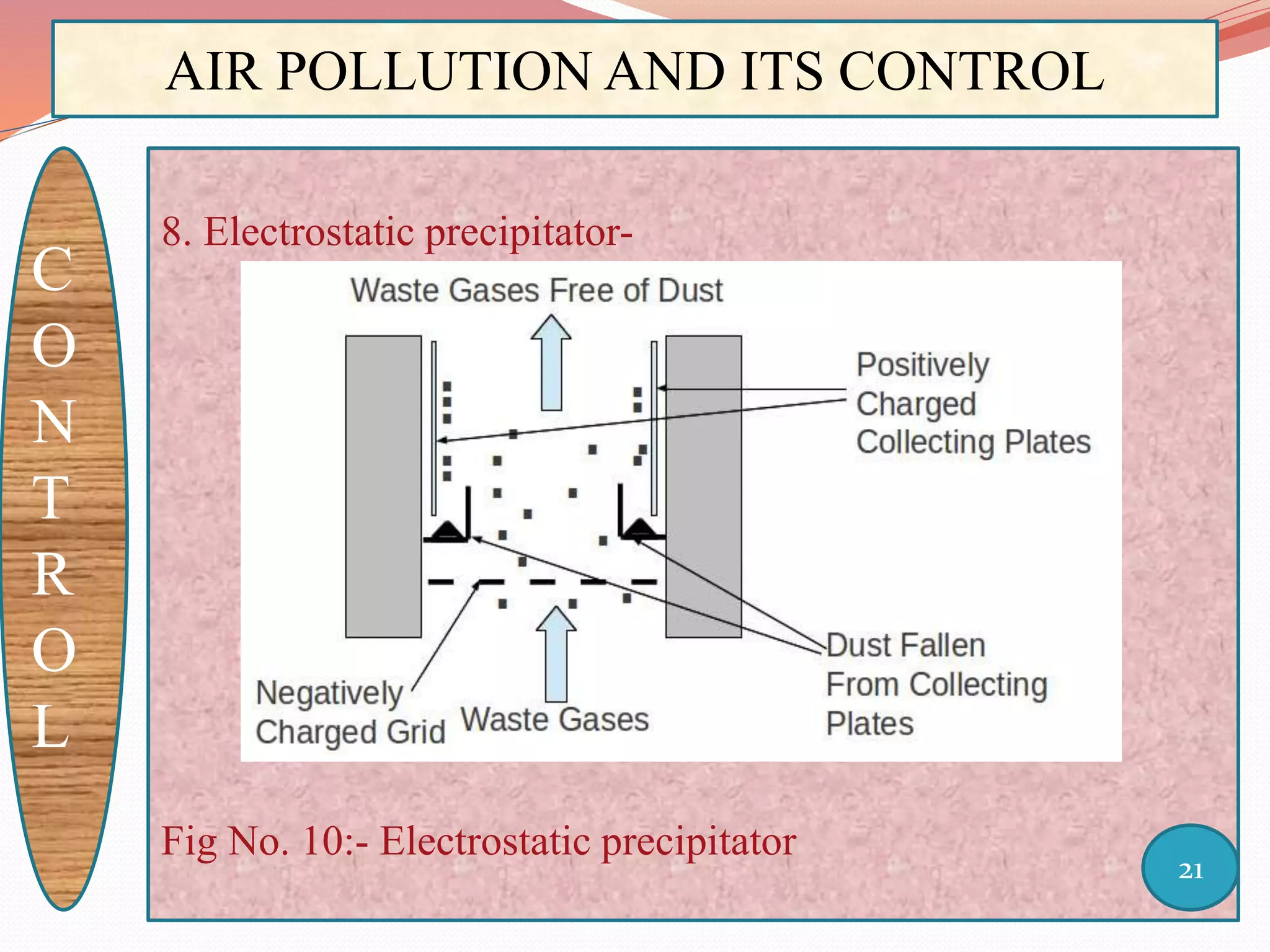
Electrostatic precipitation- In this technique, electrical
charge is used to force radioactive or other particulates in
the range of 0.001µ to 10µ to migrate out of the air stream
onto a collecting surface.
2.Gaseous pollutants-The major gaseous pollutants include
sulphur dioxide, carbon monoxide, and nitrogen oxide as well
as ozone.
i. Cold trapping- In this technique, the gaseous pollutants from
the air stream are trapped in different collecting chambers,
each maintained at progressively decreasing temperature,
ranging from 0˚C(in ice bath) to -196˚C(in liquid nitrogen
bath).
6
AIR POLLUTION AND ITS CONTROL
A
I
R
P
O
L
L
U
T
A
N
T
S
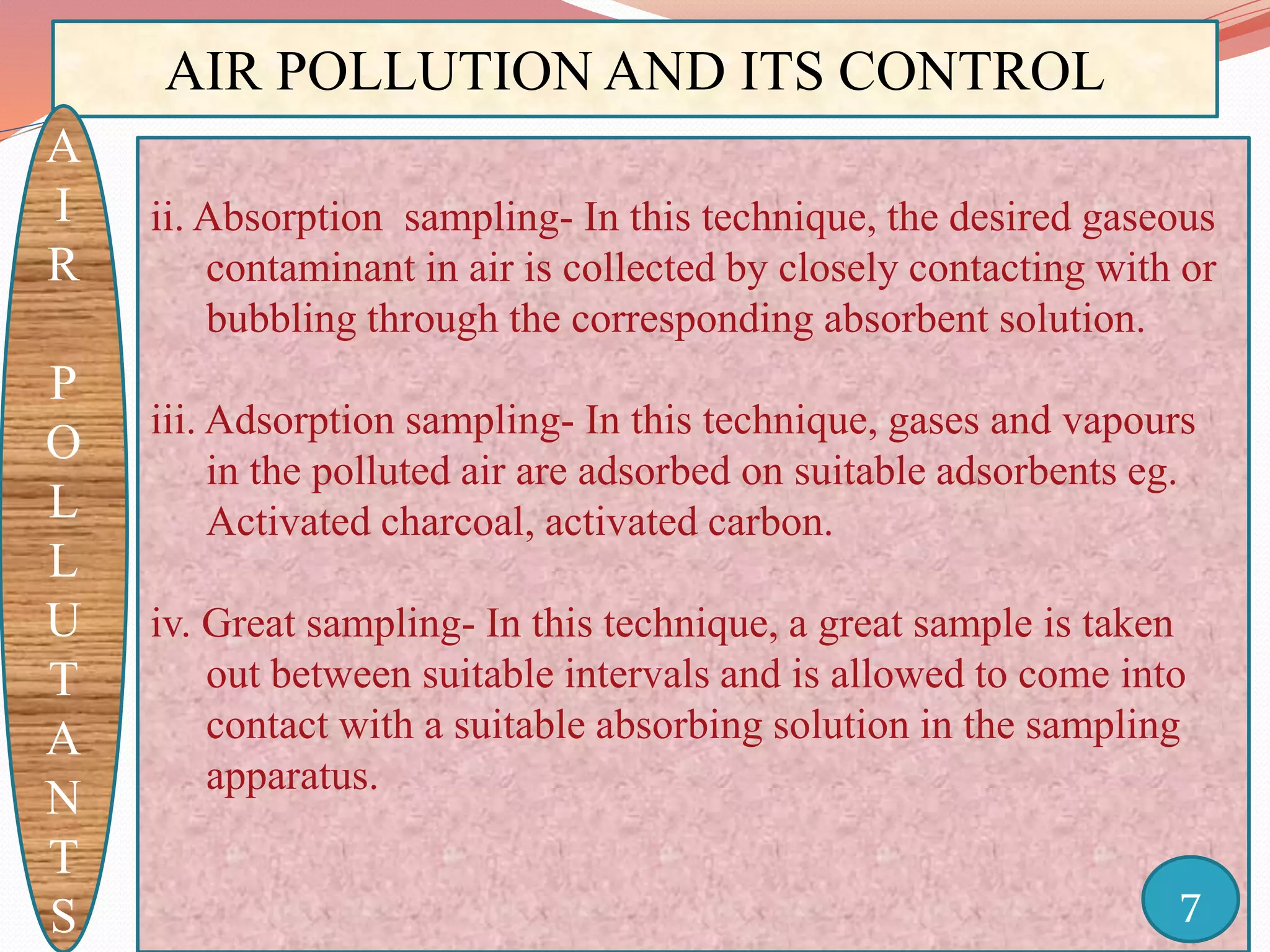
ii. Absorption sampling- In this technique, the desired gaseous
contaminant in air is collected by closely contacting with or
bubbling through the corresponding absorbent solution.
iii. Adsorption sampling- In this technique, gases and vapours
in the polluted air are adsorbed on suitable adsorbents eg.
Activated charcoal, activated carbon.
iv. Great sampling- In this technique, a great sample is taken
out between suitable intervals and is allowed to come into
contact with a suitable absorbing solution in the sampling
apparatus.
7
AIR POLLUTION AND ITS CONTROL
M
E
T
H
O
D
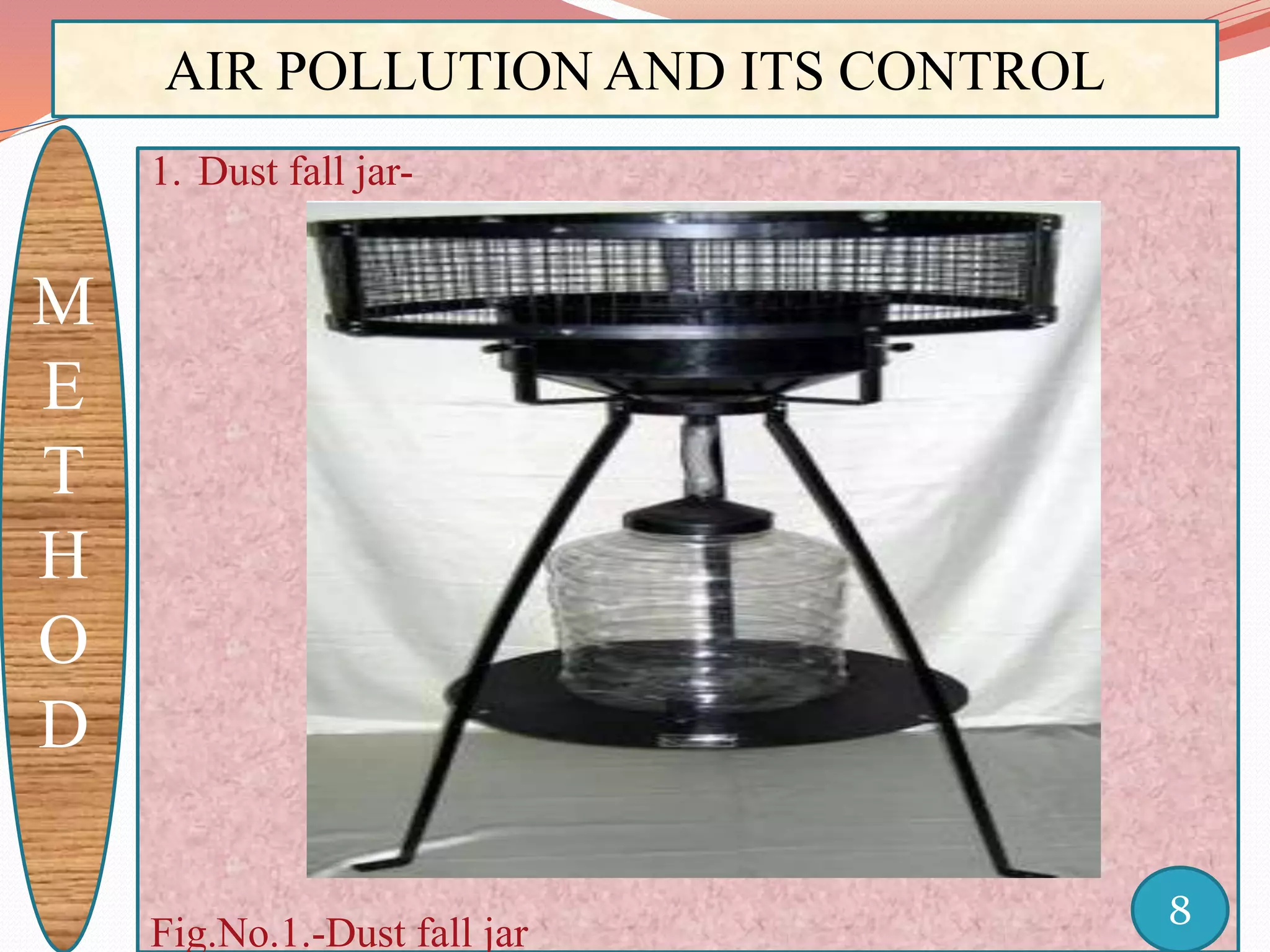
1. Dust fall jar-
Fig.No.1.-Dust fall jar
8
AIR POLLUTION AND ITS CONTROL
M
E
T
H
O
D
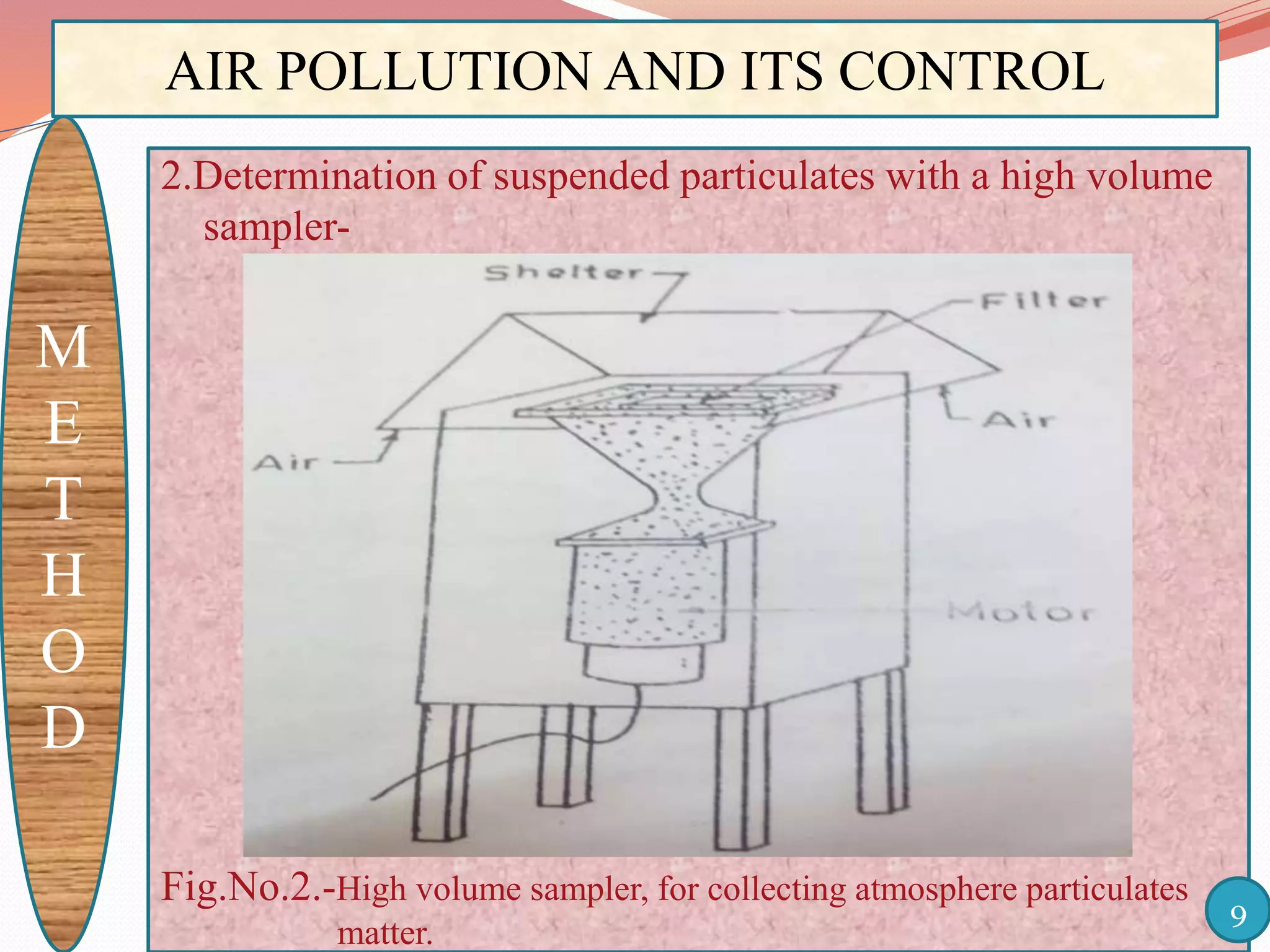
2.Determination of suspended particulates with a high volume
sampler-
Fig.No.2.-High volume sampler, for collecting atmosphere particulates
matter.
9
AIR POLLUTION AND ITS CONTROL
M
E
T
H
O
D
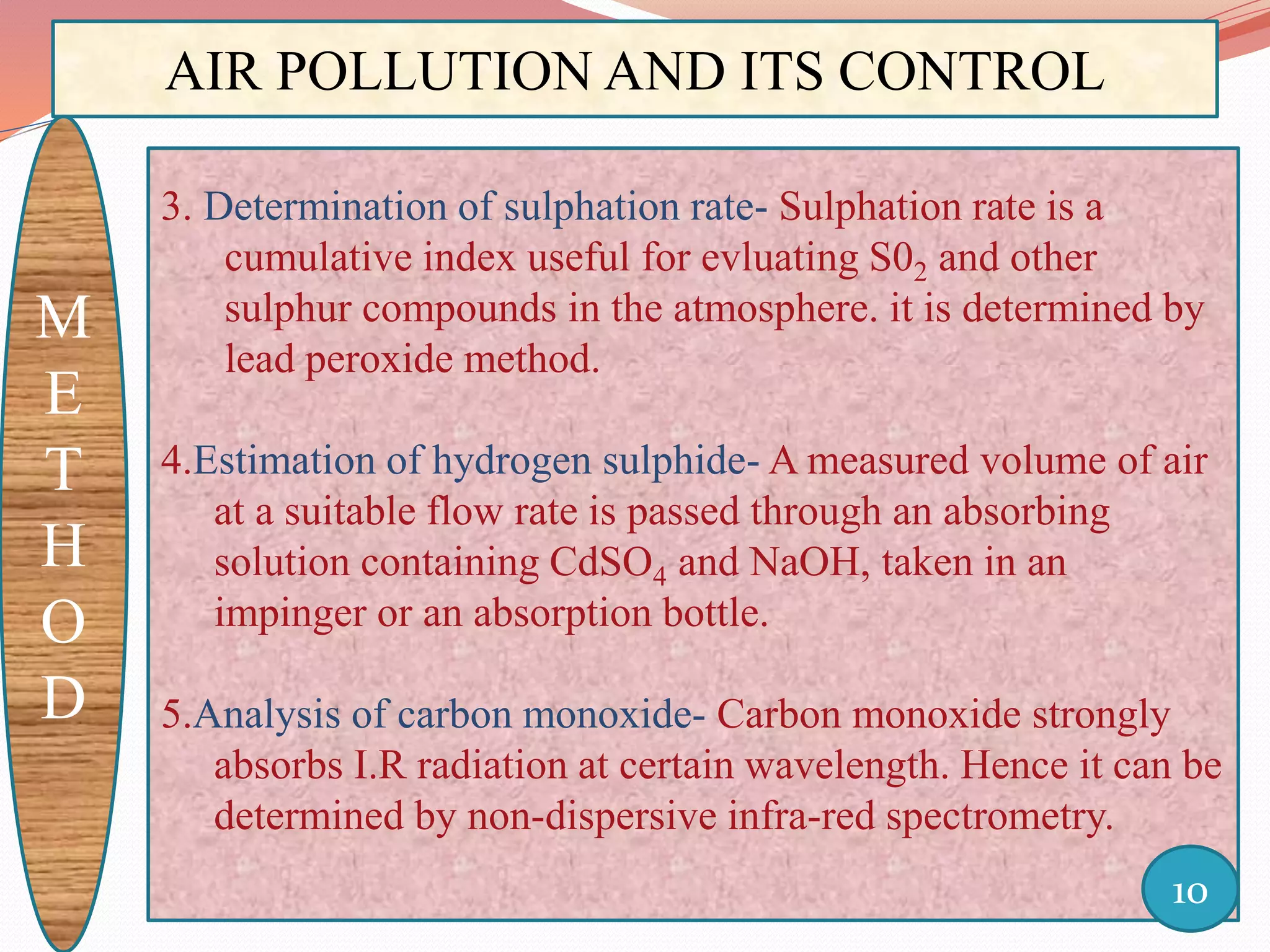
3. Determination of sulphation rate- Sulphation rate is a
cumulative index useful for evluating S02 and other
sulphur compounds in the atmosphere. it is determined by
lead peroxide method.
4.Estimation of hydrogen sulphide- A measured volume of air
at a suitable flow rate is passed through an absorbing
solution containing CdSO4 and NaOH, taken in an
impinger or an absorption bottle.
5.Analysis of carbon monoxide- Carbon monoxide strongly
absorbs I.R radiation at certain wavelength. Hence it can be
determined by non-dispersive infra-red spectrometry.
10
AIR POLLUTION AND ITS CONTROL
M
E
T
H
O
D
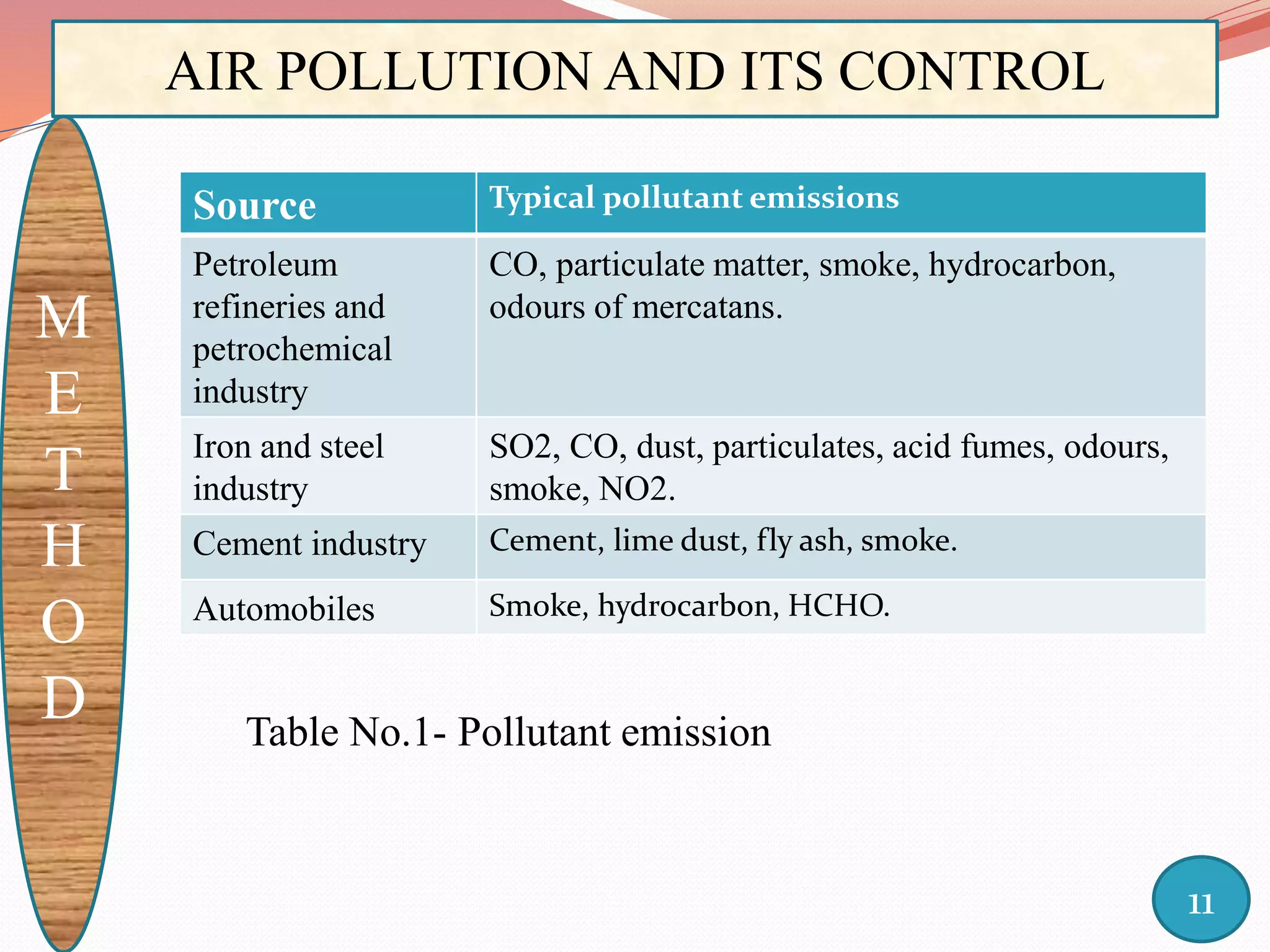
Source Typical pollutant emissions
Petroleum
refineries and
petrochemical
industry
CO, particulate matter, smoke, hydrocarbon,
odours of mercatans.
Iron and steel
industry
SO2, CO, dust, particulates, acid fumes, odours,
smoke, NO2.
Cement industry Cement, lime dust, fly ash, smoke.
Automobiles Smoke, hydrocarbon, HCHO.
11
Table No.1- Pollutant emission
AIR POLLUTION AND ITS CONTROL
C
O
N
T
R
O
L
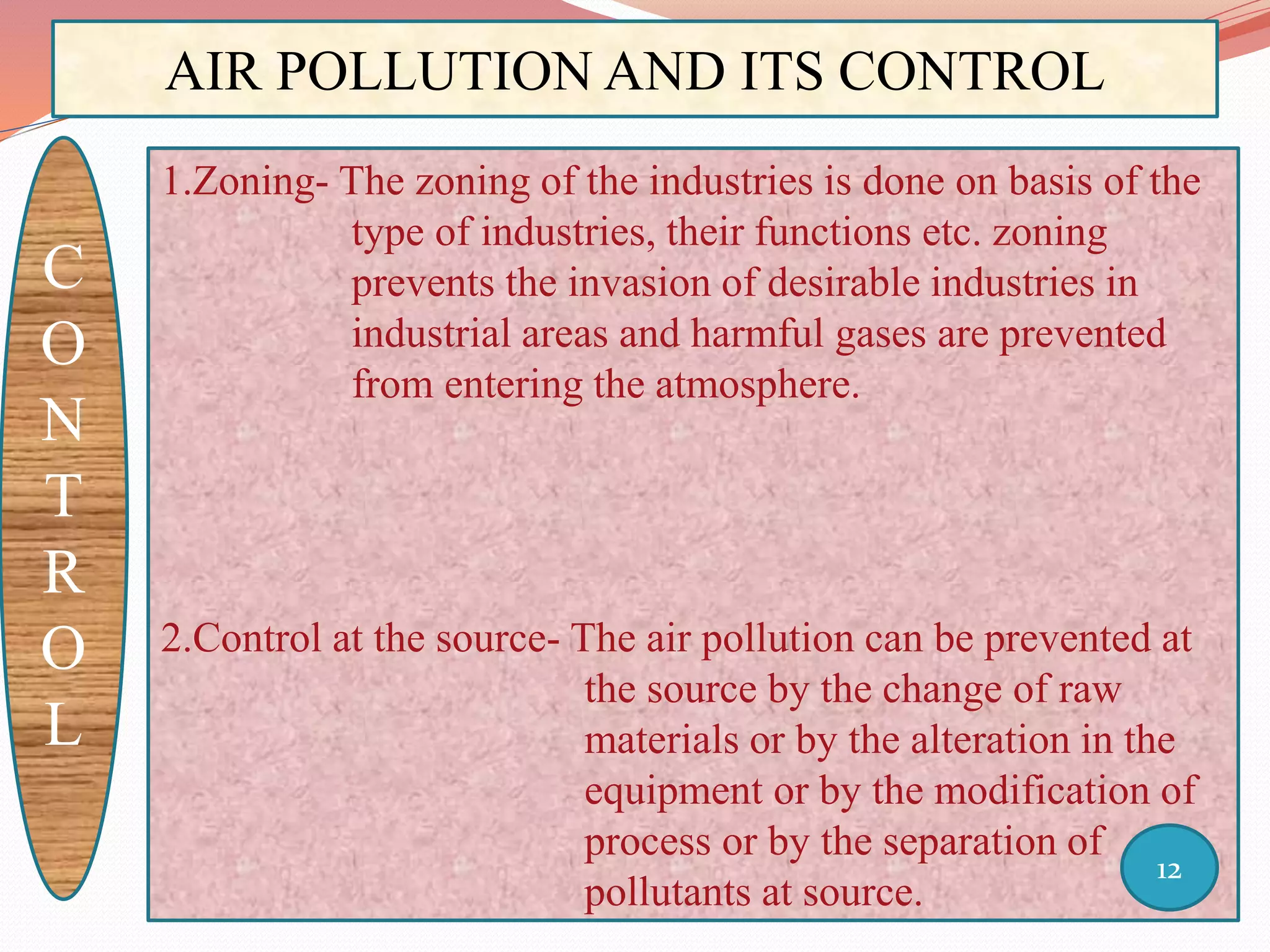
1.Zoning- The zoning of the industries is done on basis of the
type of industries, their functions etc. zoning
prevents the invasion of desirable industries in
industrial areas and harmful gases are prevented
from entering the atmosphere.
2.Control at the source- The air pollution can be prevented at
the source by the change of raw
materials or by the alteration in the
equipment or by the modification of
process or by the separation of
pollutants at source.
12
AIR POLLUTION AND ITS CONTROL
C
O
N
T
R
O
L
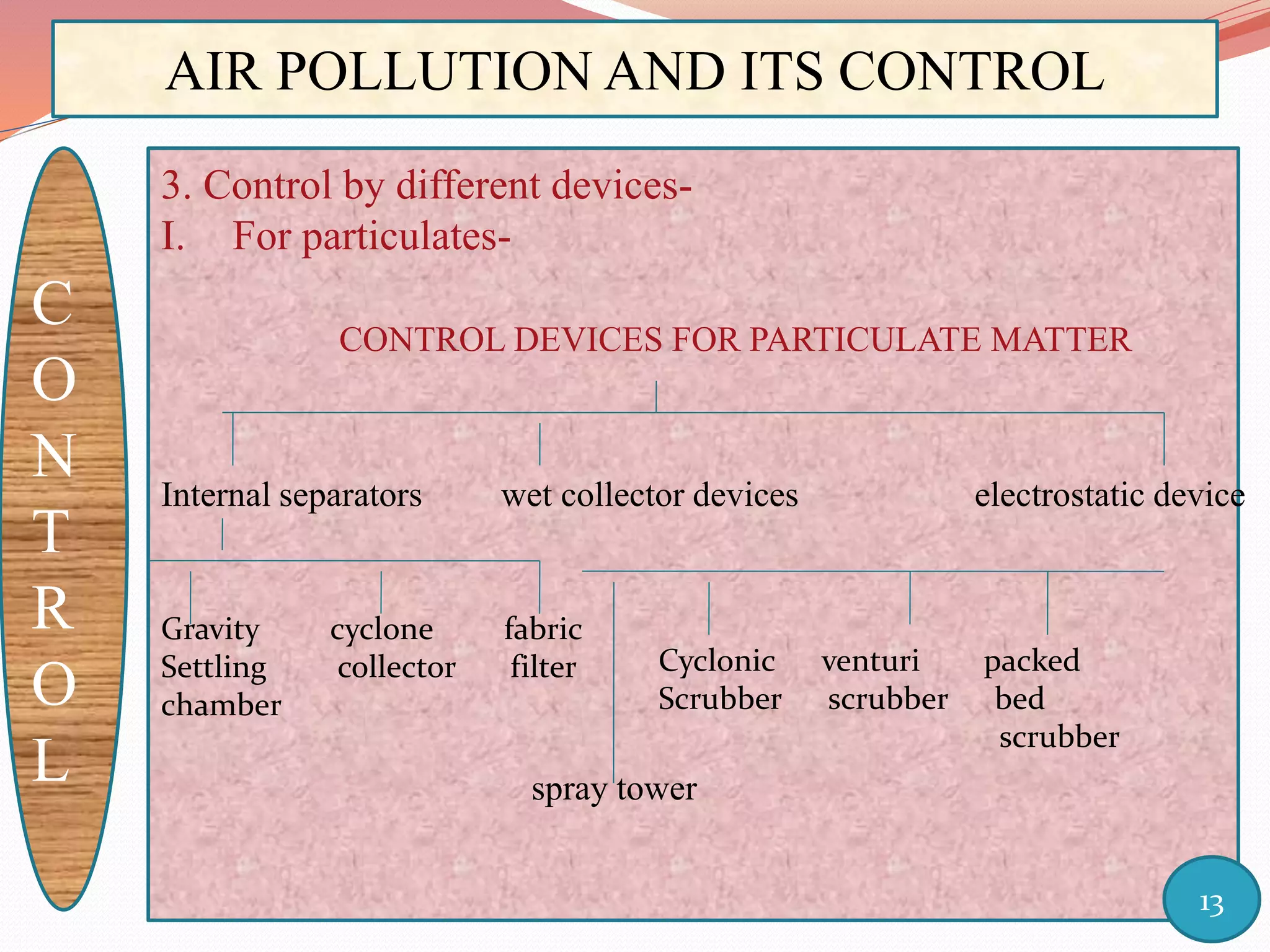
3. Control by different devices-
I. For particulates-
CONTROL DEVICES FOR PARTICULATE MATTER
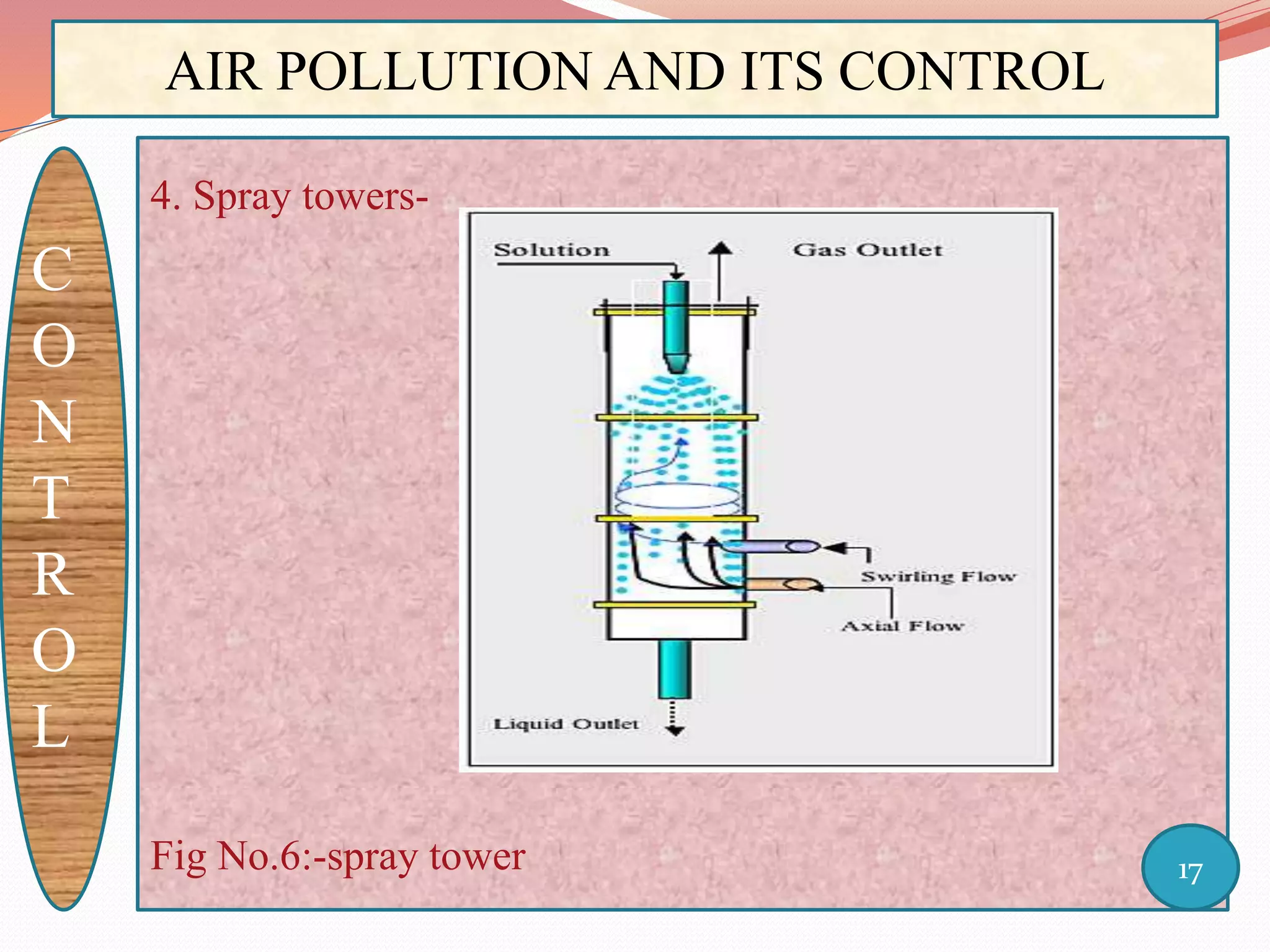
spray tower
13
Internal separators wet collector devices electrostatic device
Gravity cyclone fabric
Settling collector filter
chamber
Cyclonic venturi packed
Scrubber scrubber bed
scrubber
AIR POLLUTION AND ITS CONTROL
C
O
N
T
R
O
L
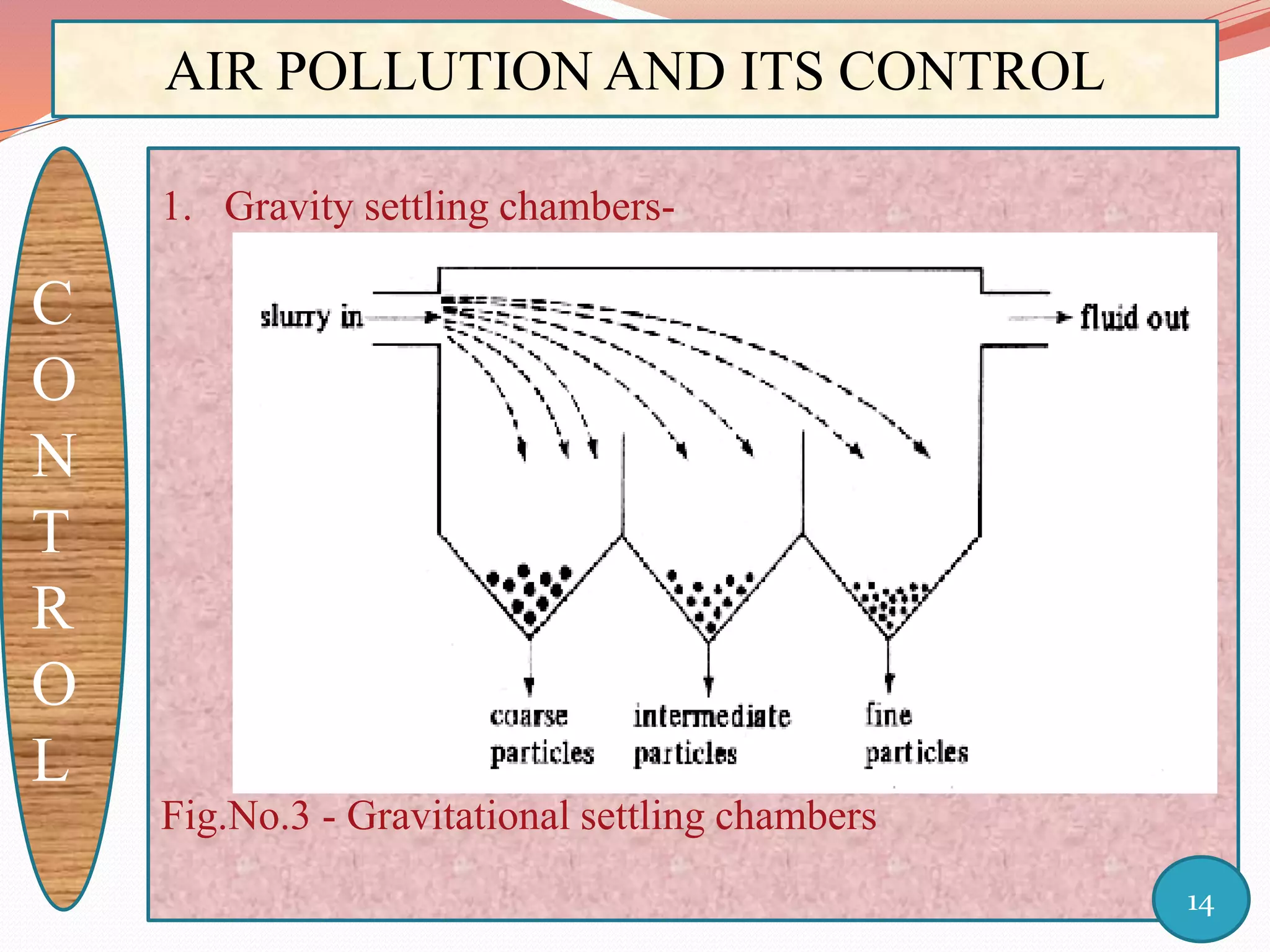
1. Gravity settling chambers-
Fig.No.3 - Gravitational settling chambers
14
AIR POLLUTION AND ITS CONTROL
C
O
N
T
R
O
L
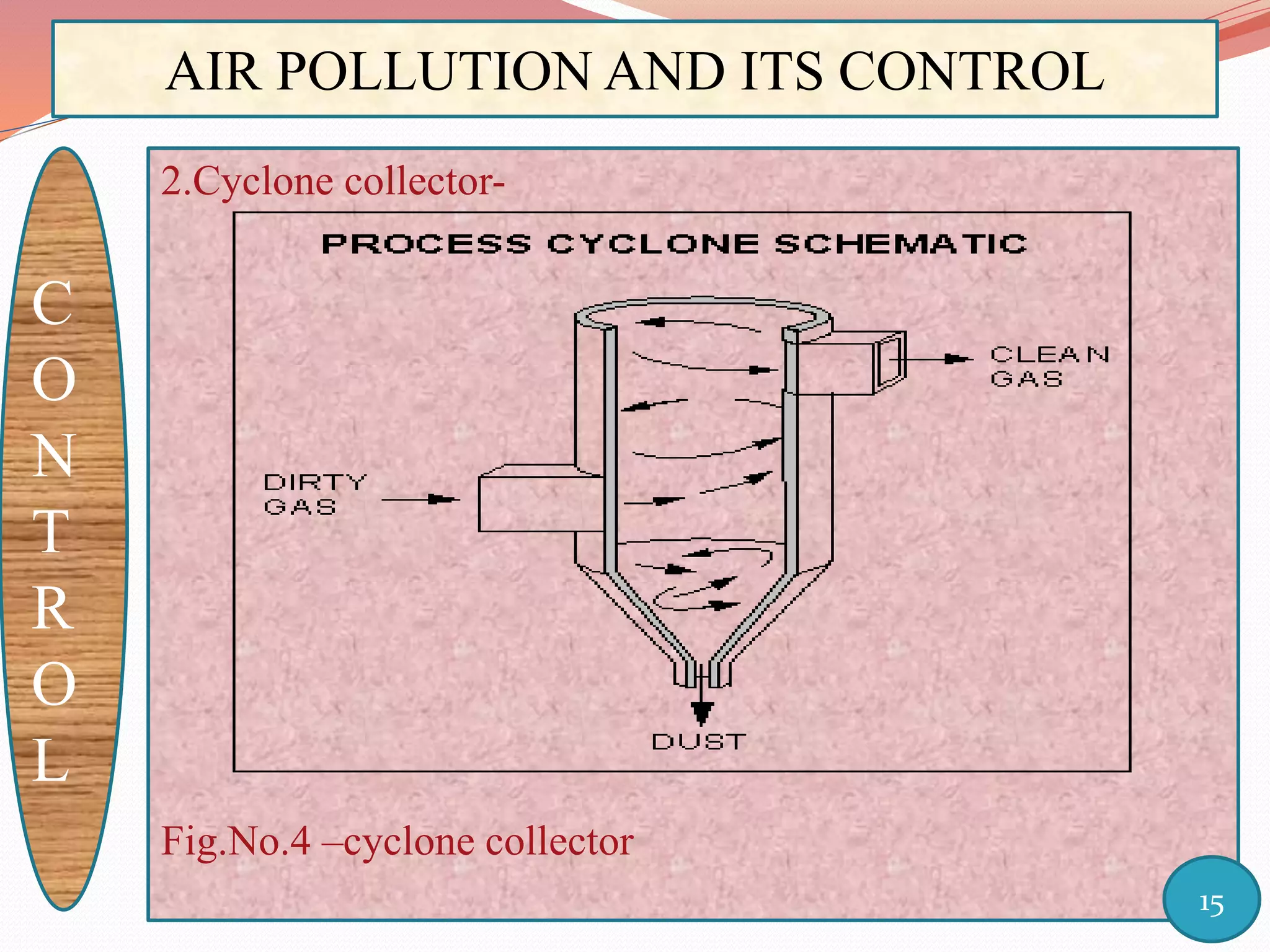
2.Cyclone collector-
Fig.No.4 –cyclone collector
15
AIR POLLUTION AND ITS CONTROL
C
O
N
T
R
O
L
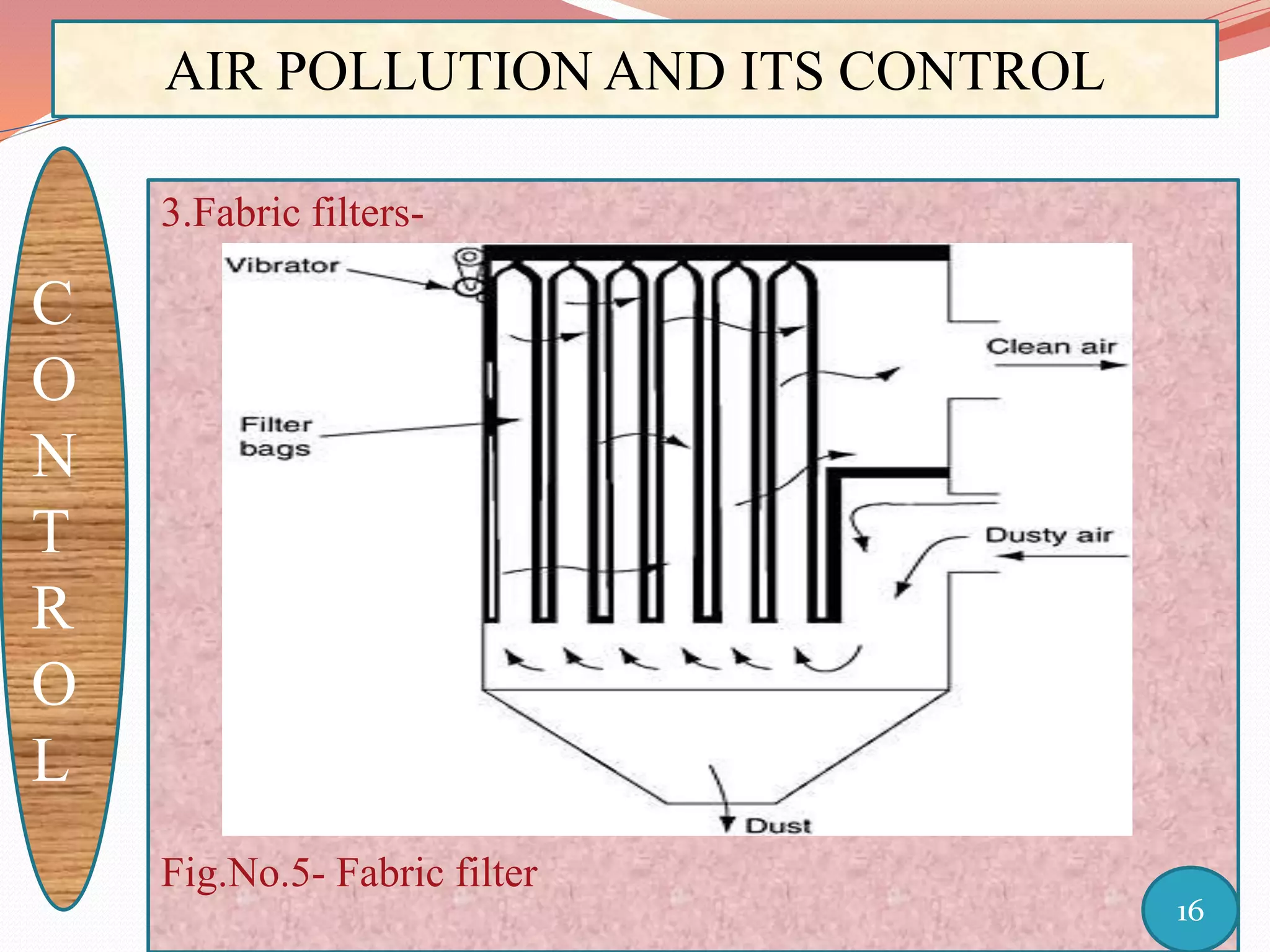
3.Fabric filters-
Fig.No.5- Fabric filter
16
AIR POLLUTION AND ITS CONTROL
C
O
N
T
R
O
L
4. Spray towers-
Fig No.6:-spray tower 17
AIR POLLUTION AND ITS CONTROL
C
O
N
T
R
O
L
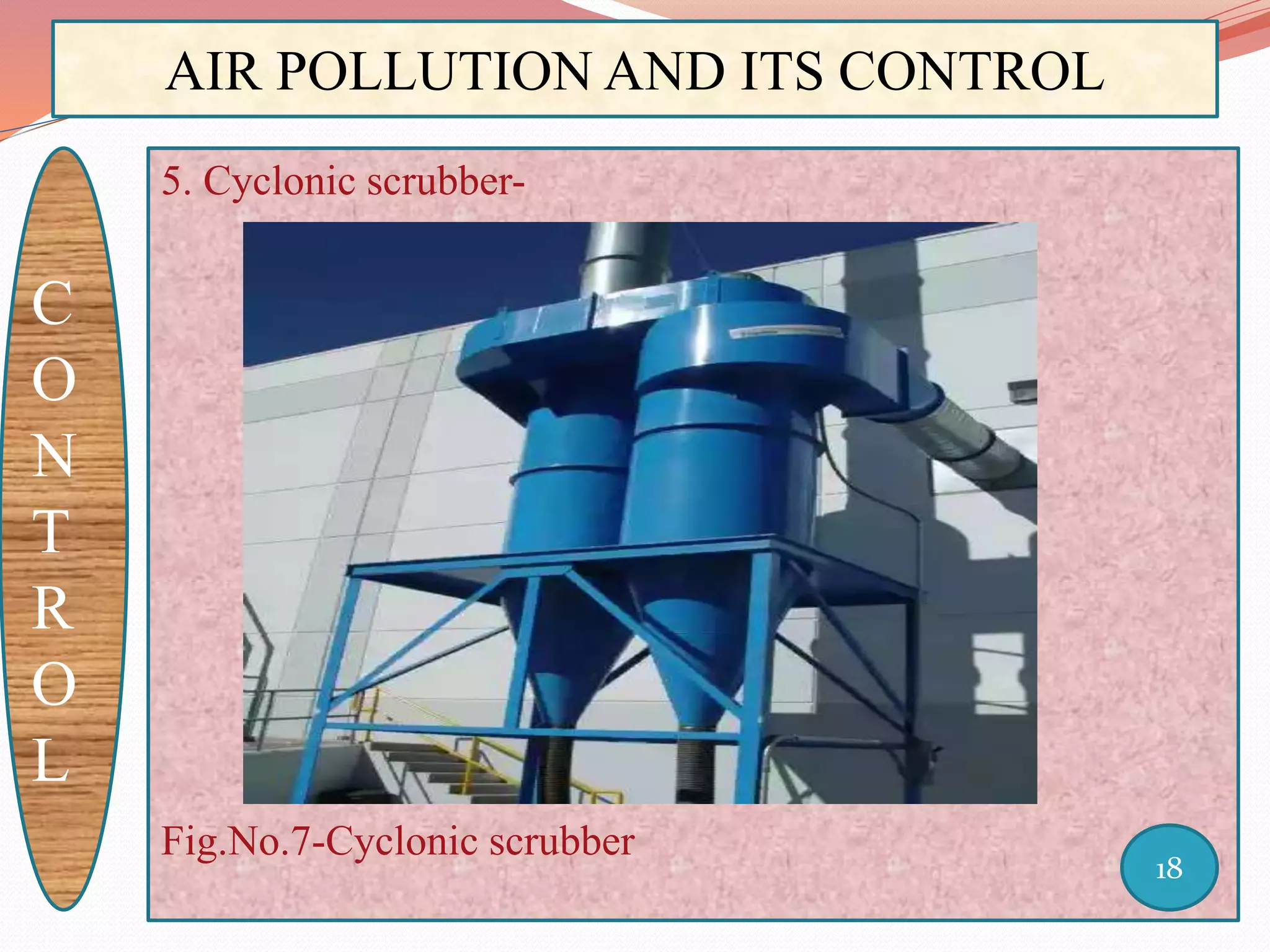
5. Cyclonic scrubber-
Fig.No.7-Cyclonic scrubber
18
AIR POLLUTION AND ITS CONTROL
C
O
N
T
R
O
L
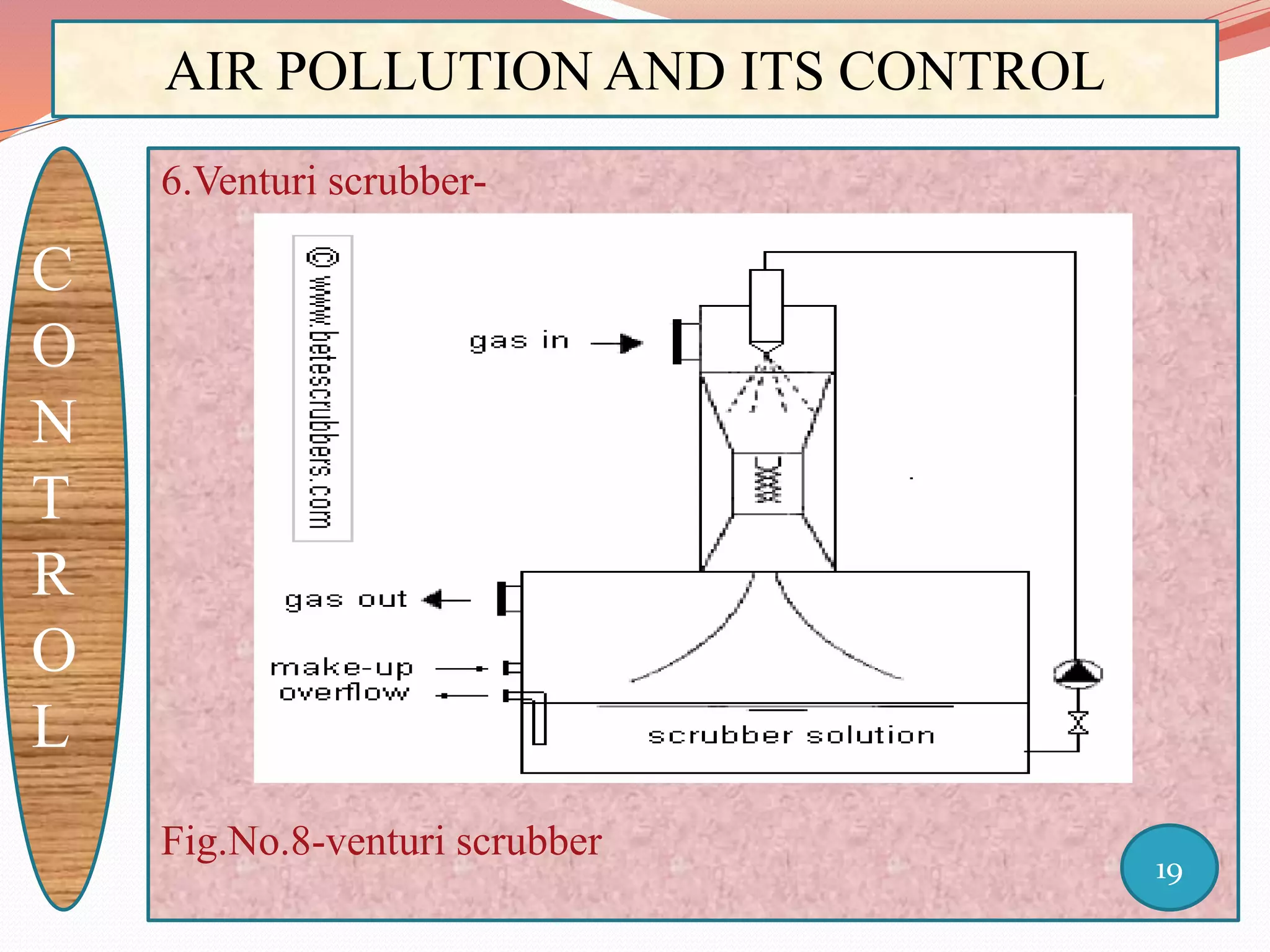
6.Venturi scrubber-
Fig.No.8-venturi scrubber
19
AIR POLLUTION AND ITS CONTROL
C
O
N
T
R
O
L
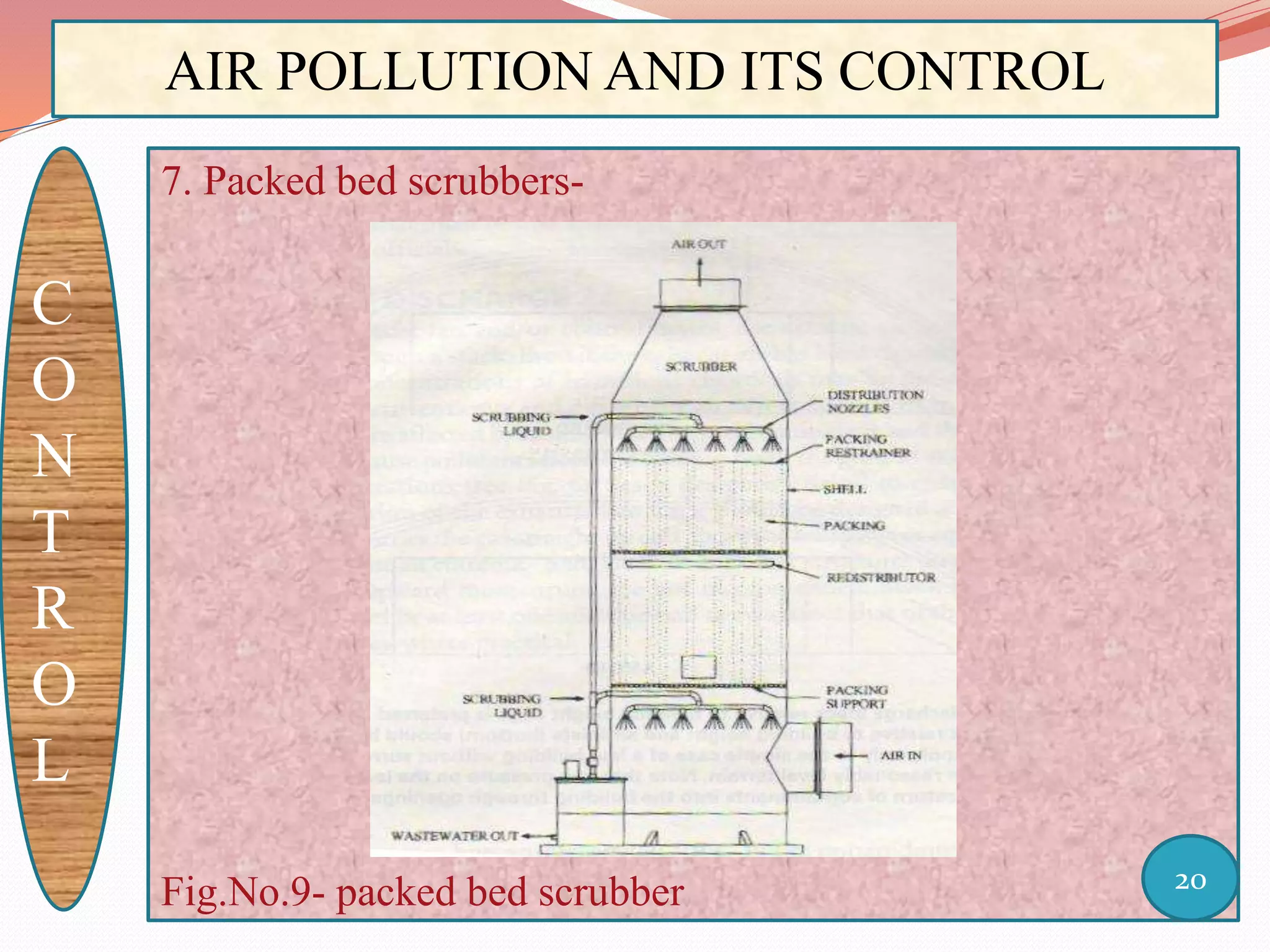
7. Packed bed scrubbers-
Fig.No.9- packed bed scrubber 20
AIR POLLUTION AND ITS CONTROL
C
O
N
T
R
O
L
8. Electrostatic precipitator-
Fig No. 10:- Electrostatic precipitator
21
AIR POLLUTION AND ITS CONTROL
C
O
N
T
R
O
L
2. For gaseous emissions-gaseous pollutants can be removed
from air stream by the following techniques-
1.absorption and adsorption
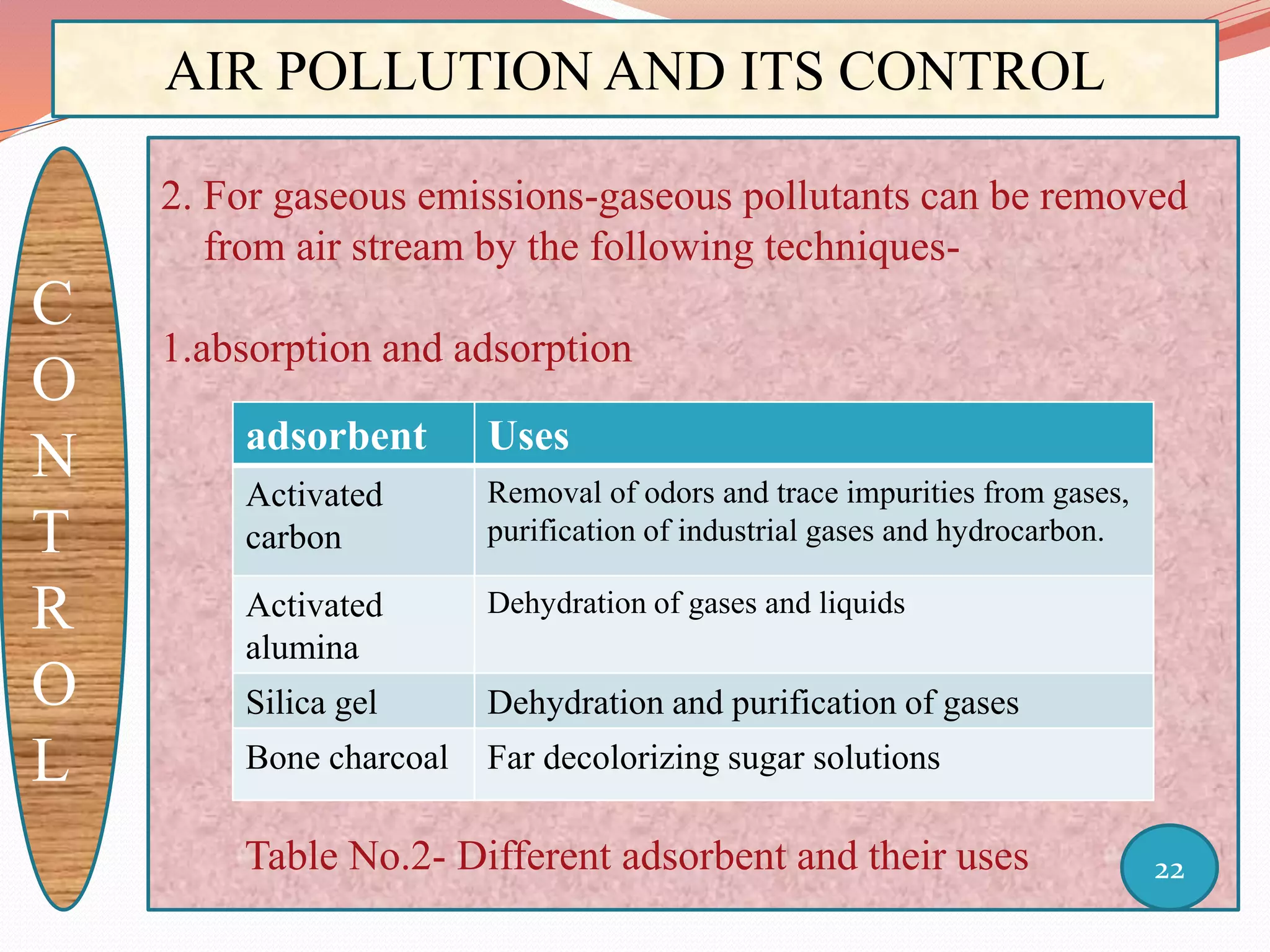
Table No.2- Different adsorbent and their uses 22
adsorbent Uses
Activated
carbon
Removal of odors and trace impurities from gases,
purification of industrial gases and hydrocarbon.
Activated
alumina
Dehydration of gases and liquids
Silica gel Dehydration and purification of gases
Bone charcoal Far decolorizing sugar solutions
AIR POLLUTION AND ITS CONTROL
C
O
N
T
R
O
L
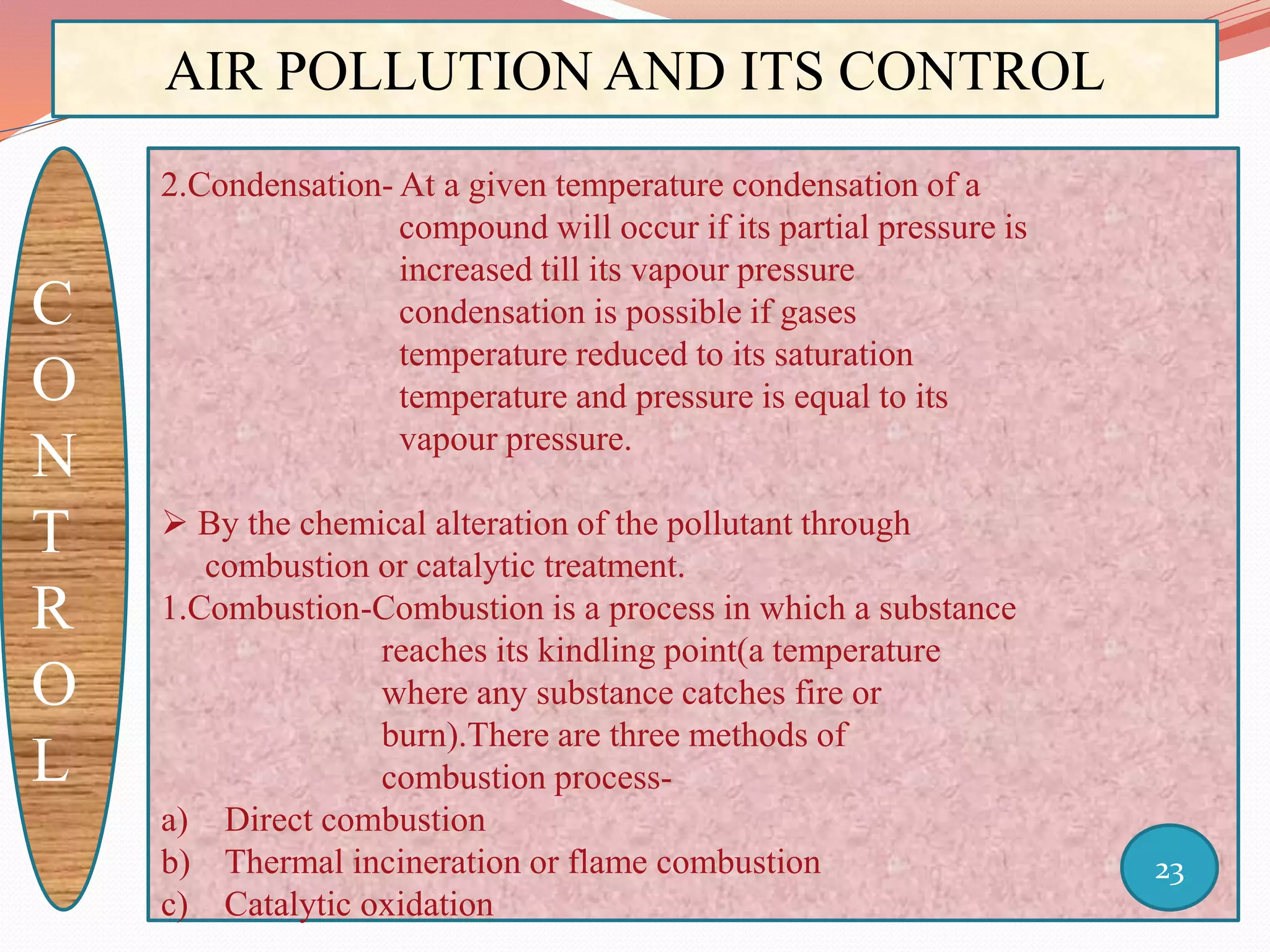
2.Condensation- At a given temperature condensation of a
compound will occur if its partial pressure is
increased till its vapour pressure
condensation is possible if gases
temperature reduced to its saturation
temperature and pressure is equal to its
vapour pressure.
 By the chemical alteration of the pollutant through
combustion or catalytic treatment.
1.Combustion-Combustion is a process in which a substance
reaches its kindling point(a temperature
where any substance catches fire or
burn).There are three methods of
combustion process-
a) Direct combustion
b) Thermal incineration or flame combustion
c) Catalytic oxidation
23
AIR POLLUTION AND ITS CONTROL
C
O
N
T
R
O
L
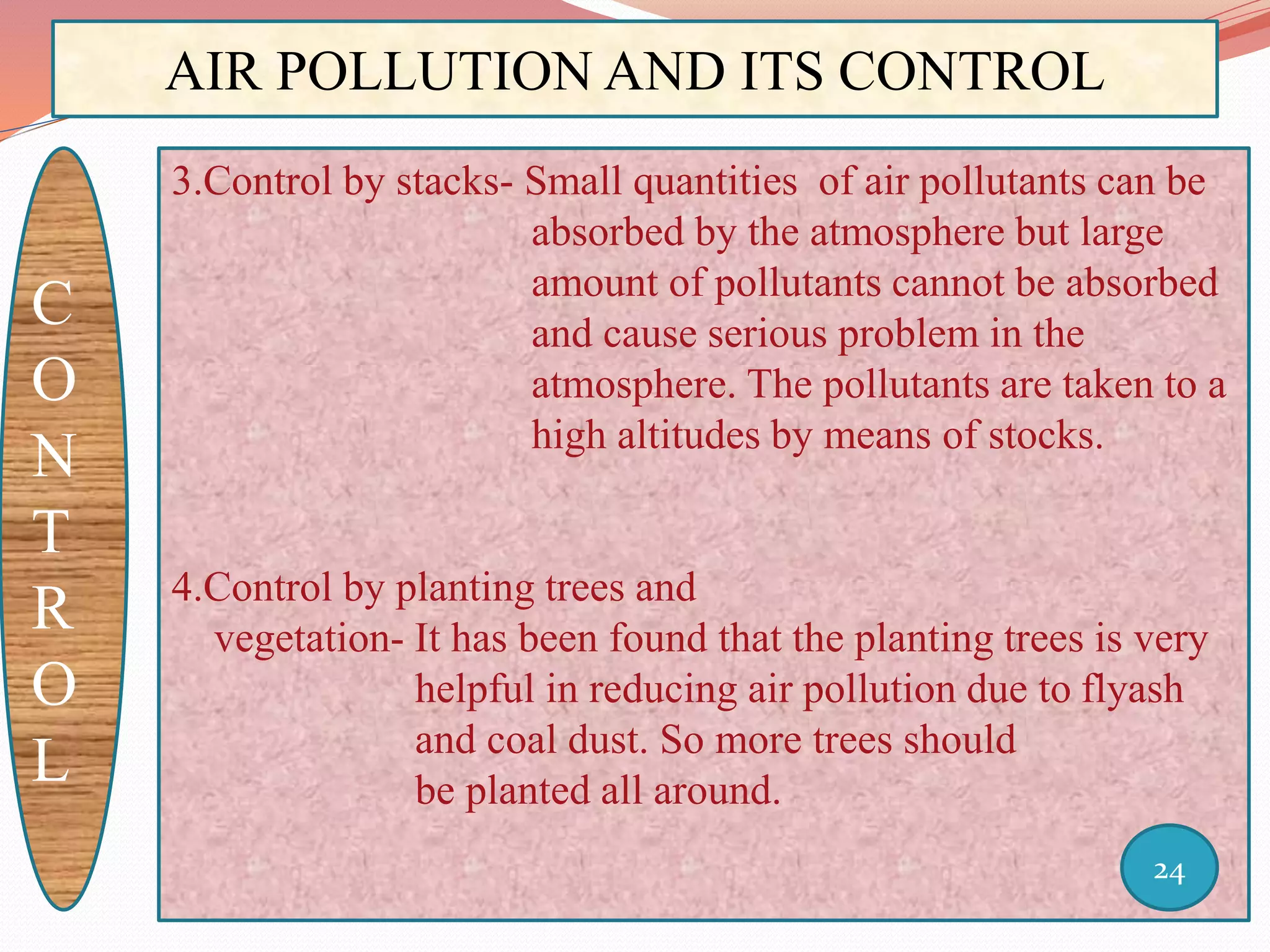
3.Control by stacks- Small quantities of air pollutants can be
absorbed by the atmosphere but large
amount of pollutants cannot be absorbed
and cause serious problem in the
atmosphere. The pollutants are taken to a
high altitudes by means of stocks.
4.Control by planting trees and
vegetation- It has been found that the planting trees is very
helpful in reducing air pollution due to flyash
and coal dust. So more trees should
be planted all around.
24
AIR POLLUTION AND ITS CONTROL
M
A
N
A
G
E
M
E
N
T
The different approaches for the management of environmental
pollution are describe by :-
Atmosphere CO2 reduction- The reduction in atmosphere CO2
concentration assumes significance. There are mainly two
approaches for the biotechnological reduction of CO2 in the
atmosphere.
1. Photosynthesis
2. Biological calcification,
1. Microalgal photosynthesis- certain microalgae are more
efficient than higher plants in utilizing atmosphere CO2 for
photosynthesis.
• These organisms are capable of generating more O2 than the
amount of CO2 consumed.
25
AIR POLLUTION AND ITS CONTROL
M
A
N
A
G
E
M
E
N
T
• Growing microalgae in the vicnity of industries and power
plants where the production of CO2 is very high will help to
minimise the polluting effects of CO2.
2. Biological calcification to reduce atmosphere CO2- Certain
organisms present in the deep sea ( corals, green and red
algae) are capable of storing CO2 through a process of
biological calcification. As the CaCO3 gets precipitated,
more and more atmospheric CO2 can be utilized for its
formation.
26
AIR POLLUTION AND ITS CONTROL
S
U
M
M
A
R
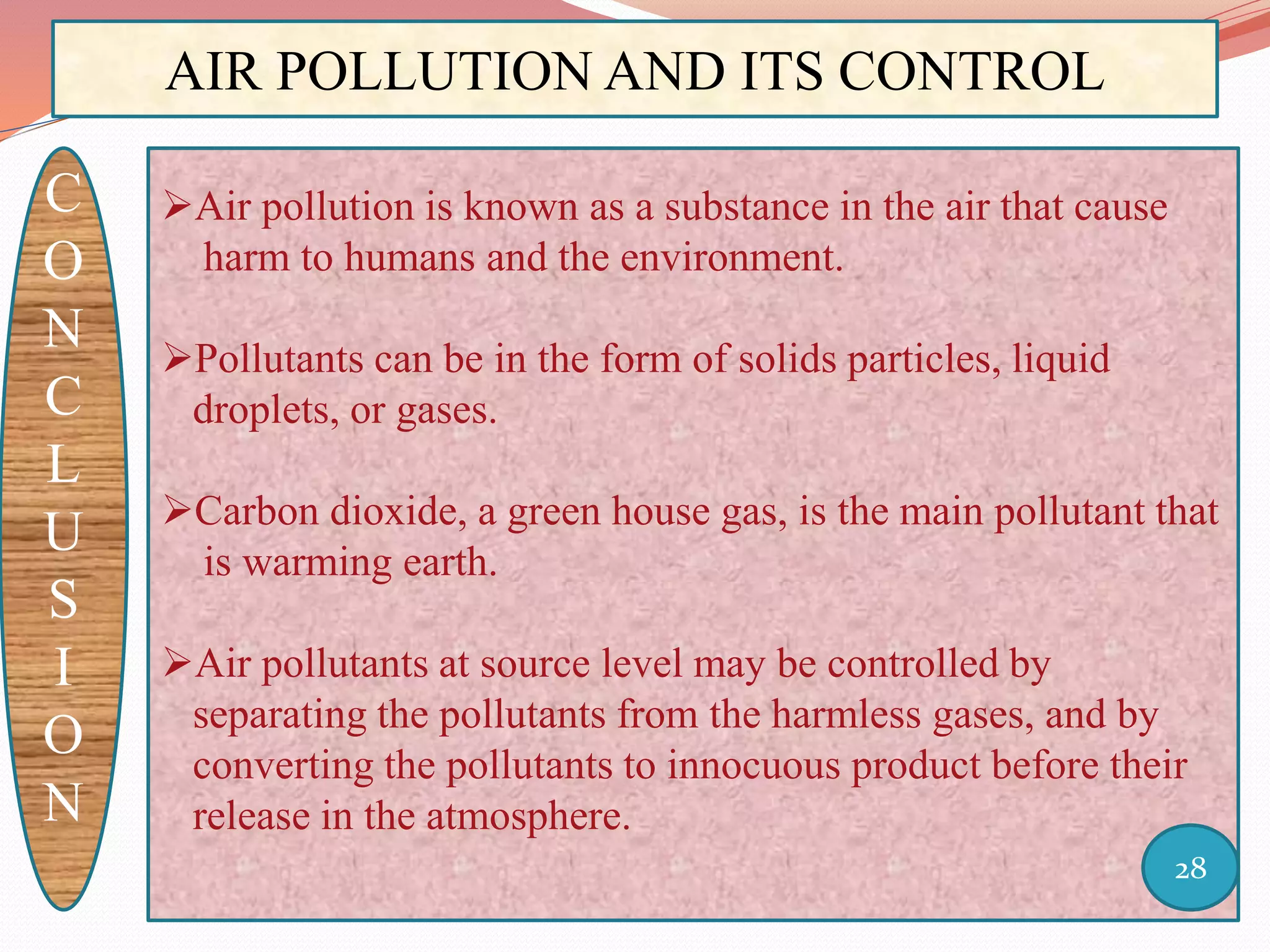
Y Fig.No.11.- Air pollution
Smog hanging over cities is the most familiar and obvious
of air pollution.
But there are different kinds of pollution some visible some
invisible that contribute to global warming. 27
AIR POLLUTION AND ITS CONTROL
C
O
N
C
L
U
S
I
O
N
Air pollution is known as a substance in the air that cause
harm to humans and the environment.
Pollutants can be in the form of solids particles, liquid
droplets, or gases.
Carbon dioxide, a green house gas, is the main pollutant that
is warming earth.
Air pollutants at source level may be controlled by
separating the pollutants from the harmless gases, and by
converting the pollutants to innocuous product before their
release in the atmosphere.
28
AIR POLLUTION AND ITS CONTROL
R
E
F
E
R
E
N
C
E
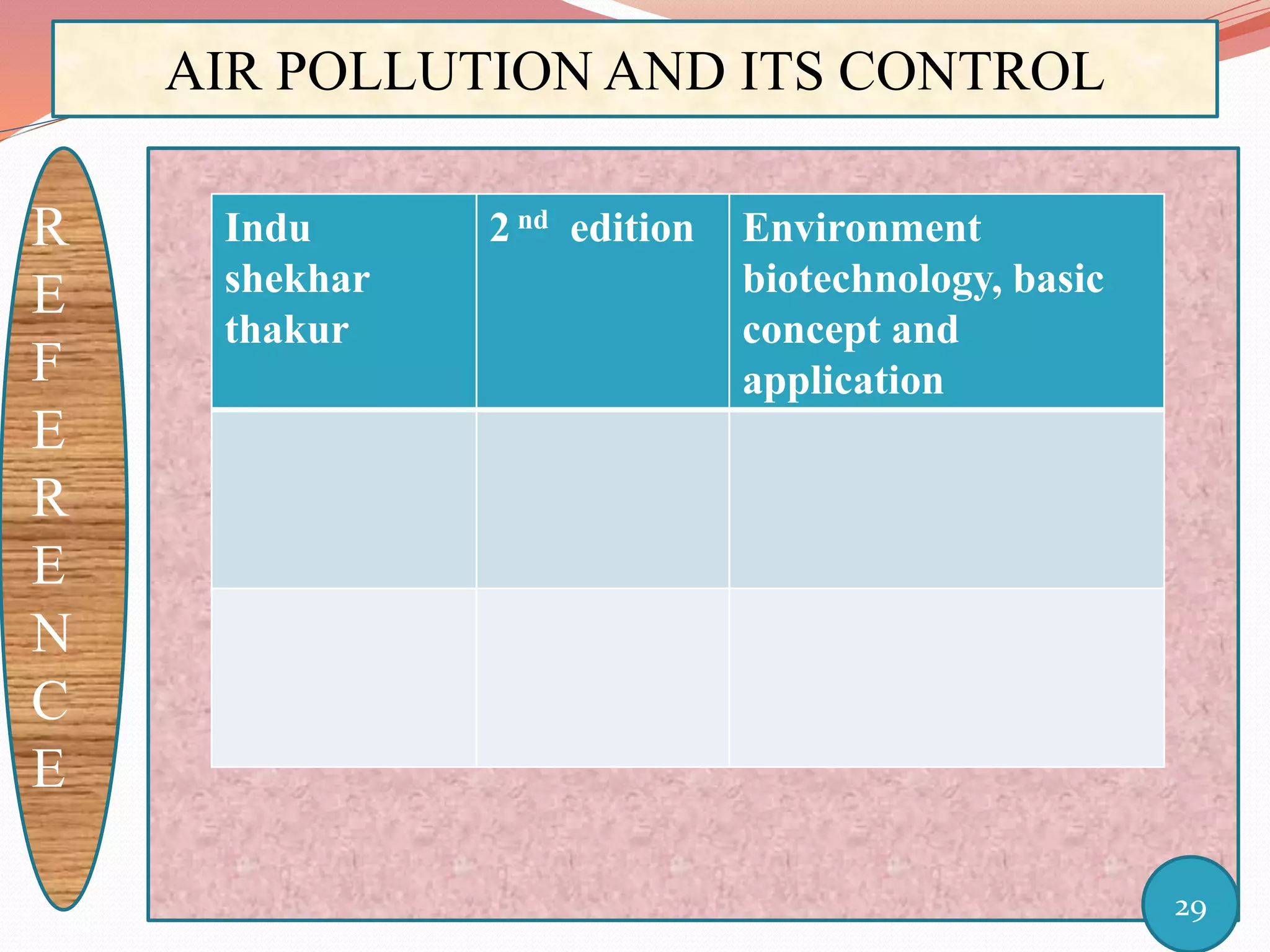
Indu
shekhar
thakur
2 nd edition Environment
biotechnology, basic
concept and
application
29

AIR POLLUTION AND ITS CONTROL THROUGH BIOTECHNOLOGY

  • 1.
    A SEMINAR ON AIR POLLUTIONAND ITS CONTROL THROUGH BIOTECHNOLOGY BY- MISS. HUMA NAZ SIDDIQU (ASST. PROF.) G.D. RUNGTA COLLEGE OF SCIENCE AND TECHNOLOGY KOHKA KURUD ROAD BHILAI, 490023 1
  • 2.
    AIR POLLUTION ANDITS CONTROL S Y N O P S I S INTRODUCTION AIR POLLUTANTS METHOD FOR ESTIMATION OF POLLUTANTS METHOD USED FOR AIR POLLUTION CONTROL THROUGH BIOTECHNOLOGY BIOTECHNOLOGY METHODS FOR MANAGEMENT OF POLLUTION SUMMARY CONCLUSION REFERENCE 2
  • 3.
    AIR POLLUTION ANDITS CONTROL I N T R O D U C T I O N What is air pollution? Air pollution is the introduction of particulates, biological molecules or other harmful materials into the earth’s atmosphere, possibly causing disease, death to humans, damage to other living organisms such as food crop, or the natural or built environment. •Air monitoring-The harmful effects of air pollution can be assessed only on the basis of adequate data collected at properly selected sampling stations using:-  Well defined sampling procedures Analytical techniques Physiochemical Biological monitoring 3
  • 4.
    AIR POLLUTION ANDITS CONTROL A I R P O L L U T A N T S 4 Gravity techniques Great sampling Particulates Gaseous Pollutants Filtration techniques Precipitation techniques Cold trapping Absorption Adsorption Thermal precipitation Electro static precipitation Air Pollutants
  • 5.
    AIR POLLUTION ANDITS CONTROL A I R P O L L U T A N T S Particulates- They are tiny pieces of solid or liquid matter associated with the earth’s atmosphere. 1. Gravity techniques- It is used to collect settleable particulates in air. Device include dust fall sampling instrument, such as dust fall bucket, dust fall jar etc. 2. Filtration technique- It is used for collecting suspended particulates that do not settle out early. Devices used include high volume sampler, paper tape sampler, etc. 3. Precipitation techniques-  Thermal precipitation- When exposed to a high temperature gradient, suspended particles tend to move to lower temperature region. 5
  • 6.
    AIR POLLUTION ANDITS CONTROL A I R P O L L U T A N T S Electrostatic precipitation- In this technique, electrical charge is used to force radioactive or other particulates in the range of 0.001µ to 10µ to migrate out of the air stream onto a collecting surface. 2.Gaseous pollutants-The major gaseous pollutants include sulphur dioxide, carbon monoxide, and nitrogen oxide as well as ozone. i. Cold trapping- In this technique, the gaseous pollutants from the air stream are trapped in different collecting chambers, each maintained at progressively decreasing temperature, ranging from 0˚C(in ice bath) to -196˚C(in liquid nitrogen bath). 6
  • 7.
    AIR POLLUTION ANDITS CONTROL A I R P O L L U T A N T S ii. Absorption sampling- In this technique, the desired gaseous contaminant in air is collected by closely contacting with or bubbling through the corresponding absorbent solution. iii. Adsorption sampling- In this technique, gases and vapours in the polluted air are adsorbed on suitable adsorbents eg. Activated charcoal, activated carbon. iv. Great sampling- In this technique, a great sample is taken out between suitable intervals and is allowed to come into contact with a suitable absorbing solution in the sampling apparatus. 7
  • 8.
    AIR POLLUTION ANDITS CONTROL M E T H O D 1. Dust fall jar- Fig.No.1.-Dust fall jar 8
  • 9.
    AIR POLLUTION ANDITS CONTROL M E T H O D 2.Determination of suspended particulates with a high volume sampler- Fig.No.2.-High volume sampler, for collecting atmosphere particulates matter. 9
  • 10.
    AIR POLLUTION ANDITS CONTROL M E T H O D 3. Determination of sulphation rate- Sulphation rate is a cumulative index useful for evluating S02 and other sulphur compounds in the atmosphere. it is determined by lead peroxide method. 4.Estimation of hydrogen sulphide- A measured volume of air at a suitable flow rate is passed through an absorbing solution containing CdSO4 and NaOH, taken in an impinger or an absorption bottle. 5.Analysis of carbon monoxide- Carbon monoxide strongly absorbs I.R radiation at certain wavelength. Hence it can be determined by non-dispersive infra-red spectrometry. 10
  • 11.
    AIR POLLUTION ANDITS CONTROL M E T H O D Source Typical pollutant emissions Petroleum refineries and petrochemical industry CO, particulate matter, smoke, hydrocarbon, odours of mercatans. Iron and steel industry SO2, CO, dust, particulates, acid fumes, odours, smoke, NO2. Cement industry Cement, lime dust, fly ash, smoke. Automobiles Smoke, hydrocarbon, HCHO. 11 Table No.1- Pollutant emission
  • 12.
    AIR POLLUTION ANDITS CONTROL C O N T R O L 1.Zoning- The zoning of the industries is done on basis of the type of industries, their functions etc. zoning prevents the invasion of desirable industries in industrial areas and harmful gases are prevented from entering the atmosphere. 2.Control at the source- The air pollution can be prevented at the source by the change of raw materials or by the alteration in the equipment or by the modification of process or by the separation of pollutants at source. 12
  • 13.
    AIR POLLUTION ANDITS CONTROL C O N T R O L 3. Control by different devices- I. For particulates- CONTROL DEVICES FOR PARTICULATE MATTER spray tower 13 Internal separators wet collector devices electrostatic device Gravity cyclone fabric Settling collector filter chamber Cyclonic venturi packed Scrubber scrubber bed scrubber
  • 14.
    AIR POLLUTION ANDITS CONTROL C O N T R O L 1. Gravity settling chambers- Fig.No.3 - Gravitational settling chambers 14
  • 15.
    AIR POLLUTION ANDITS CONTROL C O N T R O L 2.Cyclone collector- Fig.No.4 –cyclone collector 15
  • 16.
    AIR POLLUTION ANDITS CONTROL C O N T R O L 3.Fabric filters- Fig.No.5- Fabric filter 16
  • 17.
    AIR POLLUTION ANDITS CONTROL C O N T R O L 4. Spray towers- Fig No.6:-spray tower 17
  • 18.
    AIR POLLUTION ANDITS CONTROL C O N T R O L 5. Cyclonic scrubber- Fig.No.7-Cyclonic scrubber 18
  • 19.
    AIR POLLUTION ANDITS CONTROL C O N T R O L 6.Venturi scrubber- Fig.No.8-venturi scrubber 19
  • 20.
    AIR POLLUTION ANDITS CONTROL C O N T R O L 7. Packed bed scrubbers- Fig.No.9- packed bed scrubber 20
  • 21.
    AIR POLLUTION ANDITS CONTROL C O N T R O L 8. Electrostatic precipitator- Fig No. 10:- Electrostatic precipitator 21
  • 22.
    AIR POLLUTION ANDITS CONTROL C O N T R O L 2. For gaseous emissions-gaseous pollutants can be removed from air stream by the following techniques- 1.absorption and adsorption Table No.2- Different adsorbent and their uses 22 adsorbent Uses Activated carbon Removal of odors and trace impurities from gases, purification of industrial gases and hydrocarbon. Activated alumina Dehydration of gases and liquids Silica gel Dehydration and purification of gases Bone charcoal Far decolorizing sugar solutions
  • 23.
    AIR POLLUTION ANDITS CONTROL C O N T R O L 2.Condensation- At a given temperature condensation of a compound will occur if its partial pressure is increased till its vapour pressure condensation is possible if gases temperature reduced to its saturation temperature and pressure is equal to its vapour pressure.  By the chemical alteration of the pollutant through combustion or catalytic treatment. 1.Combustion-Combustion is a process in which a substance reaches its kindling point(a temperature where any substance catches fire or burn).There are three methods of combustion process- a) Direct combustion b) Thermal incineration or flame combustion c) Catalytic oxidation 23
  • 24.
    AIR POLLUTION ANDITS CONTROL C O N T R O L 3.Control by stacks- Small quantities of air pollutants can be absorbed by the atmosphere but large amount of pollutants cannot be absorbed and cause serious problem in the atmosphere. The pollutants are taken to a high altitudes by means of stocks. 4.Control by planting trees and vegetation- It has been found that the planting trees is very helpful in reducing air pollution due to flyash and coal dust. So more trees should be planted all around. 24
  • 25.
    AIR POLLUTION ANDITS CONTROL M A N A G E M E N T The different approaches for the management of environmental pollution are describe by :- Atmosphere CO2 reduction- The reduction in atmosphere CO2 concentration assumes significance. There are mainly two approaches for the biotechnological reduction of CO2 in the atmosphere. 1. Photosynthesis 2. Biological calcification, 1. Microalgal photosynthesis- certain microalgae are more efficient than higher plants in utilizing atmosphere CO2 for photosynthesis. • These organisms are capable of generating more O2 than the amount of CO2 consumed. 25
  • 26.
    AIR POLLUTION ANDITS CONTROL M A N A G E M E N T • Growing microalgae in the vicnity of industries and power plants where the production of CO2 is very high will help to minimise the polluting effects of CO2. 2. Biological calcification to reduce atmosphere CO2- Certain organisms present in the deep sea ( corals, green and red algae) are capable of storing CO2 through a process of biological calcification. As the CaCO3 gets precipitated, more and more atmospheric CO2 can be utilized for its formation. 26
  • 27.
    AIR POLLUTION ANDITS CONTROL S U M M A R Y Fig.No.11.- Air pollution Smog hanging over cities is the most familiar and obvious of air pollution. But there are different kinds of pollution some visible some invisible that contribute to global warming. 27
  • 28.
    AIR POLLUTION ANDITS CONTROL C O N C L U S I O N Air pollution is known as a substance in the air that cause harm to humans and the environment. Pollutants can be in the form of solids particles, liquid droplets, or gases. Carbon dioxide, a green house gas, is the main pollutant that is warming earth. Air pollutants at source level may be controlled by separating the pollutants from the harmless gases, and by converting the pollutants to innocuous product before their release in the atmosphere. 28
  • 29.
    AIR POLLUTION ANDITS CONTROL R E F E R E N C E Indu shekhar thakur 2 nd edition Environment biotechnology, basic concept and application 29