Environmental Pollution
Control (CH-411)
Engr. SM Tarique
Lecturer,
Chemical Engineering Department
Air Pollution
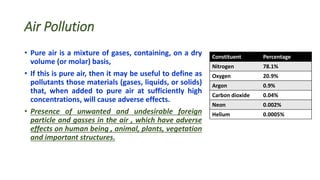
• Pure air is a mixture of gases, containing, on a dry
volume (or molar) basis,
• If this is pure air, then it may be useful to define as
pollutants those materials (gases, liquids, or solids)
that, when added to pure air at sufficiently high
concentrations, will cause adverse effects.
• Presence of unwanted and undesirable foreign
particle and gasses in the air , which have adverse
effects on human being , animal, plants, vegetation
and important structures.
Constituent Percentage
Nitrogen 78.1%
Oxygen 20.9%
Argon 0.9%
Carbon dioxide 0.04%
Neon 0.002%
Helium 0.0005%
Types/ Classification of Air Pollutants
 According to origin
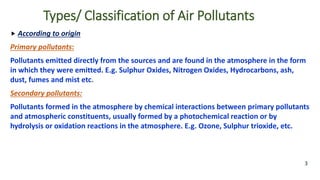
Primary pollutants:
Pollutants emitted directly from the sources and are found in the atmosphere in the form
in which they were emitted. E.g. Sulphur Oxides, Nitrogen Oxides, Hydrocarbons, ash,
dust, fumes and mist etc.
Secondary pollutants:
Pollutants formed in the atmosphere by chemical interactions between primary pollutants
and atmospheric constituents, usually formed by a photochemical reaction or by
hydrolysis or oxidation reactions in the atmosphere. E.g. Ozone, Sulphur trioxide, etc.
3
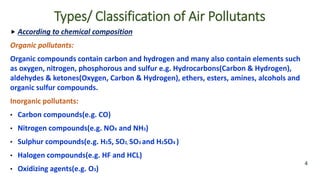
 According to chemical composition
Organic pollutants:
Organic compounds contain carbon and hydrogen and many also contain elements such
as oxygen, nitrogen, phosphorous and sulfur e.g. Hydrocarbons(Carbon & Hydrogen),
aldehydes & ketones(Oxygen, Carbon & Hydrogen), ethers, esters, amines, alcohols and
organic sulfur compounds.
Inorganic pollutants:
• Carbon compounds(e.g. CO)
• Nitrogen compounds(e.g. NOX and NH3)
• Sulphur compounds(e.g. H2S, SO2, SO3 and H2SO4 )
• Halogen compounds(e.g. HF and HCL)
• Oxidizing agents(e.g. O3)
4
Types/ Classification of Air Pollutants
 According to state of matter
Gaseous air pollutants: air pollutants:
Pollutants occurring in the gaseous state at normal temperature and pressure e.g. CO, CO2,
NOX, SOX, etc.
Particulate air pollutants:
All atmospheric substances that are not gases but may be suspended droplets, solid
particles or mixture of the two are generally referred to as particulates e.g. Aerosols, dust,
smoke, fumes, mist, fog, fly ash and soot etc.
5
Types/ Classification of Air Pollutants
Sources of Air Pollution
Atmosphere is a dynamic system which absorbs pollutants from natural as
well as anthropogenic sources and acts as a natural sink like ocean.
 Natural Sources
• They cause large scale air pollution which is beyond the control of man
• It includes
• Geogenic: Emitted from geological processes(from volcano -sulfur gases (SO2
and H2S), methane, carbon dioxide, particulates (minerals), chlorides and
petroleum gases)
• Biogenic: emitted from living organisms(from photosynthesis, decomposition of
living matter, etc)
6
 Natural Sources
• Photochemical and other reactions in the atmosphere, Salt sprays(aerosols formed from
ocean), CO from breakdown of methane, H2S and CH4 from anaerobic decomposition of
organic wastes, radioactive minerals from the earth’s crust, hydrocarbons from trees;
Smoke and dust particles from forest fires, volcanic eruptions, dust storms etc.
7
Sources of Air Pollution
 Manmade or Anthropogenic Sources
• They pose problems severe enough to endanger life and property
• Rapid industrialization, automobile revolution and deforestation
• Chemical, metallurgical, coal fired power plant and petroleum refineries produce SO2
gas, NH3, NO2, HF, HCL gas and H2S gas besides dust, fumes and tar etc.
• Solid waste disposal (i.e., household and commercial refuse, coal refuse, and agricultural
burning)
• Automobiles results in emission of hazardous pollutants as by- products of the
combustion of fossil fuels.
• Advanced agricultural techniques like spraying of crops for pest and weed control
releases many pollutants like chlorinated hydrocarbons, organic Phosphates, Arsenic,
Fluorides and Lead etc.
• Nuclear explosives used in the war result in radioactive pollutants.
8
Sources of Air Pollution
Characteristics of air pollution
 Particulates
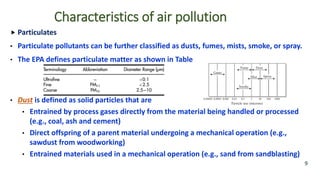
• Particulate pollutants can be further classified as dusts, fumes, mists, smoke, or spray.
• The EPA defines particulate matter as shown in Table
• Dust is defined as solid particles that are
• Entrained by process gases directly from the material being handled or processed
(e.g., coal, ash and cement)
• Direct offspring of a parent material undergoing a mechanical operation (e.g.,
sawdust from woodworking)
• Entrained materials used in a mechanical operation (e.g., sand from sandblasting)
9
Characteristics of air pollution
 Particulates
• A fume is also a solid particle, frequently a metallic oxide, formed by the condensation
of vapors by sublimation, calcination, or chemical reaction processes.
• A mist is an entrained liquid particle formed by the condensation of a vapor
• Smoke is made up of entrained solid particles formed as a result of incomplete
combustion of carbonaceous materials.
•
10
Air pollution Control Techniques
 Basic approaches to control stationary source emissions
 Source correction methods
 Pollution control equipment
 Diffusion of pollutants in air
 Vegetation
 Zoning
11
Source correction method
Industries make a major contribution towards causing air pollution. Formation of
pollutants can be prevented and the emission can be minimized at the source itself. By
carefully investigating the early stages of design and development in industrial
processes e.g. those methods which have minimum air pollution potential can be
selected to accomplish air pollution control at source itself. Such as:
 Substitution of raw materials:
If the use of particular raw material results in air pollution then it should be
substituted by another purer grade raw material which reduces the formation of
pollutants. Thus, low sulfur fuel which is less pollution potential can be used as an
alternative, and, comparatively liquid petroleum gas (LPG) or liquefied natural gas
(LNG) can be used Instead of traditional high contaminants fuels such as coal.
12
Source correction method
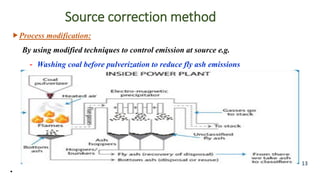
Process modification:
By using modified techniques to control emission at source e.g.
- Washing coal before pulverization to reduce fly ash emissions
•
13
Source correction method
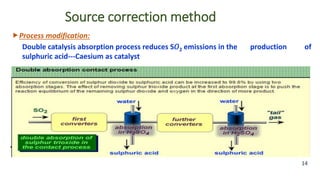
Process modification:
Double catalysis absorption process reduces S𝑂2 emissions in the production of
sulphuric acid---Caesium as catalyst
•
14
Source correction method
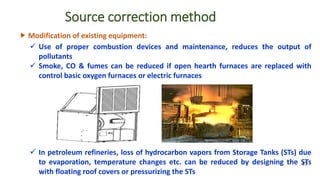
 Modification of existing equipment:
 Use of proper combustion devices and maintenance, reduces the output of
pollutants
 Smoke, CO & fumes can be reduced if open hearth furnaces are replaced with
control basic oxygen furnaces or electric furnaces
 In petroleum refineries, loss of hydrocarbon vapors from Storage Tanks (STs) due
to evaporation, temperature changes etc. can be reduced by designing the STs
with floating roof covers or pressurizing the STs
15
Source correction method
 Maintenance of equipment:
 Pollution caused due to poor maintenance of equipment such as leakage
around ducts, pipes, valves and pumps etc.
 Emission of pollutants due to negligence can be minimized by routine
checkup of the seals and gas kits.
•
16
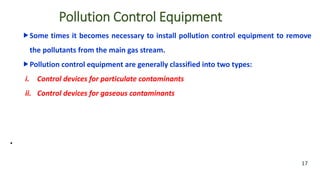
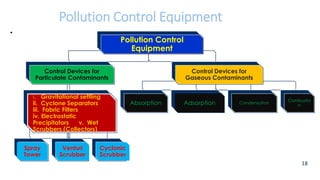
Pollution Control Equipment
Some times it becomes necessary to install pollution control equipment to remove
the pollutants from the main gas stream.
Pollution control equipment are generally classified into two types:
i. Control devices for particulate contaminants
ii. Control devices for gaseous contaminants
•
17
Pollution Control Equipment
•
18
Pollution Control
Equipment
Control Devices for
Particulate Contaminants
i. Gravitational settling
ii. Cyclone Separators
iii. Fabric Filters
iv. Electrostatic
Precipitators v. Wet
Scrubbers (Collectors)
Spray
Tower
Venturi
Scrubber
Cyclonic
Scrubber
Control Devices for
Gaseous Contaminants
Absorption Adsorption Condensation
Combustio
n
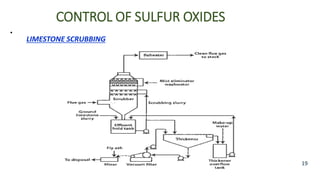
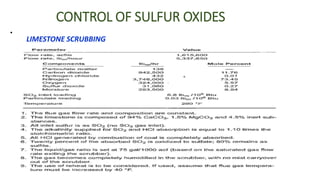
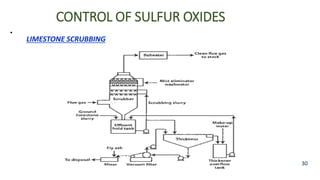
CONTROL OF SULFUR OXIDES
•
19
LIMESTONE SCRUBBING
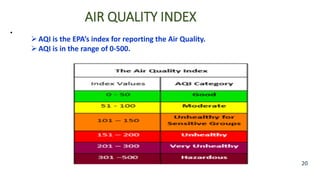
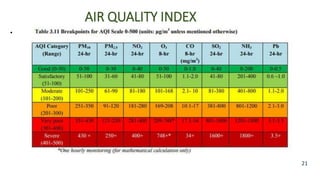
AIR QUALITY INDEX
•
20
AQI is the EPA’s index for reporting the Air Quality.
AQI is in the range of 0-500.
AIR QUALITY INDEX
•
21
AIR QUALITY INDEX
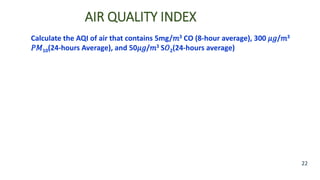
22
Calculate the AQI of air that contains 5mg/𝑚3 CO (8-hour average), 300 𝜇𝑔/𝑚3
𝑃𝑀10(24-hours Average), and 50𝜇𝑔/𝑚3 S𝑂2(24-hours average)
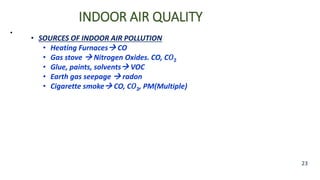
INDOOR AIR QUALITY
•
23
• SOURCES OF INDOOR AIR POLLUTION
• Heating Furnaces CO
• Gas stove  Nitrogen Oxides. CO, C𝑂2
• Glue, paints, solvents VOC
• Earth gas seepage  radon
• Cigarette smoke CO, C𝑂2, PM(Multiple)
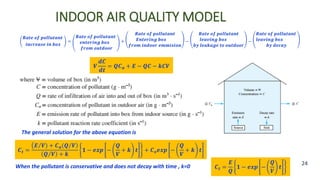
INDOOR AIR QUALITY MODEL
24
𝑹𝒂𝒕𝒆 𝒐𝒇 𝒑𝒐𝒍𝒍𝒖𝒕𝒂𝒏𝒕
𝒊𝒏𝒄𝒓𝒆𝒂𝒔𝒆 𝒊𝒏 𝒃𝒐𝒙
=
𝑹𝒂𝒕𝒆 𝒐𝒇 𝒑𝒐𝒍𝒍𝒖𝒕𝒂𝒏𝒕
𝒆𝒏𝒕𝒆𝒓𝒊𝒏𝒈 𝒃𝒐𝒙
𝒇𝒓𝒐𝒎 𝒐𝒖𝒕𝒅𝒐𝒐𝒓
+
𝑹𝒂𝒕𝒆 𝒐𝒇 𝒑𝒐𝒍𝒍𝒖𝒕𝒂𝒏𝒕
𝑬𝒏𝒕𝒆𝒓𝒊𝒏𝒈 𝒃𝒐𝒙
𝒇𝒓𝒐𝒎 𝒊𝒏𝒅𝒐𝒐𝒓 𝒆𝒎𝒎𝒊𝒔𝒊𝒐𝒏
−
𝑹𝒂𝒕𝒆 𝒐𝒇 𝒑𝒐𝒍𝒍𝒖𝒕𝒂𝒏𝒕
𝒍𝒆𝒂𝒗𝒊𝒏𝒈 𝒃𝒐𝒙
𝒃𝒚 𝒍𝒆𝒂𝒌𝒂𝒈𝒆 𝒕𝒐 𝒐𝒖𝒕𝒅𝒐𝒐𝒓
−
𝑹𝒂𝒕𝒆 𝒐𝒇 𝒑𝒐𝒍𝒍𝒖𝒕𝒂𝒏𝒕
𝒍𝒆𝒂𝒗𝒊𝒏𝒈 𝒃𝒐𝒙
𝒃𝒚 𝒅𝒆𝒄𝒂𝒚
𝑽
𝒅𝑪
𝒅𝒕
= 𝑸𝑪𝒂 + 𝑬 − 𝑸𝑪 − 𝒌𝑪𝑽
The general solution for the above equation is
𝑪𝒕 =
𝑬 𝑽 + 𝑪𝒂(𝑸 𝑽
𝑸 𝑽 + 𝒌
𝟏 − 𝒆𝒙𝒑 −
𝑸
𝑽
+ 𝒌 𝒕 + 𝑪𝒐𝒆𝒙𝒑 −
𝑸
𝑽
+ 𝒌 𝒕
When the pollutant is conservative and does not decay with time , k=0 𝑪𝒕 =
𝑬
𝑸
𝟏 − 𝒆𝒙𝒑 −
𝑸
𝑽
𝒕
INDOOR AIR QUALITY MODEL
25
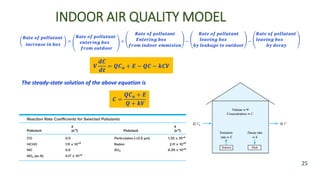
𝑹𝒂𝒕𝒆 𝒐𝒇 𝒑𝒐𝒍𝒍𝒖𝒕𝒂𝒏𝒕
𝒊𝒏𝒄𝒓𝒆𝒂𝒔𝒆 𝒊𝒏 𝒃𝒐𝒙
=
𝑹𝒂𝒕𝒆 𝒐𝒇 𝒑𝒐𝒍𝒍𝒖𝒕𝒂𝒏𝒕
𝒆𝒏𝒕𝒆𝒓𝒊𝒏𝒈 𝒃𝒐𝒙
𝒇𝒓𝒐𝒎 𝒐𝒖𝒕𝒅𝒐𝒐𝒓
+
𝑹𝒂𝒕𝒆 𝒐𝒇 𝒑𝒐𝒍𝒍𝒖𝒕𝒂𝒏𝒕
𝑬𝒏𝒕𝒆𝒓𝒊𝒏𝒈 𝒃𝒐𝒙
𝒇𝒓𝒐𝒎 𝒊𝒏𝒅𝒐𝒐𝒓 𝒆𝒎𝒎𝒊𝒔𝒊𝒐𝒏
−
𝑹𝒂𝒕𝒆 𝒐𝒇 𝒑𝒐𝒍𝒍𝒖𝒕𝒂𝒏𝒕
𝒍𝒆𝒂𝒗𝒊𝒏𝒈 𝒃𝒐𝒙
𝒃𝒚 𝒍𝒆𝒂𝒌𝒂𝒈𝒆 𝒕𝒐 𝒐𝒖𝒕𝒅𝒐𝒐𝒓
−
𝑹𝒂𝒕𝒆 𝒐𝒇 𝒑𝒐𝒍𝒍𝒖𝒕𝒂𝒏𝒕
𝒍𝒆𝒂𝒗𝒊𝒏𝒈 𝒃𝒐𝒙
𝒃𝒚 𝒅𝒆𝒄𝒂𝒚
𝑽
𝒅𝑪
𝒅𝒕
= 𝑸𝑪𝒂 + 𝑬 − 𝑸𝑪 − 𝒌𝑪𝑽
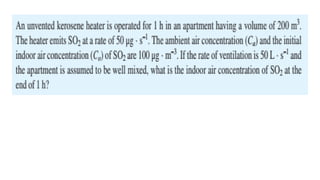
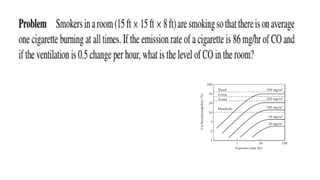
The steady-state solution of the above equation is
𝑪 =
𝑸𝑪𝒂 + 𝑬
𝑸 + 𝒌𝑽
Assignment Question
CONTROL OF SULFUR OXIDES
•
29
LIMESTONE SCRUBBING
CONTROL OF SULFUR OXIDES
•
30
LIMESTONE SCRUBBING
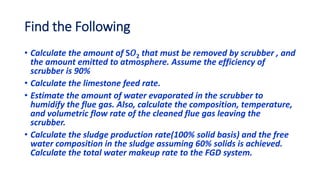
Find the Following
• Calculate the amount of S𝑂2 that must be removed by scrubber , and
the amount emitted to atmosphere. Assume the efficiency of
scrubber is 90%
• Calculate the limestone feed rate.
• Estimate the amount of water evaporated in the scrubber to
humidify the flue gas. Also, calculate the composition, temperature,
and volumetric flow rate of the cleaned flue gas leaving the
scrubber.
• Calculate the sludge production rate(100% solid basis) and the free
water composition in the sludge assuming 60% solids is achieved.
Calculate the total water makeup rate to the FGD system.

Air Pollution control for ch Lecture.pdf

  • 1.
    Environmental Pollution Control (CH-411) Engr.SM Tarique Lecturer, Chemical Engineering Department
  • 2.
    Air Pollution • Pureair is a mixture of gases, containing, on a dry volume (or molar) basis, • If this is pure air, then it may be useful to define as pollutants those materials (gases, liquids, or solids) that, when added to pure air at sufficiently high concentrations, will cause adverse effects. • Presence of unwanted and undesirable foreign particle and gasses in the air , which have adverse effects on human being , animal, plants, vegetation and important structures. Constituent Percentage Nitrogen 78.1% Oxygen 20.9% Argon 0.9% Carbon dioxide 0.04% Neon 0.002% Helium 0.0005%
  • 3.
    Types/ Classification ofAir Pollutants  According to origin Primary pollutants: Pollutants emitted directly from the sources and are found in the atmosphere in the form in which they were emitted. E.g. Sulphur Oxides, Nitrogen Oxides, Hydrocarbons, ash, dust, fumes and mist etc. Secondary pollutants: Pollutants formed in the atmosphere by chemical interactions between primary pollutants and atmospheric constituents, usually formed by a photochemical reaction or by hydrolysis or oxidation reactions in the atmosphere. E.g. Ozone, Sulphur trioxide, etc. 3
  • 4.
     According tochemical composition Organic pollutants: Organic compounds contain carbon and hydrogen and many also contain elements such as oxygen, nitrogen, phosphorous and sulfur e.g. Hydrocarbons(Carbon & Hydrogen), aldehydes & ketones(Oxygen, Carbon & Hydrogen), ethers, esters, amines, alcohols and organic sulfur compounds. Inorganic pollutants: • Carbon compounds(e.g. CO) • Nitrogen compounds(e.g. NOX and NH3) • Sulphur compounds(e.g. H2S, SO2, SO3 and H2SO4 ) • Halogen compounds(e.g. HF and HCL) • Oxidizing agents(e.g. O3) 4 Types/ Classification of Air Pollutants
  • 5.
     According tostate of matter Gaseous air pollutants: air pollutants: Pollutants occurring in the gaseous state at normal temperature and pressure e.g. CO, CO2, NOX, SOX, etc. Particulate air pollutants: All atmospheric substances that are not gases but may be suspended droplets, solid particles or mixture of the two are generally referred to as particulates e.g. Aerosols, dust, smoke, fumes, mist, fog, fly ash and soot etc. 5 Types/ Classification of Air Pollutants
  • 6.
    Sources of AirPollution Atmosphere is a dynamic system which absorbs pollutants from natural as well as anthropogenic sources and acts as a natural sink like ocean.  Natural Sources • They cause large scale air pollution which is beyond the control of man • It includes • Geogenic: Emitted from geological processes(from volcano -sulfur gases (SO2 and H2S), methane, carbon dioxide, particulates (minerals), chlorides and petroleum gases) • Biogenic: emitted from living organisms(from photosynthesis, decomposition of living matter, etc) 6
  • 7.
     Natural Sources •Photochemical and other reactions in the atmosphere, Salt sprays(aerosols formed from ocean), CO from breakdown of methane, H2S and CH4 from anaerobic decomposition of organic wastes, radioactive minerals from the earth’s crust, hydrocarbons from trees; Smoke and dust particles from forest fires, volcanic eruptions, dust storms etc. 7 Sources of Air Pollution
  • 8.
     Manmade orAnthropogenic Sources • They pose problems severe enough to endanger life and property • Rapid industrialization, automobile revolution and deforestation • Chemical, metallurgical, coal fired power plant and petroleum refineries produce SO2 gas, NH3, NO2, HF, HCL gas and H2S gas besides dust, fumes and tar etc. • Solid waste disposal (i.e., household and commercial refuse, coal refuse, and agricultural burning) • Automobiles results in emission of hazardous pollutants as by- products of the combustion of fossil fuels. • Advanced agricultural techniques like spraying of crops for pest and weed control releases many pollutants like chlorinated hydrocarbons, organic Phosphates, Arsenic, Fluorides and Lead etc. • Nuclear explosives used in the war result in radioactive pollutants. 8 Sources of Air Pollution
  • 9.
    Characteristics of airpollution  Particulates • Particulate pollutants can be further classified as dusts, fumes, mists, smoke, or spray. • The EPA defines particulate matter as shown in Table • Dust is defined as solid particles that are • Entrained by process gases directly from the material being handled or processed (e.g., coal, ash and cement) • Direct offspring of a parent material undergoing a mechanical operation (e.g., sawdust from woodworking) • Entrained materials used in a mechanical operation (e.g., sand from sandblasting) 9
  • 10.
    Characteristics of airpollution  Particulates • A fume is also a solid particle, frequently a metallic oxide, formed by the condensation of vapors by sublimation, calcination, or chemical reaction processes. • A mist is an entrained liquid particle formed by the condensation of a vapor • Smoke is made up of entrained solid particles formed as a result of incomplete combustion of carbonaceous materials. • 10
  • 11.
    Air pollution ControlTechniques  Basic approaches to control stationary source emissions  Source correction methods  Pollution control equipment  Diffusion of pollutants in air  Vegetation  Zoning 11
  • 12.
    Source correction method Industriesmake a major contribution towards causing air pollution. Formation of pollutants can be prevented and the emission can be minimized at the source itself. By carefully investigating the early stages of design and development in industrial processes e.g. those methods which have minimum air pollution potential can be selected to accomplish air pollution control at source itself. Such as:  Substitution of raw materials: If the use of particular raw material results in air pollution then it should be substituted by another purer grade raw material which reduces the formation of pollutants. Thus, low sulfur fuel which is less pollution potential can be used as an alternative, and, comparatively liquid petroleum gas (LPG) or liquefied natural gas (LNG) can be used Instead of traditional high contaminants fuels such as coal. 12
  • 13.
    Source correction method Processmodification: By using modified techniques to control emission at source e.g. - Washing coal before pulverization to reduce fly ash emissions • 13
  • 14.
    Source correction method Processmodification: Double catalysis absorption process reduces S𝑂2 emissions in the production of sulphuric acid---Caesium as catalyst • 14
  • 15.
    Source correction method Modification of existing equipment:  Use of proper combustion devices and maintenance, reduces the output of pollutants  Smoke, CO & fumes can be reduced if open hearth furnaces are replaced with control basic oxygen furnaces or electric furnaces  In petroleum refineries, loss of hydrocarbon vapors from Storage Tanks (STs) due to evaporation, temperature changes etc. can be reduced by designing the STs with floating roof covers or pressurizing the STs 15
  • 16.
    Source correction method Maintenance of equipment:  Pollution caused due to poor maintenance of equipment such as leakage around ducts, pipes, valves and pumps etc.  Emission of pollutants due to negligence can be minimized by routine checkup of the seals and gas kits. • 16
  • 17.
    Pollution Control Equipment Sometimes it becomes necessary to install pollution control equipment to remove the pollutants from the main gas stream. Pollution control equipment are generally classified into two types: i. Control devices for particulate contaminants ii. Control devices for gaseous contaminants • 17
  • 18.
    Pollution Control Equipment • 18 PollutionControl Equipment Control Devices for Particulate Contaminants i. Gravitational settling ii. Cyclone Separators iii. Fabric Filters iv. Electrostatic Precipitators v. Wet Scrubbers (Collectors) Spray Tower Venturi Scrubber Cyclonic Scrubber Control Devices for Gaseous Contaminants Absorption Adsorption Condensation Combustio n
  • 19.
    CONTROL OF SULFUROXIDES • 19 LIMESTONE SCRUBBING
  • 20.
    AIR QUALITY INDEX • 20 AQIis the EPA’s index for reporting the Air Quality. AQI is in the range of 0-500.
  • 21.
  • 22.
    AIR QUALITY INDEX 22 Calculatethe AQI of air that contains 5mg/𝑚3 CO (8-hour average), 300 𝜇𝑔/𝑚3 𝑃𝑀10(24-hours Average), and 50𝜇𝑔/𝑚3 S𝑂2(24-hours average)
  • 23.
    INDOOR AIR QUALITY • 23 •SOURCES OF INDOOR AIR POLLUTION • Heating Furnaces CO • Gas stove  Nitrogen Oxides. CO, C𝑂2 • Glue, paints, solvents VOC • Earth gas seepage  radon • Cigarette smoke CO, C𝑂2, PM(Multiple)
  • 24.
    INDOOR AIR QUALITYMODEL 24 𝑹𝒂𝒕𝒆 𝒐𝒇 𝒑𝒐𝒍𝒍𝒖𝒕𝒂𝒏𝒕 𝒊𝒏𝒄𝒓𝒆𝒂𝒔𝒆 𝒊𝒏 𝒃𝒐𝒙 = 𝑹𝒂𝒕𝒆 𝒐𝒇 𝒑𝒐𝒍𝒍𝒖𝒕𝒂𝒏𝒕 𝒆𝒏𝒕𝒆𝒓𝒊𝒏𝒈 𝒃𝒐𝒙 𝒇𝒓𝒐𝒎 𝒐𝒖𝒕𝒅𝒐𝒐𝒓 + 𝑹𝒂𝒕𝒆 𝒐𝒇 𝒑𝒐𝒍𝒍𝒖𝒕𝒂𝒏𝒕 𝑬𝒏𝒕𝒆𝒓𝒊𝒏𝒈 𝒃𝒐𝒙 𝒇𝒓𝒐𝒎 𝒊𝒏𝒅𝒐𝒐𝒓 𝒆𝒎𝒎𝒊𝒔𝒊𝒐𝒏 − 𝑹𝒂𝒕𝒆 𝒐𝒇 𝒑𝒐𝒍𝒍𝒖𝒕𝒂𝒏𝒕 𝒍𝒆𝒂𝒗𝒊𝒏𝒈 𝒃𝒐𝒙 𝒃𝒚 𝒍𝒆𝒂𝒌𝒂𝒈𝒆 𝒕𝒐 𝒐𝒖𝒕𝒅𝒐𝒐𝒓 − 𝑹𝒂𝒕𝒆 𝒐𝒇 𝒑𝒐𝒍𝒍𝒖𝒕𝒂𝒏𝒕 𝒍𝒆𝒂𝒗𝒊𝒏𝒈 𝒃𝒐𝒙 𝒃𝒚 𝒅𝒆𝒄𝒂𝒚 𝑽 𝒅𝑪 𝒅𝒕 = 𝑸𝑪𝒂 + 𝑬 − 𝑸𝑪 − 𝒌𝑪𝑽 The general solution for the above equation is 𝑪𝒕 = 𝑬 𝑽 + 𝑪𝒂(𝑸 𝑽 𝑸 𝑽 + 𝒌 𝟏 − 𝒆𝒙𝒑 − 𝑸 𝑽 + 𝒌 𝒕 + 𝑪𝒐𝒆𝒙𝒑 − 𝑸 𝑽 + 𝒌 𝒕 When the pollutant is conservative and does not decay with time , k=0 𝑪𝒕 = 𝑬 𝑸 𝟏 − 𝒆𝒙𝒑 − 𝑸 𝑽 𝒕
  • 25.
    INDOOR AIR QUALITYMODEL 25 𝑹𝒂𝒕𝒆 𝒐𝒇 𝒑𝒐𝒍𝒍𝒖𝒕𝒂𝒏𝒕 𝒊𝒏𝒄𝒓𝒆𝒂𝒔𝒆 𝒊𝒏 𝒃𝒐𝒙 = 𝑹𝒂𝒕𝒆 𝒐𝒇 𝒑𝒐𝒍𝒍𝒖𝒕𝒂𝒏𝒕 𝒆𝒏𝒕𝒆𝒓𝒊𝒏𝒈 𝒃𝒐𝒙 𝒇𝒓𝒐𝒎 𝒐𝒖𝒕𝒅𝒐𝒐𝒓 + 𝑹𝒂𝒕𝒆 𝒐𝒇 𝒑𝒐𝒍𝒍𝒖𝒕𝒂𝒏𝒕 𝑬𝒏𝒕𝒆𝒓𝒊𝒏𝒈 𝒃𝒐𝒙 𝒇𝒓𝒐𝒎 𝒊𝒏𝒅𝒐𝒐𝒓 𝒆𝒎𝒎𝒊𝒔𝒊𝒐𝒏 − 𝑹𝒂𝒕𝒆 𝒐𝒇 𝒑𝒐𝒍𝒍𝒖𝒕𝒂𝒏𝒕 𝒍𝒆𝒂𝒗𝒊𝒏𝒈 𝒃𝒐𝒙 𝒃𝒚 𝒍𝒆𝒂𝒌𝒂𝒈𝒆 𝒕𝒐 𝒐𝒖𝒕𝒅𝒐𝒐𝒓 − 𝑹𝒂𝒕𝒆 𝒐𝒇 𝒑𝒐𝒍𝒍𝒖𝒕𝒂𝒏𝒕 𝒍𝒆𝒂𝒗𝒊𝒏𝒈 𝒃𝒐𝒙 𝒃𝒚 𝒅𝒆𝒄𝒂𝒚 𝑽 𝒅𝑪 𝒅𝒕 = 𝑸𝑪𝒂 + 𝑬 − 𝑸𝑪 − 𝒌𝑪𝑽 The steady-state solution of the above equation is 𝑪 = 𝑸𝑪𝒂 + 𝑬 𝑸 + 𝒌𝑽
  • 28.
  • 29.
    CONTROL OF SULFUROXIDES • 29 LIMESTONE SCRUBBING
  • 30.
    CONTROL OF SULFUROXIDES • 30 LIMESTONE SCRUBBING
  • 31.
    Find the Following •Calculate the amount of S𝑂2 that must be removed by scrubber , and the amount emitted to atmosphere. Assume the efficiency of scrubber is 90% • Calculate the limestone feed rate. • Estimate the amount of water evaporated in the scrubber to humidify the flue gas. Also, calculate the composition, temperature, and volumetric flow rate of the cleaned flue gas leaving the scrubber. • Calculate the sludge production rate(100% solid basis) and the free water composition in the sludge assuming 60% solids is achieved. Calculate the total water makeup rate to the FGD system.