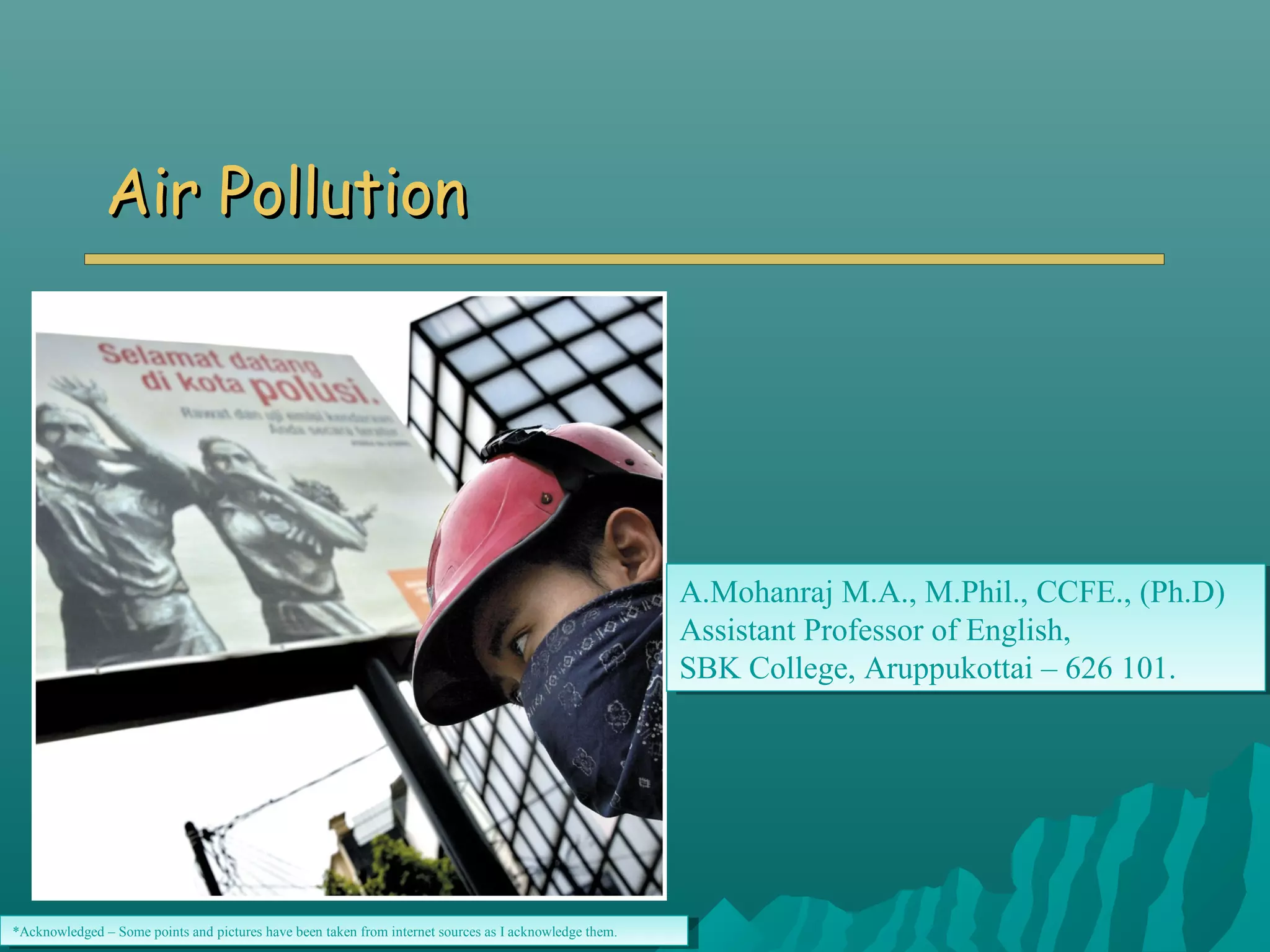
Air PollutionAir Pollution
*Acknowledged – Some points and pictures have been taken from internet sources as I acknowledge them.*Acknowledged – Some points and pictures have been taken from internet sources as I acknowledge them.
A.Mohanraj M.A., M.Phil., CCFE., (Ph.D)
Assistant Professor of English,
SBK College, Aruppukottai – 626 101.
A.Mohanraj M.A., M.Phil., CCFE., (Ph.D)
Assistant Professor of English,
SBK College, Aruppukottai – 626 101.
Overview of Air PollutionOverview of Air Pollution
o Atmosphere as a ResourceAtmosphere as a Resource
o Types and Sources of Air PollutionTypes and Sources of Air Pollution
• Major Classes of Air PollutantsMajor Classes of Air Pollutants
• Sources of Outdoor Air PollutantsSources of Outdoor Air Pollutants
• Urban Air PollutionUrban Air Pollution
o Effects of Air PollutionEffects of Air Pollution
o Controlling Air PollutionControlling Air Pollution
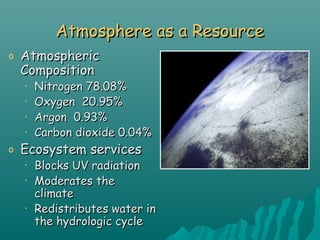
Atmosphere as a ResourceAtmosphere as a Resource
o AtmosphericAtmospheric
CompositionComposition
• Nitrogen 78.08%Nitrogen 78.08%
• Oxygen 20.95%Oxygen 20.95%
• Argon 0.93%Argon 0.93%
• Carbon dioxide 0.04%Carbon dioxide 0.04%
o Ecosystem servicesEcosystem services
• Blocks UV radiationBlocks UV radiation
• Moderates theModerates the
climateclimate
• Redistributes water inRedistributes water in
the hydrologic cyclethe hydrologic cycle
Types and Sources of Air PollutionTypes and Sources of Air Pollution
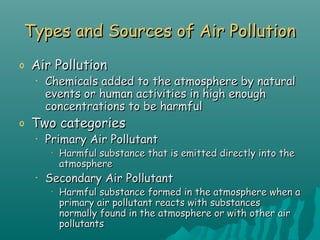
o Air PollutionAir Pollution
• Chemicals added to the atmosphere by naturalChemicals added to the atmosphere by natural
events or human activities in high enoughevents or human activities in high enough
concentrations to be harmfulconcentrations to be harmful
o Two categoriesTwo categories
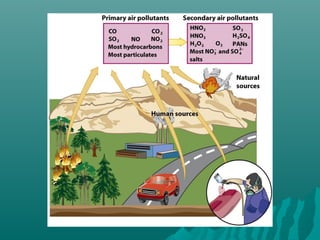
• Primary Air PollutantPrimary Air Pollutant
•
Harmful substance that is emitted directly into theHarmful substance that is emitted directly into the
atmosphereatmosphere
• Secondary Air PollutantSecondary Air Pollutant
•
Harmful substance formed in the atmosphere when aHarmful substance formed in the atmosphere when a
primary air pollutant reacts with substancesprimary air pollutant reacts with substances
normally found in the atmosphere or with other airnormally found in the atmosphere or with other air
pollutantspollutants
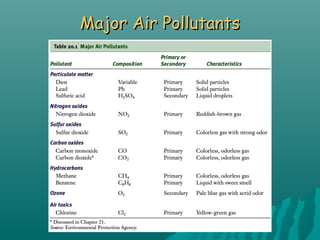
Major Air PollutantsMajor Air Pollutants
Major Classes of Air PollutantsMajor Classes of Air Pollutants
o Particulate MaterialParticulate Material
o Nitrogen OxidesNitrogen Oxides
o Sulfur OxidesSulfur Oxides
o Carbon OxidesCarbon Oxides
o HydrocarbonsHydrocarbons
o OzoneOzone
Particulate MaterialParticulate Material
o Thousands of different solid or liquidThousands of different solid or liquid
particles suspended in airparticles suspended in air
• Includes: soil particles, soot, lead, asbestos,Includes: soil particles, soot, lead, asbestos,
sea salt, and sulfuric acid dropletssea salt, and sulfuric acid droplets
o Dangerous for 2 reasonsDangerous for 2 reasons
• May contain materials with toxic effectsMay contain materials with toxic effects
• Extremely small particles can become lodged inExtremely small particles can become lodged in
lungslungs
Nitrogen and Sulfur OxidesNitrogen and Sulfur Oxides
o Nitrogen OxidesNitrogen Oxides
• Gases produced by the chemical interactionsGases produced by the chemical interactions
between atmospheric nitrogen and oxygen atbetween atmospheric nitrogen and oxygen at
high temperaturehigh temperature
• ProblemsProblems
•
Greenhouse gasesGreenhouse gases
•
Cause difficulty breathingCause difficulty breathing
o Sulfur OxidesSulfur Oxides
• Gases produced by the chemical interactionsGases produced by the chemical interactions
between sulfur and oxygenbetween sulfur and oxygen
• Causes acid precipitationCauses acid precipitation
Carbon Oxides and HydrocarbonsCarbon Oxides and Hydrocarbons
o Carbon OxidesCarbon Oxides
• Gases carbon monoxide (CO) and carbonGases carbon monoxide (CO) and carbon
dioxide (COdioxide (CO22))
• Greenhouse gasesGreenhouse gases
o HydrocarbonsHydrocarbons
• Diverse group of organic compounds thatDiverse group of organic compounds that
contain only hydrogen and carbon (ex: CHcontain only hydrogen and carbon (ex: CH44--
methane)methane)
• Some are related to photochemical smog andSome are related to photochemical smog and
greenhouse gasesgreenhouse gases
OzoneOzone
o Tropospheric OzoneTropospheric Ozone
• Man- made pollutant in the lower atmosphereMan- made pollutant in the lower atmosphere
• Secondary air pollutantSecondary air pollutant
• Component of photochemical smogComponent of photochemical smog
o Stratospheric OzoneStratospheric Ozone
• Essential component that screens out UVEssential component that screens out UV
radiation in the upper atmosphereradiation in the upper atmosphere
• Man- made pollutants (ex: CFCs) can destroy itMan- made pollutants (ex: CFCs) can destroy it
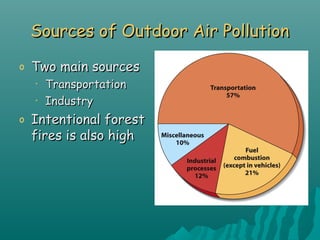
Sources of Outdoor Air PollutionSources of Outdoor Air Pollution
o Two main sourcesTwo main sources
• TransportationTransportation
• IndustryIndustry
o Intentional forestIntentional forest
fires is also highfires is also high
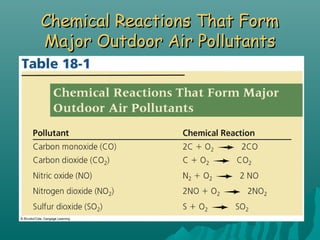
Chemical Reactions That FormChemical Reactions That Form
Major Outdoor Air PollutantsMajor Outdoor Air Pollutants
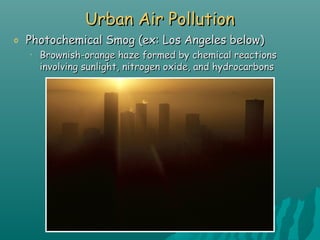
Urban Air PollutionUrban Air Pollution
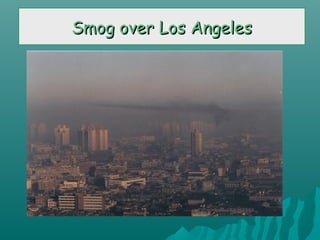
o Photochemical Smog (ex: Los Angeles below)Photochemical Smog (ex: Los Angeles below)
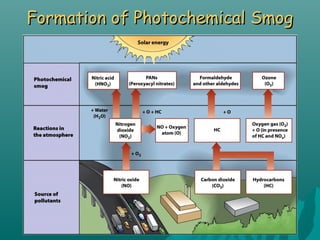
• Brownish-orange haze formed by chemical reactionsBrownish-orange haze formed by chemical reactions
involving sunlight, nitrogen oxide, and hydrocarbonsinvolving sunlight, nitrogen oxide, and hydrocarbons
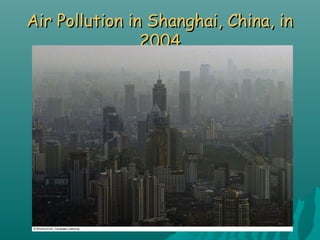
Air Pollution in Shanghai, China, inAir Pollution in Shanghai, China, in
20042004
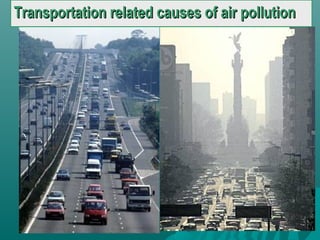
Transportation related causes of air pollutionTransportation related causes of air pollution
Formation of Photochemical SmogFormation of Photochemical Smog
Smog over Los AngelesSmog over Los Angeles
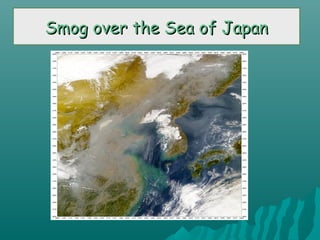
Smog over the Sea of JapanSmog over the Sea of Japan
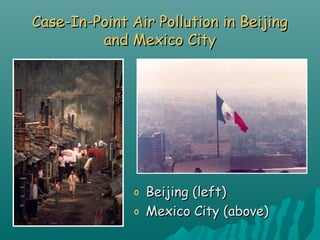
Case-In-Point Air Pollution in BeijingCase-In-Point Air Pollution in Beijing
and Mexico Cityand Mexico City
o Beijing (left)Beijing (left)
o Mexico City (above)Mexico City (above)
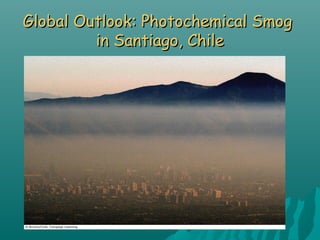
Global Outlook: Photochemical SmogGlobal Outlook: Photochemical Smog
in Santiago, Chilein Santiago, Chile
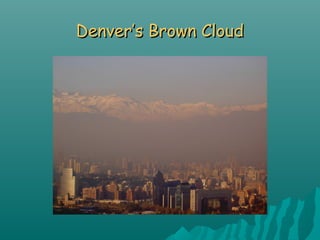
Denver’s Brown CloudDenver’s Brown Cloud
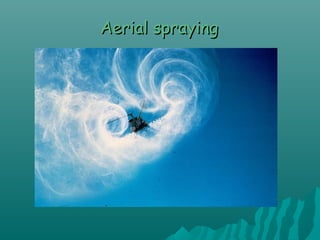
Aerial sprayingAerial spraying
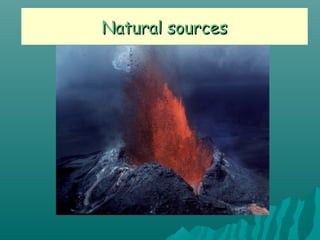
Natural sourcesNatural sources
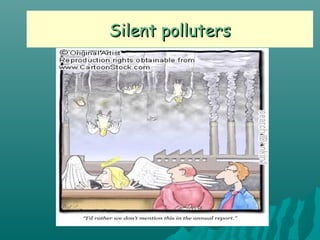
Silent pollutersSilent polluters
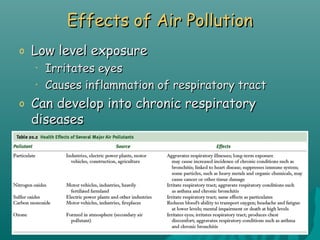
Effects of Air PollutionEffects of Air Pollution
o Low level exposureLow level exposure
• Irritates eyesIrritates eyes
• Causes inflammation of respiratory tractCauses inflammation of respiratory tract
o Can develop into chronic respiratoryCan develop into chronic respiratory
diseasesdiseases
Health Effects of Air PollutionHealth Effects of Air Pollution
o Sulfur Dioxide and Particulate materialSulfur Dioxide and Particulate material
• Irritate respiratory tract and impair ability ofIrritate respiratory tract and impair ability of
lungs to exchange gaseslungs to exchange gases
o Nitrogen DioxidesNitrogen Dioxides
• Causes airway restrictionCauses airway restriction
o Carbon monoxideCarbon monoxide
• Binds with iron in blood hemoglobinBinds with iron in blood hemoglobin
• Causes headache, fatigue, drowsiness, deathCauses headache, fatigue, drowsiness, death
o OzoneOzone
• Causes burning eyes, coughing, and chestCauses burning eyes, coughing, and chest
discomfortdiscomfort
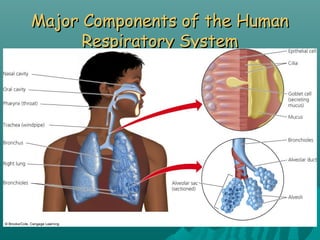
Major Components of the HumanMajor Components of the Human
Respiratory SystemRespiratory System
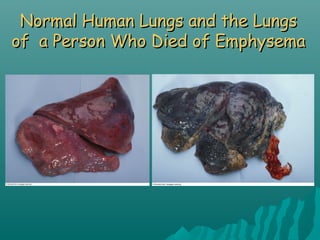
Normal Human Lungs and the LungsNormal Human Lungs and the Lungs
of a Person Who Died of Emphysemaof a Person Who Died of Emphysema
Air Pollution Is a Big KillerAir Pollution Is a Big Killer
o 3 Million deaths per year world-wide3 Million deaths per year world-wide
• Mostly in AsiaMostly in Asia
• Main causesMain causes
o EPA: proposed stricter emission standardsEPA: proposed stricter emission standards
for diesel-powered vehiclesfor diesel-powered vehicles
o Link between international trade and airLink between international trade and air
pollutionpollution
• Cargo ships and pollutionCargo ships and pollution
Children and Air PollutionChildren and Air Pollution
o Greater health threat to children thanGreater health threat to children than
adultsadults
• Air pollution can restrict lung developmentAir pollution can restrict lung development
• Children breath more often than adultsChildren breath more often than adults
o Children who live in high ozone areas areChildren who live in high ozone areas are
more likely to develop asthmamore likely to develop asthma
Controlling Air PollutionControlling Air Pollution
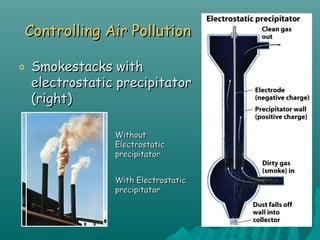
o Smokestacks withSmokestacks with
electrostatic precipitatorelectrostatic precipitator
(right)(right)
WithoutWithout
ElectrostaticElectrostatic
precipitatorprecipitator
With ElectrostaticWith Electrostatic
precipitatorprecipitator
Controlling Air PollutionControlling Air Pollution
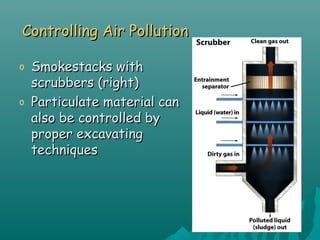
o Smokestacks withSmokestacks with
scrubbers (right)scrubbers (right)
o Particulate material canParticulate material can
also be controlled byalso be controlled by
proper excavatingproper excavating
techniquestechniques
Controlling Air PollutionControlling Air Pollution
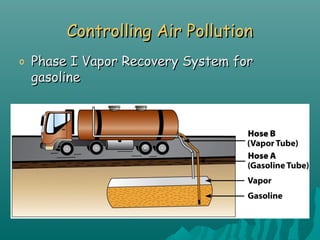
o Phase I Vapor Recovery System forPhase I Vapor Recovery System for
gasolinegasoline
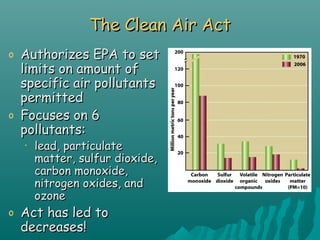
The Clean Air ActThe Clean Air Act
o Authorizes EPA to setAuthorizes EPA to set
limits on amount oflimits on amount of
specific air pollutantsspecific air pollutants
permittedpermitted
o Focuses on 6Focuses on 6
pollutants:pollutants:
• lead, particulatelead, particulate
matter, sulfur dioxide,matter, sulfur dioxide,
carbon monoxide,carbon monoxide,
nitrogen oxides, andnitrogen oxides, and
ozoneozone
o Act has led toAct has led to
decreases!decreases!
Other Ways to Improve Air QualityOther Ways to Improve Air Quality
o Reduce sulfur content in gasoline from itsReduce sulfur content in gasoline from its
current average of 330 ppm to 30 ppmcurrent average of 330 ppm to 30 ppm
• Sulfur clogs catalytic convertersSulfur clogs catalytic converters
o Require federal emission standards for allRequire federal emission standards for all
passenger vehiclespassenger vehicles
• Including SUVs, trucks and minivansIncluding SUVs, trucks and minivans
o Require emission testing for all vehiclesRequire emission testing for all vehicles
• Including dieselIncluding diesel
Ozone Depletion in StratosphereOzone Depletion in Stratosphere
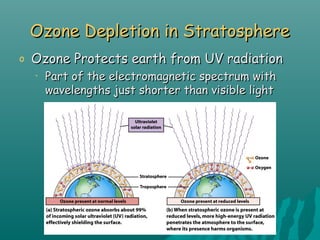
o Ozone Protects earth from UV radiationOzone Protects earth from UV radiation
• Part of the electromagnetic spectrum withPart of the electromagnetic spectrum with
wavelengths just shorter than visible lightwavelengths just shorter than visible light
Ozone Depletion in StratosphereOzone Depletion in Stratosphere
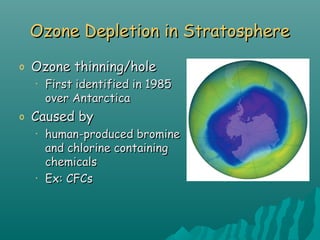
o Ozone thinning/holeOzone thinning/hole
• First identified in 1985First identified in 1985
over Antarcticaover Antarctica
o Caused byCaused by
• human-produced brominehuman-produced bromine
and chlorine containingand chlorine containing
chemicalschemicals
• Ex: CFCsEx: CFCs
Ozone Depletion in StratosphereOzone Depletion in Stratosphere
o Hole over Antarctica requires twoHole over Antarctica requires two
conditions:conditions:
• Sunlight just returning to polar regionSunlight just returning to polar region
• Circumpolar vortex- a mass of cold air thatCircumpolar vortex- a mass of cold air that
circulates around the southern polar regioncirculates around the southern polar region
•
Isolates it from the warmer air in the rest of theIsolates it from the warmer air in the rest of the
planetplanet
o Polar stratospheric clouds formPolar stratospheric clouds form
• Enables Cl and Br to destroy ozoneEnables Cl and Br to destroy ozone
Effects of Ozone DepletionEffects of Ozone Depletion
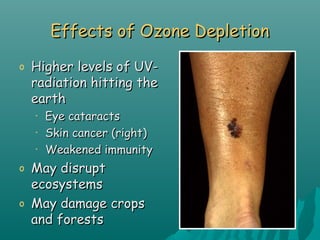
o Higher levels of UV-Higher levels of UV-
radiation hitting theradiation hitting the
earthearth
• Eye cataractsEye cataracts
• Skin cancer (right)Skin cancer (right)
• Weakened immunityWeakened immunity
o May disruptMay disrupt
ecosystemsecosystems
o May damage cropsMay damage crops
and forestsand forests
Recovery of Ozone LayerRecovery of Ozone Layer
o Montreal Protocol (1987)Montreal Protocol (1987)
• Reduction of CFCsReduction of CFCs
• Started using HCFCs (greenhouse gas)Started using HCFCs (greenhouse gas)
o Phase out of all ozone destroying chemicalsPhase out of all ozone destroying chemicals
is underway globallyis underway globally
o Satellite pictures in 2000 indicated thatSatellite pictures in 2000 indicated that
ozone layer was recoveringozone layer was recovering
o Full recovery will not occur until 2050Full recovery will not occur until 2050
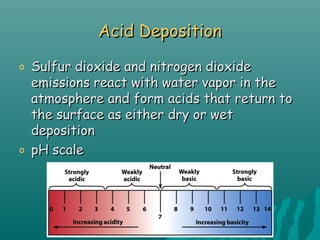
Acid DepositionAcid Deposition
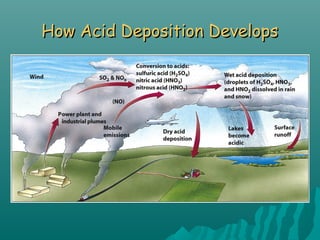
o Sulfur dioxide and nitrogen dioxideSulfur dioxide and nitrogen dioxide
emissions react with water vapor in theemissions react with water vapor in the
atmosphere and form acids that return toatmosphere and form acids that return to
the surface as either dry or wetthe surface as either dry or wet
depositiondeposition
o pH scalepH scale
Acid Deposition Has a Number ofAcid Deposition Has a Number of
Harmful EffectsHarmful Effects
o Leaching of soil nutrientsLeaching of soil nutrients
o Loss of crops and treesLoss of crops and trees
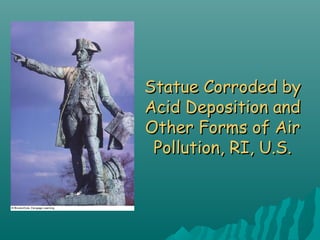
o Damage to buildings, statues, andDamage to buildings, statues, and
monumentsmonuments
How Acid Deposition DevelopsHow Acid Deposition Develops
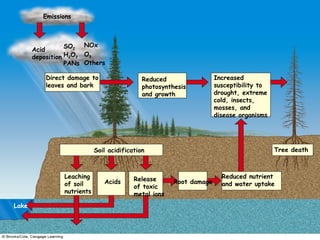
Emissions
SO2
H2O2
PANs
NOx
Acid
deposition O3
Others
Direct damage to
leaves and bark
Reduced
photosynthesis
and growth
Increased
susceptibility to
drought, extreme
cold, insects,
mosses, and
disease organisms
Soil acidification Tree death
Leaching
of soil
nutrients
Release
of toxic
metal ions
Root damage
Reduced nutrient
and water uptakeAcids
Lake
Statue Corroded byStatue Corroded by
Acid Deposition andAcid Deposition and
Other Forms of AirOther Forms of Air
Pollution, RI, U.S.Pollution, RI, U.S.
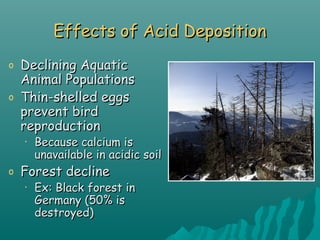
Effects of Acid DepositionEffects of Acid Deposition
o Declining AquaticDeclining Aquatic
Animal PopulationsAnimal Populations
o Thin-shelled eggsThin-shelled eggs
prevent birdprevent bird
reproductionreproduction
• Because calcium isBecause calcium is
unavailable in acidic soilunavailable in acidic soil
o Forest declineForest decline
• Ex: Black forest inEx: Black forest in
Germany (50% isGermany (50% is
destroyed)destroyed)
Fig. 18-15, p. 483
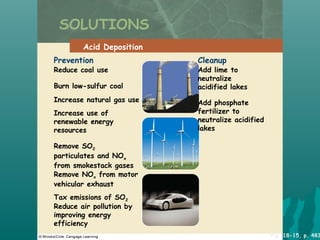
SOLUTIONS
Acid Deposition
Prevention Cleanup
Add lime to
neutralize
acidified lakes
Reduce coal use
Burn low-sulfur coal
Add phosphate
fertilizer to
neutralize acidified
lakes
Increase natural gas use
Increase use of
renewable energy
resources
Remove SO2
particulates and NOx
from smokestack gases
Remove NOx from motor
vehicular exhaust
Tax emissions of SO2
Reduce air pollution by
improving energy
efficiency
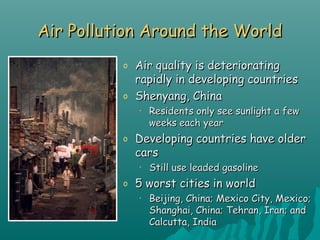
Air Pollution Around the WorldAir Pollution Around the World
o Air quality is deterioratingAir quality is deteriorating
rapidly in developing countriesrapidly in developing countries
o Shenyang, ChinaShenyang, China
• Residents only see sunlight a fewResidents only see sunlight a few
weeks each yearweeks each year
o Developing countries have olderDeveloping countries have older
carscars
• Still use leaded gasolineStill use leaded gasoline
o 5 worst cities in world5 worst cities in world
• Beijing, China; Mexico City, Mexico;Beijing, China; Mexico City, Mexico;
Shanghai, China; Tehran, Iran; andShanghai, China; Tehran, Iran; and
Calcutta, IndiaCalcutta, India
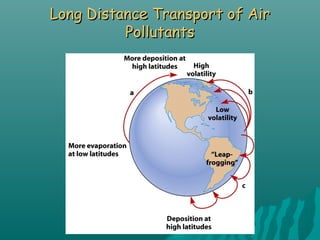
Long Distance Transport of AirLong Distance Transport of Air
PollutantsPollutants
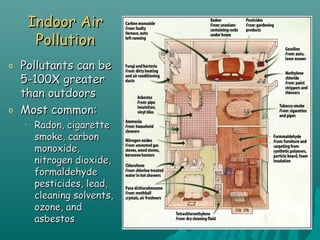
Indoor AirIndoor Air
PollutionPollution
o Pollutants can bePollutants can be
5-100X greater5-100X greater
than outdoorsthan outdoors
o Most common:Most common:
• Radon, cigaretteRadon, cigarette
smoke, carbonsmoke, carbon
monoxide,monoxide,
nitrogen dioxide,nitrogen dioxide,
formaldehydeformaldehyde
pesticides, lead,pesticides, lead,
cleaning solvents,cleaning solvents,
ozone, andozone, and
asbestosasbestos
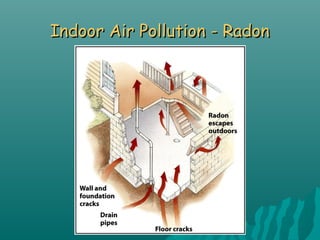
Indoor Air Pollution - RadonIndoor Air Pollution - Radon
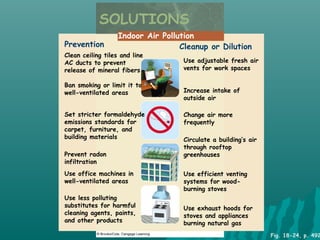
Fig. 18-24, p. 492
SOLUTIONS
Indoor Air Pollution
Prevention Cleanup or Dilution
Clean ceiling tiles and line
AC ducts to prevent
release of mineral fibers
Use adjustable fresh air
vents for work spaces
Ban smoking or limit it to
well-ventilated areas Increase intake of
outside air
Change air more
frequently
Set stricter formaldehyde
emissions standards for
carpet, furniture, and
building materials Circulate a building’s air
through rooftop
greenhousesPrevent radon
infiltration
Use efficient venting
systems for wood-
burning stoves
Use office machines in
well-ventilated areas
Use less polluting
substitutes for harmful
cleaning agents, paints,
and other products
Use exhaust hoods for
stoves and appliances
burning natural gas
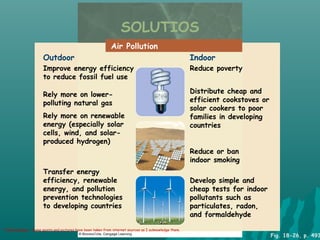
Fig. 18-26, p. 493
SOLUTIOS
Air Pollution
Outdoor Indoor
Improve energy efficiency
to reduce fossil fuel use
Reduce poverty
Distribute cheap and
efficient cookstoves or
solar cookers to poor
families in developing
countries
Rely more on lower-
polluting natural gas
Rely more on renewable
energy (especially solar
cells, wind, and solar-
produced hydrogen)
Reduce or ban
indoor smoking
Transfer energy
efficiency, renewable
energy, and pollution
prevention technologies
to developing countries
Develop simple and
cheap tests for indoor
pollutants such as
particulates, radon,
and formaldehyde
*Acknowledged – Some points and pictures have been taken from internet sources as I acknowledge them.

Air pollution

  • 1.
    Air PollutionAir Pollution *Acknowledged– Some points and pictures have been taken from internet sources as I acknowledge them.*Acknowledged – Some points and pictures have been taken from internet sources as I acknowledge them. A.Mohanraj M.A., M.Phil., CCFE., (Ph.D) Assistant Professor of English, SBK College, Aruppukottai – 626 101. A.Mohanraj M.A., M.Phil., CCFE., (Ph.D) Assistant Professor of English, SBK College, Aruppukottai – 626 101.
  • 2.
    Overview of AirPollutionOverview of Air Pollution o Atmosphere as a ResourceAtmosphere as a Resource o Types and Sources of Air PollutionTypes and Sources of Air Pollution • Major Classes of Air PollutantsMajor Classes of Air Pollutants • Sources of Outdoor Air PollutantsSources of Outdoor Air Pollutants • Urban Air PollutionUrban Air Pollution o Effects of Air PollutionEffects of Air Pollution o Controlling Air PollutionControlling Air Pollution
  • 3.
    Atmosphere as aResourceAtmosphere as a Resource o AtmosphericAtmospheric CompositionComposition • Nitrogen 78.08%Nitrogen 78.08% • Oxygen 20.95%Oxygen 20.95% • Argon 0.93%Argon 0.93% • Carbon dioxide 0.04%Carbon dioxide 0.04% o Ecosystem servicesEcosystem services • Blocks UV radiationBlocks UV radiation • Moderates theModerates the climateclimate • Redistributes water inRedistributes water in the hydrologic cyclethe hydrologic cycle
  • 4.
    Types and Sourcesof Air PollutionTypes and Sources of Air Pollution o Air PollutionAir Pollution • Chemicals added to the atmosphere by naturalChemicals added to the atmosphere by natural events or human activities in high enoughevents or human activities in high enough concentrations to be harmfulconcentrations to be harmful o Two categoriesTwo categories • Primary Air PollutantPrimary Air Pollutant • Harmful substance that is emitted directly into theHarmful substance that is emitted directly into the atmosphereatmosphere • Secondary Air PollutantSecondary Air Pollutant • Harmful substance formed in the atmosphere when aHarmful substance formed in the atmosphere when a primary air pollutant reacts with substancesprimary air pollutant reacts with substances normally found in the atmosphere or with other airnormally found in the atmosphere or with other air pollutantspollutants
  • 5.
  • 7.
    Major Classes ofAir PollutantsMajor Classes of Air Pollutants o Particulate MaterialParticulate Material o Nitrogen OxidesNitrogen Oxides o Sulfur OxidesSulfur Oxides o Carbon OxidesCarbon Oxides o HydrocarbonsHydrocarbons o OzoneOzone
  • 8.
    Particulate MaterialParticulate Material oThousands of different solid or liquidThousands of different solid or liquid particles suspended in airparticles suspended in air • Includes: soil particles, soot, lead, asbestos,Includes: soil particles, soot, lead, asbestos, sea salt, and sulfuric acid dropletssea salt, and sulfuric acid droplets o Dangerous for 2 reasonsDangerous for 2 reasons • May contain materials with toxic effectsMay contain materials with toxic effects • Extremely small particles can become lodged inExtremely small particles can become lodged in lungslungs
  • 9.
    Nitrogen and SulfurOxidesNitrogen and Sulfur Oxides o Nitrogen OxidesNitrogen Oxides • Gases produced by the chemical interactionsGases produced by the chemical interactions between atmospheric nitrogen and oxygen atbetween atmospheric nitrogen and oxygen at high temperaturehigh temperature • ProblemsProblems • Greenhouse gasesGreenhouse gases • Cause difficulty breathingCause difficulty breathing o Sulfur OxidesSulfur Oxides • Gases produced by the chemical interactionsGases produced by the chemical interactions between sulfur and oxygenbetween sulfur and oxygen • Causes acid precipitationCauses acid precipitation
  • 10.
    Carbon Oxides andHydrocarbonsCarbon Oxides and Hydrocarbons o Carbon OxidesCarbon Oxides • Gases carbon monoxide (CO) and carbonGases carbon monoxide (CO) and carbon dioxide (COdioxide (CO22)) • Greenhouse gasesGreenhouse gases o HydrocarbonsHydrocarbons • Diverse group of organic compounds thatDiverse group of organic compounds that contain only hydrogen and carbon (ex: CHcontain only hydrogen and carbon (ex: CH44-- methane)methane) • Some are related to photochemical smog andSome are related to photochemical smog and greenhouse gasesgreenhouse gases
  • 11.
    OzoneOzone o Tropospheric OzoneTroposphericOzone • Man- made pollutant in the lower atmosphereMan- made pollutant in the lower atmosphere • Secondary air pollutantSecondary air pollutant • Component of photochemical smogComponent of photochemical smog o Stratospheric OzoneStratospheric Ozone • Essential component that screens out UVEssential component that screens out UV radiation in the upper atmosphereradiation in the upper atmosphere • Man- made pollutants (ex: CFCs) can destroy itMan- made pollutants (ex: CFCs) can destroy it
  • 12.
    Sources of OutdoorAir PollutionSources of Outdoor Air Pollution o Two main sourcesTwo main sources • TransportationTransportation • IndustryIndustry o Intentional forestIntentional forest fires is also highfires is also high
  • 13.
    Chemical Reactions ThatFormChemical Reactions That Form Major Outdoor Air PollutantsMajor Outdoor Air Pollutants
  • 14.
    Urban Air PollutionUrbanAir Pollution o Photochemical Smog (ex: Los Angeles below)Photochemical Smog (ex: Los Angeles below) • Brownish-orange haze formed by chemical reactionsBrownish-orange haze formed by chemical reactions involving sunlight, nitrogen oxide, and hydrocarbonsinvolving sunlight, nitrogen oxide, and hydrocarbons
  • 15.
    Air Pollution inShanghai, China, inAir Pollution in Shanghai, China, in 20042004
  • 19.
    Transportation related causesof air pollutionTransportation related causes of air pollution
  • 20.
    Formation of PhotochemicalSmogFormation of Photochemical Smog
  • 21.
    Smog over LosAngelesSmog over Los Angeles
  • 22.
    Smog over theSea of JapanSmog over the Sea of Japan
  • 23.
    Case-In-Point Air Pollutionin BeijingCase-In-Point Air Pollution in Beijing and Mexico Cityand Mexico City o Beijing (left)Beijing (left) o Mexico City (above)Mexico City (above)
  • 24.
    Global Outlook: PhotochemicalSmogGlobal Outlook: Photochemical Smog in Santiago, Chilein Santiago, Chile
  • 25.
  • 26.
  • 27.
  • 28.
  • 29.
    Effects of AirPollutionEffects of Air Pollution o Low level exposureLow level exposure • Irritates eyesIrritates eyes • Causes inflammation of respiratory tractCauses inflammation of respiratory tract o Can develop into chronic respiratoryCan develop into chronic respiratory diseasesdiseases
  • 30.
    Health Effects ofAir PollutionHealth Effects of Air Pollution o Sulfur Dioxide and Particulate materialSulfur Dioxide and Particulate material • Irritate respiratory tract and impair ability ofIrritate respiratory tract and impair ability of lungs to exchange gaseslungs to exchange gases o Nitrogen DioxidesNitrogen Dioxides • Causes airway restrictionCauses airway restriction o Carbon monoxideCarbon monoxide • Binds with iron in blood hemoglobinBinds with iron in blood hemoglobin • Causes headache, fatigue, drowsiness, deathCauses headache, fatigue, drowsiness, death o OzoneOzone • Causes burning eyes, coughing, and chestCauses burning eyes, coughing, and chest discomfortdiscomfort
  • 31.
    Major Components ofthe HumanMajor Components of the Human Respiratory SystemRespiratory System
  • 32.
    Normal Human Lungsand the LungsNormal Human Lungs and the Lungs of a Person Who Died of Emphysemaof a Person Who Died of Emphysema
  • 33.
    Air Pollution Isa Big KillerAir Pollution Is a Big Killer o 3 Million deaths per year world-wide3 Million deaths per year world-wide • Mostly in AsiaMostly in Asia • Main causesMain causes o EPA: proposed stricter emission standardsEPA: proposed stricter emission standards for diesel-powered vehiclesfor diesel-powered vehicles o Link between international trade and airLink between international trade and air pollutionpollution • Cargo ships and pollutionCargo ships and pollution
  • 34.
    Children and AirPollutionChildren and Air Pollution o Greater health threat to children thanGreater health threat to children than adultsadults • Air pollution can restrict lung developmentAir pollution can restrict lung development • Children breath more often than adultsChildren breath more often than adults o Children who live in high ozone areas areChildren who live in high ozone areas are more likely to develop asthmamore likely to develop asthma
  • 35.
    Controlling Air PollutionControllingAir Pollution o Smokestacks withSmokestacks with electrostatic precipitatorelectrostatic precipitator (right)(right) WithoutWithout ElectrostaticElectrostatic precipitatorprecipitator With ElectrostaticWith Electrostatic precipitatorprecipitator
  • 36.
    Controlling Air PollutionControllingAir Pollution o Smokestacks withSmokestacks with scrubbers (right)scrubbers (right) o Particulate material canParticulate material can also be controlled byalso be controlled by proper excavatingproper excavating techniquestechniques
  • 37.
    Controlling Air PollutionControllingAir Pollution o Phase I Vapor Recovery System forPhase I Vapor Recovery System for gasolinegasoline
  • 38.
    The Clean AirActThe Clean Air Act o Authorizes EPA to setAuthorizes EPA to set limits on amount oflimits on amount of specific air pollutantsspecific air pollutants permittedpermitted o Focuses on 6Focuses on 6 pollutants:pollutants: • lead, particulatelead, particulate matter, sulfur dioxide,matter, sulfur dioxide, carbon monoxide,carbon monoxide, nitrogen oxides, andnitrogen oxides, and ozoneozone o Act has led toAct has led to decreases!decreases!
  • 39.
    Other Ways toImprove Air QualityOther Ways to Improve Air Quality o Reduce sulfur content in gasoline from itsReduce sulfur content in gasoline from its current average of 330 ppm to 30 ppmcurrent average of 330 ppm to 30 ppm • Sulfur clogs catalytic convertersSulfur clogs catalytic converters o Require federal emission standards for allRequire federal emission standards for all passenger vehiclespassenger vehicles • Including SUVs, trucks and minivansIncluding SUVs, trucks and minivans o Require emission testing for all vehiclesRequire emission testing for all vehicles • Including dieselIncluding diesel
  • 40.
    Ozone Depletion inStratosphereOzone Depletion in Stratosphere o Ozone Protects earth from UV radiationOzone Protects earth from UV radiation • Part of the electromagnetic spectrum withPart of the electromagnetic spectrum with wavelengths just shorter than visible lightwavelengths just shorter than visible light
  • 41.
    Ozone Depletion inStratosphereOzone Depletion in Stratosphere o Ozone thinning/holeOzone thinning/hole • First identified in 1985First identified in 1985 over Antarcticaover Antarctica o Caused byCaused by • human-produced brominehuman-produced bromine and chlorine containingand chlorine containing chemicalschemicals • Ex: CFCsEx: CFCs
  • 42.
    Ozone Depletion inStratosphereOzone Depletion in Stratosphere o Hole over Antarctica requires twoHole over Antarctica requires two conditions:conditions: • Sunlight just returning to polar regionSunlight just returning to polar region • Circumpolar vortex- a mass of cold air thatCircumpolar vortex- a mass of cold air that circulates around the southern polar regioncirculates around the southern polar region • Isolates it from the warmer air in the rest of theIsolates it from the warmer air in the rest of the planetplanet o Polar stratospheric clouds formPolar stratospheric clouds form • Enables Cl and Br to destroy ozoneEnables Cl and Br to destroy ozone
  • 43.
    Effects of OzoneDepletionEffects of Ozone Depletion o Higher levels of UV-Higher levels of UV- radiation hitting theradiation hitting the earthearth • Eye cataractsEye cataracts • Skin cancer (right)Skin cancer (right) • Weakened immunityWeakened immunity o May disruptMay disrupt ecosystemsecosystems o May damage cropsMay damage crops and forestsand forests
  • 44.
    Recovery of OzoneLayerRecovery of Ozone Layer o Montreal Protocol (1987)Montreal Protocol (1987) • Reduction of CFCsReduction of CFCs • Started using HCFCs (greenhouse gas)Started using HCFCs (greenhouse gas) o Phase out of all ozone destroying chemicalsPhase out of all ozone destroying chemicals is underway globallyis underway globally o Satellite pictures in 2000 indicated thatSatellite pictures in 2000 indicated that ozone layer was recoveringozone layer was recovering o Full recovery will not occur until 2050Full recovery will not occur until 2050
  • 45.
    Acid DepositionAcid Deposition oSulfur dioxide and nitrogen dioxideSulfur dioxide and nitrogen dioxide emissions react with water vapor in theemissions react with water vapor in the atmosphere and form acids that return toatmosphere and form acids that return to the surface as either dry or wetthe surface as either dry or wet depositiondeposition o pH scalepH scale
  • 46.
    Acid Deposition Hasa Number ofAcid Deposition Has a Number of Harmful EffectsHarmful Effects o Leaching of soil nutrientsLeaching of soil nutrients o Loss of crops and treesLoss of crops and trees o Damage to buildings, statues, andDamage to buildings, statues, and monumentsmonuments
  • 47.
    How Acid DepositionDevelopsHow Acid Deposition Develops
  • 48.
    Emissions SO2 H2O2 PANs NOx Acid deposition O3 Others Direct damageto leaves and bark Reduced photosynthesis and growth Increased susceptibility to drought, extreme cold, insects, mosses, and disease organisms Soil acidification Tree death Leaching of soil nutrients Release of toxic metal ions Root damage Reduced nutrient and water uptakeAcids Lake
  • 49.
    Statue Corroded byStatueCorroded by Acid Deposition andAcid Deposition and Other Forms of AirOther Forms of Air Pollution, RI, U.S.Pollution, RI, U.S.
  • 50.
    Effects of AcidDepositionEffects of Acid Deposition o Declining AquaticDeclining Aquatic Animal PopulationsAnimal Populations o Thin-shelled eggsThin-shelled eggs prevent birdprevent bird reproductionreproduction • Because calcium isBecause calcium is unavailable in acidic soilunavailable in acidic soil o Forest declineForest decline • Ex: Black forest inEx: Black forest in Germany (50% isGermany (50% is destroyed)destroyed)
  • 51.
    Fig. 18-15, p.483 SOLUTIONS Acid Deposition Prevention Cleanup Add lime to neutralize acidified lakes Reduce coal use Burn low-sulfur coal Add phosphate fertilizer to neutralize acidified lakes Increase natural gas use Increase use of renewable energy resources Remove SO2 particulates and NOx from smokestack gases Remove NOx from motor vehicular exhaust Tax emissions of SO2 Reduce air pollution by improving energy efficiency
  • 52.
    Air Pollution Aroundthe WorldAir Pollution Around the World o Air quality is deterioratingAir quality is deteriorating rapidly in developing countriesrapidly in developing countries o Shenyang, ChinaShenyang, China • Residents only see sunlight a fewResidents only see sunlight a few weeks each yearweeks each year o Developing countries have olderDeveloping countries have older carscars • Still use leaded gasolineStill use leaded gasoline o 5 worst cities in world5 worst cities in world • Beijing, China; Mexico City, Mexico;Beijing, China; Mexico City, Mexico; Shanghai, China; Tehran, Iran; andShanghai, China; Tehran, Iran; and Calcutta, IndiaCalcutta, India
  • 53.
    Long Distance Transportof AirLong Distance Transport of Air PollutantsPollutants
  • 54.
    Indoor AirIndoor Air PollutionPollution oPollutants can bePollutants can be 5-100X greater5-100X greater than outdoorsthan outdoors o Most common:Most common: • Radon, cigaretteRadon, cigarette smoke, carbonsmoke, carbon monoxide,monoxide, nitrogen dioxide,nitrogen dioxide, formaldehydeformaldehyde pesticides, lead,pesticides, lead, cleaning solvents,cleaning solvents, ozone, andozone, and asbestosasbestos
  • 55.
    Indoor Air Pollution- RadonIndoor Air Pollution - Radon
  • 56.
    Fig. 18-24, p.492 SOLUTIONS Indoor Air Pollution Prevention Cleanup or Dilution Clean ceiling tiles and line AC ducts to prevent release of mineral fibers Use adjustable fresh air vents for work spaces Ban smoking or limit it to well-ventilated areas Increase intake of outside air Change air more frequently Set stricter formaldehyde emissions standards for carpet, furniture, and building materials Circulate a building’s air through rooftop greenhousesPrevent radon infiltration Use efficient venting systems for wood- burning stoves Use office machines in well-ventilated areas Use less polluting substitutes for harmful cleaning agents, paints, and other products Use exhaust hoods for stoves and appliances burning natural gas
  • 57.
    Fig. 18-26, p.493 SOLUTIOS Air Pollution Outdoor Indoor Improve energy efficiency to reduce fossil fuel use Reduce poverty Distribute cheap and efficient cookstoves or solar cookers to poor families in developing countries Rely more on lower- polluting natural gas Rely more on renewable energy (especially solar cells, wind, and solar- produced hydrogen) Reduce or ban indoor smoking Transfer energy efficiency, renewable energy, and pollution prevention technologies to developing countries Develop simple and cheap tests for indoor pollutants such as particulates, radon, and formaldehyde *Acknowledged – Some points and pictures have been taken from internet sources as I acknowledge them.