AIR
POLLUTION
Group Members: (BTMT-4)
Agravio, Neil John
Baquiano, Kimberlie
Escamilla, Blessie Joy
Jamora, Keith Vain
Perez, Jenny
WHAT IS AIR POLLUTION?
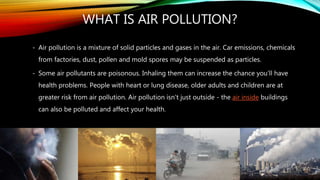
- Air pollution is a mixture of solid particles and gases in the air. Car emissions, chemicals
from factories, dust, pollen and mold spores may be suspended as particles.
- Some air pollutants are poisonous. Inhaling them can increase the chance you'll have
health problems. People with heart or lung disease, older adults and children are at
greater risk from air pollution. Air pollution isn't just outside - the air inside buildings
can also be polluted and affect your health.
SOURCES OF OUTDOOR POLLUTIONS
Smog - is a type of large-scale outdoor pollution. It is caused by chemical reactions between
pollutants derived from different sources.
-Cities are often centers of these types of activities.
Acid rains
-It’s caused when a pollutant combines with droplets of water in the air.
-The effects of acid rain on the environment can be very serious.
Greenhouse effect
-It generally comes from the build up of carbon dioxide gas in the atmosphere. Carbon dioxide
is produced when fuels are burned.
-In this type of pollution sun rays go into the atmosphere and they are trapped by
greenhouse-gasses. So the temperature on the earth raise.
Hole in the ozone layer
-It is another result of pollution. Chemicals released by our activities affect the stratosphere.
-Releases of CFC from heating, aerosol cans, refrigerator equipment removes some of the
ozone, causing "holes”.
SOURCES OF INDOOR POLLUTION
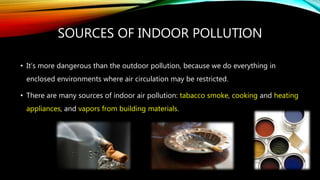
• It’s more dangerous than the outdoor pollution, because we do everything in
enclosed environments where air circulation may be restricted.
• There are many sources of indoor air pollution: tabacco smoke, cooking and heating
appliances, and vapors from building materials.
CAUSES
• Natural Sources
e.g. smoke that comes from
wildfires,
volcanoes, methane, dust
• Human Sources
e.g. power plants and
automobiles,
fumes, burning wood stoves,
fireplaces, and furnaces
POLLUTANTS
• Carbon Dioxide
• Carbon Monoxide
• Sulfur Dioxide
• Nitrogen Dioxide
MECHANISM
PRIMARY MECHANISM
• Formation of VOC (Volatile Organic Compound)
• Biological generation of VOC
• Formation of liquid aerosol droplets
• Anthropomorphic generation of particulate aerosol
• Biological formation of particulate aerosols
• Particulate aerosol formation
VOC
• volatile organic compound, a term that refers to any carbon-containing chemical
that evaporates easily at room temperature. VOCs are generated from industrial and
household products as well as daily activities.
• are emitted from several building materials, such as paint and carpets. They are also
common in household and personal care products, such as air fresheners and
cosmetics. Activities that people perform on a regular basis, such as dry cleaning
and cooking with wood-burning stoves, also generate VOCs. Exposure to excessive
amounts of VOCs may produce short-term health effects such as nasal irritation and
long-term health effects such as cancer.
SECONDARY MECHANISM
• Condensation
• Adsorption
• Nucleation
HEALTH EFFECTS
Some individuals are much more sensitive to pollutants than are others.
Air pollution can affect our health in many ways with both short-term and long-term effects.
• Human Effects
e.g. diseases
• Environmental Effects
 Acid rain
 Eutrophication
 Haze
 Wildlife
 Ozone Depletion
 Crop and forest damage
 Global Climate Change
DISEASES CAUSED BY AIR POLLUTION
Outdoor & Indoor Pollution
• ischaemic heart disease
• stroke
• chronic obstructive pulmonary disease (COPD)
• lung cancer
• lower respiratory infections in children
IMPACTS
• Climate System
• Health
• Economy
• Environment
• Ecosystem
• Forestry
• Agriculture
MITIGATION Mitigatio
n of Air
Pollution
Sustainable
Development
International
Conventions
and Treaties
National and
International
funds, Eco-
Conversion
New
Technologies,
Recycling
Lower
Combustion
Lower
Transboundar
y Emissions
Lower
Emissions
PREVENTIONS
• Air pollution prevention efforts of companies have generally focused on
waste reduction, reuse and recycling.
• So to solve these problems and to get over them we can change our
lifestyles.
• If we do these simple things we could have a better world and we could live
in a better way.

Air pollution

  • 1.
    AIR POLLUTION Group Members: (BTMT-4) Agravio,Neil John Baquiano, Kimberlie Escamilla, Blessie Joy Jamora, Keith Vain Perez, Jenny
  • 2.
    WHAT IS AIRPOLLUTION? - Air pollution is a mixture of solid particles and gases in the air. Car emissions, chemicals from factories, dust, pollen and mold spores may be suspended as particles. - Some air pollutants are poisonous. Inhaling them can increase the chance you'll have health problems. People with heart or lung disease, older adults and children are at greater risk from air pollution. Air pollution isn't just outside - the air inside buildings can also be polluted and affect your health.
  • 3.
    SOURCES OF OUTDOORPOLLUTIONS Smog - is a type of large-scale outdoor pollution. It is caused by chemical reactions between pollutants derived from different sources. -Cities are often centers of these types of activities. Acid rains -It’s caused when a pollutant combines with droplets of water in the air. -The effects of acid rain on the environment can be very serious.
  • 4.
    Greenhouse effect -It generallycomes from the build up of carbon dioxide gas in the atmosphere. Carbon dioxide is produced when fuels are burned. -In this type of pollution sun rays go into the atmosphere and they are trapped by greenhouse-gasses. So the temperature on the earth raise. Hole in the ozone layer -It is another result of pollution. Chemicals released by our activities affect the stratosphere. -Releases of CFC from heating, aerosol cans, refrigerator equipment removes some of the ozone, causing "holes”.
  • 5.
    SOURCES OF INDOORPOLLUTION • It’s more dangerous than the outdoor pollution, because we do everything in enclosed environments where air circulation may be restricted. • There are many sources of indoor air pollution: tabacco smoke, cooking and heating appliances, and vapors from building materials.
  • 6.
    CAUSES • Natural Sources e.g.smoke that comes from wildfires, volcanoes, methane, dust • Human Sources e.g. power plants and automobiles, fumes, burning wood stoves, fireplaces, and furnaces
  • 7.
    POLLUTANTS • Carbon Dioxide •Carbon Monoxide • Sulfur Dioxide • Nitrogen Dioxide
  • 8.
  • 9.
    PRIMARY MECHANISM • Formationof VOC (Volatile Organic Compound) • Biological generation of VOC • Formation of liquid aerosol droplets • Anthropomorphic generation of particulate aerosol • Biological formation of particulate aerosols • Particulate aerosol formation
  • 10.
    VOC • volatile organiccompound, a term that refers to any carbon-containing chemical that evaporates easily at room temperature. VOCs are generated from industrial and household products as well as daily activities. • are emitted from several building materials, such as paint and carpets. They are also common in household and personal care products, such as air fresheners and cosmetics. Activities that people perform on a regular basis, such as dry cleaning and cooking with wood-burning stoves, also generate VOCs. Exposure to excessive amounts of VOCs may produce short-term health effects such as nasal irritation and long-term health effects such as cancer.
  • 11.
  • 12.
    HEALTH EFFECTS Some individualsare much more sensitive to pollutants than are others. Air pollution can affect our health in many ways with both short-term and long-term effects. • Human Effects e.g. diseases • Environmental Effects  Acid rain  Eutrophication  Haze  Wildlife  Ozone Depletion  Crop and forest damage  Global Climate Change
  • 13.
    DISEASES CAUSED BYAIR POLLUTION Outdoor & Indoor Pollution • ischaemic heart disease • stroke • chronic obstructive pulmonary disease (COPD) • lung cancer • lower respiratory infections in children
  • 14.
    IMPACTS • Climate System •Health • Economy • Environment • Ecosystem • Forestry • Agriculture
  • 15.
    MITIGATION Mitigatio n ofAir Pollution Sustainable Development International Conventions and Treaties National and International funds, Eco- Conversion New Technologies, Recycling Lower Combustion Lower Transboundar y Emissions Lower Emissions
  • 16.
    PREVENTIONS • Air pollutionprevention efforts of companies have generally focused on waste reduction, reuse and recycling. • So to solve these problems and to get over them we can change our lifestyles. • If we do these simple things we could have a better world and we could live in a better way.