Air Pollution
• Airpollution is addition of particle, gaseous and chemical into
atmosphere.
• Air pollution refers to the release of pollutants into the air that are
detrimental to human health and the planet as a whole.
• Air pollution is the presence of substances in the atmosphere that are
harmful to the health of humans and other living beings, or cause
damage to the climate or to materials.
• The Clean Air Act authorizes the U.S. Environmental Protection
Agency (EPA) to protect public health by regulating the emissions of
these harmful air pollutants.
3.
Air Pollution
• Airpollution can be classified into two sections – invisible and visible
air pollution.
• Visible air pollution, as the name suggests, can be visible. The smog
you see over a city is an example of visible pollution.
• Invisible air pollutants are less noticeable, but they can be more
deadly. Good examples of invisible air pollutants are sulfur dioxide,
carbon monoxide and nitrogen oxides.
• It can be further divided into Primarily and Secondary air
pollutants if we go deep.
4.
Air Pollution
• Primarilyair pollutants can be caused by primary sources or
secondary sources. The pollutants that are a direct result of the
process can be called primary pollutants. A classic example of a
primary pollutant would be the sulfur-dioxide emitted from factories.
• Secondary pollutants are the ones that are caused by the
intermingling and reactions of primary pollutants. Smog created by
the interactions of several primary pollutants is known as a secondary
pollutant
5.
Air Pollutants :
•Particulate Matter
• Gases
• Vapours
• Air Pollution effects: Humans, Animals, Vegetation, Human Assests
6.
Natural Air Pollution
•Many forest fires start from natural causes such as lightning which set trees on fire.
However, rain extinguishes such fires without causing much damage. High
atmospheric temperatures and dryness (low humidity) offer favorable
circumstance for a fire to start.
• Dust storms have also been shown to increase the spread of disease across the
globe. Virus spores in the ground are blown into the atmosphere by
the storms with the minute particles and interact with urban air pollution
7.
SPM(Suspended Particulate Matter)
•SPM are finely divided solids or liquids that may be dispersed through
the air from combustion processes, industrial activities or natural
sources. This complex mixture includes both organic and inorganic
particles, such as dust, pollen, soot, smoke, and liquid droplets
8.
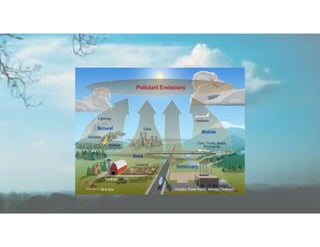
What Causes AirPollution?
• The solid and liquid particles suspended in our air are called aerosols.
• Air pollution happens when solid and liquid particles—
called aerosols—and certain gases end up in our air. These particles
and gases can be bad for the planet and for our health, so keeping
track of them is important.
The Burning of Fossil Fuels: Sulfur dioxide emitted from the
combustion of fossil fuels like coal, petroleum for energy in power
plants, and other factory combustibles is one the major cause of air
pollution.
10.
What Causes AirPollution?
• Billions of vehicles run on roads are powered by gasoline and diesel
engines that burn petroleum for releasing energy. Petroleum is made up of
hydrocarbons, and engines don’t burn them cleanly.
• As a result, pollutants such as PM, nitric oxide and NO2 (together referred
to as NOx), carbon monoxide, organic compounds, and lead emit from
vehicles including trucks, jeeps, cars, trains, airplanes, causing a high level
of pollution.
• But, their overuse is killing our environment as dangerous gases are
polluting the atmosphere. Carbon Monoxide caused by improper or
incomplete combustion and generally emitted from vehicles is another
major pollutant along with Nitrogen Oxides, that is produced from
both natural and man-made processes
11.
What Causes AirPollution?
• Agricultural Activities: Ammonia is a very common byproduct of
agriculture-related activities and is one of the most hazardous gases
in the atmosphere. The use of insecticides, pesticides, and fertilizers
in agricultural activities has grown quite a lot. They emit harmful
chemicals into the air and can also cause water pollution.
• Waste in Landfills: Landfills are land areas in which waste is deposited
or buried. These deposited or buried wastes generate methane.
Methane is a major greenhouse gas that is highly flammable and very
hazardous. E-waste is another grave concern involving a lot of
unscientific dismantlings such as chemical leaching, burning wires and
others.
12.
What Causes AirPollution?
• Exhaust From Factories and Industries: Manufacturing industries
release a large amount of carbon monoxide, hydrocarbons, organic
compounds, and chemicals into the air, thereby depleting the quality
of air.
• Mining Operations: Mining is a process wherein minerals below the
earth are extracted using large equipment. During the process, dust
and chemicals are released in the air causing massive air pollution.
• Indoor Air Pollution: Household cleaning products, painting supplies
emit toxic chemicals in the air and cause air pollution.
13.
Disastrous Effects ofAir pollution
• Respiratory and Heart Problems: The effects of air pollution are
alarming. They are known to create several respiratory and heart
conditions like asthma, chronic bronchitis, emphysema, heart attacks
and strokes along with cancer, among other threats to the body.
Several million are known to have died due to the direct or indirect
effects of Air pollution.
• Child Health Problems: Air pollution is detrimental to your health
even before you take your first breath. Exposure to high air pollution
levels during pregnancy causes miscarriages as well as premature
birth, autism, asthma and spectrum disorder in young children.
14.
Disastrous Effects ofAir pollution
• Global Warming: Another direct effect is the immediate alterations
that the world is witnessing due to global warming. With increased
temperatures worldwide, an increase in sea levels and melting of ice
from colder regions and icebergs, displacement, and loss of habitat
have already signaled an impending disaster if actions for
preservation and normalization aren’t undertaken soon.
• Acid Rain: Harmful gases like nitrogen oxides and sulfur oxides are
released into the atmosphere during the burning of fossil fuels. When
it rains, the water droplets combine with these air pollutants,
becomes acidic and then falls on the ground in the form of acid rain.
Acid rain can cause great damage to humans, animals, and crops.
15.
Disastrous Effects ofAir pollution
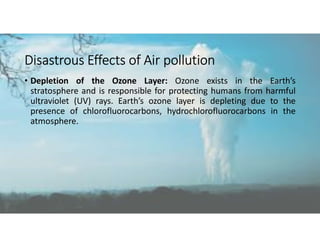
• Depletion of the Ozone Layer: Ozone exists in the Earth’s
stratosphere and is responsible for protecting humans from harmful
ultraviolet (UV) rays. Earth’s ozone layer is depleting due to the
presence of chlorofluorocarbons, hydrochlorofluorocarbons in the
atmosphere.
16.
Impressive Solutions ToAir Pollution
• Use the Public Mode of Transportation: Encourage people to use
more and more public modes of transportation to reduce pollution.
Also, try to make use of carpooling. If you and your colleagues come
from the same locality and have the same timings, you can explore
this option to save energy and money.
• Better Household Practices: Discard fireplaces and/or wooden stoves
used for heating homes. Use gas logs in place of wood. Also, eliminate
the use of gas-powered lawn and gardening equipment. Avoid setting
fire to garbage, dry leaves, or other materials in your yard, and
lighting bonfires in the open.
17.
• Conserve Energy:Switch off fans and lights when you are going out. A
large number of fossil fuels are burnt to produce electricity. You can
save the environment from degradation by reducing the number of
fossil fuels to be burned.
• Understand the Concept of Reduce, Reuse and Recycle: Do not
throw away items that are of no use to you. Instead, reuse them for
some other purpose. For example, you can use old jars to store
cereals or pulses.
• Emphasis on Clean Energy Resources: Use of Clean energy
technologies like solar, wind and geothermal is on the rise these days.
Governments of various countries have been providing grants to
consumers who are interested in installing solar panels for their
homes. Undoubtedly, this can go a long way to curb air pollution.