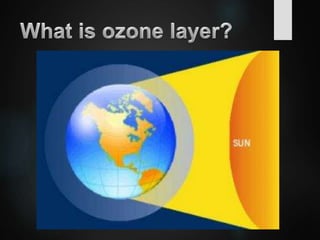
• Ozone layer is a thin, fragile shield that
contains relatively high concentrations of
ozone.
• It shields the entire Earth from much
of the harmful UV radiation that comes
from the sun
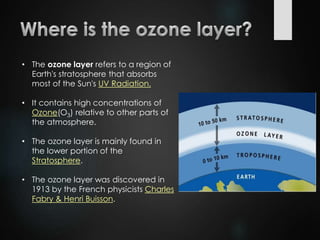
• The ozone layer refers to a region of
Earth's stratosphere that absorbs
most of the Sun's UV Radiation.
• It contains high concentrations of
Ozone(O3) relative to other parts of
the atmosphere.
• The ozone layer is mainly found in
the lower portion of the
Stratosphere.
• The ozone layer was discovered in
1913 by the French physicists Charles
Fabry & Henri Buisson.
 The sun emits energy over a broad spectrum of
wavelengths:
 Visible light that you see
 Infrared radiation that you feel as heat
 Ultraviolet (UV) radiation that you can’t see or
feel.
 UV radiation has a shorter wavelength and higher
energy than visible light.
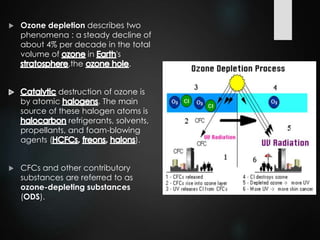
 Ozone depletion describes two
phenomena : a steady decline of
about 4% per decade in the total
volume of in 's
,the .
destruction of ozone is
by atomic . The main
source of these halogen atoms is
refrigerants, solvents,
propellants, and foam-blowing
agents ( ).
 CFCs and other contributory
substances are referred to as
ozone-depleting substances
(ODS).
• Seasons
• Weather conditions, and
• Solar cycles
Ozone-Depleting
Substance(s) (ODS)
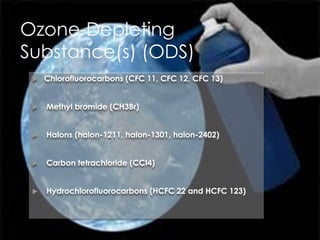
 Chlorofluorocarbons (CFC 11, CFC 12, CFC 13)
 Methyl bromide (CH3Br)
 Halons (halon-1211, halon-1301, halon-2402)
 Carbon tetrachloride (CCI4)
 Hydrochlorofluorocarbons (HCFC 22 and HCFC 123)
CFCS AND OTHER RELATED
COMPOUNDS
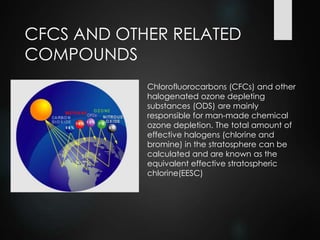
Chlorofluorocarbons (CFCs) and other
halogenated ozone depleting
substances (ODS) are mainly
responsible for man-made chemical
ozone depletion. The total amount of
effective halogens (chlorine and
bromine) in the stratosphere can be
calculated and are known as the
equivalent effective stratospheric
chlorine(EESC)
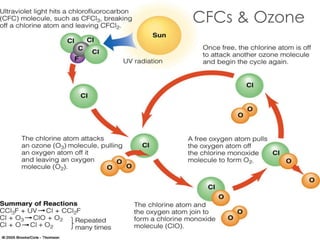
CFCs & Ozone
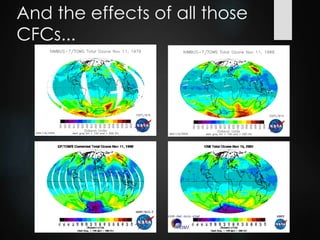
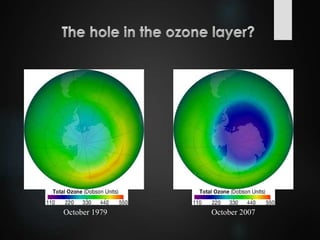
And the effects of all those
CFCs...
October 1979 October 2007
 Since the 1970’s the ozone hole has been
increasing in size over the Antarctic.
 For the first time, in September of 2000, the ozone
hole became so large it actually left populated
areas of southern Chile fully exposed to the
effects of the Sun’s UV rays.
Effects of Ozone
Depletion
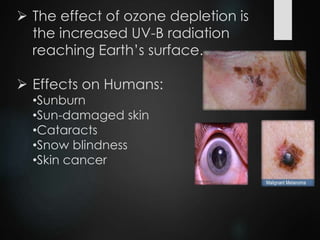
 The effect of ozone depletion is
the increased UV-B radiation
reaching Earth’s surface.
 Effects on Humans:
•Sunburn
•Sun-damaged skin
•Cataracts
•Snow blindness
•Skin cancer
• Reduced effectiveness of
immune system
• Respiratory illness and
heart problems
• As ozone levels in the stratosphere are
depleted, more solar radiation penetrates the
Earth’s atmosphere.
• This affect results in an increase in solar
radiation reaching the Earth’s surface adding
to an increase in surface temperature.
• In turn, global warming actually results in a
warming of the troposphere, but a cooling of
the stratosphere, hindering the ozone layer’s
natural chemistry for repairs.
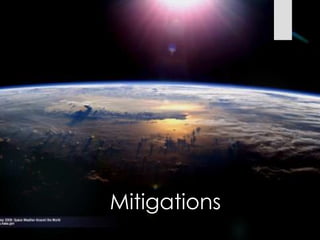
Mitigations
 After the discovery of ozone depletion in the late 1970’s,
many countries agreed that something must be done
worldwide to stop the production of man-made, ozone
harmful products.
 The international community adopted the Vienna
Convention in 1985 followed by the Montreal Protocol in 1987.
 The latest reports confirm that it has led to the phasing out of
about 95% of the consumption of ozone-depleting
substances (ODS) listed in the agreement. In turn, this has led
to the prospect of the ozone layer recovering by 2050 to
2075.
 Furthermore, the phasing out of ozone-depleting substances
has helped to fight climate change since many of these
chemicals are also powerful greenhouse gases. According to
a recent study, the phasing out of substances under the
Protocol led to more reductions in greenhouse gases than
what is foreseen under the Kyoto Protocol.
So what are we doing about it?
Image
Segmentation
Presenters….
Ozone Layer Depletion

Ozone Layer Depletion

  • 5.
    • Ozone layeris a thin, fragile shield that contains relatively high concentrations of ozone. • It shields the entire Earth from much of the harmful UV radiation that comes from the sun
  • 7.
    • The ozonelayer refers to a region of Earth's stratosphere that absorbs most of the Sun's UV Radiation. • It contains high concentrations of Ozone(O3) relative to other parts of the atmosphere. • The ozone layer is mainly found in the lower portion of the Stratosphere. • The ozone layer was discovered in 1913 by the French physicists Charles Fabry & Henri Buisson.
  • 8.
     The sunemits energy over a broad spectrum of wavelengths:  Visible light that you see  Infrared radiation that you feel as heat  Ultraviolet (UV) radiation that you can’t see or feel.  UV radiation has a shorter wavelength and higher energy than visible light.
  • 10.
     Ozone depletiondescribes two phenomena : a steady decline of about 4% per decade in the total volume of in 's ,the . destruction of ozone is by atomic . The main source of these halogen atoms is refrigerants, solvents, propellants, and foam-blowing agents ( ).  CFCs and other contributory substances are referred to as ozone-depleting substances (ODS).
  • 12.
    • Seasons • Weatherconditions, and • Solar cycles
  • 14.
    Ozone-Depleting Substance(s) (ODS)  Chlorofluorocarbons(CFC 11, CFC 12, CFC 13)  Methyl bromide (CH3Br)  Halons (halon-1211, halon-1301, halon-2402)  Carbon tetrachloride (CCI4)  Hydrochlorofluorocarbons (HCFC 22 and HCFC 123)
  • 15.
    CFCS AND OTHERRELATED COMPOUNDS Chlorofluorocarbons (CFCs) and other halogenated ozone depleting substances (ODS) are mainly responsible for man-made chemical ozone depletion. The total amount of effective halogens (chlorine and bromine) in the stratosphere can be calculated and are known as the equivalent effective stratospheric chlorine(EESC)
  • 16.
  • 17.
    And the effectsof all those CFCs...
  • 18.
  • 19.
     Since the1970’s the ozone hole has been increasing in size over the Antarctic.  For the first time, in September of 2000, the ozone hole became so large it actually left populated areas of southern Chile fully exposed to the effects of the Sun’s UV rays.
  • 20.
  • 21.
     The effectof ozone depletion is the increased UV-B radiation reaching Earth’s surface.  Effects on Humans: •Sunburn •Sun-damaged skin •Cataracts •Snow blindness •Skin cancer
  • 22.
    • Reduced effectivenessof immune system • Respiratory illness and heart problems
  • 23.
    • As ozonelevels in the stratosphere are depleted, more solar radiation penetrates the Earth’s atmosphere. • This affect results in an increase in solar radiation reaching the Earth’s surface adding to an increase in surface temperature. • In turn, global warming actually results in a warming of the troposphere, but a cooling of the stratosphere, hindering the ozone layer’s natural chemistry for repairs.
  • 25.
  • 26.
     After thediscovery of ozone depletion in the late 1970’s, many countries agreed that something must be done worldwide to stop the production of man-made, ozone harmful products.  The international community adopted the Vienna Convention in 1985 followed by the Montreal Protocol in 1987.  The latest reports confirm that it has led to the phasing out of about 95% of the consumption of ozone-depleting substances (ODS) listed in the agreement. In turn, this has led to the prospect of the ozone layer recovering by 2050 to 2075.  Furthermore, the phasing out of ozone-depleting substances has helped to fight climate change since many of these chemicals are also powerful greenhouse gases. According to a recent study, the phasing out of substances under the Protocol led to more reductions in greenhouse gases than what is foreseen under the Kyoto Protocol. So what are we doing about it?
  • 27.
  • 28.