AIR EVACUATION SYSTEM
AND
COMPARISON IN ALL STAGES
RHITESH KUMAR GUPTA
Air Zone:
 Inside the shell, a central or side portion longitudinally is
separated by an outer shield except at the bottom. This partition is
called the Air zone.
All the gases released in the condenser due to cooling are taken
out via these air zone tubes.
From a suitable portion of this air zone inside the shell an air vent
pipe is taken out and brought out of the shell for connection to an
air extraction device.
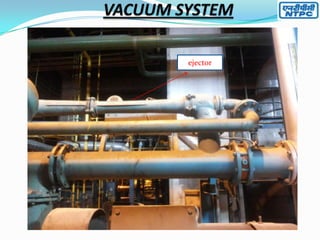
Air Ejector:
Two types of ejector:
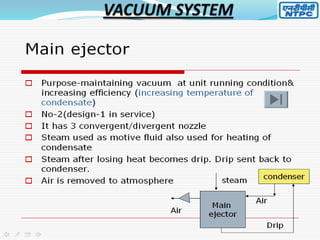
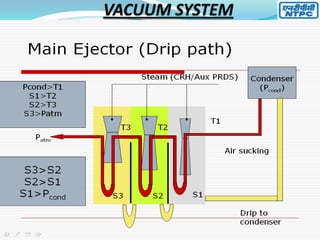
Starting Ejector
Main Ejector (two in no.)
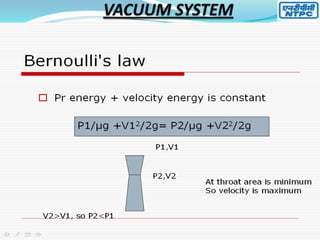
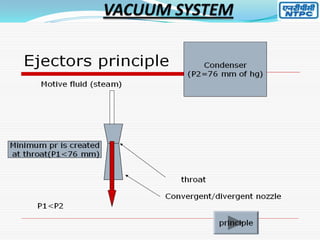
Steam is used as motive medium in air ejector.
All ejectors have its steam source from Aux PRDS Header.
VACUUM PUMP AND WORKING PRINCIPLE
Positive displacement pump:
A positive displacement pump makes a fluid move by trapping
a fixed amount and forcing (displacing) that trapped volume
into the discharge pipe.
Some positive displacement pumps use an expanding cavity on
the suction side and a decreasing cavity on the discharge side
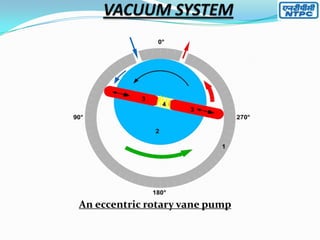
An eccentric rotary vane pump
 The Liquid Ring Vacuum Pump:

A Liquid Ring Vacuum Pump consists of a multi bladed, rotating
element (impeller), electricity positioned within a cylindrical
casing.
The compression of the gas occurs in one or two impeller stages .
Incompressible fluid, called service liquid, is introduced to the
LRVP.
Its heat capacity (specific that) and the boiling point (vapour
pressure) being two of the most important specific characteristics
service liquid.
Other factors such as the solubility of process components into
the service liquid and service liquid viscosity is also important.
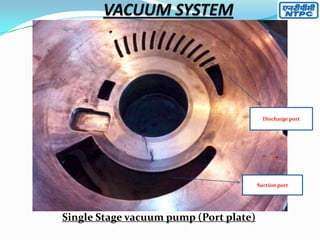
The impeller sits between two end plates (port plates) which have

shaped holes cut into them called ports.
As the impeller rotates, a ring of liquid is formed inside the pump
casing from centrifugal force.
This action draws the gaseous stream into the pump through the
inlet port.
In two stage LRPV, the second stage is volumetrically smaller
doing the final compression of the gas.
The gas then exits the pump usually at atmospheric pressure
along with the service liquid.
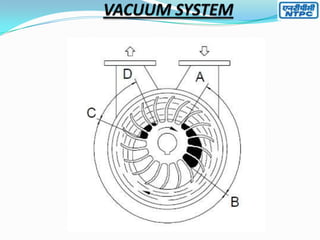
Working Principle:
The gas enters the pump chamber A-B via suction port. The gas is
trapped between two impeller
vane. The impeller rotate
eccentrically in relation to the centre line of the liquid ring that, by
centrifugal force, assumes the shape of impeller casing. The
progressive change of volume between the two vanes, the impeller
hub and the liquid ring first creates a vacuum and then a
compression of the gas in the B-C area till the gas is discharged,
together with a portion of the liquid, through the discharge port
C-D. The lost liquid must be replenished.
Cavitation:
 Cavitations is a phenomenon which occurs in specific fluid
environments and is an important factor when using this type of
vacuum equipment.
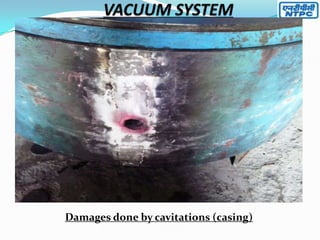
The vaporization of the service liquid sets up the structures of
cavitation in the LRVP, but the damage is caused when the vapour
bubbles collapse, not when they form. When the collapse occurs, a
high velocity micro-jet of water tears away at the metallic surfaces
of the pump internals.
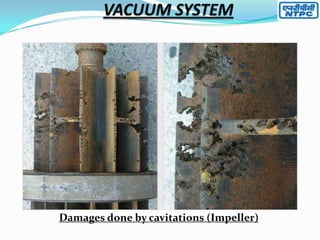
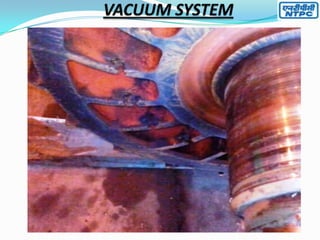
The damage is recognized as a series of craters or holes in a
continuous pattern on an LRVP impeller.
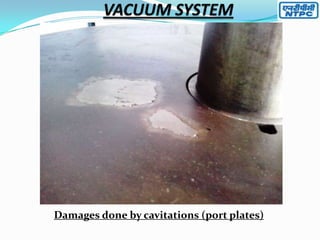
Also, damage can occur on the suction and discharge ports in
either stage of the LRVP.
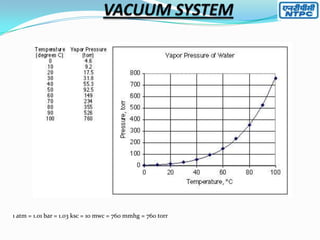
1 atm = 1.01 bar = 1.03 ksc = 10 mwc = 760 mmhg = 760 torr
Damages done by cavitations (Impeller)
Damages done by cavitations (casing)
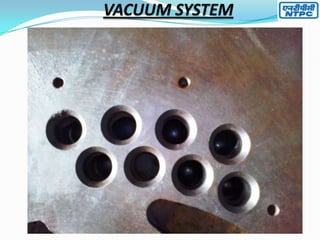
Damages done by cavitations (port plates)
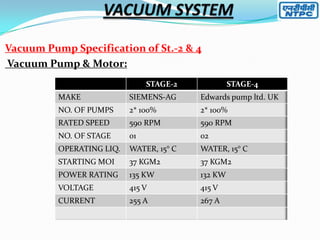
Vacuum Pump Specification of St.-2 & 4
Vacuum Pump & Motor:
STAGE-2

STAGE-4

MAKE

SIEMENS-AG

Edwards pump ltd. UK

NO. OF PUMPS

2* 100%

2* 100%

RATED SPEED

590 RPM

590 RPM

NO. OF STAGE

01

02

OPERATING LIQ.

WATER, 15° C

WATER, 15° C

STARTING MOI

37 KGM2

37 KGM2

POWER RATING

135 KW

132 KW

VOLTAGE

415 V

415 V

CURRENT

255 A

267 A
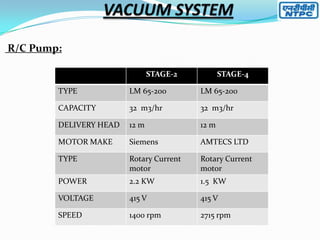
R/C Pump:
STAGE-2

STAGE-4

TYPE

LM 65-200

LM 65-200

CAPACITY

32 m3/hr

32 m3/hr

DELIVERY HEAD

12 m

12 m

MOTOR MAKE

Siemens

AMTECS LTD

TYPE

Rotary Current
motor

Rotary Current
motor

POWER

2.2 KW

1.5 KW

VOLTAGE

415 V

415 V

SPEED

1400 rpm

2715 rpm
Single-Stage vs. Two-Stage Pumps:
The above describes the cycle of a single-stage pump; so in one

revolution, we have suction (pulling a vacuum), and compression
(back to atmosphere). Some manufacturers single stage pumps can
operate up to -0.89 ksc,
A two-stage pump is just two of these operating in series, so the
discharge of the 1st stage goes into the suction port of the 2nd
stage.
Two-stage pumps have better efficiency at higher vacuum

levels (higher than -0.79 ksc) than a single stage pump.
A two-stage pump is also a much better choice if you are
handling solvents at higher vacuum levels (higher than -0.79
ksc). This has to do with the effect of sealant temperature rise
being spread across two stages and its relationship to the sealant
vapor pressure.
Major Difference:
No. of stages
Use of vacuum ejector
Used in single stage vacuum P/P
Comes in operation when (gas temp. –sealant temp) < 7 c
Sucks gas form separator tank and supply it to vacuum P/P I/L
port to prevent cavitations without affecting the air I/L line
vacuum.
Use of Anti - Cavitation line
Used in two stage vacuum P/P.
Connected to second stage second stage I/L (first stage dish.) to
prevent cavitation.
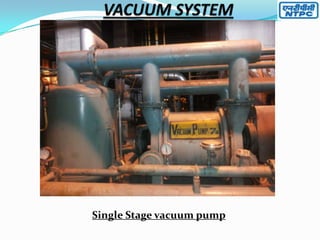
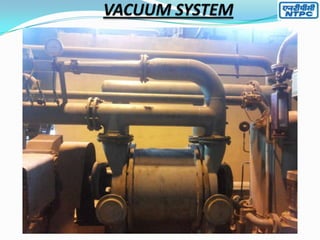
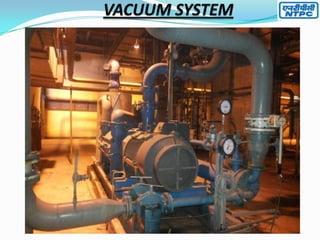
Single Stage vacuum pump
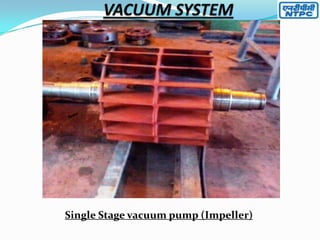
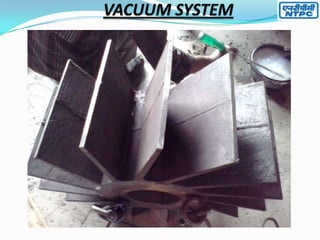
Single Stage vacuum pump (Impeller)
Discharge port

Suction port

Single Stage vacuum pump (Port plate)
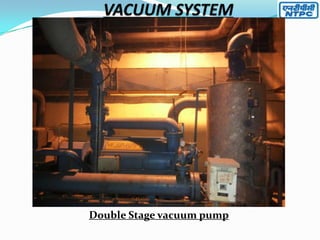
Double Stage vacuum pump
ejector
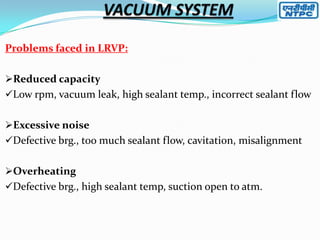
Problems faced in LRVP:
Reduced capacity
Low rpm, vacuum leak, high sealant temp., incorrect sealant flow
Excessive noise

Defective brg., too much sealant flow, cavitation, misalignment
Overheating
Defective brg., high sealant temp, suction open to atm.
Excessive Vibration
Defective brg., too much sealant flow, cavitation, misalignment
Motor overloaded
Excessive back pressure, too much sealant liquid, pump jamming
Thank You

air evacuation system and lrpv (liquid ring vacuum pump)

  • 1.
    AIR EVACUATION SYSTEM AND COMPARISONIN ALL STAGES RHITESH KUMAR GUPTA
  • 2.
    Air Zone:  Insidethe shell, a central or side portion longitudinally is separated by an outer shield except at the bottom. This partition is called the Air zone. All the gases released in the condenser due to cooling are taken out via these air zone tubes. From a suitable portion of this air zone inside the shell an air vent pipe is taken out and brought out of the shell for connection to an air extraction device.
  • 3.
    Air Ejector: Two typesof ejector: Starting Ejector Main Ejector (two in no.) Steam is used as motive medium in air ejector. All ejectors have its steam source from Aux PRDS Header.
  • 8.
    VACUUM PUMP ANDWORKING PRINCIPLE Positive displacement pump: A positive displacement pump makes a fluid move by trapping a fixed amount and forcing (displacing) that trapped volume into the discharge pipe. Some positive displacement pumps use an expanding cavity on the suction side and a decreasing cavity on the discharge side
  • 9.
  • 10.
     The LiquidRing Vacuum Pump: A Liquid Ring Vacuum Pump consists of a multi bladed, rotating element (impeller), electricity positioned within a cylindrical casing. The compression of the gas occurs in one or two impeller stages . Incompressible fluid, called service liquid, is introduced to the LRVP. Its heat capacity (specific that) and the boiling point (vapour pressure) being two of the most important specific characteristics service liquid. Other factors such as the solubility of process components into the service liquid and service liquid viscosity is also important.
  • 11.
    The impeller sitsbetween two end plates (port plates) which have shaped holes cut into them called ports. As the impeller rotates, a ring of liquid is formed inside the pump casing from centrifugal force. This action draws the gaseous stream into the pump through the inlet port. In two stage LRPV, the second stage is volumetrically smaller doing the final compression of the gas. The gas then exits the pump usually at atmospheric pressure along with the service liquid.
  • 12.
    Working Principle: The gasenters the pump chamber A-B via suction port. The gas is trapped between two impeller vane. The impeller rotate eccentrically in relation to the centre line of the liquid ring that, by centrifugal force, assumes the shape of impeller casing. The progressive change of volume between the two vanes, the impeller hub and the liquid ring first creates a vacuum and then a compression of the gas in the B-C area till the gas is discharged, together with a portion of the liquid, through the discharge port C-D. The lost liquid must be replenished.
  • 14.
    Cavitation:  Cavitations isa phenomenon which occurs in specific fluid environments and is an important factor when using this type of vacuum equipment. The vaporization of the service liquid sets up the structures of cavitation in the LRVP, but the damage is caused when the vapour bubbles collapse, not when they form. When the collapse occurs, a high velocity micro-jet of water tears away at the metallic surfaces of the pump internals. The damage is recognized as a series of craters or holes in a continuous pattern on an LRVP impeller. Also, damage can occur on the suction and discharge ports in either stage of the LRVP.
  • 15.
    1 atm =1.01 bar = 1.03 ksc = 10 mwc = 760 mmhg = 760 torr
  • 16.
    Damages done bycavitations (Impeller)
  • 17.
    Damages done bycavitations (casing)
  • 18.
    Damages done bycavitations (port plates)
  • 21.
    Vacuum Pump Specificationof St.-2 & 4 Vacuum Pump & Motor: STAGE-2 STAGE-4 MAKE SIEMENS-AG Edwards pump ltd. UK NO. OF PUMPS 2* 100% 2* 100% RATED SPEED 590 RPM 590 RPM NO. OF STAGE 01 02 OPERATING LIQ. WATER, 15° C WATER, 15° C STARTING MOI 37 KGM2 37 KGM2 POWER RATING 135 KW 132 KW VOLTAGE 415 V 415 V CURRENT 255 A 267 A
  • 22.
    R/C Pump: STAGE-2 STAGE-4 TYPE LM 65-200 LM65-200 CAPACITY 32 m3/hr 32 m3/hr DELIVERY HEAD 12 m 12 m MOTOR MAKE Siemens AMTECS LTD TYPE Rotary Current motor Rotary Current motor POWER 2.2 KW 1.5 KW VOLTAGE 415 V 415 V SPEED 1400 rpm 2715 rpm
  • 23.
    Single-Stage vs. Two-StagePumps: The above describes the cycle of a single-stage pump; so in one revolution, we have suction (pulling a vacuum), and compression (back to atmosphere). Some manufacturers single stage pumps can operate up to -0.89 ksc, A two-stage pump is just two of these operating in series, so the discharge of the 1st stage goes into the suction port of the 2nd stage.
  • 24.
    Two-stage pumps havebetter efficiency at higher vacuum levels (higher than -0.79 ksc) than a single stage pump. A two-stage pump is also a much better choice if you are handling solvents at higher vacuum levels (higher than -0.79 ksc). This has to do with the effect of sealant temperature rise being spread across two stages and its relationship to the sealant vapor pressure.
  • 25.
    Major Difference: No. ofstages Use of vacuum ejector Used in single stage vacuum P/P Comes in operation when (gas temp. –sealant temp) < 7 c Sucks gas form separator tank and supply it to vacuum P/P I/L port to prevent cavitations without affecting the air I/L line vacuum. Use of Anti - Cavitation line Used in two stage vacuum P/P. Connected to second stage second stage I/L (first stage dish.) to prevent cavitation.
  • 26.
  • 27.
    Single Stage vacuumpump (Impeller)
  • 28.
    Discharge port Suction port SingleStage vacuum pump (Port plate)
  • 29.
  • 32.
  • 35.
    Problems faced inLRVP: Reduced capacity Low rpm, vacuum leak, high sealant temp., incorrect sealant flow Excessive noise Defective brg., too much sealant flow, cavitation, misalignment Overheating Defective brg., high sealant temp, suction open to atm.
  • 36.
    Excessive Vibration Defective brg.,too much sealant flow, cavitation, misalignment Motor overloaded Excessive back pressure, too much sealant liquid, pump jamming
  • 37.