Fundamental Instructional Design
         Principles
Design


The module is comprised of autonomous tasks with a low level of guidance. Problem solving is
expected in the learning of design, where authentic tasks are used for writers to explore design
aspects in the real world.
The learning outcomes attempt to support content writers with little or no understanding of the
integration of content into a learning environment. The key concepts of instructional design in the
context of executive education are applied through learner engagement including
Reading, choosing, describing, reflecting, planning, investigation and inquiry.
A new eLearning module is being developed for the Australian
                    Institute of Company Directors.
  The problem       The challenge being addressed is to design a module which
opportunity being   provides training in the fundamental principles of instructional
   addressed        design to subject matter contributors/writers for the AICD
                    who have little or know background in education.

                    New research into designing for industry suggests that adults
                    enjoy working in groups. Modules which are self paced do not
                    allow for this. It is suggested to develop a community of
                    practice for new designers to collaborate.
The target audience will be subject
The learners/clients   matter contributors/writers for AICD.
 and how they will     The benefit to the learner will be in
      benefit          gaining understanding of the
                       fundamental principles in
                       Instructional design. The benefit to
                       the clients, will be in a design that
                       AICD may wish to use in future as well
                       as a current methodology used in
                       industry which is research based.
How the training is
currently delivered   The Currently, my guess would be that the training is
                                 through face to face support.
Fundamental skills in Instructional Design


   How the innovation          The learning design of the innovation will provide as
   will change current            self paced elearning module which will provide
         delivery                background knowledge, skills and suggestions of
                                           technology used in the design.
                              The module will also address methods for learners to
                              use reflective practice during the development of the
                              project.
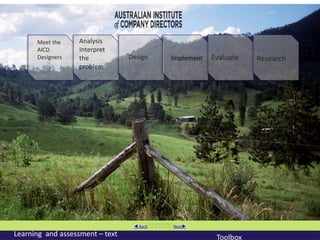
Meet the    Analysis
      AICD        Interpret
      Designers   the            Design       Implement   Evaluate   Research
                  problem


                                   BackNext
Learning and assessment – text                             Toolbox
Meet the     Analysis
AICD         Interpret
Designers    the             Design         Implement     Evaluate         Research
             problem


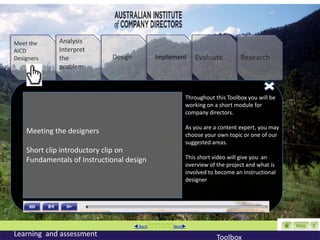
                                                      Throughout this Toolbox you will be
                                                      working on a short module for
                                                      company directors.

                                                      As you are a content expert, you may
    Meeting the designers                             choose your own topic or one of our
                                                      suggested areas.
    Short clip introductory clip on
    Fundamentals of Instructional design              This short video will give you an
                                                      overview of the project and what is
                                                      involved to become an instructional
                                                      designer


                                       BackNext
Learning and assessment                                           Toolbox
Meet the    Analysis
AICD        Interpret
Designers   the           Design         Implement     Evaluate    Research
            problem


                                    BackNext
Learning and assessment                                      Toolbox
Meet the      Analysis        Design        Implementation              Evaluate
                     AICDDesign    Interpret
                     ers           the problem


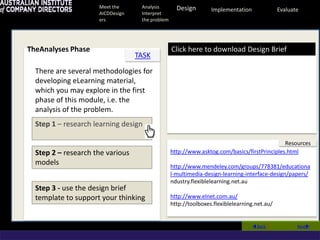
TheAnalyses Phase                                Click here to download Design Brief
                                  TASK
  There are several methodologies for
  developing eLearning material,
  which you may explore in the first
  phase of this module, i.e. the
  analysis of the problem.
  Step 1 – research learning design

                                                                                             Resources
  Step 2 – research the various                  http://www.asktog.com/basics/firstPrinciples.html
  models                                         http://www.mendeley.com/groups/778381/educationa
                                                 l-multimedia-design-learning-interface-design/papers/
                                                 ndustry.flexiblelearning.net.au
  Step 3 - use the design brief
  template to support your thinking              http://www.elnet.com.au/
                                                 http://toolboxes.flexiblelearning.net.au/


                                                                                   Back Next
Meet the        Analysis      Design      Implementation           Evaluate
                    AICD            Interpret
                    Designers       the problem


                                                                                            Design
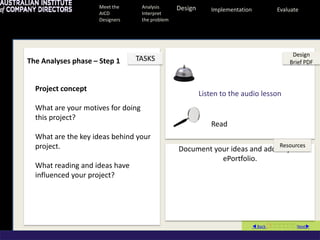
The Analyses phase – Step 1     TASKS                                                      Brief PDF


  Project concept
                                                           Listen to the audio lesson
  What are your motives for doing
  this project?
                                                              Read
  What are the key ideas behind your
  project.                                                                              Resources
                                                  Document your ideas and add to your
                                                             ePortfolio.
  What reading and ideas have
  influenced your project?


                                                                                Back Next
Meet the       Analysis       Design      Implementation           Evaluate
                    AICD           Interpret
                    Designers      the problem


                                                                                       Design Brief

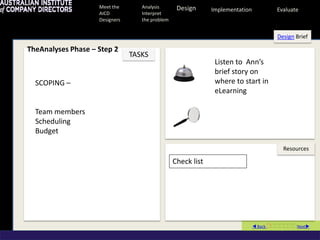
TheAnalyses Phase – Step 2
                                TASKS
                                                               Listen to Ann’s
                                                               brief story on
  SCOPING –                                                    where to start in
                                                               eLearning

  Team members
  Scheduling
  Budget

                                                                                         Resources

                                                 Check list


                                                                                Back Next
Meet the    Analysis      Design      Implementation           Evaluate
                    AICD        Interpret
                    Designers   the problem


                                                       TASKS     Design Brief        Resources

TheAnalyses Phase – Step 3


                                                                            Back Next
Meet the    Analysis
AICD        Interpret
Designers   the           Design         Implement     Evaluate    Research
            problem


                                    BackNext
Learning and assessment                                      Toolbox
Meet the      Analysis
AICD          Interpret
Designers     the              Design   Implement   Evaluate          Research
              problem


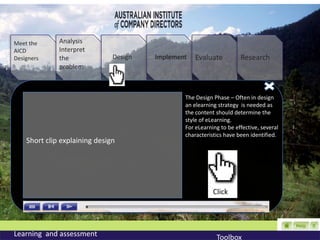
                                                The Design Phase – Often in design
                                                an elearning strategy is needed as
                                                the content should determine the
                                                style of eLearning.
                                                For eLearning to be effective, several
                                                characteristics have been identified.
    Short clip explaining design


                                                           Click


Learning and assessment                                     Toolbox
Meet the       Analysis      Design     Implementation
         AICD           Interpret                                      Evaluate
         Designers      the problem


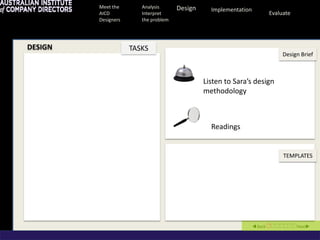
DESIGN               TASKS
                                                                            Design Brief


                                               Listen to Sara’s design
                                               methodology


                                                 Readings


                                                                            TEMPLATES


                                                                   Back Next
Meet the      Analysis      Design         Implementation
         AICD          Interpret                                          Evaluate
         Designers     the problem


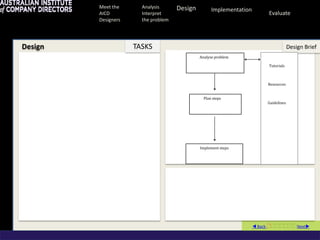
Design               TASKS                                                             Design Brief
                                              Analyse problem

                                                                          Tutorials


                                                                          Resources


                                                Plan steps
                                                                          Guidelines


                                              Implement steps


                                                                      Back Next
Meet the    Analysis      Design   Implementation
         AICD        Interpret                                    Evaluate
         Designers   the problem


DESIGN
                                                                        Design Brief
                               TASKS


                                                              Back Next
Meet the       Analysis      Design   Implementation
                     AICD           Interpret                                    Evaluate
                     Designers      the problem


The Project so Far
                                 TASKS                                                 Design Brief


                                                                                       TEMPLATES


                                                                             Back Next
Meet the    Analysis
AICD        Interpret
Designers   the           Design         Implement     Evaluate    Research
            problem


                                    BackNext
Learning and assessment                                      Toolbox
Meet the    Analysis
AICD        Interpret
Designers   the           Design         Implement     Evaluate    Research
            problem


                                    BackNext
Learning and assessment                                      Toolbox

Aicd presentation

  • 1.
  • 2.
    Design The module iscomprised of autonomous tasks with a low level of guidance. Problem solving is expected in the learning of design, where authentic tasks are used for writers to explore design aspects in the real world. The learning outcomes attempt to support content writers with little or no understanding of the integration of content into a learning environment. The key concepts of instructional design in the context of executive education are applied through learner engagement including Reading, choosing, describing, reflecting, planning, investigation and inquiry.
  • 3.
    A new eLearningmodule is being developed for the Australian Institute of Company Directors. The problem The challenge being addressed is to design a module which opportunity being provides training in the fundamental principles of instructional addressed design to subject matter contributors/writers for the AICD who have little or know background in education. New research into designing for industry suggests that adults enjoy working in groups. Modules which are self paced do not allow for this. It is suggested to develop a community of practice for new designers to collaborate.
  • 4.
    The target audiencewill be subject The learners/clients matter contributors/writers for AICD. and how they will The benefit to the learner will be in benefit gaining understanding of the fundamental principles in Instructional design. The benefit to the clients, will be in a design that AICD may wish to use in future as well as a current methodology used in industry which is research based.
  • 5.
    How the trainingis currently delivered The Currently, my guess would be that the training is through face to face support.
  • 6.
    Fundamental skills inInstructional Design How the innovation The learning design of the innovation will provide as will change current self paced elearning module which will provide delivery background knowledge, skills and suggestions of technology used in the design. The module will also address methods for learners to use reflective practice during the development of the project.
  • 7.
    Meet the Analysis AICD Interpret Designers the Design Implement Evaluate Research problem  BackNext Learning and assessment – text Toolbox
  • 8.
    Meet the Analysis AICD Interpret Designers the Design Implement Evaluate Research problem Throughout this Toolbox you will be working on a short module for company directors. As you are a content expert, you may Meeting the designers choose your own topic or one of our suggested areas. Short clip introductory clip on Fundamentals of Instructional design This short video will give you an overview of the project and what is involved to become an instructional designer  BackNext Learning and assessment Toolbox
  • 9.
    Meet the Analysis AICD Interpret Designers the Design Implement Evaluate Research problem  BackNext Learning and assessment Toolbox
  • 10.
    Meet the Analysis Design Implementation Evaluate AICDDesign Interpret ers the problem TheAnalyses Phase Click here to download Design Brief TASK There are several methodologies for developing eLearning material, which you may explore in the first phase of this module, i.e. the analysis of the problem. Step 1 – research learning design Resources Step 2 – research the various http://www.asktog.com/basics/firstPrinciples.html models http://www.mendeley.com/groups/778381/educationa l-multimedia-design-learning-interface-design/papers/ ndustry.flexiblelearning.net.au Step 3 - use the design brief template to support your thinking http://www.elnet.com.au/ http://toolboxes.flexiblelearning.net.au/  Back Next
  • 11.
    Meet the Analysis Design Implementation Evaluate AICD Interpret Designers the problem Design The Analyses phase – Step 1 TASKS Brief PDF Project concept Listen to the audio lesson What are your motives for doing this project? Read What are the key ideas behind your project. Resources Document your ideas and add to your ePortfolio. What reading and ideas have influenced your project?  Back Next
  • 12.
    Meet the Analysis Design Implementation Evaluate AICD Interpret Designers the problem Design Brief TheAnalyses Phase – Step 2 TASKS Listen to Ann’s brief story on SCOPING – where to start in eLearning Team members Scheduling Budget Resources Check list  Back Next
  • 13.
    Meet the Analysis Design Implementation Evaluate AICD Interpret Designers the problem TASKS Design Brief Resources TheAnalyses Phase – Step 3  Back Next
  • 14.
    Meet the Analysis AICD Interpret Designers the Design Implement Evaluate Research problem  BackNext Learning and assessment Toolbox
  • 15.
    Meet the Analysis AICD Interpret Designers the Design Implement Evaluate Research problem The Design Phase – Often in design an elearning strategy is needed as the content should determine the style of eLearning. For eLearning to be effective, several characteristics have been identified. Short clip explaining design Click Learning and assessment Toolbox
  • 16.
    Meet the Analysis Design Implementation AICD Interpret Evaluate Designers the problem DESIGN TASKS Design Brief Listen to Sara’s design methodology Readings TEMPLATES  Back Next
  • 17.
    Meet the Analysis Design Implementation AICD Interpret Evaluate Designers the problem Design TASKS Design Brief Analyse problem Tutorials Resources Plan steps Guidelines Implement steps  Back Next
  • 19.
    Meet the Analysis Design Implementation AICD Interpret Evaluate Designers the problem DESIGN Design Brief TASKS  Back Next
  • 20.
    Meet the Analysis Design Implementation AICD Interpret Evaluate Designers the problem The Project so Far TASKS Design Brief TEMPLATES  Back Next
  • 21.
    Meet the Analysis AICD Interpret Designers the Design Implement Evaluate Research problem  BackNext Learning and assessment Toolbox
  • 22.
    Meet the Analysis AICD Interpret Designers the Design Implement Evaluate Research problem  BackNext Learning and assessment Toolbox

Editor's Notes

  • #9 In the design of this learning object, the principles of adult learning are followed.Adults need to know why they are learning something, particular they should be told how it affectsAdults have a life time of learning and use honds on problem solving approaches to learningAdults want to apply new knowledge and skills immediately. Retention decrease if the learning is applied only someTime in the future.Objectives should be set for the course in areas of knowledge, skills and attitudes.How you are going to assess the courseOverview of the course content before the learner startsAn explanation of how the learner works their way through the course contentThe course content, including text and mediaA review of the content following completion of the course.Any assessments, whether integrated into the course or at the completion of the course3Help with using the courseOpportunity for the learner and instructor to provide feedback.
  • #10 While there are many ways to prepare a script that contains all of the information required by a programmer to put together the e-learning course, the following template contains the basics. It can be modified and expanded as required. Remember also when preparing a script for e-learning, that it should be written in such a way that a non-programmer also can understand its content. This allows all stakeholders to use the script to assess the e-learning course before programming commences.Introduction• What is the title of the e-learning course?• What is the general purpose of the e-learning course?• Who are the stakeholders?• Who are the learners?• What are the specific outcomes of the e-learning course?• Overview of how the course is designed (this could be a flowchart or description of how the course is organised).• The general style and look and feel of the course (will it be photographic or cartoon style, for example).• What are the assessment requirements, and how will these be met?• What are the record-keeping requirements, and how will these be met?• The specification document that defines the project specifications and deliverables should be referred to.For each screen• What is the purpose of the screen? A brief description helps programmers to understand the screen and the way the learner interacts with it.• What text appears on screen?• What graphics are associated with the screen?• What audio and video elements are associated with this screen?• What interactivity is associated with this screen? This includes listing all buttons on the screen, and the consequences of the learner clicking each.• How will the screen look? This may be a description of the appearance of the screen, noting the location of each element. Or it may be a storyboard view, a sketch of the screen indicating the locations of each element. 
  • #16 scriptEngages the learnerChallenges the learnerAllows the learner to demonstrate what they have learntIs set in a context related to the workplaceProvides timely feedback and contains formative and summative testingThe learners can demonstrate their understanding and application of outcomes.Is readily adaptable for new conditions if needed.A content checklist This checklist may prove useful once the content has been written, and before you send it to the programmer.q The content covers all of the objectives of the course, and is it all related to the objectives.q The course contains adequate scaffolding.q Is the course organisation clear and the content easy to read.q The content has been well edited and reviewed.q The content is interactive. That is, there are checks on how well the user has understood the content as they progress through the course, and the user has to do more than just read content on screen.q The course content is easy to navigate.q The amount of content on each screen is easily read, and there is not too much text on each screen (no more than about one screen of text).q There is appropriate use of media to support the text.q There will be no problems programming the content.  
  • #17 Preparing content for e-learningThe following general steps are involved in preparing the content for an e-learning course:determine the objectives and outcomes for the course. Elsewhere in this Practical guide is information about creating instructional objectives.summarise the main topics for the content and arrange the content into an educationally sound sequenceapply instructional design to the content. This includes determining how units of the content will be assessed, what scaffolding the learners will need, and how the learners will progress through the content. It also includes breaking the content into manageable units for the learner. Sometimes called modules or units, these are discrete segments of work that accomplish specific objectives. They help the learner to access the content easily, and to see which parts of the course they have completed as they progressbrainstorm learning activities based on the content sequence. Try separating the theory from the practice and make the practice an interactive exercise. Put the theory into learner support and scaffolding, and rather than state facts, turn the facts into questionswrite the body of the content. It is important to ensure that the language level is appropriate for the learner community. Make sure that the content is chunked in amounts that fit comfortably onto a single screen. Minimise the use of jargon and acronyms, or at least explain them when their use is unavoidable. Use a style guide to have consistency in your writing. The Australian Government Style Manual [Style Manual, 6th edition, John Wiley and Sons] is a good fall-back if there is no corporate style guidemake sure the content is divided into units that comfortably fit on one screen. This process is called chunking. While it is possible to scroll through text, scrolling can make the learning cumbersomedetermine what media will be required to support the learning content and assemble the media in a way that will support the learning contentdecide how the learner will navigate through the content. Will the learner have complete freedom to navigate anywhere within the content, or will they be directed on specific paths? Will assessments be barriers to progress?determine what will be able to be printed or downloaded by the learner. This affects decisions about how the course will be delivered.