“Using e-Learning
 to enhance the
     student
Objectives

1. To show you my understanding that the
   student experience is really
   important, and
2. A knowledge of how ILT can be used to
   support it, both for
    a) distance learning students and
    b) those in the classroom.
3. How to apply e-learning into
   “Norland’s Foundation Degree in Early
   Years Development & Learning”
"The value of College knowledge
is not the learning of many facts,
 it is for making people to think”.
Education is a lifetime
investment to yourself


     The Learner
       is in the
        middle


                           4
Classroom and Distance learning
           students


   Same objective = Pass
        Knowledge             5
Questions
are more
important
  than      6
WHAT professional skills &
experience does the society
          demand
     from a graduate?

HOW we’ll
get there
    ?

  How we’ll
   measure
performance ?                 7
How will we solve this
           problem?

                          Creating

An I.D model gives       Evaluating
structure and meaning
                          Analyzing
to the problem
                          Applying

                        Understanding

                        Remembering

                        Bloom’s         8
How will we solve this
          problem?
                                             Analysis


                     Evaluation                                  Design
Models break down
the problem into
discrete, manageab
le units.
                            Implementation              Development


                                                 ADDIE
                                                  model
                                                                      9
Activation


Integration   Problem       Demonstration


              Application


Merrill's First Principles of Instruction10
Two types of courses


                  11
Apply Reverse Engineering
       Technique
Basic Course Structure


                         13
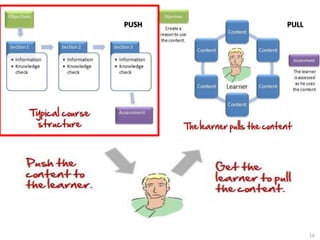
PUSH   PULL


              14
15
PUSH   PULL


              16
17
Activation


                                                            Norland’s
Integration      Problem        Demonstration   Model   Foundation Degree


                  Application


              Merrill's First
               Principles of
                Instruction                                           18
Pull the learners
 into the course
     content


                    19
Motivate - Tease the students


                Mobile
               devices &
              applications


Integration
  of social
   media

                      E-books
                     web content
                      Youtube


                                   20
21
Adapt to
                              diverse
          Enhance            learning
        the material           styles
            being
           taught

                         Boost
                        student
                       motivation


3 Reasons Teachers Use Technology in the
               Classroom

                                           22
23
24

E-learning enhance user experience

  • 1.
    “Using e-Learning toenhance the student
  • 2.
    Objectives 1. To showyou my understanding that the student experience is really important, and 2. A knowledge of how ILT can be used to support it, both for a) distance learning students and b) those in the classroom. 3. How to apply e-learning into “Norland’s Foundation Degree in Early Years Development & Learning”
  • 3.
    "The value ofCollege knowledge is not the learning of many facts, it is for making people to think”.
  • 4.
    Education is alifetime investment to yourself The Learner is in the middle 4
  • 5.
    Classroom and Distancelearning students Same objective = Pass Knowledge 5
  • 6.
  • 7.
    WHAT professional skills& experience does the society demand from a graduate? HOW we’ll get there ? How we’ll measure performance ? 7
  • 8.
    How will wesolve this problem? Creating An I.D model gives Evaluating structure and meaning Analyzing to the problem Applying Understanding Remembering Bloom’s 8
  • 9.
    How will wesolve this problem? Analysis Evaluation Design Models break down the problem into discrete, manageab le units. Implementation Development ADDIE model 9
  • 10.
    Activation Integration Problem Demonstration Application Merrill's First Principles of Instruction10
  • 11.
    Two types ofcourses 11
  • 12.
  • 13.
  • 14.
    PUSH PULL 14
  • 15.
  • 16.
    PUSH PULL 16
  • 17.
  • 18.
    Activation Norland’s Integration Problem Demonstration Model Foundation Degree Application Merrill's First Principles of Instruction 18
  • 19.
    Pull the learners into the course content 19
  • 20.
    Motivate - Teasethe students Mobile devices & applications Integration of social media E-books web content Youtube 20
  • 21.
  • 22.
    Adapt to diverse Enhance learning the material styles being taught Boost student motivation 3 Reasons Teachers Use Technology in the Classroom 22
  • 23.
  • 24.

Editor's Notes

  • #2 Good afternoon!My name is …… and in the next 15’ I’ll present you my point of view of “Using e-learning to enhance the student experience
  • #3 The objectives of this presentation are :To show you my understanding that the student experience is really important, and A knowledge of how ILT can be used to support it, both for distance learning students and those in the classroom.How to apply e-learning into “Norland’s Foundation Degree in Early Years Development & Learning”
  • #4 "The value of College knowledge is not the learning of many facts, it is for making people to think”. (Albert Einstein)Well he is absolutely right. How many of us remember in detail what we’ve learned at school or at the University, after so many years? But of course we remember where to look for and mainly how to examine the different sides of a problem or an issue in our job, before we come up with a decision.
  • #5 What I use to say to my young college students from the very first day, in order to motivate them and make them think is that “Education is a lifetime investment to yourself” It is not like an item or clothes you buy and after a month or two you are bored of it and you put it in the wardrobe. The knowledge and the experience you’ll take from this college, you’re going to carry inside your brain for the rest of your life, and based on them you are going to make decisions. That’s why you have to keep it and improve it continuously.Ok, this is from the student’s perspective.Now, from the instructor’s perspective the training system, like any other system, consists of the 3Ps (People – Processes – Products)The learner should be always in the center of training system, because he is the most important entity. In order to complete the big picture, the “learning ecosystem consists of all these elements, and only God knows in the future, from how many others in addition to them.
  • #6 Now regarding “Classroom and Distance learning students” their training has the Same objectives in other words to Pass Knowledge and experience. The difference is the “Processes” and the “Products” (Technology, training environment etc).And in order to simulate the “Classroom learning processes” we implement various modern technology techniques, such as LMS to manage people’s interaction, or LCMS to manage the learning content.
  • #7 Questions are more important than answers
  • #8 Based on what Einstein said and in order to design a learning course we have to work backwards. We have to think WHAT professional skills & experience does the society demand from a graduate? And analyzing further HOW we’ll get there ? And How we’ll measure performance?
  • #9 Well, in order to answer these questions and solve this problem we implement an Instructional Design model, which simplifies the problem and gives structure and meaning in order to understand it.Here we se Bloom’s taxonomy model
  • #11 Merrill's First Principles of Instruction Many current instructional design models suggest that the most effective learning environments are those that are problem-based and involve the student in four distinct phases of learning: activation of prior experience, demonstration of skills,application of skills, andintegration or these skills into real world activities. Much instructional practice concentrates primarily on phase 2 and ignores the other phases in this cycle of learning.At the top level the instructional design prescriptions based on first principles are as follows:• Learning is facilitated when learners are engaged in solving real-world problems. • Learning is facilitated when existing knowledge is activated as a foundation for new knowledge. • Learning is facilitated when new knowledge is demonstrated to the learner. • Learning is facilitated when new knowledge is applied by the learner • Learning is facilitated when new knowledge is integrated into the learner's world.
  • #12 Two types of coursesPassive – ActiveInformation – UnderstandingNeed to know information – Nice to know information
  • #13 In order to design and implement the course we have first to set the objectives and the assesments by answering the questions of “What we want our learners to do” and “ How do we know they got there” (In other words we have to know where to start and where to finish)
  • #14 The complete course design after the analysis appears in this slide. In gray color are the “constant modules”In light gray color the structure of 1 section. This process is repeated relatively to the number of the course sections
  • #15 PUSH vs PULLPush is linear
  • #16 And sometimes is boring. It is good though for information courses
  • #17 On the other handPULL is the methodology that the learner is active, interacts with the learning content, and makes decisions.
  • #18 In this example the learner needs to make a decision, based on his knowledge, experience and on company’s policy
  • #19 Now about Norland’sFoundation Degree and based on the website information regarding Entry Requirements, I believe that is a perfect example of applying Merrill's First Principles of Instruction Because in order to study for the Foundation Degree, you will need to:have a minimum of 2 years' relevant work experience and wish to build on this, and on your current qualifications, ……….to become a senior practitioner; andcurrently be working with children (either in paid employment or as a volunteer) for at least 2 days a week; andhave an Early Years qualification at Level 3 or above; andhave English Language and Maths GCSE at grade C or above (or a commitment to achieving these qualifications over the lifetime of the course); andhave a satisfactory enhanced DBS (formerly CRB) Disclosure. At the top level the instructional design prescriptions based on first principles are as follows:• Learning is facilitated when learners are engaged in solving real-world problems. • Learning is facilitated when existing knowledge is activated as a foundation for new knowledge. • Learning is facilitated when new knowledge is demonstrated to the learner. • Learning is facilitated when new knowledge is applied by the learner • Learning is facilitated when new knowledge is integrated into the learner's world.
  • #20 Techniques to Pull the learners into the course contentPre-assesmentFriendly and familiar learning environment, (skype, Outlook, web, twitter etc)
  • #21 Adopt in learning, anything they use in everyday life of Open source textbooks, web content and learning material, youtube1/3 of college students take at least one online courseShow them the infogram for Norland from the web
  • #22 Here is an example of teaser and familiar environment of videoShow them the web video
  • #23 3 Reasons Teachers Use Technology in the ClassroomAdapt to diverse learning stylesEnhance the material being taughtBoost student motivation