ProductCamp October 2011


 Using Contextual Inquiry
 To Understand Customer Needs


                                                              978.823.0100
                           Dave Flotree, Program Manager      2352 Main Street, Suite 302
                           dave.flotree@incontextdesign.com   Concord, MA 01742                       www.incontextdesign.com


                                                                                     Copyright © 2011 InContext Enterprises Inc. All rights reserved.
Contextual Inquiry


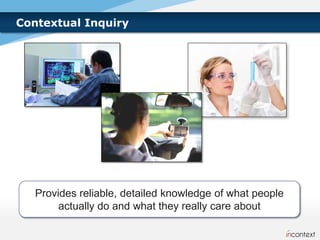
   Provides reliable, detailed knowledge of what people
        actually do and what they really care about
Contextual Inquiry


 A set of principles, not steps
               Context
             Partnership
            Interpretation
                Focus
The principle of Context


   What people say they do

  And what they actually do

              Are different
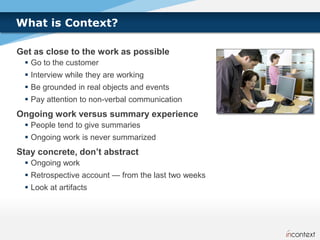
What is Context?

Get as close to the work as possible
  Go to the customer
  Interview while they are working
  Be grounded in real objects and events
  Pay attention to non-verbal communication
Ongoing work versus summary experience
  People tend to give summaries
  Ongoing work is never summarized
Stay concrete, don’t abstract
  Ongoing work
  Retrospective account — from the last two weeks
  Look at artifacts
The principle of Partnership


            People know
          everything about
           what they do…

            They just can’t
               tell you
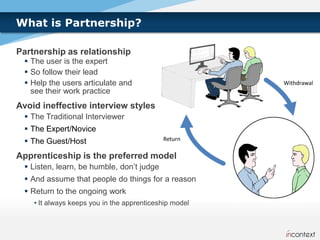
What is Partnership?

Partnership as relationship
  The user is the expert
  So follow their lead
  Help the users articulate and                        Withdrawal
   see their work practice
Avoid ineffective interview styles
  The Traditional Interviewer
  The Expert/Novice
  The Guest/Host                           Return

Apprenticeship is the preferred model
  Listen, learn, be humble, don’t judge
  And assume that people do things for a reason
  Return to the ongoing work
    • It always keeps you in the apprenticeship model
The principle of Interpretation


           It’s not the facts
             that matter…

                It’s the
           interpretation of
               the facts
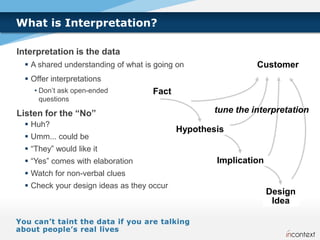
What is Interpretation?

Interpretation is the data
   A shared understanding of what is going on                Customer
   Offer interpretations
    • Don’t ask open-ended           Fact
      questions

Listen for the “No”                                 tune the interpretation
   Huh?
                                            Hypothesis
   Umm... could be
   “They” would like it
   “Yes” comes with elaboration                    Implication
   Watch for non-verbal clues
   Check your design ideas as they occur
                                                                  Design
                                                                   Idea
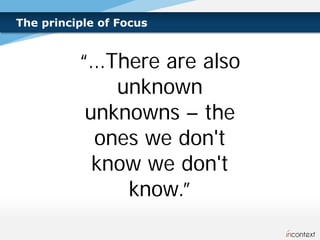
The principle of Focus


          “…There are also
              unknown
           unknowns – the
            ones we don't
            know we don't
               know.”
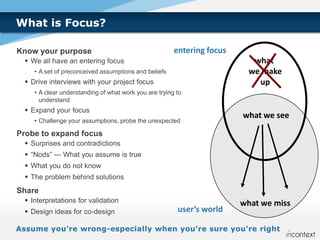
What is Focus?

Know your purpose                                      entering focus
  We all have an entering focus                                           what
    • A set of preconceived assumptions and beliefs                       we make
  Drive interviews with your project focus                                 up
    • A clear understanding of what work you are trying to
      understand
  Expand your focus
                                                                        what we see
    • Challenge your assumptions, probe the unexpected

Probe to expand focus
  Surprises and contradictions
  “Nods” — What you assume is true
  What you do not know
  The problem behind solutions
Share
  Interpretations for validation                                       what we miss
  Design ideas for co-design                           user’s world
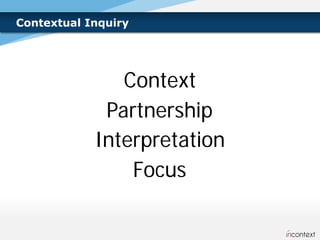
Contextual Inquiry


               Context
             Partnership
            Interpretation
                Focus
Are you visiting your users in the field?

If so, are you…
  An apprentice to their work?
  Staying concrete and not summarizing?
  Challenging your assumptions?
  Bringing back a shared interpretation of what you see happening?


If not, what are the barriers?

How are you gathering requirements?
  What’s left open for interpretation? Who ends up interpreting?
  How do you know they are right?
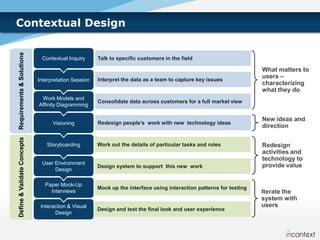
Contextual Design
Requirements & Solutions


                              Contextual Inquiry      Talk to specific customers in the field

                                                                                                                     What matters to
                                                      Interpret the data as a team to capture key issues
                                                                                                                     users –
                             Interpretation Session
                                                                                                                     characterizing
                                                                                                                     what they do
                              Work Models and
                                                      Consolidate data across customers for a full market view
                             Affinity Diagramming

                                                                                                                     New ideas and
                                   Visioning          Redesign people’s work with new technology ideas
                                                                                                                     direction
Define & Validate Concepts


                                Storyboarding         Work out the details of particular tasks and roles             Redesign
                                                                                                                     activities and
                                                                                                                     technology to
                              User Environment                                                                       provide value
                                                      Design system to support this new work
                                   Design

                                Paper Mock-Up
                                                      Mock up the interface using interaction patterns for testing
                                  Interviews                                                                         Iterate the
                                                                                                                     system with
                              Interaction & Visual                                                                   users
                                                      Design and test the final look and user experience
                                    Design
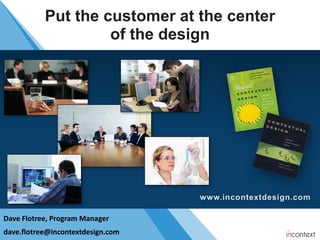
Put the customer at the center
                    of the design


Dave Flotree, Program Manager
dave.flotree@incontextdesign.com

Flotree pcs 2011

  • 1.
    ProductCamp October 2011 Using Contextual Inquiry To Understand Customer Needs 978.823.0100 Dave Flotree, Program Manager 2352 Main Street, Suite 302 dave.flotree@incontextdesign.com Concord, MA 01742 www.incontextdesign.com Copyright © 2011 InContext Enterprises Inc. All rights reserved.
  • 2.
    Contextual Inquiry Provides reliable, detailed knowledge of what people actually do and what they really care about
  • 3.
    Contextual Inquiry Aset of principles, not steps Context Partnership Interpretation Focus
  • 4.
    The principle ofContext What people say they do And what they actually do Are different
  • 5.
    What is Context? Getas close to the work as possible  Go to the customer  Interview while they are working  Be grounded in real objects and events  Pay attention to non-verbal communication Ongoing work versus summary experience  People tend to give summaries  Ongoing work is never summarized Stay concrete, don’t abstract  Ongoing work  Retrospective account — from the last two weeks  Look at artifacts
  • 6.
    The principle ofPartnership People know everything about what they do… They just can’t tell you
  • 7.
    What is Partnership? Partnershipas relationship  The user is the expert  So follow their lead  Help the users articulate and Withdrawal see their work practice Avoid ineffective interview styles  The Traditional Interviewer  The Expert/Novice  The Guest/Host Return Apprenticeship is the preferred model  Listen, learn, be humble, don’t judge  And assume that people do things for a reason  Return to the ongoing work • It always keeps you in the apprenticeship model
  • 8.
    The principle ofInterpretation It’s not the facts that matter… It’s the interpretation of the facts
  • 9.
    What is Interpretation? Interpretationis the data  A shared understanding of what is going on Customer  Offer interpretations • Don’t ask open-ended Fact questions Listen for the “No” tune the interpretation  Huh? Hypothesis  Umm... could be  “They” would like it  “Yes” comes with elaboration Implication  Watch for non-verbal clues  Check your design ideas as they occur Design Idea
  • 10.
    The principle ofFocus “…There are also unknown unknowns – the ones we don't know we don't know.”
  • 11.
    What is Focus? Knowyour purpose entering focus  We all have an entering focus what • A set of preconceived assumptions and beliefs we make  Drive interviews with your project focus up • A clear understanding of what work you are trying to understand  Expand your focus what we see • Challenge your assumptions, probe the unexpected Probe to expand focus  Surprises and contradictions  “Nods” — What you assume is true  What you do not know  The problem behind solutions Share  Interpretations for validation what we miss  Design ideas for co-design user’s world
  • 12.
    Contextual Inquiry Context Partnership Interpretation Focus
  • 13.
    Are you visitingyour users in the field? If so, are you…  An apprentice to their work?  Staying concrete and not summarizing?  Challenging your assumptions?  Bringing back a shared interpretation of what you see happening? If not, what are the barriers? How are you gathering requirements?  What’s left open for interpretation? Who ends up interpreting?  How do you know they are right?
  • 14.
    Contextual Design Requirements &Solutions Contextual Inquiry Talk to specific customers in the field What matters to Interpret the data as a team to capture key issues users – Interpretation Session characterizing what they do Work Models and Consolidate data across customers for a full market view Affinity Diagramming New ideas and Visioning Redesign people’s work with new technology ideas direction Define & Validate Concepts Storyboarding Work out the details of particular tasks and roles Redesign activities and technology to User Environment provide value Design system to support this new work Design Paper Mock-Up Mock up the interface using interaction patterns for testing Interviews Iterate the system with Interaction & Visual users Design and test the final look and user experience Design
  • 15.
    Put the customerat the center of the design Dave Flotree, Program Manager dave.flotree@incontextdesign.com