Agrobacterium
mediated gene transfer
Presented by:
Francis Timung
M.Sc 2nd Semester
Session 2013-14
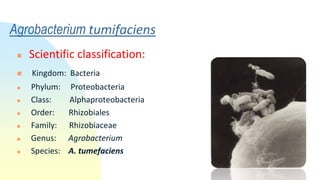
Agrobacterium tumifaciens
 Scientific classification:
 Kingdom: Bacteria
 Phylum: Proteobacteria
 Class: Alphaproteobacteria
 Order: Rhizobiales
 Family: Rhizobiaceae
 Genus: Agrobacterium
 Species: A. tumefaciens
Agrobacterium tumifaciens
 Agrobacterium tumefaciens (updated scientific name: Rhizobium radiobacter) is the causal
agent of crown gall disease (the formation of tumors) in over 140 species of dicot.
 Unlike the nitrogen fixing symbionts, tumor producing Agrobacterium are pathogenic and
do not benefit the plant.
 Economically, A. tumefaciens is a serious pathogen of walnuts, grape vines, stone fruits, nut
trees, sugar beets, horse radish and rhubarb.
Agrobacterium tumifaciens
Fig: Different types of plants infected by Crown Gall
Agrobacterium tumifaciens
Fig: Graphical illustration of Agrobacterium infection procedure
Agrobacterium tumifaciens
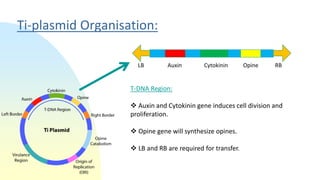
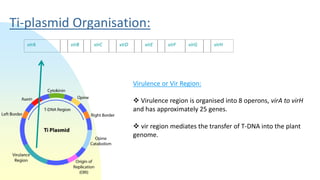
Fig: Ti Plasmid Genome Organisation
 200kb Plasmid.
 Has four (4) major regions.
 T-DNA region or Transfer DNA region which
has gene
for Auxin, Cytokinin and Opine.
 T-DNA region is integrated into the plant
genome.
 A left and right border repeat.
 An ORI.
 Virulence region that has genes that mediate
Ti-plasmid Organisation:
LB Auxin Cytokinin Opine RB
T-DNA Region:
 Auxin and Cytokinin gene induces cell division and
proliferation.
 Opine gene will synthesize opines.
 LB and RB are required for transfer.
Ti-plasmid Organisation:
virA virB virC virD virE virF virG virH
Virulence or Vir Region:
 Virulence region is organised into 8 operons, virA to virH
and has approximately 25 genes.
 vir region mediates the transfer of T-DNA into the plant
genome.
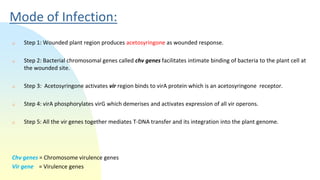
Mode of Infection:
 Step 1: Wounded plant region produces acetosyringone as wounded response.
 Step 2: Bacterial chromosomal genes called chv genes facilitates intimate binding of bacteria to the plant cell at
the wounded site.
 Step 3: Acetosyringone activates vir region binds to virA protein which is an acetosyringone receptor.
 Step 4: virA phosphorylates virG which demerises and activates expression of all vir operons.
 Step 5: All the vir genes together mediates T-DNA transfer and its integration into the plant genome.
Chv genes = Chromosome virulence genes
Vir gene = Virulence genes
 HOW IS Agrobacterium USEFUL IN GENETIC ENGINEERING?
 The DNA transmission capabilities of Agrobacterium have been vastly explored in biotechnology
as a means of inserting foreign genes into plants.
 Marc Van Montagu and Jeff Schell, discovered the gene transfer mechanism between
Agrobacterium and plants, resulted in the development of methods to alter the bacterium into
an efficient delivery system for genetic engineering in plants.
 The plasmid T-DNA that is transferred to the plant is an ideal vehicle for genetic engineering.
 This is done by cloning a desired gene sequence into the T-DNA that will be inserted into the
host DNA.
 HOW IS Agrobacterium USEFUL IN GENETIC ENGINEERING?
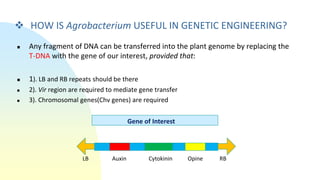
 Any fragment of DNA can be transferred into the plant genome by replacing the
T-DNA with the gene of our interest, provided that:
 1). LB and RB repeats should be there
 2). Vir region are required to mediate gene transfer
 3). Chromosomal genes(Chv genes) are required
LB Auxin Cytokinin Opine RB
Gene of Interest
Examples of Agrobacterium mediated plants:
Fig 1: Illustrates the Agrobacterium - mediated tobacco
transformation.
A: Non-transgenic tobacco leaves in germinating medium,
B: tobacco leaf discs after Agrobacterium transformation,
C: initial stages of callus formation
D: Calli towards shoot formation,
E: formation of new shoots from calli,
F: regenerated plant ready to be transferred to the green
house.
Examples of Agrobacterium mediated plants:
Fig 2 : Illustrates the Agrobacterium –
mediated Rice transformation.
(A) Germination and embryogenic calli
induction from dehulled mature seeds.
(B) Co-cultivation with A. tumefaciens after
removal of endosperm from embryogenic
calli.
(C) Selection for hygromycin-resistant calli.
(D) Shoot induction and shoot elongation
from vigorously growing calli.
(E) Acclimation and growth of transgenic
plants in green house.
THANK YOU!

Agrobacteruim_mediated_gene_transfer.ppt

  • 1.
    Agrobacterium mediated gene transfer Presentedby: Francis Timung M.Sc 2nd Semester Session 2013-14
  • 2.
    Agrobacterium tumifaciens  Scientificclassification:  Kingdom: Bacteria  Phylum: Proteobacteria  Class: Alphaproteobacteria  Order: Rhizobiales  Family: Rhizobiaceae  Genus: Agrobacterium  Species: A. tumefaciens
  • 3.
    Agrobacterium tumifaciens  Agrobacteriumtumefaciens (updated scientific name: Rhizobium radiobacter) is the causal agent of crown gall disease (the formation of tumors) in over 140 species of dicot.  Unlike the nitrogen fixing symbionts, tumor producing Agrobacterium are pathogenic and do not benefit the plant.  Economically, A. tumefaciens is a serious pathogen of walnuts, grape vines, stone fruits, nut trees, sugar beets, horse radish and rhubarb.
  • 4.
    Agrobacterium tumifaciens Fig: Differenttypes of plants infected by Crown Gall
  • 5.
    Agrobacterium tumifaciens Fig: Graphicalillustration of Agrobacterium infection procedure
  • 6.
    Agrobacterium tumifaciens Fig: TiPlasmid Genome Organisation  200kb Plasmid.  Has four (4) major regions.  T-DNA region or Transfer DNA region which has gene for Auxin, Cytokinin and Opine.  T-DNA region is integrated into the plant genome.  A left and right border repeat.  An ORI.  Virulence region that has genes that mediate
  • 7.
    Ti-plasmid Organisation: LB AuxinCytokinin Opine RB T-DNA Region:  Auxin and Cytokinin gene induces cell division and proliferation.  Opine gene will synthesize opines.  LB and RB are required for transfer.
  • 8.
    Ti-plasmid Organisation: virA virBvirC virD virE virF virG virH Virulence or Vir Region:  Virulence region is organised into 8 operons, virA to virH and has approximately 25 genes.  vir region mediates the transfer of T-DNA into the plant genome.
  • 9.
    Mode of Infection: Step 1: Wounded plant region produces acetosyringone as wounded response.  Step 2: Bacterial chromosomal genes called chv genes facilitates intimate binding of bacteria to the plant cell at the wounded site.  Step 3: Acetosyringone activates vir region binds to virA protein which is an acetosyringone receptor.  Step 4: virA phosphorylates virG which demerises and activates expression of all vir operons.  Step 5: All the vir genes together mediates T-DNA transfer and its integration into the plant genome. Chv genes = Chromosome virulence genes Vir gene = Virulence genes
  • 10.
     HOW ISAgrobacterium USEFUL IN GENETIC ENGINEERING?  The DNA transmission capabilities of Agrobacterium have been vastly explored in biotechnology as a means of inserting foreign genes into plants.  Marc Van Montagu and Jeff Schell, discovered the gene transfer mechanism between Agrobacterium and plants, resulted in the development of methods to alter the bacterium into an efficient delivery system for genetic engineering in plants.  The plasmid T-DNA that is transferred to the plant is an ideal vehicle for genetic engineering.  This is done by cloning a desired gene sequence into the T-DNA that will be inserted into the host DNA.
  • 11.
     HOW ISAgrobacterium USEFUL IN GENETIC ENGINEERING?  Any fragment of DNA can be transferred into the plant genome by replacing the T-DNA with the gene of our interest, provided that:  1). LB and RB repeats should be there  2). Vir region are required to mediate gene transfer  3). Chromosomal genes(Chv genes) are required LB Auxin Cytokinin Opine RB Gene of Interest
  • 12.
    Examples of Agrobacteriummediated plants: Fig 1: Illustrates the Agrobacterium - mediated tobacco transformation. A: Non-transgenic tobacco leaves in germinating medium, B: tobacco leaf discs after Agrobacterium transformation, C: initial stages of callus formation D: Calli towards shoot formation, E: formation of new shoots from calli, F: regenerated plant ready to be transferred to the green house.
  • 13.
    Examples of Agrobacteriummediated plants: Fig 2 : Illustrates the Agrobacterium – mediated Rice transformation. (A) Germination and embryogenic calli induction from dehulled mature seeds. (B) Co-cultivation with A. tumefaciens after removal of endosperm from embryogenic calli. (C) Selection for hygromycin-resistant calli. (D) Shoot induction and shoot elongation from vigorously growing calli. (E) Acclimation and growth of transgenic plants in green house.
  • 14.