CONTENTS
   Agriculture Price Policy
   CACP
   Food security And Food Policies
   FCI
   MSP
   PDS
   MIS
AGRICULTURE PRICE
             POLICY
      Agricultural Price Policy in India emerged in the context of food
       scarcity and price fluctuations provoked by drought of mid-
       sixties and war with Pakistan.

      The policy was framed keeping in view three different angles,
       viz.,
i.     providing food grains for the Public Distribution System,
ii.    ensuring reasonable (affordable to consumers) prices for food
       grains, and
iii.    Inducing adoption of the new technology.
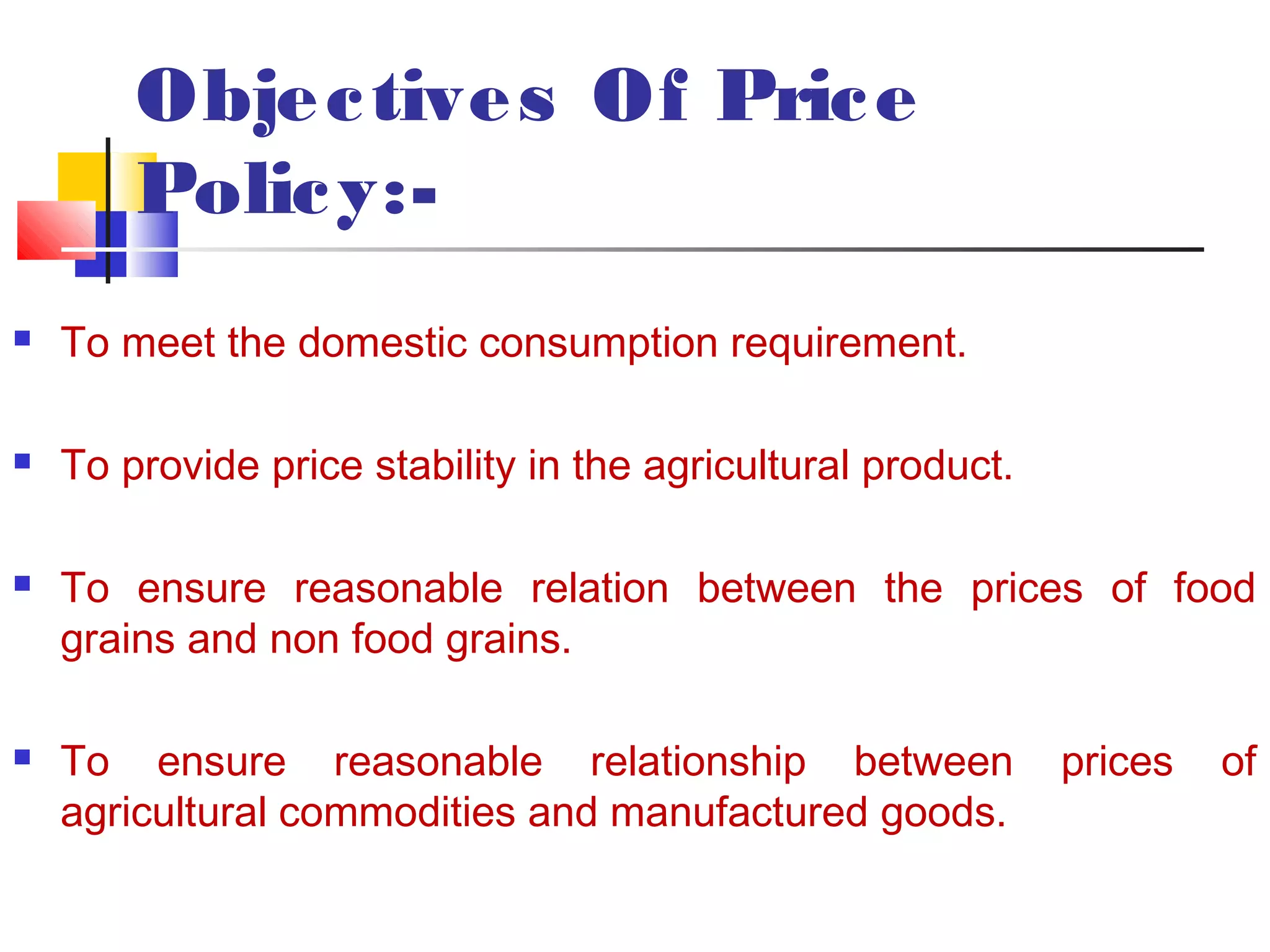
Obje c tive s Of Pric e
        Polic y:-
   To meet the domestic consumption requirement.

   To provide price stability in the agricultural product.

   To ensure reasonable relation between the prices of food
    grains and non food grains.

   To ensure reasonable relationship between                 prices   of
    agricultural commodities and manufactured goods.
 To smooth seasonal and cyclical fluctuations of prices of
agricultural commodities.

 To remove price difference between two regions.

 To make available food to consumers in the time of shortage.

 To increase the production and exports of agricultural product.

 To provide raw material to the industries at reasonable price.
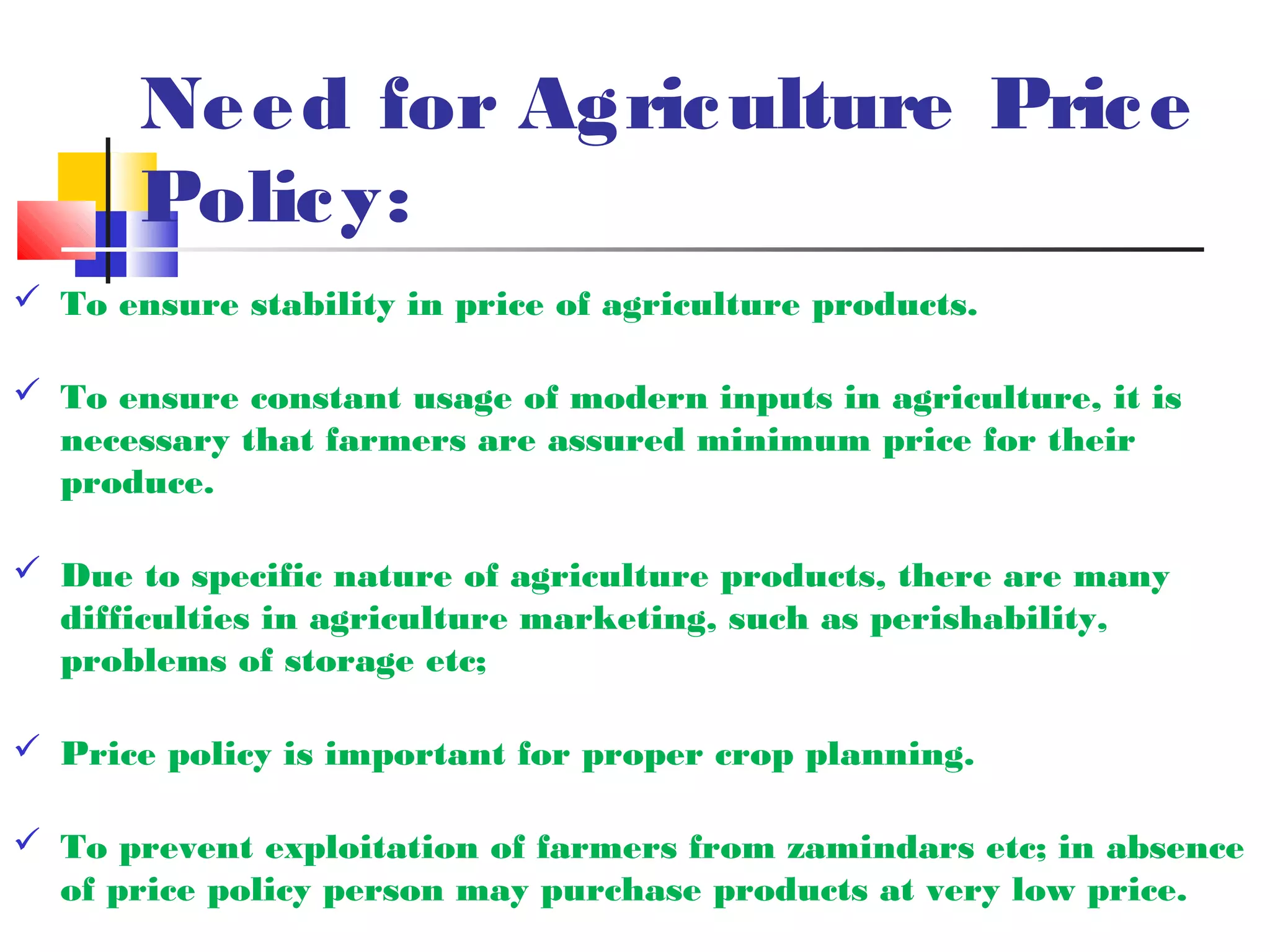
Ne e d for Agric ulture Pric e
       Polic y:
 To ensure stability in price of agriculture products.

 To ensure constant usage of modern inputs in agriculture, it is
  necessary that farmers are assured minimum price for their
  produce.

 Due to specific nature of agriculture products, there are many
  difficulties in agriculture marketing, such as perishability,
  problems of storage etc;

 Price policy is important for proper crop planning.

 To prevent exploitation of farmers from zamindars etc; in absence
  of price policy person may purchase products at very low price.
Main Features:
 Institutions: The government has set up two institutions to
  implement the price policies.
    Agriculture Price Commission (1968): This commission
  advices the government regarding agriculture price policy, also
  determines MSP and procurement prices of agriculture
  products.

     Food Corporation Of India (1985): This corporation
  organizes procurement of food grains at price determined by
  govt. and their sale through public distribution system.
 Fixation of MSP or procurement prices: The government
determines minimum support price of many agriculture product
such as wheat, rice, maize, every year based on recommendation
made by Agriculture Price Commission.

 Maximum Price Fixation: Government also determines
maximum prices for certain agriculture product. The govt. sells
many agriculture products such as grain, sugar, rice at prices
through fair prices under PDS.

 Buffer stock: To prevent change in prices of agriculture
products beyond a certain limit, govt. maintains buffer stock of
goods. This is done by FCI.
When price of food grain starts increasing, Govt. starts selling
food grains from buffer stock at specific prices. As a result,
increase in price of food grain can be checked.
 
Fac tors Take n Ac c ount:
 Cost of Product
 Changes in Input Prices
 Input / Output Price Parity
 Trends in Market Prices
 Inter-crop Price Parity
 Demand and Supply Situation
 Effect on Industrial Cost Structure
 Effect on General Price Level
 Effect on Cost of Living
 International Market Price Situation
 Parity between Prices Paid and Prices Received by
Effects Of Agriculture
     Price Policy:
Increase in production

Change in cropping pattern

Advantage to farmer

Advantage to consumer

Stability in prices
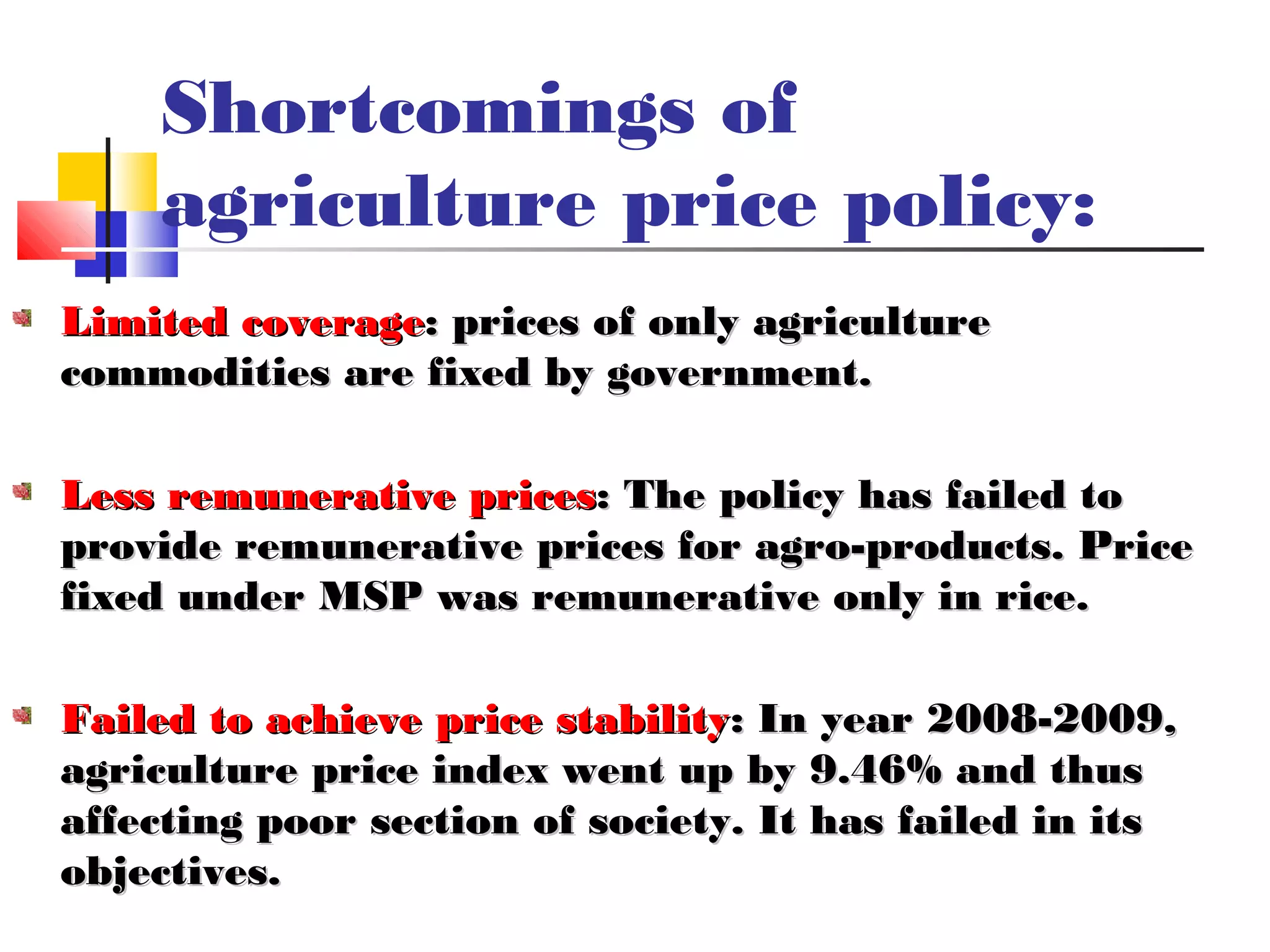
Shortcomings of
    agriculture price policy:
Limited coverage: prices of only agriculture
commodities are fixed by government.

Less remunerative prices: The policy has failed to
provide remunerative prices for agro-products. Price
fixed under MSP was remunerative only in rice.

Failed to achieve price stability: In year 2008-2009,
agriculture price index went up by 9.46% and thus
affecting poor section of society. It has failed in its
objectives.
Ineffective PDS: Strong PDS is required for providing
food grain to poor section.
 But in India, sufficient quantity isn’t being provided.

  Less number of regulated markets: More number of
regulated markets is required .
  But in India , it is less in number.
Suggestion for improving
      Agriculture Price Policy:
•Extension of price policy

•Establishment of more agencies.

•Proper fixation of prices

•Improvement in PDS

•Improvement in productivity with suitable prices

• Improvement in agriculture marketing
Commission                                       for
       Agricultural Costs                              And
       Prices (CACP)
   The organization :
 The Agricultural Prices Commission was set up in
  January, 1965 to advise the Government on price policy of
  major agricultural commodities.
 It kept a view of evolving a balance and integrated price
  structure in the perspective of the overall needs of the economy
  and with due regard to the interests of the producer and the
  consumer.
 Since March 1985, the Commission has been known as
  Commission for Agricultural Costs and Prices under Sen
  committee.
 Minimum support prices (MSP) for major agricultural
  products are fixed by the government, each year, after taking
  into account the recommendations of CACP

  The Commission is composed of
I. Chairman, a Member Secretary,
II. two official members
III.three non-official members who are representatives of the
    farming community, having long field experience and active
    association with the farming community. 

 Present :
o Chairman                         :   Dr. Ashok Gulati
  Member (Official)            :   Dr. Ashok Vishandass
  Member Secretary          :   Dr. Anandi Subramanian
Obje c tive s / Te rms of
         Re fe re nc e
1. To advise on the price policy of paddy, rice, wheat, jowar, bajra, maize,
   ragi, barley, gram, tur, moong, urad, sugarcane, groundnut and such
   other commodities.


2. To recommend from time to time, in respect of different agricultural
   commodities, measures necessary to make the price policy effective. 


3. To take into account the changes in terms of trade between agricultural
   and non agricultural sectors


4. To examine, where necessary, the prevailing methods and cost of
   marketing of agricultural commodities in different regions, suggest
   measures to reduce costs of marketing and recommend fair price
   margins for different stages of marketing.
7. To   keep under review the developing price situation and to
make appropriate recommendations, as and when necessary,
within the framework of the overall price policy.
 
8. To undertake studies in respect of different crops as may be
prescribed by Government from time to time.
 
9.  To keep under review studies relating to the price policy and
arrangements for collection of information regarding agricultural
prices and other related data and suggest improvements in the
same, and to organize research studies in the field of price policy.

10.   To advise on any problems relating to agricultural prices and
production that may be referred to it by Government from time to
time.
Food S e c urity And Food
        Polic ie s
 Food security refers to the availability of food and one's access
  to it. A household is considered food-secure when its occupants
  do not live in hunger or fear of starvation.
 Objectives of the Food Policy:

 Effective price support operations for safeguarding the interests
  of the farmers.

 Distribution of food grains throughout the country for public
  distribution system.

 Maintaining satisfactory level of operational and buffer stocks of
  food grains to ensure National Food Security
Food Grain Price Policy
   Food grains price committee was set up in 1964 to
    determine producer prices of rice and wheat on all
    India basis.

    Food grain policy committee -1966
   The important aspects pertaining are:
1. Controls on movement
2. Compulsory levy procurement
3. Fixation of maximum statutory price of food grains
4. Rationing
The Food C orporation Of
      India
The Food Corporation of India was setup under the Food
Corporation Act 1964 .
Objectives of FCI:
•To make food grains available at reasonable prices, particularly
to vulnerable section of the society

•To maintain buffer stocks as measure of Food Security

•To intervene in market for price stabilization

•to provide farmers remunerative prices
MINIMUM S UPPORT
        PRIC E/PROC UREMENT
        PRIC E
   The Minimum Support Price (MSP) Scheme is a scheme
    of the Government of India to safeguard the interests of the
    farmers.

   Under this Scheme the GOI declares the minimum support
    Prices of various agricultural produces and assures the farmers
    that their agricultural produce will be purchased at the MSP,
    thereby preventing its distress sale.

   The Food Corporation of India (FCI) acts as the Nodal Agency
    of the GOI. On behalf of FCI, the MSP Scheme is implemented
    through the State agencies.
   CROPS COVERED UNDER MSP:
    WHEAT,       BARLEY,     GRAM,      SAFFLOWER
    RAPESEED/MUSTARD, PADDY, JOWAR, BAZRA, MAIZE,
    RAGI, PULSES, GROUNDNUT, SOYABEAN, SUNFLOWER,
    SESAMUM, NIGERSEED, COTTON, TOBACCO, JUTE,
    SUGARCANE


   How does government decides MSP?
   CACP
   View of state govt.
   View of ministries
Benefits of MSP:

  income security to farmer          bringing
investment into agriculture

building up buffers,

a large network of FP shops,

stabilizing   price    line   and   consumer
welfare.
Public Distribution System
The Public Distribution System is one of the
important elements of the Government’s ‘Food
Security’ system.

 PDS involves management of supplies of
essential commodities and maintenance of their
uninterrupted flow at affordable prices to the
identified beneficiaries.

It also works as an instrument for moderating
the open market prices of food.
 PDS means distribution of essential commodities to
  a large number of people through a network of FPS
  on a recurring basis.


Commodities involved are:
 WHEAT

 RICE

 KEROSENE

 SUGAR
Goals of PDS
   Ensure social justice in distribution of basic
    necessities of life;

   Even out fluctuations in prices and availability of mass
    consumption goods;


    Support poverty-alleviation programs , particularly,
    rural employment programs .

   Check and prevent hoarding and black marketing in
    essential commodities
Who Ope rate s PDS ?
   By Central Govt: They are responsible for
    procurement, storage, transportation (upto the district
    headquarters) and bulk allocation of food grains.

   By State Govt: They are responsible for distributing
    these food grains to consumers through a network of
    Fair Price Shops.
Working of PDS
Proble ms In PDS
     The poor do not have cash to buy 35 kg at a time,
    and often they are not permitted to buy in installments.
     Low quality of food grains
     Week monitoring and lack of transparency
   Price charged exceeds the official price by 10 to 14%
   Allocations from GoI are valid only for a month, and if
    the state government is not able to lift within that time,
    its quota lapses.
Revamped PDS

    GoI introduced a RPDS in 1992 in limited areas,
    primarily drought prone, tribal and hilly, and remotely
    located.
   The RPDS was being available to all in the selected
    area.
   Food grains for distribution in RPDS areas were
    issued to the States at 50 paise below the Central
    Issue Price. The scale of issue was up to   20 kg per
    card.
Targeted PDS

    RPDS substituted by TPDS in 1997.

   It specifically aimed at BPL people in all parts of the
    country.

   State-wise BPL quota is fixed on the basis of the
    adjusted poverty share determined by the Planning
    Commission based on official poverty
UNIQUE IDENTIFICATION
         NUMBER
   It is a single answer to address wide ranging problems
    in the Public Distribution System (PDS) in the country.
   There are some concerns regarding leakages and
    misidentification due to class division in rural areas.
    The UID is an individual system so it will eliminate the
    confusion over number of households.
Policy and Procedural
        Reforms

   Elimination of Ghost Ration Cards
   There should be only one annual order
    from the district indicating quota of each
    dealer
   Making it obligatory for dealers to sell
    non-cereal items
    Oversight by citizens
   Involve civil society
MARKET INTERVENTION
       SCHEME
   FOR THOSE CROPS NOT COVERED UNDER MSP
    – ONION, POTATO, TURMERIC, CHILLIES

   THESE CROPS ARE IMPORTANT AT REGIONAL
    LEVEL

   NEED FOR PRICE SUPPORT DOES NOT ARISE
    EVERY YEAR
Diffe re nc e Be twe e n MS P
    & MIS
PARTICULARS        MSP            MIS
COMMODITIES        FIXED               NOT FIXED
REGULARITY         EVERY YEAR          AD HOC
SUPPORT PRICE DECIDED BY UNION    UNION & STATE
                             GOVERNMENT
     GOVERNMENT
PURCHASES     ALL OFFERED BY PRE-DECIDED
              FARMERS        LIMITED QUANT
APPLICABILITY      COUNTRY        SPECIFIED
LOSS          UNION GOVT.         EQUALLY
  SHARED                                BY STATE
  AND
  UNION GOVT.
Agriculture price policy