Transforming Agriculture
Through Mechanisation
A Knowledge Paper on Indian farm equipment sector
Transforming Agriculture
Through Mechanisation
A Knowledge Paper on Indian farm equipment sector
Foreword
To feed the ever-growing population that stands at 1.2 billion currently, India continues to face a significant challenge in its agriculture
sector. The ever growing demand of farm produce is further challenged by a number of factors:
•	 Sluggish growth of total cultivable land in the country.
•	 India is gradually transforming in to services and manufacturing hub – a fact evident from the increasing contribution of services and the
manufacturing sectors to the GDP.
•	 Rapid urbanisation has further led to migration of farm workers.
I believe that the only way to overcome these challenges is to increase farm mechanisation. This would increase the agricultural yield and
reduce the manual efforts to a large extent.
Studies conducted by Ministry of Agriculture suggest a direct correlation between the increased yield and farm mechanisation. This will
lead to increased savings in farm inputs such as seeds, fertilisers and drudgery etc.
Grant Thornton India LLP, in association with FICCI, through this report provides an analysis of agricultural equipment market in India
including significant information about leading players of the industry. It also highlights the challenges and presents recommendations
on how the various roadblocks can be overcome. We hope the report will encourage more discussions around Government’s vision for
sustainable agriculture and suggest how this industry will play a crucial role in achieving that.
Indian agriculture has marked its presence at the global level. India ranks among the top countries in the world in production of a number
of crops including rice, wheat, sugarcane, fruits and vegetables. However, despite this potential, two prime bottlenecks that have emerged
and can become insurmountable problem in the foreseeable future are the stagnant productivity per hectare and shortage of agriculture
labour. There is ample evidence which suggests that productivity improves dramatically with usage of more farm power. It has been further
estimated that use of proper equipment can increase the productivity by up to 30 percent and reduce the cost by about 20 percent.
Indian agriculture has since beginning of year 2000 moved far and wide beyond production of basic food grains. Indian farmer is fast
adapting farm mechanisation than ever before. The sale of tractors in India cannot be taken as the only measure of farm mechanisation but
to a greater extent it reflects the level of mechanisation. Indian tractor industry has emerged as the largest in the world and accounts for 1/3
of total global production.
While opportunities in Indian farm machinery sector are immense, the sector faces challenges on several fronts. Unlike other agricultural
sectors, farm mechanisation sector has a far more complex structural composition. It has been observed that the sector’s performance
depends on the interplay of factors, that include, financial aspects such as capital and rate of interest, lack of data, small and scattered land
holdings etc.
Innovation in farm machinery sector will drive the next phase of agricultural growth in the country. The Government of India has been
encouraging mechanisation through different policy interventions. The technologies that have evolved in the farm machinery sector in last
few years have enormous potential to realise the vision of ‘Make in India’ initiative which promotes innovation and investment.
The knowledge paper examines the current status of the farm mechanisation in India. The paper also identifies the problems in farm
equipment sector and reflects suggestions and opinions of various stakeholders collected through structured interviews. Subsequently,
the report proposes measures for transforming Indian agriculture through mechanisation. It also profiles the best practices of various
countries. FICCI has always thrived in providing thought leadership. We wish this report helps in opening up another facet to the
emergent knowledge base of the farm machinery sector.
Rahul Kapur
Partner,
Grant Thornton India LLP
A. Didar Singh
Secretary General,
FICCI
4 | Transforming Agriculture Through Mechanisation
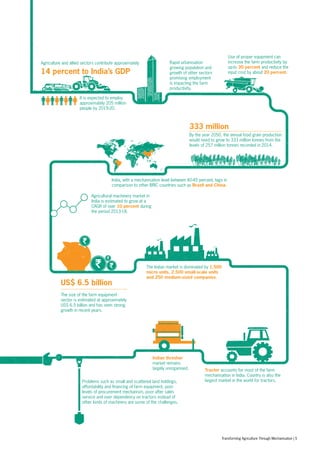
It is expected to employ
approximately 205 million
people by 2019-20.
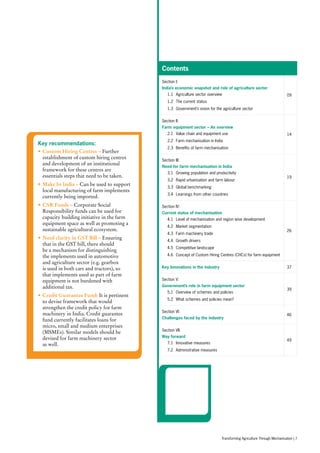
Agriculture and allied sectors contribute approximately Rapid urbanisation
growing population and
growth of other sectors
promising employment
is impacting the farm
productivity.
By the year 2050, the annual food grain production
would need to grow to 333 million tonnes from the
levels of 257 million tonnes recorded in 2014.
The size of the farm equipment
sector is estimated at approximately
US$ 6.5 billion and has seen strong
growth in recent years.
Problems such as small and scattered land holdings,
affordability and financing of farm equipment, poor
levels of procurement mechanism, poor after sales
service and over dependency on tractors instead of
other kinds of machinery are some of the challenges.
India, with a mechanisation level between 40-45 percent, lags in
comparison to other BRIC countries such as Brazil and China.
Agricultural machinery market in
India is estimated to grow at a
CAGR of over 10 percent during
the period 2013-18.
US$ 6.5 billion
Use of proper equipment can
increase the farm productivity by
up-to 30 percent and reduce the
input cost by about 20 percent.
333 million
14 percent to India’s GDP
The Indian market is dominated by 1,500
micro units, 2,500 small-scale units
and 250 medium-sized companies.
Tractor accounts for most of the farm
mechanisation in India. Country is also the
largest market in the world for tractors.
Indian thresher
market remains
largely unorganised.
Transforming Agriculture Through Mechanisation | 5
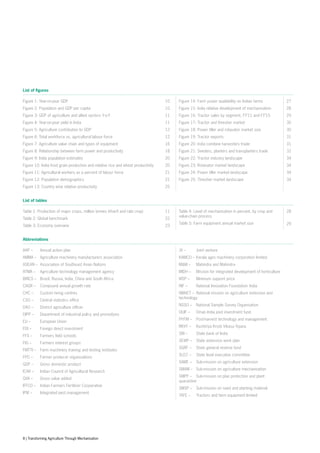
Summary
•	Agriculture and allied sectors contributes approximately
14 percent to GDP and 49.6 percent of labour force.
•	Importance of agriculture is higher in rural areas with
57 percent of rural population employed in the sector and
60 percent of the households dependent on it.
•	Agriculture sector is facing a number of challenges
—— Small farm holdings, which are continuing to decrease
in size.
—— Decreasing farm labour (estimated to drop to
approximately 26 percent of labour force by 2050).
—— Future water scarcity crisis.
•	Farm power availability in India is estimated at
2.02 kw/hectare.
•	Mechanisation level in India is about 40-45 percent with
states such as UP, Haryana and Punjab having very high
mechanisation levels but north-eastern states having
negligible mechanisation.
•	Overall industry estimated at approximately
US$ 6.5 billion.
•	Tractor is the largest segment with approximately 627,000
units sold in FY’15 (including exports); India is the largest
tractor market in the world.
•	Other major segments are threshers, rotavators and
power tillers.
•	These segments have similar structures with a few major
players dominating most of the market share.
Challenges:
•	Small and scattered land holdings – Average farm size
in India is less than 2 hectares, which is far lower than
developed regions which are highly mechanised. Larger
farm machineries are difficult to operate on such land
holdings and in some cases actually completely unsuitable.
Another factor to consider is that mechanising small and
non-contiguous group of small farms is against economies
of scale.
•	Equipment cost and poor after-sale service – Farm
equipment is capital intensive, making it a major
investment for small and marginal farmers. Quality of
after-sale service is another concern due to inadequacy of
proper maintenance in remote regions of rural areas.
•	Tractor-isation and not mechanisation – Tractor
penetration has increased from one per 150 hectares to one
per 30 hectares. However, such an increase in penetration
has not been seen in other segments of farm equipment.
•	Financing of farm equipment – Unwillingness of
commercial banks to finance farm equipment is one of the
biggest impediments to the increase in mechanisation level
in India. The interest rates that farmers face are also very
high and need to be addressed.
6 | Transforming Agriculture Through Mechanisation
Contents
Section I:
India’s economic snapshot and role of agriculture sector
	 1.1	 Agriculture sector overview
	 1.2	 The current status
	 1.3	 Government’s vision for the agriculture sector
09
Section II:
Farm equipment sector – An overview
	 2.1	 Value chain and equipment use
	 2.2	 Farm mechanisation in India
	 2.3	 Benefits of farm mechanisation
14
Section III:
Need for farm mechanisation in India
	 3.1	 Growing population and productivity
	 3.2	 Rapid urbanisation and farm labour
	 3.3	 Global benchmarking
	 3.4	 Learnings from other countries
19
Section IV:
Current status of mechanisation
	 4.1	 Level of mechanisation and region wise development
	 4.2	 Market segmentation
	 4.3	 Farm machinery trade
	 4.4	 Growth drivers
	 4.5	 Competitive landscape
	 4.6	 Concept of Custom Hiring Centres (CHCs) for farm equipment
26
Key Innovations in the industry 37
Section V:
Government’s role in farm equipment sector
	 5.1	 Overview of schemes and policies
	 5.2	 What schemes and policies mean?
39
Section VI:
Challenges faced by the industry
46
Section VII:
Way forward
	 7.1	 Innovative measures
	 7.2	 Administrative measures
49
Key recommendations:
•	Custom Hiring Centres – Further
establishment of custom hiring centres
and development of an institutional
framework for these centres are
essentials steps that need to be taken.
•	Make In India – Can be used to support
local manufacturing of farm implements
currently being imported.
•	CSR Funds – Corporate Social
Responsibility funds can be used for
capacity building initiative in the farm
equipment space as well as promoting a
sustainable agricultural ecosystem.
•	Need clarity in GST Bill – Ensuring
that in the GST bill, there should
be a mechanism for distinguishing
the implements used in automotive
and agriculture sector (e.g. gearbox
is used in both cars and tractors), so
that implements used as part of farm
equipment is not burdened with
additional tax.
•	Credit Guarantee Fund: It is pertinent
to devise framework that would
strengthen the credit policy for farm
machinery in India. Credit guarantee
fund currently facilitates loans for
micro, small and medium enterprises
(MSMEs). Similar models should be
devised for farm machinery sector
as well.
Transforming Agriculture Through Mechanisation | 7
List of figures
Figure 1: Year-on-year GDP
Figure 2: Population and GDP per capita
Figure 3: GDP of agriculture and allied sectors Y-o-Y
Figure 4: Year-on-year yield in India
Figure 5: Agriculture contribution to GDP
Figure 6: Total workforce vs. agricultural labour force
Figure 7: Agriculture value chain and types of equipment
Figure 8: Relationship between farm power and productivity
Figure 9: India population estimates
Figure 10: India food grain production and relative rice and wheat productivity
Figure 11: Agricultural workers as a percent of labour force
Figure 12: Population demographics
Figure 13: Country wise relative productivity
10
10
11
11
12
12
16
18
20
20
21
21
25
Figure 14: Farm power availability on Indian farms
Figure 15: India relative development of mechanisation
Figure 16: Tractor sales by segment, FY’11 and FY’15
Figure 17: Tractor and thresher market
Figure 18: Power tiller and rotavator market size
Figure 19: Tractor exports
Figure 20: India combine harvesters trade
Figure 21: Seeders, planters and transplanters trade
Figure 22: Tractor industry landscape
Figure 23: Rotavator market landscape
Figure 24: Power tiller market landscape
Figure 25: Thresher market landscape
27
28
29
30
30
31
31
32
34
34
34
34
List of tables
Table 1: Production of major crops, million tonnes (kharif and rabi crop)
Table 2: Global benchmark
Table 3: Economy overview
11
22
23
Table 4: Level of mechanisation in percent, by crop and
value-chain process
Table 5: Farm equipment annual market size
28
29
Abbreviations
AAP – 	 Annual action plan
AMMA – 	 Agriculture machinery manufacturers association
ASEAN – 	Association of Southeast Asian Nations
ATMA – 	 Agriculture technology management agency
BRICS – 	 Brazil, Russia, India, China and South Africa
CAGR – 	 Compound annual growth rate
CHC – 	 Custom hiring centres
CSO – 	 Central statistics office
DAO – 	 District agriculture officer
DIPP – 	 Department of industrial policy and promotions
EU – 	 European Union
FDI – 	 Foreign direct investment
FFS – 	 Farmers field schools
FIG – 	 Farmers interest groups
FMTTI – 	 Farm machinery training and testing institutes
FPO – 	 Farmer producer organisations
GDP – 	 Gross domestic product
ICAR – 	 Indian Council of Agricultural Research
GVA – 	 Gross value added
IFFCO – 	 Indian Farmers Fertilizer Cooperative
IPM – 	 Integrated pest management
JV – 	 Joint venture
KAMCO – 	Kerala agro machinery corporation limited
M&M – 	 Mahindra and Mahindra
MIDH – 	 Mission for integrated development of horticulture
MSP – 	 Minimum support price
NIF – 	 National Innovation Foundation- India
NMAET – 	National mission on agriculture extension and
technology
NSSO – 	 National Sample Survey Organisation
OIJIF – 	 Oman India joint investment fund
PHTM – 	 Post-harvest technology and management
RKVY – 	 Rashtriya Krishi Vikasa Yojana
SBI – 	 State bank of India
SEWP – 	 State extension work plan
SGRF – 	 State general reserve fund
SLEC – 	 State level executive committee
SAME – 	 Sub-mission on agriculture extension
SMAM – 	 Sub-mission on agriculture mechanisation
SMPP – 	 Sub-mission on plan protection and plant
quarantine
SMSP – 	 Sub-mission on seed and planting material
TAFE – 	 Tractors and farm equipment limited
8 | Transforming Agriculture Through Mechanisation
Section I:
India’s economic
snapshot and role
of agriculture sector
Transforming Agriculture Through Mechanisation | 9
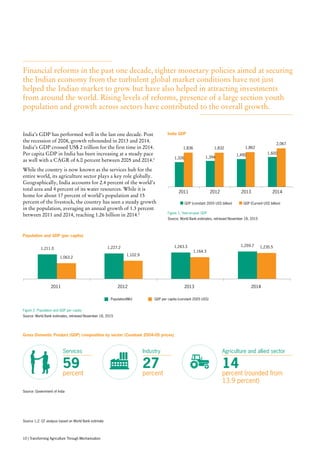
India’s GDP has performed well in the last one decade. Post
the recession of 2008, growth rebounded in 2013 and 2014.
India’s GDP crossed US$ 2 trillion for the first time in 2014.
Per capita GDP in India has been increasing at a steady pace
as well with a CAGR of 6.0 percent between 2005 and 2014.1
While the country is now known as the services hub for the
entire world, its agriculture sector plays a key role globally.
Geographically, India accounts for 2.4 percent of the world’s
total area and 4 percent of its water resources. While it is
home for about 17 percent of world’s population and 15
percent of the livestock, the country has seen a steady growth
in the population, averaging an annual growth of 1.3 percent
between 2011 and 2014, reaching 1.26 billion in 2014.2
India GDP
Population and GDP (per capita)
Gross Domestic Product (GDP) composition by sector (Constant 2004-05 prices)
Figure 1: Year-on-year GDP
Source: World Bank estimates, retrieved November 18, 2015
Figure 2: Population and GDP per capita
Source: World Bank estimates, retrieved November 18, 2015
Source: Government of India
1,326 1,394
1,490 1,600
1,836 1,832 1,862
2,067
2011 2012 2013 2014
GDP (constant 2005 US$ billion) GDP (Current US$ billion)
1,211.0 1,227.2 1,243.3 1,259.7
1,063.2
1,102.9
1,164.3
1,235.5
2011 2012 2013 2014
Population(Mn) GDP per capita (constant 2005 US$)
Services
59
percent
Industry
27
percent
Agriculture and allied sector
14
percent (rounded from
13.9 percent)
Financial reforms in the past one decade, tighter monetary policies aimed at securing
the Indian economy from the turbulent global market conditions have not just
helped the Indian market to grow but have also helped in attracting investments
from around the world. Rising levels of reforms, presence of a large section youth
population and growth across sectors have contributed to the overall growth.
Source 1,2: GT analysis based on World Bank estimate
10 | Transforming Agriculture Through Mechanisation
1.1 Agriculture sector overview
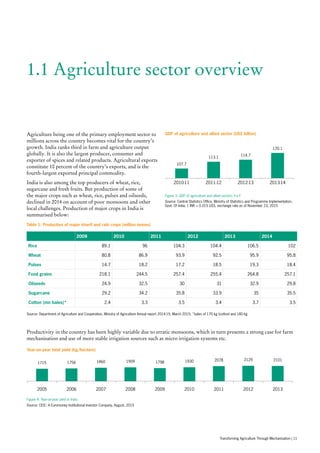
Agriculture being one of the primary employment sector to
millions across the country becomes vital for the country’s
growth. India ranks third in farm and agriculture output
globally. It is also the largest producer, consumer and
exporter of spices and related products. Agricultural exports
constitute 10 percent of the country’s exports, and is the
fourth-largest exported principal commodity.
India is also among the top producers of wheat, rice,
sugarcane and fresh fruits. But production of some of
the major crops such as wheat, rice, pulses and oilseeds,
declined in 2014 on account of poor monsoons and other
local challenges. Production of major crops in India is
summarised below:
Productivity in the country has been highly variable due to erratic monsoons, which in turn presents a strong case for farm
mechanisation and use of more stable irrigation sources such as micro irrigation systems etc.
GDP of agriculture and allied sector (US$ billion)
Table 1: Production of major kharif and rabi crops (million tonnes)
Year-on-year total yield (kg/hectare)
Figure 3: GDP of agriculture and allied sectors Y-o-Y
Source: Central Statistics Office, Ministry of Statistics and Programme Implementation,
Govt. Of India; 1 INR = 0.015 US$, exchange rate as of November 23, 2015
Source: Department of Agriculture and Cooperation, Ministry of Agriculture Annual report 2014-15, March 2015; *bales of 170 kg (cotton) and 180 kg
Figure 4: Year-on-year yield in India
Source: CEIC: A Euromoney Institutional Investor Company, August, 2015
107.7
113.1
114.7
120.1
2010-11 2011-12 2012-13 2013-14
1715 1756 1860 1909 1798 1930 2078 2129 2101
2005 2006 2007 2008 2009 2010 2011 2012 2013
2009 2010 2011 2012 2013 2014
Rice 89.1 96 104.3 104.4 106.5 102
Wheat 80.8 86.9 93.9 92.5 95.9 95.8
Pulses 14.7 18.2 17.2 18.5 19.3 18.4
Food grains 218.1 244.5 257.4 255.4 264.8 257.1
Oilseeds 24.9 32.5 30 31 32.9 29.8
Sugarcane 29.2 34.2 35.8 33.9 35 35.5
Cotton (mn bales)* 2.4 3.3 3.5 3.4 3.7 3.5
Transforming Agriculture Through Mechanisation | 11
1.2 The current status
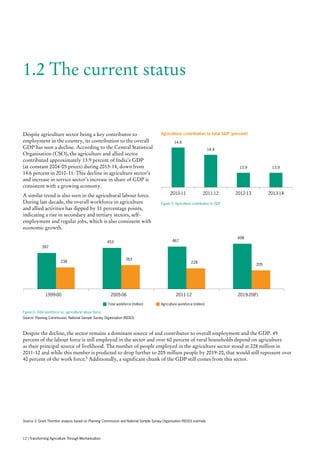
Despite agriculture sector being a key contributor to
employment in the country, its contribution to the overall
GDP has seen a decline. According to the Central Statistical
Organisation (CSO), the agriculture and allied sector
contributed approximately 13.9 percent of India’s GDP
(at constant 2004-05 prices) during 2013-14, down from
14.6 percent in 2010-11. This decline in agriculture sector’s
and increase in service sector’s increase in share of GDP is
consistent with a growing economy.
A similar trend is also seen in the agricultural labour force.
During last decade, the overall workforce in agriculture
and allied activities has dipped by 11 percentage points,
indicating a rise in secondary and tertiary sectors, self-
employment and regular jobs, which is also consistent with
economic growth.
Despite the decline, the sector remains a dominant source of and contributor to overall employment and the GDP. 49
percent of the labour force is still employed in the sector and over 60 percent of rural households depend on agriculture
as their principal source of livelihood. The number of people employed in the agriculture sector stood at 228 million in
2011-12 and while this number is predicted to drop further to 205 million people by 2019-20, that would still represent over
40 percent of the work force.3
Additionally, a significant chunk of the GDP still comes from this sector.
Agriculture contribution to total GDP (percent)
Figure 5: Agriculture contribution to GDP
14.6
14.4
13.9 13.9
2010-11 2011-12 2012-13 2013-14
397
453 467
498
238
263
228
205
1999-00 2005-06 2011-12 2019-20(F)
Total workforce (million) Agriculture workforce (million)
Figure 6: Total workforce vs. agricultural labour force
Source: Planning Commission, National Sample Survey Organisation (NSSO).
Source 3: Grant Thornton analysis based on Planning Commission and National Sample Survey Organisation (NSSO) estimate
12 | Transforming Agriculture Through Mechanisation
1.3 Government’s vision for the
agriculture sector
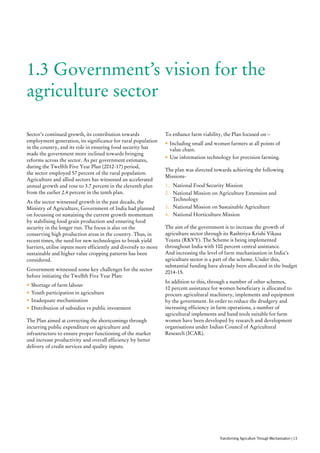
Sector’s continued growth, its contribution towards
employment generation, its significance for rural population
in the country, and its role in ensuring food security has
made the government more inclined towards bringing
reforms across the sector. As per government estimates,
during the Twelfth Five Year Plan (2012-17) period,
the sector employed 57 percent of the rural population.
Agriculture and allied sectors has witnessed an accelerated
annual growth and rose to 3.7 percent in the eleventh plan
from the earlier 2.4 percent in the tenth plan.
As the sector witnessed growth in the past decade, the
Ministry of Agriculture, Government of India had planned
on focussing on sustaining the current growth momentum
by stabilising food grain production and ensuring food
security in the longer run. The focus is also on the
conserving high production areas in the country. Thus, in
recent times, the need for new technologies to break yield
barriers, utilise inputs more efficiently and diversify to more
sustainable and higher value cropping patterns has been
considered.
Government witnessed some key challenges for the sector
before initiating the Twelfth Five Year Plan:
•	Shortage of farm labour
•	Youth participation in agriculture
•	Inadequate mechanisation
•	Distribution of subsidies vs public investment
The Plan aimed at correcting the shortcomings through
incurring public expenditure on agriculture and
infrastructure to ensure proper functioning of the market
and increase productivity and overall efficiency by better
delivery of credit services and quality inputs.
To enhance farm viability, the Plan focused on –
•	Including small and women farmers at all points of
value chain.
•	Use information technology for precision farming.
The plan was directed towards achieving the following
Missions-
1.	 National Food Security Mission
2.	 National Mission on Agriculture Extension and
Technology
3.	 National Mission on Sustainable Agriculture
4.	 National Horticulture Mission
The aim of the government is to increase the growth of
agriculture sector through its Rashtriya Krishi Vikasa
Yojana (RKVY). The Scheme is being implemented
throughout India with 100 percent central assistance.
And increasing the level of farm mechanisation in India’s
agriculture sector is a part of the scheme. Under this,
substantial funding have already been allocated in the budget
2014-15.
In addition to this, through a number of other schemes,
10 percent assistance for women beneficiary is allocated to
procure agricultural machinery, implements and equipment
by the government. In order to reduce the drudgery and
increasing efficiency in farm operations, a number of
agricultural implements and hand tools suitable for farm
women have been developed by research and development
organisations under Indian Council of Agricultural
Research (ICAR).
Transforming Agriculture Through Mechanisation | 13
Section II:
Farm equipment
sector – An
overview
14 | Transforming Agriculture Through Mechanisation
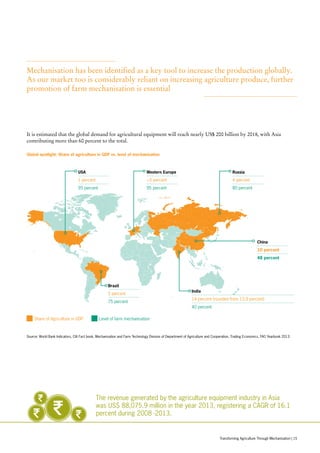
The revenue generated by the agriculture equipment industry in Asia
was US$ 88,075.9 million in the year 2013, registering a CAGR of 16.1
percent during 2008 -2013.
Global spotlight: Share of agriculture in GDP vs. level of mechanisation
Source: World Bank Indicators, CIA Fact book, Mechanisation and Farm Technology Division of Department of Agriculture and Cooperation, Trading Economics, FAO Yearbook 2013
USA
1 percent
95 percent
Brazil
5 percent
75 percent
Russia
4 percent
80 percent
China
10 percent
48 percent
India
14 percent (rounded from 13.9 percent)
40 percent
Western Europe
<5 percent
95 percent
Share of Agriculture in GDP Level of farm mechanisation
Mechanisation has been identified as a key tool to increase the production globally.
As our market too is considerably reliant on increasing agriculture produce, further
promotion of farm mechanisation is essential
It is estimated that the global demand for agricultural equipment will reach nearly US$ 200 billion by 2018, with Asia
contributing more than 60 percent to the total.
Transforming Agriculture Through Mechanisation | 15
2.1 Value chain and equipment use
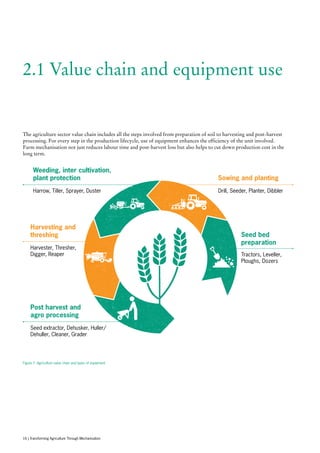
The agriculture sector value chain includes all the steps involved from preparation of soil to harvesting and post-harvest
processing. For every step in the production lifecycle, use of equipment enhances the efficiency of the unit involved.
Farm mechanisation not just reduces labour time and post-harvest loss but also helps to cut down production cost in the
long term.
Seed bed
preparation
Sowing and planting
Weeding, inter cultivation,
plant protection
Harvesting and
threshing
Post harvest and
agro processing
Tractors, Leveller,
Ploughs, Dozers
Drill, Seeder, Planter, DibblerHarrow, Tiller, Sprayer, Duster
Harvester, Thresher,
Digger, Reaper
Seed extractor, Dehusker, Huller/
Dehuller, Cleaner, Grader
Figure 7: Agriculture value chain and types of equipment
16 | Transforming Agriculture Through Mechanisation
2.2 Farm mechanisation in India
The agriculture sector in India has witnessed a considerable decline
in the use of animal and human power in agriculture related activities.
The trend has paved a way for a range of agricultural tools. A large
number of these are driven by fossil fuel operated vehicles such as
tractors, diesel engines. This has resulted in a shift from the traditional
agriculture process to a more mechanised process. Though the level
of mechanisation in India is lower as compared to other developed
countries, it is certainly on growing.
The role of tractors in the Indian agriculture sector reflects the
growing trend of tractor-isation in the country. Custom hiring of farm
equipment is a prevalent practice in India, especially among small land
owners who find ownership of large farm machines expensive and
uneconomical.
The government is therefore promoting farm mechanisation by
subsidising purchase of equipment as well as supporting bulk
buying through front-end agencies. The government also provides
credit and financial assistance to support local manufacturing of
farm mechanisation equipment. Given the labour scarcity and the
government’s subsidy programs, adoption of farm mechanisation is set
to increase.
Indigenously developed agricultural hand tools and implements have
also evolved over time and despite the strides agricultural machinery
has made, continue to play a critical role in agriculture. This is on
account of the small and irregular farm sizes, lack of machinery
available for smaller land holdings, lack of awareness and skills among
farmers and inability of farmers to afford more advanced technologies.
Hand tools have also been developed for all levels of the value chain. In
2010, when the size of the agricultural labour force was 269.74 million,
the estimated number of hand tools in use was 809.22 million, which
equates to about 3 hand tools per labourer4
. However, the prevalence
of these tools comes with the issue of safety.
An ICAR study (2004-2007) showed that 34.2 percent of accidents in
agriculture were due to hand tools, with sickles and spades involved
in 46 percent of farm injuries. Implications of injuries due to hand
tools are severe as these injuries are very painful and disabling due to
delayed treatment. A survey conducted in India showed that 70 percent
of agricultural hand tools injuries had a recovery time of more than
seven days. Thus, developing farm machinery more suited to the local
conditions is essential so that injuries and problems that come with
the use of hand tools can be abated while making agricultural practices
more productive.
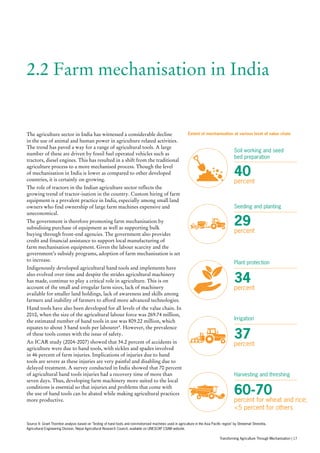
40
percent
Soil working and seed
bed preparation
29
percent
Seeding and planting
34
percent
Plant protection
37
percent
Irrigation
60-70
percent for wheat and rice;
<5 percent for others
Harvesting and threshing
Source 4: Grant Thornton analysis based on ‘Testing of hand tools and non-motorised machines used in agriculture in the Asia Pacific region’ by Shreemat Shreshta,
Agricultural Engineering Division, Nepal Agricultural Research Council, available on UNESCAP CSAM website.
Extent of mechanisation at various level of value chain
Transforming Agriculture Through Mechanisation | 17
2.3 Benefits of farm mechanisation
Farm mechanisation has been known to provide a number
of economic and social benefits to farmers. Primary among
the economic benefits is the improved yield that comes as
a result of greater level of mechanisation. Looming water
scarcity crisis along with the need to ensure food security
in the country, the benefits of farm mechanisation makes
it a crucial component of shaping the future of Indian
agriculture.
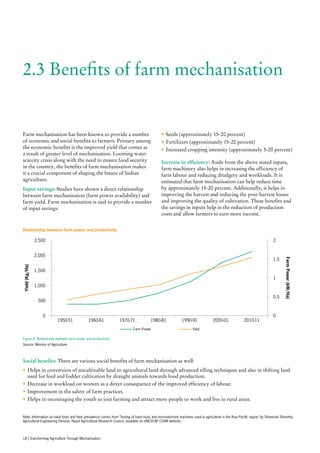
Input savings: Studies have shown a direct relationship
between farm mechanisation (farm power availability) and
farm yield. Farm mechanisation is said to provide a number
of input savings:
•	Seeds (approximately 15-20 percent)
•	Fertilizers (approximately 15-20 percent)
•	Increased cropping intensity (approximately 5-20 percent)
Increase in efficiency: Aside from the above stated inputs,
farm machinery also helps in increasing the efficiency of
farm labour and reducing drudgery and workloads. It is
estimated that farm mechanisation can help reduce time
by approximately 15-20 percent. Additionally, it helps in
improving the harvest and reducing the post-harvest losses
and improving the quality of cultivation. These benefits and
the savings in inputs help in the reduction of production
costs and allow farmers to earn more income.
Social benefits: There are various social benefits of farm mechanisation as well:
•	Helps in conversion of uncultivable land to agricultural land through advanced tilling techniques and also in shifting land
used for feed and fodder cultivation by draught animals towards food production.
•	Decrease in workload on women as a direct consequence of the improved efficiency of labour.
•	Improvement in the safety of farm practices.
•	Helps in encouraging the youth to join farming and attract more people to work and live in rural areas.
0
500
1,000
1,500
2,000
2,500
1950-51 1960-61 1970-71 1980-81 1990-91 2000-01 2010-11
0
0.5
1
1.5
2
Yield(Kg/Ha)
FarmPower(kW/Ha)
Farm Power Yield
Relationship between farm power and productivity
Figure 8: Relationship between farm power and productivity
Source: Ministry of Agriculture
Note: Information on hand tools and their prevalence comes from ‘Testing of hand tools and non-motorised machines used in agriculture in the Asia Pacific region’ by Shreemat Shreshta,
Agricultural Engineering Division, Nepal Agricultural Research Council, available on UNESCAP CSAM website.
18 | Transforming Agriculture Through Mechanisation
Section III:
Need for farm
mechanisation
in India
Transforming Agriculture Through Mechanisation | 19
3.1 Growing population and
productivity
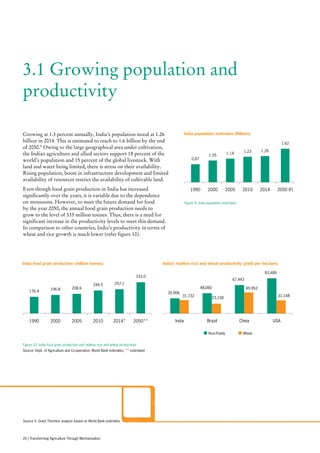
Growing at 1.3 percent annually, India’s population stood at 1.26
billion in 2014. This is estimated to reach to 1.6 billion by the end
of 2050.5
Owing to the large geographical area under cultivation,
the Indian agriculture and allied sectors support 18 percent of the
world’s population and 15 percent of the global livestock. With
land and water being limited, there is stress on their availability.
Rising population, boost in infrastructure development and limited
availability of resources restrict the availability of cultivable land.
Even though food grain production in India has increased
significantly over the years, it is variable due to the dependence
on monsoons. However, to meet the future demand for food
by the year 2050, the annual food grain production needs to
grow to the level of 333 million tonnes. Thus, there is a need for
significant increase in the productivity levels to meet this demand.
In comparison to other countries, India’s productivity in terms of
wheat and rice growth is much lower (refer figure 10).
India population estimates (Billions)
Figure 9: India population estimates
Figure 10: India food grain production and relative rice and wheat productivity
Source: Dept. of Agriculture and Co-operation; World Bank estimates; ** estimated
0.87
1990
1.05
2000
1.14
2005
1.23
2010
1.26
2014
1.62
2050 (F)
India food grain production (million tonnes)
176.4
196.8 208.6
244.5 257.1
333.0
1990 2000 2005 2010 2014* 2050**
India’s relative rice and wheat productivity (yield per hectare)
35,906
48,060
67,443
83,489
31,732 23,158
49,952
31,148
India Brazil China USA
Rice/Paddy Wheat
Source 5: Grant Thornton analysis based on World Bank estimates
20 | Transforming Agriculture Through Mechanisation
The agriculture sector in India, for a long time, has
depended on cheap and surplus labour. One of the
stated reasons behind sufficient supply of such labour
was lack of opportunities. However, the situation is
now changing with more opportunities available in
factories and services as well as the government’s rural
employment creation program, which guarantees 100
days of employment on public-works projects.
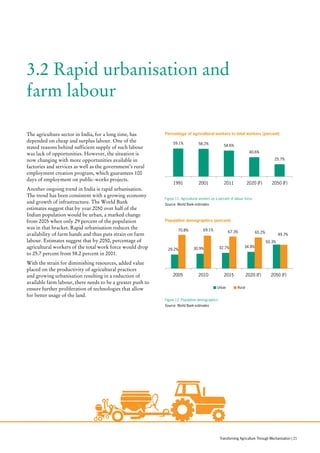
Another ongoing trend in India is rapid urbanisation.
The trend has been consistent with a growing economy
and growth of infrastructure. The World Bank
estimates suggest that by year 2050 over half of the
Indian population would be urban, a marked change
from 2005 when only 29 percent of the population
was in that bracket. Rapid urbanisation reduces the
availability of farm hands and thus puts strain on farm
labour. Estimates suggest that by 2050, percentage of
agricultural workers of the total work force would drop
to 25.7 percent from 58.2 percent in 2001.
With the strain for diminishing resources, added value
placed on the productivity of agricultural practices
and growing urbanisation resulting in a reduction of
available farm labour, there needs to be a greater push to
ensure further proliferation of technologies that allow
for better usage of the land.
Percentage of agricultural workers to total workers (percent)
Figure 11: Agricultural workers as a percent of labour force
Source: World Bank estimates
59.1% 58.2% 54.6%
40.6%
25.7%
1991 2001 2011 2020 (F) 2050 (F)
Population demographics (percent)
Figure 12: Population demographics
Source: World Bank estimates
29.2% 30.9% 32.7% 34.8%
50.3%
70.8% 69.1% 67.3% 65.2%
49.7%
2005 2010 2015 2020 (F) 2050 (F)
Urban Rural
3.2 Rapid urbanisation and
farm labour
Transforming Agriculture Through Mechanisation | 21
3.3 Global benchmarking
In 2011, China overtook the European countries and the US to become the largest producer of farm equipment in the world.
In order to cover the technological gap between the domestic and international firms in China, the government is open to
the establishment of joint ventures between Chinese and foreign enterprises. In return, the multinational companies enjoy
access to the vast Chinese market.
In India, presence of a large number of non-banking financial Corporations (NBFCs) has encouraged farmers to buy
agriculture machinery on credit. Of the entire machinery, tractors have the highest number of share in the overall sales.
These accounted for 66.1 percent share in the total number of agricultural equipment sold in India in FY’2013. However,
the overall market for agriculture equipment has witnessed a slowdown recently, largely due to reduced sales of tractors and
combine harvesters.
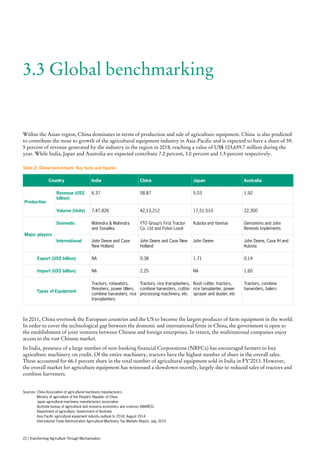
Within the Asian region, China dominates in terms of production and sale of agriculture equipment. China is also predicted
to contribute the most to growth of the agricultural equipment industry in Asia-Pacific and is expected to have a share of 59.
5 percent of revenue generated by the industry in the region in 2018, reaching a value of US$ 103,659.7 million during the
year. While India, Japan and Australia are expected contribute 7.2 percent, 3.0 percent and 1.5 percent respectively.
Country India China Japan Australia
Production
Revenue (US$
billion)
6.37 58.87 5.03 1.92
Volume (Units) 7,47,826 42,13,212 17,51,510 22,300
Major players
Domestic Mahindra & Mahindra
and Sonalika
YTO Group’s First Tractor
Co. Ltd and Foton Lovol
Kubota and Yanmar Gernonimo and John
Berends implements
International John Deere and Case
New Holland
John Deere and Case New
Holland
John Deere John Deere, Case IH and
Kubota
Export (US$ billion) NA 9.38 1.71 0.14
Import (US$ billion) NA 2.25 NA 1.60
Types of Equipment
Tractors, rotavators,
threshers, power tillers,
combine harvesters, rice
transplanters
Tractors, rice transplanters,
combine harvesters, cotton
processing machinery, etc.
Bush cutter, tractors,
rice tansplanter, power
sprayer and duster, etc
Tractors, combine
harvesters, balers
Table 2: Global benchmark: Key facts and figures
Sources: China Association of agricultural machinery manufacturers
Ministry of agriculture of the People’s Republic of China
Japan agricultural machinery manufacturers association
Australia bureau of agricultural and resource economics and sciences (ABARES)
Department of agriculture, Government of Australia
Asia Pacific agricultural equipment industry outlook to 2018, August 2014
International Trade Administration Agricultural Machinery Top Markets Report, July, 2015
22 | Transforming Agriculture Through Mechanisation
3.4 Learnings from other countries
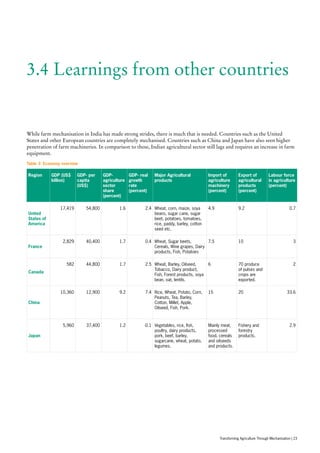
Table 3: Economy overview
While farm mechanisation in India has made strong strides, there is much that is needed. Countries such as the United
States and other European countries are completely mechanised. Countries such as China and Japan have also seen higher
penetration of farm machineries. In comparison to these, Indian agricultural sector still lags and requires an increase in farm
equipment.
Region GDP (US$
billion)
GDP- per
capita
(US$)
GDP-
agriculture
sector
share
(percent)
GDP- real
growth
rate
(percent)
Major Agricultural
products
Import of
agriculture
machinery
(percent)
Export of
agricultural
products
(percent)
Labour force
in agriculture
(percent)
United
States of
America
17,419 54,800 1.6 2.4 Wheat, corn, maize, soya
beans, sugar cane, sugar
beet, potatoes, tomatoes,
rice, paddy, barley, cotton
seed etc.
4.9 9.2 0.7
France
2,829 40,400 1.7 0.4 Wheat, Sugar beets,
Cereals, Wine grapes, Dairy
products, Fish, Potatoes
7.5 10 3
Canada
582 44,800 1.7 2.5 Wheat, Barley, Oilseed,
Tobacco, Dairy product,
Fish, Forest products, soya
bean, oat, lentils.
6 70 produce
of pulses and
crops are
exported.
2
China
10,360 12,900 9.2 7.4 Rice, Wheat, Potato, Corn,
Peanuts, Tea, Barley,
Cotton, Millet, Apple,
Oilseed, Fish, Pork.
15 20 33.6
Japan
5,960 37,400 1.2 -0.1 Vegetables, rice, fish,
poultry, dairy products,
pork, beef, barley,
sugarcane, wheat, potato,
legumes.
Mainly meat,
processed
food, cereals
and oilseeds
and products.
Fishery and
forestry
products.
2.9
Transforming Agriculture Through Mechanisation | 23
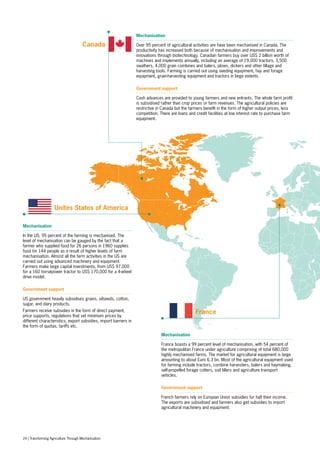
Mechanisation
Over 95 percent of agricultural activities are have been mechanised in Canada. The
productivity has increased both because of mechanisation and improvements and
innovations through biotechnology. Canadian farmers buy over US$ 2 billion worth of
machines and implements annually, including an average of 19,000 tractors, 3,500
swathers, 4,000 grain combines and balers, plows, dickers and other tillage and
harvesting tools. Farming is carried out using seeding equipment, hay and forage
equipment, grain-harvesting equipment and tractors in large extents.
Government support
Cash advances are provided to young farmers and new entrants. The whole farm profit
is subsidised rather than crop prices or farm revenues. The agricultural policies are
restrictive in Canada but the farmers benefit in the form of higher output prices, less
competition. There are loans and credit facilities at low interest rate to purchase farm
equipment.
Mechanisation
In the US, 95 percent of the farming is mechanised. The
level of mechanisation can be gauged by the fact that a
farmer who supplied food for 26 persons in 1960 supplies
food for 144 people as a result of higher levels of farm
mechanisation. Almost all the farm activities in the US are
carried out using advanced machinery and equipment.
Farmers make large capital investments, from US$ 97,000
for a 160 horsepower tractor to US$ 170,000 for a 4-wheel
drive model.
Government support
US government heavily subsidises grains, oilseeds, cotton,
sugar, and dairy products.
Farmers receive subsidies in the form of direct payment,
price supports, regulations that set minimum prices by
different characteristics, export subsidies, import barriers in
the form of quotas, tariffs etc.
Mechanisation
France boasts a 99 percent level of mechanisation, with 54 percent of
the metropolitan France under agriculture comprising of total 680,000
highly mechanised farms. The market for agricultural equipment is large
amounting to about Euro 6.3 bn. Most of the agricultural equipment used
for farming include tractors, combine harvesters, balers and haymaking,
self-propelled forage cutters, soil tillers and agriculture transport
vehicles.
Government support
French farmers rely on Europian Union subsidies for half their income.
The exports are subsidised and farmers also get subsidies to import
agricultural machinery and equipment.
Canada
Unites States of America
France
24 | Transforming Agriculture Through Mechanisation
Mechanisation
Japan is one of the most agriculturally mechanised
nations in Asia Pacific region and the tractor power
per hectare of agricultural land is 7 HP which is at
par with that of the US, the UK and France. The
main equipment used comprises of bush cutter,
plant protecting machinery, walking type tractor,
tractors, rice transplanters and grain combine
harvesters.
Government support
Government subsidies for agriculture in Japan
amounted to US$ 68,266.5 in 2014. Government
grants subsidies to the farmers on the loss
incurred to make them competitive in the market.
Government impose high import tariffs on
agricultural imports.
Mechanisation
China has around 60 percent of farm activities mechanised. Main agricultural equipment used
include tractors, combine harvesters (self-propelled and tractor-mounted), rice transplanters and
cotton processing machinery. Level of mechanisation for various activities such as ploughing,
planting and harvesting levels are 76.1 percent, 49.2 percent and 46.9 percent, respectively.
Government support
The Government of China provides subsidies on agriculture equipment and machinery purchase,
which is approximately 30 percent of the price of the equipment.
Both direct and indirect subsidies are given to the farmers. Direct subsidy includes mainly price
subsidies whereas indirect subsidies are in the form of remitting agricultural tax, special discount
rates etc.
China
Japan
5925
7524
5851
3625
6134
3020
7340 7074
5891
4170
6105
2962
0
10000
United States France China Canada Japan India
2012 2013
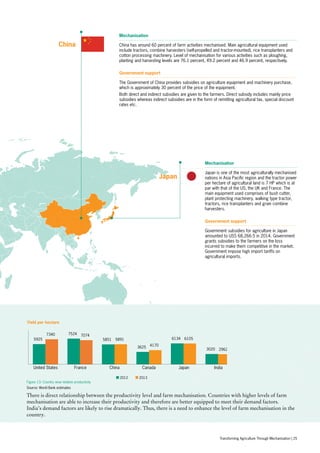
Yield per hectare
Figure 13: Country wise relative productivity
Source: World Bank estimates
There is direct relationship between the productivity level and farm mechanisation. Countries with higher levels of farm
mechanisation are able to increase their productivity and therefore are better equipped to meet their demand factors.
India’s demand factors are likely to rise dramatically. Thus, there is a need to enhance the level of farm mechanisation in the
country.
Transforming Agriculture Through Mechanisation | 25
Section IV:
Current status of
mechanisation
26 | Transforming Agriculture Through Mechanisation
4.1 Level of mechanisation
and region wise development
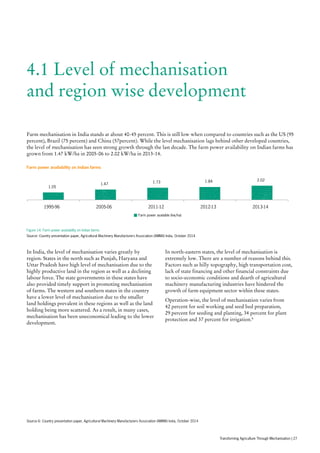
Farm mechanisation in India stands at about 40-45 percent. This is still low when compared to countries such as the US (95
percent), Brazil (75 percent) and China (57percent). While the level mechanisation lags behind other developed countries,
the level of mechanisation has seen strong growth through the last decade. The farm power availability on Indian farms has
grown from 1.47 kW/ha in 2005-06 to 2.02 kW/ha in 2013-14.
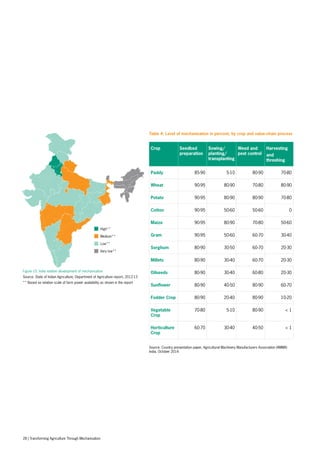
In India, the level of mechanisation varies greatly by
region. States in the north such as Punjab, Haryana and
Uttar Pradesh have high level of mechanisation due to the
highly productive land in the region as well as a declining
labour force. The state governments in these states have
also provided timely support in promoting mechanisation
of farms. The western and southern states in the country
have a lower level of mechanisation due to the smaller
land holdings prevalent in these regions as well as the land
holding being more scattered. As a result, in many cases,
mechanisation has been uneconomical leading to the lower
development.
In north-eastern states, the level of mechanisation is
extremely low. There are a number of reasons behind this.
Factors such as hilly topography, high transportation cost,
lack of state financing and other financial constraints due
to socio-economic conditions and dearth of agricultural
machinery manufacturing industries have hindered the
growth of farm equipment sector within these states.
Operation-wise, the level of mechanisation varies from
42 percent for soil working and seed bed preparation,
29 percent for seeding and planting, 34 percent for plant
protection and 37 percent for irrigation.6
1.05
1.47 1.73 1.84 2.02
1995-96 2005-06 2011-12 2012-13 2013-14
Farm power available (kw/ha)
Farm power availability on Indian farms
Figure 14: Farm power availability on Indian farms
Source: Country presentation paper, Agricultural Machinery Manufacturers Association (AMMA) India, October 2014
Source 6: Country presentation paper, Agricultural Machinery Manufacturers Association (AMMA) India, October 2014
Transforming Agriculture Through Mechanisation | 27
High**
Medium**
Low**
Very low**
Figure 15: India relative development of mechanisation
Source: State of Indian Agriculture, Department of Agriculture report, 2012-13
** Based on relative scale of farm power availability as shown in the report
Table 4: Level of mechanisation in percent, by crop and value-chain process
Crop Seedbed
preparation
Sowing/
planting/
transplanting
Weed and
pest control
Harvesting
and
threshing
Paddy 85-90 5-10 80-90 70-80
Wheat 90-95 80-90 70-80 80-90
Potato 90-95 80-90 80-90 70-80
Cotton 90-95 50-60 50-60 0
Maize 90-95 80-90 70-80 50-60
Gram 90-95 50-60 60-70 30-40
Sorghum 80-90 30-50 60-70 20-30
Millets 80-90 30-40 60-70 20-30
Oilseeds 80-90 30-40 60-80 20-30
Sunflower 80-90 40-50 80-90 60-70
Fodder Crop 80-90 20-40 80-90 10-20
Vegetable
Crop
70-80 5-10 80-90  1
Horticulture
Crop
60-70 30-40 40-50  1
Source: Country presentation paper, Agricultural Machinery Manufacturers Association (AMMA)
India, October 2014
28 | Transforming Agriculture Through Mechanisation
10.3%
31.8%44.1%
13.8%
 30 HP
31-40 HP
41-50 HP
 50 HP
9.7%
34.0%44.0%
12.3%
 30 HP
31-40 HP
41-50 HP
 50 HP
Source 7: ICRA Research Services, June 2015 report
4.2 Market segmentation
Table 5: Farm equipment annual market size
Equipment Annual market size
(units)
Estimate
year
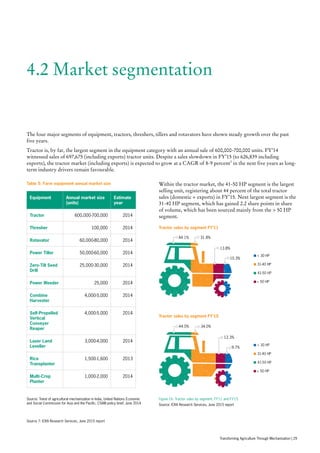
Tractor 600,000-700,000 2014
Thresher 100,000 2014
Rotavator 60,000-80,000 2014
Power Tiller 50,000-60,000 2014
Zero-Till Seed
Drill
25,000-30,000 2014
Power Weeder 25,000 2014
Combine
Harvester
4,000-5,000 2014
Self-Propelled
Vertical
Conveyer
Reaper
4,000-5,000 2014
Laser Land
Leveller
3,000-4,000 2014
Rice
Transplanter
1,500-1,600 2013
Multi-Crop
Planter
1,000-2,000 2014
Source: Trend of agricultural mechanisation in India, United Nations Economic
and Social Commission for Asia and the Pacific, CSAM policy brief, June 2014
The four major segments of equipment, tractors, threshers, tillers and rotavators have shown steady growth over the past
five years.
Tractor is, by far, the largest segment in the equipment category with an annual sale of 600,000-700,000 units. FY’14
witnessed sales of 697,675 (including exports) tractor units. Despite a sales slowdown in FY’15 (to 626,839 including
exports), the tractor market (including exports) is expected to grow at a CAGR of 8-9 percent7
in the next five years as long-
term industry drivers remain favourable.
Within the tractor market, the 41-50 HP segment is the largest
selling unit, registering about 44 percent of the total tractor
sales (domestic + exports) in FY’15. Next largest segment is the
31-40 HP segment, which has gained 2.2 share points in share
of volume, which has been sourced mainly from the  50 HP
segment.
Tractor sales by segment FY’11
Tractor sales by segment FY’15
Figure 16: Tractor sales by segment, FY’11 and FY’15
Source: ICRA Research Services, June 2015 report
Transforming Agriculture Through Mechanisation | 29
Tractor market (US$ millions)
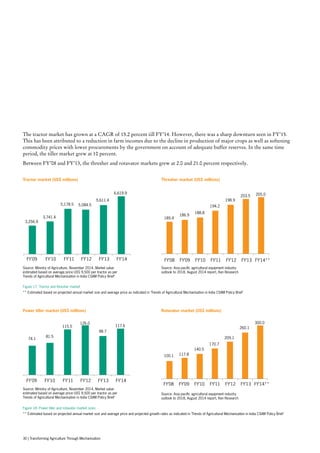
The tractor market has grown at a CAGR of 15.2 percent till FY’14. However, there was a sharp downturn seen in FY’15.
This has been attributed to a reduction in farm incomes due to the decline in production of major crops as well as softening
commodity prices with lower procurements by the government on account of adequate buffer reserves. In the same time
period, the tiller market grew at 10 percent.
Between FY’08 and FY’13, the thresher and rotavator markets grew at 2.0 and 21.0 percent respectively.
3,256.9
3,741.4
5,178.5 5,084.5
5,611.4
6,619.9
FY'09 FY'10 FY'11 FY'12 FY'13 FY'14
Figure 18: Power tiller and rotavator market sizes
** Estimated based on projected annual market size and average price and projected growth rates as indicated in ‘Trends of Agricultural Mechanisation in India CSAM Policy Brief’
Source: Asia pacific agricultural equipment industry
outlook to 2018, August 2014 report, Ken Research
Source: Ministry of Agriculture, November 2014, Market value
estimated based on average price US$ 9,500 per tractor as per
Trends of Agricultural Mechanisation in India CSAM Policy Brief’
Power tiller market (US$ millions)
74.1
81.5
115.5
126.0
98.7
117.6
FY'09 FY'10 FY'11 FY'12 FY'13 FY'14
Rotavator market (US$ millions)
FY’14**FY’13FY’12FY’11FY’10FY’09FY’08
100.1 117.8
140.5
170.7
209.1
260.1
300.0
Thresher market (US$ millions)
Figure 17: Tractor and thresher market
** Estimated based on projected annual market size and average price as indicated in ‘Trends of Agricultural Mechanisation in India CSAM Policy Brief’
Source: Asia pacific agricultural equipment industry
outlook to 2018, August 2014 report, Ken Research
Source: Ministry of Agriculture, November 2014, Market value
estimated based on average price US$ 9,500 per tractor as per
Trends of Agricultural Mechanisation in India CSAM Policy Brief’
FY’14**FY’13FY’12FY’11FY’10FY’09FY’08
185.4
186.9
188.8
194.2
198.9
203.5 205.0
30 | Transforming Agriculture Through Mechanisation
4.3 Farm machinery trade
Globally BRICS nations (Brazil, Russia, India, China and South Africa) with Japan and Turkey are joining the ranks of
heavy weight agricultural machinery markets. India is too involved in the international trade of a number of different farm
equipment.
Tractor trade:
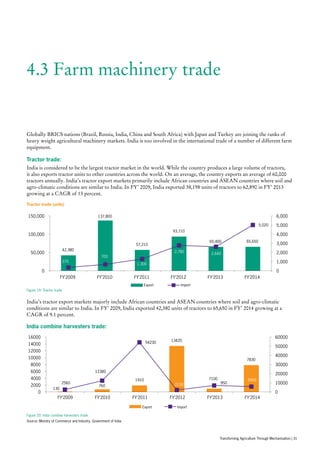
India is considered to be the largest tractor market in the world. While the country produces a large volume of tractors,
it also exports tractor units to other countries across the world. On an average, the country exports an average of 60,000
tractors annually. India’s tractor export markets primarily include African countries and ASEAN countries where soil and
agro-climatic conditions are similar to India. In FY’ 2009, India exported 38,198 units of tractors to 62,890 in FY’ 2013
growing at a CAGR of 13 percent.
India’s tractor export markets majorly include African countries and ASEAN countries where soil and agro-climatic
conditions are similar to India. In FY’ 2009, India exported 42,380 units of tractors to 65,650 in FY’ 2014 growing at a
CAGR of 9.1 percent.
42,380
137,800
57,210
93,710
65,400 65,650
370
700
1,300
2,780
2,640
5,020
0
1,000
2,000
3,000
4,000
5,000
6,000
0
50,000
100,000
150,000
FY'2009 FY'2010 FY'2011 FY'2012 FY'2013 FY'2014
Export Import
Figure 19: Tractor trade
Tractor trade (units)
India combine harvesters trade:
130
760
1910
13420
950
7830
2560
12380
54230
2130
7100 5950
0
10000
20000
30000
40000
50000
60000
0
2000
4000
6000
8000
10000
12000
14000
16000
FY'2009 FY'2010 FY'2011 FY'2012 FY'2013 FY'2014
Export Import
Figure 20: India combine harvesters trade
Source: Ministry of Commerce and Industry, Government of India
Transforming Agriculture Through Mechanisation | 31
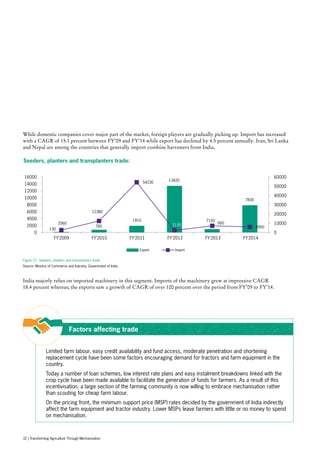
While domestic companies cover major part of the market, foreign players are gradually picking up. Import has increased
with a CAGR of 15.1 percent between FY’09 and FY’14 while export has declined by 4.5 percent annually. Iran, Sri Lanka
and Nepal are among the countries that generally import combine harvesters from India.
India majorly relies on imported machinery in this segment. Imports of the machinery grew at impressive CAGR
18.4 percent whereas; the exports saw a growth of CAGR of over 100 percent over the period from FY’09 to FY’14.
Seeders, planters and transplanters trade:
130
760
1910
13420
950
7830
2560
12380
54230
2130
7100
5950
0
10000
20000
30000
40000
50000
60000
0
2000
4000
6000
8000
10000
12000
14000
16000
FY'2009 FY'2010 FY'2011 FY'2012 FY'2013 FY'2014
Export Import
Figure 21: Seeders, planters and transplanters trade
Source: Ministry of Commerce and Industry, Government of India
Limited farm labour, easy credit availability and fund access, moderate penetration and shortening
replacement cycle have been some factors encouraging demand for tractors and farm equipment in the
country.
Today a number of loan schemes, low interest rate plans and easy instalment breakdowns linked with the
crop cycle have been made available to facilitate the generation of funds for farmers. As a result of this
incentivisation, a large section of the farming community is now willing to embrace mechanisation rather
than scouting for cheap farm labour.
On the pricing front, the minimum support price (MSP) rates decided by the government of India indirectly
affect the farm equipment and tractor industry. Lower MSPs leave farmers with little or no money to spend
on mechanisation.
Factors affecting trade
32 | Transforming Agriculture Through Mechanisation
4.4 Growth drivers
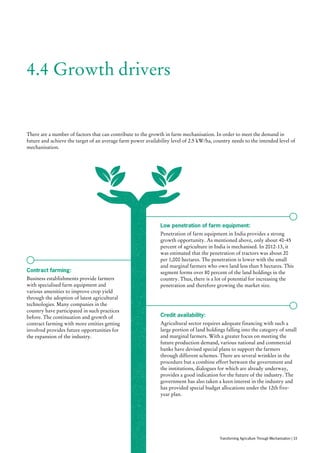
There are a number of factors that can contribute to the growth in farm mechanisation. In order to meet the demand in
future and achieve the target of an average farm power availability level of 2.5 kW/ha, country needs to the intended level of
mechanisation.
Low penetration of farm equipment:
Penetration of farm equipment in India provides a strong
growth opportunity. As mentioned above, only about 40-45
percent of agriculture in India is mechanised. In 2012-13, it
was estimated that the penetration of tractors was about 20
per 1,000 hectares. The penetration is lower with the small
and marginal farmers who own land less than 5 hectares. This
segment forms over 80 percent of the land holdings in the
country. Thus, there is a lot of potential for increasing the
penetration and therefore growing the market size.
Contract farming:
Business establishments provide farmers
with specialised farm equipment and
various amenities to improve crop yield
through the adoption of latest agricultural
technologies. Many companies in the
country have participated in such practices
before. The continuation and growth of
contract farming with more entities getting
involved provides future opportunities for
the expansion of the industry.
Credit availability:
Agricultural sector requires adequate financing with such a
large portion of land holdings falling into the category of small
and marginal farmers. With a greater focus on meeting the
future production demand, various national and commercial
banks have devised special plans to support the farmers
through different schemes. There are several wrinkles in the
procedure but a combine effort between the government and
the institutions, dialogues for which are already underway,
provides a good indication for the future of the industry. The
government has also taken a keen interest in the industry and
has provided special budget allocations under the 12th five-
year plan.
Transforming Agriculture Through Mechanisation | 33
Top 2 power tiller manufacturers
Others
68.0%
32.0%
33.0%
67.0%
Major thresher manufacturer
Others
83.0%
Top 4 tractor manufacturers
Others
17.0%
Top 4 rotavator manufacturers
Others
84.0%
16.0%
4.5 Competitive landscape
The competitive landscape in each of the four major segments of focus shows a few, very large players dominate the market.
Other smaller-manufacturers have lesser market share.
Tractor Market:
The largest tractor manufacturers not only cater to
the Indian market, but are also major exporters of
tractors to regions such as the US, China, Australia,
Latin America, the Middle East and South Asia.
Power Tiller Market:
This market is dominated by two Indian companies
collectively catering to more than 65 percent of the market.
The remaining market is catered to by small firms and
primarily by those importing Chinese power tillers. The
key Indian tiller manufacturers also cater to the export
market, exporting to regions such as the Middle East, Russia,
Turkey, the European markets and other parts of Asia.
Thresher Market:
The majority of the thresher marker in India remains
unorganised. Only one large manufacturer stands out and
holds about a third of the market. The other is divided up
into numerous smaller players.
Rotavator Market:
The Indian rotavator market is also dominated by
a number of smaller firms. The top four rotavator
manufacturers hold more than 80 percent of the
market.
Figure 22: Tractor industry landscape
Figure 24: Power tiller market landscape
Figure 23: Rotavator market landscape
Figure 25: Thresher market landscape
Tractor industry market share
Tiller industry market share
Rotavator industry market share
Thresher industry market share
34 | Transforming Agriculture Through Mechanisation
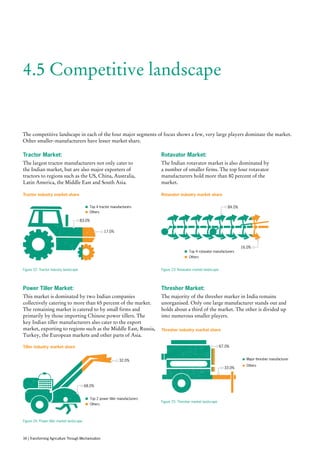
Work on a district/sub-district level.
These are generally tractor dealers that
also sell other implements
Sometime customers have a direct retail option but
only possible with very large manufacturers.
These retail outlets sometimes work on a franchises.
Financing remains a key hurdle for farmers accessing the subsidies extended by the government. Even with
subsidy support, farmers have limited options. Even some equipment manufacturers provide assistance to the
farmers. For example, large tractor manufacturers provide assistance to farmers for purchase of tractors by
giving out loans through their finance division.
Farmers also have the option of approaching cooperative agricultural banks such as National Bank for
Agriculture and Rural Development (NABARD) for assistance. Agricultural loans are also available to farmers for
a multitude of farming activities through public sectors banks in India. These include the State Bank of India as
well as other nationalised banks that offer a variety of schemes to help farmers in purchase of farm equipment.
Finally, farmers can also approach commercial banks for financing farm equipment.
Although farmers have a number of options for financing, a number of challenges continue to hinder credit flow
within the beneficiaries. These include high collaterals, especially for loans of more than INR 1 lakh, high interest
rates and relatively low repayment periods (5-7 years). Industry experts believe that easier financing norms and
more financing from commercial banks are needed to promote farm mechanisation in the country.
Distribution channels for farm equipment
OEMs Dealer’s network Customer
Retail
Financing options for acquiring farm machinery
Transforming Agriculture Through Mechanisation | 35
4.6 Concept of Custom Hiring
Centres (CHCs) for farm equipment
Custom hiring of farm machinery (CHCs) was introduced
in Indian agriculture in as early as 1912. Organised move
to promote multi-farm use of agricultural machinery was
made in mid-1960 when Agro-Industries Corporations were
established within the states.
CHCs are a unit comprising a set of farm machinery,
implements and equipment for hiring by farmers. These
centres give farm machinery on a rental basis to farmers who
cannot afford to purchase high-end agricultural machinery
and equipment, apart from servicing old machinery. Farm
machineries/equipment available at CHCs include tractor,
rotavator, multi-crop thresher, MB plough, cultivator,
leveller blade, blade harrow, seed cum fertilizer drill,
knapsack sprayer, power weeder, winnowing fan, electronic
balance, repairing tools.
These units are generally located in close proximities to
large and small land holdings, which supply machinery and
equipment to villages close to it reducing transport cost and
transportation time.
States such as Punjab, Haryana, Uttar Pradesh, Uttarakhand,
Gujarat, Maharashtra, Karnataka and TN, which are
highly mechanised, have maximum number of registered
and unregistered CHCs catering to the machinery and
equipment requirements of the farmers.
Other states do have operational CHCs but farm
mechanisation still remains a serious concern. Custom
hiring centres, in order to work effectively and efficiently
require a sound infrastructure setup for its operations, which
include all weather roads, spatial distribution of machinery
ownership and servicing network.
The government also recognises the value of these centres
and the role they can play in mechanisation of farm
operations. As a result, establishment of farm machinery
banks for custom hiring is one of the core components of the
Sub-Mission on Agricultural Mechanisation (SMAM) and
government provides financial assistance for setting them up.
However, there is a need for enhanced participation from
the private sector in an endeavour of setting up CHCs and
capacity building. Only then the subsequent upskilling and
training can bring a sustainable and more inclusive growth.
Global perspective:
Custom hiring of agricultural machinery in China
The Government of China pays great attention to
farm mechanisation, recognising and appreciating its
importance. It has launched a number of policies in
support of custom hiring of agricultural equipment.
In 2004, congress adopted the ‘Law on Promoting
Agricultural Mechanisation of the People’s Republic
of China’ and in 2010, released the ‘Opinion on
Promoting Sound and Fast Development of Agricultural
Mechanisation and Agricultural Machinery Industry’.
Under these, the responsibilities of all levels of
government and agricultural authorities were outlined
with respect to promoting agricultural mechanisation
in their respective regions and measures and
requirements for promoting custom hiring of equipment
were laid out.
China also has a subsidy policy for farmers, which has
promoted farmers’ willingness to purchase machinery,
which in turn, has laid a solid foundation for custom
hiring. There are number of steps the government took
to help foster custom hiring and as a result. Statistics
from the year 2013 show that China had 5.24 million
machinery service-providing households, 168,000
organisations, 201,000 machinery maintenance
plants and stops, and 7,000 intermediary service
organisations. In particular, machinery cooperatives,
specialised in cooperative use of machinery have
seen strong growth. Custom hiring of farm machinery
including leasing, cross-region operations, order
placement and contract management, has met the
diversified needs of the farmers.
36 | Transforming Agriculture Through Mechanisation
Below are just some examples of innovations in agricultural equipment that came about to address specific but real issues
farmers face on the farms on a daily basis:
Innovation is intrinsic to agriculture. Ever since humans discovered the technique
of multiplying wild seeds into food and other products, an unbreakable relationship
between agriculture and creativity was born. India presents unique opportunities
with its small land holdings, variety of climatic zones and different soil types across
different regions. Thus, innovation is essential for Indian agriculture as a result
of the above-stated factors. In order to adapt to these, furthering the innovative
spirit among all stakeholders (individual farmers to large-scale manufacturers) is
necessary.
Key Innovations in the industry
value chain for efficient farming
Mobile groundnut thresher-cum-collector:8
The machinery was invented on account of the farm labour scarcity. Non-availability of farm labour during peak season
of sowing and harvesting delays the collection and ultimately results in yield losses. To overcome these problems, a tractor
mounted PTO powered mobile thresher was developed. This has a separate chamber for collection of groundnut pods
and stalk. The manufacturer of the machine was awarded at the 7th National Award Function of the National Innovation
Foundation – India (NIF) in 2013.
The salient features of this innovation are:
•	Provision of storage chambers and feeding mechanism making it suitable for threshing while moving around the field.
•	It reduces time and labour cost.
Source 8: Information on innovations and images used are from the National Innovation Foundation – India (NIF)
Transforming Agriculture Through Mechanisation | 37
Groundnut digger:9
Labour scarcity also promoted the development of a groundnut digger. One of the major challenges faced by farmers is the
shortage of labour for harvesting operations. The machine has a tractor-mounted, PTO-powered groundnut digger. The
innovator was awarded at the 7th National Award Function of the National Innovation Foundation – India (NIF) in 2013.
The salient features of this innovation are:
•	This machine not only mechanises the digging but also undertakes cleaning and drying.
•	Damage to the pods is much lesser than the alternatives currently available.
•	The machine can be used in different kinds of soil. On an average the machine can harvest about 0.4 acre per hour.
Sugarcane Bud Planter:10
Sowing of sugarcane buds in field is cumbersome.. Not maintaining uniform distances between the buds and varying the
depth while sowing manually, may result in less productivity. As an attempt to address these issues, the Sugarcane Bud
Planter was born, which is a tractor operated bud planter.
Using this planter the plantation cost is estimated to reduce to about INR 800/acre from about INR 6,000/acre using labour.
The plant-to-plant sowing distance can also be adjusted according to the requirements. It can also be used for simultaneous
application of fertilizer, pesticides or herbicides in the field. For this purpose, the machine is equipped with a sprayer pump.
The machine can also be used for intercropping along with sowing of sugarcane buds. Pulses, wheat, and peanuts can be
planted in between two rows of sugarcane. Apart from these, the machine can also be used for planting potatoes. The
machine becomes helpful for those farmers, who face constant scarcity of farm workforce. The machine requires manpower
only to fill the bud box whenever it gets empty. The innovator was awarded at the 8th National Award Function of the
National Innovation foundation – India (NIF) in 2015.
Solar-powered water pumps:
These pumps use the abundant solar power available to pump water from the ground. These provide an energy-efficient way
to farmers for irrigating their land.
These also have the potential of providing additional income to the farmer. The saved power on the farms can be sold back
to the grid.
Taking a cue from countries such as Japan and China, both of which invest heavily in research and development for
technological innovation in farming, India must also take more steps to promote and foster an innovative environment in
agriculture. This can help the country in achieving higher penetration levels as well as a more productive labour force. #
Source 9,10: Information on innovations and images used are from the National Innovation Foundation – India (NIF)
38 | Transforming Agriculture Through Mechanisation
Section V:
Government’s
role in farm
equipment sector
Transforming Agriculture Through Mechanisation | 39
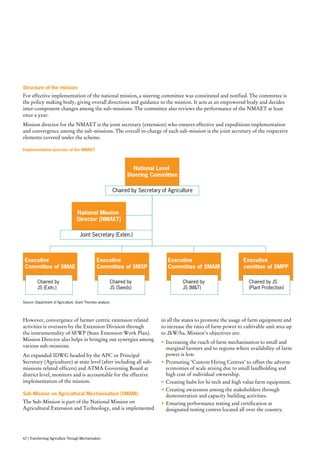
5.1 Overview of schemes and policies
The Government has implemented various farm mechanisation programmes in
the country through schemes such as Rashtriya Krishi Vikas Yojna (RKVY),
Mission for Integrated Development of Horticulture (MIDH), National Mission on
Oilseeds and Oil Palm (NMOOP) and National Food Security Mission (NFSM).
In addition to development of such schemes, the government has also implemented
the National Mission on Agricultural Extension and Technology (NMAET)
to strengthen the extension machinery and utilise the same for synergising the
interventions under these schemes.
Mechanisation under the National Food Security
Mission (NFSM):
The National Development Council (NDC) adopted a
resolution to launch a food security mission comprising of
wheat, rice and pulses to increase production of wheat by
8 million tons and pulses by 2 million tons by the end of
the XIth five-year plan. Accordingly, the National Food
Security Mission (NFSM) was launched in October, 2007.
The mission is being continued in the XIIth five-year
plan with revised targets. The plan now targets additional
production of food grains of up to 25 million tons (10
million tons of rice, 8 million tons of wheat, 4 million tons
of pulses and 3 million tons of coarse cereals) by the end
of the five-year plan. In accordance with that, the Mission
makes provisions for assistance (up to 50 percent the cost of
machinery) to be provided for adoption of farm machinery
such as pump sets, tractor mounted sprayers, seed drills,
zero till seed drill etc. to varying degrees.
Mechanisation under the Rashtriya Krishi Vikas
Yojna (RKVY):
To spur growth in agriculture and allied sectors, the
Government of India, in consultation with the Planning
Commission, Department of Agriculture and Cooperation,
launched the RKVY in 2007-08. The main objectives of the
schemes include:
•	Incentivising states to increase investment in agriculture
and allied sectors.
•	Ensuring the preparation of agricultural plans for the
districts and states based on agro-climatic conditions,
availability of technology and natural resources.
•	Achieving the goal of reducing the yield gaps in important
crops, through focused interventions along with
maximising returns to the farmers.
•	Bringing about quantifiable changes in the production and
productivity of various components of agriculture and
allied sectors by addressing them in a holistic manner.
The scheme works through four main streams:
•	RKVY Production growth – with 35 percent of the outlay.
•	RKVY Infrastructure and assets – with 35 percent of
the outlay.
•	RKVY Special schemes – with 20 percent of the outlay.
•	RKVY Flexi fund – with 10 percent of the outlay (States
can undertake either production growth or infrastructure
and assets projects with this allocation).
40 | Transforming Agriculture Through Mechanisation
Agricultural mechanisation falls under the production
growth stream of the scheme. Under this scheme, assistance
can be provided to farmers for farm mechanisation efforts,
as detailed in the state/ district agricultural plans, especially
for improved and gender friendly tools, implements and
machinery. However, assistance for large equipment (e.g.
tractor, combine harvester, sugarcane harvester, cotton
picker etc.) for which ownership may not be economically
viable, assistance should only be provided for establishing
custom hiring centres under RKVY (infrastructure and
assets stream).
Mechanisation under the Mission for Integrated
Development of Horticulture (MIDH):
MIDH is a centrally sponsored scheme for the overall
growth of the horticulture sector covering fruits, vegetables,
root and tuber crops, mushrooms, spices, flowers, aromatic
plants, coconut, cashew, cocoa and bamboo. The Central
Government provides 85 percent of the assistance and
the remaining 15 percent is provided by the states (except
in the north-eastern and Himalayan states where the
central government’s contribution is 100 percent). One of
the key interventions under the scheme is ‘Horticulture
Mechanisation’ which aims to improve farm efficiency
and reduce drudgery of the workforce. Assistance in this
regard is provided for activities such as procurement of
power operated machines and tools, besides import of new
machines. Assistance is also available to grower associations,
farmer groups, self-help groups, and women farmer groups
etc. (with more than 10 members) that are engaged in
cultivation of horticulture crops. 60 percent of the cost of
machines will be borne by such groups.
National Mission on Agricultural Extension and
Technology (NMAET):
Agricultural technology, including the adoption/ promotion
of critical inputs and improved agronomic practices,
was being disseminated under 17 different schemes of
the Department of Agriculture and Cooperation during
the 11th plan. The Modified Extension Reforms Scheme
was introduced in 2010 with an objective to strengthen
the extension machinery and utilise it for synergising the
interventions under these schemes under the umbrella of
Agriculture Technology Management Agency (ATMA).
NMAET was envisaged as the next step towards this
objective through the amalgamation of these schemes. It
includes four sub-missions:
•	Sub-Mission on Agriculture Extension (SMAE)
•	Sub-Mission on Seed and Planting Material (SMSP)
•	Sub-Mission on Agricultural Mechanisation (SMAM)
•	Sub-Mission on Plan Protection and Plant
Quarantine (SMPP)
These sub–missions are inextricably linked to each other.
The common thread running across all four sub-missions is
‘Extension and Technology’.
The objectives of this Scheme can be achieved through
a judicious mix of extensive physical dissemination,
use of ICT, popularisation of modern and appropriate
technologies, capacity building and institutional
strengthening to promote mechanisation, availability of
quality seeds, plant protection and also encouragement
of aggregation of farmers interest groups (FIGs) to form
Farmer Producer Organisations (FPOs).
Transforming Agriculture Through Mechanisation | 41
National Level
Steering Committee
Chaired by Secretary of Agriculture
Executive
Committee of SMAE
Chaired by
JS (Extn.)
Chaired by
JS (Seeds)
Chaired by
JS (MT)
Executive
Committee of SMSP
Executive
Committee of SMAM
Executive
comittee of SMPP
Chaired by JS
(Plant Protection)
National Mission
Director (NMAET)
Joint Secretary (Exten.)
Structure of the mission:
For effective implementation of the national mission, a steering committee was constituted and notified. The committee is
the policy making body, giving overall directions and guidance to the mission. It acts as an empowered body and decides
inter-component changes among the sub-missions. The committee also reviews the performance of the NMAET at least
once a year.
Mission director for the NMAET is the joint secretary (extension) who ensures effective and expeditious implementation
and convergence among the sub-missions. The overall in-charge of each sub-mission is the joint secretary of the respective
elements covered under the scheme.
However, convergence of farmer centric extension related
activities is overseen by the Extension Division through
the instrumentality of SEWP (State Extension Work Plan).
Mission Director also helps in bringing out synergies among
various sub-missions.
An expanded IDWG headed by the APC or Principal
Secretary (Agriculture) at state level (after including all sub-
missions related officers) and ATMA Governing Board at
district level, monitors and is accountable for the effective
implementation of the mission.
Sub-Mission on Agricultural Mechanisation (SMAM):
The Sub-Mission is part of the National Mission on
Agricultural Extension and Technology, and is implemented
in all the states to promote the usage of farm equipment and
to increase the ratio of farm power to cultivable unit area up
to 2kW/ha. Mission’s objectives are:
•	Increasing the reach of farm mechanisation to small and
marginal farmers and to regions where availability of farm
power is low.
•	Promoting ‘Custom Hiring Centres’ to offset the adverse
economies of scale arising due to small landholding and
high cost of individual ownership.
•	Creating hubs for hi-tech and high value farm equipment.
•	Creating awareness among the stakeholders through
demonstration and capacity building activities.
•	Ensuring performance testing and certification at
designated testing centres located all over the country.
Source: Department of Agriculture, Grant Thornton analysis
Implementation process of the NMAET:
42 | Transforming Agriculture Through Mechanisation
Mission executive committee
Submits AAP to national steering committe for approval and fund release
Distric Level Executive
Committee
Annual Action
Plan (AAP)
Distric Level Executive
Committee
Annual Action
Plan (AAP)
Distric Level Executive
Committee
Annual Action
Plan (AAP)
Distric Level Executive
Committee
Annual Action
Plan (AAP)
State Level
Executive
Committee
State Agriculture/Agricultural
Engineering department: Nodal Agency
The district level annual plans are submitted to the nodal
agency, which are the state agricultural departments or
agricultural engineering departments. These agencies then
prepare the state annual plans in consonance with the
mission’s goals and objectives, taking into account the
tentative outlay of the state as outlined by the Department
of Agriculture, Cooperation and Farmer Welfare (DAC 
FW). The nodal agencies also ensure suitable integration of
AAP with other schemes such as the RKVY, NFSM, and
MIDH. The state annual plans are then submitted to the
State Level Executive Committee (SLEC) for approval and
thereafter to the executive committee. Upon approval of the
plans, the nodal agencies receive the funds from the
DAC  FW for the implementing agencies and oversee,
monitor and review implementation of the programmes.
Monitoring:
The mission envisages a coordinated approach for
monitoring and evaluation with active involvement of the
implementing agencies, beneficiaries and other stakeholders.
A combination of periodic desk review, field visits and
web-based mechanism has been adopted for releasing funds,
monitoring physical and financial progress and monitoring
the progress of the other mission interventions at the
national level by Mechanisation  Technology (MT)
division at the DAC  FW.
Source: Department of Agriculture, Grant Thornton analysis
To achieve these objectives, the mission has the following components:
•	Promotion and strengthening of agricultural mechanisation through training, testing and demonstration [Central Sector
Scheme/ Component].
•	Demonstration, training and distribution of Post-Harvest Technology and Management (PHTM) [Central Sector Scheme/
Component].
•	Financial assistance for procurement of agricultural machinery and equipment.
•	Establishment of farm machinery banks for custom hiring.
•	Establishment of hi-tech and productive equipment hub for custom hiring.
•	Financial assistance for promotion of mechanised operations/ hectare carried out through custom hiring centre.
•	Promotion of farm machinery and equipment in north-east region.
Implementation process of the SMAM:
Transforming Agriculture Through Mechanisation | 43
5.2 What schemes and policies mean?
Subsidies to the tune of 25 to 50 percent are made available
to farmers by the Government to ensure the machinery/
equipment is available at a better price. However, ceiling
limits are available to all category of farmers for the purchase
of various agricultural equipment’s under varied schemes
of the Department of Agriculture and Cooperation such as
Macro Management of Agriculture, National Food Security
Mission (NFSM), Rashtriya Krishi Vikas Yojana (RKVY),
National Horticulture Mission etc.
Preliminary targets under the NFSM for the Twelfth Plan
were enhancing production by additional 25 million tonnes
of food grains, which includes 10 million tonnes of rice, 10
million tonnes of wheat, 3 million tonnes of pulses and 2
million tonnes of millet. Also, the scheme aims to expand
fodder production to meet the demand both of green and
dry fodder. The Union Budget 2013-14 had allocated
US$ 339.5 million (INR 2,250 crore) to the mission.
New farm practices were encouraged through 5.79 lakh
demonstrations of improved package of practices on rice,
wheat and pulses. About 100.70 lakh ha area had been
treated with soil ameliorants (gypsum/ lime/ micro nutrients
etc.) to restore soil fertility for higher productivity. Whereas,
an area of about 39.42 lakh ha was treated under Integrated
Pest Management (IPM).
Nearly 30.16 lakh improved farm machineries including
water saving devices are distributed. Capacity building of
farmers has been encouraged through arranging 43,656
farmers’ field schools (FFS) at the farm level so far. All the
targets were less than what actually was achieved during the
Eleventh Plan and are consistent with demand forecasts.
This would amount to targeting 2–2.5 percent increase in
food grains production in the Twelfth Plan.
Two programmes were started as RKVY sub-components
in the Eleventh Plan by the government namely, the
60,000 pulses village programme and the intensive millets
production programme were shifted into NFSM.
Funds allocated under government’s initiative RKVY and
its sub-schemes for 2015-16 are US$ 559.4 million (INR
3,707.16 crores). Whereas, for the year 2014-15 the funds
released by the government for the scheme across all states
were US$ 1,262.20 million (INR 8,363.89 crores) and the
expenditure made for the same year was US$ 826.35 million
(INR 5,475.85 crores).
44 | Transforming Agriculture Through Mechanisation
Agriculture Equipment Industry: SWOT analysis
A SWOT analysis to promote mechanisation of Indian Agriculture
S W O T
Strengths
•	Large infrastructure of over 20,000 manufacturers in small scale industry; vast network of academic
and RD institutions including AICRPs under NARS for human resource development and RD.
•	Trained manpower for RD in agricultural engineering.
•	Over 100 cooperating centres of AICRPs is the area of agricultural engineering.
•	Computer aided design adopted by the institutes for high pace of RD.
Opportunities
•	Development of entrepreneurship for custom hiring of farm machinery and
agro-processing equipment.
•	Post-harvest loss reduction and value addition at the production catchments
through rural level agro-processing centres.
•	Establishment of value chain for commercial supply, transport and marketing
of agricultural produce.
•	Opportunity to increase the irrigated area by introducing micro-irrigation.
•	Reducing yield gaps and increasing productivity through precision farming
technologies.
Threats
•	Migration of farmers from agriculture to other industries.
•	Fragmentation and continuous reduction of operational holdings.
•	Slow pace of RD and commercialisation.
•	Inadequate infrastructure back up, for after sales support of
farming equipment.
•	Renewable energy technology is still subsidy dependent.
Weaknesses
•	Unreliable after sales service of agricultural equipment.
•	Poor liaison with industries for RD and commercialisation.
•	Non effective feedback system.
•	Absence of non-land economic activities.
•	Non-systematic marketing of agricultural equipment.
Transforming Agriculture Through Mechanisation | 45
Section VI:
Challenges faced
by the industry
46 | Transforming Agriculture Through Mechanisation
Small and scattered land holdings:
Average farm size in India is less than 2 hectares, which is
far lower than regions like European Union (14 hectare) and
the US (170 hectare). Large farm machineries are difficult
to operate on such land holdings, which in some cases are
completely unsuitable.
Another factor to consider is mechanising small and non-
contiguous group of small farms is against economies of
scale, especially in operations such as land preparation and
harvesting. As land holdings get smaller, more and more
farmers fall into the adverse category and therefore make
ownership of machinery lesser economical.
Equipment cost, quality and after-sale service:
Farm equipment, especially the energy-efficient options, are
capital intensive and are a major investment for most of the
farmers in India. A majority of them belong to the low-
income bracket. This is evidenced by the fact that almost
90 percent of the tractors sold in India are done so with the
assistance of some financial institution.
The quality and after-sales service of farm equipment is
another concern, since agriculture is largely carried out
in rural parts of India and there is still an inadequacy of
service-centres for proper maintenance.
‘Tractor-isation’ and not mechanisation:
Tractors have an annual market of 600,000-700,000 units
in India whereas, threshers, the next largest segment, has
an annual market of just 100,000 units. The penetration of
tractors has grown from one per 150 hectares to one per 30
hectares on agricultural land.
However, such a growth in penetration has not been seen in
other agricultural implements. This phenomenon has been
dubbed as ‘tractor-isation’ by many industry stakeholders.
It is to be noted that for a sustainable agricultural future,
other farm implements, and not just tractors, need to be
advanced to farmers in the country.
Tendering process:
There are various inefficiencies in the tendering process,
especially with regard to the time and length of the process.
In some states, the tendering process goes through the
months of August and September (even October in some
cases), due to which a time lag crops up. By this time the
main season has already ended. Hence, farmers are unable
to draw the optimal benefit of the available machinery. The
tiller market is especially impacted by this, as virtually all
the tillers sold in the country are done so on subsidy (since
subsidy applies to imported tillers as well). Therefore,
ensuring timely completion of the tendering process (before
the beginning of April) is paramount to safeguard the
interests of the farmers.
Procurement process for the farmer:
The entire process of acquiring farm equipment is very
tedious and cumbersome for a farmer. A farmer has to go
through various levels/ departments to get his land records
verified. Post clearance, he has to go through further checks
from the District Agriculture Officer in order to obtain
approval and clearance for the purchase. This process itself
becomes a big hindrance and discomfort to the farmer.
There are a number of obstacles in achieving the target level of 2.5 Kw/ha farm
power availability. It is imperative that all stakeholders in farm equipment sector
have a clear understanding of these challenges and can collaborate to overcome these
issues.
Transforming Agriculture Through Mechanisation | 47
Financing of farm equipment:
Purchase of farm equipment is a significant investment for
most of the farmers in India. Hence, reasonable financing
norms are a must for ensuring mechanisation.
An issue that has been persistent in financing is the purchase
of standalone implements. The only exception is seen in case
of tractors where the required details of the equipment e.g.
engine number, chassis number etc. are available. Hence,
institutions insist on purchase of the tractor along with other
farm implements. This seems to discourage farmers from
investing at large, as they need to shell out a huge amount.
This adds to the ‘tractor-isation’ trend that is visible in the
industry and doesn’t add to overall mechanisation.
Industry stakeholders also feel that commercial banks must
be encouraged to provide adequate financing for various
farm equipment. This is seen by many industry sources as
the biggest impediment to growth. Industry believes that
commercial banks are reluctant to provide financing for
agricultural equipment, owing to the risk it poses.
Redundancies and inefficiencies in the equipment
testing process:
One of the strategies laid out in the Sub-Mission on
Agricultural Mechanisation (SMAM) is conducting
performance testing for various farm equipment at the four
Farm Machinery Training and Testing Institutes (FMTTI),
designated State Agricultural Universities (SAUs) and
ICAR institutions. This ensures that a farmer can trust
the technology being purchased. However, the number of
institutions that can provide these FMTTI certificates is low
and causes many logistical issues for the manufacturers. The
redundancies in the process of testing further contributes to
the logistical issues faced by manufacturers.
Pricing of equipment:
The government has allocated a substantial subsidy for farm
equipment of about US$ 300 million (INR 2,000 crore),
under the SMAM. However, the government also feels
that the pricing of the equipment needs to be addressed
with equal importance. The prices of equipment under
subsidy are seen to be higher than the market price of these
equipment. This poses a challenge for the government as
well as the farmers.
In order to ensure optimal use of the subsidy being
provided, ensuring fair prices for the equipment is essential.
The government suggests the ‘pricing cartel’ issue to be
resolved through hosting the list of manufacturers and the
equipment price on a central portal, which can then be
communicated to the states.
Other challenges the industry faces:
A host of other challenges are faced by the industry and
impacts proper functioning of the system.
•	There is a lack of proper mandatory safety standards for
use of machinery as well as absence of standardised norms
to ensure quality of the equipment. As a result, there is no
premium for the higher quality products, which leads to
lesser incentives for manufacturers to invest in quality and
also to invest in new and cutting-edge technologies.
•	Another problem the industry faces is the lack of data/
information. Also, there is a clear absence of farm
machinery management data regarding use-patterns,
annual-use, breakdown-frequency, repair and management
cost, reliability, granular information on the extent/
penetration of mechanisation etc. In absence of data,
requirements of the scope of market growth remains
unclear and are often targets are missed.
•	Some manufacturers also face issues of excise duties
that need to be paid on intermediate parts such as
higher-quality gear-boxes that are imported and used
in assembling the final product. Therefore, even if parts
are imported and assembled and used in the country, the
manufacturers have to bear the cost.
48 | Transforming Agriculture Through Mechanisation
Section VII:
Way forward
Transforming Agriculture Through Mechanisation | 49
A. Custom Hiring Centres (CHC) for various
purposes:
Promoting establishment of more CHCs is essential for
future of the industry. But these centres could play more
than the traditional role. These centres can be used as central
hub for a number of activities:
•	Ensuring availability of crop and local-condition specific
equipment for use.
•	Promoting the idea of cooperative farming among small
and marginal farmers so that these ‘cooperatives’ can
together fund farm equipment and use concurrently.
•	Act as a point-of-sale for second-hand equipment as
well as hubs for after-sale service. CHCs could establish
linkages with OEMs and dealers to make themselves the
centre of all these different activities.
•	These centres could be established on a ‘hub-and-spoke’
model wherein last-mile outreach is established by having
smaller outlets at the village level, which can also provide
support for farming practices.
B. Creating an institutionalised framework for
custom hiring in the country:
While custom hiring is prevalent in India for some of the
agriculture machinery, it is highly unorganised and sporadic
in present situation. The is on account of the following
factors -
•	Custom hiring centres need a minimum scale for efficient
operation as the activity is capital intensive. They
also have a longer gestation period due to lower asset
utilisation on account of the seasonal nature of agriculture
machinery demand.
•	There is significant entry barrier for small entrepreneurs
to establish these centres. Small entrepreneurs are neither
creditworthy nor there are any special policy incentives
for promoting them.
•	Credit policies of the banks need to evaluated. Generally,
the banks insist on collateral guarantees apart from
hypothecation of farm equipments for giving loans and
as a result, the response from entrepreneurs is decreasing.
Therefore, there is a need for stakeholders to devise an
institutional framework for custom hiring in the country.
C. ‘Make in India’ support for farm implements:
The ‘Make in India’ initiative launched by the Government
could be used to support the manufacture of inputs and farm
implements currently being imported. This would help in
reducing the overall capital cost.
7.1 Innovative measures
“It will make impact on the items that
are imported by saving on custom
duties. For example, laser land levellers
and paddy transplanters. But the impact
would be immense. Low HP tractors
manufacturing should be encouraged”
Based on our interviews with various stakeholders, industry advisors , operators
and manufacturers, various measures are recommended. These measures have
been divided into two broad categories: Innovative measures and administrative
measures. Innovative measures are new initiatives that can be taken into
consideration in the future and administrative steps are those that will remove the
inefficiencies and redundancies that exist in the current system
50 | Transforming Agriculture Through Mechanisation
%
D. Alternate route for the subsidy:
The subsidy amount could be re-routed to ensure that the
interest rate on financing the farmers produce is brought to
a much lower rate and that farmers can get longer payback
periods as well as longer moratoriums (few years without
interest). This would also apply to the financial assistance
provided for setting up CHCs. Commercial banks could
be brought into the fold to ensure greater participation on
their part.
E. CSR funds with a purpose:
In accordance with Section 135 of the Companies Act of
2013, eligible firms are required to spend at least two percent
of their average net profit in the preceding three financial
years, towards CSR. These funds could be used in a few
innovative ways for the benefit of the industry.
•	Companies that are directly involved in the agriculture
equipment industry and are unable to invest in to
corporate social activities in line of their business, could
use the funds for initiatives such as ‘Adopt a Village’
and promote, through capacity building, practices such
as precision agriculture, skill development and micro
irrigation. This would ensure that the agricultural eco-
system is built in a sustainable manner.
•	Companies in this industry could approach others
not directly involved in farm machinery and pitch the
idea of investing their CSR funds into promoting farm
mechanisation through capacity building initiatives as
well as infrastructure creation in order to help in skill
development and establish custom hiring centres.
“Commercial banks need to be
encouraged to provide financing for
equipment. Commercial banks’ not
willing to finance these machines is the
biggest impediment in the industry”
“The subsidy needs to be re-visited. The
farmers need better rate of interest for
mechanisation to increase” “Yes, this would
help the farmers
a lot and get their
morale up”
Transforming Agriculture Through Mechanisation | 51
“The tendering
process needs to be
looked at again and if
it must exist, it must
be completed by April”
“There has been
growth in tractors
but other latest
technologies are not
reaching to the farmer”
“Leave the choice to
the farmer. If he wants
to buy a luxury car or
an economy car, he
should be able to”
“We need to have
standardised
norms for quality”
•	Tendering process: The tendering process in states must
be completed before the sowing season. The states should
be encouraged to ensure that before April all the tendering
processes are completed so that subsidies are in place for
farmers, in case tendering processes are continued.
•	Re-visit of the Regional Comprehensive Economic
Partnership (RCEP) agreement by the Government so as
to include farm equipment as a product line in the trade
agreement, to ensure that the industry doesn’t absorb
custom costs and gets the benefit of free-trade agreements
(FTAs)
•	The government, in association with ICAR, should
establish standardised quality norms for equipment and
farm implements.
•	Stakeholders to drive to further research and development
efforts into crop-specific implements that are suitable for
the Indian conditions.
•	Testing of implements to be done at the class-level and
not variations. For example only one of the 5-foot, 6-foot
and 7-foot rotavators needs to be tested. This will help
reduce redundancies in the testing procedures, saving time
and costs.
•	As an endeavour, the government should try to accelerate
the setting up of more certification centres to ensure that
testing of the equipment can be done more quickly.
•	Equipment inputs in the GST bill: A mechanism for
distinguishing the implements used in automotive and
agriculture sector (e.g. gearbox is used in both cars and
tractors), can be included as a part of the GST bill, so
that implements used as part of farm equipment are not
burdened with additional tax.
•	Equipment manufacturers should publish/ share with
the government, the list of machinery and market prices,
which can then be put into a central portal. This will act
as a ready-reckoner for all stakeholders and can help in
doing away with the tendering process.
•	A re-visit of the subsidy slabs is required, so that the large
pool of small and marginal farmers actually benefit from
these programmes.
•	Promoting use of renewable energy in farm equipment
segment such as solar-powered pumps, tapping the
immense potential in India for solar-power and creating
alternate source of revenue for the farmer by selling the
additional power general back to the grid.
•	Credit Guarantee Fund: It is pertinent to devise
framework that would strengthen the credit policy
for farm machinery in India. Credit guarantee fund is
in operation for facilitating loans for micro, small and
medium enterprises (MSMEs). Similar models should be
devised for farm machinery sector as well.
These initiatives would help in accelerating mechanisation of
Indian farms and therefore, help the country reach the goal
of a sustainable agricultural production.
7.2 Administrative measures
52 | Transforming Agriculture Through Mechanisation
About us
Grant Thornton International Ltd.
Grant Thornton is one of the world’s leading organisations of independent assurance, tax and advisory firms. These firms
help dynamic organisations unlock their potential for growth by providing meaningful, forward looking advice. Proactive
teams, led by approachable partners in these firms, use insights, experience and instinct to understand complex issues for
privately owned, publicly listed and public sector clients and help them to find solutions. More than 40, 000 Grant Thornton
people, across over 130 countries, are focused on making a difference to clients, colleagues and the communities in which we
live and work.
Grant Thornton in India
Grant Thornton in India is one of the largest assurance, tax, and advisory firms in India. With over 2, 000 professional staff
across 13 offices, the firm provides robust compliance services and growth navigation solutions on complex business and
financial matters through focused practice groups. The firm has extensive experience across a range of industries, market
segments, and geographical corridors. It is on a fast-track to becoming the best growth advisor to dynamic Indian businesses
with global ambitions. With shorter decision-making chains, more senior personnel involvement, and empowered client
service teams, the firm is able to operate in a coordinated way and respond with agility.
Over the years, Grant Thornton in India has added lateral talent across service lines and has developed a host of specialist
services such as Corporate Finance, Governance, Risk and Operations, and Forensic and Investigation. The firm’s strong
Subject Matter Expertise (SME) focus not only enhances the reach but also helps deliver bespoke solutions tailored to the
needs of its clients.
FICCI
Established in 1927, FICCI is the largest and oldest apex business organisation in India. Its history is closely interwoven
with India’s struggle for independence, its industrialisation, and its emergence as one of the most rapidly growing global
economies.
A non-government, not-for-profit organisation, FICCI is the voice of India’s business and industry. From influencing
policy to encouraging debate, engaging with policy makers and civil society, FICCI articulates the views and concerns
of industry. It serves its members from the Indian private and public corporate sectors and multinational companies,
drawing its strength from diverse regional chambers of commerce and industry across states, reaching out to over 2,50,000
companies.
FICCI provides a platform for networking and consensus building within and across sectors and is the first port of call for
Indian industry, policy makers and the international business community.
Transforming Agriculture Through Mechanisation | 53
Credits and Acknowledgement
Grant Thornton FICCI
Authors
Rahul Kapur
Swarnima Chouhan
Sukrit Gulati
Vinayak Saxena
Acknowledgement
Jasmeet Singh
Ruchira Saini
Sarita Kohli
Babita Bharti
Editorial and review
Devesh Chandra Srivastava
Samridhi Jamwal
Design
Mrityunjay Gautam
For further information, please contact
our subject matter expert:
Rahul Kapur
Partner
Grant Thornton India LLP
M: +91 98112 10501 | E: Rahul.Kapur@in.gt.com
Swarnima Chouhan
Manager
Grant Thornton India LLP
M: +91 95604 94666 | E: Swarnima.Chouhan@in.gt.com
Disclaimer
This report has been prepared from various public sources and interaction with stakeholders, the information thus received from these sources is
believed to be reliable
Our work does not constitute an audit and thereof, the objective is the expression of an opinion based on an analysis of the information collected
and discussions held in light of the same. The information contained in this report is selective and is subject to updation, expansion, revision and
amendment. While the information provided herein is believed to be accurate and reliable, Grant Thornton does not make any representations or
warranties, expressed or implied, as to the accuracy or completeness of such information and data available in the public domain.
All assumptions made in order to develop the report are based on information or opinions that are current. Nothing has come to our attention
to cause us to believe that the facts and data set forth in this report are not true or correct. Therefore, no responsibility is assumed for technical
information furnished by any third party organisations and this is believed to be reliable.
Whilst due care has been taken in the preparation of this document and information contained herein, neither Grant Thornton nor other legal
entities in the group to which they belong, accept any liability whatsoever, for any direct or consequential loss arising from any use of this
document or its contents or otherwise arising in connection herewith.
Acknowledgement
A special note of thanks to Mr. Ashwani Kumar, Joint Secretary, Mechanisation and Technology (MT), Department of Agriculture 
Cooperation, Ministry of Agriculture  Farmers Welfare, GOI and Dr. Kanchan Kumar, Assistant Director General (Engineering), Indian Council
of Agricultural Research (ICAR) for their inputs and expert guidance.
We would also like to acknowledge the support of Mr. Mukul Varshney, Director-Corporate Affairs, John Deere India Pvt Ltd., Mr. T R Kesavan,
Chief Operating Officer, Product Strategy  Corporate Relations, TAFE Motors and Tractors Ltd., Mr. D S Balachandra Babu, Managing Director,
Farm Implements India Pvt Ltd., Mr. Rakesh Kumar Kadian, Head Business Development - South Asia, Trimble Agriculture, Dr. S Baskar Reddy,
Executive Director, Syngenta Foundation India and Mr. (CA) B.C.S. Iyengar, Director Corporate Strategy, VST Tillers for providing valuable
suggestions and guidance throughout the period of this report.
Also we would like to thank all the participants of “Interactive Session with Indian farm equipment sector” organised by FICCI on 12
October’2015 for the ineresting discussions which helped in developing the content of the report.
54 | Transforming Agriculture Through Mechanisation
For more information or for any queries, write to us at contact@in.gt.com
NEW DELHI
National Office
Outer Circle
L 41 Connaught Circus
New Delhi 110001
T +91 11 4278 7070
AHMEDABAD
BSQUARE Managed Offices
7th Floor, Shree Krishna
Centre
Nr. Mithakali Six Roads
Navrangpura
Ahmedabad 380009
T +91 76000 01620
BENGALURU
“Wings”, 1st Floor
16/1 Cambridge Road
Ulsoor
Bengaluru 560008
T +91 80 4243 0700
CHANDIGARH
B-406A, 4th Floor
LT Elante Office Building
Industrial Area Phase I
Chandigarh 160002
T +91 172 4338 000
CHENNAI
Arihant Nitco Park,
6th Floor, No. 90,
Dr. Radhakrishnan Salai
Mylapore
Chennai 600004
T +91 44 4294 0000
GURGAON
21st Floor, DLF Square
Jacaranda Marg
DLF Phase II
Gurgaon 122002
T +91 124 462 8000
HYDERABAD
7th Floor, Block III
White House
Kundan Bagh, Begumpet
Hyderabad 500016
T +91 40 6630 8200
KOCHI
7th Floor, Modayil Centre
point
Warriam road junction
M. G. Road
Kochi 682016
T +91 484 406 4541
KOLKATA
10C Hungerford Street
5th Floor
Kolkata 700017
T +91 33 4050 8000
MUMBAI
16th Floor, Tower II
Indiabulls Finance Centre
SB Marg, Elphinstone (W)
Mumbai 400013
T +91 22 6626 2600
MUMBAI
9th Floor, Classic Pentagon
Nr Bisleri factory, Western
Express Highway
Andheri (E)
Mumbai 400099
T +91 22 6176 7800
NOIDA
Plot No. 19A, 7th Floor
Sector – 16A
Noida 201301
T +91 120 7109 001
PUNE
401 Century Arcade
Narangi Baug Road
Off Boat Club Road
Pune 411001
T +91 20 4105 7000
To know more about Grant Thornton in India, please visit www.grantthornton.in or contact any of our offices as
mentioned below:
Contact us
Follow us @GrantThorntonIN
Transforming Agriculture Through Mechanisation | 55
© 2015 Grant Thornton India LLP. All rights reserved.
“Grant Thornton in India” means Grant Thornton India LLP, a member firm within Grant Thornton International Ltd, and those legal entities which are its related parties as defined by the
Companies Act, 2013 read in conjunction with the applicable Accounting Standards issued by the Institute of Chartered Accountants of India.
Grant Thornton India LLP (formerly Grant Thornton India) is registered with limited liability with identity number AAA-7677 and has its registered office at L-41 Connaught Circus, New
Delhi, 110001.
References to Grant Thornton are to Grant Thornton International Ltd (Grant Thornton International) or its member firms. Grant Thornton International and the member firms are not a
worldwide partnership. Services are delivered independently by the member firms.
Agriculture Division
Federation House, Tansen Marg
New Delhi 110001, India
Ph: +91-11-23738760 to 70
(Extn-407, 291)/ +91-11-23765323
Fax: +91 – 11 – 23765333, 23721504

Transforming agriculture through_mechanisation

  • 1.
    Transforming Agriculture Through Mechanisation AKnowledge Paper on Indian farm equipment sector
  • 3.
    Transforming Agriculture Through Mechanisation AKnowledge Paper on Indian farm equipment sector
  • 4.
    Foreword To feed theever-growing population that stands at 1.2 billion currently, India continues to face a significant challenge in its agriculture sector. The ever growing demand of farm produce is further challenged by a number of factors: • Sluggish growth of total cultivable land in the country. • India is gradually transforming in to services and manufacturing hub – a fact evident from the increasing contribution of services and the manufacturing sectors to the GDP. • Rapid urbanisation has further led to migration of farm workers. I believe that the only way to overcome these challenges is to increase farm mechanisation. This would increase the agricultural yield and reduce the manual efforts to a large extent. Studies conducted by Ministry of Agriculture suggest a direct correlation between the increased yield and farm mechanisation. This will lead to increased savings in farm inputs such as seeds, fertilisers and drudgery etc. Grant Thornton India LLP, in association with FICCI, through this report provides an analysis of agricultural equipment market in India including significant information about leading players of the industry. It also highlights the challenges and presents recommendations on how the various roadblocks can be overcome. We hope the report will encourage more discussions around Government’s vision for sustainable agriculture and suggest how this industry will play a crucial role in achieving that. Indian agriculture has marked its presence at the global level. India ranks among the top countries in the world in production of a number of crops including rice, wheat, sugarcane, fruits and vegetables. However, despite this potential, two prime bottlenecks that have emerged and can become insurmountable problem in the foreseeable future are the stagnant productivity per hectare and shortage of agriculture labour. There is ample evidence which suggests that productivity improves dramatically with usage of more farm power. It has been further estimated that use of proper equipment can increase the productivity by up to 30 percent and reduce the cost by about 20 percent. Indian agriculture has since beginning of year 2000 moved far and wide beyond production of basic food grains. Indian farmer is fast adapting farm mechanisation than ever before. The sale of tractors in India cannot be taken as the only measure of farm mechanisation but to a greater extent it reflects the level of mechanisation. Indian tractor industry has emerged as the largest in the world and accounts for 1/3 of total global production. While opportunities in Indian farm machinery sector are immense, the sector faces challenges on several fronts. Unlike other agricultural sectors, farm mechanisation sector has a far more complex structural composition. It has been observed that the sector’s performance depends on the interplay of factors, that include, financial aspects such as capital and rate of interest, lack of data, small and scattered land holdings etc. Innovation in farm machinery sector will drive the next phase of agricultural growth in the country. The Government of India has been encouraging mechanisation through different policy interventions. The technologies that have evolved in the farm machinery sector in last few years have enormous potential to realise the vision of ‘Make in India’ initiative which promotes innovation and investment. The knowledge paper examines the current status of the farm mechanisation in India. The paper also identifies the problems in farm equipment sector and reflects suggestions and opinions of various stakeholders collected through structured interviews. Subsequently, the report proposes measures for transforming Indian agriculture through mechanisation. It also profiles the best practices of various countries. FICCI has always thrived in providing thought leadership. We wish this report helps in opening up another facet to the emergent knowledge base of the farm machinery sector. Rahul Kapur Partner, Grant Thornton India LLP A. Didar Singh Secretary General, FICCI 4 | Transforming Agriculture Through Mechanisation
  • 5.
    It is expectedto employ approximately 205 million people by 2019-20. Agriculture and allied sectors contribute approximately Rapid urbanisation growing population and growth of other sectors promising employment is impacting the farm productivity. By the year 2050, the annual food grain production would need to grow to 333 million tonnes from the levels of 257 million tonnes recorded in 2014. The size of the farm equipment sector is estimated at approximately US$ 6.5 billion and has seen strong growth in recent years. Problems such as small and scattered land holdings, affordability and financing of farm equipment, poor levels of procurement mechanism, poor after sales service and over dependency on tractors instead of other kinds of machinery are some of the challenges. India, with a mechanisation level between 40-45 percent, lags in comparison to other BRIC countries such as Brazil and China. Agricultural machinery market in India is estimated to grow at a CAGR of over 10 percent during the period 2013-18. US$ 6.5 billion Use of proper equipment can increase the farm productivity by up-to 30 percent and reduce the input cost by about 20 percent. 333 million 14 percent to India’s GDP The Indian market is dominated by 1,500 micro units, 2,500 small-scale units and 250 medium-sized companies. Tractor accounts for most of the farm mechanisation in India. Country is also the largest market in the world for tractors. Indian thresher market remains largely unorganised. Transforming Agriculture Through Mechanisation | 5
  • 6.
    Summary • Agriculture and alliedsectors contributes approximately 14 percent to GDP and 49.6 percent of labour force. • Importance of agriculture is higher in rural areas with 57 percent of rural population employed in the sector and 60 percent of the households dependent on it. • Agriculture sector is facing a number of challenges —— Small farm holdings, which are continuing to decrease in size. —— Decreasing farm labour (estimated to drop to approximately 26 percent of labour force by 2050). —— Future water scarcity crisis. • Farm power availability in India is estimated at 2.02 kw/hectare. • Mechanisation level in India is about 40-45 percent with states such as UP, Haryana and Punjab having very high mechanisation levels but north-eastern states having negligible mechanisation. • Overall industry estimated at approximately US$ 6.5 billion. • Tractor is the largest segment with approximately 627,000 units sold in FY’15 (including exports); India is the largest tractor market in the world. • Other major segments are threshers, rotavators and power tillers. • These segments have similar structures with a few major players dominating most of the market share. Challenges: • Small and scattered land holdings – Average farm size in India is less than 2 hectares, which is far lower than developed regions which are highly mechanised. Larger farm machineries are difficult to operate on such land holdings and in some cases actually completely unsuitable. Another factor to consider is that mechanising small and non-contiguous group of small farms is against economies of scale. • Equipment cost and poor after-sale service – Farm equipment is capital intensive, making it a major investment for small and marginal farmers. Quality of after-sale service is another concern due to inadequacy of proper maintenance in remote regions of rural areas. • Tractor-isation and not mechanisation – Tractor penetration has increased from one per 150 hectares to one per 30 hectares. However, such an increase in penetration has not been seen in other segments of farm equipment. • Financing of farm equipment – Unwillingness of commercial banks to finance farm equipment is one of the biggest impediments to the increase in mechanisation level in India. The interest rates that farmers face are also very high and need to be addressed. 6 | Transforming Agriculture Through Mechanisation
  • 7.
    Contents Section I: India’s economicsnapshot and role of agriculture sector 1.1 Agriculture sector overview 1.2 The current status 1.3 Government’s vision for the agriculture sector 09 Section II: Farm equipment sector – An overview 2.1 Value chain and equipment use 2.2 Farm mechanisation in India 2.3 Benefits of farm mechanisation 14 Section III: Need for farm mechanisation in India 3.1 Growing population and productivity 3.2 Rapid urbanisation and farm labour 3.3 Global benchmarking 3.4 Learnings from other countries 19 Section IV: Current status of mechanisation 4.1 Level of mechanisation and region wise development 4.2 Market segmentation 4.3 Farm machinery trade 4.4 Growth drivers 4.5 Competitive landscape 4.6 Concept of Custom Hiring Centres (CHCs) for farm equipment 26 Key Innovations in the industry 37 Section V: Government’s role in farm equipment sector 5.1 Overview of schemes and policies 5.2 What schemes and policies mean? 39 Section VI: Challenges faced by the industry 46 Section VII: Way forward 7.1 Innovative measures 7.2 Administrative measures 49 Key recommendations: • Custom Hiring Centres – Further establishment of custom hiring centres and development of an institutional framework for these centres are essentials steps that need to be taken. • Make In India – Can be used to support local manufacturing of farm implements currently being imported. • CSR Funds – Corporate Social Responsibility funds can be used for capacity building initiative in the farm equipment space as well as promoting a sustainable agricultural ecosystem. • Need clarity in GST Bill – Ensuring that in the GST bill, there should be a mechanism for distinguishing the implements used in automotive and agriculture sector (e.g. gearbox is used in both cars and tractors), so that implements used as part of farm equipment is not burdened with additional tax. • Credit Guarantee Fund: It is pertinent to devise framework that would strengthen the credit policy for farm machinery in India. Credit guarantee fund currently facilitates loans for micro, small and medium enterprises (MSMEs). Similar models should be devised for farm machinery sector as well. Transforming Agriculture Through Mechanisation | 7
  • 8.
    List of figures Figure1: Year-on-year GDP Figure 2: Population and GDP per capita Figure 3: GDP of agriculture and allied sectors Y-o-Y Figure 4: Year-on-year yield in India Figure 5: Agriculture contribution to GDP Figure 6: Total workforce vs. agricultural labour force Figure 7: Agriculture value chain and types of equipment Figure 8: Relationship between farm power and productivity Figure 9: India population estimates Figure 10: India food grain production and relative rice and wheat productivity Figure 11: Agricultural workers as a percent of labour force Figure 12: Population demographics Figure 13: Country wise relative productivity 10 10 11 11 12 12 16 18 20 20 21 21 25 Figure 14: Farm power availability on Indian farms Figure 15: India relative development of mechanisation Figure 16: Tractor sales by segment, FY’11 and FY’15 Figure 17: Tractor and thresher market Figure 18: Power tiller and rotavator market size Figure 19: Tractor exports Figure 20: India combine harvesters trade Figure 21: Seeders, planters and transplanters trade Figure 22: Tractor industry landscape Figure 23: Rotavator market landscape Figure 24: Power tiller market landscape Figure 25: Thresher market landscape 27 28 29 30 30 31 31 32 34 34 34 34 List of tables Table 1: Production of major crops, million tonnes (kharif and rabi crop) Table 2: Global benchmark Table 3: Economy overview 11 22 23 Table 4: Level of mechanisation in percent, by crop and value-chain process Table 5: Farm equipment annual market size 28 29 Abbreviations AAP – Annual action plan AMMA – Agriculture machinery manufacturers association ASEAN – Association of Southeast Asian Nations ATMA – Agriculture technology management agency BRICS – Brazil, Russia, India, China and South Africa CAGR – Compound annual growth rate CHC – Custom hiring centres CSO – Central statistics office DAO – District agriculture officer DIPP – Department of industrial policy and promotions EU – European Union FDI – Foreign direct investment FFS – Farmers field schools FIG – Farmers interest groups FMTTI – Farm machinery training and testing institutes FPO – Farmer producer organisations GDP – Gross domestic product ICAR – Indian Council of Agricultural Research GVA – Gross value added IFFCO – Indian Farmers Fertilizer Cooperative IPM – Integrated pest management JV – Joint venture KAMCO – Kerala agro machinery corporation limited M&M – Mahindra and Mahindra MIDH – Mission for integrated development of horticulture MSP – Minimum support price NIF – National Innovation Foundation- India NMAET – National mission on agriculture extension and technology NSSO – National Sample Survey Organisation OIJIF – Oman India joint investment fund PHTM – Post-harvest technology and management RKVY – Rashtriya Krishi Vikasa Yojana SBI – State bank of India SEWP – State extension work plan SGRF – State general reserve fund SLEC – State level executive committee SAME – Sub-mission on agriculture extension SMAM – Sub-mission on agriculture mechanisation SMPP – Sub-mission on plan protection and plant quarantine SMSP – Sub-mission on seed and planting material TAFE – Tractors and farm equipment limited 8 | Transforming Agriculture Through Mechanisation
  • 9.
    Section I: India’s economic snapshotand role of agriculture sector Transforming Agriculture Through Mechanisation | 9
  • 10.
    India’s GDP hasperformed well in the last one decade. Post the recession of 2008, growth rebounded in 2013 and 2014. India’s GDP crossed US$ 2 trillion for the first time in 2014. Per capita GDP in India has been increasing at a steady pace as well with a CAGR of 6.0 percent between 2005 and 2014.1 While the country is now known as the services hub for the entire world, its agriculture sector plays a key role globally. Geographically, India accounts for 2.4 percent of the world’s total area and 4 percent of its water resources. While it is home for about 17 percent of world’s population and 15 percent of the livestock, the country has seen a steady growth in the population, averaging an annual growth of 1.3 percent between 2011 and 2014, reaching 1.26 billion in 2014.2 India GDP Population and GDP (per capita) Gross Domestic Product (GDP) composition by sector (Constant 2004-05 prices) Figure 1: Year-on-year GDP Source: World Bank estimates, retrieved November 18, 2015 Figure 2: Population and GDP per capita Source: World Bank estimates, retrieved November 18, 2015 Source: Government of India 1,326 1,394 1,490 1,600 1,836 1,832 1,862 2,067 2011 2012 2013 2014 GDP (constant 2005 US$ billion) GDP (Current US$ billion) 1,211.0 1,227.2 1,243.3 1,259.7 1,063.2 1,102.9 1,164.3 1,235.5 2011 2012 2013 2014 Population(Mn) GDP per capita (constant 2005 US$) Services 59 percent Industry 27 percent Agriculture and allied sector 14 percent (rounded from 13.9 percent) Financial reforms in the past one decade, tighter monetary policies aimed at securing the Indian economy from the turbulent global market conditions have not just helped the Indian market to grow but have also helped in attracting investments from around the world. Rising levels of reforms, presence of a large section youth population and growth across sectors have contributed to the overall growth. Source 1,2: GT analysis based on World Bank estimate 10 | Transforming Agriculture Through Mechanisation
  • 11.
    1.1 Agriculture sectoroverview Agriculture being one of the primary employment sector to millions across the country becomes vital for the country’s growth. India ranks third in farm and agriculture output globally. It is also the largest producer, consumer and exporter of spices and related products. Agricultural exports constitute 10 percent of the country’s exports, and is the fourth-largest exported principal commodity. India is also among the top producers of wheat, rice, sugarcane and fresh fruits. But production of some of the major crops such as wheat, rice, pulses and oilseeds, declined in 2014 on account of poor monsoons and other local challenges. Production of major crops in India is summarised below: Productivity in the country has been highly variable due to erratic monsoons, which in turn presents a strong case for farm mechanisation and use of more stable irrigation sources such as micro irrigation systems etc. GDP of agriculture and allied sector (US$ billion) Table 1: Production of major kharif and rabi crops (million tonnes) Year-on-year total yield (kg/hectare) Figure 3: GDP of agriculture and allied sectors Y-o-Y Source: Central Statistics Office, Ministry of Statistics and Programme Implementation, Govt. Of India; 1 INR = 0.015 US$, exchange rate as of November 23, 2015 Source: Department of Agriculture and Cooperation, Ministry of Agriculture Annual report 2014-15, March 2015; *bales of 170 kg (cotton) and 180 kg Figure 4: Year-on-year yield in India Source: CEIC: A Euromoney Institutional Investor Company, August, 2015 107.7 113.1 114.7 120.1 2010-11 2011-12 2012-13 2013-14 1715 1756 1860 1909 1798 1930 2078 2129 2101 2005 2006 2007 2008 2009 2010 2011 2012 2013 2009 2010 2011 2012 2013 2014 Rice 89.1 96 104.3 104.4 106.5 102 Wheat 80.8 86.9 93.9 92.5 95.9 95.8 Pulses 14.7 18.2 17.2 18.5 19.3 18.4 Food grains 218.1 244.5 257.4 255.4 264.8 257.1 Oilseeds 24.9 32.5 30 31 32.9 29.8 Sugarcane 29.2 34.2 35.8 33.9 35 35.5 Cotton (mn bales)* 2.4 3.3 3.5 3.4 3.7 3.5 Transforming Agriculture Through Mechanisation | 11
  • 12.
    1.2 The currentstatus Despite agriculture sector being a key contributor to employment in the country, its contribution to the overall GDP has seen a decline. According to the Central Statistical Organisation (CSO), the agriculture and allied sector contributed approximately 13.9 percent of India’s GDP (at constant 2004-05 prices) during 2013-14, down from 14.6 percent in 2010-11. This decline in agriculture sector’s and increase in service sector’s increase in share of GDP is consistent with a growing economy. A similar trend is also seen in the agricultural labour force. During last decade, the overall workforce in agriculture and allied activities has dipped by 11 percentage points, indicating a rise in secondary and tertiary sectors, self- employment and regular jobs, which is also consistent with economic growth. Despite the decline, the sector remains a dominant source of and contributor to overall employment and the GDP. 49 percent of the labour force is still employed in the sector and over 60 percent of rural households depend on agriculture as their principal source of livelihood. The number of people employed in the agriculture sector stood at 228 million in 2011-12 and while this number is predicted to drop further to 205 million people by 2019-20, that would still represent over 40 percent of the work force.3 Additionally, a significant chunk of the GDP still comes from this sector. Agriculture contribution to total GDP (percent) Figure 5: Agriculture contribution to GDP 14.6 14.4 13.9 13.9 2010-11 2011-12 2012-13 2013-14 397 453 467 498 238 263 228 205 1999-00 2005-06 2011-12 2019-20(F) Total workforce (million) Agriculture workforce (million) Figure 6: Total workforce vs. agricultural labour force Source: Planning Commission, National Sample Survey Organisation (NSSO). Source 3: Grant Thornton analysis based on Planning Commission and National Sample Survey Organisation (NSSO) estimate 12 | Transforming Agriculture Through Mechanisation
  • 13.
    1.3 Government’s visionfor the agriculture sector Sector’s continued growth, its contribution towards employment generation, its significance for rural population in the country, and its role in ensuring food security has made the government more inclined towards bringing reforms across the sector. As per government estimates, during the Twelfth Five Year Plan (2012-17) period, the sector employed 57 percent of the rural population. Agriculture and allied sectors has witnessed an accelerated annual growth and rose to 3.7 percent in the eleventh plan from the earlier 2.4 percent in the tenth plan. As the sector witnessed growth in the past decade, the Ministry of Agriculture, Government of India had planned on focussing on sustaining the current growth momentum by stabilising food grain production and ensuring food security in the longer run. The focus is also on the conserving high production areas in the country. Thus, in recent times, the need for new technologies to break yield barriers, utilise inputs more efficiently and diversify to more sustainable and higher value cropping patterns has been considered. Government witnessed some key challenges for the sector before initiating the Twelfth Five Year Plan: • Shortage of farm labour • Youth participation in agriculture • Inadequate mechanisation • Distribution of subsidies vs public investment The Plan aimed at correcting the shortcomings through incurring public expenditure on agriculture and infrastructure to ensure proper functioning of the market and increase productivity and overall efficiency by better delivery of credit services and quality inputs. To enhance farm viability, the Plan focused on – • Including small and women farmers at all points of value chain. • Use information technology for precision farming. The plan was directed towards achieving the following Missions- 1. National Food Security Mission 2. National Mission on Agriculture Extension and Technology 3. National Mission on Sustainable Agriculture 4. National Horticulture Mission The aim of the government is to increase the growth of agriculture sector through its Rashtriya Krishi Vikasa Yojana (RKVY). The Scheme is being implemented throughout India with 100 percent central assistance. And increasing the level of farm mechanisation in India’s agriculture sector is a part of the scheme. Under this, substantial funding have already been allocated in the budget 2014-15. In addition to this, through a number of other schemes, 10 percent assistance for women beneficiary is allocated to procure agricultural machinery, implements and equipment by the government. In order to reduce the drudgery and increasing efficiency in farm operations, a number of agricultural implements and hand tools suitable for farm women have been developed by research and development organisations under Indian Council of Agricultural Research (ICAR). Transforming Agriculture Through Mechanisation | 13
  • 14.
    Section II: Farm equipment sector– An overview 14 | Transforming Agriculture Through Mechanisation
  • 15.
    The revenue generatedby the agriculture equipment industry in Asia was US$ 88,075.9 million in the year 2013, registering a CAGR of 16.1 percent during 2008 -2013. Global spotlight: Share of agriculture in GDP vs. level of mechanisation Source: World Bank Indicators, CIA Fact book, Mechanisation and Farm Technology Division of Department of Agriculture and Cooperation, Trading Economics, FAO Yearbook 2013 USA 1 percent 95 percent Brazil 5 percent 75 percent Russia 4 percent 80 percent China 10 percent 48 percent India 14 percent (rounded from 13.9 percent) 40 percent Western Europe <5 percent 95 percent Share of Agriculture in GDP Level of farm mechanisation Mechanisation has been identified as a key tool to increase the production globally. As our market too is considerably reliant on increasing agriculture produce, further promotion of farm mechanisation is essential It is estimated that the global demand for agricultural equipment will reach nearly US$ 200 billion by 2018, with Asia contributing more than 60 percent to the total. Transforming Agriculture Through Mechanisation | 15
  • 16.
    2.1 Value chainand equipment use The agriculture sector value chain includes all the steps involved from preparation of soil to harvesting and post-harvest processing. For every step in the production lifecycle, use of equipment enhances the efficiency of the unit involved. Farm mechanisation not just reduces labour time and post-harvest loss but also helps to cut down production cost in the long term. Seed bed preparation Sowing and planting Weeding, inter cultivation, plant protection Harvesting and threshing Post harvest and agro processing Tractors, Leveller, Ploughs, Dozers Drill, Seeder, Planter, DibblerHarrow, Tiller, Sprayer, Duster Harvester, Thresher, Digger, Reaper Seed extractor, Dehusker, Huller/ Dehuller, Cleaner, Grader Figure 7: Agriculture value chain and types of equipment 16 | Transforming Agriculture Through Mechanisation
  • 17.
    2.2 Farm mechanisationin India The agriculture sector in India has witnessed a considerable decline in the use of animal and human power in agriculture related activities. The trend has paved a way for a range of agricultural tools. A large number of these are driven by fossil fuel operated vehicles such as tractors, diesel engines. This has resulted in a shift from the traditional agriculture process to a more mechanised process. Though the level of mechanisation in India is lower as compared to other developed countries, it is certainly on growing. The role of tractors in the Indian agriculture sector reflects the growing trend of tractor-isation in the country. Custom hiring of farm equipment is a prevalent practice in India, especially among small land owners who find ownership of large farm machines expensive and uneconomical. The government is therefore promoting farm mechanisation by subsidising purchase of equipment as well as supporting bulk buying through front-end agencies. The government also provides credit and financial assistance to support local manufacturing of farm mechanisation equipment. Given the labour scarcity and the government’s subsidy programs, adoption of farm mechanisation is set to increase. Indigenously developed agricultural hand tools and implements have also evolved over time and despite the strides agricultural machinery has made, continue to play a critical role in agriculture. This is on account of the small and irregular farm sizes, lack of machinery available for smaller land holdings, lack of awareness and skills among farmers and inability of farmers to afford more advanced technologies. Hand tools have also been developed for all levels of the value chain. In 2010, when the size of the agricultural labour force was 269.74 million, the estimated number of hand tools in use was 809.22 million, which equates to about 3 hand tools per labourer4 . However, the prevalence of these tools comes with the issue of safety. An ICAR study (2004-2007) showed that 34.2 percent of accidents in agriculture were due to hand tools, with sickles and spades involved in 46 percent of farm injuries. Implications of injuries due to hand tools are severe as these injuries are very painful and disabling due to delayed treatment. A survey conducted in India showed that 70 percent of agricultural hand tools injuries had a recovery time of more than seven days. Thus, developing farm machinery more suited to the local conditions is essential so that injuries and problems that come with the use of hand tools can be abated while making agricultural practices more productive. 40 percent Soil working and seed bed preparation 29 percent Seeding and planting 34 percent Plant protection 37 percent Irrigation 60-70 percent for wheat and rice; <5 percent for others Harvesting and threshing Source 4: Grant Thornton analysis based on ‘Testing of hand tools and non-motorised machines used in agriculture in the Asia Pacific region’ by Shreemat Shreshta, Agricultural Engineering Division, Nepal Agricultural Research Council, available on UNESCAP CSAM website. Extent of mechanisation at various level of value chain Transforming Agriculture Through Mechanisation | 17
  • 18.
    2.3 Benefits offarm mechanisation Farm mechanisation has been known to provide a number of economic and social benefits to farmers. Primary among the economic benefits is the improved yield that comes as a result of greater level of mechanisation. Looming water scarcity crisis along with the need to ensure food security in the country, the benefits of farm mechanisation makes it a crucial component of shaping the future of Indian agriculture. Input savings: Studies have shown a direct relationship between farm mechanisation (farm power availability) and farm yield. Farm mechanisation is said to provide a number of input savings: • Seeds (approximately 15-20 percent) • Fertilizers (approximately 15-20 percent) • Increased cropping intensity (approximately 5-20 percent) Increase in efficiency: Aside from the above stated inputs, farm machinery also helps in increasing the efficiency of farm labour and reducing drudgery and workloads. It is estimated that farm mechanisation can help reduce time by approximately 15-20 percent. Additionally, it helps in improving the harvest and reducing the post-harvest losses and improving the quality of cultivation. These benefits and the savings in inputs help in the reduction of production costs and allow farmers to earn more income. Social benefits: There are various social benefits of farm mechanisation as well: • Helps in conversion of uncultivable land to agricultural land through advanced tilling techniques and also in shifting land used for feed and fodder cultivation by draught animals towards food production. • Decrease in workload on women as a direct consequence of the improved efficiency of labour. • Improvement in the safety of farm practices. • Helps in encouraging the youth to join farming and attract more people to work and live in rural areas. 0 500 1,000 1,500 2,000 2,500 1950-51 1960-61 1970-71 1980-81 1990-91 2000-01 2010-11 0 0.5 1 1.5 2 Yield(Kg/Ha) FarmPower(kW/Ha) Farm Power Yield Relationship between farm power and productivity Figure 8: Relationship between farm power and productivity Source: Ministry of Agriculture Note: Information on hand tools and their prevalence comes from ‘Testing of hand tools and non-motorised machines used in agriculture in the Asia Pacific region’ by Shreemat Shreshta, Agricultural Engineering Division, Nepal Agricultural Research Council, available on UNESCAP CSAM website. 18 | Transforming Agriculture Through Mechanisation
  • 19.
    Section III: Need forfarm mechanisation in India Transforming Agriculture Through Mechanisation | 19
  • 20.
    3.1 Growing populationand productivity Growing at 1.3 percent annually, India’s population stood at 1.26 billion in 2014. This is estimated to reach to 1.6 billion by the end of 2050.5 Owing to the large geographical area under cultivation, the Indian agriculture and allied sectors support 18 percent of the world’s population and 15 percent of the global livestock. With land and water being limited, there is stress on their availability. Rising population, boost in infrastructure development and limited availability of resources restrict the availability of cultivable land. Even though food grain production in India has increased significantly over the years, it is variable due to the dependence on monsoons. However, to meet the future demand for food by the year 2050, the annual food grain production needs to grow to the level of 333 million tonnes. Thus, there is a need for significant increase in the productivity levels to meet this demand. In comparison to other countries, India’s productivity in terms of wheat and rice growth is much lower (refer figure 10). India population estimates (Billions) Figure 9: India population estimates Figure 10: India food grain production and relative rice and wheat productivity Source: Dept. of Agriculture and Co-operation; World Bank estimates; ** estimated 0.87 1990 1.05 2000 1.14 2005 1.23 2010 1.26 2014 1.62 2050 (F) India food grain production (million tonnes) 176.4 196.8 208.6 244.5 257.1 333.0 1990 2000 2005 2010 2014* 2050** India’s relative rice and wheat productivity (yield per hectare) 35,906 48,060 67,443 83,489 31,732 23,158 49,952 31,148 India Brazil China USA Rice/Paddy Wheat Source 5: Grant Thornton analysis based on World Bank estimates 20 | Transforming Agriculture Through Mechanisation
  • 21.
    The agriculture sectorin India, for a long time, has depended on cheap and surplus labour. One of the stated reasons behind sufficient supply of such labour was lack of opportunities. However, the situation is now changing with more opportunities available in factories and services as well as the government’s rural employment creation program, which guarantees 100 days of employment on public-works projects. Another ongoing trend in India is rapid urbanisation. The trend has been consistent with a growing economy and growth of infrastructure. The World Bank estimates suggest that by year 2050 over half of the Indian population would be urban, a marked change from 2005 when only 29 percent of the population was in that bracket. Rapid urbanisation reduces the availability of farm hands and thus puts strain on farm labour. Estimates suggest that by 2050, percentage of agricultural workers of the total work force would drop to 25.7 percent from 58.2 percent in 2001. With the strain for diminishing resources, added value placed on the productivity of agricultural practices and growing urbanisation resulting in a reduction of available farm labour, there needs to be a greater push to ensure further proliferation of technologies that allow for better usage of the land. Percentage of agricultural workers to total workers (percent) Figure 11: Agricultural workers as a percent of labour force Source: World Bank estimates 59.1% 58.2% 54.6% 40.6% 25.7% 1991 2001 2011 2020 (F) 2050 (F) Population demographics (percent) Figure 12: Population demographics Source: World Bank estimates 29.2% 30.9% 32.7% 34.8% 50.3% 70.8% 69.1% 67.3% 65.2% 49.7% 2005 2010 2015 2020 (F) 2050 (F) Urban Rural 3.2 Rapid urbanisation and farm labour Transforming Agriculture Through Mechanisation | 21
  • 22.
    3.3 Global benchmarking In2011, China overtook the European countries and the US to become the largest producer of farm equipment in the world. In order to cover the technological gap between the domestic and international firms in China, the government is open to the establishment of joint ventures between Chinese and foreign enterprises. In return, the multinational companies enjoy access to the vast Chinese market. In India, presence of a large number of non-banking financial Corporations (NBFCs) has encouraged farmers to buy agriculture machinery on credit. Of the entire machinery, tractors have the highest number of share in the overall sales. These accounted for 66.1 percent share in the total number of agricultural equipment sold in India in FY’2013. However, the overall market for agriculture equipment has witnessed a slowdown recently, largely due to reduced sales of tractors and combine harvesters. Within the Asian region, China dominates in terms of production and sale of agriculture equipment. China is also predicted to contribute the most to growth of the agricultural equipment industry in Asia-Pacific and is expected to have a share of 59. 5 percent of revenue generated by the industry in the region in 2018, reaching a value of US$ 103,659.7 million during the year. While India, Japan and Australia are expected contribute 7.2 percent, 3.0 percent and 1.5 percent respectively. Country India China Japan Australia Production Revenue (US$ billion) 6.37 58.87 5.03 1.92 Volume (Units) 7,47,826 42,13,212 17,51,510 22,300 Major players Domestic Mahindra & Mahindra and Sonalika YTO Group’s First Tractor Co. Ltd and Foton Lovol Kubota and Yanmar Gernonimo and John Berends implements International John Deere and Case New Holland John Deere and Case New Holland John Deere John Deere, Case IH and Kubota Export (US$ billion) NA 9.38 1.71 0.14 Import (US$ billion) NA 2.25 NA 1.60 Types of Equipment Tractors, rotavators, threshers, power tillers, combine harvesters, rice transplanters Tractors, rice transplanters, combine harvesters, cotton processing machinery, etc. Bush cutter, tractors, rice tansplanter, power sprayer and duster, etc Tractors, combine harvesters, balers Table 2: Global benchmark: Key facts and figures Sources: China Association of agricultural machinery manufacturers Ministry of agriculture of the People’s Republic of China Japan agricultural machinery manufacturers association Australia bureau of agricultural and resource economics and sciences (ABARES) Department of agriculture, Government of Australia Asia Pacific agricultural equipment industry outlook to 2018, August 2014 International Trade Administration Agricultural Machinery Top Markets Report, July, 2015 22 | Transforming Agriculture Through Mechanisation
  • 23.
    3.4 Learnings fromother countries Table 3: Economy overview While farm mechanisation in India has made strong strides, there is much that is needed. Countries such as the United States and other European countries are completely mechanised. Countries such as China and Japan have also seen higher penetration of farm machineries. In comparison to these, Indian agricultural sector still lags and requires an increase in farm equipment. Region GDP (US$ billion) GDP- per capita (US$) GDP- agriculture sector share (percent) GDP- real growth rate (percent) Major Agricultural products Import of agriculture machinery (percent) Export of agricultural products (percent) Labour force in agriculture (percent) United States of America 17,419 54,800 1.6 2.4 Wheat, corn, maize, soya beans, sugar cane, sugar beet, potatoes, tomatoes, rice, paddy, barley, cotton seed etc. 4.9 9.2 0.7 France 2,829 40,400 1.7 0.4 Wheat, Sugar beets, Cereals, Wine grapes, Dairy products, Fish, Potatoes 7.5 10 3 Canada 582 44,800 1.7 2.5 Wheat, Barley, Oilseed, Tobacco, Dairy product, Fish, Forest products, soya bean, oat, lentils. 6 70 produce of pulses and crops are exported. 2 China 10,360 12,900 9.2 7.4 Rice, Wheat, Potato, Corn, Peanuts, Tea, Barley, Cotton, Millet, Apple, Oilseed, Fish, Pork. 15 20 33.6 Japan 5,960 37,400 1.2 -0.1 Vegetables, rice, fish, poultry, dairy products, pork, beef, barley, sugarcane, wheat, potato, legumes. Mainly meat, processed food, cereals and oilseeds and products. Fishery and forestry products. 2.9 Transforming Agriculture Through Mechanisation | 23
  • 24.
    Mechanisation Over 95 percentof agricultural activities are have been mechanised in Canada. The productivity has increased both because of mechanisation and improvements and innovations through biotechnology. Canadian farmers buy over US$ 2 billion worth of machines and implements annually, including an average of 19,000 tractors, 3,500 swathers, 4,000 grain combines and balers, plows, dickers and other tillage and harvesting tools. Farming is carried out using seeding equipment, hay and forage equipment, grain-harvesting equipment and tractors in large extents. Government support Cash advances are provided to young farmers and new entrants. The whole farm profit is subsidised rather than crop prices or farm revenues. The agricultural policies are restrictive in Canada but the farmers benefit in the form of higher output prices, less competition. There are loans and credit facilities at low interest rate to purchase farm equipment. Mechanisation In the US, 95 percent of the farming is mechanised. The level of mechanisation can be gauged by the fact that a farmer who supplied food for 26 persons in 1960 supplies food for 144 people as a result of higher levels of farm mechanisation. Almost all the farm activities in the US are carried out using advanced machinery and equipment. Farmers make large capital investments, from US$ 97,000 for a 160 horsepower tractor to US$ 170,000 for a 4-wheel drive model. Government support US government heavily subsidises grains, oilseeds, cotton, sugar, and dairy products. Farmers receive subsidies in the form of direct payment, price supports, regulations that set minimum prices by different characteristics, export subsidies, import barriers in the form of quotas, tariffs etc. Mechanisation France boasts a 99 percent level of mechanisation, with 54 percent of the metropolitan France under agriculture comprising of total 680,000 highly mechanised farms. The market for agricultural equipment is large amounting to about Euro 6.3 bn. Most of the agricultural equipment used for farming include tractors, combine harvesters, balers and haymaking, self-propelled forage cutters, soil tillers and agriculture transport vehicles. Government support French farmers rely on Europian Union subsidies for half their income. The exports are subsidised and farmers also get subsidies to import agricultural machinery and equipment. Canada Unites States of America France 24 | Transforming Agriculture Through Mechanisation
  • 25.
    Mechanisation Japan is oneof the most agriculturally mechanised nations in Asia Pacific region and the tractor power per hectare of agricultural land is 7 HP which is at par with that of the US, the UK and France. The main equipment used comprises of bush cutter, plant protecting machinery, walking type tractor, tractors, rice transplanters and grain combine harvesters. Government support Government subsidies for agriculture in Japan amounted to US$ 68,266.5 in 2014. Government grants subsidies to the farmers on the loss incurred to make them competitive in the market. Government impose high import tariffs on agricultural imports. Mechanisation China has around 60 percent of farm activities mechanised. Main agricultural equipment used include tractors, combine harvesters (self-propelled and tractor-mounted), rice transplanters and cotton processing machinery. Level of mechanisation for various activities such as ploughing, planting and harvesting levels are 76.1 percent, 49.2 percent and 46.9 percent, respectively. Government support The Government of China provides subsidies on agriculture equipment and machinery purchase, which is approximately 30 percent of the price of the equipment. Both direct and indirect subsidies are given to the farmers. Direct subsidy includes mainly price subsidies whereas indirect subsidies are in the form of remitting agricultural tax, special discount rates etc. China Japan 5925 7524 5851 3625 6134 3020 7340 7074 5891 4170 6105 2962 0 10000 United States France China Canada Japan India 2012 2013 Yield per hectare Figure 13: Country wise relative productivity Source: World Bank estimates There is direct relationship between the productivity level and farm mechanisation. Countries with higher levels of farm mechanisation are able to increase their productivity and therefore are better equipped to meet their demand factors. India’s demand factors are likely to rise dramatically. Thus, there is a need to enhance the level of farm mechanisation in the country. Transforming Agriculture Through Mechanisation | 25
  • 26.
    Section IV: Current statusof mechanisation 26 | Transforming Agriculture Through Mechanisation
  • 27.
    4.1 Level ofmechanisation and region wise development Farm mechanisation in India stands at about 40-45 percent. This is still low when compared to countries such as the US (95 percent), Brazil (75 percent) and China (57percent). While the level mechanisation lags behind other developed countries, the level of mechanisation has seen strong growth through the last decade. The farm power availability on Indian farms has grown from 1.47 kW/ha in 2005-06 to 2.02 kW/ha in 2013-14. In India, the level of mechanisation varies greatly by region. States in the north such as Punjab, Haryana and Uttar Pradesh have high level of mechanisation due to the highly productive land in the region as well as a declining labour force. The state governments in these states have also provided timely support in promoting mechanisation of farms. The western and southern states in the country have a lower level of mechanisation due to the smaller land holdings prevalent in these regions as well as the land holding being more scattered. As a result, in many cases, mechanisation has been uneconomical leading to the lower development. In north-eastern states, the level of mechanisation is extremely low. There are a number of reasons behind this. Factors such as hilly topography, high transportation cost, lack of state financing and other financial constraints due to socio-economic conditions and dearth of agricultural machinery manufacturing industries have hindered the growth of farm equipment sector within these states. Operation-wise, the level of mechanisation varies from 42 percent for soil working and seed bed preparation, 29 percent for seeding and planting, 34 percent for plant protection and 37 percent for irrigation.6 1.05 1.47 1.73 1.84 2.02 1995-96 2005-06 2011-12 2012-13 2013-14 Farm power available (kw/ha) Farm power availability on Indian farms Figure 14: Farm power availability on Indian farms Source: Country presentation paper, Agricultural Machinery Manufacturers Association (AMMA) India, October 2014 Source 6: Country presentation paper, Agricultural Machinery Manufacturers Association (AMMA) India, October 2014 Transforming Agriculture Through Mechanisation | 27
  • 28.
    High** Medium** Low** Very low** Figure 15:India relative development of mechanisation Source: State of Indian Agriculture, Department of Agriculture report, 2012-13 ** Based on relative scale of farm power availability as shown in the report Table 4: Level of mechanisation in percent, by crop and value-chain process Crop Seedbed preparation Sowing/ planting/ transplanting Weed and pest control Harvesting and threshing Paddy 85-90 5-10 80-90 70-80 Wheat 90-95 80-90 70-80 80-90 Potato 90-95 80-90 80-90 70-80 Cotton 90-95 50-60 50-60 0 Maize 90-95 80-90 70-80 50-60 Gram 90-95 50-60 60-70 30-40 Sorghum 80-90 30-50 60-70 20-30 Millets 80-90 30-40 60-70 20-30 Oilseeds 80-90 30-40 60-80 20-30 Sunflower 80-90 40-50 80-90 60-70 Fodder Crop 80-90 20-40 80-90 10-20 Vegetable Crop 70-80 5-10 80-90 1 Horticulture Crop 60-70 30-40 40-50 1 Source: Country presentation paper, Agricultural Machinery Manufacturers Association (AMMA) India, October 2014 28 | Transforming Agriculture Through Mechanisation
  • 29.
    10.3% 31.8%44.1% 13.8% 30 HP 31-40HP 41-50 HP 50 HP 9.7% 34.0%44.0% 12.3% 30 HP 31-40 HP 41-50 HP 50 HP Source 7: ICRA Research Services, June 2015 report 4.2 Market segmentation Table 5: Farm equipment annual market size Equipment Annual market size (units) Estimate year Tractor 600,000-700,000 2014 Thresher 100,000 2014 Rotavator 60,000-80,000 2014 Power Tiller 50,000-60,000 2014 Zero-Till Seed Drill 25,000-30,000 2014 Power Weeder 25,000 2014 Combine Harvester 4,000-5,000 2014 Self-Propelled Vertical Conveyer Reaper 4,000-5,000 2014 Laser Land Leveller 3,000-4,000 2014 Rice Transplanter 1,500-1,600 2013 Multi-Crop Planter 1,000-2,000 2014 Source: Trend of agricultural mechanisation in India, United Nations Economic and Social Commission for Asia and the Pacific, CSAM policy brief, June 2014 The four major segments of equipment, tractors, threshers, tillers and rotavators have shown steady growth over the past five years. Tractor is, by far, the largest segment in the equipment category with an annual sale of 600,000-700,000 units. FY’14 witnessed sales of 697,675 (including exports) tractor units. Despite a sales slowdown in FY’15 (to 626,839 including exports), the tractor market (including exports) is expected to grow at a CAGR of 8-9 percent7 in the next five years as long- term industry drivers remain favourable. Within the tractor market, the 41-50 HP segment is the largest selling unit, registering about 44 percent of the total tractor sales (domestic + exports) in FY’15. Next largest segment is the 31-40 HP segment, which has gained 2.2 share points in share of volume, which has been sourced mainly from the 50 HP segment. Tractor sales by segment FY’11 Tractor sales by segment FY’15 Figure 16: Tractor sales by segment, FY’11 and FY’15 Source: ICRA Research Services, June 2015 report Transforming Agriculture Through Mechanisation | 29
  • 30.
    Tractor market (US$millions) The tractor market has grown at a CAGR of 15.2 percent till FY’14. However, there was a sharp downturn seen in FY’15. This has been attributed to a reduction in farm incomes due to the decline in production of major crops as well as softening commodity prices with lower procurements by the government on account of adequate buffer reserves. In the same time period, the tiller market grew at 10 percent. Between FY’08 and FY’13, the thresher and rotavator markets grew at 2.0 and 21.0 percent respectively. 3,256.9 3,741.4 5,178.5 5,084.5 5,611.4 6,619.9 FY'09 FY'10 FY'11 FY'12 FY'13 FY'14 Figure 18: Power tiller and rotavator market sizes ** Estimated based on projected annual market size and average price and projected growth rates as indicated in ‘Trends of Agricultural Mechanisation in India CSAM Policy Brief’ Source: Asia pacific agricultural equipment industry outlook to 2018, August 2014 report, Ken Research Source: Ministry of Agriculture, November 2014, Market value estimated based on average price US$ 9,500 per tractor as per Trends of Agricultural Mechanisation in India CSAM Policy Brief’ Power tiller market (US$ millions) 74.1 81.5 115.5 126.0 98.7 117.6 FY'09 FY'10 FY'11 FY'12 FY'13 FY'14 Rotavator market (US$ millions) FY’14**FY’13FY’12FY’11FY’10FY’09FY’08 100.1 117.8 140.5 170.7 209.1 260.1 300.0 Thresher market (US$ millions) Figure 17: Tractor and thresher market ** Estimated based on projected annual market size and average price as indicated in ‘Trends of Agricultural Mechanisation in India CSAM Policy Brief’ Source: Asia pacific agricultural equipment industry outlook to 2018, August 2014 report, Ken Research Source: Ministry of Agriculture, November 2014, Market value estimated based on average price US$ 9,500 per tractor as per Trends of Agricultural Mechanisation in India CSAM Policy Brief’ FY’14**FY’13FY’12FY’11FY’10FY’09FY’08 185.4 186.9 188.8 194.2 198.9 203.5 205.0 30 | Transforming Agriculture Through Mechanisation
  • 31.
    4.3 Farm machinerytrade Globally BRICS nations (Brazil, Russia, India, China and South Africa) with Japan and Turkey are joining the ranks of heavy weight agricultural machinery markets. India is too involved in the international trade of a number of different farm equipment. Tractor trade: India is considered to be the largest tractor market in the world. While the country produces a large volume of tractors, it also exports tractor units to other countries across the world. On an average, the country exports an average of 60,000 tractors annually. India’s tractor export markets primarily include African countries and ASEAN countries where soil and agro-climatic conditions are similar to India. In FY’ 2009, India exported 38,198 units of tractors to 62,890 in FY’ 2013 growing at a CAGR of 13 percent. India’s tractor export markets majorly include African countries and ASEAN countries where soil and agro-climatic conditions are similar to India. In FY’ 2009, India exported 42,380 units of tractors to 65,650 in FY’ 2014 growing at a CAGR of 9.1 percent. 42,380 137,800 57,210 93,710 65,400 65,650 370 700 1,300 2,780 2,640 5,020 0 1,000 2,000 3,000 4,000 5,000 6,000 0 50,000 100,000 150,000 FY'2009 FY'2010 FY'2011 FY'2012 FY'2013 FY'2014 Export Import Figure 19: Tractor trade Tractor trade (units) India combine harvesters trade: 130 760 1910 13420 950 7830 2560 12380 54230 2130 7100 5950 0 10000 20000 30000 40000 50000 60000 0 2000 4000 6000 8000 10000 12000 14000 16000 FY'2009 FY'2010 FY'2011 FY'2012 FY'2013 FY'2014 Export Import Figure 20: India combine harvesters trade Source: Ministry of Commerce and Industry, Government of India Transforming Agriculture Through Mechanisation | 31
  • 32.
    While domestic companiescover major part of the market, foreign players are gradually picking up. Import has increased with a CAGR of 15.1 percent between FY’09 and FY’14 while export has declined by 4.5 percent annually. Iran, Sri Lanka and Nepal are among the countries that generally import combine harvesters from India. India majorly relies on imported machinery in this segment. Imports of the machinery grew at impressive CAGR 18.4 percent whereas; the exports saw a growth of CAGR of over 100 percent over the period from FY’09 to FY’14. Seeders, planters and transplanters trade: 130 760 1910 13420 950 7830 2560 12380 54230 2130 7100 5950 0 10000 20000 30000 40000 50000 60000 0 2000 4000 6000 8000 10000 12000 14000 16000 FY'2009 FY'2010 FY'2011 FY'2012 FY'2013 FY'2014 Export Import Figure 21: Seeders, planters and transplanters trade Source: Ministry of Commerce and Industry, Government of India Limited farm labour, easy credit availability and fund access, moderate penetration and shortening replacement cycle have been some factors encouraging demand for tractors and farm equipment in the country. Today a number of loan schemes, low interest rate plans and easy instalment breakdowns linked with the crop cycle have been made available to facilitate the generation of funds for farmers. As a result of this incentivisation, a large section of the farming community is now willing to embrace mechanisation rather than scouting for cheap farm labour. On the pricing front, the minimum support price (MSP) rates decided by the government of India indirectly affect the farm equipment and tractor industry. Lower MSPs leave farmers with little or no money to spend on mechanisation. Factors affecting trade 32 | Transforming Agriculture Through Mechanisation
  • 33.
    4.4 Growth drivers Thereare a number of factors that can contribute to the growth in farm mechanisation. In order to meet the demand in future and achieve the target of an average farm power availability level of 2.5 kW/ha, country needs to the intended level of mechanisation. Low penetration of farm equipment: Penetration of farm equipment in India provides a strong growth opportunity. As mentioned above, only about 40-45 percent of agriculture in India is mechanised. In 2012-13, it was estimated that the penetration of tractors was about 20 per 1,000 hectares. The penetration is lower with the small and marginal farmers who own land less than 5 hectares. This segment forms over 80 percent of the land holdings in the country. Thus, there is a lot of potential for increasing the penetration and therefore growing the market size. Contract farming: Business establishments provide farmers with specialised farm equipment and various amenities to improve crop yield through the adoption of latest agricultural technologies. Many companies in the country have participated in such practices before. The continuation and growth of contract farming with more entities getting involved provides future opportunities for the expansion of the industry. Credit availability: Agricultural sector requires adequate financing with such a large portion of land holdings falling into the category of small and marginal farmers. With a greater focus on meeting the future production demand, various national and commercial banks have devised special plans to support the farmers through different schemes. There are several wrinkles in the procedure but a combine effort between the government and the institutions, dialogues for which are already underway, provides a good indication for the future of the industry. The government has also taken a keen interest in the industry and has provided special budget allocations under the 12th five- year plan. Transforming Agriculture Through Mechanisation | 33
  • 34.
    Top 2 powertiller manufacturers Others 68.0% 32.0% 33.0% 67.0% Major thresher manufacturer Others 83.0% Top 4 tractor manufacturers Others 17.0% Top 4 rotavator manufacturers Others 84.0% 16.0% 4.5 Competitive landscape The competitive landscape in each of the four major segments of focus shows a few, very large players dominate the market. Other smaller-manufacturers have lesser market share. Tractor Market: The largest tractor manufacturers not only cater to the Indian market, but are also major exporters of tractors to regions such as the US, China, Australia, Latin America, the Middle East and South Asia. Power Tiller Market: This market is dominated by two Indian companies collectively catering to more than 65 percent of the market. The remaining market is catered to by small firms and primarily by those importing Chinese power tillers. The key Indian tiller manufacturers also cater to the export market, exporting to regions such as the Middle East, Russia, Turkey, the European markets and other parts of Asia. Thresher Market: The majority of the thresher marker in India remains unorganised. Only one large manufacturer stands out and holds about a third of the market. The other is divided up into numerous smaller players. Rotavator Market: The Indian rotavator market is also dominated by a number of smaller firms. The top four rotavator manufacturers hold more than 80 percent of the market. Figure 22: Tractor industry landscape Figure 24: Power tiller market landscape Figure 23: Rotavator market landscape Figure 25: Thresher market landscape Tractor industry market share Tiller industry market share Rotavator industry market share Thresher industry market share 34 | Transforming Agriculture Through Mechanisation
  • 35.
    Work on adistrict/sub-district level. These are generally tractor dealers that also sell other implements Sometime customers have a direct retail option but only possible with very large manufacturers. These retail outlets sometimes work on a franchises. Financing remains a key hurdle for farmers accessing the subsidies extended by the government. Even with subsidy support, farmers have limited options. Even some equipment manufacturers provide assistance to the farmers. For example, large tractor manufacturers provide assistance to farmers for purchase of tractors by giving out loans through their finance division. Farmers also have the option of approaching cooperative agricultural banks such as National Bank for Agriculture and Rural Development (NABARD) for assistance. Agricultural loans are also available to farmers for a multitude of farming activities through public sectors banks in India. These include the State Bank of India as well as other nationalised banks that offer a variety of schemes to help farmers in purchase of farm equipment. Finally, farmers can also approach commercial banks for financing farm equipment. Although farmers have a number of options for financing, a number of challenges continue to hinder credit flow within the beneficiaries. These include high collaterals, especially for loans of more than INR 1 lakh, high interest rates and relatively low repayment periods (5-7 years). Industry experts believe that easier financing norms and more financing from commercial banks are needed to promote farm mechanisation in the country. Distribution channels for farm equipment OEMs Dealer’s network Customer Retail Financing options for acquiring farm machinery Transforming Agriculture Through Mechanisation | 35
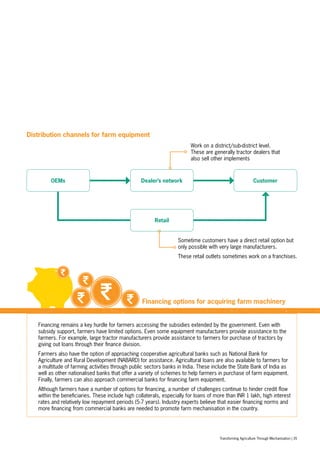
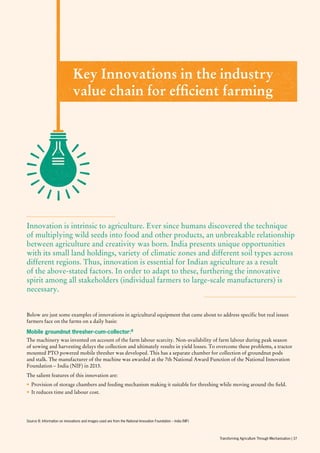
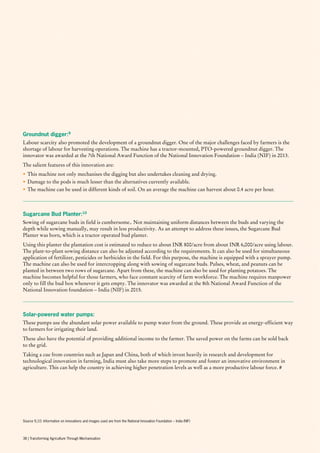
  • 36.
    4.6 Concept ofCustom Hiring Centres (CHCs) for farm equipment Custom hiring of farm machinery (CHCs) was introduced in Indian agriculture in as early as 1912. Organised move to promote multi-farm use of agricultural machinery was made in mid-1960 when Agro-Industries Corporations were established within the states. CHCs are a unit comprising a set of farm machinery, implements and equipment for hiring by farmers. These centres give farm machinery on a rental basis to farmers who cannot afford to purchase high-end agricultural machinery and equipment, apart from servicing old machinery. Farm machineries/equipment available at CHCs include tractor, rotavator, multi-crop thresher, MB plough, cultivator, leveller blade, blade harrow, seed cum fertilizer drill, knapsack sprayer, power weeder, winnowing fan, electronic balance, repairing tools. These units are generally located in close proximities to large and small land holdings, which supply machinery and equipment to villages close to it reducing transport cost and transportation time. States such as Punjab, Haryana, Uttar Pradesh, Uttarakhand, Gujarat, Maharashtra, Karnataka and TN, which are highly mechanised, have maximum number of registered and unregistered CHCs catering to the machinery and equipment requirements of the farmers. Other states do have operational CHCs but farm mechanisation still remains a serious concern. Custom hiring centres, in order to work effectively and efficiently require a sound infrastructure setup for its operations, which include all weather roads, spatial distribution of machinery ownership and servicing network. The government also recognises the value of these centres and the role they can play in mechanisation of farm operations. As a result, establishment of farm machinery banks for custom hiring is one of the core components of the Sub-Mission on Agricultural Mechanisation (SMAM) and government provides financial assistance for setting them up. However, there is a need for enhanced participation from the private sector in an endeavour of setting up CHCs and capacity building. Only then the subsequent upskilling and training can bring a sustainable and more inclusive growth. Global perspective: Custom hiring of agricultural machinery in China The Government of China pays great attention to farm mechanisation, recognising and appreciating its importance. It has launched a number of policies in support of custom hiring of agricultural equipment. In 2004, congress adopted the ‘Law on Promoting Agricultural Mechanisation of the People’s Republic of China’ and in 2010, released the ‘Opinion on Promoting Sound and Fast Development of Agricultural Mechanisation and Agricultural Machinery Industry’. Under these, the responsibilities of all levels of government and agricultural authorities were outlined with respect to promoting agricultural mechanisation in their respective regions and measures and requirements for promoting custom hiring of equipment were laid out. China also has a subsidy policy for farmers, which has promoted farmers’ willingness to purchase machinery, which in turn, has laid a solid foundation for custom hiring. There are number of steps the government took to help foster custom hiring and as a result. Statistics from the year 2013 show that China had 5.24 million machinery service-providing households, 168,000 organisations, 201,000 machinery maintenance plants and stops, and 7,000 intermediary service organisations. In particular, machinery cooperatives, specialised in cooperative use of machinery have seen strong growth. Custom hiring of farm machinery including leasing, cross-region operations, order placement and contract management, has met the diversified needs of the farmers. 36 | Transforming Agriculture Through Mechanisation
  • 37.
    Below are justsome examples of innovations in agricultural equipment that came about to address specific but real issues farmers face on the farms on a daily basis: Innovation is intrinsic to agriculture. Ever since humans discovered the technique of multiplying wild seeds into food and other products, an unbreakable relationship between agriculture and creativity was born. India presents unique opportunities with its small land holdings, variety of climatic zones and different soil types across different regions. Thus, innovation is essential for Indian agriculture as a result of the above-stated factors. In order to adapt to these, furthering the innovative spirit among all stakeholders (individual farmers to large-scale manufacturers) is necessary. Key Innovations in the industry value chain for efficient farming Mobile groundnut thresher-cum-collector:8 The machinery was invented on account of the farm labour scarcity. Non-availability of farm labour during peak season of sowing and harvesting delays the collection and ultimately results in yield losses. To overcome these problems, a tractor mounted PTO powered mobile thresher was developed. This has a separate chamber for collection of groundnut pods and stalk. The manufacturer of the machine was awarded at the 7th National Award Function of the National Innovation Foundation – India (NIF) in 2013. The salient features of this innovation are: • Provision of storage chambers and feeding mechanism making it suitable for threshing while moving around the field. • It reduces time and labour cost. Source 8: Information on innovations and images used are from the National Innovation Foundation – India (NIF) Transforming Agriculture Through Mechanisation | 37
  • 38.
    Groundnut digger:9 Labour scarcityalso promoted the development of a groundnut digger. One of the major challenges faced by farmers is the shortage of labour for harvesting operations. The machine has a tractor-mounted, PTO-powered groundnut digger. The innovator was awarded at the 7th National Award Function of the National Innovation Foundation – India (NIF) in 2013. The salient features of this innovation are: • This machine not only mechanises the digging but also undertakes cleaning and drying. • Damage to the pods is much lesser than the alternatives currently available. • The machine can be used in different kinds of soil. On an average the machine can harvest about 0.4 acre per hour. Sugarcane Bud Planter:10 Sowing of sugarcane buds in field is cumbersome.. Not maintaining uniform distances between the buds and varying the depth while sowing manually, may result in less productivity. As an attempt to address these issues, the Sugarcane Bud Planter was born, which is a tractor operated bud planter. Using this planter the plantation cost is estimated to reduce to about INR 800/acre from about INR 6,000/acre using labour. The plant-to-plant sowing distance can also be adjusted according to the requirements. It can also be used for simultaneous application of fertilizer, pesticides or herbicides in the field. For this purpose, the machine is equipped with a sprayer pump. The machine can also be used for intercropping along with sowing of sugarcane buds. Pulses, wheat, and peanuts can be planted in between two rows of sugarcane. Apart from these, the machine can also be used for planting potatoes. The machine becomes helpful for those farmers, who face constant scarcity of farm workforce. The machine requires manpower only to fill the bud box whenever it gets empty. The innovator was awarded at the 8th National Award Function of the National Innovation foundation – India (NIF) in 2015. Solar-powered water pumps: These pumps use the abundant solar power available to pump water from the ground. These provide an energy-efficient way to farmers for irrigating their land. These also have the potential of providing additional income to the farmer. The saved power on the farms can be sold back to the grid. Taking a cue from countries such as Japan and China, both of which invest heavily in research and development for technological innovation in farming, India must also take more steps to promote and foster an innovative environment in agriculture. This can help the country in achieving higher penetration levels as well as a more productive labour force. # Source 9,10: Information on innovations and images used are from the National Innovation Foundation – India (NIF) 38 | Transforming Agriculture Through Mechanisation
  • 39.
    Section V: Government’s role infarm equipment sector Transforming Agriculture Through Mechanisation | 39
  • 40.
    5.1 Overview ofschemes and policies The Government has implemented various farm mechanisation programmes in the country through schemes such as Rashtriya Krishi Vikas Yojna (RKVY), Mission for Integrated Development of Horticulture (MIDH), National Mission on Oilseeds and Oil Palm (NMOOP) and National Food Security Mission (NFSM). In addition to development of such schemes, the government has also implemented the National Mission on Agricultural Extension and Technology (NMAET) to strengthen the extension machinery and utilise the same for synergising the interventions under these schemes. Mechanisation under the National Food Security Mission (NFSM): The National Development Council (NDC) adopted a resolution to launch a food security mission comprising of wheat, rice and pulses to increase production of wheat by 8 million tons and pulses by 2 million tons by the end of the XIth five-year plan. Accordingly, the National Food Security Mission (NFSM) was launched in October, 2007. The mission is being continued in the XIIth five-year plan with revised targets. The plan now targets additional production of food grains of up to 25 million tons (10 million tons of rice, 8 million tons of wheat, 4 million tons of pulses and 3 million tons of coarse cereals) by the end of the five-year plan. In accordance with that, the Mission makes provisions for assistance (up to 50 percent the cost of machinery) to be provided for adoption of farm machinery such as pump sets, tractor mounted sprayers, seed drills, zero till seed drill etc. to varying degrees. Mechanisation under the Rashtriya Krishi Vikas Yojna (RKVY): To spur growth in agriculture and allied sectors, the Government of India, in consultation with the Planning Commission, Department of Agriculture and Cooperation, launched the RKVY in 2007-08. The main objectives of the schemes include: • Incentivising states to increase investment in agriculture and allied sectors. • Ensuring the preparation of agricultural plans for the districts and states based on agro-climatic conditions, availability of technology and natural resources. • Achieving the goal of reducing the yield gaps in important crops, through focused interventions along with maximising returns to the farmers. • Bringing about quantifiable changes in the production and productivity of various components of agriculture and allied sectors by addressing them in a holistic manner. The scheme works through four main streams: • RKVY Production growth – with 35 percent of the outlay. • RKVY Infrastructure and assets – with 35 percent of the outlay. • RKVY Special schemes – with 20 percent of the outlay. • RKVY Flexi fund – with 10 percent of the outlay (States can undertake either production growth or infrastructure and assets projects with this allocation). 40 | Transforming Agriculture Through Mechanisation
  • 41.
    Agricultural mechanisation fallsunder the production growth stream of the scheme. Under this scheme, assistance can be provided to farmers for farm mechanisation efforts, as detailed in the state/ district agricultural plans, especially for improved and gender friendly tools, implements and machinery. However, assistance for large equipment (e.g. tractor, combine harvester, sugarcane harvester, cotton picker etc.) for which ownership may not be economically viable, assistance should only be provided for establishing custom hiring centres under RKVY (infrastructure and assets stream). Mechanisation under the Mission for Integrated Development of Horticulture (MIDH): MIDH is a centrally sponsored scheme for the overall growth of the horticulture sector covering fruits, vegetables, root and tuber crops, mushrooms, spices, flowers, aromatic plants, coconut, cashew, cocoa and bamboo. The Central Government provides 85 percent of the assistance and the remaining 15 percent is provided by the states (except in the north-eastern and Himalayan states where the central government’s contribution is 100 percent). One of the key interventions under the scheme is ‘Horticulture Mechanisation’ which aims to improve farm efficiency and reduce drudgery of the workforce. Assistance in this regard is provided for activities such as procurement of power operated machines and tools, besides import of new machines. Assistance is also available to grower associations, farmer groups, self-help groups, and women farmer groups etc. (with more than 10 members) that are engaged in cultivation of horticulture crops. 60 percent of the cost of machines will be borne by such groups. National Mission on Agricultural Extension and Technology (NMAET): Agricultural technology, including the adoption/ promotion of critical inputs and improved agronomic practices, was being disseminated under 17 different schemes of the Department of Agriculture and Cooperation during the 11th plan. The Modified Extension Reforms Scheme was introduced in 2010 with an objective to strengthen the extension machinery and utilise it for synergising the interventions under these schemes under the umbrella of Agriculture Technology Management Agency (ATMA). NMAET was envisaged as the next step towards this objective through the amalgamation of these schemes. It includes four sub-missions: • Sub-Mission on Agriculture Extension (SMAE) • Sub-Mission on Seed and Planting Material (SMSP) • Sub-Mission on Agricultural Mechanisation (SMAM) • Sub-Mission on Plan Protection and Plant Quarantine (SMPP) These sub–missions are inextricably linked to each other. The common thread running across all four sub-missions is ‘Extension and Technology’. The objectives of this Scheme can be achieved through a judicious mix of extensive physical dissemination, use of ICT, popularisation of modern and appropriate technologies, capacity building and institutional strengthening to promote mechanisation, availability of quality seeds, plant protection and also encouragement of aggregation of farmers interest groups (FIGs) to form Farmer Producer Organisations (FPOs). Transforming Agriculture Through Mechanisation | 41
  • 42.
    National Level Steering Committee Chairedby Secretary of Agriculture Executive Committee of SMAE Chaired by JS (Extn.) Chaired by JS (Seeds) Chaired by JS (MT) Executive Committee of SMSP Executive Committee of SMAM Executive comittee of SMPP Chaired by JS (Plant Protection) National Mission Director (NMAET) Joint Secretary (Exten.) Structure of the mission: For effective implementation of the national mission, a steering committee was constituted and notified. The committee is the policy making body, giving overall directions and guidance to the mission. It acts as an empowered body and decides inter-component changes among the sub-missions. The committee also reviews the performance of the NMAET at least once a year. Mission director for the NMAET is the joint secretary (extension) who ensures effective and expeditious implementation and convergence among the sub-missions. The overall in-charge of each sub-mission is the joint secretary of the respective elements covered under the scheme. However, convergence of farmer centric extension related activities is overseen by the Extension Division through the instrumentality of SEWP (State Extension Work Plan). Mission Director also helps in bringing out synergies among various sub-missions. An expanded IDWG headed by the APC or Principal Secretary (Agriculture) at state level (after including all sub- missions related officers) and ATMA Governing Board at district level, monitors and is accountable for the effective implementation of the mission. Sub-Mission on Agricultural Mechanisation (SMAM): The Sub-Mission is part of the National Mission on Agricultural Extension and Technology, and is implemented in all the states to promote the usage of farm equipment and to increase the ratio of farm power to cultivable unit area up to 2kW/ha. Mission’s objectives are: • Increasing the reach of farm mechanisation to small and marginal farmers and to regions where availability of farm power is low. • Promoting ‘Custom Hiring Centres’ to offset the adverse economies of scale arising due to small landholding and high cost of individual ownership. • Creating hubs for hi-tech and high value farm equipment. • Creating awareness among the stakeholders through demonstration and capacity building activities. • Ensuring performance testing and certification at designated testing centres located all over the country. Source: Department of Agriculture, Grant Thornton analysis Implementation process of the NMAET: 42 | Transforming Agriculture Through Mechanisation
  • 43.
    Mission executive committee SubmitsAAP to national steering committe for approval and fund release Distric Level Executive Committee Annual Action Plan (AAP) Distric Level Executive Committee Annual Action Plan (AAP) Distric Level Executive Committee Annual Action Plan (AAP) Distric Level Executive Committee Annual Action Plan (AAP) State Level Executive Committee State Agriculture/Agricultural Engineering department: Nodal Agency The district level annual plans are submitted to the nodal agency, which are the state agricultural departments or agricultural engineering departments. These agencies then prepare the state annual plans in consonance with the mission’s goals and objectives, taking into account the tentative outlay of the state as outlined by the Department of Agriculture, Cooperation and Farmer Welfare (DAC FW). The nodal agencies also ensure suitable integration of AAP with other schemes such as the RKVY, NFSM, and MIDH. The state annual plans are then submitted to the State Level Executive Committee (SLEC) for approval and thereafter to the executive committee. Upon approval of the plans, the nodal agencies receive the funds from the DAC FW for the implementing agencies and oversee, monitor and review implementation of the programmes. Monitoring: The mission envisages a coordinated approach for monitoring and evaluation with active involvement of the implementing agencies, beneficiaries and other stakeholders. A combination of periodic desk review, field visits and web-based mechanism has been adopted for releasing funds, monitoring physical and financial progress and monitoring the progress of the other mission interventions at the national level by Mechanisation Technology (MT) division at the DAC FW. Source: Department of Agriculture, Grant Thornton analysis To achieve these objectives, the mission has the following components: • Promotion and strengthening of agricultural mechanisation through training, testing and demonstration [Central Sector Scheme/ Component]. • Demonstration, training and distribution of Post-Harvest Technology and Management (PHTM) [Central Sector Scheme/ Component]. • Financial assistance for procurement of agricultural machinery and equipment. • Establishment of farm machinery banks for custom hiring. • Establishment of hi-tech and productive equipment hub for custom hiring. • Financial assistance for promotion of mechanised operations/ hectare carried out through custom hiring centre. • Promotion of farm machinery and equipment in north-east region. Implementation process of the SMAM: Transforming Agriculture Through Mechanisation | 43
  • 44.
    5.2 What schemesand policies mean? Subsidies to the tune of 25 to 50 percent are made available to farmers by the Government to ensure the machinery/ equipment is available at a better price. However, ceiling limits are available to all category of farmers for the purchase of various agricultural equipment’s under varied schemes of the Department of Agriculture and Cooperation such as Macro Management of Agriculture, National Food Security Mission (NFSM), Rashtriya Krishi Vikas Yojana (RKVY), National Horticulture Mission etc. Preliminary targets under the NFSM for the Twelfth Plan were enhancing production by additional 25 million tonnes of food grains, which includes 10 million tonnes of rice, 10 million tonnes of wheat, 3 million tonnes of pulses and 2 million tonnes of millet. Also, the scheme aims to expand fodder production to meet the demand both of green and dry fodder. The Union Budget 2013-14 had allocated US$ 339.5 million (INR 2,250 crore) to the mission. New farm practices were encouraged through 5.79 lakh demonstrations of improved package of practices on rice, wheat and pulses. About 100.70 lakh ha area had been treated with soil ameliorants (gypsum/ lime/ micro nutrients etc.) to restore soil fertility for higher productivity. Whereas, an area of about 39.42 lakh ha was treated under Integrated Pest Management (IPM). Nearly 30.16 lakh improved farm machineries including water saving devices are distributed. Capacity building of farmers has been encouraged through arranging 43,656 farmers’ field schools (FFS) at the farm level so far. All the targets were less than what actually was achieved during the Eleventh Plan and are consistent with demand forecasts. This would amount to targeting 2–2.5 percent increase in food grains production in the Twelfth Plan. Two programmes were started as RKVY sub-components in the Eleventh Plan by the government namely, the 60,000 pulses village programme and the intensive millets production programme were shifted into NFSM. Funds allocated under government’s initiative RKVY and its sub-schemes for 2015-16 are US$ 559.4 million (INR 3,707.16 crores). Whereas, for the year 2014-15 the funds released by the government for the scheme across all states were US$ 1,262.20 million (INR 8,363.89 crores) and the expenditure made for the same year was US$ 826.35 million (INR 5,475.85 crores). 44 | Transforming Agriculture Through Mechanisation
  • 45.
    Agriculture Equipment Industry:SWOT analysis A SWOT analysis to promote mechanisation of Indian Agriculture S W O T Strengths • Large infrastructure of over 20,000 manufacturers in small scale industry; vast network of academic and RD institutions including AICRPs under NARS for human resource development and RD. • Trained manpower for RD in agricultural engineering. • Over 100 cooperating centres of AICRPs is the area of agricultural engineering. • Computer aided design adopted by the institutes for high pace of RD. Opportunities • Development of entrepreneurship for custom hiring of farm machinery and agro-processing equipment. • Post-harvest loss reduction and value addition at the production catchments through rural level agro-processing centres. • Establishment of value chain for commercial supply, transport and marketing of agricultural produce. • Opportunity to increase the irrigated area by introducing micro-irrigation. • Reducing yield gaps and increasing productivity through precision farming technologies. Threats • Migration of farmers from agriculture to other industries. • Fragmentation and continuous reduction of operational holdings. • Slow pace of RD and commercialisation. • Inadequate infrastructure back up, for after sales support of farming equipment. • Renewable energy technology is still subsidy dependent. Weaknesses • Unreliable after sales service of agricultural equipment. • Poor liaison with industries for RD and commercialisation. • Non effective feedback system. • Absence of non-land economic activities. • Non-systematic marketing of agricultural equipment. Transforming Agriculture Through Mechanisation | 45
  • 46.
    Section VI: Challenges faced bythe industry 46 | Transforming Agriculture Through Mechanisation
  • 47.
    Small and scatteredland holdings: Average farm size in India is less than 2 hectares, which is far lower than regions like European Union (14 hectare) and the US (170 hectare). Large farm machineries are difficult to operate on such land holdings, which in some cases are completely unsuitable. Another factor to consider is mechanising small and non- contiguous group of small farms is against economies of scale, especially in operations such as land preparation and harvesting. As land holdings get smaller, more and more farmers fall into the adverse category and therefore make ownership of machinery lesser economical. Equipment cost, quality and after-sale service: Farm equipment, especially the energy-efficient options, are capital intensive and are a major investment for most of the farmers in India. A majority of them belong to the low- income bracket. This is evidenced by the fact that almost 90 percent of the tractors sold in India are done so with the assistance of some financial institution. The quality and after-sales service of farm equipment is another concern, since agriculture is largely carried out in rural parts of India and there is still an inadequacy of service-centres for proper maintenance. ‘Tractor-isation’ and not mechanisation: Tractors have an annual market of 600,000-700,000 units in India whereas, threshers, the next largest segment, has an annual market of just 100,000 units. The penetration of tractors has grown from one per 150 hectares to one per 30 hectares on agricultural land. However, such a growth in penetration has not been seen in other agricultural implements. This phenomenon has been dubbed as ‘tractor-isation’ by many industry stakeholders. It is to be noted that for a sustainable agricultural future, other farm implements, and not just tractors, need to be advanced to farmers in the country. Tendering process: There are various inefficiencies in the tendering process, especially with regard to the time and length of the process. In some states, the tendering process goes through the months of August and September (even October in some cases), due to which a time lag crops up. By this time the main season has already ended. Hence, farmers are unable to draw the optimal benefit of the available machinery. The tiller market is especially impacted by this, as virtually all the tillers sold in the country are done so on subsidy (since subsidy applies to imported tillers as well). Therefore, ensuring timely completion of the tendering process (before the beginning of April) is paramount to safeguard the interests of the farmers. Procurement process for the farmer: The entire process of acquiring farm equipment is very tedious and cumbersome for a farmer. A farmer has to go through various levels/ departments to get his land records verified. Post clearance, he has to go through further checks from the District Agriculture Officer in order to obtain approval and clearance for the purchase. This process itself becomes a big hindrance and discomfort to the farmer. There are a number of obstacles in achieving the target level of 2.5 Kw/ha farm power availability. It is imperative that all stakeholders in farm equipment sector have a clear understanding of these challenges and can collaborate to overcome these issues. Transforming Agriculture Through Mechanisation | 47
  • 48.
    Financing of farmequipment: Purchase of farm equipment is a significant investment for most of the farmers in India. Hence, reasonable financing norms are a must for ensuring mechanisation. An issue that has been persistent in financing is the purchase of standalone implements. The only exception is seen in case of tractors where the required details of the equipment e.g. engine number, chassis number etc. are available. Hence, institutions insist on purchase of the tractor along with other farm implements. This seems to discourage farmers from investing at large, as they need to shell out a huge amount. This adds to the ‘tractor-isation’ trend that is visible in the industry and doesn’t add to overall mechanisation. Industry stakeholders also feel that commercial banks must be encouraged to provide adequate financing for various farm equipment. This is seen by many industry sources as the biggest impediment to growth. Industry believes that commercial banks are reluctant to provide financing for agricultural equipment, owing to the risk it poses. Redundancies and inefficiencies in the equipment testing process: One of the strategies laid out in the Sub-Mission on Agricultural Mechanisation (SMAM) is conducting performance testing for various farm equipment at the four Farm Machinery Training and Testing Institutes (FMTTI), designated State Agricultural Universities (SAUs) and ICAR institutions. This ensures that a farmer can trust the technology being purchased. However, the number of institutions that can provide these FMTTI certificates is low and causes many logistical issues for the manufacturers. The redundancies in the process of testing further contributes to the logistical issues faced by manufacturers. Pricing of equipment: The government has allocated a substantial subsidy for farm equipment of about US$ 300 million (INR 2,000 crore), under the SMAM. However, the government also feels that the pricing of the equipment needs to be addressed with equal importance. The prices of equipment under subsidy are seen to be higher than the market price of these equipment. This poses a challenge for the government as well as the farmers. In order to ensure optimal use of the subsidy being provided, ensuring fair prices for the equipment is essential. The government suggests the ‘pricing cartel’ issue to be resolved through hosting the list of manufacturers and the equipment price on a central portal, which can then be communicated to the states. Other challenges the industry faces: A host of other challenges are faced by the industry and impacts proper functioning of the system. • There is a lack of proper mandatory safety standards for use of machinery as well as absence of standardised norms to ensure quality of the equipment. As a result, there is no premium for the higher quality products, which leads to lesser incentives for manufacturers to invest in quality and also to invest in new and cutting-edge technologies. • Another problem the industry faces is the lack of data/ information. Also, there is a clear absence of farm machinery management data regarding use-patterns, annual-use, breakdown-frequency, repair and management cost, reliability, granular information on the extent/ penetration of mechanisation etc. In absence of data, requirements of the scope of market growth remains unclear and are often targets are missed. • Some manufacturers also face issues of excise duties that need to be paid on intermediate parts such as higher-quality gear-boxes that are imported and used in assembling the final product. Therefore, even if parts are imported and assembled and used in the country, the manufacturers have to bear the cost. 48 | Transforming Agriculture Through Mechanisation
  • 49.
    Section VII: Way forward TransformingAgriculture Through Mechanisation | 49
  • 50.
    A. Custom HiringCentres (CHC) for various purposes: Promoting establishment of more CHCs is essential for future of the industry. But these centres could play more than the traditional role. These centres can be used as central hub for a number of activities: • Ensuring availability of crop and local-condition specific equipment for use. • Promoting the idea of cooperative farming among small and marginal farmers so that these ‘cooperatives’ can together fund farm equipment and use concurrently. • Act as a point-of-sale for second-hand equipment as well as hubs for after-sale service. CHCs could establish linkages with OEMs and dealers to make themselves the centre of all these different activities. • These centres could be established on a ‘hub-and-spoke’ model wherein last-mile outreach is established by having smaller outlets at the village level, which can also provide support for farming practices. B. Creating an institutionalised framework for custom hiring in the country: While custom hiring is prevalent in India for some of the agriculture machinery, it is highly unorganised and sporadic in present situation. The is on account of the following factors - • Custom hiring centres need a minimum scale for efficient operation as the activity is capital intensive. They also have a longer gestation period due to lower asset utilisation on account of the seasonal nature of agriculture machinery demand. • There is significant entry barrier for small entrepreneurs to establish these centres. Small entrepreneurs are neither creditworthy nor there are any special policy incentives for promoting them. • Credit policies of the banks need to evaluated. Generally, the banks insist on collateral guarantees apart from hypothecation of farm equipments for giving loans and as a result, the response from entrepreneurs is decreasing. Therefore, there is a need for stakeholders to devise an institutional framework for custom hiring in the country. C. ‘Make in India’ support for farm implements: The ‘Make in India’ initiative launched by the Government could be used to support the manufacture of inputs and farm implements currently being imported. This would help in reducing the overall capital cost. 7.1 Innovative measures “It will make impact on the items that are imported by saving on custom duties. For example, laser land levellers and paddy transplanters. But the impact would be immense. Low HP tractors manufacturing should be encouraged” Based on our interviews with various stakeholders, industry advisors , operators and manufacturers, various measures are recommended. These measures have been divided into two broad categories: Innovative measures and administrative measures. Innovative measures are new initiatives that can be taken into consideration in the future and administrative steps are those that will remove the inefficiencies and redundancies that exist in the current system 50 | Transforming Agriculture Through Mechanisation
  • 51.
    % D. Alternate routefor the subsidy: The subsidy amount could be re-routed to ensure that the interest rate on financing the farmers produce is brought to a much lower rate and that farmers can get longer payback periods as well as longer moratoriums (few years without interest). This would also apply to the financial assistance provided for setting up CHCs. Commercial banks could be brought into the fold to ensure greater participation on their part. E. CSR funds with a purpose: In accordance with Section 135 of the Companies Act of 2013, eligible firms are required to spend at least two percent of their average net profit in the preceding three financial years, towards CSR. These funds could be used in a few innovative ways for the benefit of the industry. • Companies that are directly involved in the agriculture equipment industry and are unable to invest in to corporate social activities in line of their business, could use the funds for initiatives such as ‘Adopt a Village’ and promote, through capacity building, practices such as precision agriculture, skill development and micro irrigation. This would ensure that the agricultural eco- system is built in a sustainable manner. • Companies in this industry could approach others not directly involved in farm machinery and pitch the idea of investing their CSR funds into promoting farm mechanisation through capacity building initiatives as well as infrastructure creation in order to help in skill development and establish custom hiring centres. “Commercial banks need to be encouraged to provide financing for equipment. Commercial banks’ not willing to finance these machines is the biggest impediment in the industry” “The subsidy needs to be re-visited. The farmers need better rate of interest for mechanisation to increase” “Yes, this would help the farmers a lot and get their morale up” Transforming Agriculture Through Mechanisation | 51
  • 52.
    “The tendering process needsto be looked at again and if it must exist, it must be completed by April” “There has been growth in tractors but other latest technologies are not reaching to the farmer” “Leave the choice to the farmer. If he wants to buy a luxury car or an economy car, he should be able to” “We need to have standardised norms for quality” • Tendering process: The tendering process in states must be completed before the sowing season. The states should be encouraged to ensure that before April all the tendering processes are completed so that subsidies are in place for farmers, in case tendering processes are continued. • Re-visit of the Regional Comprehensive Economic Partnership (RCEP) agreement by the Government so as to include farm equipment as a product line in the trade agreement, to ensure that the industry doesn’t absorb custom costs and gets the benefit of free-trade agreements (FTAs) • The government, in association with ICAR, should establish standardised quality norms for equipment and farm implements. • Stakeholders to drive to further research and development efforts into crop-specific implements that are suitable for the Indian conditions. • Testing of implements to be done at the class-level and not variations. For example only one of the 5-foot, 6-foot and 7-foot rotavators needs to be tested. This will help reduce redundancies in the testing procedures, saving time and costs. • As an endeavour, the government should try to accelerate the setting up of more certification centres to ensure that testing of the equipment can be done more quickly. • Equipment inputs in the GST bill: A mechanism for distinguishing the implements used in automotive and agriculture sector (e.g. gearbox is used in both cars and tractors), can be included as a part of the GST bill, so that implements used as part of farm equipment are not burdened with additional tax. • Equipment manufacturers should publish/ share with the government, the list of machinery and market prices, which can then be put into a central portal. This will act as a ready-reckoner for all stakeholders and can help in doing away with the tendering process. • A re-visit of the subsidy slabs is required, so that the large pool of small and marginal farmers actually benefit from these programmes. • Promoting use of renewable energy in farm equipment segment such as solar-powered pumps, tapping the immense potential in India for solar-power and creating alternate source of revenue for the farmer by selling the additional power general back to the grid. • Credit Guarantee Fund: It is pertinent to devise framework that would strengthen the credit policy for farm machinery in India. Credit guarantee fund is in operation for facilitating loans for micro, small and medium enterprises (MSMEs). Similar models should be devised for farm machinery sector as well. These initiatives would help in accelerating mechanisation of Indian farms and therefore, help the country reach the goal of a sustainable agricultural production. 7.2 Administrative measures 52 | Transforming Agriculture Through Mechanisation
  • 53.
    About us Grant ThorntonInternational Ltd. Grant Thornton is one of the world’s leading organisations of independent assurance, tax and advisory firms. These firms help dynamic organisations unlock their potential for growth by providing meaningful, forward looking advice. Proactive teams, led by approachable partners in these firms, use insights, experience and instinct to understand complex issues for privately owned, publicly listed and public sector clients and help them to find solutions. More than 40, 000 Grant Thornton people, across over 130 countries, are focused on making a difference to clients, colleagues and the communities in which we live and work. Grant Thornton in India Grant Thornton in India is one of the largest assurance, tax, and advisory firms in India. With over 2, 000 professional staff across 13 offices, the firm provides robust compliance services and growth navigation solutions on complex business and financial matters through focused practice groups. The firm has extensive experience across a range of industries, market segments, and geographical corridors. It is on a fast-track to becoming the best growth advisor to dynamic Indian businesses with global ambitions. With shorter decision-making chains, more senior personnel involvement, and empowered client service teams, the firm is able to operate in a coordinated way and respond with agility. Over the years, Grant Thornton in India has added lateral talent across service lines and has developed a host of specialist services such as Corporate Finance, Governance, Risk and Operations, and Forensic and Investigation. The firm’s strong Subject Matter Expertise (SME) focus not only enhances the reach but also helps deliver bespoke solutions tailored to the needs of its clients. FICCI Established in 1927, FICCI is the largest and oldest apex business organisation in India. Its history is closely interwoven with India’s struggle for independence, its industrialisation, and its emergence as one of the most rapidly growing global economies. A non-government, not-for-profit organisation, FICCI is the voice of India’s business and industry. From influencing policy to encouraging debate, engaging with policy makers and civil society, FICCI articulates the views and concerns of industry. It serves its members from the Indian private and public corporate sectors and multinational companies, drawing its strength from diverse regional chambers of commerce and industry across states, reaching out to over 2,50,000 companies. FICCI provides a platform for networking and consensus building within and across sectors and is the first port of call for Indian industry, policy makers and the international business community. Transforming Agriculture Through Mechanisation | 53
  • 54.
    Credits and Acknowledgement GrantThornton FICCI Authors Rahul Kapur Swarnima Chouhan Sukrit Gulati Vinayak Saxena Acknowledgement Jasmeet Singh Ruchira Saini Sarita Kohli Babita Bharti Editorial and review Devesh Chandra Srivastava Samridhi Jamwal Design Mrityunjay Gautam For further information, please contact our subject matter expert: Rahul Kapur Partner Grant Thornton India LLP M: +91 98112 10501 | E: Rahul.Kapur@in.gt.com Swarnima Chouhan Manager Grant Thornton India LLP M: +91 95604 94666 | E: Swarnima.Chouhan@in.gt.com Disclaimer This report has been prepared from various public sources and interaction with stakeholders, the information thus received from these sources is believed to be reliable Our work does not constitute an audit and thereof, the objective is the expression of an opinion based on an analysis of the information collected and discussions held in light of the same. The information contained in this report is selective and is subject to updation, expansion, revision and amendment. While the information provided herein is believed to be accurate and reliable, Grant Thornton does not make any representations or warranties, expressed or implied, as to the accuracy or completeness of such information and data available in the public domain. All assumptions made in order to develop the report are based on information or opinions that are current. Nothing has come to our attention to cause us to believe that the facts and data set forth in this report are not true or correct. Therefore, no responsibility is assumed for technical information furnished by any third party organisations and this is believed to be reliable. Whilst due care has been taken in the preparation of this document and information contained herein, neither Grant Thornton nor other legal entities in the group to which they belong, accept any liability whatsoever, for any direct or consequential loss arising from any use of this document or its contents or otherwise arising in connection herewith. Acknowledgement A special note of thanks to Mr. Ashwani Kumar, Joint Secretary, Mechanisation and Technology (MT), Department of Agriculture Cooperation, Ministry of Agriculture Farmers Welfare, GOI and Dr. Kanchan Kumar, Assistant Director General (Engineering), Indian Council of Agricultural Research (ICAR) for their inputs and expert guidance. We would also like to acknowledge the support of Mr. Mukul Varshney, Director-Corporate Affairs, John Deere India Pvt Ltd., Mr. T R Kesavan, Chief Operating Officer, Product Strategy Corporate Relations, TAFE Motors and Tractors Ltd., Mr. D S Balachandra Babu, Managing Director, Farm Implements India Pvt Ltd., Mr. Rakesh Kumar Kadian, Head Business Development - South Asia, Trimble Agriculture, Dr. S Baskar Reddy, Executive Director, Syngenta Foundation India and Mr. (CA) B.C.S. Iyengar, Director Corporate Strategy, VST Tillers for providing valuable suggestions and guidance throughout the period of this report. Also we would like to thank all the participants of “Interactive Session with Indian farm equipment sector” organised by FICCI on 12 October’2015 for the ineresting discussions which helped in developing the content of the report. 54 | Transforming Agriculture Through Mechanisation
  • 55.
    For more informationor for any queries, write to us at contact@in.gt.com NEW DELHI National Office Outer Circle L 41 Connaught Circus New Delhi 110001 T +91 11 4278 7070 AHMEDABAD BSQUARE Managed Offices 7th Floor, Shree Krishna Centre Nr. Mithakali Six Roads Navrangpura Ahmedabad 380009 T +91 76000 01620 BENGALURU “Wings”, 1st Floor 16/1 Cambridge Road Ulsoor Bengaluru 560008 T +91 80 4243 0700 CHANDIGARH B-406A, 4th Floor LT Elante Office Building Industrial Area Phase I Chandigarh 160002 T +91 172 4338 000 CHENNAI Arihant Nitco Park, 6th Floor, No. 90, Dr. Radhakrishnan Salai Mylapore Chennai 600004 T +91 44 4294 0000 GURGAON 21st Floor, DLF Square Jacaranda Marg DLF Phase II Gurgaon 122002 T +91 124 462 8000 HYDERABAD 7th Floor, Block III White House Kundan Bagh, Begumpet Hyderabad 500016 T +91 40 6630 8200 KOCHI 7th Floor, Modayil Centre point Warriam road junction M. G. Road Kochi 682016 T +91 484 406 4541 KOLKATA 10C Hungerford Street 5th Floor Kolkata 700017 T +91 33 4050 8000 MUMBAI 16th Floor, Tower II Indiabulls Finance Centre SB Marg, Elphinstone (W) Mumbai 400013 T +91 22 6626 2600 MUMBAI 9th Floor, Classic Pentagon Nr Bisleri factory, Western Express Highway Andheri (E) Mumbai 400099 T +91 22 6176 7800 NOIDA Plot No. 19A, 7th Floor Sector – 16A Noida 201301 T +91 120 7109 001 PUNE 401 Century Arcade Narangi Baug Road Off Boat Club Road Pune 411001 T +91 20 4105 7000 To know more about Grant Thornton in India, please visit www.grantthornton.in or contact any of our offices as mentioned below: Contact us Follow us @GrantThorntonIN Transforming Agriculture Through Mechanisation | 55
  • 56.
    © 2015 GrantThornton India LLP. All rights reserved. “Grant Thornton in India” means Grant Thornton India LLP, a member firm within Grant Thornton International Ltd, and those legal entities which are its related parties as defined by the Companies Act, 2013 read in conjunction with the applicable Accounting Standards issued by the Institute of Chartered Accountants of India. Grant Thornton India LLP (formerly Grant Thornton India) is registered with limited liability with identity number AAA-7677 and has its registered office at L-41 Connaught Circus, New Delhi, 110001. References to Grant Thornton are to Grant Thornton International Ltd (Grant Thornton International) or its member firms. Grant Thornton International and the member firms are not a worldwide partnership. Services are delivered independently by the member firms. Agriculture Division Federation House, Tansen Marg New Delhi 110001, India Ph: +91-11-23738760 to 70 (Extn-407, 291)/ +91-11-23765323 Fax: +91 – 11 – 23765333, 23721504