Small Scale Poultry Egg Production
Enterprise: A Case Study of
Omeiza Farm
AGBAJE OMEIZA ADEBAYO
Matric No: 196442
A SEMINAR PAPER SUBMITTED TOTHE DEPARTMENT OF AGRICULTURAL AND
ENVIRONMENTAL ENGINEERING
FACULTY OF TECHNOLOGY
UNIVERSITY OF IBADAN
NIGERIA
SUPERVISOR: PROF. M. A ONILUDE
SEPTEMBER, 2016
By
About this Seminar work
• This seminar work is about my post National Youth Service
Corp(NYSC) experience
• Small scale poultry production enterprise managed between 2012 and
2014 specialized only on egg production
• The business started with 500day old commercial pullet and were
raised on deep litter throughout their production cycle.
INTRODUCTION
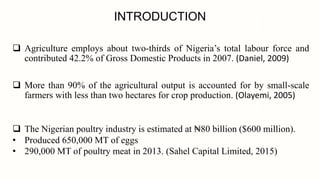
 Agriculture employs about two-thirds of Nigeria’s total labour force and
contributed 42.2% of Gross Domestic Products in 2007. (Daniel, 2009)
 More than 90% of the agricultural output is accounted for by small-scale
farmers with less than two hectares for crop production. (Olayemi, 2005)
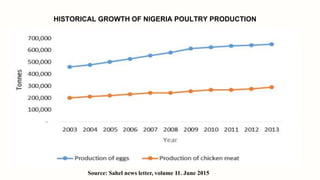
 The Nigerian poultry industry is estimated at ₦80 billion ($600 million).
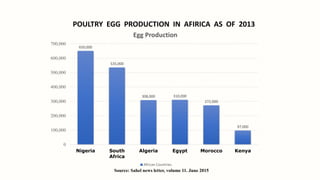
• Produced 650,000 MT of eggs
• 290,000 MT of poultry meat in 2013. (Sahel Capital Limited, 2015)
HISTORICAL GROWTH OF NIGERIA POULTRY PRODUCTION
Source: Sahel news letter, volume 11. June 2015
650,000
535,000
308,000 310,000
272,000
97,000
0
100,000
200,000
300,000
400,000
500,000
600,000
700,000
Nigeria South
Africa
Algeria Egypt Morocco Kenya
Egg Production
African Countries
POULTRY EGG PRODUCTION IN AFIRICA AS OF 2013
Source: Sahel news letter, volume 11. June 2015
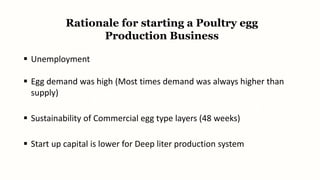
Rationale for starting a Poultry egg
Production Business
 Unemployment
 Egg demand was high (Most times demand was always higher than
supply)
 Sustainability of Commercial egg type layers (48 weeks)
 Start up capital is lower for Deep liter production system
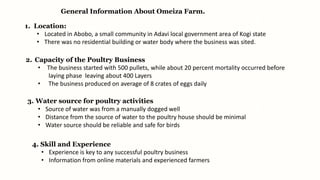
General Information About Omeiza Farm.
1. Location:
• Located in Abobo, a small community in Adavi local government area of Kogi state
• There was no residential building or water body where the business was sited.
2. Capacity of the Poultry Business
• The business started with 500 pullets, while about 20 percent mortality occurred before
laying phase leaving about 400 Layers
• The business produced on average of 8 crates of eggs daily
3. Water source for poultry activities
• Source of water was from a manually dogged well
• Distance from the source of water to the poultry house should be minimal
• Water source should be reliable and safe for birds
4. Skill and Experience
• Experience is key to any successful poultry business
• Information from online materials and experienced farmers
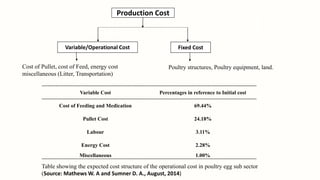
Cost of Pullet, cost of Feed, energy cost
miscellaneous (Litter, Transportation)
Poultry structures, Poultry equipment, land.
Production Cost
Variable/Operational Cost Fixed Cost
Table showing the expected cost structure of the operational cost in poultry egg sub sector
(Source: Mathews W. A and Sumner D. A., August, 2014)
Variable Cost Percentages in reference to Initial cost
Cost of Feeding and Medication 69.44%
Pullet Cost 24.18%
Labour 3.11%
Energy Cost 2.28%
Miscellaneous 1.00%
Poultry Housing Requirement and design
A good poultry house should protect the birds from the
following
• Harsh weather condition (High Temperature, Rain)
• Predator and Theft
• Poultry house should be dry and will ventilated
• Orientation of the building with reference to sunlight and wind
• Well drained soil to prevent dampness and saturation of the floor
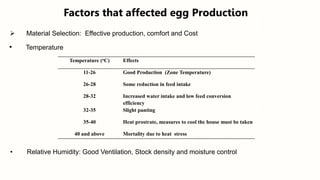
Factors that affected egg Production
 Material Selection: Effective production, comfort and Cost
• Temperature
• Relative Humidity: Good Ventilation, Stock density and moisture control
Temperature (oC) Effects
11-26 Good Production (Zone Temperature)
26-28 Some reduction in feed intake
28-32 Increased water intake and low feed conversion
efficiency
32-35 Slight panting
35-40 Heat prostrate, measures to cool the house must be taken
40 and above Mortality due to heat stress
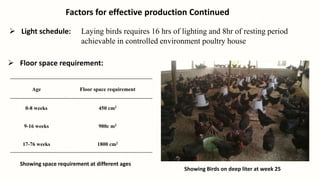
Factors for effective production Continued
 Light schedule: Laying birds requires 16 hrs of lighting and 8hr of resting period
achievable in controlled environment poultry house
 Floor space requirement:
Age Floor space requirement
0-8 weeks 450 cm2
9-16 weeks 900c m2
17-76 weeks 1800 cm2
Showing space requirement at different ages
Showing Birds on deep liter at week 25
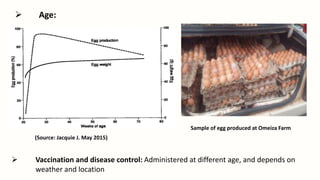
 Age:
(Source: Jacquie J. May 2015)
 Vaccination and disease control: Administered at different age, and depends on
weather and location
Sample of egg produced at Omeiza Farm
Challenges Encountered
• High priced and poor quality poultry feed
• Poor road network for transportation of poultry products
• Problems associated with expired vaccines
• Decline in the performance of commercial layer
• Egg glut associated to poor storage facility
Critical review of Omeiza Poultry Farm
 The Use of deep liter method instead of cage type system
 Use of tradition feeders and drinkers instead of automatic feeders
and nipple type drinkers
 Use of overpriced finished feed instead of feed formulation
according to bird’s nutritional requirement.
 Reliability on natural lighting instead of controlled artificial
lighting program for improved yield.
Conclusion
• Relatively lower startup cost
• Source of gainful employment
• Numbers of birds raised will determine the income
Recommendations
• Capacity training of poultry farmers to enable them cope with the challenges of
modern poultry farming and commercialization of the poultry sub-sector.
• Policies such as encouraging bank and financial institutions to reduce
lending rate associated with money borrowed for agricultural purposes
AGBAJE OMEIZA ADEBAYO

AGBAJE OMEIZA ADEBAYO

  • 1.
    Small Scale PoultryEgg Production Enterprise: A Case Study of Omeiza Farm AGBAJE OMEIZA ADEBAYO Matric No: 196442 A SEMINAR PAPER SUBMITTED TOTHE DEPARTMENT OF AGRICULTURAL AND ENVIRONMENTAL ENGINEERING FACULTY OF TECHNOLOGY UNIVERSITY OF IBADAN NIGERIA SUPERVISOR: PROF. M. A ONILUDE SEPTEMBER, 2016 By
  • 2.
    About this Seminarwork • This seminar work is about my post National Youth Service Corp(NYSC) experience • Small scale poultry production enterprise managed between 2012 and 2014 specialized only on egg production • The business started with 500day old commercial pullet and were raised on deep litter throughout their production cycle.
  • 3.
    INTRODUCTION  Agriculture employsabout two-thirds of Nigeria’s total labour force and contributed 42.2% of Gross Domestic Products in 2007. (Daniel, 2009)  More than 90% of the agricultural output is accounted for by small-scale farmers with less than two hectares for crop production. (Olayemi, 2005)  The Nigerian poultry industry is estimated at ₦80 billion ($600 million). • Produced 650,000 MT of eggs • 290,000 MT of poultry meat in 2013. (Sahel Capital Limited, 2015)
  • 4.
    HISTORICAL GROWTH OFNIGERIA POULTRY PRODUCTION Source: Sahel news letter, volume 11. June 2015
  • 5.
    650,000 535,000 308,000 310,000 272,000 97,000 0 100,000 200,000 300,000 400,000 500,000 600,000 700,000 Nigeria South Africa AlgeriaEgypt Morocco Kenya Egg Production African Countries POULTRY EGG PRODUCTION IN AFIRICA AS OF 2013 Source: Sahel news letter, volume 11. June 2015
  • 6.
    Rationale for startinga Poultry egg Production Business  Unemployment  Egg demand was high (Most times demand was always higher than supply)  Sustainability of Commercial egg type layers (48 weeks)  Start up capital is lower for Deep liter production system
  • 7.
    General Information AboutOmeiza Farm. 1. Location: • Located in Abobo, a small community in Adavi local government area of Kogi state • There was no residential building or water body where the business was sited. 2. Capacity of the Poultry Business • The business started with 500 pullets, while about 20 percent mortality occurred before laying phase leaving about 400 Layers • The business produced on average of 8 crates of eggs daily 3. Water source for poultry activities • Source of water was from a manually dogged well • Distance from the source of water to the poultry house should be minimal • Water source should be reliable and safe for birds 4. Skill and Experience • Experience is key to any successful poultry business • Information from online materials and experienced farmers
  • 8.
    Cost of Pullet,cost of Feed, energy cost miscellaneous (Litter, Transportation) Poultry structures, Poultry equipment, land. Production Cost Variable/Operational Cost Fixed Cost Table showing the expected cost structure of the operational cost in poultry egg sub sector (Source: Mathews W. A and Sumner D. A., August, 2014) Variable Cost Percentages in reference to Initial cost Cost of Feeding and Medication 69.44% Pullet Cost 24.18% Labour 3.11% Energy Cost 2.28% Miscellaneous 1.00%
  • 9.
    Poultry Housing Requirementand design A good poultry house should protect the birds from the following • Harsh weather condition (High Temperature, Rain) • Predator and Theft • Poultry house should be dry and will ventilated • Orientation of the building with reference to sunlight and wind • Well drained soil to prevent dampness and saturation of the floor
  • 10.
    Factors that affectedegg Production  Material Selection: Effective production, comfort and Cost • Temperature • Relative Humidity: Good Ventilation, Stock density and moisture control Temperature (oC) Effects 11-26 Good Production (Zone Temperature) 26-28 Some reduction in feed intake 28-32 Increased water intake and low feed conversion efficiency 32-35 Slight panting 35-40 Heat prostrate, measures to cool the house must be taken 40 and above Mortality due to heat stress
  • 11.
    Factors for effectiveproduction Continued  Light schedule: Laying birds requires 16 hrs of lighting and 8hr of resting period achievable in controlled environment poultry house  Floor space requirement: Age Floor space requirement 0-8 weeks 450 cm2 9-16 weeks 900c m2 17-76 weeks 1800 cm2 Showing space requirement at different ages Showing Birds on deep liter at week 25
  • 12.
     Age: (Source: JacquieJ. May 2015)  Vaccination and disease control: Administered at different age, and depends on weather and location Sample of egg produced at Omeiza Farm
  • 13.
    Challenges Encountered • Highpriced and poor quality poultry feed • Poor road network for transportation of poultry products • Problems associated with expired vaccines • Decline in the performance of commercial layer • Egg glut associated to poor storage facility
  • 14.
    Critical review ofOmeiza Poultry Farm  The Use of deep liter method instead of cage type system  Use of tradition feeders and drinkers instead of automatic feeders and nipple type drinkers  Use of overpriced finished feed instead of feed formulation according to bird’s nutritional requirement.  Reliability on natural lighting instead of controlled artificial lighting program for improved yield.
  • 15.
    Conclusion • Relatively lowerstartup cost • Source of gainful employment • Numbers of birds raised will determine the income Recommendations • Capacity training of poultry farmers to enable them cope with the challenges of modern poultry farming and commercialization of the poultry sub-sector. • Policies such as encouraging bank and financial institutions to reduce lending rate associated with money borrowed for agricultural purposes