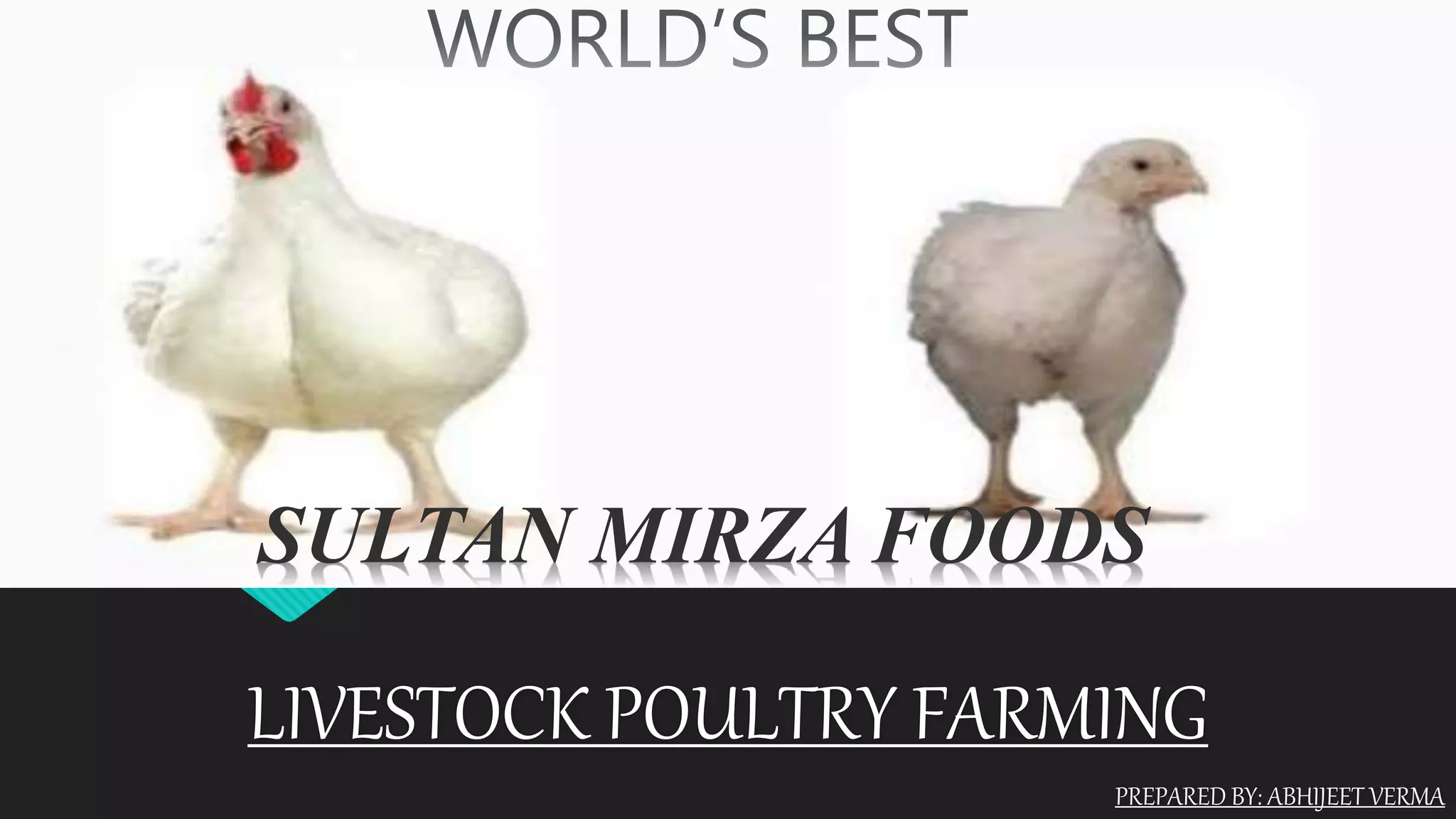
LIVESTOCK POULTRY FARMING
PREPARED BY: ABHIJEET VERMA
SULTAN MIRZA FOODS
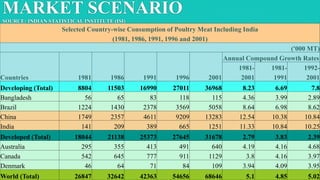
MARKET SCENARIO
SOURCE: INDIAN STATISTICAL INSTITUTE (ISI)
Selected Country-wise Consumption of Poultry Meat Including India
(1981, 1986, 1991, 1996 and 2001)
('000 MT)
Countries 1981 1986 1991 1996 2001
Annual Compound Growth Rates
1981- 1981- 1992-
2001 1991 2001
Developing (Total) 8804 11503 16990 27011 36968 8.23 6.69 7.8
Bangladesh 56 65 83 118 115 4.36 3.99 2.89
Brazil 1224 1430 2378 3569 5058 8.64 6.98 8.62
China 1749 2357 4611 9209 13283 12.54 10.38 10.84
India 141 209 389 665 1251 11.33 10.84 10.25
Developed (Total) 18044 21138 25373 27645 31678 2.79 3.83 2.39
Australia 295 355 413 491 640 4.19 4.16 4.68
Canada 542 645 777 911 1129 3.8 4.16 3.97
Denmark 46 64 71 84 109 3.94 4.09 3.95
World (Total) 26847 32642 42363 54656 68646 5.1 4.85 5.02
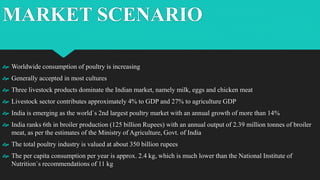
MARKET SCENARIO
 Worldwide consumption of poultry is increasing
 Generally accepted in most cultures
 Three livestock products dominate the Indian market, namely milk, eggs and chicken meat
 Livestock sector contributes approximately 4% to GDP and 27% to agriculture GDP
 India is emerging as the world`s 2nd largest poultry market with an annual growth of more than 14%
 India ranks 6th in broiler production (125 billion Rupees) with an annual output of 2.39 million tonnes of broiler
meat, as per the estimates of the Ministry of Agriculture, Govt. of India
 The total poultry industry is valued at about 350 billion rupees
 The per capita consumption per year is approx. 2.4 kg, which is much lower than the National Institute of
Nutrition`s recommendations of 11 kg
MAJOR INSTITUTION SUPPORT
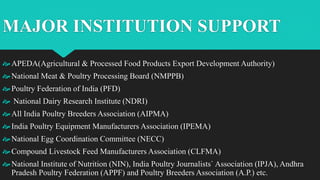
APEDA(Agricultural & Processed Food Products Export Development Authority)
National Meat & Poultry Processing Board (NMPPB)
Poultry Federation of India (PFD)
 National Dairy Research Institute (NDRI)
All India Poultry Breeders Association (AIPMA)
India Poultry Equipment Manufacturers Association (IPEMA)
National Egg Coordination Committee (NECC)
Compound Livestock Feed Manufacturers Association (CLFMA)
National Institute of Nutrition (NIN), India Poultry Journalists` Association (IPJA), Andhra
Pradesh Poultry Federation (APPF) and Poultry Breeders Association (A.P.) etc.
DEMAND & SUPPLY: JHARKHAND
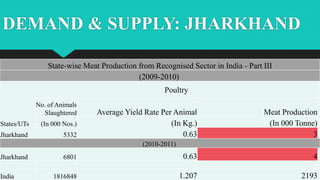
State-wise Meat Production from Recognised Sector in India - Part III
(2009-2010)
States/UTs
Poultry
No. of Animals
Slaughtered Average Yield Rate Per Animal Meat Production
(In 000 Nos.) (In Kg.) (In 000 Tonne)
Jharkhand 5332 0.63 3
(2010-2011)
Jharkhand 6801 0.63 4
India 1816848 1.207 2193
DEMAND & SUPPLY: JHARKHAND
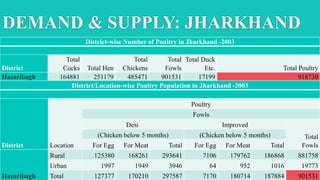
District-wise Number of Poultry in Jharkhand -2003
District
Total
Cocks Total Hen
Total
Chickens
Total
Fowls
Total Duck
Etc. Total Poultry
Hazaribagh 164881 251179 485471 901531 17199 918730
District/Location-wise Poultry Population in Jharkhand -2003
District Location
Poultry
Fowls
Desi Improved
Total
Fowls
(Chicken below 5 months) (Chicken below 5 months)
For Egg For Meat Total For Egg For Meat Total
Hazaribagh
Rural 125380 168261 293641 7106 179762 186868 881758
Urban 1997 1949 3946 64 952 1016 19773
Total 127377 170210 297587 7170 180714 187884 901531
DEMAND PROJECTION: INDIA
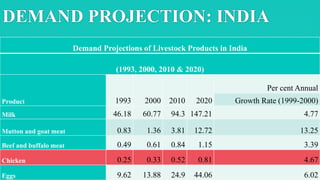
Demand Projections of Livestock Products in India
(1993, 2000, 2010 & 2020)
Product 1993 2000 2010 2020
Per cent Annual
Growth Rate (1999-2000)
Milk 46.18 60.77 94.3 147.21 4.77
Mutton and goat meat 0.83 1.36 3.81 12.72 13.25
Beef and buffalo meat 0.49 0.61 0.84 1.15 3.39
Chicken 0.25 0.33 0.52 0.81 4.67
Eggs 9.62 13.88 24.9 44.06 6.02
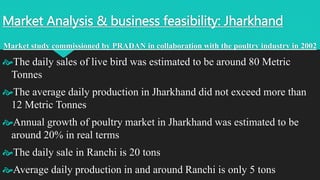
Market Analysis & business feasibility: Jharkhand
Market study commissioned by PRADAN in collaboration with the poultry industry in 2002
The daily sales of live bird was estimated to be around 80 Metric
Tonnes
The average daily production in Jharkhand did not exceed more than
12 Metric Tonnes
Annual growth of poultry market in Jharkhand was estimated to be
around 20% in real terms
The daily sale in Ranchi is 20 tons
Average daily production in and around Ranchi is only 5 tons
OPERATIONS
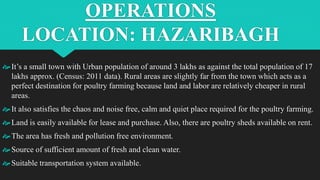
LOCATION: HAZARIBAGH
It’s a small town with Urban population of around 3 lakhs as against the total population of 17
lakhs approx. (Census: 2011 data). Rural areas are slightly far from the town which acts as a
perfect destination for poultry farming because land and labor are relatively cheaper in rural
areas.
It also satisfies the chaos and noise free, calm and quiet place required for the poultry farming.
Land is easily available for lease and purchase. Also, there are poultry sheds available on rent.
The area has fresh and pollution free environment.
Source of sufficient amount of fresh and clean water.
Suitable transportation system available.
OPERATIONS
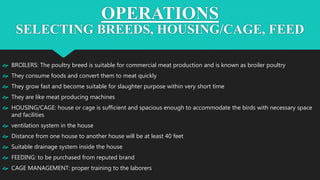
SELECTING BREEDS, HOUSING/CAGE, FEED
 BROILERS: The poultry breed is suitable for commercial meat production and is known as broiler poultry
 They consume foods and convert them to meat quickly
 They grow fast and become suitable for slaughter purpose within very short time
 They are like meat producing machines
 HOUSING/CAGE: house or cage is sufficient and spacious enough to accommodate the birds with necessary space
and facilities
 ventilation system in the house
 Distance from one house to another house will be at least 40 feet
 Suitable drainage system inside the house
 FEEDING: to be purchased from reputed brand
 CAGE MANAGEMENT: proper training to the laborers
PRODUCTION
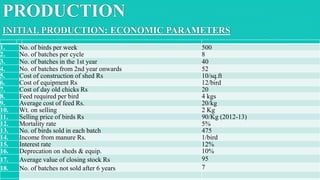
INITIAL PRODUCTION: ECONOMIC PARAMETERS
1. No. of birds per week 500
2. No. of batches per cycle 8
3. No. of batches in the 1st year 40
4. No. of batches from 2nd year onwards 52
5. Cost of construction of shed Rs 10/sq.ft
6. Cost of equipment Rs 12/bird
7. Cost of day old chicks Rs 20
8. Feed required per bird 4 kgs
9. Average cost of feed Rs. 20/kg
10. Wt. on selling 2 Kg
11. Selling price of birds Rs 90/Kg (2012-13)
12. Mortality rate 5%
13. No. of birds sold in each batch 475
14. Income from manure Rs. 1/bird
15. Interest rate 12%
16. Deprecation on sheds & equip. 10%
17. Average value of closing stock Rs 95
18. No. of batches not sold after 6 years 7
EXPENDITURE
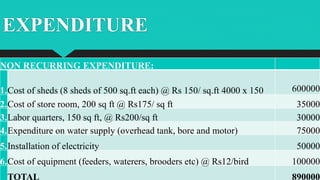
NON RECURRING EXPENDITURE:
1.Cost of sheds (8 sheds of 500 sq.ft each) @ Rs 150/ sq.ft 4000 x 150 600000
2.Cost of store room, 200 sq ft @ Rs175/ sq ft 35000
3.Labor quarters, 150 sq ft, @ Rs200/sq ft 30000
4.Expenditure on water supply (overhead tank, bore and motor) 75000
5.Installation of electricity 50000
6.Cost of equipment (feeders, waterers, brooders etc) @ Rs12/bird 100000
TOTAL 890000
EXPENDITURE
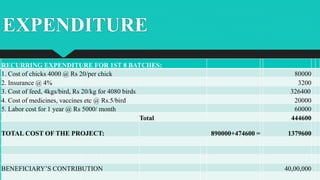
RECURRING EXPENDITURE FOR 1ST 8 BATCHES:
1. Cost of chicks 4000 @ Rs 20/per chick 80000
2. Insurance @ 4% 3200
3. Cost of feed, 4kgs/bird, Rs 20/kg for 4080 birds 326400
4. Cost of medicines, vaccines etc @ Rs.5/bird 20000
5. Labor cost for 1 year @ Rs 5000/ month 60000
Total 444600
TOTAL COST OF THE PROJECT: 890000+474600 = 1379600
BENEFICIARY’S CONTRIBUTION 40,00,000
COMPETITION
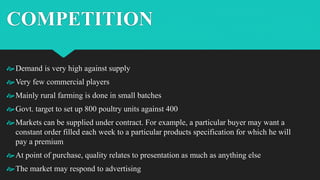
Demand is very high against supply
Very few commercial players
Mainly rural farming is done in small batches
Govt. target to set up 800 poultry units against 400
Markets can be supplied under contract. For example, a particular buyer may want a
constant order filled each week to a particular products specification for which he will
pay a premium
At point of purchase, quality relates to presentation as much as anything else
The market may respond to advertising
FINAL MARKETING
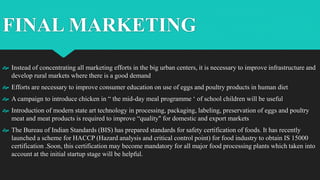
 Instead of concentrating all marketing efforts in the big urban centers, it is necessary to improve infrastructure and
develop rural markets where there is a good demand
 Efforts are necessary to improve consumer education on use of eggs and poultry products in human diet
 A campaign to introduce chicken in “ the mid-day meal programme ‘ of school children will be useful
 Introduction of modern state art technology in processing, packaging, labeling, preservation of eggs and poultry
meat and meat products is required to improve “quality" for domestic and export markets
 The Bureau of Indian Standards (BIS) has prepared standards for safety certification of foods. It has recently
launched a scheme for HACCP (Hazard analysis and critical control point) for food industry to obtain IS 15000
certification .Soon, this certification may become mandatory for all major food processing plants which taken into
account at the initial startup stage will be helpful.
THANK YOU
SULTAN MIRZA FOODS

Project on Poultry

  • 1.
    LIVESTOCK POULTRY FARMING PREPAREDBY: ABHIJEET VERMA SULTAN MIRZA FOODS
  • 2.
    MARKET SCENARIO SOURCE: INDIANSTATISTICAL INSTITUTE (ISI) Selected Country-wise Consumption of Poultry Meat Including India (1981, 1986, 1991, 1996 and 2001) ('000 MT) Countries 1981 1986 1991 1996 2001 Annual Compound Growth Rates 1981- 1981- 1992- 2001 1991 2001 Developing (Total) 8804 11503 16990 27011 36968 8.23 6.69 7.8 Bangladesh 56 65 83 118 115 4.36 3.99 2.89 Brazil 1224 1430 2378 3569 5058 8.64 6.98 8.62 China 1749 2357 4611 9209 13283 12.54 10.38 10.84 India 141 209 389 665 1251 11.33 10.84 10.25 Developed (Total) 18044 21138 25373 27645 31678 2.79 3.83 2.39 Australia 295 355 413 491 640 4.19 4.16 4.68 Canada 542 645 777 911 1129 3.8 4.16 3.97 Denmark 46 64 71 84 109 3.94 4.09 3.95 World (Total) 26847 32642 42363 54656 68646 5.1 4.85 5.02
  • 3.
    MARKET SCENARIO  Worldwideconsumption of poultry is increasing  Generally accepted in most cultures  Three livestock products dominate the Indian market, namely milk, eggs and chicken meat  Livestock sector contributes approximately 4% to GDP and 27% to agriculture GDP  India is emerging as the world`s 2nd largest poultry market with an annual growth of more than 14%  India ranks 6th in broiler production (125 billion Rupees) with an annual output of 2.39 million tonnes of broiler meat, as per the estimates of the Ministry of Agriculture, Govt. of India  The total poultry industry is valued at about 350 billion rupees  The per capita consumption per year is approx. 2.4 kg, which is much lower than the National Institute of Nutrition`s recommendations of 11 kg
  • 4.
    MAJOR INSTITUTION SUPPORT APEDA(Agricultural& Processed Food Products Export Development Authority) National Meat & Poultry Processing Board (NMPPB) Poultry Federation of India (PFD)  National Dairy Research Institute (NDRI) All India Poultry Breeders Association (AIPMA) India Poultry Equipment Manufacturers Association (IPEMA) National Egg Coordination Committee (NECC) Compound Livestock Feed Manufacturers Association (CLFMA) National Institute of Nutrition (NIN), India Poultry Journalists` Association (IPJA), Andhra Pradesh Poultry Federation (APPF) and Poultry Breeders Association (A.P.) etc.
  • 5.
    DEMAND & SUPPLY:JHARKHAND State-wise Meat Production from Recognised Sector in India - Part III (2009-2010) States/UTs Poultry No. of Animals Slaughtered Average Yield Rate Per Animal Meat Production (In 000 Nos.) (In Kg.) (In 000 Tonne) Jharkhand 5332 0.63 3 (2010-2011) Jharkhand 6801 0.63 4 India 1816848 1.207 2193
  • 6.
    DEMAND & SUPPLY:JHARKHAND District-wise Number of Poultry in Jharkhand -2003 District Total Cocks Total Hen Total Chickens Total Fowls Total Duck Etc. Total Poultry Hazaribagh 164881 251179 485471 901531 17199 918730 District/Location-wise Poultry Population in Jharkhand -2003 District Location Poultry Fowls Desi Improved Total Fowls (Chicken below 5 months) (Chicken below 5 months) For Egg For Meat Total For Egg For Meat Total Hazaribagh Rural 125380 168261 293641 7106 179762 186868 881758 Urban 1997 1949 3946 64 952 1016 19773 Total 127377 170210 297587 7170 180714 187884 901531
  • 7.
    DEMAND PROJECTION: INDIA DemandProjections of Livestock Products in India (1993, 2000, 2010 & 2020) Product 1993 2000 2010 2020 Per cent Annual Growth Rate (1999-2000) Milk 46.18 60.77 94.3 147.21 4.77 Mutton and goat meat 0.83 1.36 3.81 12.72 13.25 Beef and buffalo meat 0.49 0.61 0.84 1.15 3.39 Chicken 0.25 0.33 0.52 0.81 4.67 Eggs 9.62 13.88 24.9 44.06 6.02
  • 8.
    Market Analysis &business feasibility: Jharkhand Market study commissioned by PRADAN in collaboration with the poultry industry in 2002 The daily sales of live bird was estimated to be around 80 Metric Tonnes The average daily production in Jharkhand did not exceed more than 12 Metric Tonnes Annual growth of poultry market in Jharkhand was estimated to be around 20% in real terms The daily sale in Ranchi is 20 tons Average daily production in and around Ranchi is only 5 tons
  • 9.
    OPERATIONS LOCATION: HAZARIBAGH It’s asmall town with Urban population of around 3 lakhs as against the total population of 17 lakhs approx. (Census: 2011 data). Rural areas are slightly far from the town which acts as a perfect destination for poultry farming because land and labor are relatively cheaper in rural areas. It also satisfies the chaos and noise free, calm and quiet place required for the poultry farming. Land is easily available for lease and purchase. Also, there are poultry sheds available on rent. The area has fresh and pollution free environment. Source of sufficient amount of fresh and clean water. Suitable transportation system available.
  • 10.
    OPERATIONS SELECTING BREEDS, HOUSING/CAGE,FEED  BROILERS: The poultry breed is suitable for commercial meat production and is known as broiler poultry  They consume foods and convert them to meat quickly  They grow fast and become suitable for slaughter purpose within very short time  They are like meat producing machines  HOUSING/CAGE: house or cage is sufficient and spacious enough to accommodate the birds with necessary space and facilities  ventilation system in the house  Distance from one house to another house will be at least 40 feet  Suitable drainage system inside the house  FEEDING: to be purchased from reputed brand  CAGE MANAGEMENT: proper training to the laborers
  • 11.
    PRODUCTION INITIAL PRODUCTION: ECONOMICPARAMETERS 1. No. of birds per week 500 2. No. of batches per cycle 8 3. No. of batches in the 1st year 40 4. No. of batches from 2nd year onwards 52 5. Cost of construction of shed Rs 10/sq.ft 6. Cost of equipment Rs 12/bird 7. Cost of day old chicks Rs 20 8. Feed required per bird 4 kgs 9. Average cost of feed Rs. 20/kg 10. Wt. on selling 2 Kg 11. Selling price of birds Rs 90/Kg (2012-13) 12. Mortality rate 5% 13. No. of birds sold in each batch 475 14. Income from manure Rs. 1/bird 15. Interest rate 12% 16. Deprecation on sheds & equip. 10% 17. Average value of closing stock Rs 95 18. No. of batches not sold after 6 years 7
  • 12.
    EXPENDITURE NON RECURRING EXPENDITURE: 1.Costof sheds (8 sheds of 500 sq.ft each) @ Rs 150/ sq.ft 4000 x 150 600000 2.Cost of store room, 200 sq ft @ Rs175/ sq ft 35000 3.Labor quarters, 150 sq ft, @ Rs200/sq ft 30000 4.Expenditure on water supply (overhead tank, bore and motor) 75000 5.Installation of electricity 50000 6.Cost of equipment (feeders, waterers, brooders etc) @ Rs12/bird 100000 TOTAL 890000
  • 13.
    EXPENDITURE RECURRING EXPENDITURE FOR1ST 8 BATCHES: 1. Cost of chicks 4000 @ Rs 20/per chick 80000 2. Insurance @ 4% 3200 3. Cost of feed, 4kgs/bird, Rs 20/kg for 4080 birds 326400 4. Cost of medicines, vaccines etc @ Rs.5/bird 20000 5. Labor cost for 1 year @ Rs 5000/ month 60000 Total 444600 TOTAL COST OF THE PROJECT: 890000+474600 = 1379600 BENEFICIARY’S CONTRIBUTION 40,00,000
  • 14.
    COMPETITION Demand is veryhigh against supply Very few commercial players Mainly rural farming is done in small batches Govt. target to set up 800 poultry units against 400 Markets can be supplied under contract. For example, a particular buyer may want a constant order filled each week to a particular products specification for which he will pay a premium At point of purchase, quality relates to presentation as much as anything else The market may respond to advertising
  • 15.
    FINAL MARKETING  Insteadof concentrating all marketing efforts in the big urban centers, it is necessary to improve infrastructure and develop rural markets where there is a good demand  Efforts are necessary to improve consumer education on use of eggs and poultry products in human diet  A campaign to introduce chicken in “ the mid-day meal programme ‘ of school children will be useful  Introduction of modern state art technology in processing, packaging, labeling, preservation of eggs and poultry meat and meat products is required to improve “quality" for domestic and export markets  The Bureau of Indian Standards (BIS) has prepared standards for safety certification of foods. It has recently launched a scheme for HACCP (Hazard analysis and critical control point) for food industry to obtain IS 15000 certification .Soon, this certification may become mandatory for all major food processing plants which taken into account at the initial startup stage will be helpful.
  • 16.