THE ROLE OF CHICKEN IN THE TANZANIAN ECONOMY
AND OPPORTUNITIES FOR DEVELOPMENT: AN
OVERVIEW
D.M. Komwihangilo
Tanzania Livestock Research Institute (TALIRI)
United Republic of Tanzania
TANZANIA LIVESTOCK RESEARCH INSTITUTE
First ACGG Tanzania Innovation Platform Meeting
Dar es Salaam, Tanzania
13-14 July 2015
In this presentation:
1. Introduction
– Poultry production systems and general
performance
2. Role of chickens in the household
and national economy
3. Challenges in the chicken industry
4. Opportunities for development of the
chicken industry
5. Conclusion
Introduction
The poultry industry in Tanzania comprises of two
production systems
1. The traditional/
family poultry or
the local chicken
• Poultry population -
37 million
• 90% of poultry in
Tanzania are chickens.
2. The commercial
poultry systems
• 32 million are
commercial chickens
• kept in the urban and
peri-urban areas for
egg and meat
production.
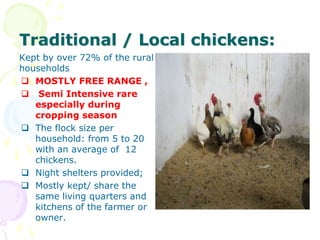
Traditional / Local chickens:
Kept by over 72% of the rural
households
 MOSTLY FREE RANGE ,
 Semi Intensive rare
especially during
cropping season
 The flock size per
household: from 5 to 20
with an average of 12
chickens.
 Night shelters provided;
 Mostly kept/ share the
same living quarters and
kitchens of the farmer or
owner.
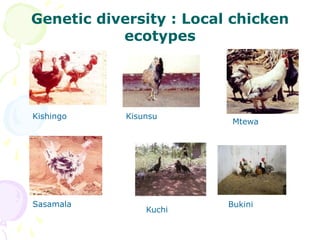
Kishingo Kisunsu
Sasamala
Mtewa
Genetic diversity : Local chicken
ecotypes
Kuchi
Bukini
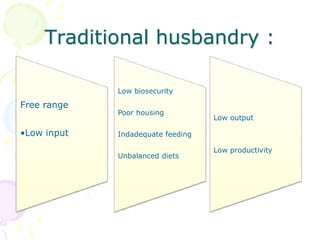
Traditional husbandry :
Free range
•Low input
Low biosecurity
Poor housing
Indadequate feeding
Unbalanced diets
Low output
Low productivity
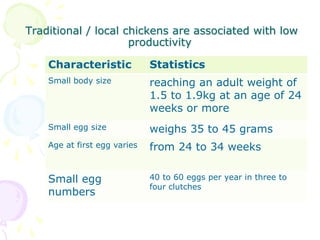
Traditional / local chickens are associated with low
productivity
Characteristic Statistics
Small body size reaching an adult weight of
1.5 to 1.9kg at an age of 24
weeks or more
Small egg size weighs 35 to 45 grams
Age at first egg varies from 24 to 34 weeks
Small egg
numbers
40 to 60 eggs per year in three to
four clutches
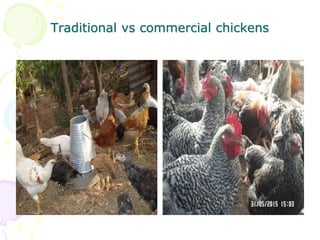
Traditional vs commercial chickens
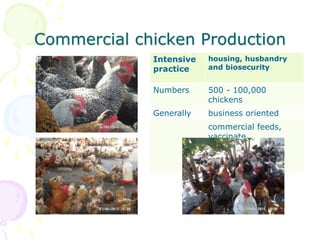
Commercial chicken Production
Intensive
practice
housing, husbandry
and biosecurity
Numbers 500 - 100,000
chickens
Generally business oriented
commercial feeds,
vaccinate
Role of chickens in the household
and national economy
Traditional / Local chickens have
several Socio economic roles
nutrition - the egg and meat as a
source of rich animal protein
Food security, can exchange for grains
when there is shortage in a household
Source of households income-
money for needs; school uniforms,
medical treatments, sugar and salt
Religious and ritual ceremonies.
Role of chickens in the household and
national economy ……………..
• Agriculture as a whole contributes
30% to the national GDP
• The livestock sector contributes
18% of Agricultural GDP and 4.7% of
national GDP
• Chickens contribute 16% of livestock
GDP, 3% of agricultural GDP and 1%
of national GDP.
• Thus the contribution of chicken to
the national economy is significant.
Role of chickens in the economy………..
• In 2013, the total chicken meat produced was
87,408 tons which are 87,408,000 kg.
• According to the 2006/2007 statistics, the total
number eggs produced was 910 million. Out of
these eggs 367,955,296 were from local
chickens.
• About 68% of all eggs produced by local chickens
are sold, that is 250,209,600 eggs, which is very
significant to the economy of for rural
households.
Role of chickens in the economy………..
• The current price of 1kg chicken meat is about
Shs. 10,000/= on the average while eggs are
sold at Shs. 400 per egg or Shs. 12,000/= per
tray of 12 eggs.
• Therefore the yearly monetary value of chicken
meat produced in Tanzania is over Shs. 874
billion while the value of eggs is Shs. 364 billion.
• Total yearly value of chickens and eggs is 1,242
billion.
Role of chickens in the economy………..
• If this income is compared to this year’s total
Ministerial budget (2015/2016) amounting to
Shs. 68,810,404,000/= of which Shs.
46,158,922,000 is for operational expenses and
Shs. 22,651,482,000/= for development, the
sector contribute about 2 percent.
• Assuming that 68% of the chicken produce is
sold, then the direct income from chicken meat
and eggs is Shs. 841.8 billion. However, on the
expected monetary contribution from chicken
industry is expected to be much higher if all
nodes along value chain are considered (Indirect
contribution).
Summary : Other socio-economic roles
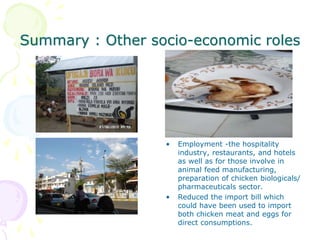
• Employment -the hospitality
industry, restaurants, and hotels
as well as for those involve in
animal feed manufacturing,
preparation of chicken biologicals/
pharmaceuticals sector.
• Reduced the import bill which
could have been used to import
both chicken meat and eggs for
direct consumptions.
Challenges in the chicken industry
1. Chicken loss:
• The losses are caused by
chicken diseases (NCD,
coccidiosis, collibacillosis and
salmonellosis, ectoparasites,
causing over 50% to 100%
mortality
• Malnutrition and predation
due to poor husbandry
practices and poor
biosecurity.
• Among commercial chickens,
failure to apply proper and
regular vaccination regimes
as well as regular treatments,
especially against coccidiosis
and worms are the major
reasons for the losses.
Challenges …….
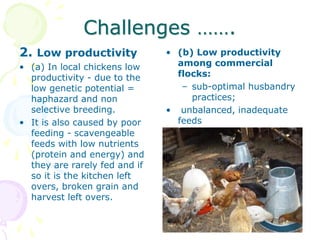
2. Low productivity
• (a) In local chickens low
productivity - due to the
low genetic potential =
haphazard and non
selective breeding.
• It is also caused by poor
feeding - scavengeable
feeds with low nutrients
(protein and energy) and
they are rarely fed and if
so it is the kitchen left
overs, broken grain and
harvest left overs.
• (b) Low productivity
among commercial
flocks:
– sub-optimal husbandry
practices;
• unbalanced, inadequate
feeds
Challenges …….
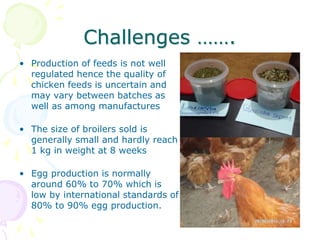
• Production of feeds is not well
regulated hence the quality of
chicken feeds is uncertain and
may vary between batches as
well as among manufactures
• The size of broilers sold is
generally small and hardly reach
1 kg in weight at 8 weeks
• Egg production is normally
around 60% to 70% which is
low by international standards of
80% to 90% egg production.
Challenges ………
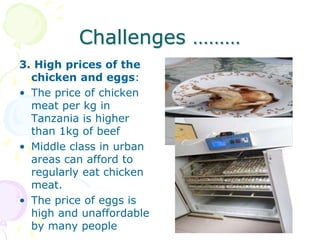
3. High prices of the
chicken and eggs:
• The price of chicken
meat per kg in
Tanzania is higher
than 1kg of beef
• Middle class in urban
areas can afford to
regularly eat chicken
meat.
• The price of eggs is
high and unaffordable
by many people
Challenges ………
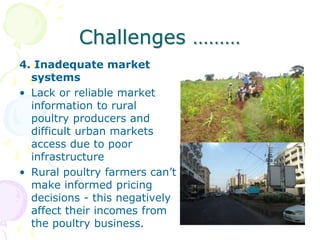
4. Inadequate market
systems
• Lack or reliable market
information to rural
poultry producers and
difficult urban markets
access due to poor
infrastructure
• Rural poultry farmers can’t
make informed pricing
decisions - this negatively
affect their incomes from
the poultry business.
Opportunities
1. A ready market for the chicken and products - Chicken
meat and eggs are in high demand especially in the urban
and peri-urban areas
– Prices for the chicken and products must be
reduced and be lower than beef, the main
competitor
2. Room for increased production
– addressing challenges, Improve extension services,
– training of farmers on optimal chicken husbandry for
both the commercial farmers and local chicken keepers
– Extension packages must address the constraints listed
under challenges – reduce chicken losses
– Export of chicken and products, establishing processing
industry for the chicken and products, more income /
tax, poverty reduction
CONCLUSION
• Chickens play substantial roles in the household and
national economy
• For the traditional poultry/chicken industry to move to large-scale
commercial production, it will require institutional support
systems including:
– efficient extension services
– stronger regulatory capacity at the central and council levels to
ensure the quality of poultry inputs and products entering the
market
– adequate capacity for disease control including epidemic
preparedness;
– increased investment in new technologies and promotion of
new knowledge use to drive scales;
– easy access to liquidity to stimulate private sector investment;
and
– supportive market systems to enable more profitable sales
chickens and increase income from the poultry enterprise

The role of chicken in the Tanzanian economy and opportunities for development: An overview

  • 1.
    THE ROLE OFCHICKEN IN THE TANZANIAN ECONOMY AND OPPORTUNITIES FOR DEVELOPMENT: AN OVERVIEW D.M. Komwihangilo Tanzania Livestock Research Institute (TALIRI) United Republic of Tanzania TANZANIA LIVESTOCK RESEARCH INSTITUTE First ACGG Tanzania Innovation Platform Meeting Dar es Salaam, Tanzania 13-14 July 2015
  • 2.
    In this presentation: 1.Introduction – Poultry production systems and general performance 2. Role of chickens in the household and national economy 3. Challenges in the chicken industry 4. Opportunities for development of the chicken industry 5. Conclusion
  • 3.
    Introduction The poultry industryin Tanzania comprises of two production systems 1. The traditional/ family poultry or the local chicken • Poultry population - 37 million • 90% of poultry in Tanzania are chickens. 2. The commercial poultry systems • 32 million are commercial chickens • kept in the urban and peri-urban areas for egg and meat production.
  • 4.
    Traditional / Localchickens: Kept by over 72% of the rural households  MOSTLY FREE RANGE ,  Semi Intensive rare especially during cropping season  The flock size per household: from 5 to 20 with an average of 12 chickens.  Night shelters provided;  Mostly kept/ share the same living quarters and kitchens of the farmer or owner.
  • 5.
    Kishingo Kisunsu Sasamala Mtewa Genetic diversity: Local chicken ecotypes Kuchi Bukini
  • 6.
    Traditional husbandry : Freerange •Low input Low biosecurity Poor housing Indadequate feeding Unbalanced diets Low output Low productivity
  • 7.
    Traditional / localchickens are associated with low productivity Characteristic Statistics Small body size reaching an adult weight of 1.5 to 1.9kg at an age of 24 weeks or more Small egg size weighs 35 to 45 grams Age at first egg varies from 24 to 34 weeks Small egg numbers 40 to 60 eggs per year in three to four clutches
  • 8.
  • 9.
    Commercial chicken Production Intensive practice housing,husbandry and biosecurity Numbers 500 - 100,000 chickens Generally business oriented commercial feeds, vaccinate
  • 10.
    Role of chickensin the household and national economy Traditional / Local chickens have several Socio economic roles nutrition - the egg and meat as a source of rich animal protein Food security, can exchange for grains when there is shortage in a household Source of households income- money for needs; school uniforms, medical treatments, sugar and salt Religious and ritual ceremonies.
  • 11.
    Role of chickensin the household and national economy …………….. • Agriculture as a whole contributes 30% to the national GDP • The livestock sector contributes 18% of Agricultural GDP and 4.7% of national GDP • Chickens contribute 16% of livestock GDP, 3% of agricultural GDP and 1% of national GDP. • Thus the contribution of chicken to the national economy is significant.
  • 12.
    Role of chickensin the economy……….. • In 2013, the total chicken meat produced was 87,408 tons which are 87,408,000 kg. • According to the 2006/2007 statistics, the total number eggs produced was 910 million. Out of these eggs 367,955,296 were from local chickens. • About 68% of all eggs produced by local chickens are sold, that is 250,209,600 eggs, which is very significant to the economy of for rural households.
  • 13.
    Role of chickensin the economy……….. • The current price of 1kg chicken meat is about Shs. 10,000/= on the average while eggs are sold at Shs. 400 per egg or Shs. 12,000/= per tray of 12 eggs. • Therefore the yearly monetary value of chicken meat produced in Tanzania is over Shs. 874 billion while the value of eggs is Shs. 364 billion. • Total yearly value of chickens and eggs is 1,242 billion.
  • 14.
    Role of chickensin the economy……….. • If this income is compared to this year’s total Ministerial budget (2015/2016) amounting to Shs. 68,810,404,000/= of which Shs. 46,158,922,000 is for operational expenses and Shs. 22,651,482,000/= for development, the sector contribute about 2 percent. • Assuming that 68% of the chicken produce is sold, then the direct income from chicken meat and eggs is Shs. 841.8 billion. However, on the expected monetary contribution from chicken industry is expected to be much higher if all nodes along value chain are considered (Indirect contribution).
  • 15.
    Summary : Othersocio-economic roles • Employment -the hospitality industry, restaurants, and hotels as well as for those involve in animal feed manufacturing, preparation of chicken biologicals/ pharmaceuticals sector. • Reduced the import bill which could have been used to import both chicken meat and eggs for direct consumptions.
  • 16.
    Challenges in thechicken industry 1. Chicken loss: • The losses are caused by chicken diseases (NCD, coccidiosis, collibacillosis and salmonellosis, ectoparasites, causing over 50% to 100% mortality • Malnutrition and predation due to poor husbandry practices and poor biosecurity. • Among commercial chickens, failure to apply proper and regular vaccination regimes as well as regular treatments, especially against coccidiosis and worms are the major reasons for the losses.
  • 17.
    Challenges ……. 2. Lowproductivity • (a) In local chickens low productivity - due to the low genetic potential = haphazard and non selective breeding. • It is also caused by poor feeding - scavengeable feeds with low nutrients (protein and energy) and they are rarely fed and if so it is the kitchen left overs, broken grain and harvest left overs. • (b) Low productivity among commercial flocks: – sub-optimal husbandry practices; • unbalanced, inadequate feeds
  • 18.
    Challenges ……. • Productionof feeds is not well regulated hence the quality of chicken feeds is uncertain and may vary between batches as well as among manufactures • The size of broilers sold is generally small and hardly reach 1 kg in weight at 8 weeks • Egg production is normally around 60% to 70% which is low by international standards of 80% to 90% egg production.
  • 19.
    Challenges ……… 3. Highprices of the chicken and eggs: • The price of chicken meat per kg in Tanzania is higher than 1kg of beef • Middle class in urban areas can afford to regularly eat chicken meat. • The price of eggs is high and unaffordable by many people
  • 20.
    Challenges ……… 4. Inadequatemarket systems • Lack or reliable market information to rural poultry producers and difficult urban markets access due to poor infrastructure • Rural poultry farmers can’t make informed pricing decisions - this negatively affect their incomes from the poultry business.
  • 21.
    Opportunities 1. A readymarket for the chicken and products - Chicken meat and eggs are in high demand especially in the urban and peri-urban areas – Prices for the chicken and products must be reduced and be lower than beef, the main competitor 2. Room for increased production – addressing challenges, Improve extension services, – training of farmers on optimal chicken husbandry for both the commercial farmers and local chicken keepers – Extension packages must address the constraints listed under challenges – reduce chicken losses – Export of chicken and products, establishing processing industry for the chicken and products, more income / tax, poverty reduction
  • 22.
    CONCLUSION • Chickens playsubstantial roles in the household and national economy • For the traditional poultry/chicken industry to move to large-scale commercial production, it will require institutional support systems including: – efficient extension services – stronger regulatory capacity at the central and council levels to ensure the quality of poultry inputs and products entering the market – adequate capacity for disease control including epidemic preparedness; – increased investment in new technologies and promotion of new knowledge use to drive scales; – easy access to liquidity to stimulate private sector investment; and – supportive market systems to enable more profitable sales chickens and increase income from the poultry enterprise