Welcome
To our
Presentation
We present you all
Poultry Farm management
In
Pakistan
We are
1.Abdul Rehman 1298
2. Mustaq Meo 1297
3.Abdul Rehman 1296
Introduction
Poultry is one of the most important sectors
of agriculture in Pakistan for maintaining
the need of protein and nutrition. It was in
1965that the poultry industry started in an
organized manner in Pakistan.
Importance of Poultry Production in
Pakistan
•Health protein
•National economy
•Contribution in GDP
•Poverty reduction
•Employment to new generation
Overview of poultry sector in
Pakistan
 Campaign launched in 1963 to increase the
poultry production of the country
 Allotment of state lands on lease for poultry
farms
 Development of Pakistan's poultry industry
 1st phase is 1960-1970
 2nd phase 1971-1975
 3rd phase is 1976-1980 and onwards
Intensive (commercial) poultry
•Farms 25897
•Hatcheries 305
•Feed mills 154
Types of farms
1.Breeding farms
2.Layer farms
3.Broiler farm
Farm preparation
Disinfection (washing with 4%
formalin)
Fumigation (kmno4 + formalin)
Washing of drinker and feeding
pans
Maintenance and clarification of
the farms
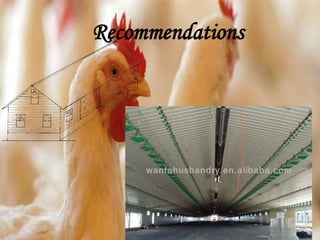
Recommendations
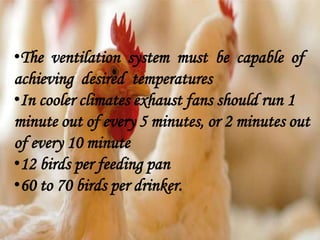
•The ventilation system must be capable of
achieving desired temperatures
•In cooler climates exhaust fans should run 1
minute out of every 5 minutes, or 2 minutes out
of every 10 minute
•12 birds per feeding pan
•60 to 70 birds per drinker.
Breeder Farm Management
1) Preparing for chick arrival
•Transport should be in clean, proper
ventilated and temperature controlled
vehicles
• All the chick should be the same age.
• Brood chick on an all-in, all-out
program
Planning for chick placement
Female Rearing Floor space recommendation
sq.ft/bird birds/sq.meter
Brooding area( first 5 days) 0.36 30.00
Open sided area 1.75 6.00
Dark out Area 1.50 7.00
Production
Floor open sided 2.75 3.85
Dark out Area 2.25 4.70
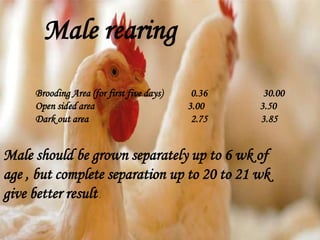
Male rearing
Brooding Area (for first five days) 0.36 30.00
Open sided area 3.00 3.50
Dark out area 2.75 3.85
Male should be grown separately up to 6 wk of
age , but complete separation up to 20 to 21 wk
give better result.
•Cover the whole space with litter
•Proper ventilation
•Provide 2 supplementary drinker for every 100
chicks
•Provide 1 feeder try for 75 birds
•Provide attraction light so that chicks remain
close to the heat.
•Brooder surrounded guard should be no more
then 46cm high(18 inc)
Start or Brooding phase(1-14 days)
Feed ,Water ,Temperature, Air quality
• Fresh feed & Water
•Brooder & Heater should be check regularly
•Supplemental Drinker
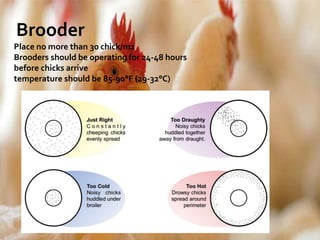
Brooder
Place no more than 30 chick/m2
Brooders should be operating for 24-48 hours
before chicks arrive
temperature should be 85-90°F (29-32°C)
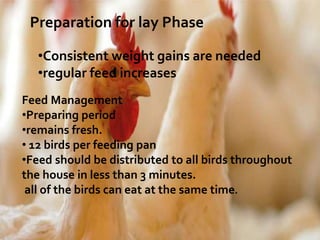
Preparation for lay Phase
•Consistent weight gains are needed
•regular feed increases
Feed Management
•Preparing period
•remains fresh.
• 12 birds per feeding pan
•Feed should be distributed to all birds throughout
the house in less than 3 minutes.
all of the birds can eat at the same time.
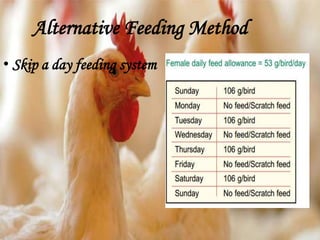
Alternative Feeding Method
• Skip a day feeding system
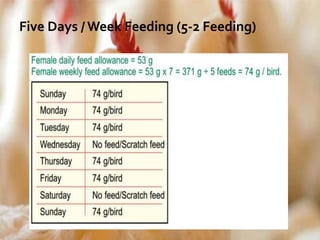
Five Days / Week Feeding (5-2 Feeding)
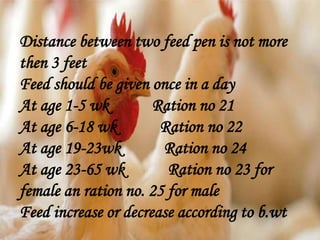
Distance between two feed pen is not more
then 3 feet
Feed should be given once in a day
At age 1-5 wk Ration no 21
At age 6-18 wk Ration no 22
At age 19-23wk Ration no 24
At age 23-65 wk Ration no 23 for
female an ration no. 25 for male
Feed increase or decrease according to b.wt
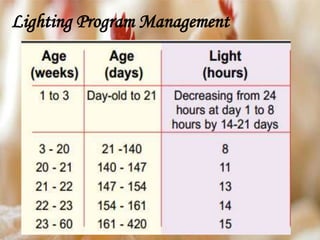
Lighting Program Management
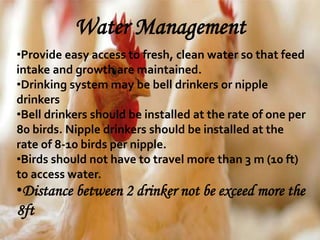
Water Management
•Provide easy access to fresh, clean water so that feed
intake and growth are maintained.
•Drinking system may be bell drinkers or nipple
drinkers
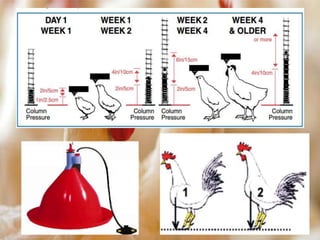
•Bell drinkers should be installed at the rate of one per
80 birds. Nipple drinkers should be installed at the
rate of 8-10 birds per nipple.
•Birds should not have to travel more than 3 m (10 ft)
to access water.
•Distance between 2 drinker not be exceed more the
8ft
Daily water consumption
•Chickens normally drink between 1.6
– 2.0 times their feed intake on a daily
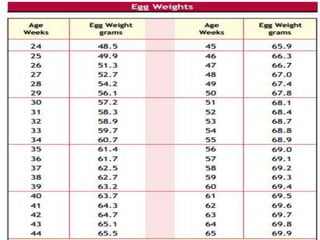
basis at 21°C (70°F)
Measurement of Cubical water tank
Length xWidth x Height
1cub.ft contain 28.32 litter water
7 x 3 x 4 = 84 cub.ft
Water in 84 cub. ft = 84 x 28.32 = 2378 L
Birds weighing & Body weight control
•Objective of body weight control is to rear
all of the birds to the target weight for age
with good uniformity
•Feed amounts during rearing are based on
body weight and maintenance, whereas in
lay they are based on these two factors plus
egg production and egg weight.
Uniformity
Mark the chart at body weights of 5% or 7% either
side of the average body weight. Count the
number of birds that fall into this band. Calculate
the percentage of the sample that this number
represents.
e.g. 1000 +900+950+1050+1100
Avg. 1000 gm
1000 + 5% = 1050gm
1000 – 5% = 950gm
5 – 2 = 3
3/5 x 100 = 60%
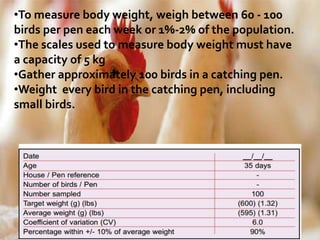
•To measure body weight, weigh between 60 - 100
birds per pen each week or 1%-2% of the population.
•The scales used to measure body weight must have
a capacity of 5 kg
•Gather approximately 100 birds in a catching pen.
•Weight every bird in the catching pen, including
small birds.
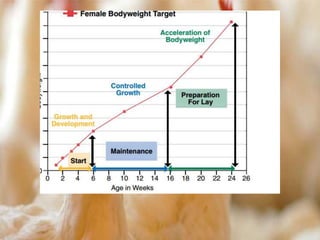
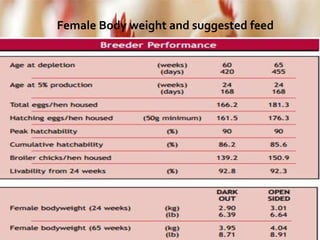
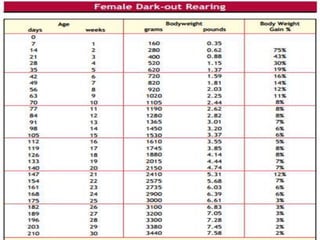
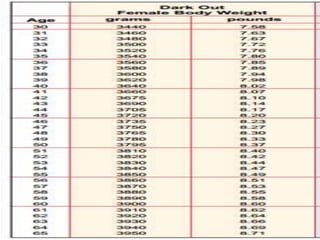
Female Body weight and suggested feed
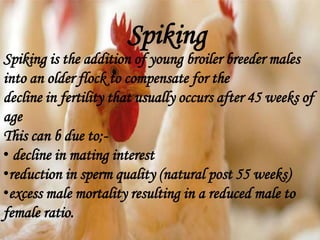
Spiking
Spiking is the addition of young broiler breeder males
into an older flock to compensate for the
decline in fertility that usually occurs after 45 weeks of
age
This can b due to;-
• decline in mating interest
•reduction in sperm quality (natural post 55 weeks)
•excess male mortality resulting in a reduced male to
female ratio.
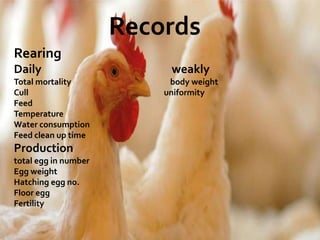
Records
Rearing
Daily weakly
Total mortality body weight
Cull uniformity
Feed
Temperature
Water consumption
Feed clean up time
Production
total egg in number
Egg weight
Hatching egg no.
Floor egg
Fertility
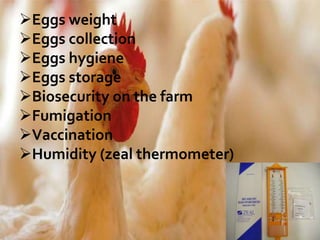
Eggs weight
Eggs collection
Eggs hygiene
Eggs storage
Biosecurity on the farm
Fumigation
Vaccination
Humidity (zeal thermometer)
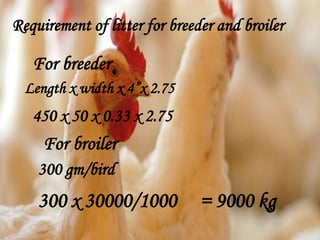
Requirement of litter for breeder and broiler
For breeder
Length x width x 4”x 2.75
450 x 50 x 0.33 x 2.75
For broiler
300 gm/bird
300 x 30000/1000 = 9000 kg
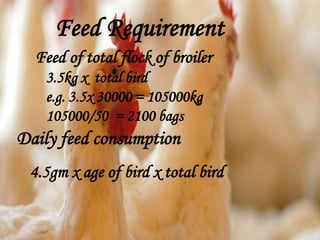
Feed Requirement
Feed of total flock of broiler
3.5kg x total bird
e.g. 3.5x 30000 = 105000kg
105000/50 = 2100 bags
Daily feed consumption
4.5gm x age of bird x total bird
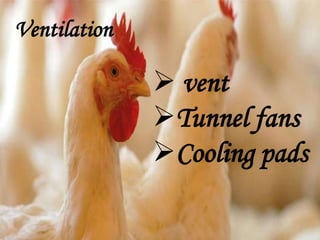
Ventilation
 vent
Tunnel fans
Cooling pads
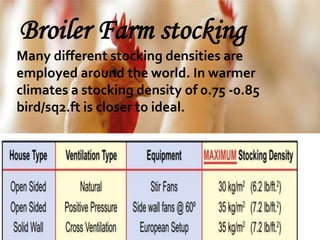
Broiler Farm stocking
Many different stocking densities are
employed around the world. In warmer
climates a stocking density of 0.75 -0.85
bird/sq2.ft is closer to ideal.
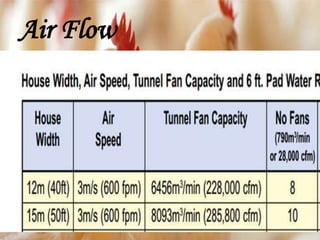
Air Flow
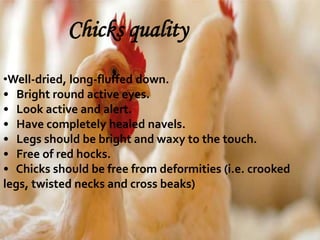
Chicks quality
•Well-dried, long-fluffed down.
• Bright round active eyes.
• Look active and alert.
• Have completely healed navels.
• Legs should be bright and waxy to the touch.
• Free of red hocks.
• Chicks should be free from deformities (i.e. crooked
legs, twisted necks and cross beaks)
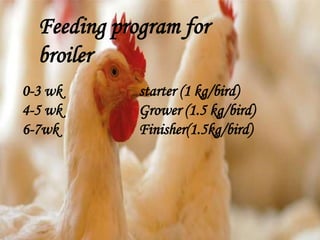
Feeding program for
broiler
0-3 wk starter (1 kg/bird)
4-5 wk Grower (1.5 kg/bird)
6-7wk Finisher(1.5kg/bird)
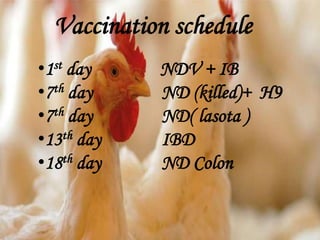
Vaccination schedule
•1st day NDV + IB
•7th day ND (killed)+ H9
•7th day ND( lasota )
•13th day IBD
•18th day ND Colon
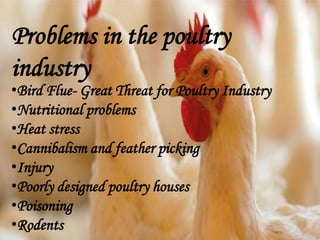
•Bird Flue- Great Threat for Poultry Industry
•Nutritional problems
•Heat stress
•Cannibalism and feather picking
•Injury
•Poorly designed poultry houses
•Poisoning
•Rodents
Problems in the poultry
industry
Do
You
Have
Any
Question??
Thank you
everyone
for staying with us
through out the
whole
Presentation’

poultry farm management GCVS

  • 1.
  • 2.
    We present youall Poultry Farm management In Pakistan
  • 3.
    We are 1.Abdul Rehman1298 2. Mustaq Meo 1297 3.Abdul Rehman 1296
  • 4.
    Introduction Poultry is oneof the most important sectors of agriculture in Pakistan for maintaining the need of protein and nutrition. It was in 1965that the poultry industry started in an organized manner in Pakistan.
  • 5.
    Importance of PoultryProduction in Pakistan •Health protein •National economy •Contribution in GDP •Poverty reduction •Employment to new generation
  • 6.
    Overview of poultrysector in Pakistan  Campaign launched in 1963 to increase the poultry production of the country  Allotment of state lands on lease for poultry farms  Development of Pakistan's poultry industry  1st phase is 1960-1970  2nd phase 1971-1975  3rd phase is 1976-1980 and onwards
  • 7.
    Intensive (commercial) poultry •Farms25897 •Hatcheries 305 •Feed mills 154
  • 8.
    Types of farms 1.Breedingfarms 2.Layer farms 3.Broiler farm
  • 9.
    Farm preparation Disinfection (washingwith 4% formalin) Fumigation (kmno4 + formalin) Washing of drinker and feeding pans Maintenance and clarification of the farms
  • 10.
  • 11.
    •The ventilation systemmust be capable of achieving desired temperatures •In cooler climates exhaust fans should run 1 minute out of every 5 minutes, or 2 minutes out of every 10 minute •12 birds per feeding pan •60 to 70 birds per drinker.
  • 12.
    Breeder Farm Management 1)Preparing for chick arrival •Transport should be in clean, proper ventilated and temperature controlled vehicles • All the chick should be the same age. • Brood chick on an all-in, all-out program
  • 13.
    Planning for chickplacement Female Rearing Floor space recommendation sq.ft/bird birds/sq.meter Brooding area( first 5 days) 0.36 30.00 Open sided area 1.75 6.00 Dark out Area 1.50 7.00 Production Floor open sided 2.75 3.85 Dark out Area 2.25 4.70
  • 14.
    Male rearing Brooding Area(for first five days) 0.36 30.00 Open sided area 3.00 3.50 Dark out area 2.75 3.85 Male should be grown separately up to 6 wk of age , but complete separation up to 20 to 21 wk give better result.
  • 15.
    •Cover the wholespace with litter •Proper ventilation •Provide 2 supplementary drinker for every 100 chicks •Provide 1 feeder try for 75 birds •Provide attraction light so that chicks remain close to the heat. •Brooder surrounded guard should be no more then 46cm high(18 inc)
  • 17.
    Start or Broodingphase(1-14 days) Feed ,Water ,Temperature, Air quality • Fresh feed & Water •Brooder & Heater should be check regularly •Supplemental Drinker
  • 18.
    Brooder Place no morethan 30 chick/m2 Brooders should be operating for 24-48 hours before chicks arrive temperature should be 85-90°F (29-32°C)
  • 19.
    Preparation for layPhase •Consistent weight gains are needed •regular feed increases Feed Management •Preparing period •remains fresh. • 12 birds per feeding pan •Feed should be distributed to all birds throughout the house in less than 3 minutes. all of the birds can eat at the same time.
  • 20.
    Alternative Feeding Method •Skip a day feeding system
  • 21.
    Five Days /Week Feeding (5-2 Feeding)
  • 22.
    Distance between twofeed pen is not more then 3 feet Feed should be given once in a day At age 1-5 wk Ration no 21 At age 6-18 wk Ration no 22 At age 19-23wk Ration no 24 At age 23-65 wk Ration no 23 for female an ration no. 25 for male Feed increase or decrease according to b.wt
  • 23.
  • 24.
    Water Management •Provide easyaccess to fresh, clean water so that feed intake and growth are maintained. •Drinking system may be bell drinkers or nipple drinkers •Bell drinkers should be installed at the rate of one per 80 birds. Nipple drinkers should be installed at the rate of 8-10 birds per nipple. •Birds should not have to travel more than 3 m (10 ft) to access water. •Distance between 2 drinker not be exceed more the 8ft
  • 26.
    Daily water consumption •Chickensnormally drink between 1.6 – 2.0 times their feed intake on a daily basis at 21°C (70°F)
  • 27.
    Measurement of Cubicalwater tank Length xWidth x Height 1cub.ft contain 28.32 litter water 7 x 3 x 4 = 84 cub.ft Water in 84 cub. ft = 84 x 28.32 = 2378 L
  • 28.
    Birds weighing &Body weight control •Objective of body weight control is to rear all of the birds to the target weight for age with good uniformity •Feed amounts during rearing are based on body weight and maintenance, whereas in lay they are based on these two factors plus egg production and egg weight.
  • 29.
    Uniformity Mark the chartat body weights of 5% or 7% either side of the average body weight. Count the number of birds that fall into this band. Calculate the percentage of the sample that this number represents. e.g. 1000 +900+950+1050+1100 Avg. 1000 gm 1000 + 5% = 1050gm 1000 – 5% = 950gm 5 – 2 = 3 3/5 x 100 = 60%
  • 30.
    •To measure bodyweight, weigh between 60 - 100 birds per pen each week or 1%-2% of the population. •The scales used to measure body weight must have a capacity of 5 kg •Gather approximately 100 birds in a catching pen. •Weight every bird in the catching pen, including small birds.
  • 31.
    Female Body weightand suggested feed
  • 35.
    Spiking Spiking is theaddition of young broiler breeder males into an older flock to compensate for the decline in fertility that usually occurs after 45 weeks of age This can b due to;- • decline in mating interest •reduction in sperm quality (natural post 55 weeks) •excess male mortality resulting in a reduced male to female ratio.
  • 36.
    Records Rearing Daily weakly Total mortalitybody weight Cull uniformity Feed Temperature Water consumption Feed clean up time Production total egg in number Egg weight Hatching egg no. Floor egg Fertility
  • 37.
    Eggs weight Eggs collection Eggshygiene Eggs storage Biosecurity on the farm Fumigation Vaccination Humidity (zeal thermometer)
  • 38.
    Requirement of litterfor breeder and broiler For breeder Length x width x 4”x 2.75 450 x 50 x 0.33 x 2.75 For broiler 300 gm/bird 300 x 30000/1000 = 9000 kg
  • 39.
    Feed Requirement Feed oftotal flock of broiler 3.5kg x total bird e.g. 3.5x 30000 = 105000kg 105000/50 = 2100 bags Daily feed consumption 4.5gm x age of bird x total bird
  • 40.
  • 41.
    Broiler Farm stocking Manydifferent stocking densities are employed around the world. In warmer climates a stocking density of 0.75 -0.85 bird/sq2.ft is closer to ideal.
  • 42.
  • 43.
    Chicks quality •Well-dried, long-fluffeddown. • Bright round active eyes. • Look active and alert. • Have completely healed navels. • Legs should be bright and waxy to the touch. • Free of red hocks. • Chicks should be free from deformities (i.e. crooked legs, twisted necks and cross beaks)
  • 44.
    Feeding program for broiler 0-3wk starter (1 kg/bird) 4-5 wk Grower (1.5 kg/bird) 6-7wk Finisher(1.5kg/bird)
  • 45.
    Vaccination schedule •1st dayNDV + IB •7th day ND (killed)+ H9 •7th day ND( lasota ) •13th day IBD •18th day ND Colon
  • 46.
    •Bird Flue- GreatThreat for Poultry Industry •Nutritional problems •Heat stress •Cannibalism and feather picking •Injury •Poorly designed poultry houses •Poisoning •Rodents Problems in the poultry industry
  • 47.
  • 48.
    Thank you everyone for stayingwith us through out the whole Presentation’