Email Security &
Development
By: Yosef Gamble
CS 325
https://commons.wikimedia.org/wiki/File:Crypto_key.svg
Table of Contents
Email Security Flaws
Encryption Techniques
Public key Infrastructure (PKI)
Pretty Good Privacy (PGP)
Application
Future Development
Email Security Flaws
Email is sent in plain text.
Email uses outdated protocol, Simple Mail
Transfer Protocol (SMTP).
Includes a header full of revealing metadata.
Can easily become intercepted.
Encryption Techniques - PKI
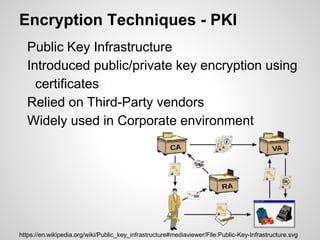
Public Key Infrastructure
Introduced public/private key encryption using
certificates
Relied on Third-Party vendors
Widely used in Corporate environment
https://en.wikipedia.org/wiki/Public_key_infrastructure#mediaviewer/File:Public-Key-Infrastructure.svg
Encryption Technique - PGP
Pretty Good Privacy
Decentralised version of PKI
Removed Third-Party Involvement
Uses ‘Web of Trust’ authentication
https://www.sandboxgeneral.com/?p=974
Applications
GNU Privacy Guard (GnuPG)
Hushmail
Lavabit, Silent Circle, & PrivateSky
Third-Party Plugins Webmail
https://en.wikipedia.org/wiki/GNU_Privacy_Guard#mediaviewer/File:Gnupg_logo.svg
Future Development
Focus on End-to-End Email Encryption and
Usability
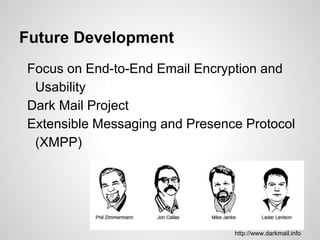
Dark Mail Project
Extensible Messaging and Presence Protocol
(XMPP)
http://www.darkmail.info
Conclusion
Email Security Flaws
Encryption Techniques
Public key Infrastructure (PKI)
Pretty Good Privacy (PGP)
Application
Future Development
Questions?
?
Works Cited
Bradbury, D. (2014, March). Can we make email secure? Network Security, 2014(3), 13-16.
Retrieved May 27, 2014, from ACM Database.
Ellison, C., & Schneier, B. (2000). Risks of pki: Secure email. Communications of the ACM,
43(1), 160.
Hallam-Baker P. (2014). Privacy protected email. Retrieved from
https://www.w3.org/2014/strint/papers/01.pdf
Nguyen P. (2004). Can we trust cryptographic software? cryptographic flaws in gnu privacy guard
V1.2.3. In C. Cachin and J. Camenisch (Eds.), Advances in Cryptology - EUROCRYPT 2004, 3027, 555-
570.
Shelley L. I. (2003). Organized crime, terrorism and cybercrime. In A. Bryden, P. Fluri (Eds.),
Security sector reform: Institutions, society and good governance (pp. 303-312).
Baden-Baden, DE: Nomos Verlagsgesellschaft.
Yu J., Cheval V., Ryan M. (2014). Challenges with end-to-end email encryption. Retrieved from
https://www.w3.org/2014/strint/papers/08.pdf

Email Security Presentation

  • 1.
    Email Security & Development By:Yosef Gamble CS 325 https://commons.wikimedia.org/wiki/File:Crypto_key.svg
  • 2.
    Table of Contents EmailSecurity Flaws Encryption Techniques Public key Infrastructure (PKI) Pretty Good Privacy (PGP) Application Future Development
  • 3.
    Email Security Flaws Emailis sent in plain text. Email uses outdated protocol, Simple Mail Transfer Protocol (SMTP). Includes a header full of revealing metadata. Can easily become intercepted.
  • 4.
    Encryption Techniques -PKI Public Key Infrastructure Introduced public/private key encryption using certificates Relied on Third-Party vendors Widely used in Corporate environment https://en.wikipedia.org/wiki/Public_key_infrastructure#mediaviewer/File:Public-Key-Infrastructure.svg
  • 5.
    Encryption Technique -PGP Pretty Good Privacy Decentralised version of PKI Removed Third-Party Involvement Uses ‘Web of Trust’ authentication https://www.sandboxgeneral.com/?p=974
  • 6.
    Applications GNU Privacy Guard(GnuPG) Hushmail Lavabit, Silent Circle, & PrivateSky Third-Party Plugins Webmail https://en.wikipedia.org/wiki/GNU_Privacy_Guard#mediaviewer/File:Gnupg_logo.svg
  • 7.
    Future Development Focus onEnd-to-End Email Encryption and Usability Dark Mail Project Extensible Messaging and Presence Protocol (XMPP) http://www.darkmail.info
  • 8.
    Conclusion Email Security Flaws EncryptionTechniques Public key Infrastructure (PKI) Pretty Good Privacy (PGP) Application Future Development
  • 9.
  • 10.
    Works Cited Bradbury, D.(2014, March). Can we make email secure? Network Security, 2014(3), 13-16. Retrieved May 27, 2014, from ACM Database. Ellison, C., & Schneier, B. (2000). Risks of pki: Secure email. Communications of the ACM, 43(1), 160. Hallam-Baker P. (2014). Privacy protected email. Retrieved from https://www.w3.org/2014/strint/papers/01.pdf Nguyen P. (2004). Can we trust cryptographic software? cryptographic flaws in gnu privacy guard V1.2.3. In C. Cachin and J. Camenisch (Eds.), Advances in Cryptology - EUROCRYPT 2004, 3027, 555- 570. Shelley L. I. (2003). Organized crime, terrorism and cybercrime. In A. Bryden, P. Fluri (Eds.), Security sector reform: Institutions, society and good governance (pp. 303-312). Baden-Baden, DE: Nomos Verlagsgesellschaft. Yu J., Cheval V., Ryan M. (2014). Challenges with end-to-end email encryption. Retrieved from https://www.w3.org/2014/strint/papers/08.pdf