AFFINITY
CHROMATOGRAPHY
Sweta Yadav
CHROMATOGRAPHY
Chromatography is the collective term for a set
of laboratory techniques for the separation of
mixtures.
CHROMATOGRAPHY
It is a physical method of separation in which the
components to be separated are distributed between
two phases, one of which is stationary (immobilize
phase) while the other (the mobile phase) moves in a
definite direction
• Can separate complex mixtures composed of many
very similar components.
• Chromatography is often coupled with analytical
instruments to complete analysis.
• A single chromatographic analysis can isolate, identify
, and quantitate multiple components of mixtures
The term comes from Greek
χρώμα:chroma means color and
γραφειν:graphein means write
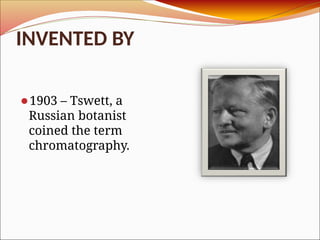
INVENTED BY
⚫1903 – Tswett, a
Russian botanist
coined the term
chromatography.
TERMINOLOGY
An immobilized phase is a stationary phase which is
immobilized on the support particles, or on the inner wall of the
column tubing.
The mobile phase is the phase which moves in a definite
direction. It may be a liquid (LC), a gas (GC), or a supercritical
fluid (SFC).
A better definition:The mobile phase consists of the sample being
separated and the solvent that moves the sample through the
column.
TERMINOLOGY
The analyte is the substance that is to be separated
during chromatography.
The sample is the matter analysed in
chromatography. It may consist of a single component
or it may be a mixture of components.
⚫Elution
- washing of the mixture
⚫Eluent
- additional solvents used for elution
⚫Residency
- time spent on column
Types of Chromatography
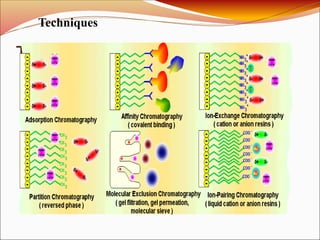
Techniques
Properties of Chromatography
1) Immiscible stationary and mobile phases
2) An arrangement where a mixture is deposited at one
end of the Stationary phase
3) Flow of the mobile phase towards the other end of
the stationary Phase
4) Different rates of partitioning for each component
5) Means for visualizing the separation of each
component
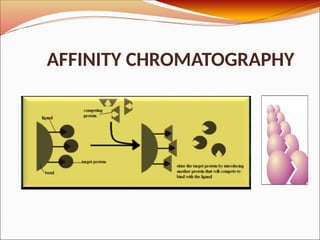
AFFINITY CHROMATOGRAPHY
Affinity History
• 1930s, first developed by A.Wilhelm Tiselius-a swedish
biochemist, won the Nobel Prize in 1948
• Used to study enzymes and other proteins
• Relies on the affinity of various biochemical compounds with
specific properties
• Affinity Chromatography is essentially a sample purification
technique, used primarily for biological molecules such as
proteins.
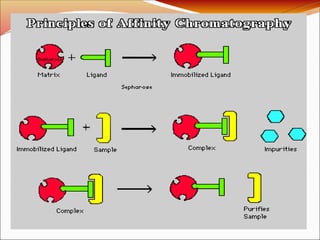
• It is a method of separating a mixture of proteins or nucleic acids
(molecules) by specific interactions of those molecules with a
component known as a ligand, which is immobilized on a
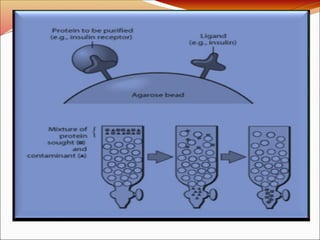
support. If a solution of, say, a mixture of proteins is passed over
(through) the column, one of the proteins binds to the ligand on
the basis of specificity and high affinity (they fit together like a
lock and key).
• The other proteins in the solution wash through the column
because they were not able to bind to the ligand.
The principle of affinity chromatography
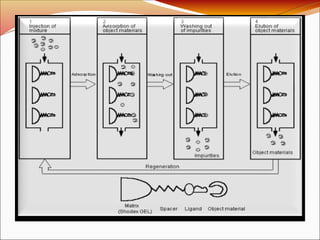
1)Inject a sample into an initially equilibrated affinity chromatography
column.
2) Only the substances with affinity for the ligand are retained in the
column.
3) Other substances with no affinity for the ligand are eluted from the
column.
4) The substances retained in the column can be eluted from the column
by changing pH or salt or organic solvent concentration of the eluent.
Specificity of Affinity Chromatography
Specificity is based on three aspect of affinity
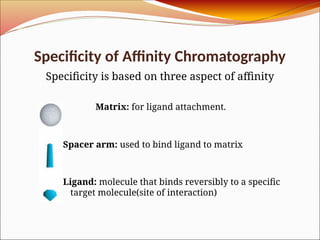
Matrix: for ligand attachment.
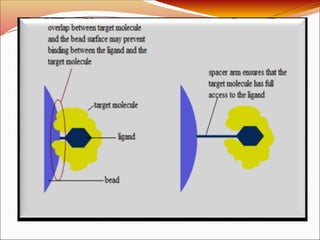
Spacer arm: used to bind ligand to matrix
Ligand: molecule that binds reversibly to a specific
target molecule(site of interaction)
Chromatographic Media
• A matrix in its use here is a substance, usually in bead form to which a
specific ligand is covalently bound.
Properties:
• It must be insoluble in solvents and buffers employed in the process
• It must be chemically and mechanically stable...
• It must be easily coupled to a ligand or spacer arm onto which the ligand can
be attached.
• It must exhibit good flow properties and have a relatively large surface area
for attachment
Immobilized Ligand
• The ligand can be selected only after the nature of the macromolecule to be
isolated is known.
• When a hormone receptor protein is to be purified by affinity
chromatography, the hormone itself is an ideal candidate for the ligand.
• For antibody isolation, an antigen or hapten may be used as ligand.
• If an enzyme is to be purified, a substrate analog, inhibitor, cofactor, or
effector may be used as an immobilized ligand.
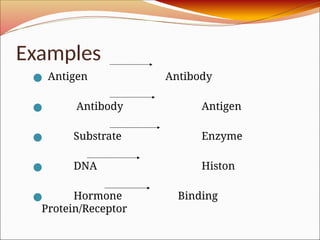
Examples
● Antigen Antibody
● Antibody Antigen
● Substrate Enzyme
● DNA Histon
● Hormone Binding
Protein/Receptor
Attachment of Ligand to Matrix
Several procedures have been developed for the covalent
attachment of the ligand to the stationary phase. All procedures
for gel modification proceed in two separate
Chemical steps:
• Activation of the functional groups on the matrix and
• Joining of the ligand to the functional group on the matrix.
Pre-packed columns
• Hi-Trap Heparin HP (High performance)
• Column size: 5 × 1 mm 1 × 5 mm 5 × 5 mm
• Average particle diameter : 34μm
• Maximum operating flow rate: 4 ml/min 20 ml/min.
Storage of pre-packed columns
• At 2-8 °C in an upright position with both caps in place.
• Thio-mersal may be added for long term storage.
• DO NOT FREEZE
• Application areas : purification, isolation or removal of the
following substances: Anti-thrombin III and other coagulation
factors, lipoproteins, lipases, protein synthesis factors
AFFINITY CHROMATOGRAPHY
Can be used;
• Purify and concentrate a substance from a mixture into a
buffering solution
• Reduce the amount of a substance in a mixture
• Discern what biological compounds bind to a particular
substance, such as drugs
• Purify and concentrate an enzyme solution
Applications
• Used in Genetic Engineering
• - nucleic acid purification
• Production of Vaccines
• - antibody purification from blood serum
• And Basic Metabolic Research
• - protein or enzyme purification from cell
free extracts
Industrial Applications
• Affinity chromatography is widely used in the pharmaceutical
industry to purify and extract molecules of interest from
complex mixtures.
• These molecules tend to be enzymes, proteins or amino acids,
but other biological species can be selectively retained.
• Once isolated, these biological species can be selectively
amplified to produce larger quantities, although at large
concentrations.
Therapeutic & clinical application:
• Hyper-lipidemia : here the sample is made to pass through
coloumn containing antibody & plasma LDL so, it can easily be
separated out by eluting with glycine hydrochloride buffer
(pH 3).
• Others :
• Pregnancy test
• Allergy test
• Immuno assay
• Kinetic studies
• Qualitative measurment of substrate.
ADVANTAGES OF AFFINITY CHROMATOGRAPHY
1) Extremely high specificity
2) High degrees of purity can be obtained
3) The process is reproducible
4) The binding sites of biological molecules can be simply
investigated
DISADVANTAGES OF AFFINITY CHROMATOGRAPHY
1) Expensive ligands
2) Leakage of ligand
3) Degradation of the solid support
4) Limited lifetime
5) Non-specific adsorption
6) Relatively low productivity
REFERENCES
[1]http://en.wikipedia.org/wiki/Affinity_chromatography
[2]www.apsu.edu/reedr/.../Affinity%20Chromatography%201.ppt
[3] www.rpi.edu/dept/chem-eng/WWW/faculty/.../Lecture%2001.pdf -
[4]www.chemistryinnovation.co.uk/.../Technology%20Area
%20Affinity%20Chromatography.pdf -
THANKS…

Affinity Chromatography/Ligand/Mobilized

  • 1.
  • 2.
    CHROMATOGRAPHY Chromatography is thecollective term for a set of laboratory techniques for the separation of mixtures.
  • 3.
    CHROMATOGRAPHY It is aphysical method of separation in which the components to be separated are distributed between two phases, one of which is stationary (immobilize phase) while the other (the mobile phase) moves in a definite direction
  • 4.
    • Can separatecomplex mixtures composed of many very similar components. • Chromatography is often coupled with analytical instruments to complete analysis. • A single chromatographic analysis can isolate, identify , and quantitate multiple components of mixtures
  • 5.
    The term comesfrom Greek χρώμα:chroma means color and γραφειν:graphein means write
  • 6.
    INVENTED BY ⚫1903 –Tswett, a Russian botanist coined the term chromatography.
  • 7.
    TERMINOLOGY An immobilized phaseis a stationary phase which is immobilized on the support particles, or on the inner wall of the column tubing. The mobile phase is the phase which moves in a definite direction. It may be a liquid (LC), a gas (GC), or a supercritical fluid (SFC). A better definition:The mobile phase consists of the sample being separated and the solvent that moves the sample through the column.
  • 8.
    TERMINOLOGY The analyte isthe substance that is to be separated during chromatography. The sample is the matter analysed in chromatography. It may consist of a single component or it may be a mixture of components.
  • 9.
    ⚫Elution - washing ofthe mixture ⚫Eluent - additional solvents used for elution ⚫Residency - time spent on column
  • 10.
  • 11.
    Properties of Chromatography 1)Immiscible stationary and mobile phases 2) An arrangement where a mixture is deposited at one end of the Stationary phase 3) Flow of the mobile phase towards the other end of the stationary Phase 4) Different rates of partitioning for each component 5) Means for visualizing the separation of each component
  • 12.
  • 13.
    Affinity History • 1930s,first developed by A.Wilhelm Tiselius-a swedish biochemist, won the Nobel Prize in 1948 • Used to study enzymes and other proteins • Relies on the affinity of various biochemical compounds with specific properties • Affinity Chromatography is essentially a sample purification technique, used primarily for biological molecules such as proteins.
  • 14.
    • It isa method of separating a mixture of proteins or nucleic acids (molecules) by specific interactions of those molecules with a component known as a ligand, which is immobilized on a support. If a solution of, say, a mixture of proteins is passed over (through) the column, one of the proteins binds to the ligand on the basis of specificity and high affinity (they fit together like a lock and key). • The other proteins in the solution wash through the column because they were not able to bind to the ligand.
  • 16.
    The principle ofaffinity chromatography 1)Inject a sample into an initially equilibrated affinity chromatography column. 2) Only the substances with affinity for the ligand are retained in the column. 3) Other substances with no affinity for the ligand are eluted from the column. 4) The substances retained in the column can be eluted from the column by changing pH or salt or organic solvent concentration of the eluent.
  • 17.
    Specificity of AffinityChromatography Specificity is based on three aspect of affinity Matrix: for ligand attachment. Spacer arm: used to bind ligand to matrix Ligand: molecule that binds reversibly to a specific target molecule(site of interaction)
  • 18.
    Chromatographic Media • Amatrix in its use here is a substance, usually in bead form to which a specific ligand is covalently bound. Properties: • It must be insoluble in solvents and buffers employed in the process • It must be chemically and mechanically stable... • It must be easily coupled to a ligand or spacer arm onto which the ligand can be attached. • It must exhibit good flow properties and have a relatively large surface area for attachment
  • 21.
    Immobilized Ligand • Theligand can be selected only after the nature of the macromolecule to be isolated is known. • When a hormone receptor protein is to be purified by affinity chromatography, the hormone itself is an ideal candidate for the ligand. • For antibody isolation, an antigen or hapten may be used as ligand. • If an enzyme is to be purified, a substrate analog, inhibitor, cofactor, or effector may be used as an immobilized ligand.
  • 22.
    Examples ● Antigen Antibody ●Antibody Antigen ● Substrate Enzyme ● DNA Histon ● Hormone Binding Protein/Receptor
  • 23.
    Attachment of Ligandto Matrix Several procedures have been developed for the covalent attachment of the ligand to the stationary phase. All procedures for gel modification proceed in two separate Chemical steps: • Activation of the functional groups on the matrix and • Joining of the ligand to the functional group on the matrix.
  • 25.
    Pre-packed columns • Hi-TrapHeparin HP (High performance) • Column size: 5 × 1 mm 1 × 5 mm 5 × 5 mm • Average particle diameter : 34μm • Maximum operating flow rate: 4 ml/min 20 ml/min.
  • 26.
    Storage of pre-packedcolumns • At 2-8 °C in an upright position with both caps in place. • Thio-mersal may be added for long term storage. • DO NOT FREEZE • Application areas : purification, isolation or removal of the following substances: Anti-thrombin III and other coagulation factors, lipoproteins, lipases, protein synthesis factors
  • 27.
    AFFINITY CHROMATOGRAPHY Can beused; • Purify and concentrate a substance from a mixture into a buffering solution • Reduce the amount of a substance in a mixture • Discern what biological compounds bind to a particular substance, such as drugs • Purify and concentrate an enzyme solution
  • 28.
    Applications • Used inGenetic Engineering • - nucleic acid purification • Production of Vaccines • - antibody purification from blood serum • And Basic Metabolic Research • - protein or enzyme purification from cell free extracts
  • 29.
    Industrial Applications • Affinitychromatography is widely used in the pharmaceutical industry to purify and extract molecules of interest from complex mixtures. • These molecules tend to be enzymes, proteins or amino acids, but other biological species can be selectively retained. • Once isolated, these biological species can be selectively amplified to produce larger quantities, although at large concentrations.
  • 30.
    Therapeutic & clinicalapplication: • Hyper-lipidemia : here the sample is made to pass through coloumn containing antibody & plasma LDL so, it can easily be separated out by eluting with glycine hydrochloride buffer (pH 3). • Others : • Pregnancy test • Allergy test • Immuno assay • Kinetic studies • Qualitative measurment of substrate.
  • 31.
    ADVANTAGES OF AFFINITYCHROMATOGRAPHY 1) Extremely high specificity 2) High degrees of purity can be obtained 3) The process is reproducible 4) The binding sites of biological molecules can be simply investigated
  • 32.
    DISADVANTAGES OF AFFINITYCHROMATOGRAPHY 1) Expensive ligands 2) Leakage of ligand 3) Degradation of the solid support 4) Limited lifetime 5) Non-specific adsorption 6) Relatively low productivity
  • 33.
  • 34.