Chapter 6
Vertical Photographs
Elements of Photogrammetry
with Applications in GIS
Digital Rock Mass Survey
Wolf, Paul R.; Wolf, Paul R.; DeWitt, Bon A.; DeWitt, Bon A.; Wilkinson, Benjamin E.; Wilkinson, Benjamin E..
Elements of Photogrammetry with Application in GIS, Fourth Edition McGraw-Hill Education. Kindle Edition.
1. Geometry of Vertical Photographs
- Definition: photographs taken from an aircraft with the optical axis of the camera
vertical (truly vertical) or as nearly vertical as possible.
- Equations are developed assuming truly vertical photographs.
- Most of vertical photos have tilts usually less than 1° and rare exceed 3°.
- Near-vertical or tilted photographs can be analyzed using the equations for truly
vertical photos without serious error.
- Photo coordinate axis system is assumed to have its origin at the photographic
principal point and various distortions are assumed to be corrected throughout this
chapter.
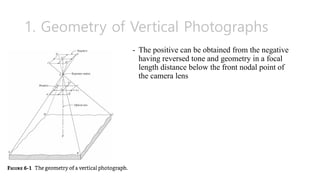
1. Geometry of Vertical Photographs
- The positive can be obtained from the negative
having reversed tone and geometry in a focal
length distance below the front nodal point of
the camera lens
2. Scale
- Map (photograph) scale: ratio of a map (photograph) distance to the corresponding
distance on the ground.
- A vertical aerial photograph is a perspective projection where the scale varies
according to terrain elevation while the map scale is not influenced by terrain
variations.
- Expression of scales: 1 in = 1,000 ft (unit equivalents), 1 in/1000 ft (unit fraction),
1/12,000 (dimensionless representative fraction), or 1:12000 (dimensionless ratio)
- A large number in a scale expression denotes a small scale, and vice versa:
1:1000 is larger scale than 1:5000.
3. Scale of a Vertical Photograph over
Flat Terrain
- The scale of a vertical photograph over
flat terrain is the ratio of photo distance
ab to ground distance AB, or of focal
length f to height H’:
𝑆 =
𝑎𝑏
𝐴𝐵
=
𝑓
𝐻′
[Example 6-1] A vertical aerial photo is
taken over flat terrain with 152.4 mm of
focal length and 1,830 m of height. Photo
scale?
𝑆 =
𝑓
𝐻′
=
0.1524
1830
= 1/12,000 = 1:12,000
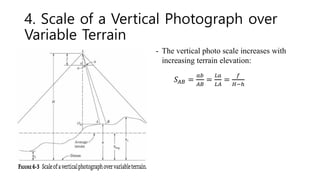
4. Scale of a Vertical Photograph over
Variable Terrain
- The vertical photo scale increases with
increasing terrain elevation:
𝑆𝐴𝐵 =
𝑎𝑏
𝐴𝐵
=
𝐿𝑎
𝐿𝐴
=
𝑓
𝐻−ℎ
5. Average Photo Scale
- Average scale is the scale at the average elevation of the terrain:
[Example 6-2] The highest terrain ℎ1, average terrain ℎ𝑎𝑣𝑔, and lowest terrain ℎ2
are 610, 460, 310 m above mean sea level, respectively. Calculate the maximum,
minimum, and average scales if flying height above mean sea level is 3000 m and
the camera focal length is 152.4 mm.
𝑆𝑚𝑎𝑥 =
0.1524
3000−610
= Τ
1
15,700 = 1: 15,700, 𝑆𝑚𝑖𝑛 =
0.1524
3000−310
= Τ
1
17,700 =
1: 17,700
𝑆𝑎𝑣𝑔 =
0.1524
3000−460
= Τ
1
16,700 = 1: 16,700
𝑆𝑎𝑣𝑔 =
𝑓
𝐻 − ℎ𝑎𝑣𝑔
6. Other Methods of Determining Scale
of Vertical Photographs
- The scale can be simply determined by the ratio of the photo distance to the
ground distance.
[Example 6-3] The horizontal distance AB between the centers of two street
intersections was measured on the ground as 402 m. Corresponding line ab on a
vertical photograph was 95.8 mm. Photo scale of the line?
- The scale of a vertical aerial photograph can be determined if a map of the
corresponding area is available
𝑆 =
0.0958
402
=
1
4200
= 1: 4200
𝑆 =
photo distance
map distance
map scale
6. Other Methods of Determining Scale
of Vertical Photographs
[Example 6-4] An airport runway measures 160 mm on a vertical photograph and
103 mm on a map whose scale is 1:24,000. Scale of the photograph?
𝑆 =
160
103

1
24,000
=1/15,400=1:15,400
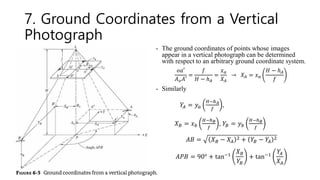
7. Ground Coordinates from a Vertical
Photograph
- The ground coordinates of points whose images
appear in a vertical photograph can be determined
with respect to an arbitrary ground coordinate system.
- Similarly
𝑌
𝐴 = 𝑦𝑎
𝐻−ℎ𝐴
𝑓
,
𝑋𝐵 = 𝑥𝑏
𝐻−ℎ𝐵
𝑓
, 𝑌𝐵 = 𝑦𝑏
𝐻−ℎ𝐵
𝑓
𝐴𝐵 = 𝑋𝐵 − 𝑋𝐴
2 + 𝑌𝐵 − 𝑌
𝐴
2
𝐴𝑃𝐵 = 90° + tan−1
𝑋𝐵
𝑌𝐵
+ tan−1
𝑌
𝐴
𝑋𝐴
𝑜𝑎′
𝐴𝑜𝐴′
=
𝑓
𝐻 − ℎ𝐴
=
𝑥𝑎
𝑋𝐴
→ 𝑋𝐴 = 𝑥𝑎
𝐻 − ℎ𝐴
𝑓
7. Ground Coordinates from a Vertical
Photograph
[Example 6-6]
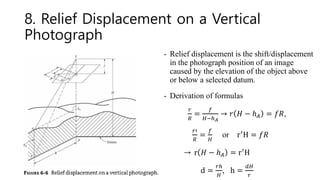
8. Relief Displacement on a Vertical
Photograph
- Relief displacement is the shift/displacement
in the photograph position of an image
caused by the elevation of the object above
or below a selected datum.
- Derivation of formulas
𝑟
𝑅
=
𝑓
𝐻−ℎ𝐴
→ 𝑟 𝐻 − ℎ𝐴 = 𝑓𝑅,
𝑟′
𝑅
=
𝑓
𝐻
or r′
H = 𝑓𝑅
→ r 𝐻 − ℎ𝐴 = r′
H
d =
𝑟ℎ
𝐻
, h =
𝑑𝐻
𝑟
8. Relief Displacement on a Vertical
Photograph
- Relief displacement occurs radially from the
center of the photograph (principal point).
[Example 6-7] A vertical photo taken from an
elevation of 535 m above mean sea level. The
elevation at the base of a tower in the photo is
259 m above MSL. The relief distance d of
the tower is 54.1 mm, and the radial distance
to the top of the tower from the photo center
was 121.7 mm. What is the height of the tower?
→𝐻 = 535 − 259 = 276 m
h =
𝑑𝐻
𝑟
=
54.1 276
121.7
= 123 m
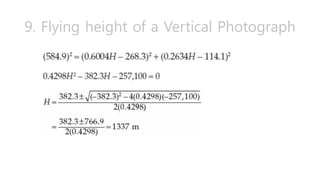
9. Flying height of a Vertical Photograph
- Flying height above datum is an important quantity for solving photogrammetric
equations such as in scale, ground coordinate, and relief displacement.
[Example 6-8] A section line whose length is 5,280 ft on fairly level terrain is
measured 94.0 mm on photograph. Find the flying height if the camera focal length
is 88.9 mm.
𝑆 =
𝑓
𝐻
→ 𝐻 =
𝑓
𝑆
=
88.9
94.0/5,280
= 4,993.5ft = 1,522 m
9. Flying height of a Vertical Photograph
[Example 6-9] Ground point A and B have elevation 437.4 m and 445.3 m above sea
level, respectively, and the horizontal length of line AB is 584.9 m. The measured
photo coordinates of a and b which are images of A and B are 𝑥𝑎 = 18.21 mm, 𝑦𝑎 =
− 61.32 mm, 𝑥𝑏 = 109.65 mm, and 𝑦𝑏 = −21.21 mm. Calculate the flying height
of the photograph above sea level.
9. Flying height of a Vertical Photograph
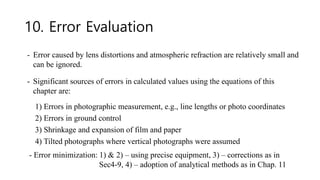
10. Error Evaluation
- Error caused by lens distortions and atmospheric refraction are relatively small and
can be ignored.
- Significant sources of errors in calculated values using the equations of this
chapter are:
1) Errors in photographic measurement, e.g., line lengths or photo coordinates
2) Errors in ground control
3) Shrinkage and expansion of film and paper
4) Tilted photographs where vertical photographs were assumed
- Error minimization: 1) & 2) – using precise equipment, 3) – corrections as in
Sec4-9, 4) – adoption of analytical methods as in Chap. 11
10. Error Evaluation
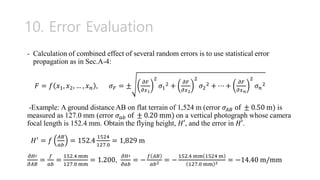
- Calculation of combined effect of several random errors is to use statistical error
propagation as in Sec.A-4:
𝐹 = 𝑓 𝑥1, 𝑥2, … , 𝑥𝑛 , 𝜎𝐹 = ±
𝜕𝐹
𝜕𝑥1
2
𝜎1
2 +
𝜕𝐹
𝜕𝑥2
2
𝜎2
2 + ⋯ +
𝜕𝐹
𝜕𝑥𝑛
2
𝜎𝑛
2
-Example: A ground distance AB on flat terrain of 1,524 m (error 𝜎𝐴𝐵 of ± 0.50 m) is
measured as 127.0 mm (error 𝜎𝑎𝑏 of ± 0.20 mm) on a vertical photograph whose camera
focal length is 152.4 mm. Obtain the flying height, 𝐻′, and the error in 𝐻′.
𝐻′
= 𝑓
𝐴𝐵
𝑎𝑏
= 152.4
1524
127.0
= 1,829 m
𝜕𝐻′
𝜕𝐴𝐵
=
𝑓
𝑎𝑏
=
152.4 mm
127.0 mm
= 1.200,
𝜕𝐻′
𝜕𝑎𝑏
= −
𝑓 𝐴𝐵
𝑎𝑏2 = −
152.4 mm 1524 m
127.0 mm 2 = −14.40 m/mm
10. Error Evaluation
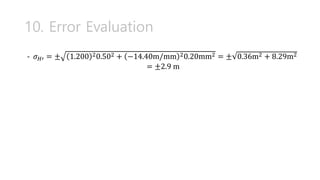
- 𝜎𝐻′ = ± 1.200 20.502 + −14.40m/mm 20.20mm2 = ± 0.36m2 + 8.29m2
= ±2.9 m

05_Photogrammetry-ch6-Vertical Photographs.pdf

  • 1.
    Chapter 6 Vertical Photographs Elementsof Photogrammetry with Applications in GIS Digital Rock Mass Survey Wolf, Paul R.; Wolf, Paul R.; DeWitt, Bon A.; DeWitt, Bon A.; Wilkinson, Benjamin E.; Wilkinson, Benjamin E.. Elements of Photogrammetry with Application in GIS, Fourth Edition McGraw-Hill Education. Kindle Edition.
  • 2.
    1. Geometry ofVertical Photographs - Definition: photographs taken from an aircraft with the optical axis of the camera vertical (truly vertical) or as nearly vertical as possible. - Equations are developed assuming truly vertical photographs. - Most of vertical photos have tilts usually less than 1° and rare exceed 3°. - Near-vertical or tilted photographs can be analyzed using the equations for truly vertical photos without serious error. - Photo coordinate axis system is assumed to have its origin at the photographic principal point and various distortions are assumed to be corrected throughout this chapter.
  • 3.
    1. Geometry ofVertical Photographs - The positive can be obtained from the negative having reversed tone and geometry in a focal length distance below the front nodal point of the camera lens
  • 4.
    2. Scale - Map(photograph) scale: ratio of a map (photograph) distance to the corresponding distance on the ground. - A vertical aerial photograph is a perspective projection where the scale varies according to terrain elevation while the map scale is not influenced by terrain variations. - Expression of scales: 1 in = 1,000 ft (unit equivalents), 1 in/1000 ft (unit fraction), 1/12,000 (dimensionless representative fraction), or 1:12000 (dimensionless ratio) - A large number in a scale expression denotes a small scale, and vice versa: 1:1000 is larger scale than 1:5000.
  • 5.
    3. Scale ofa Vertical Photograph over Flat Terrain - The scale of a vertical photograph over flat terrain is the ratio of photo distance ab to ground distance AB, or of focal length f to height H’: 𝑆 = 𝑎𝑏 𝐴𝐵 = 𝑓 𝐻′ [Example 6-1] A vertical aerial photo is taken over flat terrain with 152.4 mm of focal length and 1,830 m of height. Photo scale? 𝑆 = 𝑓 𝐻′ = 0.1524 1830 = 1/12,000 = 1:12,000
  • 6.
    4. Scale ofa Vertical Photograph over Variable Terrain - The vertical photo scale increases with increasing terrain elevation: 𝑆𝐴𝐵 = 𝑎𝑏 𝐴𝐵 = 𝐿𝑎 𝐿𝐴 = 𝑓 𝐻−ℎ
  • 7.
    5. Average PhotoScale - Average scale is the scale at the average elevation of the terrain: [Example 6-2] The highest terrain ℎ1, average terrain ℎ𝑎𝑣𝑔, and lowest terrain ℎ2 are 610, 460, 310 m above mean sea level, respectively. Calculate the maximum, minimum, and average scales if flying height above mean sea level is 3000 m and the camera focal length is 152.4 mm. 𝑆𝑚𝑎𝑥 = 0.1524 3000−610 = Τ 1 15,700 = 1: 15,700, 𝑆𝑚𝑖𝑛 = 0.1524 3000−310 = Τ 1 17,700 = 1: 17,700 𝑆𝑎𝑣𝑔 = 0.1524 3000−460 = Τ 1 16,700 = 1: 16,700 𝑆𝑎𝑣𝑔 = 𝑓 𝐻 − ℎ𝑎𝑣𝑔
  • 8.
    6. Other Methodsof Determining Scale of Vertical Photographs - The scale can be simply determined by the ratio of the photo distance to the ground distance. [Example 6-3] The horizontal distance AB between the centers of two street intersections was measured on the ground as 402 m. Corresponding line ab on a vertical photograph was 95.8 mm. Photo scale of the line? - The scale of a vertical aerial photograph can be determined if a map of the corresponding area is available 𝑆 = 0.0958 402 = 1 4200 = 1: 4200 𝑆 = photo distance map distance map scale
  • 9.
    6. Other Methodsof Determining Scale of Vertical Photographs [Example 6-4] An airport runway measures 160 mm on a vertical photograph and 103 mm on a map whose scale is 1:24,000. Scale of the photograph? 𝑆 = 160 103  1 24,000 =1/15,400=1:15,400
  • 10.
    7. Ground Coordinatesfrom a Vertical Photograph - The ground coordinates of points whose images appear in a vertical photograph can be determined with respect to an arbitrary ground coordinate system. - Similarly 𝑌 𝐴 = 𝑦𝑎 𝐻−ℎ𝐴 𝑓 , 𝑋𝐵 = 𝑥𝑏 𝐻−ℎ𝐵 𝑓 , 𝑌𝐵 = 𝑦𝑏 𝐻−ℎ𝐵 𝑓 𝐴𝐵 = 𝑋𝐵 − 𝑋𝐴 2 + 𝑌𝐵 − 𝑌 𝐴 2 𝐴𝑃𝐵 = 90° + tan−1 𝑋𝐵 𝑌𝐵 + tan−1 𝑌 𝐴 𝑋𝐴 𝑜𝑎′ 𝐴𝑜𝐴′ = 𝑓 𝐻 − ℎ𝐴 = 𝑥𝑎 𝑋𝐴 → 𝑋𝐴 = 𝑥𝑎 𝐻 − ℎ𝐴 𝑓
  • 11.
    7. Ground Coordinatesfrom a Vertical Photograph [Example 6-6]
  • 12.
    8. Relief Displacementon a Vertical Photograph - Relief displacement is the shift/displacement in the photograph position of an image caused by the elevation of the object above or below a selected datum. - Derivation of formulas 𝑟 𝑅 = 𝑓 𝐻−ℎ𝐴 → 𝑟 𝐻 − ℎ𝐴 = 𝑓𝑅, 𝑟′ 𝑅 = 𝑓 𝐻 or r′ H = 𝑓𝑅 → r 𝐻 − ℎ𝐴 = r′ H d = 𝑟ℎ 𝐻 , h = 𝑑𝐻 𝑟
  • 13.
    8. Relief Displacementon a Vertical Photograph - Relief displacement occurs radially from the center of the photograph (principal point). [Example 6-7] A vertical photo taken from an elevation of 535 m above mean sea level. The elevation at the base of a tower in the photo is 259 m above MSL. The relief distance d of the tower is 54.1 mm, and the radial distance to the top of the tower from the photo center was 121.7 mm. What is the height of the tower? →𝐻 = 535 − 259 = 276 m h = 𝑑𝐻 𝑟 = 54.1 276 121.7 = 123 m
  • 14.
    9. Flying heightof a Vertical Photograph - Flying height above datum is an important quantity for solving photogrammetric equations such as in scale, ground coordinate, and relief displacement. [Example 6-8] A section line whose length is 5,280 ft on fairly level terrain is measured 94.0 mm on photograph. Find the flying height if the camera focal length is 88.9 mm. 𝑆 = 𝑓 𝐻 → 𝐻 = 𝑓 𝑆 = 88.9 94.0/5,280 = 4,993.5ft = 1,522 m
  • 15.
    9. Flying heightof a Vertical Photograph [Example 6-9] Ground point A and B have elevation 437.4 m and 445.3 m above sea level, respectively, and the horizontal length of line AB is 584.9 m. The measured photo coordinates of a and b which are images of A and B are 𝑥𝑎 = 18.21 mm, 𝑦𝑎 = − 61.32 mm, 𝑥𝑏 = 109.65 mm, and 𝑦𝑏 = −21.21 mm. Calculate the flying height of the photograph above sea level.
  • 16.
    9. Flying heightof a Vertical Photograph
  • 17.
    10. Error Evaluation -Error caused by lens distortions and atmospheric refraction are relatively small and can be ignored. - Significant sources of errors in calculated values using the equations of this chapter are: 1) Errors in photographic measurement, e.g., line lengths or photo coordinates 2) Errors in ground control 3) Shrinkage and expansion of film and paper 4) Tilted photographs where vertical photographs were assumed - Error minimization: 1) & 2) – using precise equipment, 3) – corrections as in Sec4-9, 4) – adoption of analytical methods as in Chap. 11
  • 18.
    10. Error Evaluation -Calculation of combined effect of several random errors is to use statistical error propagation as in Sec.A-4: 𝐹 = 𝑓 𝑥1, 𝑥2, … , 𝑥𝑛 , 𝜎𝐹 = ± 𝜕𝐹 𝜕𝑥1 2 𝜎1 2 + 𝜕𝐹 𝜕𝑥2 2 𝜎2 2 + ⋯ + 𝜕𝐹 𝜕𝑥𝑛 2 𝜎𝑛 2 -Example: A ground distance AB on flat terrain of 1,524 m (error 𝜎𝐴𝐵 of ± 0.50 m) is measured as 127.0 mm (error 𝜎𝑎𝑏 of ± 0.20 mm) on a vertical photograph whose camera focal length is 152.4 mm. Obtain the flying height, 𝐻′, and the error in 𝐻′. 𝐻′ = 𝑓 𝐴𝐵 𝑎𝑏 = 152.4 1524 127.0 = 1,829 m 𝜕𝐻′ 𝜕𝐴𝐵 = 𝑓 𝑎𝑏 = 152.4 mm 127.0 mm = 1.200, 𝜕𝐻′ 𝜕𝑎𝑏 = − 𝑓 𝐴𝐵 𝑎𝑏2 = − 152.4 mm 1524 m 127.0 mm 2 = −14.40 m/mm
  • 19.
    10. Error Evaluation -𝜎𝐻′ = ± 1.200 20.502 + −14.40m/mm 20.20mm2 = ± 0.36m2 + 8.29m2 = ±2.9 m