“Statnamic Testing For Piles”


                          Sravan M V
                         1BM03CV049
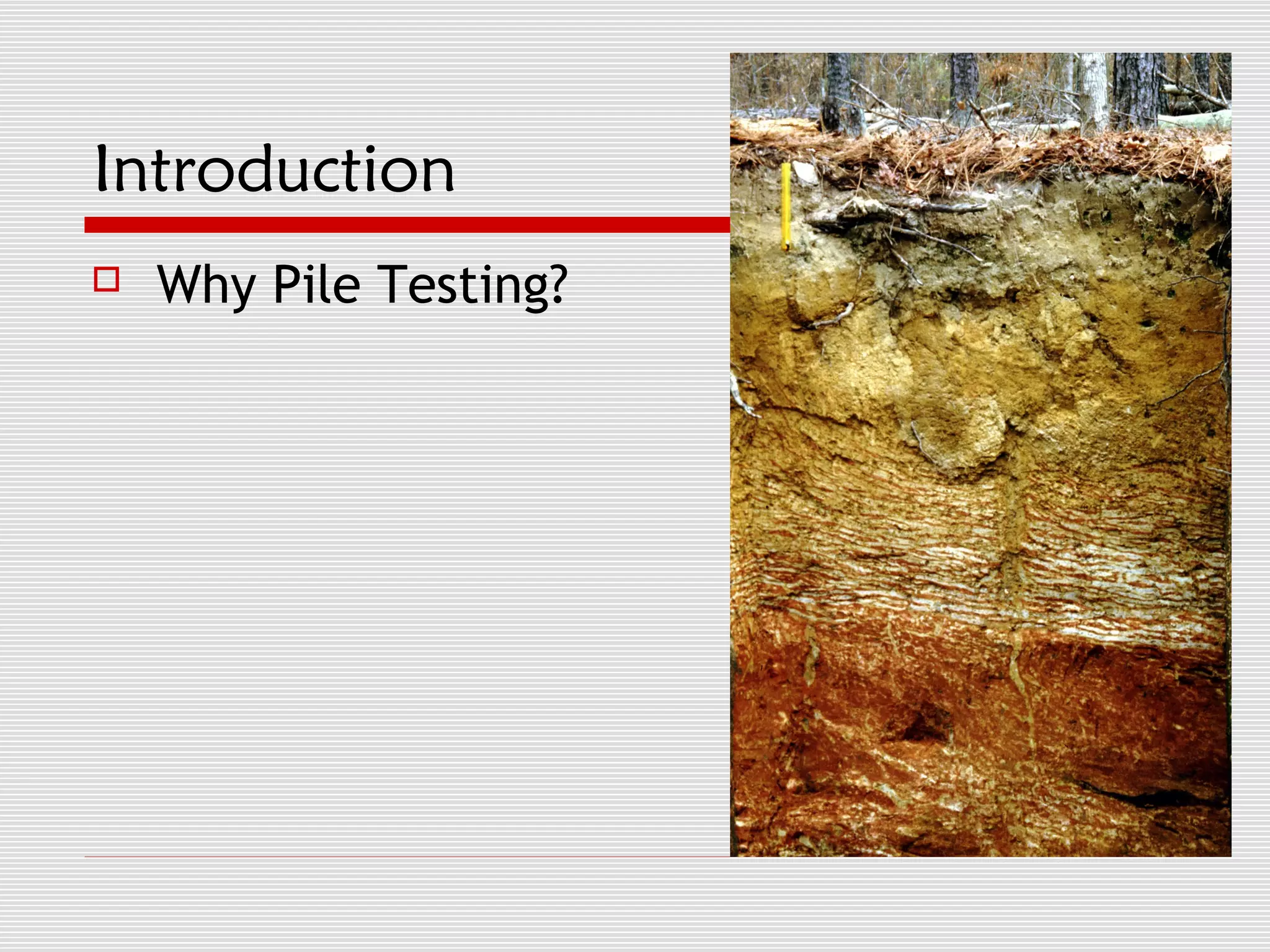
Introduction
   Why Pile Testing?
Types of Testing for Piles
   Static Testing

   Dynamic Testing

   Statnamic Testing
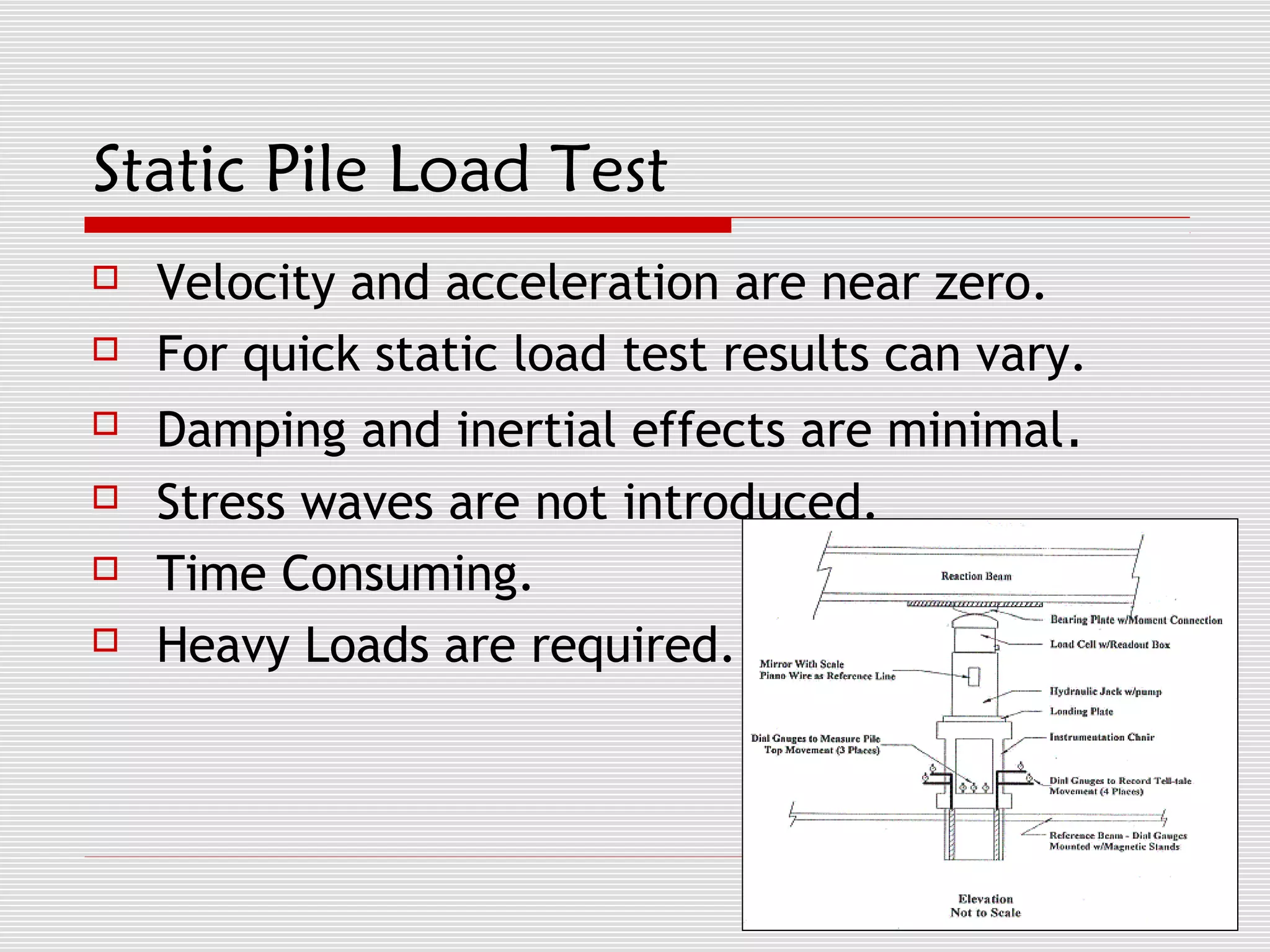
Static Pile Load Test
   Velocity and acceleration are near zero.
   For quick static load test results can vary.
   Damping and inertial effects are minimal.
   Stress waves are not introduced.
   Time Consuming.
   Heavy Loads are required.
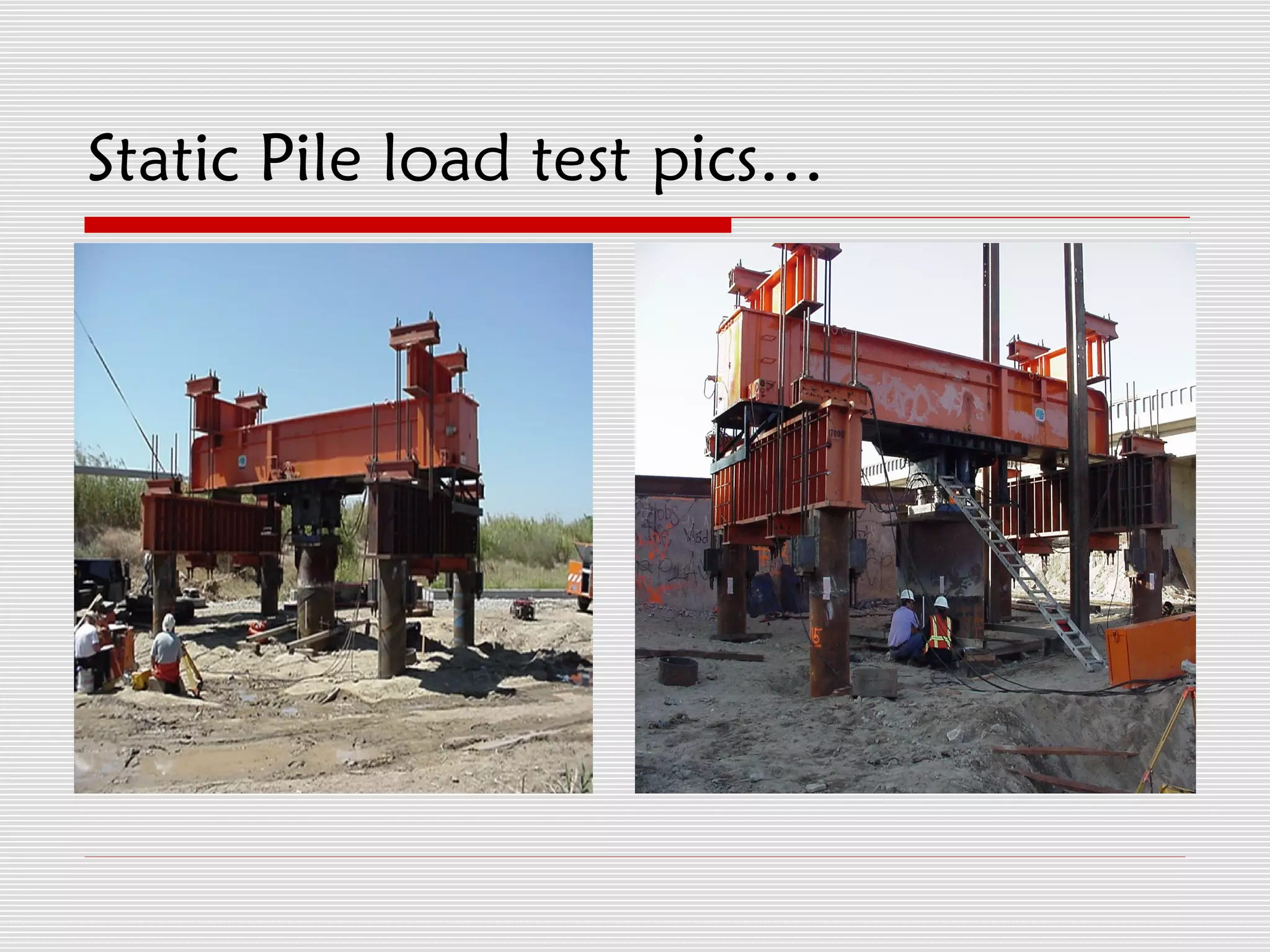
Static Pile load test pics…
Stress Wave Mechanics

   In conventional static loading, the pile compresses as
    a whole throughout loading such that the pile is in
    compression. However, as the load duration
    decreases, stress waves are introduced to the pile
    which effect pile/soil behavior. Stress waves
    propagate along the pile at the speed of sound within
    the pile
   c = stress wave velocity
        Is 6 milliseconds, the natural pile period.
Dynamic Pile Load test

   Time taken is around 5-10 ms
   Stress Waves are induced which affects the pile/soil
    behavior
   Damping and inertial effects exert a strong influence
    on the test result and are more difficult to quantify.
   Cause tensile stresses in piles, damage them.
   Very expensive.
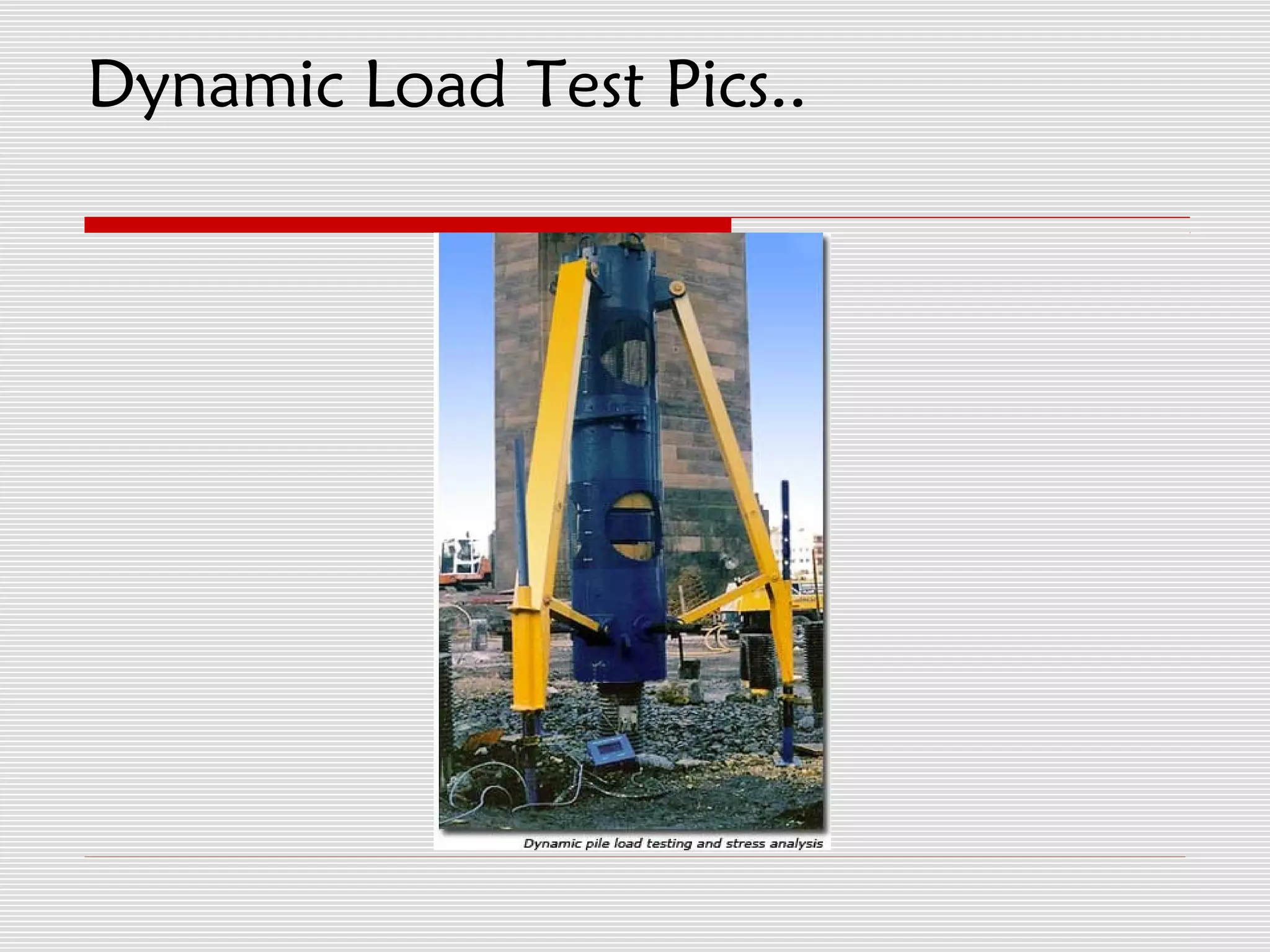
Dynamic Load Test Pics..
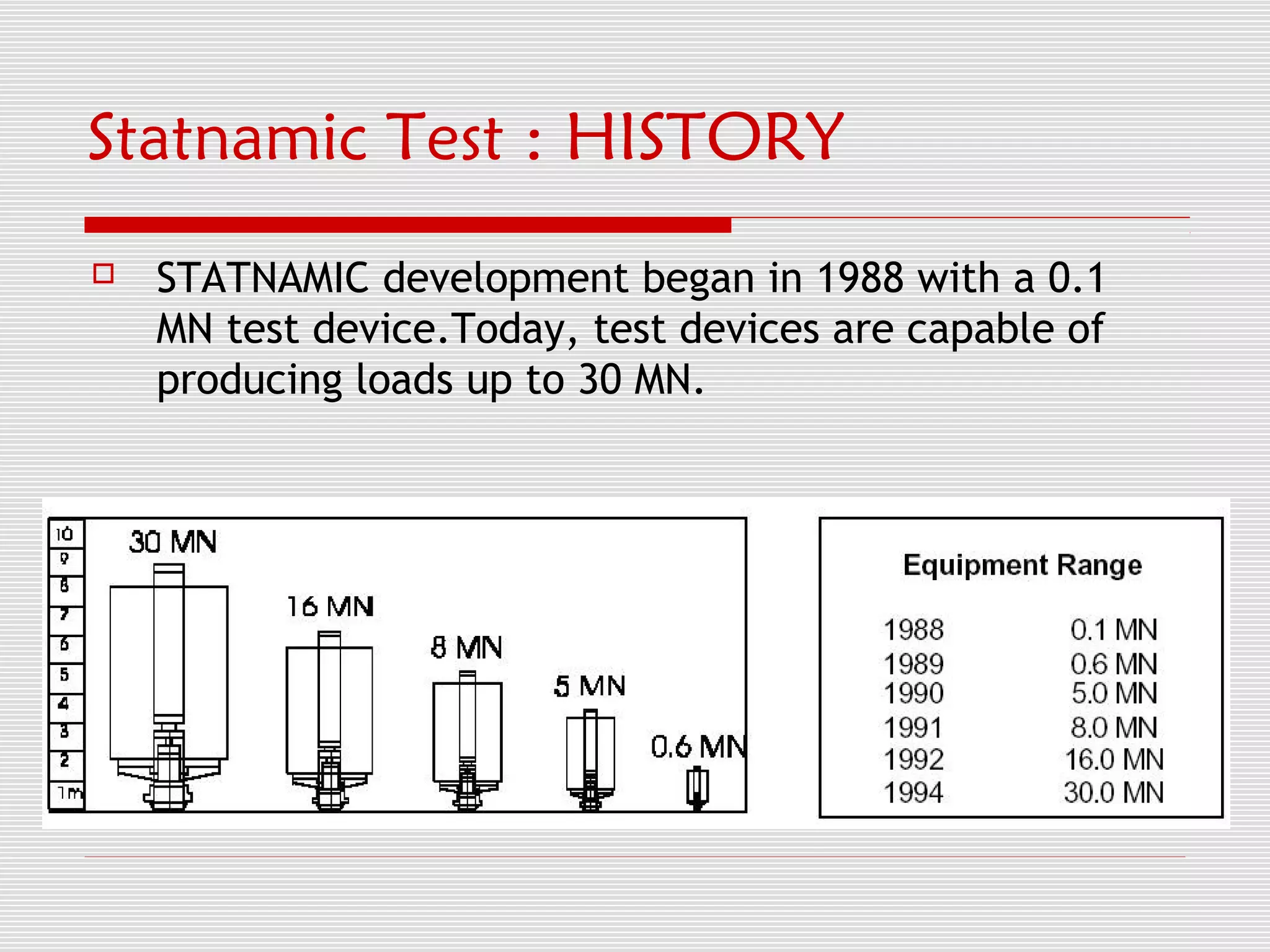
Statnamic Test : HISTORY
   STATNAMIC development began in 1988 with a 0.1
    MN test device.Today, test devices are capable of
    producing loads up to 30 MN.
Statnamic Test : Stats
   STATNAMIC load tests have been conducted in
    Canada, the United States, the Netherlands, Japan,
    Germany, Israel, Korea, Taiwan, United Arab
    Emirates, Egypt, United Kingdom, Malaysia,
    Indonesia, Australia, China, Belgium, Hungary,
    Grenada, Argentina.
   Testing options include single piles, pile groups,
    structural elements, bridge piers, spread footings
    and plates.
Statnamic Test : Stats
    STATNAMIC can be used on any pile type or
    structure:
   micro piles
   piles
   batter piles
   lateral load tests
   pile groups
   bridge piers
   caissons
   spread footings
Statnamic Test : Procedure
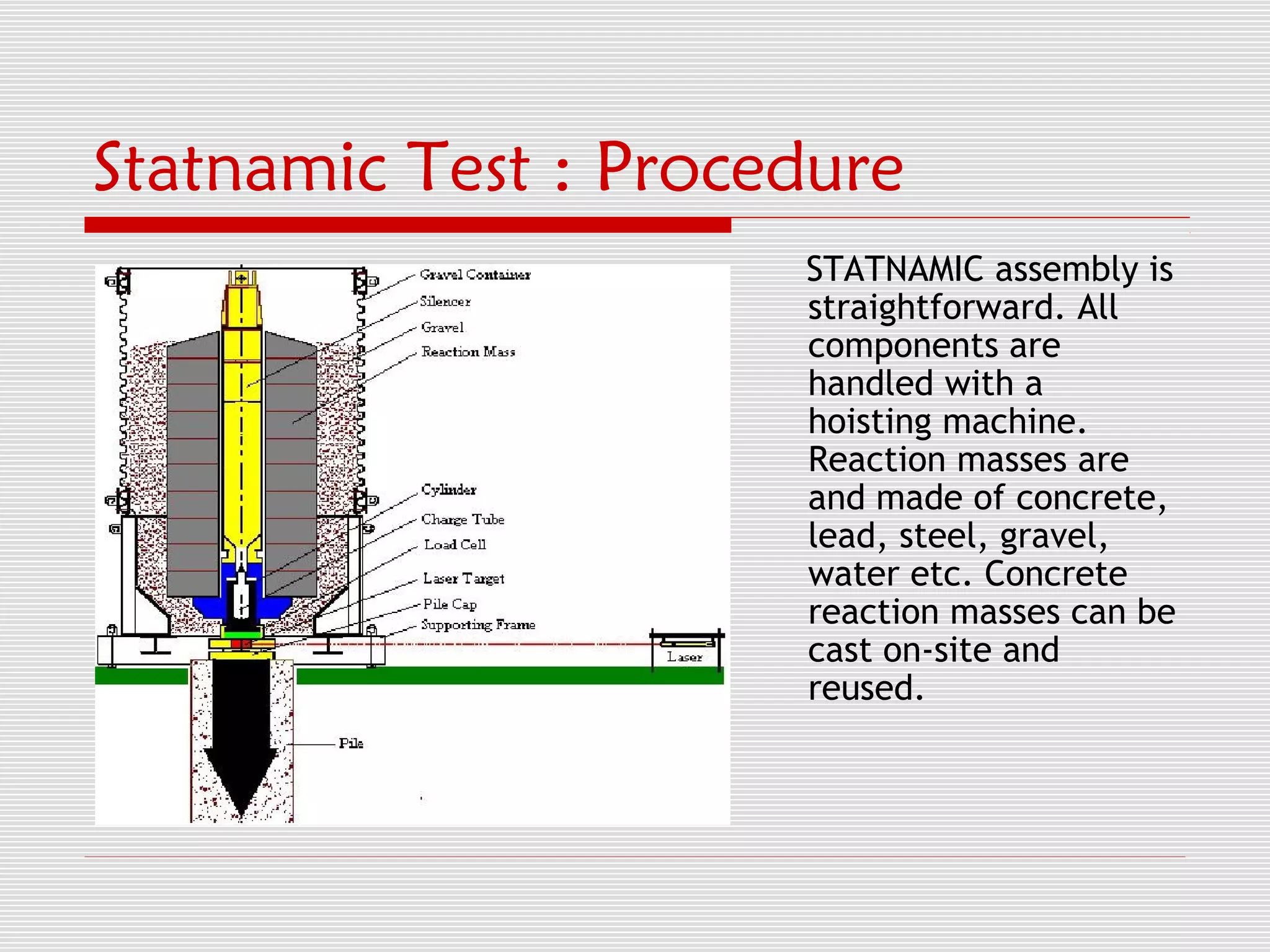
                      STATNAMIC assembly is
                      straightforward. All
                      components are
                      handled with a
                      hoisting machine.
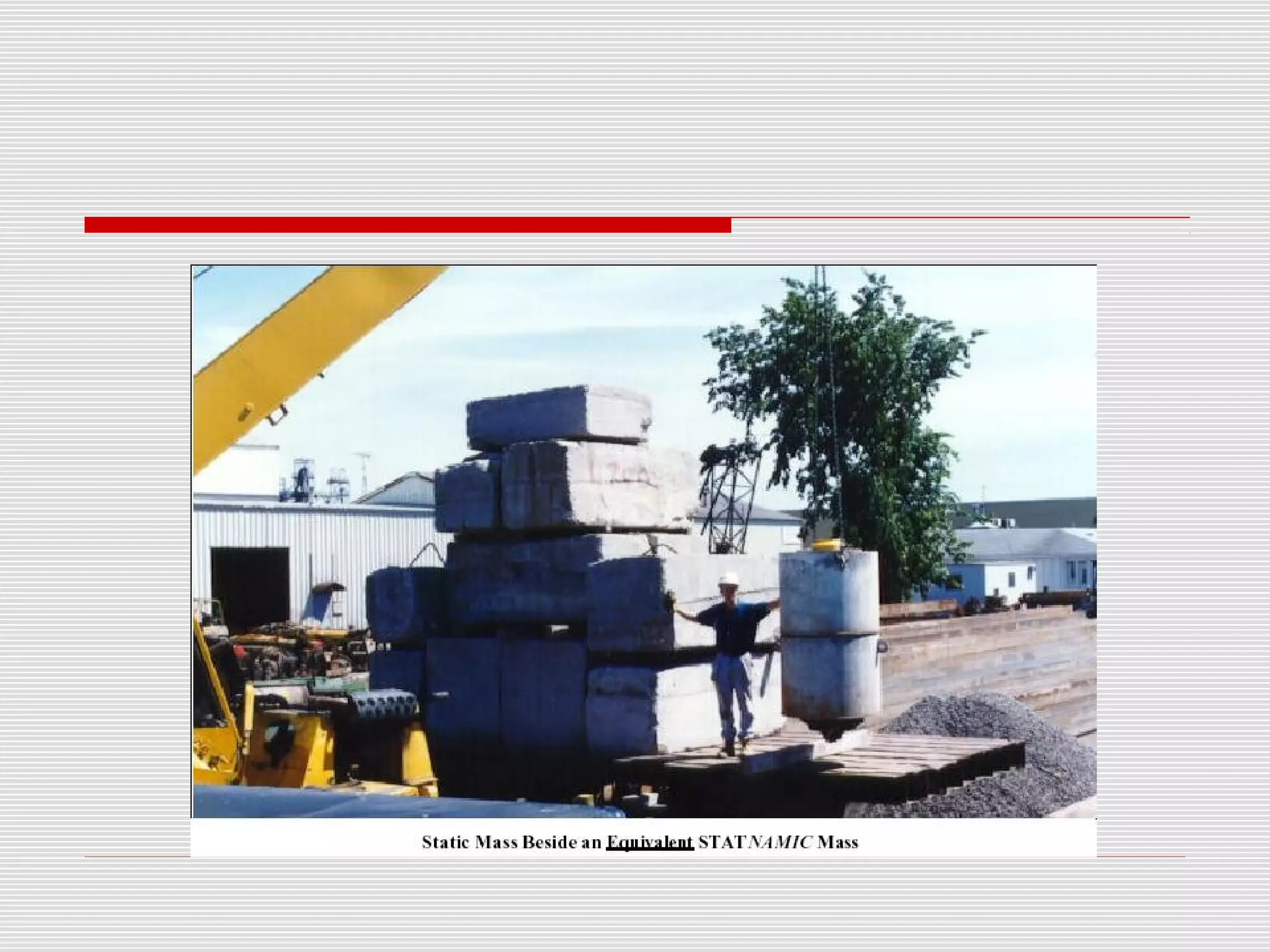
                      Reaction masses are
                      and made of concrete,
                      lead, steel, gravel,
                      water etc. Concrete
                      reaction masses can be
                      cast on-site and
                      reused.
Statnamic Test : Procedure
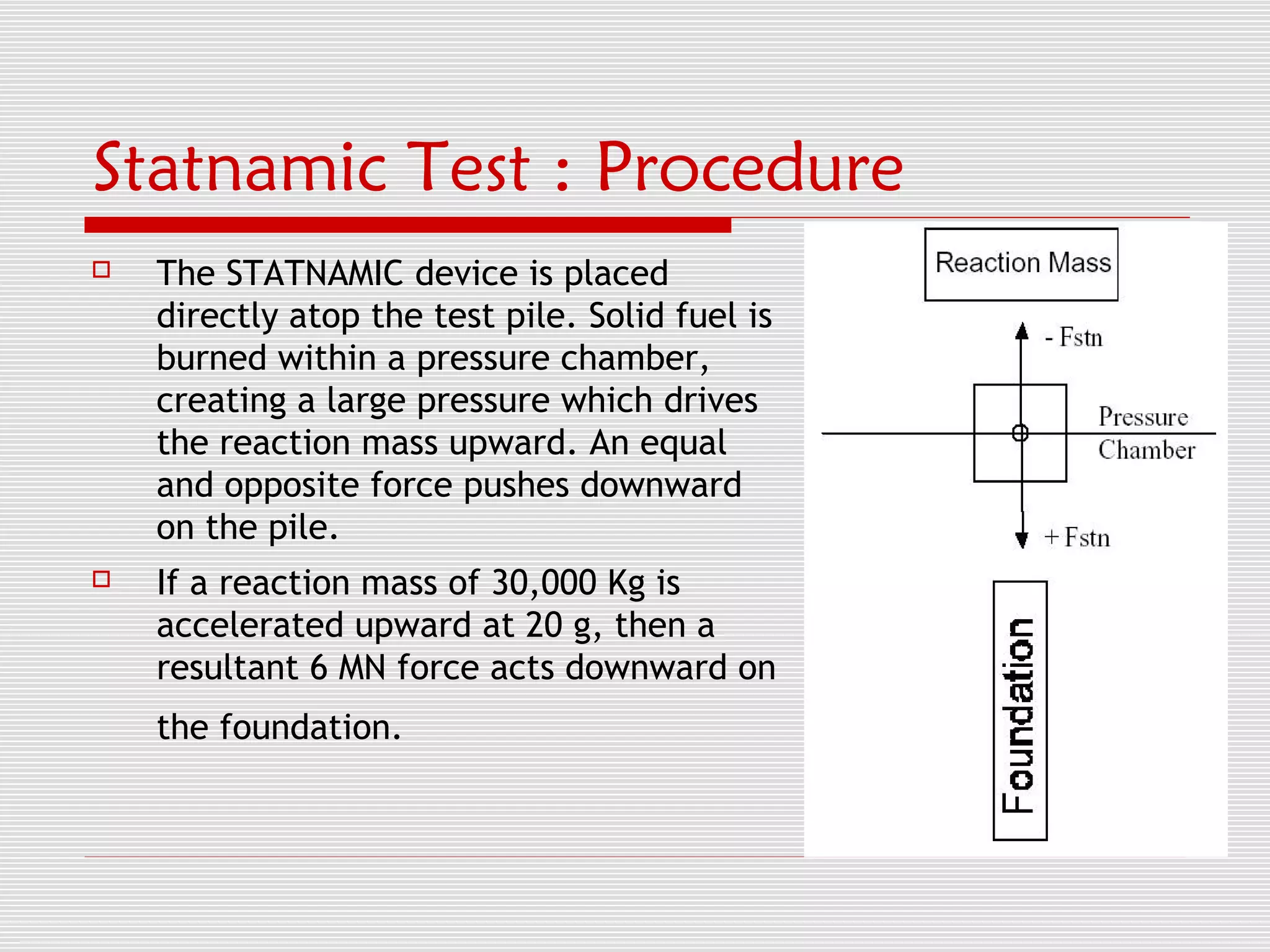
   The STATNAMIC device is placed
    directly atop the test pile. Solid fuel is
    burned within a pressure chamber,
    creating a large pressure which drives
    the reaction mass upward. An equal
    and opposite force pushes downward
    on the pile.
   If a reaction mass of 30,000 Kg is
    accelerated upward at 20 g, then a
    resultant 6 MN force acts downward on
    the foundation.
Statnamic Test : Procedure
   STATNAMIC loading is applied in
    a gradually increasing manner
    and unloading is achieved by a
    controlled venting of the
    pressure.
   The total duration of force is
    on the order of 120
    milliseconds.
   Typical STATNAMIC pile
    accelerations of 1-3 g are 100–
    1000 times less than a
    conventional dynamic load
    test.
Statnamic Test : Procedure
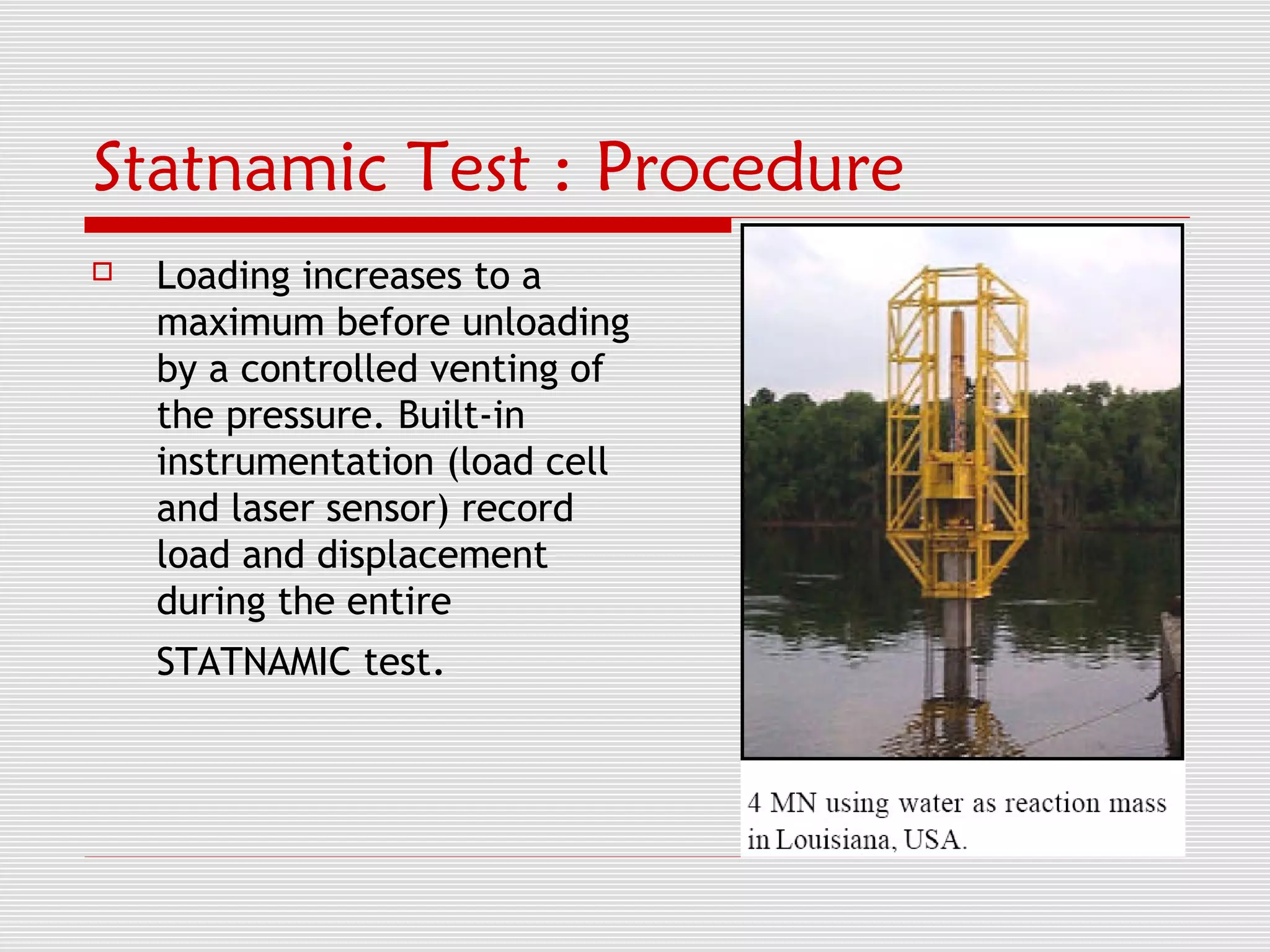
   Loading increases to a
    maximum before unloading
    by a controlled venting of
    the pressure. Built-in
    instrumentation (load cell
    and laser sensor) record
    load and displacement
    during the entire
    STATNAMIC test.
Statnamic Test : Advantages
   STATNAMIC applies loads up to 30 MN (3,400 tons).
   STATNAMIC can test bridge foundations, pile groups,
    spread footings, and off-shore piles.
   STATNAMIC can test the lateral capacity of
    foundations.
   Production piles can be tested without prior
    planning. No reaction piles are required.
   Three 600 ton tests can be conducted in a one day
    shift.
   Several STATNAMIC tests can be conducted for the
    cost of a single static test.
Statnamic Test : Advantages
   The duration of loading is on the order of 10 Hz.
   STATNAMIC 's built-in load cell and laser sensor
    provide direct measurements of load-displacement
    behavior.
   STATNAMIC loads the pile and soil together.
   STATNAMIC produces load-displacement results
    immediately on site.
Description W.R.T Newton Laws.
   1st Law (Law of Inertia):
    “A body will continue in a state of rest or uniform motion
    unless compelled to change that state by an external
    force.”
    In a load test, two external forces act on a pile - the
    loading force and pile resistance.
Description W.R.T Newton Laws.
   2nd Law (Law of Acceleration):

“ When acted upon by an external force, a body accelerates
   in the direction of that external force and is proportional
   to the magnitude of that force.” F = ma

    In static, statnamic, and dynamic load testing, the same
    net force can be applied to a pile by different means.
    Compare:
    Static: F = M *g = Mg
    STAT NAMIC: F = M/20 * 20g = Mg
    Dynamic: F = M/500 * 500g = Mg
Description W.R.T Newton Laws.
    3rd Law (Action and Reaction):
    “For every action there is an equal and opposite reaction.”
     F12 = -F21

     During STATNAMIC loading, the STATNAMIC device exerts
     an upward force on the reaction masses, while an equal
     and opposite force reacts downward on the pile.
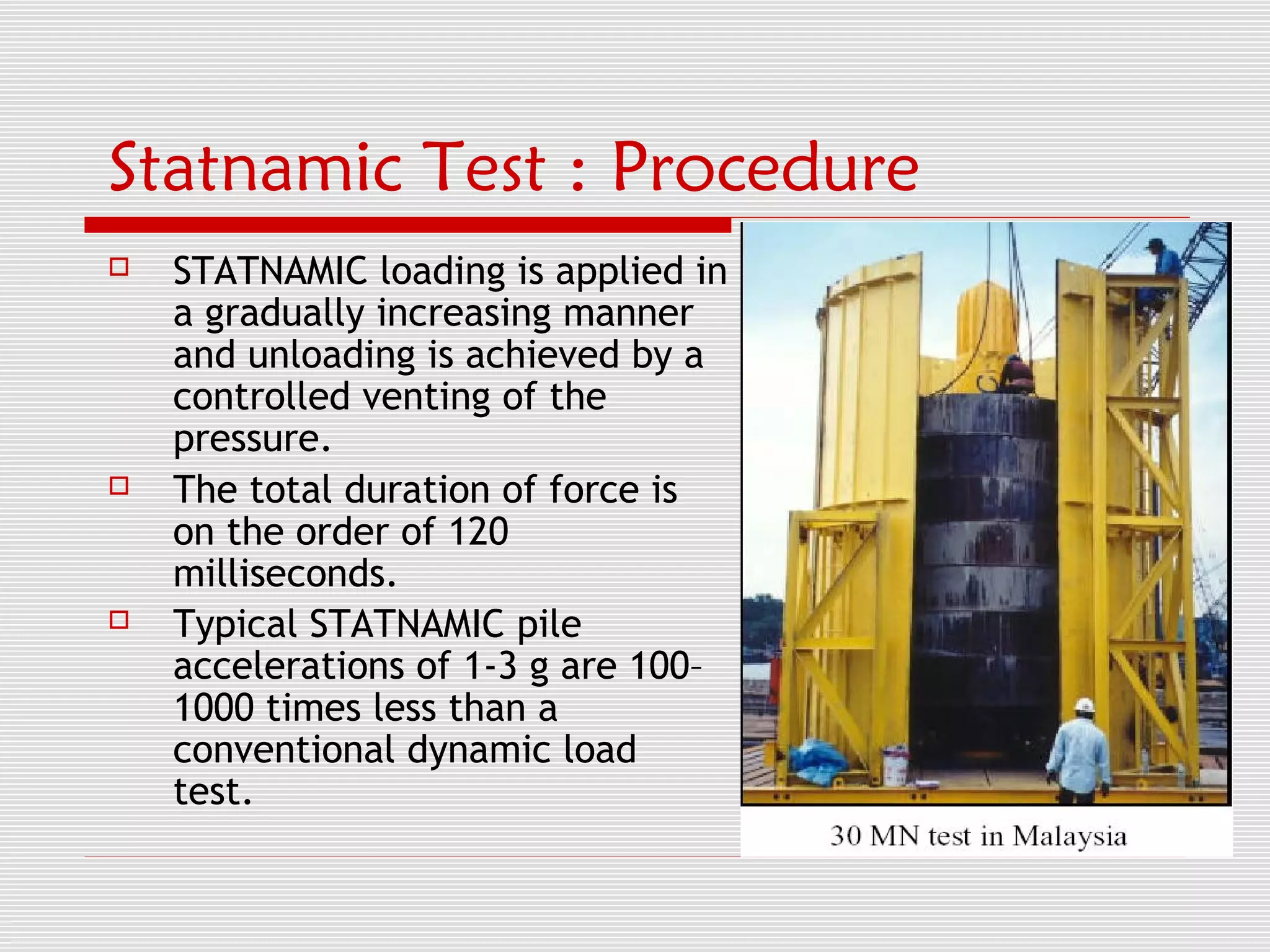
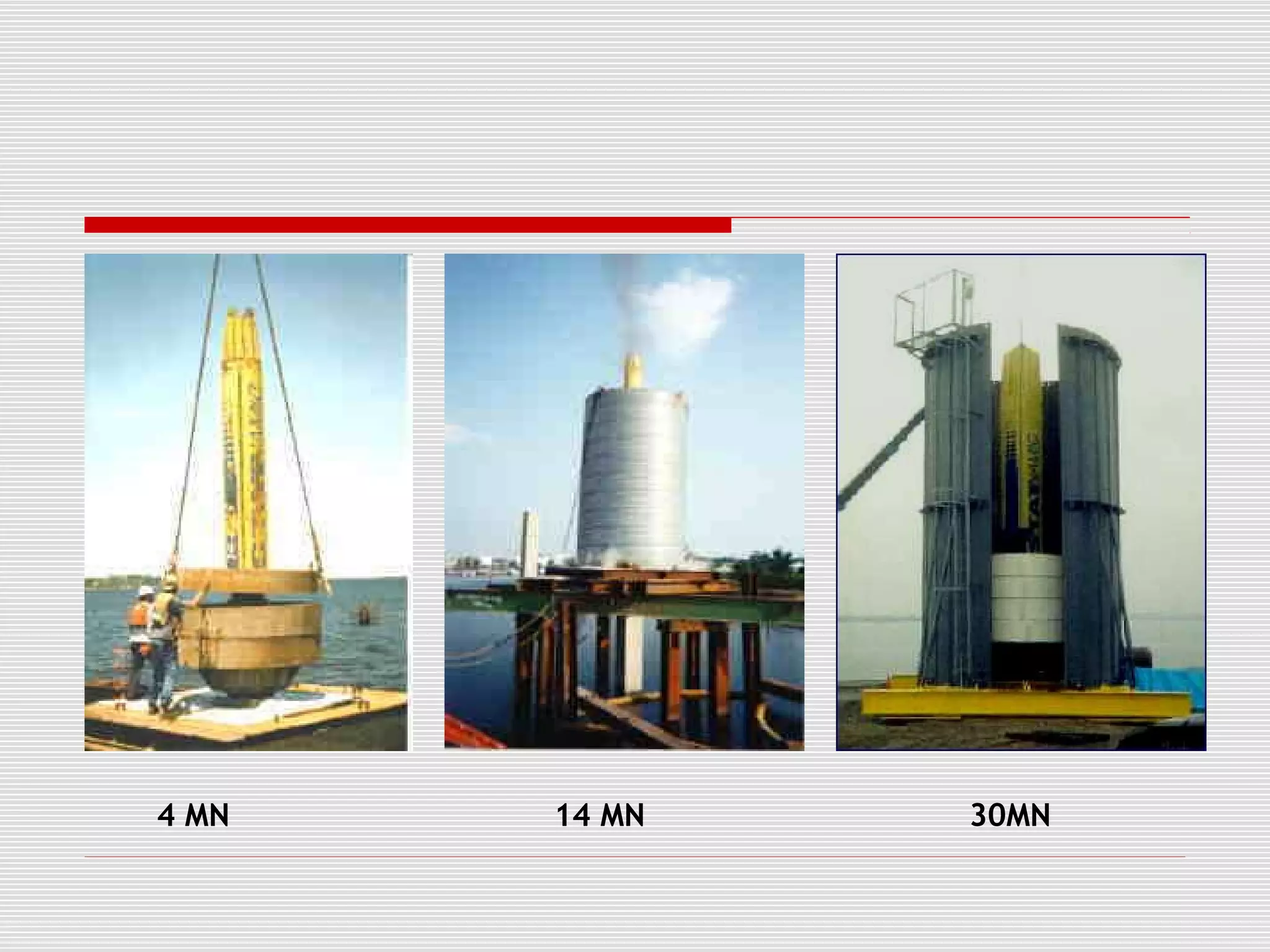
4 MN   14 MN   30MN
CONCLUSION!!

   The STATNAMIC load test was developed to meet
    the construction industry's demand for an
    accurate and cost-effective method of
    determining the load bearing capacity of
    caissons and high capacity piles.
REFERENCES
   “SOIL MECHANICS AND FOUNDATIONS” – Dr. BC
    PUNMIA,Ashok Kumar Jain & Arun Kumar Jain
   http://www.berminghammer.com/stat.html
   http://www.piletest.co.uk/statnamic.html
“Your job might be only to clean a railway-
  crossing, but it is for you to make it so clean
  that no other crossing in the world is as
  clean as your's.”
                 - Sir M Viswesvaraiah


Thank you!

Statnamic testing of soils

  • 1.
    “Statnamic Testing ForPiles” Sravan M V 1BM03CV049
  • 2.
    Introduction  Why Pile Testing?
  • 3.
    Types of Testingfor Piles  Static Testing  Dynamic Testing  Statnamic Testing
  • 4.
    Static Pile LoadTest  Velocity and acceleration are near zero.  For quick static load test results can vary.  Damping and inertial effects are minimal.  Stress waves are not introduced.  Time Consuming.  Heavy Loads are required.
  • 5.
    Static Pile loadtest pics…
  • 6.
    Static Pile loadtest pics…
  • 7.
    Stress Wave Mechanics  In conventional static loading, the pile compresses as a whole throughout loading such that the pile is in compression. However, as the load duration decreases, stress waves are introduced to the pile which effect pile/soil behavior. Stress waves propagate along the pile at the speed of sound within the pile  c = stress wave velocity Is 6 milliseconds, the natural pile period.
  • 8.
    Dynamic Pile Loadtest  Time taken is around 5-10 ms  Stress Waves are induced which affects the pile/soil behavior  Damping and inertial effects exert a strong influence on the test result and are more difficult to quantify.  Cause tensile stresses in piles, damage them.  Very expensive.
  • 9.
  • 10.
    Statnamic Test :HISTORY  STATNAMIC development began in 1988 with a 0.1 MN test device.Today, test devices are capable of producing loads up to 30 MN.
  • 11.
    Statnamic Test :Stats  STATNAMIC load tests have been conducted in Canada, the United States, the Netherlands, Japan, Germany, Israel, Korea, Taiwan, United Arab Emirates, Egypt, United Kingdom, Malaysia, Indonesia, Australia, China, Belgium, Hungary, Grenada, Argentina.  Testing options include single piles, pile groups, structural elements, bridge piers, spread footings and plates.
  • 12.
    Statnamic Test :Stats STATNAMIC can be used on any pile type or structure:  micro piles  piles  batter piles  lateral load tests  pile groups  bridge piers  caissons  spread footings
  • 13.
    Statnamic Test :Procedure STATNAMIC assembly is straightforward. All components are handled with a hoisting machine. Reaction masses are and made of concrete, lead, steel, gravel, water etc. Concrete reaction masses can be cast on-site and reused.
  • 14.
    Statnamic Test :Procedure  The STATNAMIC device is placed directly atop the test pile. Solid fuel is burned within a pressure chamber, creating a large pressure which drives the reaction mass upward. An equal and opposite force pushes downward on the pile.  If a reaction mass of 30,000 Kg is accelerated upward at 20 g, then a resultant 6 MN force acts downward on the foundation.
  • 15.
    Statnamic Test :Procedure  STATNAMIC loading is applied in a gradually increasing manner and unloading is achieved by a controlled venting of the pressure.  The total duration of force is on the order of 120 milliseconds.  Typical STATNAMIC pile accelerations of 1-3 g are 100– 1000 times less than a conventional dynamic load test.
  • 16.
    Statnamic Test :Procedure  Loading increases to a maximum before unloading by a controlled venting of the pressure. Built-in instrumentation (load cell and laser sensor) record load and displacement during the entire STATNAMIC test.
  • 17.
    Statnamic Test :Advantages  STATNAMIC applies loads up to 30 MN (3,400 tons).  STATNAMIC can test bridge foundations, pile groups, spread footings, and off-shore piles.  STATNAMIC can test the lateral capacity of foundations.  Production piles can be tested without prior planning. No reaction piles are required.  Three 600 ton tests can be conducted in a one day shift.  Several STATNAMIC tests can be conducted for the cost of a single static test.
  • 18.
    Statnamic Test :Advantages  The duration of loading is on the order of 10 Hz.  STATNAMIC 's built-in load cell and laser sensor provide direct measurements of load-displacement behavior.  STATNAMIC loads the pile and soil together.  STATNAMIC produces load-displacement results immediately on site.
  • 19.
    Description W.R.T NewtonLaws.  1st Law (Law of Inertia): “A body will continue in a state of rest or uniform motion unless compelled to change that state by an external force.” In a load test, two external forces act on a pile - the loading force and pile resistance.
  • 20.
    Description W.R.T NewtonLaws.  2nd Law (Law of Acceleration): “ When acted upon by an external force, a body accelerates in the direction of that external force and is proportional to the magnitude of that force.” F = ma In static, statnamic, and dynamic load testing, the same net force can be applied to a pile by different means. Compare: Static: F = M *g = Mg STAT NAMIC: F = M/20 * 20g = Mg Dynamic: F = M/500 * 500g = Mg
  • 21.
    Description W.R.T NewtonLaws.  3rd Law (Action and Reaction): “For every action there is an equal and opposite reaction.” F12 = -F21 During STATNAMIC loading, the STATNAMIC device exerts an upward force on the reaction masses, while an equal and opposite force reacts downward on the pile.
  • 23.
    4 MN 14 MN 30MN
  • 24.
    CONCLUSION!!  The STATNAMIC load test was developed to meet the construction industry's demand for an accurate and cost-effective method of determining the load bearing capacity of caissons and high capacity piles.
  • 25.
    REFERENCES  “SOIL MECHANICS AND FOUNDATIONS” – Dr. BC PUNMIA,Ashok Kumar Jain & Arun Kumar Jain  http://www.berminghammer.com/stat.html  http://www.piletest.co.uk/statnamic.html
  • 26.
    “Your job mightbe only to clean a railway- crossing, but it is for you to make it so clean that no other crossing in the world is as clean as your's.” - Sir M Viswesvaraiah Thank you!