TSL 042
ADVERBS
What are adverbs?
Definition
Adverbs are words that
describe or modify verbs,
adjectives and another
adverb
Examples
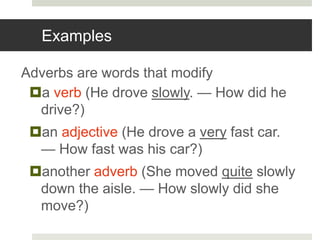
Adverbs are words that modify
a verb (He drove slowly. — How did he
drive?)
an adjective (He drove a very fast car.
— How fast was his car?)
another adverb (She moved quite slowly
down the aisle. — How slowly did she
move?)
Types of adverbs
Adverbs of:
1. Manner
2. Time
3. Place
4. Frequency
5. Degree
6. Purpose
Adverb of manner
Says how something happens or is done.
Answers the question “how”
Eg:
1. The lion roared ferociously.
2. She is seriously ill.
3. She angrily tore up the letter.
4. He walked happily towards his house.
5. He walked towards his house happily.
6. Happily he walked towards his house.
Adverb of time
 Tells us when something happens.
 Answers the question “when”
 Eg.
 Robin drove to school last Tuesday.
 Let us start now.
 You must wake up early.
 Tomorrow I am leaving for Penang.
 They soon realised their mistake.
 I just asked a question just and
 He is still working for the same institution. & still in mid
position
 She has finally got a job.
Adverb of place
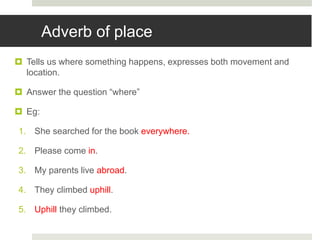
 Tells us where something happens, expresses both movement and
location.
 Answer the question “where”
 Eg:
1. She searched for the book everywhere.
2. Please come in.
3. My parents live abroad.
4. They climbed uphill.
5. Uphill they climbed.
Adverb of frequency
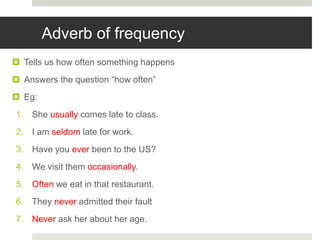
 Tells us how often something happens
 Answers the question “how often”
 Eg:
1. She usually comes late to class.
2. I am seldom late for work.
3. Have you ever been to the US?
4. We visit them occasionally.
5. Often we eat in that restaurant.
6. They never admitted their fault
7. Never ask her about her age.
Adverb of degree
 Tells us about the degree or extent of an action, quality or manner.
 Eg:
1. She is very beautiful.
2. I am extremely sorry.
3. He had hardly begun his work.
4. She hardly did her work.
5. You are not old enough to marry. Placed after
6. This is good enough for me. adjective/adverb
Adverb of certainty
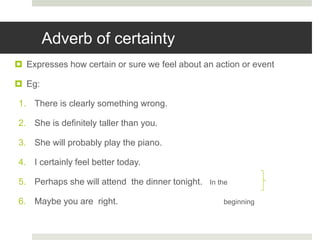
 Expresses how certain or sure we feel about an action or event
 Eg:
1. There is clearly something wrong.
2. She is definitely taller than you.
3. She will probably play the piano.
4. I certainly feel better today.
5. Perhaps she will attend the dinner tonight. In the
6. Maybe you are right. beginning
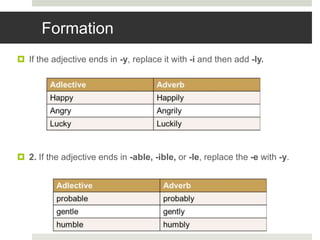
Formation
 If the adjective ends in -y, replace it with -i and then add -ly.
 2. If the adjective ends in -able, -ible, or -le, replace the -e with -y.
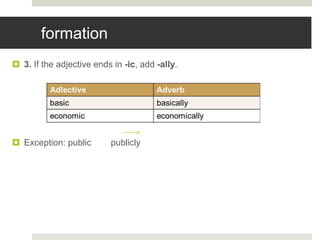
formation
 3. If the adjective ends in -ic, add -ally.
 Exception: public publicly

Adverbs

  • 1.
  • 2.
  • 3.
    Definition Adverbs are wordsthat describe or modify verbs, adjectives and another adverb
  • 4.
    Examples Adverbs are wordsthat modify a verb (He drove slowly. — How did he drive?) an adjective (He drove a very fast car. — How fast was his car?) another adverb (She moved quite slowly down the aisle. — How slowly did she move?)
  • 5.
    Types of adverbs Adverbsof: 1. Manner 2. Time 3. Place 4. Frequency 5. Degree 6. Purpose
  • 6.
    Adverb of manner Sayshow something happens or is done. Answers the question “how” Eg: 1. The lion roared ferociously. 2. She is seriously ill. 3. She angrily tore up the letter. 4. He walked happily towards his house. 5. He walked towards his house happily. 6. Happily he walked towards his house.
  • 7.
    Adverb of time Tells us when something happens.  Answers the question “when”  Eg.  Robin drove to school last Tuesday.  Let us start now.  You must wake up early.  Tomorrow I am leaving for Penang.  They soon realised their mistake.  I just asked a question just and  He is still working for the same institution. & still in mid position  She has finally got a job.
  • 8.
    Adverb of place Tells us where something happens, expresses both movement and location.  Answer the question “where”  Eg: 1. She searched for the book everywhere. 2. Please come in. 3. My parents live abroad. 4. They climbed uphill. 5. Uphill they climbed.
  • 9.
    Adverb of frequency Tells us how often something happens  Answers the question “how often”  Eg: 1. She usually comes late to class. 2. I am seldom late for work. 3. Have you ever been to the US? 4. We visit them occasionally. 5. Often we eat in that restaurant. 6. They never admitted their fault 7. Never ask her about her age.
  • 10.
    Adverb of degree Tells us about the degree or extent of an action, quality or manner.  Eg: 1. She is very beautiful. 2. I am extremely sorry. 3. He had hardly begun his work. 4. She hardly did her work. 5. You are not old enough to marry. Placed after 6. This is good enough for me. adjective/adverb
  • 11.
    Adverb of certainty Expresses how certain or sure we feel about an action or event  Eg: 1. There is clearly something wrong. 2. She is definitely taller than you. 3. She will probably play the piano. 4. I certainly feel better today. 5. Perhaps she will attend the dinner tonight. In the 6. Maybe you are right. beginning
  • 12.
    Formation  If theadjective ends in -y, replace it with -i and then add -ly.  2. If the adjective ends in -able, -ible, or -le, replace the -e with -y.
  • 13.
    formation  3. Ifthe adjective ends in -ic, add -ally.  Exception: public publicly