1r Batxillerat. Unit 4
Modal Verbs
Semi-modal Verbs
CONTENTS
1.Modals and semi-modals. Why are they special?
2.Modal verbs in the past
3.What do modal verbs express? Double
meanings.
4.Important points to remember.
5.Example sentences. Exercise
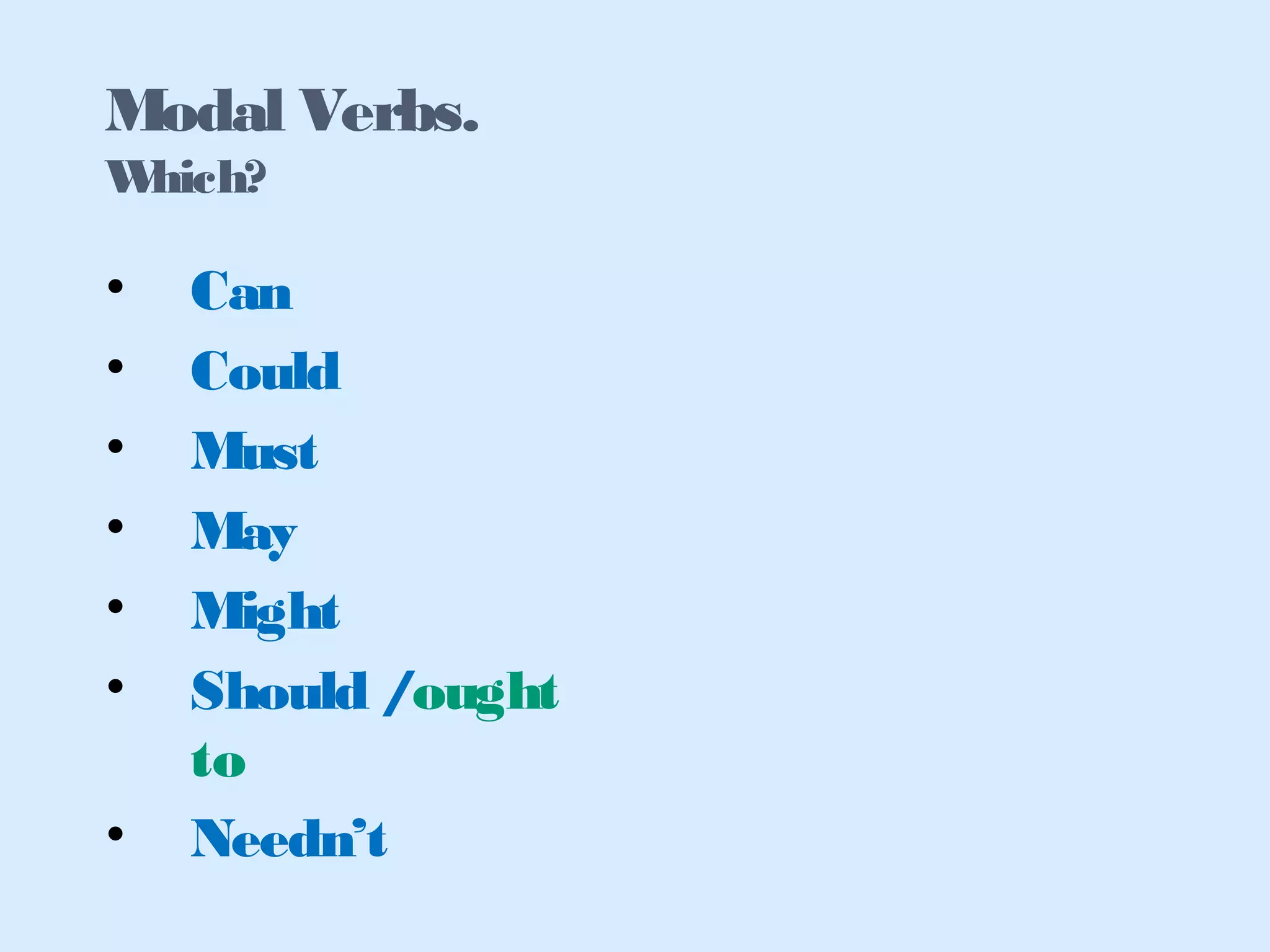
• Can
• Could
• Must
• May
• Might
• Should /ought
to
• Needn’t
Modal Verbs.
Which?
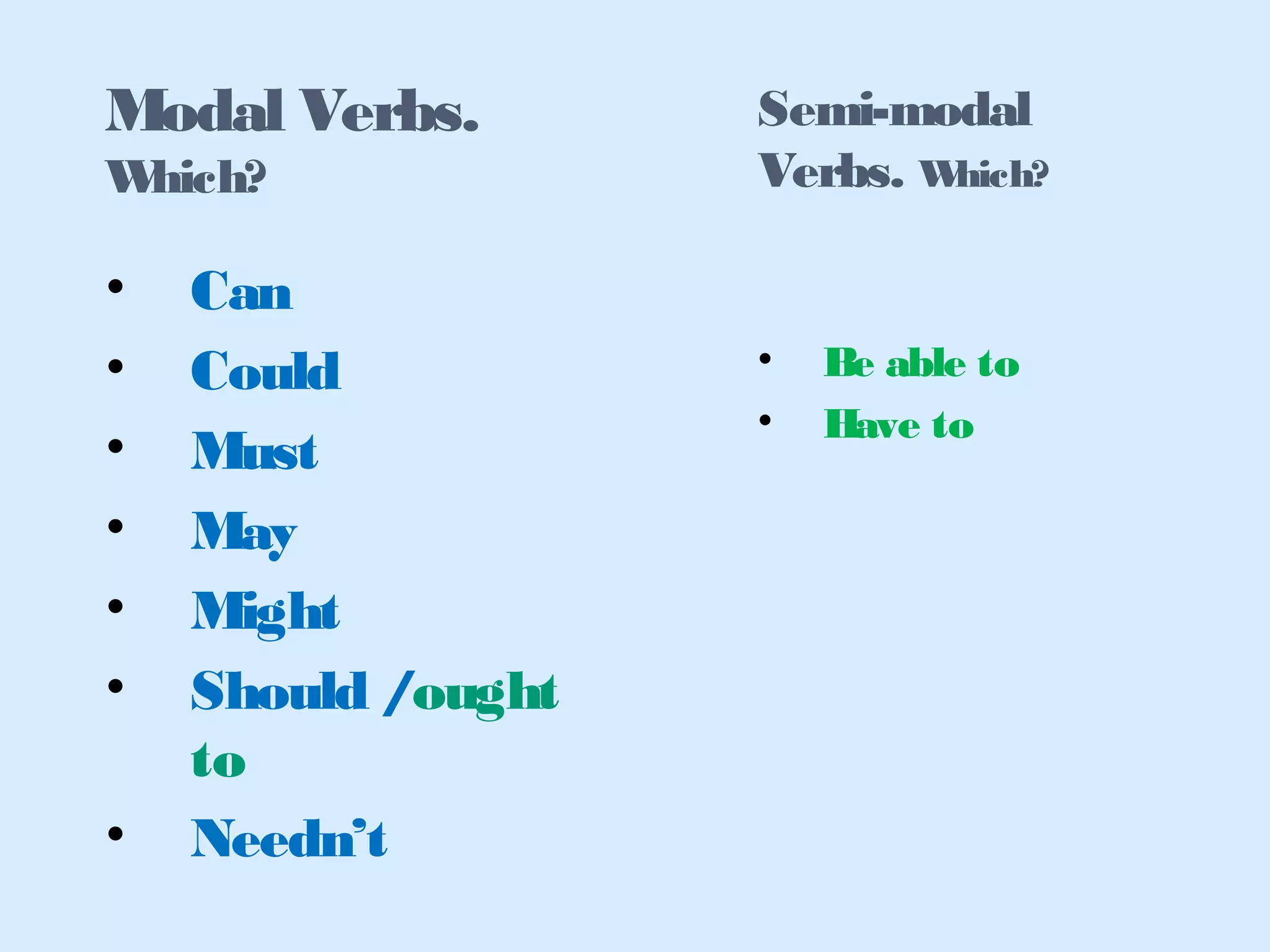
• Can
• Could
• Must
• May
• Might
• Should /ought
to
• Needn’t
Modal Verbs.
Which?
Semi-modal
Verbs. Which?
• Be able to
• Have to
Modal Verbs. What makes them
special?
 He can speak
English.
 She shouldn’t
smoke.
 It may be his jacket
but I don’t know.
Modal Verbs. What makes them
special?
 He can speak
English.
 She shouldn’t
smoke.
 It may be his jacket
but I don’t know.
 They are auxiliary
verbs that give
additional meaning to
the main verb.
 They do not need any
otheraux. verbs.
 They do not accept
conjugation
 They are followed by an
infinitive without to.
Modal Verbs. What makes them
special?
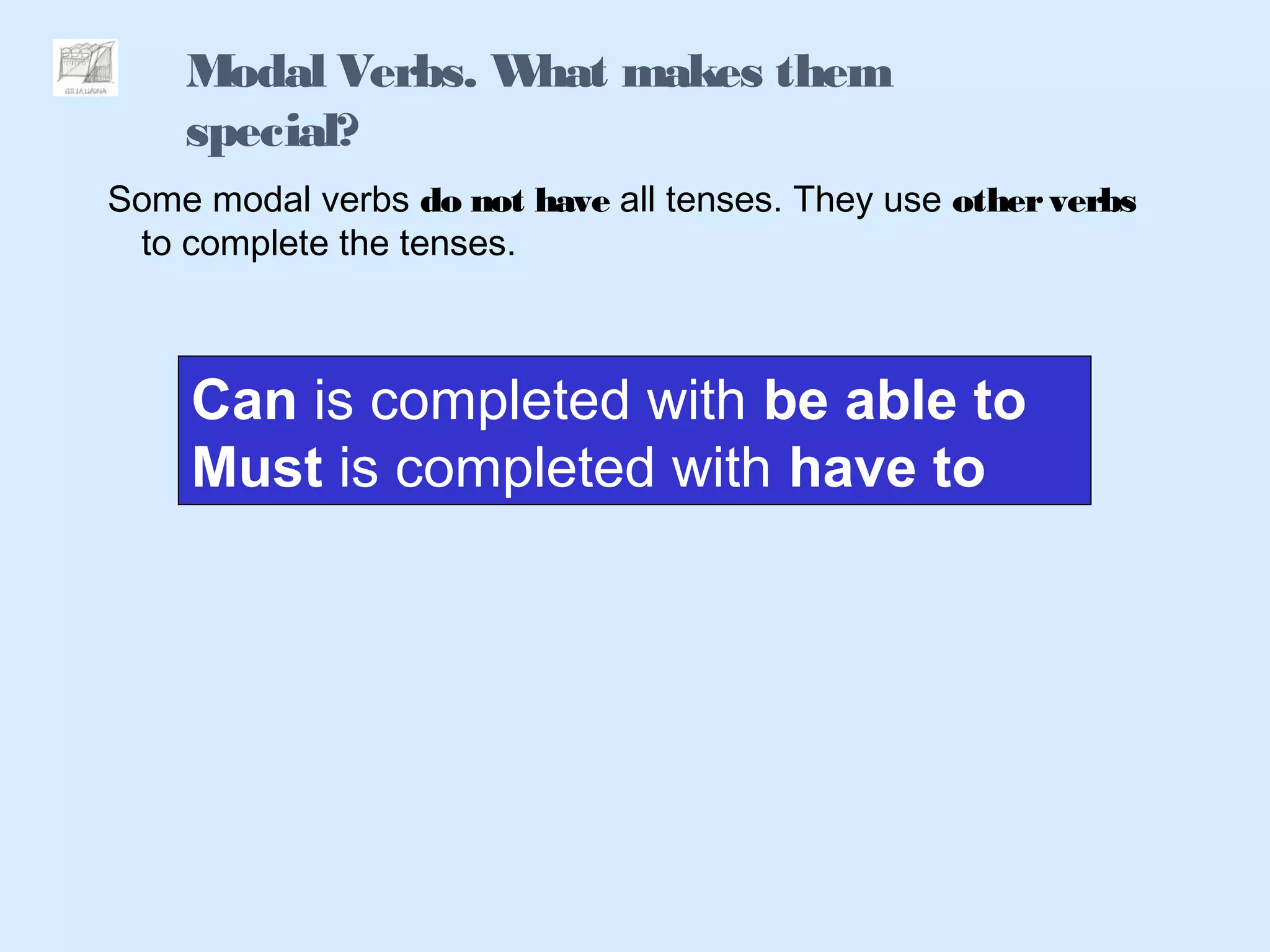
Some modal verbs do not have all tenses. They use otherverbs
to complete the tenses.
Can is completed with be able to
Must is completed with have to
Semi-modal Verbs. What makes themspecial?
They are called semi-modal because:
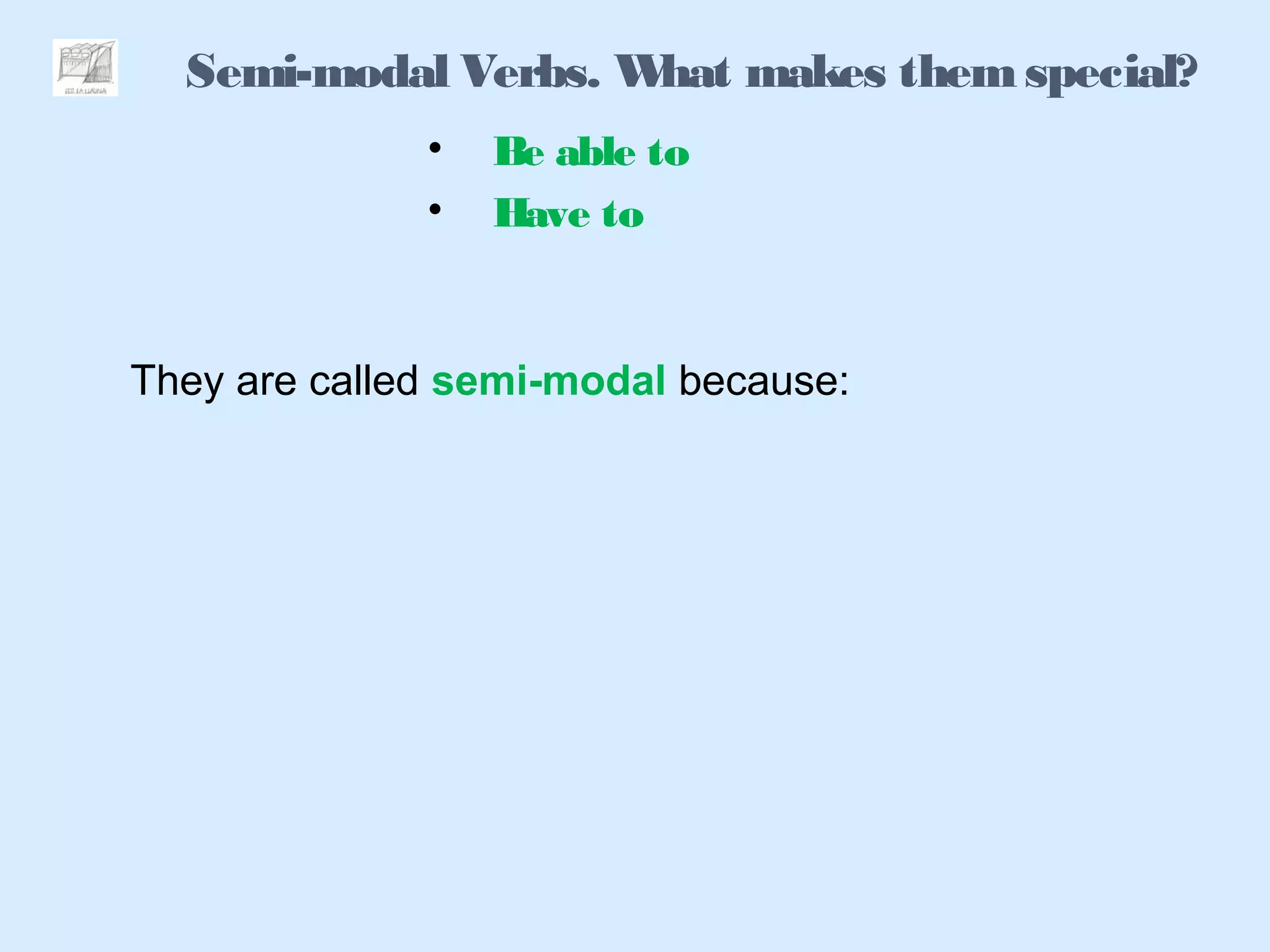
• Be able to
• Have to
Semi-modal Verbs. What makes themspecial?
They are called semi-modal because:
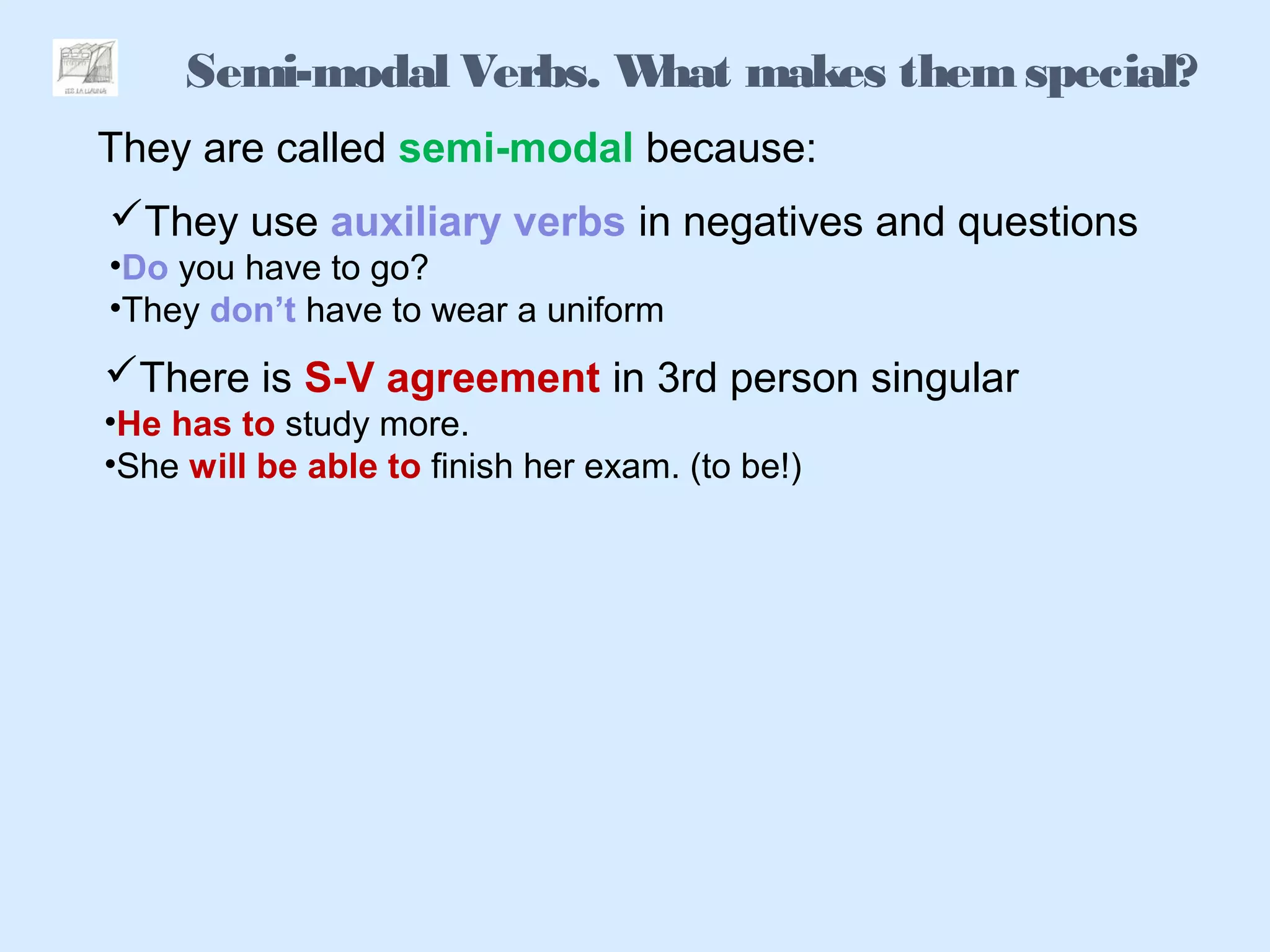
They use auxiliary verbs in negatives and questions
•Do you have to go?
•They don’t have to wear a uniform
Semi-modal Verbs. What makes themspecial?
They are called semi-modal because:
They use auxiliary verbs in negatives and questions
•Do you have to go?
•They don’t have to wear a uniform
There is S-V agreement in 3rd person singular
•He has to study more.
•She will be able to finish her exam. (to be!)
Semi-modal Verbs. What makes themspecial?
They are called semi-modal because:
They use auxiliary verbs in negatives and questions
•Do you have to go?
•They don’t have to wear a uniform
There is S-V agreement in 3rd person singular
•He has to study more.
•She will be able to finish her exam. (to be!)
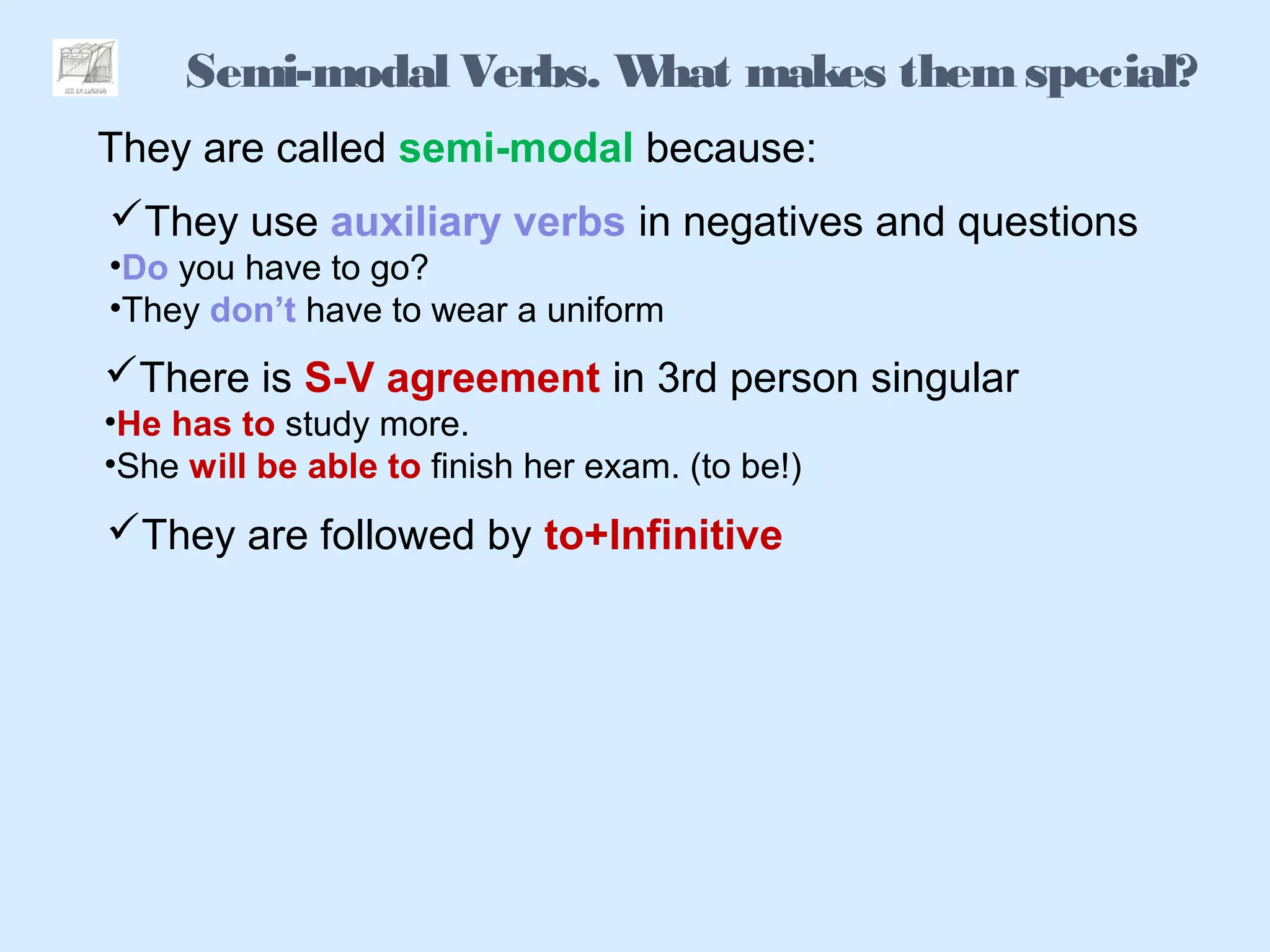
They are followed by to+Infinitive
Semi-modal Verbs. What makes themspecial?
They are called semi-modal because:
They use auxiliary verbs in negatives and questions
•Do you have to go?
•They don’t have to wear a uniform
There is S-V agreement in 3rd person singular
•He has to study more.
•She will be able to finish her exam. (to be!)
They are followed by to+Infinitive
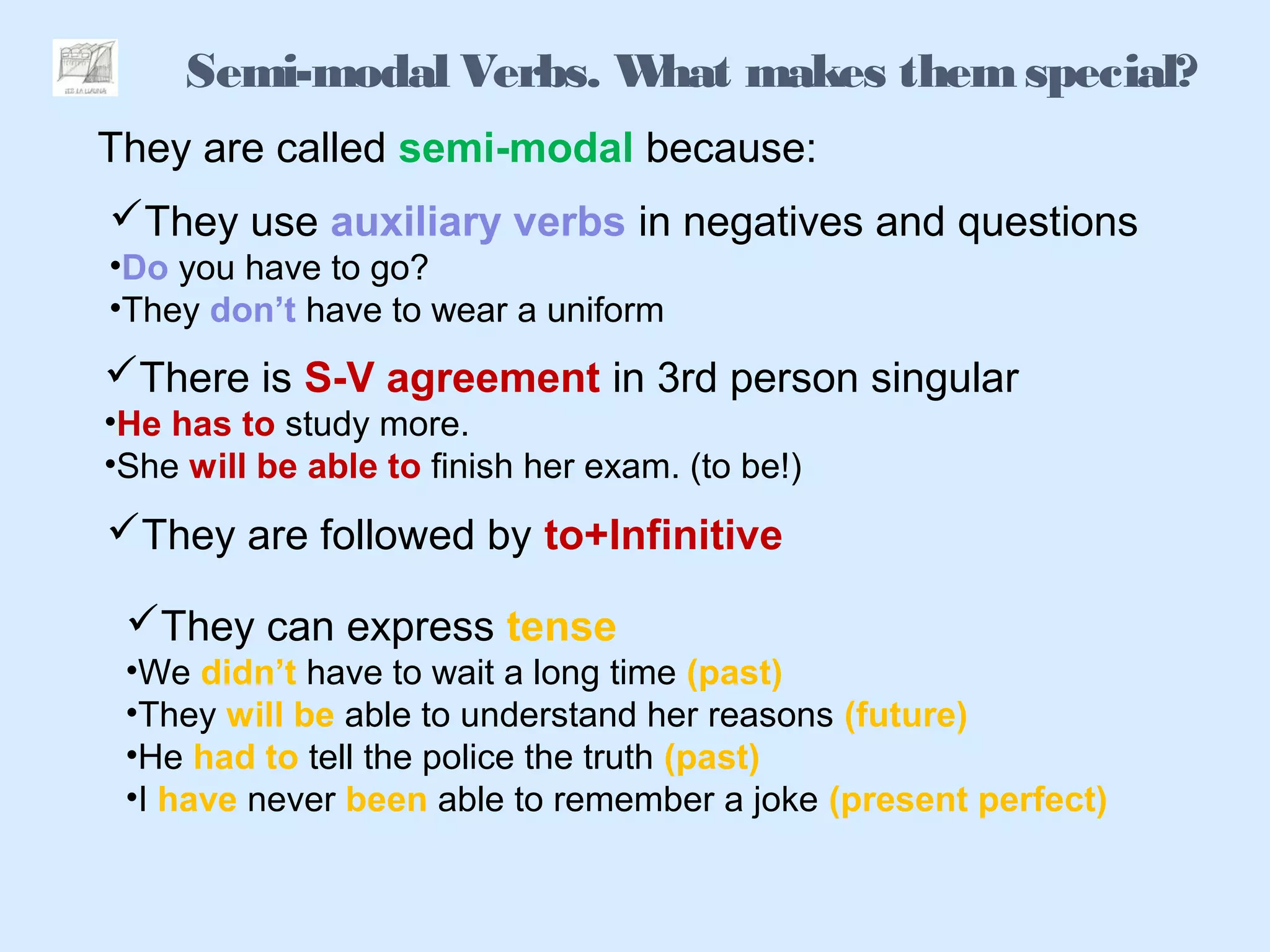
They can express tense
•We didn’t have to wait a long time (past)
•They will be able to understand her reasons (future)
•He had to tell the police the truth (past)
•I have never been able to remember a joke (present perfect)
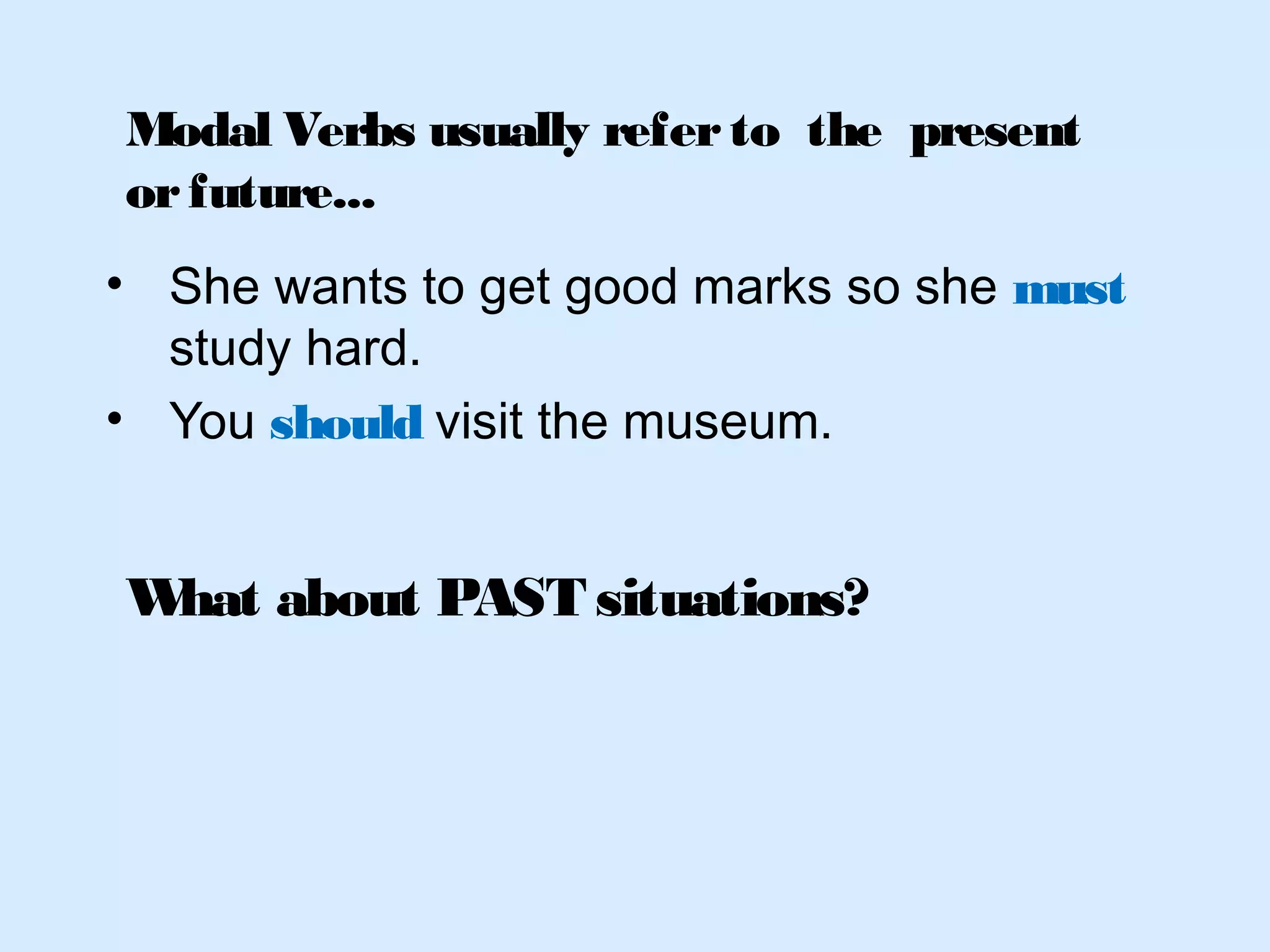
• She wants to get good marks so she must
study hard.
• You should visit the museum.
What about PAST situations?
Modal Verbs usually referto the present
orfuture...
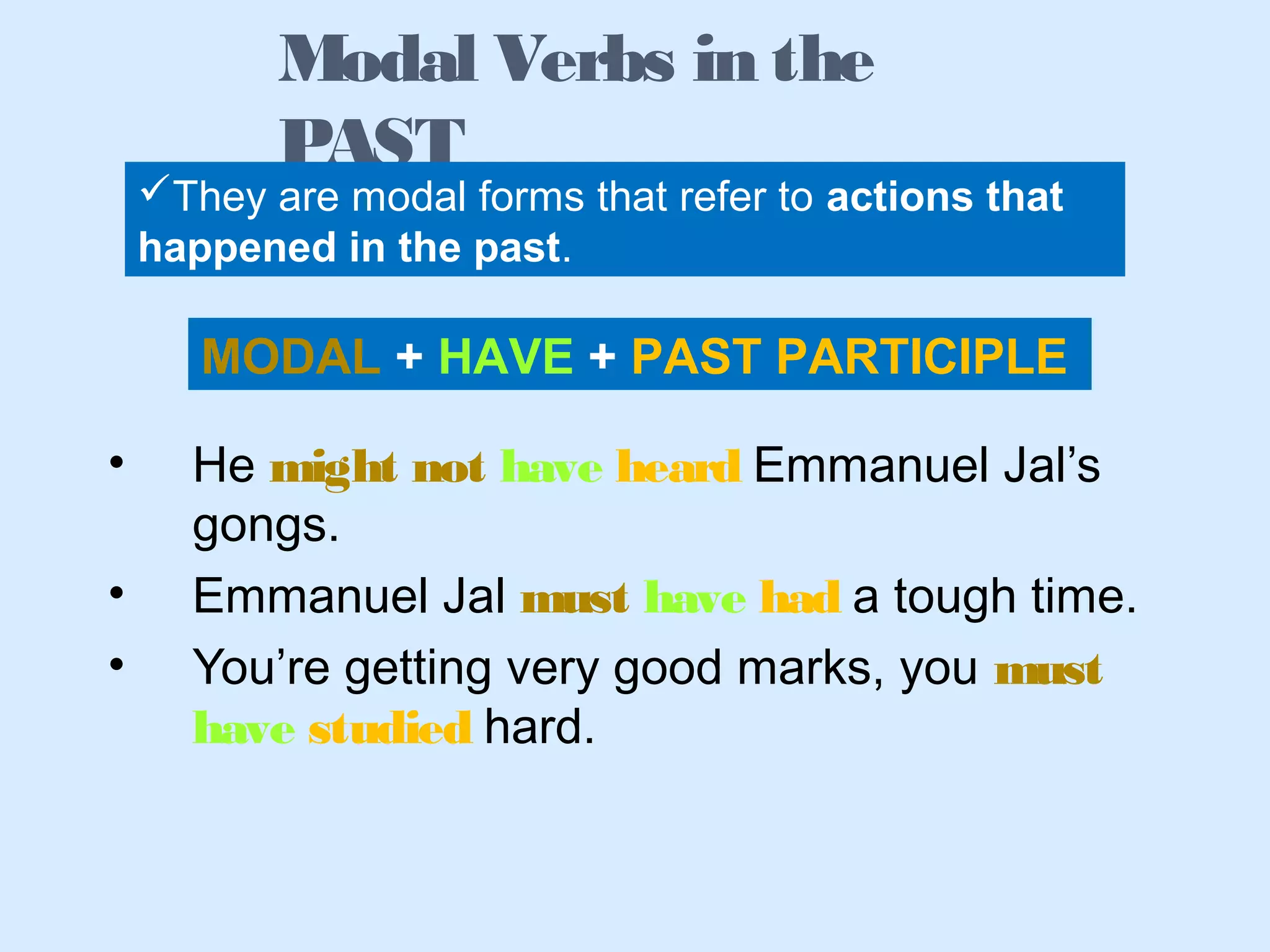
Modal Verbs in the
PAST
They are modal forms that refer to actions that
happened in the past.
MODAL + HAVE + PAST PARTICIPLE
• He might not have heard Emmanuel Jal’s
gongs.
• Emmanuel Jal must have had a tough time.
• You’re getting very good marks, you must
have studied hard.
Modal Verbs in the
PAST
They are modal forms that refer to actions that
happened in the past.
MODAL + HAVE + PAST PARTICIPLE
Modal Verbs in the
PAST
Other forms
Ability – can / could . Compare:
•I could ride my bike when I was 4 (ability)
•I could have done that but I didn’t (unrealised
past ability)
Obligation – have to / had to
•Emmanuel Jal had to join the army
What do they express?
Meaning
Some can have more than one meaning
depending on the situations
What do they express?
Present and Future Past
1. Ability Can/ Can’t / be able
to
Could (general ability) (podia)
Could (n’t) have +pp (unrealised
past ability) (hagués pogut)
2. Advice
Suggestion
Should(n’t)
Ought (n’t) to
Must
Should(n’t) have + pp
Ought (n’t) to + have +pp
Could (n’t) have +pp
3. Obligation Must (internal)
Have to (external)
Had to
4. Lackof
obligation
Don’t have to (no has
de, no hi ha
obligació)
Didn’t have to (a past activity wasn’t
necessary but we don’t know if it
happened)
Needn’t
(informal: don’t need
to)
(no fa falta que)
Needn’t have + pp (a past activity
happened but it wasn’t necessary)
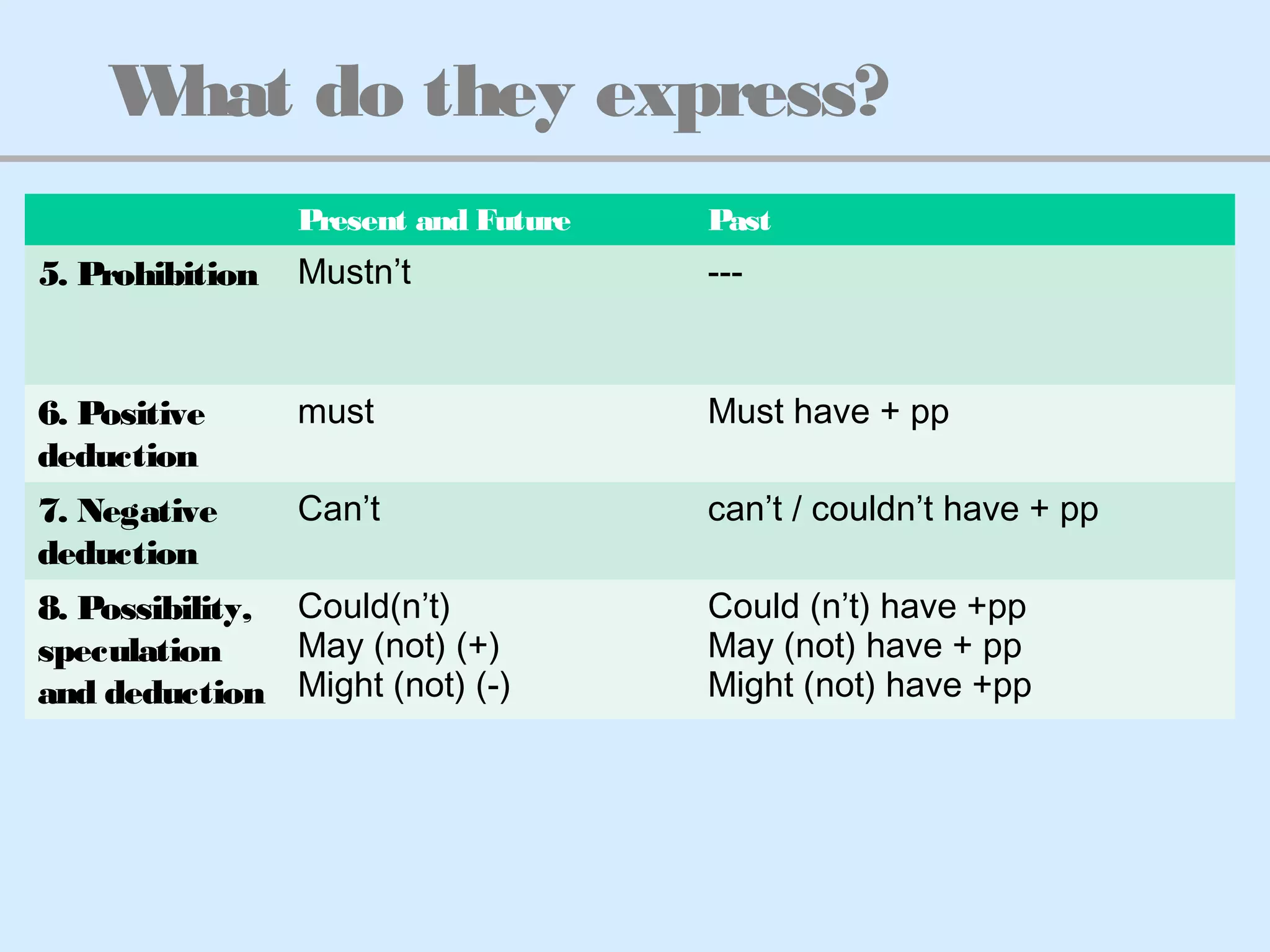
What do they express?
Present and Future Past
5. Prohibition Mustn’t ---
6. Positive
deduction
must Must have + pp
7. Negative
deduction
Can’t can’t / couldn’t have + pp
8. Possibility,
speculation
and deduction
Could(n’t)
May (not) (+)
Might (not) (-)
Could (n’t) have +pp
May (not) have + pp
Might (not) have +pp
What do they express?
Some can have more than one meaning
depending on the situations
More than one meaning
Must Obligation
Strong advice
deduction
Can Ability
Permission
Can’t Negative ability
Negative deduction
Prohibition
Could Permission
Possibility, speculation
Advice
May Permission
Possibility / speculation
POINTS TO
REMEMBER:
POINTS TO
REMEMBER:
 Need as a modal verb is used mainly in negative, has no –s in the third
person singular, needs no auxiliaries. He needn’t wear a tie.
Informal spoken English. He doesn’t need to wear a tie.
POINTS TO
REMEMBER:
 Need as a modal verb is used mainly in negative, has no –s in the third
person singular, needs no auxiliaries. He needn’t wear a tie.
Informal spoken English. He doesn’t need to wear a tie.
 Must (internal obligation)
Have to (rules,..)
Must in the past = had to
POINTS TO
REMEMBER:
 Need as a modal verb is used mainly in negative, has no –s in the third
person singular, needs no auxiliaries. He needn’t wear a tie.
 The meaning of modal verbs can change when they are used in
affirmative or negative.
I have to take an exam tomorrow
You don’t have to take this exam.
Informal spoken English. He doesn’t need to wear a tie.
 Must (internal obligation)
Have to (rules,..)
Must in the past = had to
POINTS TO
REMEMBER:
 Don’t have to = lack of obligation (no has de)
Needn’t = lack of necessity (no fa falta que)
Didn’t have to (no sabem si va passar)
Needn’t have + pp ( sí que va passar)
 Need as a modal verb is used mainly in negative, has no –s in the third
person singular, needs no auxiliaries. He needn’t wear a tie.
 The meaning of modal verbs can change when they are used in
affirmative or negative.
I have to take an exam tomorrow
You don’t have to take this exam.
Informal spoken English. He doesn’t need to wear a tie.
 Must (internal obligation)
Have to (rules,..)
Must in the past = had to
Example sentences. Present and
Future 
1 . She has to practise the vio lin.
2. Yo u do n’t have to co m e to day.
3. Yo u m ust de cide no w.
4. She can’t sing ve ry we ll.
5. Yo u sho uldn’t co m plain allthe tim e .
6 . He ne e dn’t wo rk in an o ffice .
7 . She o ug ht to se nd he r so ng s to a pro duce r.
8 . Yo u m ustn’t ride a m o to rbike witho ut a he lm e t.
9 . He can’t be a pro fe ssio nalsing e r. He sing s re ally badly.
1 0 . She m ust be a m usician. She kno ws a lo t abo ut m usic.
1 1 . The pho ne is ring ing . It co uld be m y siste r.
1 2. If we do n’t hurry up, we m ig ht no t arrive o n tim e .
1 3. Ihave to subm it the applicatio n fo rm to day.
1 4. She hasn’t be e n able to finish o n tim e .
1 5. Se rg io willso o n be able to play the drum s.
Example sentences. Past
 
a. The co nce rt m ust have finishe d late . The y lo o k
tire d.
b. Yo u sho uld have le ft e arlie r.
c. Mario co uld play the vio lin whe n he was o nly
fo ur.
d. He can’t have practise d fo r the auditio n. He was
with m e allday.
e . She m ay have wo n the co m pe titio n. She was
ve ry g o o d.
f. The y m ig ht have calle d but Iwasn’t at ho m e .
g . Isho uldn’t have m isse d the training .

Unit4 btx1 modalverbs_1516

  • 1.
    1r Batxillerat. Unit4 Modal Verbs Semi-modal Verbs
  • 2.
    CONTENTS 1.Modals and semi-modals.Why are they special? 2.Modal verbs in the past 3.What do modal verbs express? Double meanings. 4.Important points to remember. 5.Example sentences. Exercise
  • 3.
    • Can • Could •Must • May • Might • Should /ought to • Needn’t Modal Verbs. Which?
  • 4.
    • Can • Could •Must • May • Might • Should /ought to • Needn’t Modal Verbs. Which? Semi-modal Verbs. Which? • Be able to • Have to
  • 5.
    Modal Verbs. Whatmakes them special?  He can speak English.  She shouldn’t smoke.  It may be his jacket but I don’t know.
  • 6.
    Modal Verbs. Whatmakes them special?  He can speak English.  She shouldn’t smoke.  It may be his jacket but I don’t know.  They are auxiliary verbs that give additional meaning to the main verb.  They do not need any otheraux. verbs.  They do not accept conjugation  They are followed by an infinitive without to.
  • 7.
    Modal Verbs. Whatmakes them special? Some modal verbs do not have all tenses. They use otherverbs to complete the tenses. Can is completed with be able to Must is completed with have to
  • 8.
    Semi-modal Verbs. Whatmakes themspecial? They are called semi-modal because: • Be able to • Have to
  • 9.
    Semi-modal Verbs. Whatmakes themspecial? They are called semi-modal because: They use auxiliary verbs in negatives and questions •Do you have to go? •They don’t have to wear a uniform
  • 10.
    Semi-modal Verbs. Whatmakes themspecial? They are called semi-modal because: They use auxiliary verbs in negatives and questions •Do you have to go? •They don’t have to wear a uniform There is S-V agreement in 3rd person singular •He has to study more. •She will be able to finish her exam. (to be!)
  • 11.
    Semi-modal Verbs. Whatmakes themspecial? They are called semi-modal because: They use auxiliary verbs in negatives and questions •Do you have to go? •They don’t have to wear a uniform There is S-V agreement in 3rd person singular •He has to study more. •She will be able to finish her exam. (to be!) They are followed by to+Infinitive
  • 12.
    Semi-modal Verbs. Whatmakes themspecial? They are called semi-modal because: They use auxiliary verbs in negatives and questions •Do you have to go? •They don’t have to wear a uniform There is S-V agreement in 3rd person singular •He has to study more. •She will be able to finish her exam. (to be!) They are followed by to+Infinitive They can express tense •We didn’t have to wait a long time (past) •They will be able to understand her reasons (future) •He had to tell the police the truth (past) •I have never been able to remember a joke (present perfect)
  • 13.
    • She wantsto get good marks so she must study hard. • You should visit the museum. What about PAST situations? Modal Verbs usually referto the present orfuture...
  • 14.
    Modal Verbs inthe PAST They are modal forms that refer to actions that happened in the past. MODAL + HAVE + PAST PARTICIPLE
  • 15.
    • He mightnot have heard Emmanuel Jal’s gongs. • Emmanuel Jal must have had a tough time. • You’re getting very good marks, you must have studied hard. Modal Verbs in the PAST They are modal forms that refer to actions that happened in the past. MODAL + HAVE + PAST PARTICIPLE
  • 16.
    Modal Verbs inthe PAST Other forms Ability – can / could . Compare: •I could ride my bike when I was 4 (ability) •I could have done that but I didn’t (unrealised past ability) Obligation – have to / had to •Emmanuel Jal had to join the army
  • 17.
    What do theyexpress? Meaning Some can have more than one meaning depending on the situations
  • 18.
    What do theyexpress? Present and Future Past 1. Ability Can/ Can’t / be able to Could (general ability) (podia) Could (n’t) have +pp (unrealised past ability) (hagués pogut) 2. Advice Suggestion Should(n’t) Ought (n’t) to Must Should(n’t) have + pp Ought (n’t) to + have +pp Could (n’t) have +pp 3. Obligation Must (internal) Have to (external) Had to 4. Lackof obligation Don’t have to (no has de, no hi ha obligació) Didn’t have to (a past activity wasn’t necessary but we don’t know if it happened) Needn’t (informal: don’t need to) (no fa falta que) Needn’t have + pp (a past activity happened but it wasn’t necessary)
  • 19.
    What do theyexpress? Present and Future Past 5. Prohibition Mustn’t --- 6. Positive deduction must Must have + pp 7. Negative deduction Can’t can’t / couldn’t have + pp 8. Possibility, speculation and deduction Could(n’t) May (not) (+) Might (not) (-) Could (n’t) have +pp May (not) have + pp Might (not) have +pp
  • 20.
    What do theyexpress? Some can have more than one meaning depending on the situations More than one meaning Must Obligation Strong advice deduction Can Ability Permission Can’t Negative ability Negative deduction Prohibition Could Permission Possibility, speculation Advice May Permission Possibility / speculation
  • 21.
  • 22.
    POINTS TO REMEMBER:  Needas a modal verb is used mainly in negative, has no –s in the third person singular, needs no auxiliaries. He needn’t wear a tie. Informal spoken English. He doesn’t need to wear a tie.
  • 23.
    POINTS TO REMEMBER:  Needas a modal verb is used mainly in negative, has no –s in the third person singular, needs no auxiliaries. He needn’t wear a tie. Informal spoken English. He doesn’t need to wear a tie.  Must (internal obligation) Have to (rules,..) Must in the past = had to
  • 24.
    POINTS TO REMEMBER:  Needas a modal verb is used mainly in negative, has no –s in the third person singular, needs no auxiliaries. He needn’t wear a tie.  The meaning of modal verbs can change when they are used in affirmative or negative. I have to take an exam tomorrow You don’t have to take this exam. Informal spoken English. He doesn’t need to wear a tie.  Must (internal obligation) Have to (rules,..) Must in the past = had to
  • 25.
    POINTS TO REMEMBER:  Don’thave to = lack of obligation (no has de) Needn’t = lack of necessity (no fa falta que) Didn’t have to (no sabem si va passar) Needn’t have + pp ( sí que va passar)  Need as a modal verb is used mainly in negative, has no –s in the third person singular, needs no auxiliaries. He needn’t wear a tie.  The meaning of modal verbs can change when they are used in affirmative or negative. I have to take an exam tomorrow You don’t have to take this exam. Informal spoken English. He doesn’t need to wear a tie.  Must (internal obligation) Have to (rules,..) Must in the past = had to
  • 26.
    Example sentences. Presentand Future  1 . She has to practise the vio lin. 2. Yo u do n’t have to co m e to day. 3. Yo u m ust de cide no w. 4. She can’t sing ve ry we ll. 5. Yo u sho uldn’t co m plain allthe tim e . 6 . He ne e dn’t wo rk in an o ffice . 7 . She o ug ht to se nd he r so ng s to a pro duce r. 8 . Yo u m ustn’t ride a m o to rbike witho ut a he lm e t. 9 . He can’t be a pro fe ssio nalsing e r. He sing s re ally badly. 1 0 . She m ust be a m usician. She kno ws a lo t abo ut m usic. 1 1 . The pho ne is ring ing . It co uld be m y siste r. 1 2. If we do n’t hurry up, we m ig ht no t arrive o n tim e . 1 3. Ihave to subm it the applicatio n fo rm to day. 1 4. She hasn’t be e n able to finish o n tim e . 1 5. Se rg io willso o n be able to play the drum s.
  • 27.
    Example sentences. Past   a.The co nce rt m ust have finishe d late . The y lo o k tire d. b. Yo u sho uld have le ft e arlie r. c. Mario co uld play the vio lin whe n he was o nly fo ur. d. He can’t have practise d fo r the auditio n. He was with m e allday. e . She m ay have wo n the co m pe titio n. She was ve ry g o o d. f. The y m ig ht have calle d but Iwasn’t at ho m e . g . Isho uldn’t have m isse d the training .