Infinitives
 Holly Cin
 Fall 2016
 ESOL 0352
Infinitives
 Like gerunds, infinitives also function as
nouns, which means…
1. Infinitives can be used as subjects.
2. Infinitives can be used as objects.
*However, unlike gerunds, infinitives cannot be used
as objects of prepositions.
Infinitives as subjects
To be successful requires hard work.
To work hard is important.
Not to miss the flight was my objective.
This language is quite formal.
Infinitives as subjects
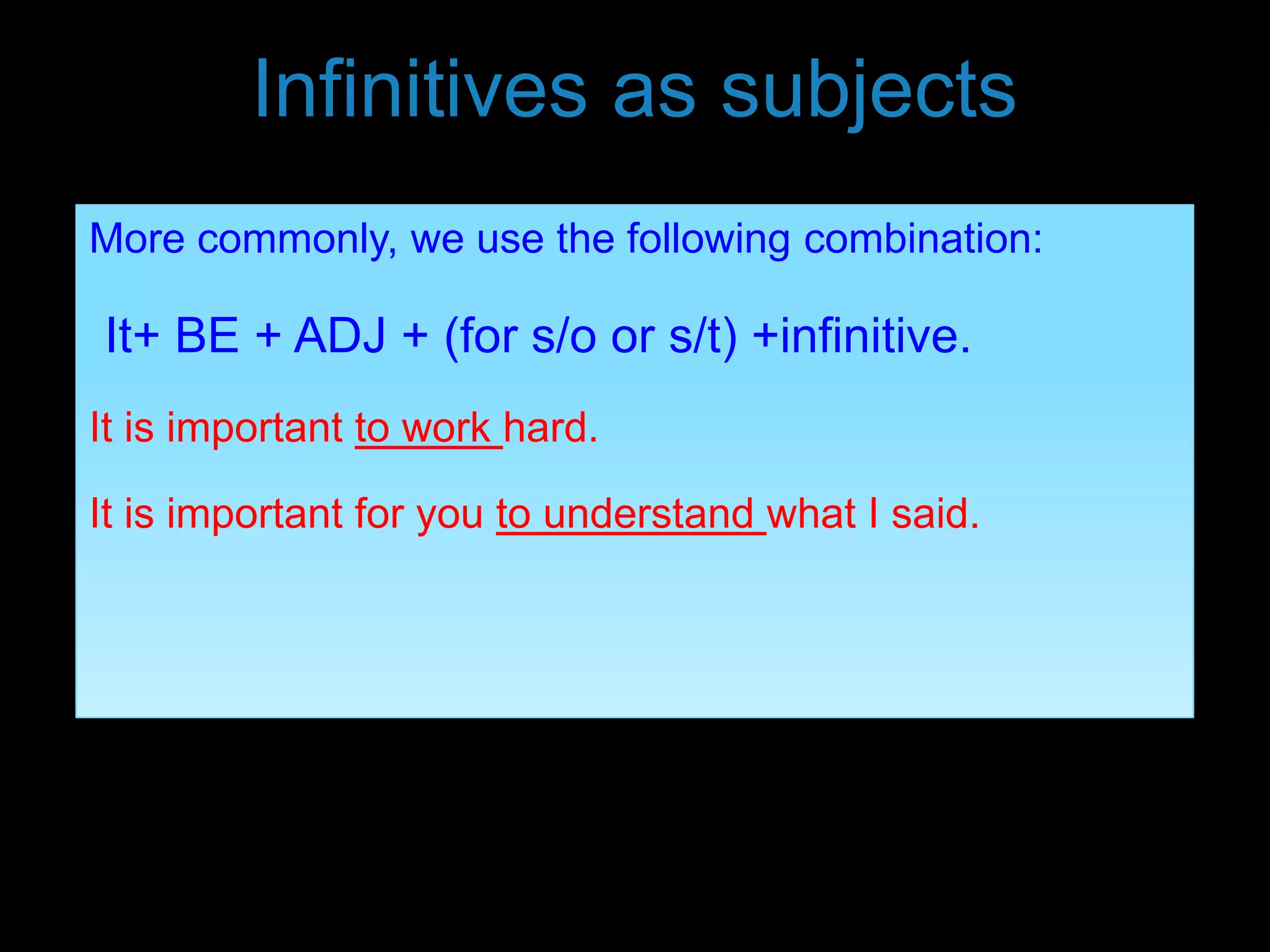
More commonly, we use the following combination:
It+ BE + ADJ + (for s/o or s/t) +infinitive.
It is important to work hard.
It is important for you to understand what I said.
Infinitives as objects
 More commonly, infinitives are used as objects of the verb.
Most HCC students try to be successful.
I want to buy a new car.
Itzel asked her mother to send her a warm coat.
Hernan told Erika to wait for him at the store.
Dongmei doesn’t want to give birth before the final exam.
Common verbs followed by
infinitives (mental verbs)
 Hope
 Plan
 Intend
 Decide
 Promise
 Agree
 Offer
 Refuse
 Seem
 Appear
 Pretend
 Ask
 Expect
 Would like
 Want
 Need
Verb + Object + Infinitive
 Tell someone to
 Advise someone to
 Encourage someone to
 Remind someone to
 Invite someone to
 Permit someone to
 Allow someone to
 Warn someone to
 Require someone to
 Order someone to
 Force someone to
 Ask someone to
 Would like someone to
 Expect someone to
 Want someone to
 Need someone to
Common verbs followed by
either gerunds or infinitives
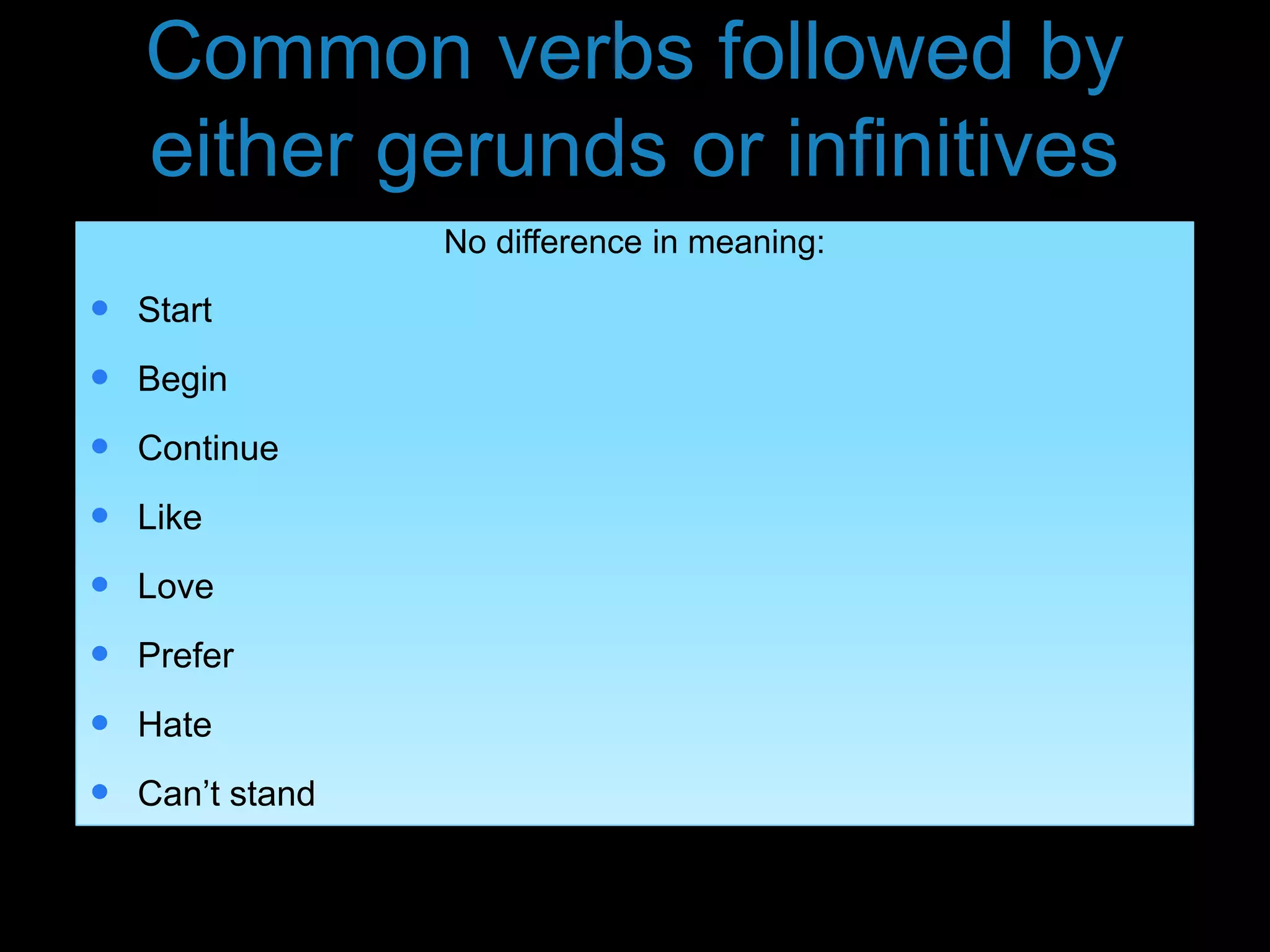
No difference in meaning:
 Start
 Begin
 Continue
 Like
 Love
 Prefer
 Hate
 Can’t stand
Infinitives of Purpose
 Infinitives of purpose answer the question “why” or “for
what reason?”
 Question: Why did Gustavo come to HCC?
 Answer: He came here to study English.
 We can also use “in order” before the infinitive to
express purpose.
 He came here in order to study English
 IMPORTANT: DO NOT USE “FOR” TO EXPRESS
PURPOSE!
 He came here for studying English. INCORRECT!
Adjectives followed by
infinitives
 Sorry
 Surprised
 Happy
 Glad
 Delighted
 Pleased
 Relieved
 Lucky
 Sad
 Eager
 Embarrassed
 Prepared
 Anxious
 Afraid
 Likely
 Surprised
 Astonished
 Shocked
 Reluctant
 Hesitant
Infinitives with TOO and
ENOUGH
 (not ) too + adj. + (for someone) + infinitive
 (not) enough + noun + (for someone) + infinitive
 (not) + adj. + enough + infinitive
 The class is not too difficult to pass.
 I don’t have enough money to buy a Porsche.
 The chair is not too heavy for me to lift.
 She’s not old enough to get married.

Infinitives l3

  • 1.
    Infinitives  Holly Cin Fall 2016  ESOL 0352
  • 2.
    Infinitives  Like gerunds,infinitives also function as nouns, which means… 1. Infinitives can be used as subjects. 2. Infinitives can be used as objects. *However, unlike gerunds, infinitives cannot be used as objects of prepositions.
  • 3.
    Infinitives as subjects Tobe successful requires hard work. To work hard is important. Not to miss the flight was my objective. This language is quite formal.
  • 4.
    Infinitives as subjects Morecommonly, we use the following combination: It+ BE + ADJ + (for s/o or s/t) +infinitive. It is important to work hard. It is important for you to understand what I said.
  • 5.
    Infinitives as objects More commonly, infinitives are used as objects of the verb. Most HCC students try to be successful. I want to buy a new car. Itzel asked her mother to send her a warm coat. Hernan told Erika to wait for him at the store. Dongmei doesn’t want to give birth before the final exam.
  • 6.
    Common verbs followedby infinitives (mental verbs)  Hope  Plan  Intend  Decide  Promise  Agree  Offer  Refuse  Seem  Appear  Pretend  Ask  Expect  Would like  Want  Need
  • 7.
    Verb + Object+ Infinitive  Tell someone to  Advise someone to  Encourage someone to  Remind someone to  Invite someone to  Permit someone to  Allow someone to  Warn someone to  Require someone to  Order someone to  Force someone to  Ask someone to  Would like someone to  Expect someone to  Want someone to  Need someone to
  • 8.
    Common verbs followedby either gerunds or infinitives No difference in meaning:  Start  Begin  Continue  Like  Love  Prefer  Hate  Can’t stand
  • 9.
    Infinitives of Purpose Infinitives of purpose answer the question “why” or “for what reason?”  Question: Why did Gustavo come to HCC?  Answer: He came here to study English.  We can also use “in order” before the infinitive to express purpose.  He came here in order to study English  IMPORTANT: DO NOT USE “FOR” TO EXPRESS PURPOSE!  He came here for studying English. INCORRECT!
  • 10.
    Adjectives followed by infinitives Sorry  Surprised  Happy  Glad  Delighted  Pleased  Relieved  Lucky  Sad  Eager  Embarrassed  Prepared  Anxious  Afraid  Likely  Surprised  Astonished  Shocked  Reluctant  Hesitant
  • 11.
    Infinitives with TOOand ENOUGH  (not ) too + adj. + (for someone) + infinitive  (not) enough + noun + (for someone) + infinitive  (not) + adj. + enough + infinitive  The class is not too difficult to pass.  I don’t have enough money to buy a Porsche.  The chair is not too heavy for me to lift.  She’s not old enough to get married.