Modifier and descriptor
an ADVERB?
What
is
An adverb is a word that
describes or modifies a verb,
an adjective, or another
adverb. It answer the questions
where, when, how, how
often, and to what extent.
ADVERB
• Josh went out to take out trash. (WHERE)
• They always quarrel. (HOW OFTEN)
• My friend arrived later. (WHEN)
• That was a very good presentation. (TO WHAT
EXTENT)
• She spoke softly. (HOW)
EXAMPLES:
THAT MODIFY VERBS
ADVERBS
ADVERBS THAT MODIFY VERBS
Words that describe an action or how does an
action was made.
• She passed the ball slowly.
• She quickly ran towards the
store.
• Is this the fastest you can
drive?
• I will love you thoroughly.
QUIZ 1:
Underline the adverb in each of the following
sentences.
• Sarah is silently crying because she lost battle of
debate.
• I love people who loudly talks about their pet
peeves.
• She is a gold digger, because she can quickly
find men and ask for luxury.
•
THAT MODIFY ADJECTIVES
ADVERBS
ADVERBS THAT MODIFY ADJECTIVES
• It describes to what extent does the noun is
being described.
• Also known as an intensifier.
• She faces an extremely difficult situation.
• That is an unusually tall tree.
• A very blue bird flew.
• Jared's sister is exceptionally smart.
• The surprisingly young violinist plays well.
THAT MODIFY ANOTHER
ADVERBS
ADVERBS
ADVERBS THAT MODIFY ADVERBS
• It describes to what extent does the action is
being described.
• Also known as an intensifier.
• My sister runs very fast.
• He wrote so neatly.
• You will have to listen very carefully.
• Jenn is reading so quickly.
• Please work very carefully.
TYPES OF ADVERBS
TYPES OF ADVERBS
TIME (WHEN)
PLACE (WHERE)
MANNER (HOW)
FREQUENCY (HOW OFTEN)
DEGREE (TO WHAT EXTENT)
ADVERBS OF TIME
• Some adverbs tell us when something
happens.
• Adverbs of time include words that refer to
specific times and more general time periods.
EXAMPLES:
today, yesterday, tomorrow, tonight, soon,
later, now, eventually, forever, still, yet, early,
late, recently, since
ADVERBS OF TIME
EXAMPLES:
• We are going to see a movie tomorrow.
• My daughter hasn’t learned how to tie her
shoes yet.
• Recently, Trevor got a job as a
construction worker.
• I will eat my dinner later.
ADVERBS OF PLACE
• Adverbs of place tell us where something
happens.
EXAMPLES:
• here, there, everywhere, nowhere,
somewhere, anywhere, in, out, inside,
outside, wherever, on, off, over, under, above,
away, left, right, north, south, east, west
ADVERBS OF PLACE
EXAMPLES:
• I can’t find my keys anywhere.
• She loves to spend sunny afternoons outside by
the pool.
• The lost travelers went north until they found a
small town.
• The balloons floated above.
• The parrots flew across.
• I ran inside.
ADVERBS OF MANNER
• Adverbs of manner tell us how something
happens. A huge number of adverbs fall
under this type and many of the -ly adverbs
formed from adjectives fit into this group.
EXAMPLES:
• angrily, cautiously, hungrily, nicely, slowly, deftly,
precisely, unknowingly, loudly
ADVERBS OF MANNER
EXAMPLES:
• The clown skillfully made animals out of
balloons.
• She bravely rescued a kitten from a tree.
• Natalie wisely took an extra umbrella with
her.
• I cautiously check my bag because I heard a
weird sound.
ADVERBS OF FREQUENCY
• A number of adverbs are used to describe the
frequency of an event. By doing so, these
adverbs describe how often something
happens.
EXAMPLES:
• constantly, frequently, occasionally, sometimes,
usually, never, always, rarely, daily, weekly,
monthly, yearly
ADVERBS OF FREQUENCY
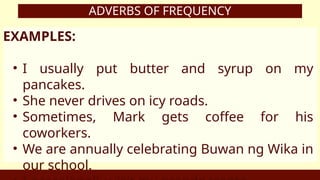
EXAMPLES:
• I usually put butter and syrup on my
pancakes.
• She never drives on icy roads.
• Sometimes, Mark gets coffee for his
coworkers.
• We are annually celebrating Buwan ng Wika in
our school.
ADVERBS OF FREQUENCY
• An adverb of degree is employed in
a sentence to depict the intensity or
degree of an adjective, verb or
another adverb. It usually answers
the question ‘to what extent’.
• They are normally positioned before
the word (an adjective in most
cases) they are modifying.
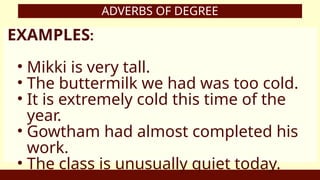
ADVERBS OF DEGREE
EXAMPLES:
• Mikki is very tall.
• The buttermilk we had was too cold.
• It is extremely cold this time of the
year.
• Gowtham had almost completed his
work.
• The class is unusually quiet today.
QUIZ 2:
Underline the adverb in each of the following sentences.
1. They spoke loudly.
2. I am highly impressed with her presentation.
3. She looked quite nervous.
4. Radha works diligently in order to get promoted.
5. Fox is often believed to be cunning animal,
6. Barking dogs seldom bite.
7. Earlier, they used to travel in their car.
8. The birds were chirping merrily.
9. I sometimes go for a walk in the park.
10. He never came to my place to visit me.
Happy
learning!

4-ADVERBS.pptx..................................

  • 1.
  • 2.
    An adverb isa word that describes or modifies a verb, an adjective, or another adverb. It answer the questions where, when, how, how often, and to what extent. ADVERB
  • 3.
    • Josh wentout to take out trash. (WHERE) • They always quarrel. (HOW OFTEN) • My friend arrived later. (WHEN) • That was a very good presentation. (TO WHAT EXTENT) • She spoke softly. (HOW) EXAMPLES:
  • 4.
  • 5.
    ADVERBS THAT MODIFYVERBS Words that describe an action or how does an action was made. • She passed the ball slowly. • She quickly ran towards the store. • Is this the fastest you can drive? • I will love you thoroughly.
  • 6.
    QUIZ 1: Underline theadverb in each of the following sentences. • Sarah is silently crying because she lost battle of debate. • I love people who loudly talks about their pet peeves. • She is a gold digger, because she can quickly find men and ask for luxury. •
  • 7.
  • 8.
    ADVERBS THAT MODIFYADJECTIVES • It describes to what extent does the noun is being described. • Also known as an intensifier. • She faces an extremely difficult situation. • That is an unusually tall tree. • A very blue bird flew. • Jared's sister is exceptionally smart. • The surprisingly young violinist plays well.
  • 9.
  • 10.
    ADVERBS THAT MODIFYADVERBS • It describes to what extent does the action is being described. • Also known as an intensifier. • My sister runs very fast. • He wrote so neatly. • You will have to listen very carefully. • Jenn is reading so quickly. • Please work very carefully.
  • 11.
  • 12.
    TYPES OF ADVERBS TIME(WHEN) PLACE (WHERE) MANNER (HOW) FREQUENCY (HOW OFTEN) DEGREE (TO WHAT EXTENT)
  • 13.
    ADVERBS OF TIME •Some adverbs tell us when something happens. • Adverbs of time include words that refer to specific times and more general time periods. EXAMPLES: today, yesterday, tomorrow, tonight, soon, later, now, eventually, forever, still, yet, early, late, recently, since
  • 14.
    ADVERBS OF TIME EXAMPLES: •We are going to see a movie tomorrow. • My daughter hasn’t learned how to tie her shoes yet. • Recently, Trevor got a job as a construction worker. • I will eat my dinner later.
  • 15.
    ADVERBS OF PLACE •Adverbs of place tell us where something happens. EXAMPLES: • here, there, everywhere, nowhere, somewhere, anywhere, in, out, inside, outside, wherever, on, off, over, under, above, away, left, right, north, south, east, west
  • 16.
    ADVERBS OF PLACE EXAMPLES: •I can’t find my keys anywhere. • She loves to spend sunny afternoons outside by the pool. • The lost travelers went north until they found a small town. • The balloons floated above. • The parrots flew across. • I ran inside.
  • 17.
    ADVERBS OF MANNER •Adverbs of manner tell us how something happens. A huge number of adverbs fall under this type and many of the -ly adverbs formed from adjectives fit into this group. EXAMPLES: • angrily, cautiously, hungrily, nicely, slowly, deftly, precisely, unknowingly, loudly
  • 18.
    ADVERBS OF MANNER EXAMPLES: •The clown skillfully made animals out of balloons. • She bravely rescued a kitten from a tree. • Natalie wisely took an extra umbrella with her. • I cautiously check my bag because I heard a weird sound.
  • 19.
    ADVERBS OF FREQUENCY •A number of adverbs are used to describe the frequency of an event. By doing so, these adverbs describe how often something happens. EXAMPLES: • constantly, frequently, occasionally, sometimes, usually, never, always, rarely, daily, weekly, monthly, yearly
  • 20.
    ADVERBS OF FREQUENCY EXAMPLES: •I usually put butter and syrup on my pancakes. • She never drives on icy roads. • Sometimes, Mark gets coffee for his coworkers. • We are annually celebrating Buwan ng Wika in our school.
  • 21.
    ADVERBS OF FREQUENCY •An adverb of degree is employed in a sentence to depict the intensity or degree of an adjective, verb or another adverb. It usually answers the question ‘to what extent’. • They are normally positioned before the word (an adjective in most cases) they are modifying.
  • 22.
    ADVERBS OF DEGREE EXAMPLES: •Mikki is very tall. • The buttermilk we had was too cold. • It is extremely cold this time of the year. • Gowtham had almost completed his work. • The class is unusually quiet today.
  • 23.
    QUIZ 2: Underline theadverb in each of the following sentences. 1. They spoke loudly. 2. I am highly impressed with her presentation. 3. She looked quite nervous. 4. Radha works diligently in order to get promoted. 5. Fox is often believed to be cunning animal, 6. Barking dogs seldom bite. 7. Earlier, they used to travel in their car. 8. The birds were chirping merrily. 9. I sometimes go for a walk in the park. 10. He never came to my place to visit me.
  • 24.