Evaluatory seminar on
Advances in oral trans mucosal
drug delivery
Presented by :
Gasper Fernandes (160603016)
MPharm 1st year
Department of Pharmaceutics
Under the guidance of : Dr. Shaila Lewis
Contents
 Introduction
 Why Buccal/Sublingual
 Anatomy of oral mucosa
 Transport Routes
 Theories of Mucoadhesion
 Formulation consideration
 Basic components
 Formulation
 Evaluation
 Conclusion
 Reference
Introduction
 Oral trans-mucosal drug delivery concerned
with the systemic delivery of the drug moiety
via mucous membrane of the oral cavity.
 Oral trans-mucosal drug delivery can be
subdivided into:
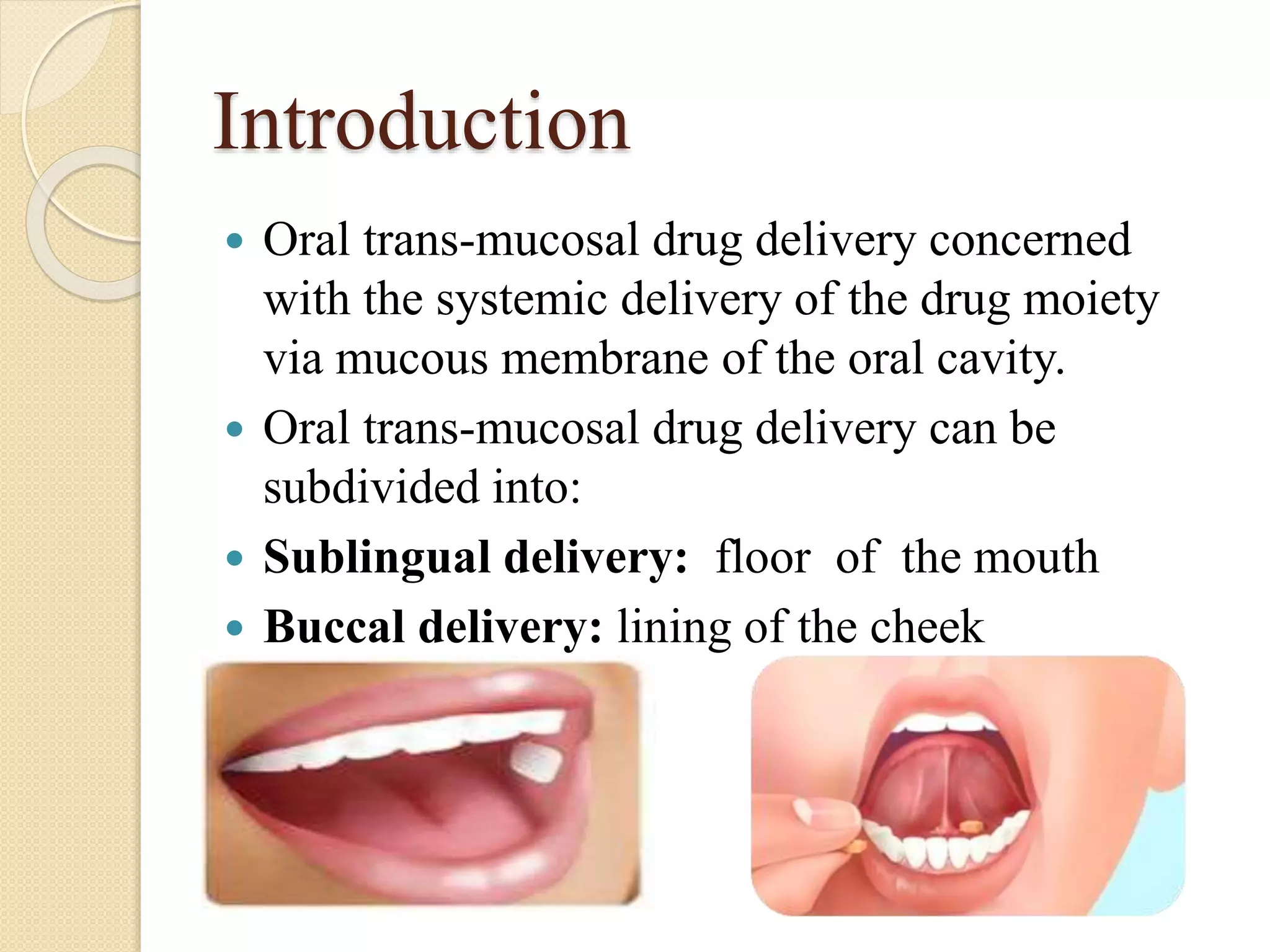
 Sublingual delivery: floor of the mouth
 Buccal delivery: lining of the cheek
Oral cavity
Comparison with different part
Why Buccal/Sublingual?
 To avoid first-pass metabolism
 Protection from pH and digestive enzymes
 Rapid onset of action
 Painless administration
 Rapid and extensive drug absorption
 Easy termination of therapy
Anatomy of oral mucosa
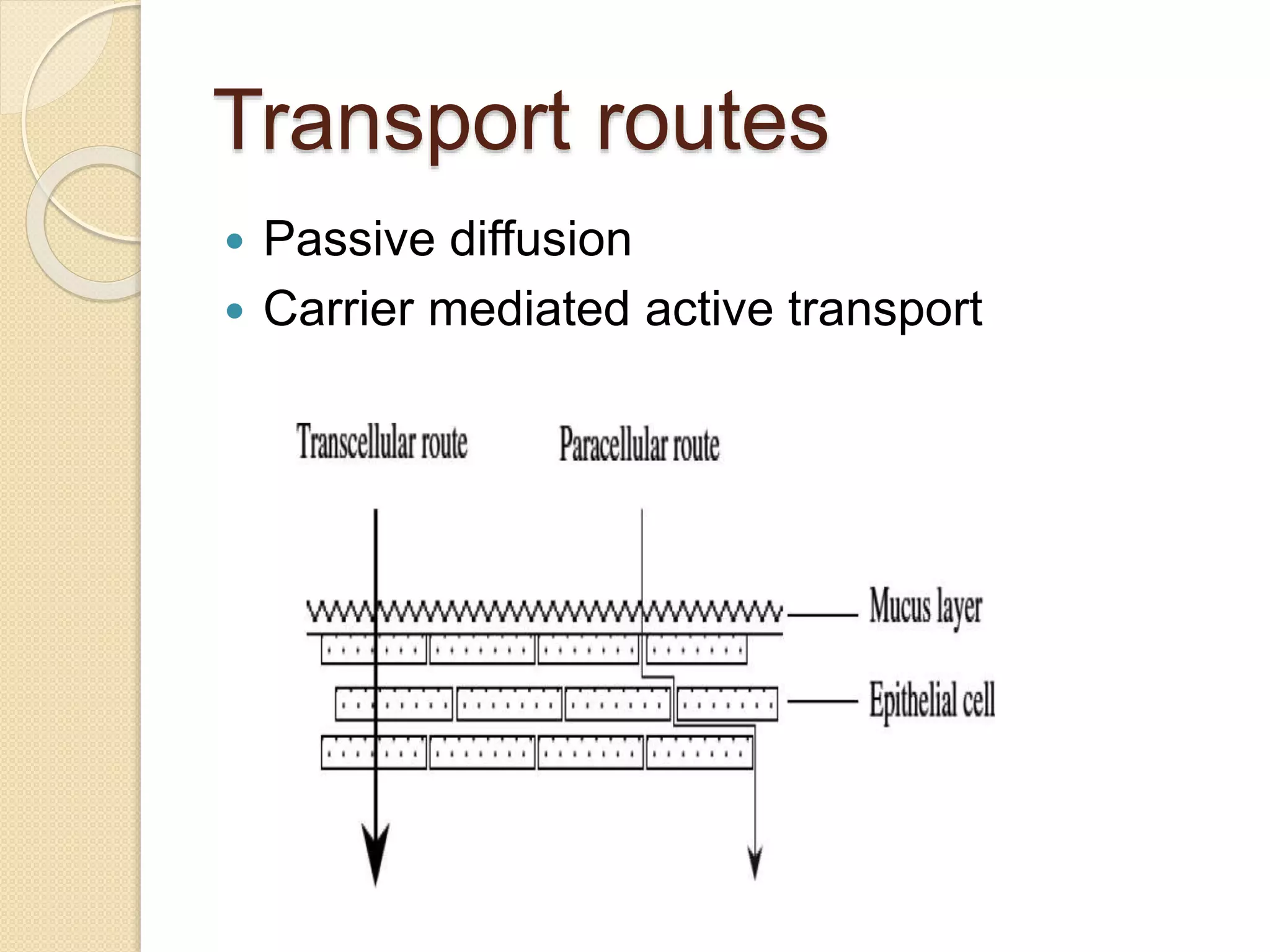
Transport routes
 Passive diffusion
 Carrier mediated active transport
Mucoadhesion
Mucoadhesion: The adhesion between biological
materials or artificial substrate and mucus
membrane.
Mucoadhesion is necessary:
 to maximize the intimacy of contact of the drug
delivery system with the mucosa;
 to retain the delivery system in the oral cavity
Theory of Mucoadhesion
 Diffusion theory: Entanglements of the polymer
 Electronic theory: Attractive forces
 Wetting theory: Measure of spread ability of drug
delivery system on biological substrate
 Fracture theory: Force necessary to separate two
layers
 Adsorption Theory: Secondary chemical bonds
Formulation
considerations
 Molecular size- small molecules(75-100Da)
 Degree of ionization- Non-ionized forms of
drug have greater transport.
 Lipid solubility-More lipid soluble higher its
permeability
 Drug substance
 Bioadhesive polymers
 Backing membrane
 Permeation enhancers
Basic components
Selection of drug
 Dose of the drug should be small
 Half-life between 2-8 hours
 Exhibit first pass effect or presystemic drug
elimination.
 Absorption should be passive when given
orally
Bioadhesive polymers
 Must not decompose on storage
 Inert and compatible with the environment
 Polymer and its degradation products should be
non-toxic absorbable from the mucous layer.
 Adhere quickly to moist tissue surface
 Natural polymers
Ex.: Gelatin, sodium alginate.
 Synthetic and semisynthetic polymers
Ex.: PVA, PEG, HPMC, PVP, NA-CMC
Backing membrane
 The impermeable backing layer controls the
direction of release and reduces drug loss away
from the site of contact.
 It also protects the other layers and acts as a
mechanical support.
 Examples: PVA, Ethyl celulose.
Permeation enhancers
Mechanism:
 Changing mucus rheology
 Increasing the fluidity of lipid bilayer membrane
 Acting on the components at tight junctions
 Increase thermodynamic activity of drug
 Examples: Capric acid, Citric acid, Aprotinin,
Chitosan-cysteine
Formulations
I. Tablets:
 Buccal tablets are small, flat, and oval, with a
diameter of approximately 5–8 mm.
 When placed directly onto the mucosal surface
tablets adhere to the buccal mucosa in presence of
saliva.
 Prepared by direct compression, but wet
granulation techniques can also be used.
Marketed buccal tablets
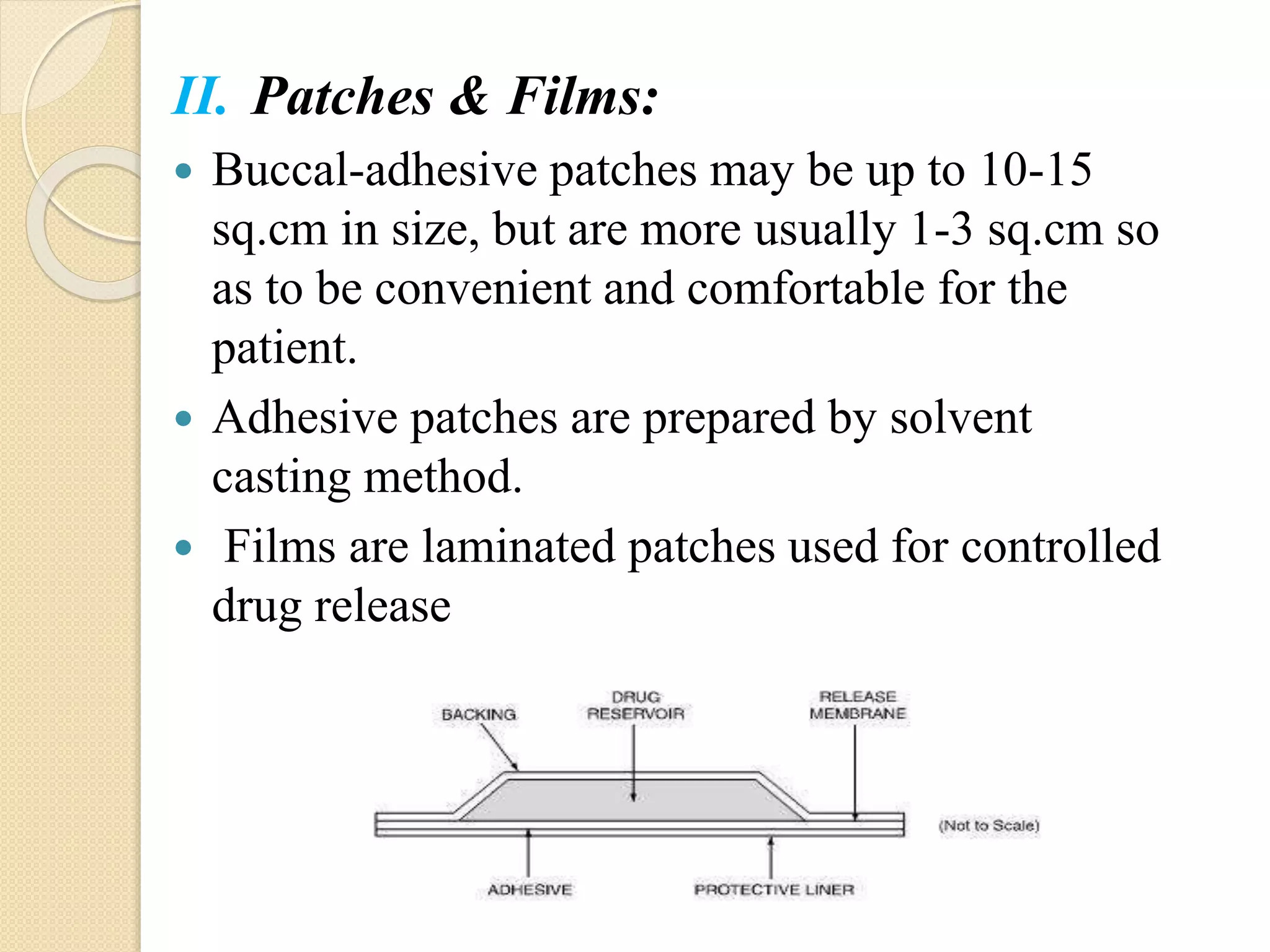
II. Patches & Films:
 Buccal-adhesive patches may be up to 10-15
sq.cm in size, but are more usually 1-3 sq.cm so
as to be convenient and comfortable for the
patient.
 Adhesive patches are prepared by solvent
casting method.
 Films are laminated patches used for controlled
drug release
Marketed buccal patches
Bio Erodible Muco Adhesive
 Buccoadhesive sprays are
gaining popularity over
other dosage forms because
of
◦ flexibility,
◦ comfort,
◦ availability of drug in
solution form.
 Drugs generally given by
these routes are fentanyl,
buprenorphine. Naloxone
etc
III. Buccoadhesive Spray:
Methods for evaluation
1. Tests for measuring mucoadhesive strength:
•Measuring the force required to break the binding
between the model membrane and the mucoadhesive.
•Depending on the direction in which the
mucoadhesive is separated from the substrate, is it
possible to obtain the detachment, shear, and rupture
tensile strengths.
• Here the force required to remove the formulation
from a model membrane is measured.
Texture analyzer:
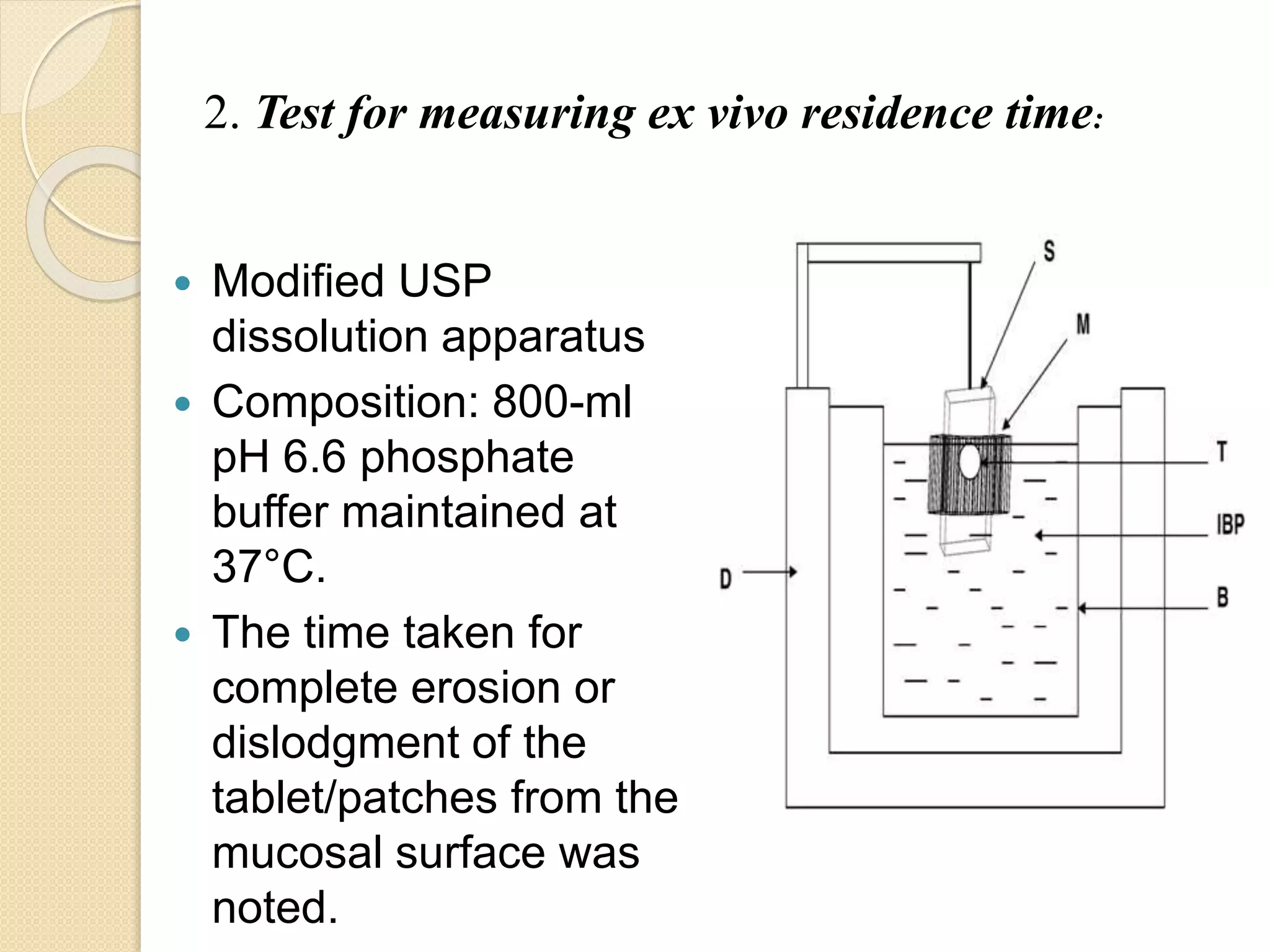
 Modified USP
dissolution apparatus
 Composition: 800-ml
pH 6.6 phosphate
buffer maintained at
37°C.
 The time taken for
complete erosion or
dislodgment of the
tablet/patches from the
mucosal surface was
noted.
2. Test for measuring ex vivo residence time:
3. Degree of swelling of buccal tablet/patches:
Where,
W1 is Initial weight of tablet
W2 is weight of swollen tablets
Appropriate swelling property of a buccal adhesive
device is required for uniform and prolonged release
of drug with proper mucoadhesion.
Other evaluation test:
• In vitro drug release: USP apparatus 2 i.e. rotating
paddle method.
• Permeation study of buccal patch: Using Franz
diffusion cell.
• Stability of buccal tablets: Performed using human
saliva.
• General test for buccal tablet: Weight variation,
friability, hardness, content uniformity.
• General test for buccal patch/film: Surface pH
studies, content uniformity, folding endurance,
thickness & weight variation.
Conclusion
Oral transmucosal drug delivery is a promising
area for systemic delivery of orally inefficient
drugs as well as an attractive alternative for
noninvasive delivery of potent peptide and
perhaps protein drug molecules.
References
 Mathiowitz, Edith. 1999. Encyclopedia Of Controlled Drug
Delivery. Vol.1, New York, John Wiley & Sons, Inc
 Viralkumar F. Patel a, Fang Liu a, Marc B. Brown, Advances in oral
transmucosal drug delivery, Journal of Controlled Release 153
(2011) 106–116.
 Nookala Venkala Satheesh Madhav, Ravindra Semwal,Deepak
Kumar Semwal & Ruchi B Semwal, Recent trends in oral
transmucosal drug delivery systems: an emphasis on the soft palatal
route, Expert Opinion on Drug Delivery · April 2012.
 Bandyopadhyay, A. K., 2006. “Buckle bioadhesive drug delivery —
A promising option for orally less efficient drugs.” Journal of
Controlled Release 114 (2006)15–40.
 Smart J. D., 1993. “Drug delivery using buccal-adhesive systems.”
Advanced Drug Delivery Reviews, ll (1993) 253-270.
 Sudhakar Y., Kuotsu K., et al. (2006). "Buckle bioadhesive drug
delivery — A promising option for orally less efficient drugs "
Journal of Controlled Release 114: 15-40.
 Jain.N.K, editor. New Delhi: CBS Publishers and Distributors PVT.
LTD; Advances in Controlled and Novel Drug Delivery). 2001. p.
53-75
Advances in transmucosal drug delivery

Advances in transmucosal drug delivery

  • 1.
    Evaluatory seminar on Advancesin oral trans mucosal drug delivery Presented by : Gasper Fernandes (160603016) MPharm 1st year Department of Pharmaceutics Under the guidance of : Dr. Shaila Lewis
  • 2.
    Contents  Introduction  WhyBuccal/Sublingual  Anatomy of oral mucosa  Transport Routes  Theories of Mucoadhesion  Formulation consideration  Basic components  Formulation  Evaluation  Conclusion  Reference
  • 3.
    Introduction  Oral trans-mucosaldrug delivery concerned with the systemic delivery of the drug moiety via mucous membrane of the oral cavity.  Oral trans-mucosal drug delivery can be subdivided into:  Sublingual delivery: floor of the mouth  Buccal delivery: lining of the cheek
  • 4.
  • 5.
  • 6.
    Why Buccal/Sublingual?  Toavoid first-pass metabolism  Protection from pH and digestive enzymes  Rapid onset of action  Painless administration  Rapid and extensive drug absorption  Easy termination of therapy
  • 7.
  • 8.
    Transport routes  Passivediffusion  Carrier mediated active transport
  • 9.
    Mucoadhesion Mucoadhesion: The adhesionbetween biological materials or artificial substrate and mucus membrane. Mucoadhesion is necessary:  to maximize the intimacy of contact of the drug delivery system with the mucosa;  to retain the delivery system in the oral cavity
  • 10.
    Theory of Mucoadhesion Diffusion theory: Entanglements of the polymer  Electronic theory: Attractive forces  Wetting theory: Measure of spread ability of drug delivery system on biological substrate  Fracture theory: Force necessary to separate two layers  Adsorption Theory: Secondary chemical bonds
  • 11.
    Formulation considerations  Molecular size-small molecules(75-100Da)  Degree of ionization- Non-ionized forms of drug have greater transport.  Lipid solubility-More lipid soluble higher its permeability
  • 12.
     Drug substance Bioadhesive polymers  Backing membrane  Permeation enhancers Basic components
  • 13.
    Selection of drug Dose of the drug should be small  Half-life between 2-8 hours  Exhibit first pass effect or presystemic drug elimination.  Absorption should be passive when given orally
  • 14.
    Bioadhesive polymers  Mustnot decompose on storage  Inert and compatible with the environment  Polymer and its degradation products should be non-toxic absorbable from the mucous layer.  Adhere quickly to moist tissue surface  Natural polymers Ex.: Gelatin, sodium alginate.  Synthetic and semisynthetic polymers Ex.: PVA, PEG, HPMC, PVP, NA-CMC
  • 15.
    Backing membrane  Theimpermeable backing layer controls the direction of release and reduces drug loss away from the site of contact.  It also protects the other layers and acts as a mechanical support.  Examples: PVA, Ethyl celulose.
  • 16.
    Permeation enhancers Mechanism:  Changingmucus rheology  Increasing the fluidity of lipid bilayer membrane  Acting on the components at tight junctions  Increase thermodynamic activity of drug  Examples: Capric acid, Citric acid, Aprotinin, Chitosan-cysteine
  • 17.
    Formulations I. Tablets:  Buccaltablets are small, flat, and oval, with a diameter of approximately 5–8 mm.  When placed directly onto the mucosal surface tablets adhere to the buccal mucosa in presence of saliva.  Prepared by direct compression, but wet granulation techniques can also be used.
  • 18.
  • 19.
    II. Patches &Films:  Buccal-adhesive patches may be up to 10-15 sq.cm in size, but are more usually 1-3 sq.cm so as to be convenient and comfortable for the patient.  Adhesive patches are prepared by solvent casting method.  Films are laminated patches used for controlled drug release
  • 20.
  • 21.
  • 22.
     Buccoadhesive spraysare gaining popularity over other dosage forms because of ◦ flexibility, ◦ comfort, ◦ availability of drug in solution form.  Drugs generally given by these routes are fentanyl, buprenorphine. Naloxone etc III. Buccoadhesive Spray:
  • 23.
    Methods for evaluation 1.Tests for measuring mucoadhesive strength: •Measuring the force required to break the binding between the model membrane and the mucoadhesive. •Depending on the direction in which the mucoadhesive is separated from the substrate, is it possible to obtain the detachment, shear, and rupture tensile strengths.
  • 24.
    • Here theforce required to remove the formulation from a model membrane is measured. Texture analyzer:
  • 25.
     Modified USP dissolutionapparatus  Composition: 800-ml pH 6.6 phosphate buffer maintained at 37°C.  The time taken for complete erosion or dislodgment of the tablet/patches from the mucosal surface was noted. 2. Test for measuring ex vivo residence time:
  • 26.
    3. Degree ofswelling of buccal tablet/patches: Where, W1 is Initial weight of tablet W2 is weight of swollen tablets Appropriate swelling property of a buccal adhesive device is required for uniform and prolonged release of drug with proper mucoadhesion.
  • 27.
    Other evaluation test: •In vitro drug release: USP apparatus 2 i.e. rotating paddle method. • Permeation study of buccal patch: Using Franz diffusion cell. • Stability of buccal tablets: Performed using human saliva. • General test for buccal tablet: Weight variation, friability, hardness, content uniformity. • General test for buccal patch/film: Surface pH studies, content uniformity, folding endurance, thickness & weight variation.
  • 28.
    Conclusion Oral transmucosal drugdelivery is a promising area for systemic delivery of orally inefficient drugs as well as an attractive alternative for noninvasive delivery of potent peptide and perhaps protein drug molecules.
  • 29.
    References  Mathiowitz, Edith.1999. Encyclopedia Of Controlled Drug Delivery. Vol.1, New York, John Wiley & Sons, Inc  Viralkumar F. Patel a, Fang Liu a, Marc B. Brown, Advances in oral transmucosal drug delivery, Journal of Controlled Release 153 (2011) 106–116.  Nookala Venkala Satheesh Madhav, Ravindra Semwal,Deepak Kumar Semwal & Ruchi B Semwal, Recent trends in oral transmucosal drug delivery systems: an emphasis on the soft palatal route, Expert Opinion on Drug Delivery · April 2012.  Bandyopadhyay, A. K., 2006. “Buckle bioadhesive drug delivery — A promising option for orally less efficient drugs.” Journal of Controlled Release 114 (2006)15–40.  Smart J. D., 1993. “Drug delivery using buccal-adhesive systems.” Advanced Drug Delivery Reviews, ll (1993) 253-270.  Sudhakar Y., Kuotsu K., et al. (2006). "Buckle bioadhesive drug delivery — A promising option for orally less efficient drugs " Journal of Controlled Release 114: 15-40.  Jain.N.K, editor. New Delhi: CBS Publishers and Distributors PVT. LTD; Advances in Controlled and Novel Drug Delivery). 2001. p. 53-75