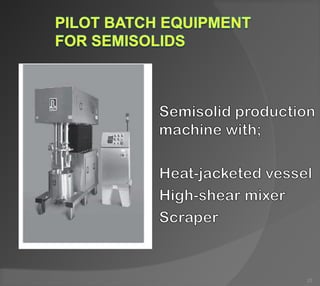
1
Presented by:
Asst. Prof. MA. LOURDES LICSI-MOJARES,
RPh
CEU School of Pharmacy
USES OF TOPICAL
PHARMACEUTICALS
 VEHICLES FOR TOPICALLY –
APPLIED DRUGS
( Non-medicated ointment bases)
 EMOLLIENTS – provide soothing /
softening effects on the surface
tissues
 PROTECTIVES / OCCLUSIVE
DRESSINGS
2
FACTORS INFLUENCING
ABSORPTION
OF DRUGS THROUGH THE SKIN
A. Partition Coefficient of Drugs through the
Skin
Substances possessing both water
and lipid solubility are favorably
absorbed through the skin.
3
FACTORS INFLUENCING ABSORPTION
OF DRUGS THROUGH THE SKIN
B. Moisture and Temperature in the Environment
of the Skin
B.1 Moisture Balance in the Skin
It is found in the stratum corneum layer of the
epidermis.
It prevents the NMF (Natural Moisturizing
Factor) from being stripped from the skin.
NMF prevents skin from drying out, even
during excessive contact of the skin with water.
4
FACTORS INFLUENCING
ABSORPTION
OF DRUGS THROUGH THE SKIN
B.2 Insensible Perspiration
The skin constantly releases water in the
skin surface, which evaporates quickly
without being noticed.
When the surrounding environment has
a high moisture content, the rate of
evaporation of sweat is slowed down,
and the person becomes aware of the
clammy moist sensation on his skin.
5
FACTORS INFLUENCING ABSORPTION
OF DRUGS THROUGH THE SKIN
C. Pathological Injury to the Skin
Skin penetration has been enhanced
by abrasions or when the skin is
stripped of its barrier layer.
6
FACTORS INFLUENCING ABSORPTION
OF DRUGS THROUGH THE SKIN
D. Type of Vehicle Used
Skin penetration of drug substances
may be enhanced by the use of a
suitable semisolid base.
The vehicle may help increase the rate
of penetration of a drug substances
into the skin.
It serves as a carrier for the API.
7
RAW MATERIALS IN THE FORMULATION
OF
MEDICATED APPLICATIONS
FDA approves chemical substances and
states the maximum concentration
considered safe for food and cosmetics
(GRAS grade).
The supplier of these drug substances
supplies brochures / information which
indicates that FDA APPROVAL SAFETY
TESTS are conducted.
8
THE FREQUENT RAW MATERIALS FOR
MEDICATED SEMISOLIDS
 HYDROCARBONS
Petrolatum and Mineral oil are the MOST
WIDELY USED substances in semisolids,
next to water.
PETROLATUM– a complex mixture of
semisolids containing hydrocarbon aliphatic,
cyclic, saturated, unsaturated, branched and
unbranched substances in varying
proportions.
MINERAL OIL – derived from petroleum acid.
It is less tacky and with lower viscosity.
9
THE FREQUENT RAW MATERIALS FOR
MEDICATED SEMISOLIDS
 HYDROCARBON WAXES
1. Help increase the viscosity of
hydrocarbons such as petrolatum and
mineral oil
2. prevent separation of hydrocarbons
from the ointment.
Examples: paraffin, beeswax, ceresin wax
(mixture of paraffin and
ozokerite).
10
THE FREQUENT RAW MATERIALS FOR
MEDICATED SEMISOLIDS
 OLEAGINOUS SUBSTANCES
Vegetable fixed oils which contain
glycerides of mixtures of saturated and
unsaturated fatty acids (MCT’s and FA’s).
These are employed for its EMOLLIENT
and SKIN-LUBRICATING effects.
Examples: Fixed oils of peanut, olive,
sesame, cottonseed, coconut, corn
11
THE FREQUENT RAW MATERIALS FOR
MEDICATED SEMISOLIDS
 FATTY ACIDS and ALCOHOLS
Functions as;
1. auxiliary emulsifiers
2. viscosity –builders
Examples:
Stearic acid – emulsifiers in water-removable
creams
Stearyl / Cetyl Alcohols - emollients, provides
the necessary firmness / softness in consistency
of creams.
12
THE FREQUENT RAW MATERIALS FOR
MEDICATED SEMISOLIDS
 EMULSIFIERS
Substances that;
a. Prevent Coalescence
b. act as Product stabilizers
Examples: Triethanolamine stearate,
SPANS, TWEENS, Carbowax
13
THE FREQUENT RAW MATERIALS FOR
MEDICATED SEMISOLIDS
 POLYOLS
Used as Humectants, prevents
dehydration and “Crusting” on top of
creams and ointments in jars.
Examples: Glycerin, PG, Sorbitol 70%,
PEG (lower MW)
14
THE FREQUENT RAW MATERIALS FOR
MEDICATED SEMISOLIDS
 INSOLUBLE POWDERS
These must be uniformly dispersed
throughout the semisolid vehicle to
assure product homogeneity.
These solids must be impalpable to the
touch..
Particles less than 74 micronsParticles less than 74 microns
(equivalent to 200 mesh) is said to be(equivalent to 200 mesh) is said to be
impalpable to most peopleimpalpable to most people..
15
TYPES OF SEMISOLID VEHICLES
NON-MEDICATED BASES
 Factors which Influence the Choice of
Semisolid Vehicles
1. Nature of the skin lesion
2. Skin Type
3. Solubility of the formulation
components
4. Stability of the API’s
16
TYPES OF SEMISOLID VEHICLES
NON-MEDICATED BASES
 HYDROCARBON BASES
 Typically lipophilic
 Spreads easily onto the skin
 Difficult to remove / wash-off
 Act as occlusive dressings, since the
normal evaporation of insensible
perspiration is inhibited.
 Examples are White petrolatum, Mineral
oil, White / Yellow Ointment, USP
17
TYPES OF SEMISOLID VEHICLES
NON-MEDICATED BASES
 ABSORPTION / EMULSIFIABLE BASES
 These are hydrophilic mixtures formed by
the addition of substances that possess
polar groupings ( sulfates, carboxyl, hydroxyl
or ether linkages) to a Hydrocarbon Base.
Lanolin, Cholesterol, Sorbitan
monostearate / monooleate are added to
Hydrocarbon bases to make it hydrophilic.
18
TYPES OF SEMISOLID VEHICLES
NON-MEDICATED BASES
 WATER – REMOVABLE / WASHABLE
BASES
 These are o/w emulsions referred to as
Creams.
 Upon application, there is little or no
evidence of its presence onto the skin.
 Best for moist skin lesions, since its o/w
character tend to adsorb serous
discharges.
19
TYPES OF SEMISOLID VEHICLES
NON-MEDICATED BASES
 WATER – REMOVABLE / WASHABLE
BASES
 Vanishing creams, Foundation
creams, Shaving Creams.
 Vanishing creams type of vehicles
are of o/w type.
 Absorption bases are of w/o type.
20
TYPES OF SEMISOLID VEHICLES
NON-MEDICATED BASES
 WATER-SOLUBLE / GREASELESS
BASES
 Prepared from mixtures of high and
low MW PEG
 No water is required in its
preparation
 Water soluble, due to many polar
groups and ether linkages
21
TYPES OF SEMISOLID VEHICLES
NON-MEDICATED BASES
 WATER-SOLUBLE / GREASELESS BASES
 Suitable combinations of high and low
MW PEG yield products having an
ointment-like consistency, which soften or
melt when applied topically.
 Low MW PEG – liquids
 Moderately high MW PEG – unctuous
 Very High MW PEG - solids
22
OPTHALMIC OINTMENTS
 Semisolid ophthalmic vehicles frequently
contain any of the ff. bases that have been
sterilized;
1. petroleum jelly
2. absorption base
(Lanolin or Lanolin Alcohol)
3. water-soluble base
 Insoluble API powders should meet the
requirements for IMPALPABILITY.
 Ophthalmic ointments should be rendered
STERILE and ISOTONIC.
23
OTHER
OPTHALMIC OINMENT BASES
 Lanolin
Sterilized by Gamma Radiation or
Sterilization by Filtration
 Lanolin Alcohol
Possess emollient properties suitable
for eye ointment formulation.
24
25
PRESERVATION FROM MICROBIAL
SPOILAGE
 The chemical preservative for
semisolids should be evaluated as to:
1. Stability with regard to formulation
components
2. Container to be used.
26
CHARACTERISTICS OF
PRESERVATIVES
FOR SEMISOLID PRODUCTS
 Some preservatives become inactive
in the presence of other ingredients.
 Boric acid may be used in ophthalmic
ointments against bacterial/ fungal
contamination.
 Bacterial counts should be made on
the water supply, RM, pipelines, filling
equipment and containers.
27
USE OF ANTI-OXIDANTS
 Anti-oxidants are added to semisolids,
whenever oxidative deterioration is
anticipated.
 BHA, BHT, Propyl gallate
28
USE OF ANTI-OXIDANTS
 The choice of anti-oxidant is made
upon consideration of the following
factors:
1. toxicity / irritating potency
2. compatibility
3. odor
4. discoloration
5. solubility
6. stability
29
MANUFACTURING PROCESS OF
SEMI-SOLIDS
 Factors to be controlled during the
Fusion Method:
1. Time of mixing
2. Temperature of mixing
3. Rate of agitation ( and other mechanical
works)
30
MANUFACTURING PROCESS OF
SEMI-SOLIDS
 FUSION METHOD
ANHYDROUS OINTMENTS are
manufactured by this process, which is
made by dissolving the API’s in the
previously melted fats and waxes.
The melted mass must be mixed while
cooling to ensure the homogenous
distribution of the ingredients.
31
STEPS IN FUSION METHOD
Step 1: PREPARATION OF THE OIL PHASE
Flake / pulverize the dry ingredients.
Heating is required to melt some
ingredients (waxes), usually at 700
C to
750
C.
Blend in advance and disperse in mineral
oil or silicone oil.
32
STEPS IN FUSION METHOD
Step 2: HYDRATION OF THE INGREDIENTS
IN THE AQUEOUS PHASE
Emulsifiers, stabilizers, thickening agents
are dispersed into water in a separate
vessel.
Usually followed by a filtration procedure,
if needed.
Heating may be required to accelerate
hydration.
33
STEPS IN FUSION METHOD
Step 3: FOAMING THE EMULSION
The aqueous and oil phases are blended
under vigorous agitation, to form the
emulsion.
Temperature is controlled between 300
C to
400
C.
Defoaming procedures are done to minimize
foam formation after the product has
emulsified.
34
STEPS IN FUSION METHOD
Step 4: DISPERSION OF THE ACTIVE/S
The API’s make up only a small
proportion of the formulation.
It must be EFFICIENTLY DISPERSED to
maximize yield and product
effectiveness.
35
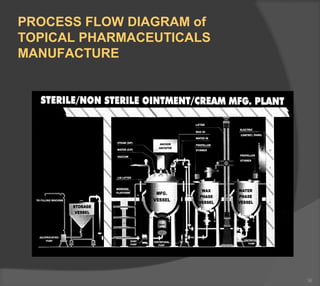
PROCESS FLOW DIAGRAM of
TOPICAL PHARMACEUTICALS
MANUFACTURE
36
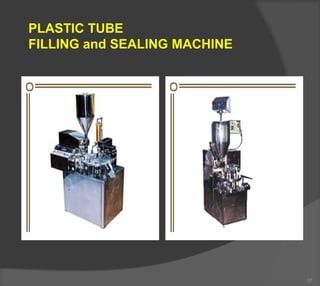
PLASTIC TUBE
FILLING and SEALING MACHINE
37
METHODS OF FILLING
OPTHALMIC OINTMENTS
 BLOW FILL SEAL METHOD (BFS)
SEQUENCE in ONE EASY
OPERATION:
1. Fabrication of containers
2. Filling the product
3. Sealing
38
METHODS OF FILLING
OPTHALMIC OINTMENTS
 FORM FILL SEAL METHOD (FFS)
The conventional method of filling
opthalmic ointments.
39
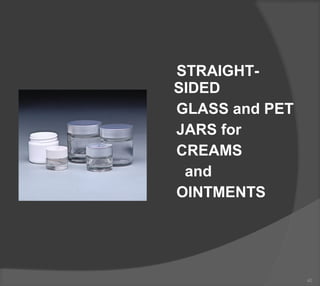
STRAIGHT-
SIDED
GLASS and PET
JARS for
CREAMS
and
OINTMENTS
40
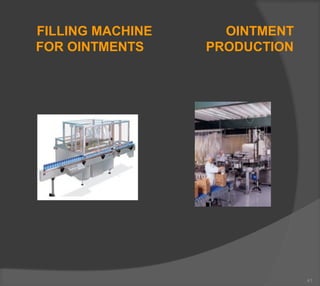
FILLING MACHINE OINTMENT
FOR OINTMENTS PRODUCTION
41
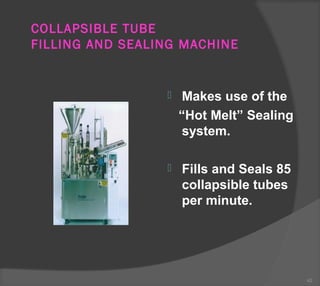
COLLAPSIBLE TUBE
FILLING AND SEALING MACHINE
 Makes use of the
“Hot Melt” Sealing
system.
 Fills and Seals 85
collapsible tubes
per minute.
42
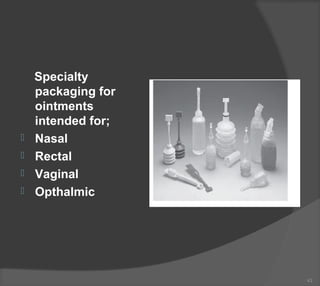
Specialty
packaging for
ointments
intended for;
 Nasal
 Rectal
 Vaginal
 Opthalmic
43
 STORAGE and LABELING
 MICROBIAL SCREENING
( Microbial Limit Tests)
1. Staphylococcus aureus
2. Pseudomonas aeruginosa
44
As per USP Requirements:
 MINIMUM FILL
Assessment of the Content Uniformity of
semi-solids.
Product weighing 60 g or mL – nlt 90% of
the labeled amount.
Product weighing 60 g or mL to 150 g or
mL – nlt 95% of the labeled amount.
45
As per USP Requirements:
 STANDARD ASSAYS of the API’s
(Quantitative assay of % Purity or %
Content)
 STERILITY TESTS
1. Membrane Filtration Technique
2. Test Tube Inoculation Method
46
As per USP Requirements:
 In vivo BA/BE – Dermatopharmacokinetic
Studies (DPS)
Applicable to semisolids that contain:
1. Antifungals
2. Antivirals
3. Corticosteroids
4. Antibiotics
5. Topicals for vaginal use
47
As per USP Requirements:
 In vivo BA/BE – Dermatopharmacokinetic
Studies (DPS)
Not applicable to semisolids for;
a. otic use
b. opthalmic use
c. that damage the stratum corneum of the
skin.
48
As per USP Requirements:
 In vivo BA/BE – Dermatopharmacokinetic
Studies (DPS)
It involves measurement of the ff.;
1. drug concentration in the stratum
corneum
2. drug uptake
3. apparent steady state
4. elimination after drug application onto
the skin
49
As per USP Requirements:
As per Non- USP requirements
 pH
 Water Content (Karl Fisher
Method)
Water affects the;
a. physical stability
b. chemical stability
c. microbial stability
50
Usual water limit: 0.5% to 1%
NMT 0.5% water content for
Ointments containing:
1. Bacitracin
2. Chlortetracycline HCl
3. Nystatin
51
NMT 1% water content for
ointments, creams or gels
containing;
1. Erythromycin
2. Gentamycin sulfate
3. Neomycin sulfate
4. Tetracycline HCl
52
 Foreign Substances
 Homogeneity
( also refers to Content
Uniformity by Minimum Fill
testing)
53
 Metal Particle Detection Test –
mandatory for opthalmic ointments
only.
Limits:
NMT 3 tubes out of the 10 tubes
tested should contain 8 metal
particles.
54
 Leaker Test
Mandatory for opthalmic ointments
filled in collapsible tubes.
By Classical Blotting Paper Method
55
Specs / Limits:
NMT 1 tube out of the 10 tubes should
leak.
If MT 1 tube leaks, repeat the test on
20 additional tubes.
NMT 1 tube out of the 30 tubes should
leak.
56

Chapter 8 medicated applications

  • 1.
    1 Presented by: Asst. Prof.MA. LOURDES LICSI-MOJARES, RPh CEU School of Pharmacy
  • 2.
    USES OF TOPICAL PHARMACEUTICALS VEHICLES FOR TOPICALLY – APPLIED DRUGS ( Non-medicated ointment bases)  EMOLLIENTS – provide soothing / softening effects on the surface tissues  PROTECTIVES / OCCLUSIVE DRESSINGS 2
  • 3.
    FACTORS INFLUENCING ABSORPTION OF DRUGSTHROUGH THE SKIN A. Partition Coefficient of Drugs through the Skin Substances possessing both water and lipid solubility are favorably absorbed through the skin. 3
  • 4.
    FACTORS INFLUENCING ABSORPTION OFDRUGS THROUGH THE SKIN B. Moisture and Temperature in the Environment of the Skin B.1 Moisture Balance in the Skin It is found in the stratum corneum layer of the epidermis. It prevents the NMF (Natural Moisturizing Factor) from being stripped from the skin. NMF prevents skin from drying out, even during excessive contact of the skin with water. 4
  • 5.
    FACTORS INFLUENCING ABSORPTION OF DRUGSTHROUGH THE SKIN B.2 Insensible Perspiration The skin constantly releases water in the skin surface, which evaporates quickly without being noticed. When the surrounding environment has a high moisture content, the rate of evaporation of sweat is slowed down, and the person becomes aware of the clammy moist sensation on his skin. 5
  • 6.
    FACTORS INFLUENCING ABSORPTION OFDRUGS THROUGH THE SKIN C. Pathological Injury to the Skin Skin penetration has been enhanced by abrasions or when the skin is stripped of its barrier layer. 6
  • 7.
    FACTORS INFLUENCING ABSORPTION OFDRUGS THROUGH THE SKIN D. Type of Vehicle Used Skin penetration of drug substances may be enhanced by the use of a suitable semisolid base. The vehicle may help increase the rate of penetration of a drug substances into the skin. It serves as a carrier for the API. 7
  • 8.
    RAW MATERIALS INTHE FORMULATION OF MEDICATED APPLICATIONS FDA approves chemical substances and states the maximum concentration considered safe for food and cosmetics (GRAS grade). The supplier of these drug substances supplies brochures / information which indicates that FDA APPROVAL SAFETY TESTS are conducted. 8
  • 9.
    THE FREQUENT RAWMATERIALS FOR MEDICATED SEMISOLIDS  HYDROCARBONS Petrolatum and Mineral oil are the MOST WIDELY USED substances in semisolids, next to water. PETROLATUM– a complex mixture of semisolids containing hydrocarbon aliphatic, cyclic, saturated, unsaturated, branched and unbranched substances in varying proportions. MINERAL OIL – derived from petroleum acid. It is less tacky and with lower viscosity. 9
  • 10.
    THE FREQUENT RAWMATERIALS FOR MEDICATED SEMISOLIDS  HYDROCARBON WAXES 1. Help increase the viscosity of hydrocarbons such as petrolatum and mineral oil 2. prevent separation of hydrocarbons from the ointment. Examples: paraffin, beeswax, ceresin wax (mixture of paraffin and ozokerite). 10
  • 11.
    THE FREQUENT RAWMATERIALS FOR MEDICATED SEMISOLIDS  OLEAGINOUS SUBSTANCES Vegetable fixed oils which contain glycerides of mixtures of saturated and unsaturated fatty acids (MCT’s and FA’s). These are employed for its EMOLLIENT and SKIN-LUBRICATING effects. Examples: Fixed oils of peanut, olive, sesame, cottonseed, coconut, corn 11
  • 12.
    THE FREQUENT RAWMATERIALS FOR MEDICATED SEMISOLIDS  FATTY ACIDS and ALCOHOLS Functions as; 1. auxiliary emulsifiers 2. viscosity –builders Examples: Stearic acid – emulsifiers in water-removable creams Stearyl / Cetyl Alcohols - emollients, provides the necessary firmness / softness in consistency of creams. 12
  • 13.
    THE FREQUENT RAWMATERIALS FOR MEDICATED SEMISOLIDS  EMULSIFIERS Substances that; a. Prevent Coalescence b. act as Product stabilizers Examples: Triethanolamine stearate, SPANS, TWEENS, Carbowax 13
  • 14.
    THE FREQUENT RAWMATERIALS FOR MEDICATED SEMISOLIDS  POLYOLS Used as Humectants, prevents dehydration and “Crusting” on top of creams and ointments in jars. Examples: Glycerin, PG, Sorbitol 70%, PEG (lower MW) 14
  • 15.
    THE FREQUENT RAWMATERIALS FOR MEDICATED SEMISOLIDS  INSOLUBLE POWDERS These must be uniformly dispersed throughout the semisolid vehicle to assure product homogeneity. These solids must be impalpable to the touch.. Particles less than 74 micronsParticles less than 74 microns (equivalent to 200 mesh) is said to be(equivalent to 200 mesh) is said to be impalpable to most peopleimpalpable to most people.. 15
  • 16.
    TYPES OF SEMISOLIDVEHICLES NON-MEDICATED BASES  Factors which Influence the Choice of Semisolid Vehicles 1. Nature of the skin lesion 2. Skin Type 3. Solubility of the formulation components 4. Stability of the API’s 16
  • 17.
    TYPES OF SEMISOLIDVEHICLES NON-MEDICATED BASES  HYDROCARBON BASES  Typically lipophilic  Spreads easily onto the skin  Difficult to remove / wash-off  Act as occlusive dressings, since the normal evaporation of insensible perspiration is inhibited.  Examples are White petrolatum, Mineral oil, White / Yellow Ointment, USP 17
  • 18.
    TYPES OF SEMISOLIDVEHICLES NON-MEDICATED BASES  ABSORPTION / EMULSIFIABLE BASES  These are hydrophilic mixtures formed by the addition of substances that possess polar groupings ( sulfates, carboxyl, hydroxyl or ether linkages) to a Hydrocarbon Base. Lanolin, Cholesterol, Sorbitan monostearate / monooleate are added to Hydrocarbon bases to make it hydrophilic. 18
  • 19.
    TYPES OF SEMISOLIDVEHICLES NON-MEDICATED BASES  WATER – REMOVABLE / WASHABLE BASES  These are o/w emulsions referred to as Creams.  Upon application, there is little or no evidence of its presence onto the skin.  Best for moist skin lesions, since its o/w character tend to adsorb serous discharges. 19
  • 20.
    TYPES OF SEMISOLIDVEHICLES NON-MEDICATED BASES  WATER – REMOVABLE / WASHABLE BASES  Vanishing creams, Foundation creams, Shaving Creams.  Vanishing creams type of vehicles are of o/w type.  Absorption bases are of w/o type. 20
  • 21.
    TYPES OF SEMISOLIDVEHICLES NON-MEDICATED BASES  WATER-SOLUBLE / GREASELESS BASES  Prepared from mixtures of high and low MW PEG  No water is required in its preparation  Water soluble, due to many polar groups and ether linkages 21
  • 22.
    TYPES OF SEMISOLIDVEHICLES NON-MEDICATED BASES  WATER-SOLUBLE / GREASELESS BASES  Suitable combinations of high and low MW PEG yield products having an ointment-like consistency, which soften or melt when applied topically.  Low MW PEG – liquids  Moderately high MW PEG – unctuous  Very High MW PEG - solids 22
  • 23.
    OPTHALMIC OINTMENTS  Semisolidophthalmic vehicles frequently contain any of the ff. bases that have been sterilized; 1. petroleum jelly 2. absorption base (Lanolin or Lanolin Alcohol) 3. water-soluble base  Insoluble API powders should meet the requirements for IMPALPABILITY.  Ophthalmic ointments should be rendered STERILE and ISOTONIC. 23
  • 24.
    OTHER OPTHALMIC OINMENT BASES Lanolin Sterilized by Gamma Radiation or Sterilization by Filtration  Lanolin Alcohol Possess emollient properties suitable for eye ointment formulation. 24
  • 25.
  • 26.
    PRESERVATION FROM MICROBIAL SPOILAGE The chemical preservative for semisolids should be evaluated as to: 1. Stability with regard to formulation components 2. Container to be used. 26
  • 27.
    CHARACTERISTICS OF PRESERVATIVES FOR SEMISOLIDPRODUCTS  Some preservatives become inactive in the presence of other ingredients.  Boric acid may be used in ophthalmic ointments against bacterial/ fungal contamination.  Bacterial counts should be made on the water supply, RM, pipelines, filling equipment and containers. 27
  • 28.
    USE OF ANTI-OXIDANTS Anti-oxidants are added to semisolids, whenever oxidative deterioration is anticipated.  BHA, BHT, Propyl gallate 28
  • 29.
    USE OF ANTI-OXIDANTS The choice of anti-oxidant is made upon consideration of the following factors: 1. toxicity / irritating potency 2. compatibility 3. odor 4. discoloration 5. solubility 6. stability 29
  • 30.
    MANUFACTURING PROCESS OF SEMI-SOLIDS Factors to be controlled during the Fusion Method: 1. Time of mixing 2. Temperature of mixing 3. Rate of agitation ( and other mechanical works) 30
  • 31.
    MANUFACTURING PROCESS OF SEMI-SOLIDS FUSION METHOD ANHYDROUS OINTMENTS are manufactured by this process, which is made by dissolving the API’s in the previously melted fats and waxes. The melted mass must be mixed while cooling to ensure the homogenous distribution of the ingredients. 31
  • 32.
    STEPS IN FUSIONMETHOD Step 1: PREPARATION OF THE OIL PHASE Flake / pulverize the dry ingredients. Heating is required to melt some ingredients (waxes), usually at 700 C to 750 C. Blend in advance and disperse in mineral oil or silicone oil. 32
  • 33.
    STEPS IN FUSIONMETHOD Step 2: HYDRATION OF THE INGREDIENTS IN THE AQUEOUS PHASE Emulsifiers, stabilizers, thickening agents are dispersed into water in a separate vessel. Usually followed by a filtration procedure, if needed. Heating may be required to accelerate hydration. 33
  • 34.
    STEPS IN FUSIONMETHOD Step 3: FOAMING THE EMULSION The aqueous and oil phases are blended under vigorous agitation, to form the emulsion. Temperature is controlled between 300 C to 400 C. Defoaming procedures are done to minimize foam formation after the product has emulsified. 34
  • 35.
    STEPS IN FUSIONMETHOD Step 4: DISPERSION OF THE ACTIVE/S The API’s make up only a small proportion of the formulation. It must be EFFICIENTLY DISPERSED to maximize yield and product effectiveness. 35
  • 36.
    PROCESS FLOW DIAGRAMof TOPICAL PHARMACEUTICALS MANUFACTURE 36
  • 37.
    PLASTIC TUBE FILLING andSEALING MACHINE 37
  • 38.
    METHODS OF FILLING OPTHALMICOINTMENTS  BLOW FILL SEAL METHOD (BFS) SEQUENCE in ONE EASY OPERATION: 1. Fabrication of containers 2. Filling the product 3. Sealing 38
  • 39.
    METHODS OF FILLING OPTHALMICOINTMENTS  FORM FILL SEAL METHOD (FFS) The conventional method of filling opthalmic ointments. 39
  • 40.
    STRAIGHT- SIDED GLASS and PET JARSfor CREAMS and OINTMENTS 40
  • 41.
    FILLING MACHINE OINTMENT FOROINTMENTS PRODUCTION 41
  • 42.
    COLLAPSIBLE TUBE FILLING ANDSEALING MACHINE  Makes use of the “Hot Melt” Sealing system.  Fills and Seals 85 collapsible tubes per minute. 42
  • 43.
    Specialty packaging for ointments intended for; Nasal  Rectal  Vaginal  Opthalmic 43
  • 44.
     STORAGE andLABELING  MICROBIAL SCREENING ( Microbial Limit Tests) 1. Staphylococcus aureus 2. Pseudomonas aeruginosa 44 As per USP Requirements:
  • 45.
     MINIMUM FILL Assessmentof the Content Uniformity of semi-solids. Product weighing 60 g or mL – nlt 90% of the labeled amount. Product weighing 60 g or mL to 150 g or mL – nlt 95% of the labeled amount. 45 As per USP Requirements:
  • 46.
     STANDARD ASSAYSof the API’s (Quantitative assay of % Purity or % Content)  STERILITY TESTS 1. Membrane Filtration Technique 2. Test Tube Inoculation Method 46 As per USP Requirements:
  • 47.
     In vivoBA/BE – Dermatopharmacokinetic Studies (DPS) Applicable to semisolids that contain: 1. Antifungals 2. Antivirals 3. Corticosteroids 4. Antibiotics 5. Topicals for vaginal use 47 As per USP Requirements:
  • 48.
     In vivoBA/BE – Dermatopharmacokinetic Studies (DPS) Not applicable to semisolids for; a. otic use b. opthalmic use c. that damage the stratum corneum of the skin. 48 As per USP Requirements:
  • 49.
     In vivoBA/BE – Dermatopharmacokinetic Studies (DPS) It involves measurement of the ff.; 1. drug concentration in the stratum corneum 2. drug uptake 3. apparent steady state 4. elimination after drug application onto the skin 49 As per USP Requirements:
  • 50.
    As per Non-USP requirements  pH  Water Content (Karl Fisher Method) Water affects the; a. physical stability b. chemical stability c. microbial stability 50
  • 51.
    Usual water limit:0.5% to 1% NMT 0.5% water content for Ointments containing: 1. Bacitracin 2. Chlortetracycline HCl 3. Nystatin 51
  • 52.
    NMT 1% watercontent for ointments, creams or gels containing; 1. Erythromycin 2. Gentamycin sulfate 3. Neomycin sulfate 4. Tetracycline HCl 52
  • 53.
     Foreign Substances Homogeneity ( also refers to Content Uniformity by Minimum Fill testing) 53
  • 54.
     Metal ParticleDetection Test – mandatory for opthalmic ointments only. Limits: NMT 3 tubes out of the 10 tubes tested should contain 8 metal particles. 54
  • 55.
     Leaker Test Mandatoryfor opthalmic ointments filled in collapsible tubes. By Classical Blotting Paper Method 55
  • 56.
    Specs / Limits: NMT1 tube out of the 10 tubes should leak. If MT 1 tube leaks, repeat the test on 20 additional tubes. NMT 1 tube out of the 30 tubes should leak. 56

Editor's Notes

  • #3 They are generally referred to as therapeutic ointments and creams, pastes and other forms of viscous consistency intended for external application onto the skin.
  • #6 There are drug substances which penetrate faster, when the external environment temperature is higher.
  • #8 Example; Ethanol generates faster in olive oil, than in NSS, as a topical vehicle.
  • #17 Skin penetration is an important consideration in the choice of vehicle for medicated semisolids, but not for cosmetics. A well formulated semisolid should be both therapeutically effective and aesthetically /cosmetically appealing.
  • #19 Mineral oil is usually added to reduce the stickiness / tackiness of the hydrocarbon base.
  • #25 LANOLIN ALCOHOL – Prepared by saponification of Lanolin. Hydrophobic vehicle ideal for dry skin ointments, w/o creams and for opthalmic use. 0.1% antioxidant should be added.
  • #27 Preservatives are added to prevent contamination, deterioration and spoilage by bacteria and molds. Containers may be a contributing source of contamination by harboring bacterial spores or by sorption or by chemical interaction with the preservative like plastics, rubber seals and closures.
  • #28 5% TWEEN 80 inactivates 80% of the total methylparaben present. Thus a higher concentration of a preservative is required.
  • #36 THIS CAN BE ASSESSED BY PERFORMING MINIMUM FILL TESTING OF THE PRODUCTS.
  • #39 BFS - Cost- effective alternative for sterile-sealing operations, since the product can be sterile-filled.
  • #45 MINIMUM FILL – applicable to products NMT 150 gram or ml of the product, assesses the Content Uniformity. If the product weight is less than 60 g or mL, the net content of any single container should not be less than 90% of the labeled amount. If the product weight is between 60 and 150 g or mL, the net content of any single container should not be less than 95% of the labeled amount. If these limits are not met, the test is repeated with an additional 20 containers. BA/BE – Bioavailability / Bioequivalency tests. Mandatory by BFAD. Dermatopharmacokinetic (DPS) studies are required. Dermatopharmacokinetic (DPK) studies are applicable for topical semisolid products that contain antifungals, antivirals, corticosteroids, and antibiotics and vaginally applied products. They are not applicable for ophthalmic, otic, and other products that damage stratum corneum. DPK studies involve measurement of drug concentrations in stratum corneum, drug uptake, apparent steady state, and elimination after application of the test product onto skin. MICROBIAL SCREENING – Staph. aureus and Pseudo. aeruginosa for topical ointments.
  • #46 MINIMUM FILL – applicable to products NMT 150 gram or ml of the product, assesses the Content Uniformity. If the product weight is less than 60 g or mL, the net content of any single container should not be less than 90% of the labeled amount. If the product weight is between 60 and 150 g or mL, the net content of any single container should not be less than 95% of the labeled amount. If these limits are not met, the test is repeated with an additional 20 containers. BA/BE – Bioavailability / Bioequivalency tests. Mandatory by BFAD. Dermatopharmacokinetic (DPS) studies are required. Dermatopharmacokinetic (DPK) studies are applicable for topical semisolid products that contain antifungals, antivirals, corticosteroids, and antibiotics and vaginally applied products. They are not applicable for ophthalmic, otic, and other products that damage stratum corneum. DPK studies involve measurement of drug concentrations in stratum corneum, drug uptake, apparent steady state, and elimination after application of the test product onto skin. MICROBIAL SCREENING – Staph. aureus and Pseudo. aeruginosa for topical ointments.
  • #47 MINIMUM FILL – applicable to products NMT 150 gram or ml of the product, assesses the Content Uniformity. If the product weight is less than 60 g or mL, the net content of any single container should not be less than 90% of the labeled amount. If the product weight is between 60 and 150 g or mL, the net content of any single container should not be less than 95% of the labeled amount. If these limits are not met, the test is repeated with an additional 20 containers. BA/BE – Bioavailability / Bioequivalency tests. Mandatory by BFAD. Dermatopharmacokinetic (DPS) studies are required. Dermatopharmacokinetic (DPK) studies are applicable for topical semisolid products that contain antifungals, antivirals, corticosteroids, and antibiotics and vaginally applied products. They are not applicable for ophthalmic, otic, and other products that damage stratum corneum. DPK studies involve measurement of drug concentrations in stratum corneum, drug uptake, apparent steady state, and elimination after application of the test product onto skin. MICROBIAL SCREENING – Staph. aureus and Pseudo. aeruginosa for topical ointments.
  • #48 MINIMUM FILL – applicable to products NMT 150 gram or ml of the product, assesses the Content Uniformity. If the product weight is less than 60 g or mL, the net content of any single container should not be less than 90% of the labeled amount. If the product weight is between 60 and 150 g or mL, the net content of any single container should not be less than 95% of the labeled amount. If these limits are not met, the test is repeated with an additional 20 containers. BA/BE – Bioavailability / Bioequivalency tests. Mandatory by BFAD. Dermatopharmacokinetic (DPS) studies are required. Dermatopharmacokinetic (DPK) studies are applicable for topical semisolid products that contain antifungals, antivirals, corticosteroids, and antibiotics and vaginally applied products. They are not applicable for ophthalmic, otic, and other products that damage stratum corneum. DPK studies involve measurement of drug concentrations in stratum corneum, drug uptake, apparent steady state, and elimination after application of the test product onto skin. MICROBIAL SCREENING – Staph. aureus and Pseudo. aeruginosa for topical ointments.
  • #49 MINIMUM FILL – applicable to products NMT 150 gram or ml of the product, assesses the Content Uniformity. If the product weight is less than 60 g or mL, the net content of any single container should not be less than 90% of the labeled amount. If the product weight is between 60 and 150 g or mL, the net content of any single container should not be less than 95% of the labeled amount. If these limits are not met, the test is repeated with an additional 20 containers. BA/BE – Bioavailability / Bioequivalency tests. Mandatory by BFAD. Dermatopharmacokinetic (DPS) studies are required. Dermatopharmacokinetic (DPK) studies are applicable for topical semisolid products that contain antifungals, antivirals, corticosteroids, and antibiotics and vaginally applied products. They are not applicable for ophthalmic, otic, and other products that damage stratum corneum. DPK studies involve measurement of drug concentrations in stratum corneum, drug uptake, apparent steady state, and elimination after application of the test product onto skin. MICROBIAL SCREENING – Staph. aureus and Pseudo. aeruginosa for topical ointments.
  • #50 MINIMUM FILL – applicable to products NMT 150 gram or ml of the product, assesses the Content Uniformity. If the product weight is less than 60 g or mL, the net content of any single container should not be less than 90% of the labeled amount. If the product weight is between 60 and 150 g or mL, the net content of any single container should not be less than 95% of the labeled amount. If these limits are not met, the test is repeated with an additional 20 containers. BA/BE – Bioavailability / Bioequivalency tests. Mandatory by BFAD. Dermatopharmacokinetic (DPS) studies are required. Dermatopharmacokinetic (DPK) studies are applicable for topical semisolid products that contain antifungals, antivirals, corticosteroids, and antibiotics and vaginally applied products. They are not applicable for ophthalmic, otic, and other products that damage stratum corneum. DPK studies involve measurement of drug concentrations in stratum corneum, drug uptake, apparent steady state, and elimination after application of the test product onto skin. MICROBIAL SCREENING – Staph. aureus and Pseudo. aeruginosa for topical ointments.
  • #51 WATER CONTENT – by Karl Fisher method. Water affects the physical, chemical and microbial stability of pharmaceuticals. LIMITS:0.5% to 1 % The limit of water in bacitracin, chlortetracycline hydrochloride, and nystatin ointments is not more than 0.5%, whereas amphotericin SEMISOLID DOSAGES: OINTMENTS, CREAMS, AND GELS B, erythromycin, gentamycin sulfate, neomycin sulfate, and tetracycline hydrochloride ointments may contain up to 1% moisture . METAL PARTICLE DETECTION – for opthalmic ointments. LIMITS: nmt 3 tubes are allowed to contain 8 particles. LEAKER TEST – mandatory for opthalmic ointments. LIMITS: nmt 1 tube leaks out of 30 tubes
  • #52 WATER CONTENT – by Karl Fisher method. Water affects the physical, chemical and microbial stability of pharmaceuticals. LIMITS:0.5% to 1 % The limit of water in bacitracin, chlortetracycline hydrochloride, and nystatin ointments is not more than 0.5%, whereas amphotericin SEMISOLID DOSAGES: OINTMENTS, CREAMS, AND GELS B, erythromycin, gentamycin sulfate, neomycin sulfate, and tetracycline hydrochloride ointments may contain up to 1% moisture . METAL PARTICLE DETECTION – for opthalmic ointments. LIMITS: nmt 3 tubes are allowed to contain 8 particles. LEAKER TEST – mandatory for opthalmic ointments. LIMITS: nmt 1 tube leaks out of 30 tubes
  • #53 WATER CONTENT – by Karl Fisher method. Water affects the physical, chemical and microbial stability of pharmaceuticals. LIMITS:0.5% to 1 % The limit of water in bacitracin, chlortetracycline hydrochloride, and nystatin ointments is not more than 0.5%, whereas amphotericin SEMISOLID DOSAGES: OINTMENTS, CREAMS, AND GELS B, erythromycin, gentamycin sulfate, neomycin sulfate, and tetracycline hydrochloride ointments may contain up to 1% moisture . METAL PARTICLE DETECTION – for opthalmic ointments. LIMITS: nmt 3 tubes are allowed to contain 8 particles. LEAKER TEST – mandatory for opthalmic ointments. LIMITS: nmt 1 tube leaks out of 30 tubes
  • #54 WATER CONTENT – by Karl Fisher method. Water affects the physical, chemical and microbial stability of pharmaceuticals. LIMITS:0.5% to 1 % The limit of water in bacitracin, chlortetracycline hydrochloride, and nystatin ointments is not more than 0.5%, whereas amphotericin SEMISOLID DOSAGES: OINTMENTS, CREAMS, AND GELS B, erythromycin, gentamycin sulfate, neomycin sulfate, and tetracycline hydrochloride ointments may contain up to 1% moisture . METAL PARTICLE DETECTION – for opthalmic ointments. LIMITS: nmt 3 tubes are allowed to contain 8 particles. LEAKER TEST – mandatory for opthalmic ointments. LIMITS: nmt 1 tube leaks out of 30 tubes
  • #55 WATER CONTENT – by Karl Fisher method. Water affects the physical, chemical and microbial stability of pharmaceuticals. LIMITS:0.5% to 1 % The limit of water in bacitracin, chlortetracycline hydrochloride, and nystatin ointments is not more than 0.5%, whereas amphotericin SEMISOLID DOSAGES: OINTMENTS, CREAMS, AND GELS B, erythromycin, gentamycin sulfate, neomycin sulfate, and tetracycline hydrochloride ointments may contain up to 1% moisture . METAL PARTICLE DETECTION – for opthalmic ointments. LIMITS: nmt 3 tubes are allowed to contain 8 particles. LEAKER TEST – mandatory for opthalmic ointments. LIMITS: nmt 1 tube leaks out of 30 tubes
  • #56 WATER CONTENT – by Karl Fisher method. Water affects the physical, chemical and microbial stability of pharmaceuticals. LIMITS:0.5% to 1 % The limit of water in bacitracin, chlortetracycline hydrochloride, and nystatin ointments is not more than 0.5%, whereas amphotericin SEMISOLID DOSAGES: OINTMENTS, CREAMS, AND GELS B, erythromycin, gentamycin sulfate, neomycin sulfate, and tetracycline hydrochloride ointments may contain up to 1% moisture . METAL PARTICLE DETECTION – for opthalmic ointments. LIMITS: nmt 3 tubes are allowed to contain 8 particles. LEAKER TEST – mandatory for opthalmic ointments. LIMITS: nmt 1 tube leaks out of 30 tubes
  • #57 WATER CONTENT – by Karl Fisher method. Water affects the physical, chemical and microbial stability of pharmaceuticals. LIMITS:0.5% to 1 % The limit of water in bacitracin, chlortetracycline hydrochloride, and nystatin ointments is not more than 0.5%, whereas amphotericin SEMISOLID DOSAGES: OINTMENTS, CREAMS, AND GELS B, erythromycin, gentamycin sulfate, neomycin sulfate, and tetracycline hydrochloride ointments may contain up to 1% moisture . METAL PARTICLE DETECTION – for opthalmic ointments. LIMITS: nmt 3 tubes are allowed to contain 8 particles. LEAKER TEST – mandatory for opthalmic ointments. LIMITS: nmt 1 tube leaks out of 30 tubes