A CRITICAL REVIEW ON BUCCAL FILMS A NOVEL
FORMULATION OF WIDE SPECTRUM DRUGS
Presented by
VINY DAVE
M.Pharm IIIrd semester
Department of Pharmacy
Barkatullah University
at
Sagar Institute of Technology, Bhopal
Guided By
Prof. A.K.Pathak
Prof. Aswani Mishra
INDEX
 Introduction
 Need for buccal adminstration
 Limitation
 Classification of buccal systems
 Formulation consideration
 Active pharmaceutical ingredients
 Methods of manufacturing of buccal film
 Evaluation of buccal films
INTRODUCTION
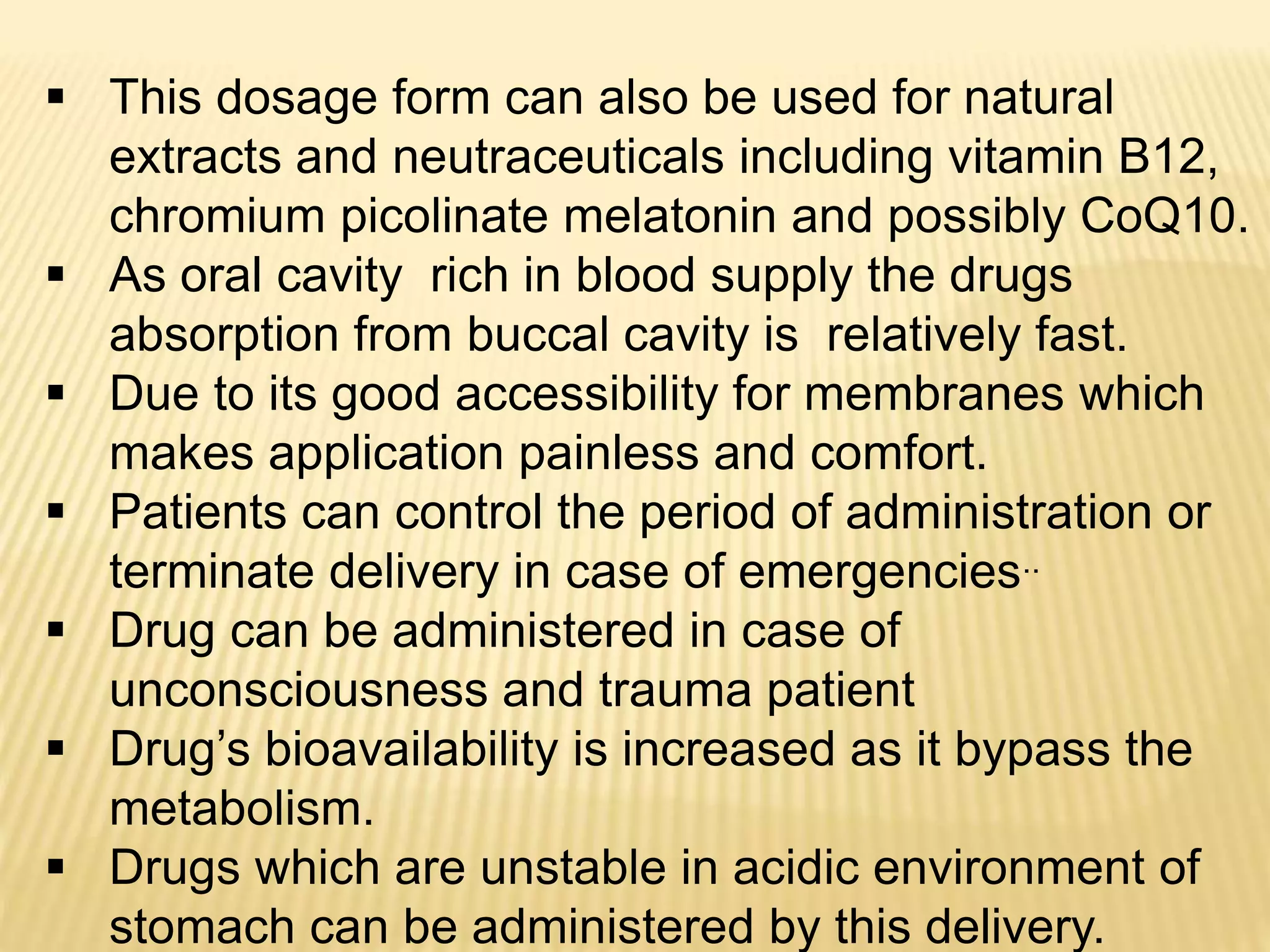
Buccal administration refers to a topical route of
administration by which drugs held or applied in the
buccal area (in the cheek) diffuse through the oral
mucosa (tissues which line the mouth) and enter directly
into the bloodstream. Buccal administration may provide
better bioavailability of some drugs and a more
rapid onset of action as compared to oral administration
because the medication does not pass through
the digestive system and thereby avoids first pass
metabolism.
NEED FOR BUCCAL ADMINISTREATION
Drug administration via the buccoadhesive drug
delivery offers several advantages such as:
 Improved clinical effect which are demonstrated for
pain killers or local anaesthetics.
 Certain pathologies requires instant release as well
as rapid clinical effect by individual as in case of
migraine.
 In case of sore, throat, cough, allergy and other local
oral manifestations region-specific delivery of
medicament is required.
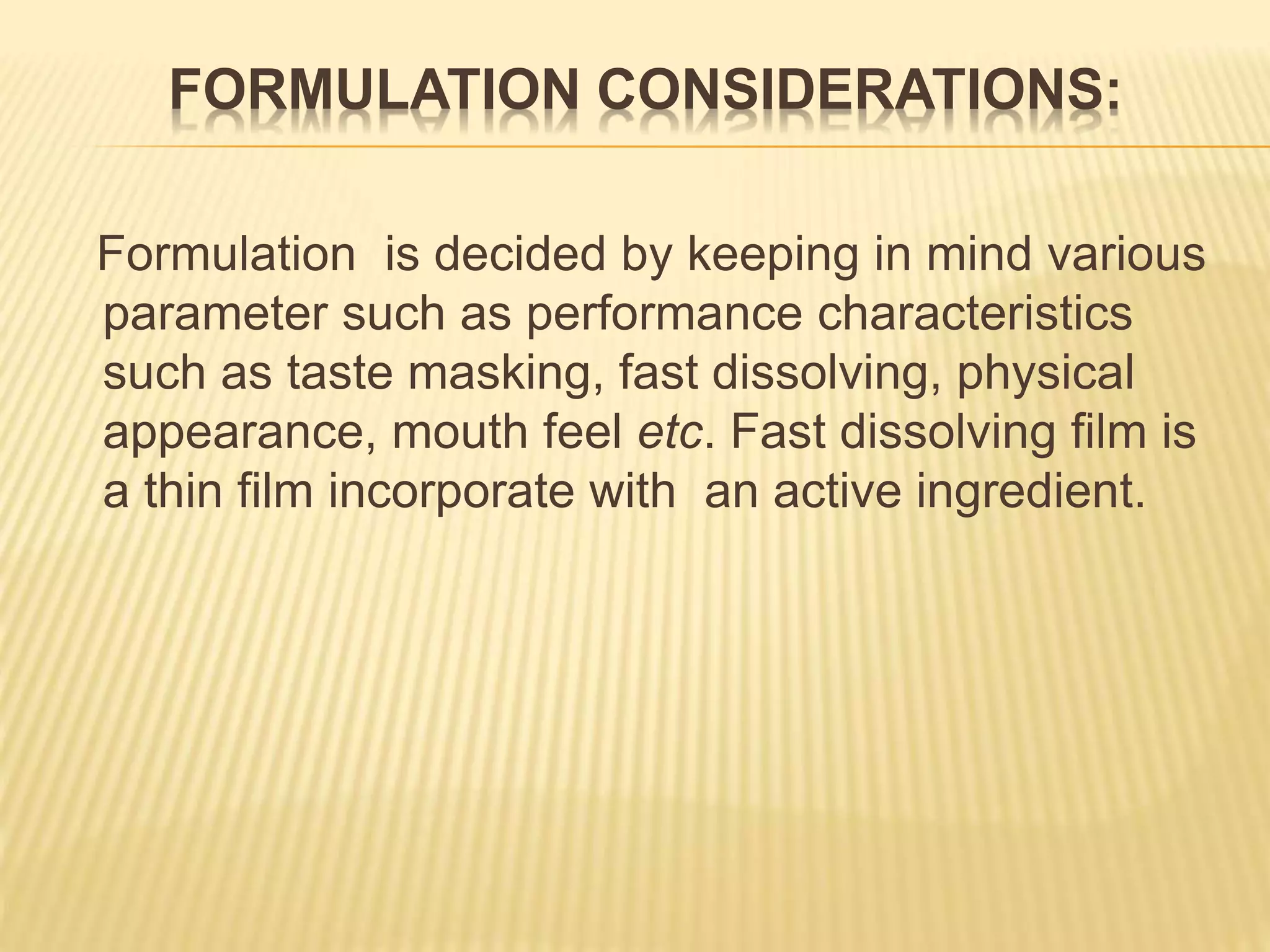
 This dosage form can also be used for natural
extracts and neutraceuticals including vitamin B12,
chromium picolinate melatonin and possibly CoQ10.
 As oral cavity rich in blood supply the drugs
absorption from buccal cavity is relatively fast.
 Due to its good accessibility for membranes which
makes application painless and comfort.
 Patients can control the period of administration or
terminate delivery in case of emergencies..
 Drug can be administered in case of
unconsciousness and trauma patient
 Drug’s bioavailability is increased as it bypass the
metabolism.
 Drugs which are unstable in acidic environment of
stomach can be administered by this delivery.
LIMITATIOJN
 Drugs which are unstable at buccal pH.cannot
be administered
 Drugs cannot be formulated for buccal cavity
which will cause allergic reactions, discoloration
of teeth or contain antimicrobial agents which
affects desired natural microbes..
 As compared to sublingual membrane buccal
membrane has low permeability.
 Drugs which have bitter taste or unpleasant
taste or an obnoxious odor or irritate the
mucosa are not applicable for this route
FORMULATION CONSIDERATIONS:
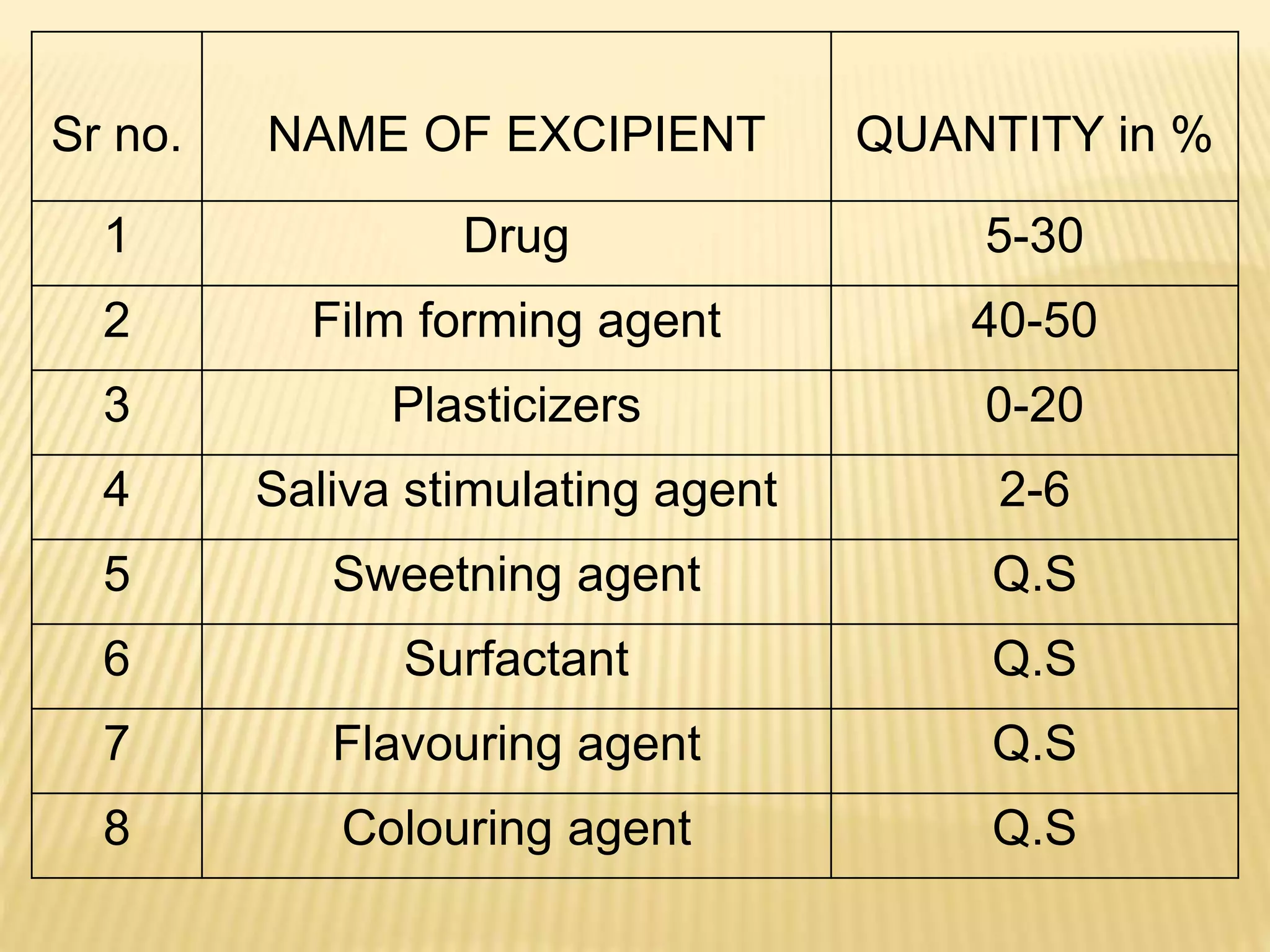
Formulation is decided by keeping in mind various
parameter such as performance characteristics
such as taste masking, fast dissolving, physical
appearance, mouth feel etc. Fast dissolving film is
a thin film incorporate with an active ingredient.
Sr no. NAME OF EXCIPIENT QUANTITY in %
1 Drug 5-30
2 Film forming agent 40-50
3 Plasticizers 0-20
4 Saliva stimulating agent 2-6
5 Sweetning agent Q.S
6 Surfactant Q.S
7 Flavouring agent Q.S
8 Colouring agent Q.S
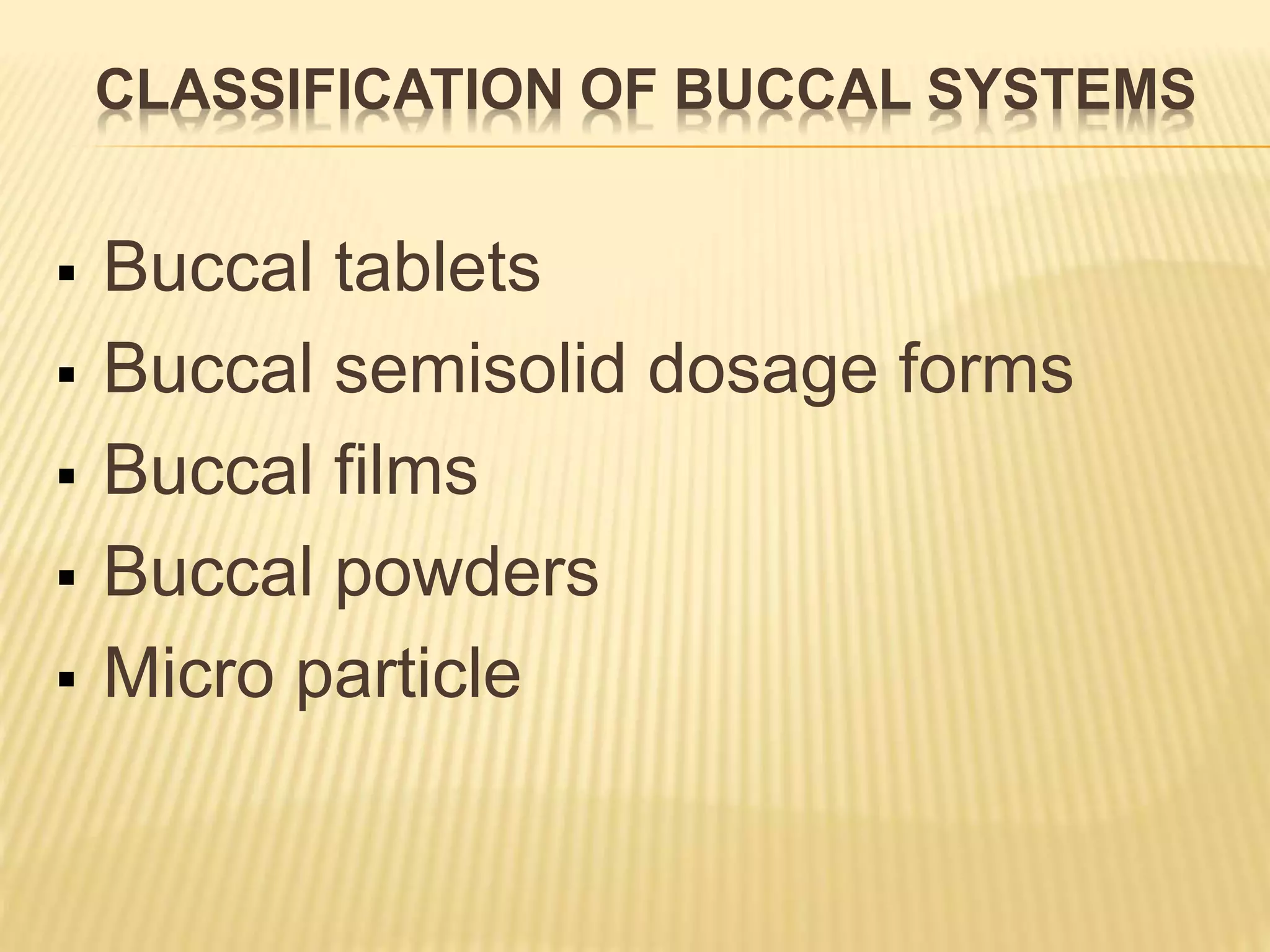
CLASSIFICATION OF BUCCAL SYSTEMS
 Buccal tablets
 Buccal semisolid dosage forms
 Buccal films
 Buccal powders
 Micro particle
CHARACTERSTICS OF DRUG REQUIRED
The drug should have following characteristics .
 The conventional single dose of the drug should be small.
 The drugs having biological half-life between 2-8 hrs are
good candidates for controlled drug delivery.
 Tmax of the drug shows wider-fluctuations or higher values
when given orally.
 Through oral route drug may exhibit first pass effect or
presystemic drug elimination.
 The drug absorption should be passive when given orally.
ACTIVE PHARMACEUTICAL AGENTS
From any class of drugs, active substance
can be used for administration but it must be
compatible to the buccal environment. Drug
can be added from 5%-25%w/w of total
weight of polymer. Dose of drug in mg(less
than 20mg/day) is required for effective
formulation.
FORMULATION RELATED FACTORS
 Molecular Size
 Partition coefficient
 pH value
 pKa value
CLASS OF DRUG USED IN BUCCAL FILM
Several class of drugs can be formulated as
mouth dissolving films including paediatrics
(anti-tussive, expectorants,anti–asthmatics),
geriatrics,antiepileptic,expectorants),
gastrointestinal diseases, nausea (e.g. due to
cytostatic therapy), pain (e.g. migraine), CNS
(ex. Anti Parkinsonism therapy).Depending on
their compatibilty with the formulation and
different physiochemical properties of Drug .
Anti-emetics Ondansetron, Granisetron, Plonosetron,
Dronabinol, Aprepitant, Ramosetron,
Trimethobezamide, Nabilone,
Metoclopramide, Dolasetron, Dimenhydramine
Serotonin
inhibitors
Fluoxetine, Setraline, Paroxetine, Fluxoamine,
Citalopram and Alaproclate,
5HT3
antagonists
Alosetron, Ondansetron, Granisetron,
Palonosetron, Rmosetron and Tropisetron
Anti-epileptics Carbamezapine, Clonazepalm, Diazepam,
Divalproex sodium, Fosphenyloin, Gabapentin,
Lamotrigine, Levetiracetam, Oxacarbazepine,
Phenytoin, Primidone and Valproate sodium
Anti-migraines Almotriptan, Dihydrogotamine Mesylate,
Eletriptan, Frovatriptan, Naratriptan,Rizatriptan,
Sumatriptan and Zolmitriptan
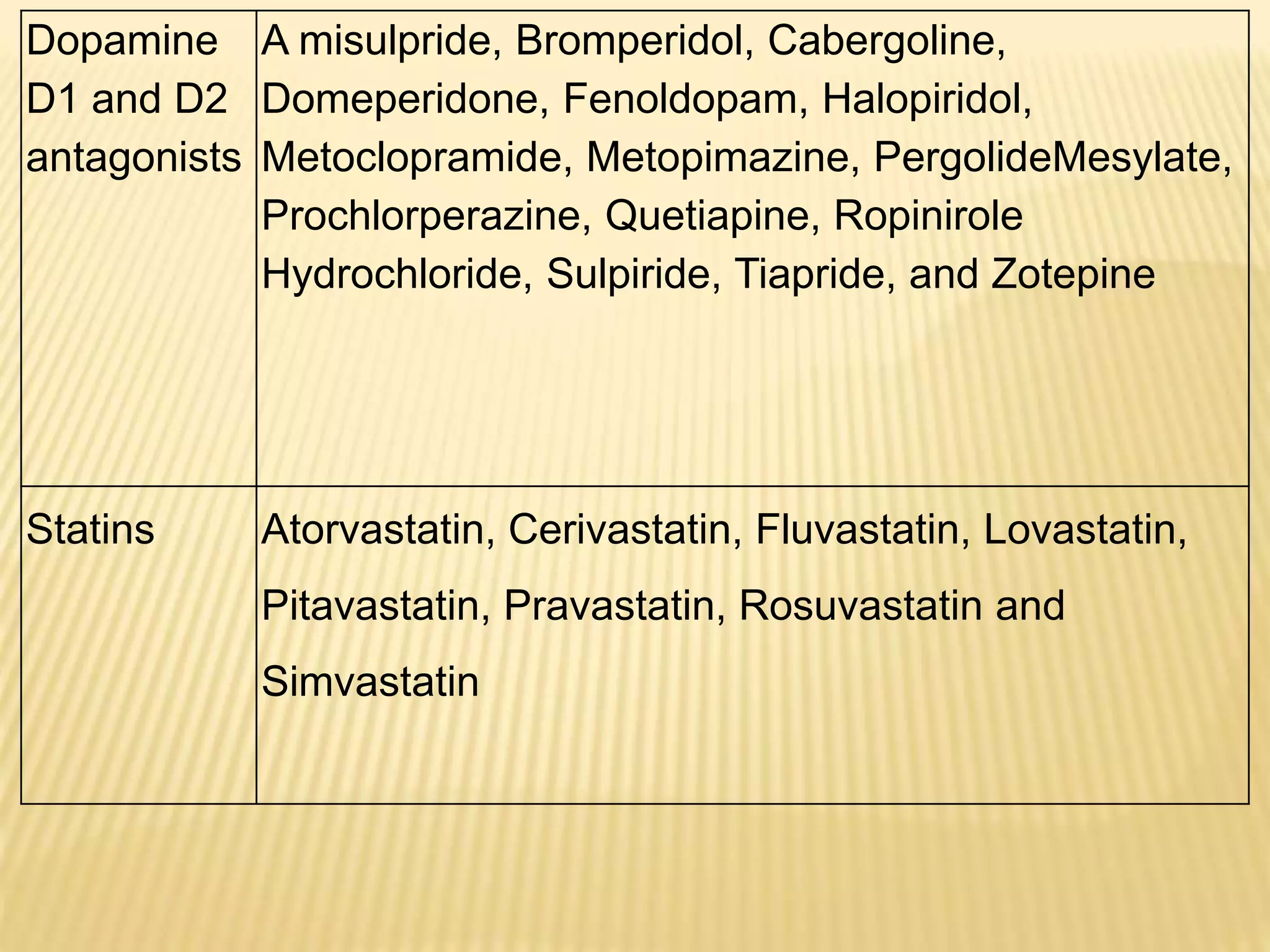
Dopamine
D1 and D2
antagonists
A misulpride, Bromperidol, Cabergoline,
Domeperidone, Fenoldopam, Halopiridol,
Metoclopramide, Metopimazine, PergolideMesylate,
Prochlorperazine, Quetiapine, Ropinirole
Hydrochloride, Sulpiride, Tiapride, and Zotepine
Statins Atorvastatin, Cerivastatin, Fluvastatin, Lovastatin,
Pitavastatin, Pravastatin, Rosuvastatin and
Simvastatin
FEW RECENT RESEARCH DONE IN
BUCOADHESIVE DOSAGE FORM
Drug Polymer Dosage form
Transforming growth
factor-b (TGF-b)
Chitosan-H Gel
Ibuprofen PVP Carboxymethylcellulose sodium salt
(NaCMC)
Patch
Nystatin Carbomer Hydroxypropylmethylcellulose Double-Layered
tablet
Propranolol Ethyl cellulose, polyvinyl pyrolidone K-30,
hydroxypropyl methyl cellulose-15cps,
hydroxyl ethyl cellulose-10cps
Film
Clotrimazole Carbopol-934P Hydroxypropyl cellulose-M Film
Miconazole nitrate Hydroxypropylmethylcellulose, Sodium
carboxymethylcellulose, Carbopol 934P,
and sodium alginate.
Slow-Release
Tablets
Benzocaine Sodium carboxymethylcellulose, Xanthan
gum
Liquid gel, Ointment
METHODS OF MANUFACTURE OF FILMS
 Solvent casting
 Greater uniformity of thickness and much
clarity than extrusion.
 Film has fine gloss and freedom from defects
such as die lines.
 More flexibility and better physical Properties
Finished film in thickness is typically 12-100
μm
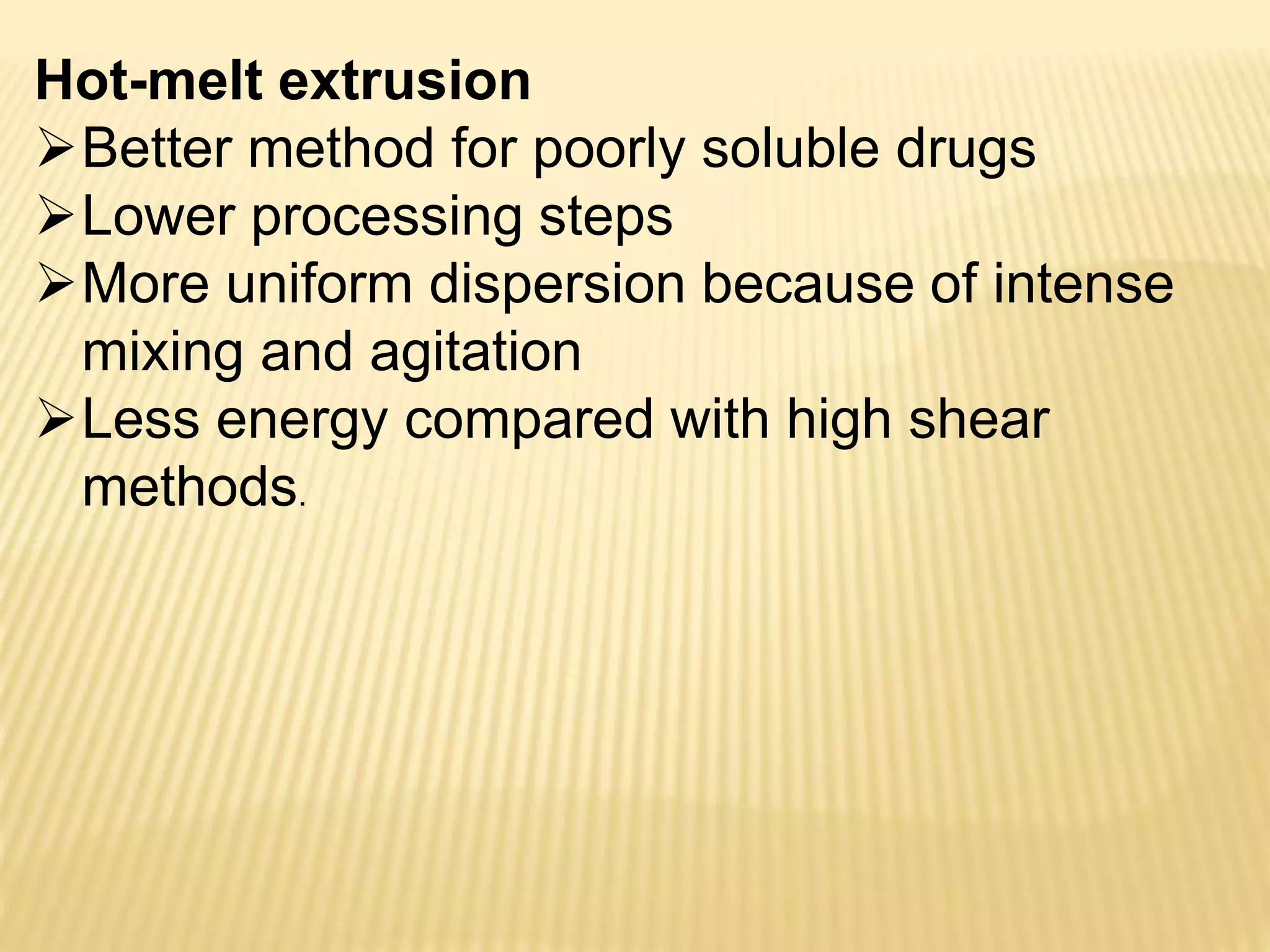
Hot-melt extrusion
Better method for poorly soluble drugs
Lower processing steps
More uniform dispersion because of intense
mixing and agitation
Less energy compared with high shear
methods.
EVALUATIONS OF BUCCAL PATCH:
 Surface pH
 Thickness measurements
 Swelling study.
 Folding endurance
 Water absorption capacity test
 Ex-vivo bioadhesion test
 In vitro drug release
 Permeation study of buccal patch
 Ex-vivo mucoadhesion time:-
 Measurement of mechanical properties:-
 Stability study in human saliva
CONCLUSION
Pharmaceutical industries have recognized the
potential for delivering medicinal products
through buccal film and have launched several
products for various kind of drugs in the market
using this technology. Recently buccal films
have gained popularity as dosage forms.
Gaining importance as they are ideal dosage
form for use in every categories of patient
whether young children, as well as geriatric
patients. Also, many industries have pipelines of
molecules of shifting their existing tablets
preparation to oral strips.
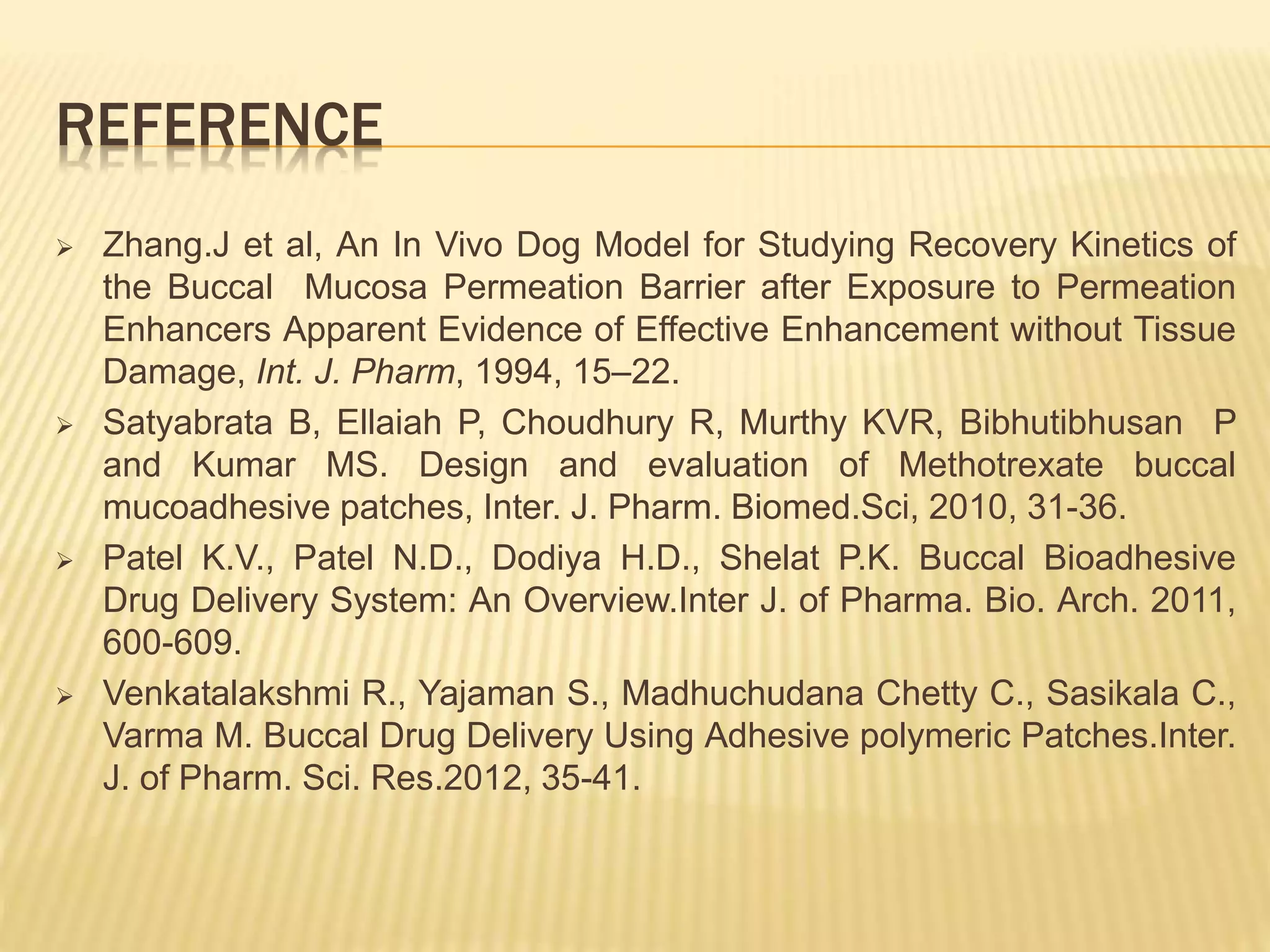
REFERENCE
 Zhang.J et al, An In Vivo Dog Model for Studying Recovery Kinetics of
the Buccal Mucosa Permeation Barrier after Exposure to Permeation
Enhancers Apparent Evidence of Effective Enhancement without Tissue
Damage, Int. J. Pharm, 1994, 15–22.
 Satyabrata B, Ellaiah P, Choudhury R, Murthy KVR, Bibhutibhusan P
and Kumar MS. Design and evaluation of Methotrexate buccal
mucoadhesive patches, Inter. J. Pharm. Biomed.Sci, 2010, 31-36.
 Patel K.V., Patel N.D., Dodiya H.D., Shelat P.K. Buccal Bioadhesive
Drug Delivery System: An Overview.Inter J. of Pharma. Bio. Arch. 2011,
600-609.
 Venkatalakshmi R., Yajaman S., Madhuchudana Chetty C., Sasikala C.,
Varma M. Buccal Drug Delivery Using Adhesive polymeric Patches.Inter.
J. of Pharm. Sci. Res.2012, 35-41.
 Gandhi Pankil A., Patel K.R., Patel M.R., Patel N.M. A Review Article
on Muccoadhesive Buccal Drug Delivery System.Inter. J. of Pharm.
Res. Development.2011, 159-173.
 Prajapati V., Bansal M., Sharma P.K. Mucoadhesive Buccal Patches
and Use of Natural Polymer in Its Preparation – A Review. Inter. J. of
PharmTech Res.2012, 582-589.
 Puratchikody A., Prasanth V.V, Mathew S.T., Kumar B.A. Buccal Drug
Delivery: Past, Present and Future – A Review. Inter. J. of Drug
Delivery.2011,171-184.
 S.K. Gupta, I.J. Singhavi, M. Shirsat, G. Karwani, A. Agrawal, A.
Agrawal, Buccal adhesive drug delivery system: a review, Asian J.
Biochemical and pharmaceutical research, 2011,105-114.
 Thuslasiramaraju TV, Tejeswar Kumar B, Kartik Kumar A, Naresh T.
Bucco-Adhesive Drug Delivery System: A Novel Drug Delivery
Technique. (www.ajrbps.com.)
 R Dixit; S Puthli. J of Controlled Release: (Mumbai, India) Official J of
Controlled Release Society, 139(2), 94-107.
Sirt presentation

Sirt presentation

  • 1.
    A CRITICAL REVIEWON BUCCAL FILMS A NOVEL FORMULATION OF WIDE SPECTRUM DRUGS Presented by VINY DAVE M.Pharm IIIrd semester Department of Pharmacy Barkatullah University at Sagar Institute of Technology, Bhopal Guided By Prof. A.K.Pathak Prof. Aswani Mishra
  • 2.
    INDEX  Introduction  Needfor buccal adminstration  Limitation  Classification of buccal systems  Formulation consideration  Active pharmaceutical ingredients  Methods of manufacturing of buccal film  Evaluation of buccal films
  • 3.
    INTRODUCTION Buccal administration refersto a topical route of administration by which drugs held or applied in the buccal area (in the cheek) diffuse through the oral mucosa (tissues which line the mouth) and enter directly into the bloodstream. Buccal administration may provide better bioavailability of some drugs and a more rapid onset of action as compared to oral administration because the medication does not pass through the digestive system and thereby avoids first pass metabolism.
  • 4.
    NEED FOR BUCCALADMINISTREATION Drug administration via the buccoadhesive drug delivery offers several advantages such as:  Improved clinical effect which are demonstrated for pain killers or local anaesthetics.  Certain pathologies requires instant release as well as rapid clinical effect by individual as in case of migraine.  In case of sore, throat, cough, allergy and other local oral manifestations region-specific delivery of medicament is required.
  • 5.
     This dosageform can also be used for natural extracts and neutraceuticals including vitamin B12, chromium picolinate melatonin and possibly CoQ10.  As oral cavity rich in blood supply the drugs absorption from buccal cavity is relatively fast.  Due to its good accessibility for membranes which makes application painless and comfort.  Patients can control the period of administration or terminate delivery in case of emergencies..  Drug can be administered in case of unconsciousness and trauma patient  Drug’s bioavailability is increased as it bypass the metabolism.  Drugs which are unstable in acidic environment of stomach can be administered by this delivery.
  • 6.
    LIMITATIOJN  Drugs whichare unstable at buccal pH.cannot be administered  Drugs cannot be formulated for buccal cavity which will cause allergic reactions, discoloration of teeth or contain antimicrobial agents which affects desired natural microbes..  As compared to sublingual membrane buccal membrane has low permeability.  Drugs which have bitter taste or unpleasant taste or an obnoxious odor or irritate the mucosa are not applicable for this route
  • 7.
    FORMULATION CONSIDERATIONS: Formulation isdecided by keeping in mind various parameter such as performance characteristics such as taste masking, fast dissolving, physical appearance, mouth feel etc. Fast dissolving film is a thin film incorporate with an active ingredient.
  • 8.
    Sr no. NAMEOF EXCIPIENT QUANTITY in % 1 Drug 5-30 2 Film forming agent 40-50 3 Plasticizers 0-20 4 Saliva stimulating agent 2-6 5 Sweetning agent Q.S 6 Surfactant Q.S 7 Flavouring agent Q.S 8 Colouring agent Q.S
  • 9.
    CLASSIFICATION OF BUCCALSYSTEMS  Buccal tablets  Buccal semisolid dosage forms  Buccal films  Buccal powders  Micro particle
  • 10.
    CHARACTERSTICS OF DRUGREQUIRED The drug should have following characteristics .  The conventional single dose of the drug should be small.  The drugs having biological half-life between 2-8 hrs are good candidates for controlled drug delivery.  Tmax of the drug shows wider-fluctuations or higher values when given orally.  Through oral route drug may exhibit first pass effect or presystemic drug elimination.  The drug absorption should be passive when given orally.
  • 11.
    ACTIVE PHARMACEUTICAL AGENTS Fromany class of drugs, active substance can be used for administration but it must be compatible to the buccal environment. Drug can be added from 5%-25%w/w of total weight of polymer. Dose of drug in mg(less than 20mg/day) is required for effective formulation.
  • 12.
    FORMULATION RELATED FACTORS Molecular Size  Partition coefficient  pH value  pKa value
  • 13.
    CLASS OF DRUGUSED IN BUCCAL FILM Several class of drugs can be formulated as mouth dissolving films including paediatrics (anti-tussive, expectorants,anti–asthmatics), geriatrics,antiepileptic,expectorants), gastrointestinal diseases, nausea (e.g. due to cytostatic therapy), pain (e.g. migraine), CNS (ex. Anti Parkinsonism therapy).Depending on their compatibilty with the formulation and different physiochemical properties of Drug .
  • 14.
    Anti-emetics Ondansetron, Granisetron,Plonosetron, Dronabinol, Aprepitant, Ramosetron, Trimethobezamide, Nabilone, Metoclopramide, Dolasetron, Dimenhydramine Serotonin inhibitors Fluoxetine, Setraline, Paroxetine, Fluxoamine, Citalopram and Alaproclate, 5HT3 antagonists Alosetron, Ondansetron, Granisetron, Palonosetron, Rmosetron and Tropisetron Anti-epileptics Carbamezapine, Clonazepalm, Diazepam, Divalproex sodium, Fosphenyloin, Gabapentin, Lamotrigine, Levetiracetam, Oxacarbazepine, Phenytoin, Primidone and Valproate sodium Anti-migraines Almotriptan, Dihydrogotamine Mesylate, Eletriptan, Frovatriptan, Naratriptan,Rizatriptan, Sumatriptan and Zolmitriptan
  • 15.
    Dopamine D1 and D2 antagonists Amisulpride, Bromperidol, Cabergoline, Domeperidone, Fenoldopam, Halopiridol, Metoclopramide, Metopimazine, PergolideMesylate, Prochlorperazine, Quetiapine, Ropinirole Hydrochloride, Sulpiride, Tiapride, and Zotepine Statins Atorvastatin, Cerivastatin, Fluvastatin, Lovastatin, Pitavastatin, Pravastatin, Rosuvastatin and Simvastatin
  • 16.
    FEW RECENT RESEARCHDONE IN BUCOADHESIVE DOSAGE FORM Drug Polymer Dosage form Transforming growth factor-b (TGF-b) Chitosan-H Gel Ibuprofen PVP Carboxymethylcellulose sodium salt (NaCMC) Patch Nystatin Carbomer Hydroxypropylmethylcellulose Double-Layered tablet Propranolol Ethyl cellulose, polyvinyl pyrolidone K-30, hydroxypropyl methyl cellulose-15cps, hydroxyl ethyl cellulose-10cps Film Clotrimazole Carbopol-934P Hydroxypropyl cellulose-M Film Miconazole nitrate Hydroxypropylmethylcellulose, Sodium carboxymethylcellulose, Carbopol 934P, and sodium alginate. Slow-Release Tablets Benzocaine Sodium carboxymethylcellulose, Xanthan gum Liquid gel, Ointment
  • 17.
    METHODS OF MANUFACTUREOF FILMS  Solvent casting  Greater uniformity of thickness and much clarity than extrusion.  Film has fine gloss and freedom from defects such as die lines.  More flexibility and better physical Properties Finished film in thickness is typically 12-100 μm
  • 18.
    Hot-melt extrusion Better methodfor poorly soluble drugs Lower processing steps More uniform dispersion because of intense mixing and agitation Less energy compared with high shear methods.
  • 19.
    EVALUATIONS OF BUCCALPATCH:  Surface pH  Thickness measurements  Swelling study.  Folding endurance  Water absorption capacity test  Ex-vivo bioadhesion test  In vitro drug release  Permeation study of buccal patch  Ex-vivo mucoadhesion time:-  Measurement of mechanical properties:-  Stability study in human saliva
  • 20.
    CONCLUSION Pharmaceutical industries haverecognized the potential for delivering medicinal products through buccal film and have launched several products for various kind of drugs in the market using this technology. Recently buccal films have gained popularity as dosage forms. Gaining importance as they are ideal dosage form for use in every categories of patient whether young children, as well as geriatric patients. Also, many industries have pipelines of molecules of shifting their existing tablets preparation to oral strips.
  • 21.
    REFERENCE  Zhang.J etal, An In Vivo Dog Model for Studying Recovery Kinetics of the Buccal Mucosa Permeation Barrier after Exposure to Permeation Enhancers Apparent Evidence of Effective Enhancement without Tissue Damage, Int. J. Pharm, 1994, 15–22.  Satyabrata B, Ellaiah P, Choudhury R, Murthy KVR, Bibhutibhusan P and Kumar MS. Design and evaluation of Methotrexate buccal mucoadhesive patches, Inter. J. Pharm. Biomed.Sci, 2010, 31-36.  Patel K.V., Patel N.D., Dodiya H.D., Shelat P.K. Buccal Bioadhesive Drug Delivery System: An Overview.Inter J. of Pharma. Bio. Arch. 2011, 600-609.  Venkatalakshmi R., Yajaman S., Madhuchudana Chetty C., Sasikala C., Varma M. Buccal Drug Delivery Using Adhesive polymeric Patches.Inter. J. of Pharm. Sci. Res.2012, 35-41.
  • 22.
     Gandhi PankilA., Patel K.R., Patel M.R., Patel N.M. A Review Article on Muccoadhesive Buccal Drug Delivery System.Inter. J. of Pharm. Res. Development.2011, 159-173.  Prajapati V., Bansal M., Sharma P.K. Mucoadhesive Buccal Patches and Use of Natural Polymer in Its Preparation – A Review. Inter. J. of PharmTech Res.2012, 582-589.  Puratchikody A., Prasanth V.V, Mathew S.T., Kumar B.A. Buccal Drug Delivery: Past, Present and Future – A Review. Inter. J. of Drug Delivery.2011,171-184.  S.K. Gupta, I.J. Singhavi, M. Shirsat, G. Karwani, A. Agrawal, A. Agrawal, Buccal adhesive drug delivery system: a review, Asian J. Biochemical and pharmaceutical research, 2011,105-114.  Thuslasiramaraju TV, Tejeswar Kumar B, Kartik Kumar A, Naresh T. Bucco-Adhesive Drug Delivery System: A Novel Drug Delivery Technique. (www.ajrbps.com.)  R Dixit; S Puthli. J of Controlled Release: (Mumbai, India) Official J of Controlled Release Society, 139(2), 94-107.