By:
Swati Abat
M.Pharm, 1st year
2017-2019
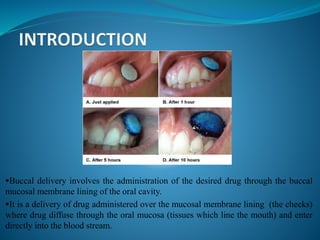
Buccal delivery involves the administration of the desired drug through the buccal
mucosal membrane lining of the oral cavity.
It is a delivery of drug administered over the mucosal membrane lining (the cheeks)
where drug diffuse through the oral mucosa (tissues which line the mouth) and enter
directly into the blood stream.
Overview of oral mucosa
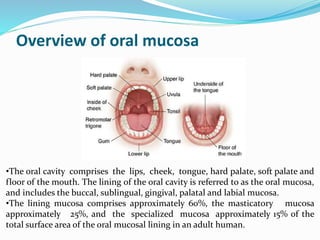
•The oral cavity comprises the lips, cheek, tongue, hard palate, soft palate and
floor of the mouth. The lining of the oral cavity is referred to as the oral mucosa,
and includes the buccal, sublingual, gingival, palatal and labial mucosa.
•The lining mucosa comprises approximately 60%, the masticatory mucosa
approximately 25%, and the specialized mucosa approximately 15% of the
total surface area of the oral mucosal lining in an adult human.
Bioadhesion
“Bioadhesion is defined as a substance that is capable of interacting with biological
material and being retained on them or holding them together for persistent period
of time.”
Mechanism of bioadhesion
For bio-adhesion to occur, three steps take place:
 A close contact among a bioadhesive and a membrane either from a good
wetting of the bioadhesive and a membrane or from the swelling of
bioadhesive.
 Penetration of the bio-adhesive into the tissue takes place.
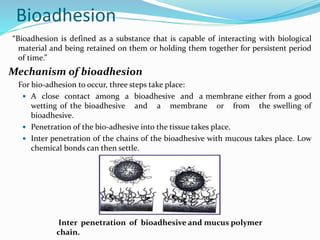
 Inter penetration of the chains of the bioadhesive with mucous takes place. Low
chemical bonds can then settle.
Inter penetration of bioadhesive and mucus polymer
chain.
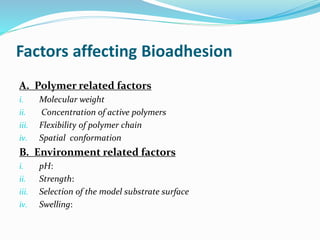
Factors affecting Bioadhesion
A. Polymer related factors
i. Molecular weight
ii. Concentration of active polymers
iii. Flexibility of polymer chain
iv. Spatial conformation
B. Environment related factors
i. pH:
ii. Strength:
iii. Selection of the model substrate surface
iv. Swelling:
Theories of bioadhesion/mucoadhesion
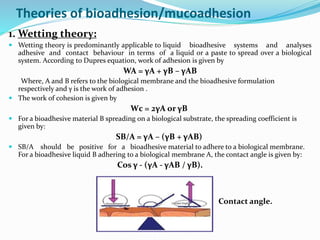
1. Wetting theory:
 Wetting theory is predominantly applicable to liquid bioadhesive systems and analyses
adhesive and contact behaviour in terms of a liquid or a paste to spread over a biological
system. According to Dupres equation, work of adhesion is given by
WA = γA + γB – γAB
Where, A and B refers to the biological membrane and the bioadhesive formulation
respectively and γ is the work of adhesion .
 The work of cohesion is given by
Wc = 2γA or γB
 For a bioadhesive material B spreading on a biological substrate, the spreading coefficient is
given by:
SB/A = γA – (γB + γAB)
 SB/A should be positive for a bioadhesive material to adhere to a biological membrane.
For a bioadhesive liquid B adhering to a biological membrane A, the contact angle is given by:
Cos γ - (γA - γAB / γB).
Contact angle.
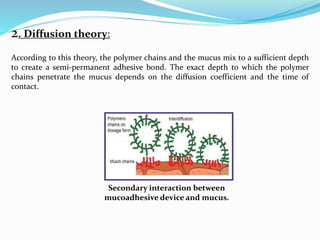
2. Diffusion theory:
According to this theory, the polymer chains and the mucus mix to a sufficient depth
to create a semi-permanent adhesive bond. The exact depth to which the polymer
chains penetrate the mucus depends on the diffusion coefficient and the time of
contact.
Secondary interaction between
mucoadhesive device and mucus.
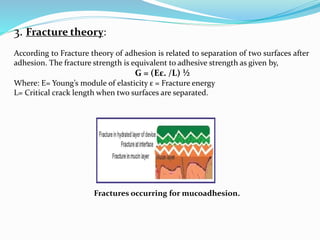
3. Fracture theory:
According to Fracture theory of adhesion is related to separation of two surfaces after
adhesion. The fracture strength is equivalent to adhesive strength as given by,
G = (Eε. /L) ½
Where: E= Young’s module of elasticity ε = Fracture energy
L= Critical crack length when two surfaces are separated.
Fractures occurring for mucoadhesion.
4. Adsorption theory:
According to this theory, after an initial contact between two surfaces, the materials
adhere because of surface forces acting between the atoms in the two surfaces.
Two types of chemical bonds such as primary covalent (permanent) and secondary
chemical bonds (including electrostatic forces, Vander-waal’s forces and hydrogen and
hydrophobic bonds) are involved in the adsorption process.
Basic components of Buccal drug delivery system
The basic components of buccal drug delivery system are Drug substance
a) Drug substance
b) Bio adhesive polymers
Backing membrane
c) Permeation enhancers
Drug substance
The drug should have following characteristics:
•The conventional single dose of the drug should be small.
•The drugs having biological half-life between 2-8 hrs are good candidates for
controlled drug delivery.
•Tmax of the drug shows wider-fluctuations or higher values when given orally.
•Through oral route drug may exhibit first pass effect or pre-systemic drug
elimination.
Bioadhesive polymer:
An ideal polymer for buccoadhesive drug delivery systems should have following
characteristics.
i. It should be inert and compatible with the environment
ii. The polymer and its degradation products should benon-toxic absorbable from
the mucous layer.
iii. It should adhere quickly to moist tissue surface and should possess some site
specificity.
iv. The polymer must not decompose on storage or during the shelf life of the dosage
form.
v. The polymer should be easily available in the market and economical.
vi. It should allow easy incorporation of drug in to the formulation.
Backing Membrane:
Backing membrane plays a major role in the attachment of bioadhesive devices to the
mucus membrane. The materials used as backing membrane should be inert, and
impermeable to the drug and penetration enhancer.
Permeation enhancers:
Substances that facilitate the permeation through buccal mucosa are referred as
permeation enhancers. Selection of enhancer and its efficacy depends on the
physicochemical properties of the drug, site of administration, nature of the
vehicle and other excipients.
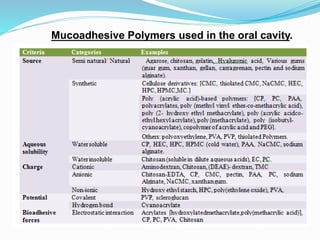
Mucoadhesive Polymers used in the oral cavity.
Examples of permeation enhancers with mechanism
CLASSIFICATION
OF BUCCAL
SYSTEM
BUCCAL TABLETS
BUCCAL
SEMISOLID
DOSAGE FORM
BUCCAL FILMS
BUCCAL
POWDERS
WAFER
LOZENGES
BUCCAL PATCHES
•Buccal drug delivery system has
following advantages over conventional
drug delivery systems.
•Persists the residence time of the dosage
form at the absorption site, hence rises
the bioavailability.
•Outstanding availability, rapid onset of
action possible.
•Fast absorption because of huge blood
supply and good perfusion rates.
•Preferable patient acquiescence.
•Likewise, rapid cellular recuperating and
healing of the local site.
• In this, there is reduced dosing frequency.
• It required shorter treatment period.
•Developed safety margin of high strength
drugs due to better control of plasma
levels.
•Extreme utilization of drug facilitating
reduction in total amount of drug
administered.
• By this route the drugs, which irritate the
oral mucosa, have a bitter or unpleasant
taste, odour cannot be administered.
•Only drugs, which are absorbed by
passive diffusion, can be administered by
this route.
•By this route, drugs which are unstable at
buccal pH, cannot be administered
•Only drugs with lesser dose requirements
can be administered.
•Drugs may be swallowed along with the
saliva and fail the benefits of buccal route.
• Eating and drinking may become
restricted.
• It may get displaced.
Advantages Disadvantages
Conclusions
Due to success, advantages and ease of access of drug delivery through oral
mucosal tissue the buccal and sublingual routes have favourable opportunities and
many formulation approaches; although the current commercially available
formulation are mostly limited to tablets and films.
The buccal mucosa offers several advantages for controlled drug delivery for long
period of time and also favourable area for systemic delivery of orally unsatisfactory
drugs and attractive alternative for non-offensive delivery of potent peptide and
protein drug molecule.
Reference-
 Gawas SM. et al. Pharmaceutical and Biological Evaluations 2016; vol. 3 (2): 165-177.
 DiMasi JA. The price of innovation: New estimates of drug development costs. Journal of
Health Economics. 2003;22:151-85.
 Alexander A, Ajazuddin S, TripathiDK, Verma T, Maurya J, Patel S. Mechanism
responsible for mucoadhesion of mucoadhesive drug delivery system: a review. Int J App
Bio and Pharm Tech. 2011;2(1):434-45.
 Collins LMC, Dawes C. The surface area of adult human mouth and thickness of salivary
film covering the teeth and oral mucosa. J Dent Res. 1987;66:1300-2.
 RaghavendraRao NG, Shravani B, Reddy MS. Overview on Buccal Drug Delivery System.
Journal of pharmaceutical sciences and research.
 Pharmaceutics the science of dosage form Design 2nd edition edited by M. E. Aulton.
Published by Harcourt publishers Limited. 2002; 198-200.
 Edgar WM. Saliva: its secretion, composition and functions. Br Dent J. 1992;172:305-12,
Buccal Drug Delivery System

Buccal Drug Delivery System

  • 1.
  • 2.
    Buccal delivery involvesthe administration of the desired drug through the buccal mucosal membrane lining of the oral cavity. It is a delivery of drug administered over the mucosal membrane lining (the cheeks) where drug diffuse through the oral mucosa (tissues which line the mouth) and enter directly into the blood stream.
  • 3.
    Overview of oralmucosa •The oral cavity comprises the lips, cheek, tongue, hard palate, soft palate and floor of the mouth. The lining of the oral cavity is referred to as the oral mucosa, and includes the buccal, sublingual, gingival, palatal and labial mucosa. •The lining mucosa comprises approximately 60%, the masticatory mucosa approximately 25%, and the specialized mucosa approximately 15% of the total surface area of the oral mucosal lining in an adult human.
  • 4.
    Bioadhesion “Bioadhesion is definedas a substance that is capable of interacting with biological material and being retained on them or holding them together for persistent period of time.” Mechanism of bioadhesion For bio-adhesion to occur, three steps take place:  A close contact among a bioadhesive and a membrane either from a good wetting of the bioadhesive and a membrane or from the swelling of bioadhesive.  Penetration of the bio-adhesive into the tissue takes place.  Inter penetration of the chains of the bioadhesive with mucous takes place. Low chemical bonds can then settle. Inter penetration of bioadhesive and mucus polymer chain.
  • 5.
    Factors affecting Bioadhesion A.Polymer related factors i. Molecular weight ii. Concentration of active polymers iii. Flexibility of polymer chain iv. Spatial conformation B. Environment related factors i. pH: ii. Strength: iii. Selection of the model substrate surface iv. Swelling:
  • 6.
    Theories of bioadhesion/mucoadhesion 1.Wetting theory:  Wetting theory is predominantly applicable to liquid bioadhesive systems and analyses adhesive and contact behaviour in terms of a liquid or a paste to spread over a biological system. According to Dupres equation, work of adhesion is given by WA = γA + γB – γAB Where, A and B refers to the biological membrane and the bioadhesive formulation respectively and γ is the work of adhesion .  The work of cohesion is given by Wc = 2γA or γB  For a bioadhesive material B spreading on a biological substrate, the spreading coefficient is given by: SB/A = γA – (γB + γAB)  SB/A should be positive for a bioadhesive material to adhere to a biological membrane. For a bioadhesive liquid B adhering to a biological membrane A, the contact angle is given by: Cos γ - (γA - γAB / γB). Contact angle.
  • 7.
    2. Diffusion theory: Accordingto this theory, the polymer chains and the mucus mix to a sufficient depth to create a semi-permanent adhesive bond. The exact depth to which the polymer chains penetrate the mucus depends on the diffusion coefficient and the time of contact. Secondary interaction between mucoadhesive device and mucus.
  • 8.
    3. Fracture theory: Accordingto Fracture theory of adhesion is related to separation of two surfaces after adhesion. The fracture strength is equivalent to adhesive strength as given by, G = (Eε. /L) ½ Where: E= Young’s module of elasticity ε = Fracture energy L= Critical crack length when two surfaces are separated. Fractures occurring for mucoadhesion.
  • 9.
    4. Adsorption theory: Accordingto this theory, after an initial contact between two surfaces, the materials adhere because of surface forces acting between the atoms in the two surfaces. Two types of chemical bonds such as primary covalent (permanent) and secondary chemical bonds (including electrostatic forces, Vander-waal’s forces and hydrogen and hydrophobic bonds) are involved in the adsorption process.
  • 10.
    Basic components ofBuccal drug delivery system The basic components of buccal drug delivery system are Drug substance a) Drug substance b) Bio adhesive polymers Backing membrane c) Permeation enhancers Drug substance The drug should have following characteristics: •The conventional single dose of the drug should be small. •The drugs having biological half-life between 2-8 hrs are good candidates for controlled drug delivery. •Tmax of the drug shows wider-fluctuations or higher values when given orally. •Through oral route drug may exhibit first pass effect or pre-systemic drug elimination.
  • 11.
    Bioadhesive polymer: An idealpolymer for buccoadhesive drug delivery systems should have following characteristics. i. It should be inert and compatible with the environment ii. The polymer and its degradation products should benon-toxic absorbable from the mucous layer. iii. It should adhere quickly to moist tissue surface and should possess some site specificity. iv. The polymer must not decompose on storage or during the shelf life of the dosage form. v. The polymer should be easily available in the market and economical. vi. It should allow easy incorporation of drug in to the formulation. Backing Membrane: Backing membrane plays a major role in the attachment of bioadhesive devices to the mucus membrane. The materials used as backing membrane should be inert, and impermeable to the drug and penetration enhancer.
  • 12.
    Permeation enhancers: Substances thatfacilitate the permeation through buccal mucosa are referred as permeation enhancers. Selection of enhancer and its efficacy depends on the physicochemical properties of the drug, site of administration, nature of the vehicle and other excipients.
  • 13.
    Mucoadhesive Polymers usedin the oral cavity.
  • 14.
    Examples of permeationenhancers with mechanism
  • 15.
    CLASSIFICATION OF BUCCAL SYSTEM BUCCAL TABLETS BUCCAL SEMISOLID DOSAGEFORM BUCCAL FILMS BUCCAL POWDERS WAFER LOZENGES BUCCAL PATCHES
  • 16.
    •Buccal drug deliverysystem has following advantages over conventional drug delivery systems. •Persists the residence time of the dosage form at the absorption site, hence rises the bioavailability. •Outstanding availability, rapid onset of action possible. •Fast absorption because of huge blood supply and good perfusion rates. •Preferable patient acquiescence. •Likewise, rapid cellular recuperating and healing of the local site. • In this, there is reduced dosing frequency. • It required shorter treatment period. •Developed safety margin of high strength drugs due to better control of plasma levels. •Extreme utilization of drug facilitating reduction in total amount of drug administered. • By this route the drugs, which irritate the oral mucosa, have a bitter or unpleasant taste, odour cannot be administered. •Only drugs, which are absorbed by passive diffusion, can be administered by this route. •By this route, drugs which are unstable at buccal pH, cannot be administered •Only drugs with lesser dose requirements can be administered. •Drugs may be swallowed along with the saliva and fail the benefits of buccal route. • Eating and drinking may become restricted. • It may get displaced. Advantages Disadvantages
  • 17.
    Conclusions Due to success,advantages and ease of access of drug delivery through oral mucosal tissue the buccal and sublingual routes have favourable opportunities and many formulation approaches; although the current commercially available formulation are mostly limited to tablets and films. The buccal mucosa offers several advantages for controlled drug delivery for long period of time and also favourable area for systemic delivery of orally unsatisfactory drugs and attractive alternative for non-offensive delivery of potent peptide and protein drug molecule.
  • 18.
    Reference-  Gawas SM.et al. Pharmaceutical and Biological Evaluations 2016; vol. 3 (2): 165-177.  DiMasi JA. The price of innovation: New estimates of drug development costs. Journal of Health Economics. 2003;22:151-85.  Alexander A, Ajazuddin S, TripathiDK, Verma T, Maurya J, Patel S. Mechanism responsible for mucoadhesion of mucoadhesive drug delivery system: a review. Int J App Bio and Pharm Tech. 2011;2(1):434-45.  Collins LMC, Dawes C. The surface area of adult human mouth and thickness of salivary film covering the teeth and oral mucosa. J Dent Res. 1987;66:1300-2.  RaghavendraRao NG, Shravani B, Reddy MS. Overview on Buccal Drug Delivery System. Journal of pharmaceutical sciences and research.  Pharmaceutics the science of dosage form Design 2nd edition edited by M. E. Aulton. Published by Harcourt publishers Limited. 2002; 198-200.  Edgar WM. Saliva: its secretion, composition and functions. Br Dent J. 1992;172:305-12,