P R E S E N T E D B Y
J . S A M A T H A
B . C H A I T H A N Y A
BUCCAL DRUG DELIVERY
SYSTEM
Contents
 Introduction
 Advantages
 Disadvantages
 Structure of oral mucosa
 Anatomy and physiology of oral mucosa
 Routes of drug transport
 Formulation of BDDS
 Theories of mucoadhesion
 Mechanism of mucoadhesion
 Factors affecting buccal absorbtion
 Evaluation
 conclusion
Introduction
What is BDDS?
Delivery of drug through buccal mucosa of oral cavity
is called BDDS. The buccal mucosa lines the inner
cheek
 It is placed between the upper gingivae and cheek
 Treat local and systemic conditions
 An ideal dosage regimen in the drug therapy of any
disease
Advantages
 Termination of therapy is possible
 Permits localization of drug to the oral cavity for
extended period of time
 Ease of administration
 Avoids first pass metabolism
 Reduction in dose can be achieved selective use of
therapeutic agents like peptides, proteins and
ionised species can be achieved.
 Drugs which are unstable in acidic environment of
stomach or destroyed by the alkaline environment
of the intestine can be given by this route
 Administration of drugs with poor bioavailability
 It follows passive diffusion
 Dissolution of drug is easy unlike in case of rectal
and transdermal route.
 administration of drugs with short half life
 Prolongation of contact time with mucosa.
 Flexibility in shifting the position of the drug in
buccal cavity.
Disadvantages
 Over hydration
 Eating and drinking may be restricted
 By mistake tablet can be swallowed
 Saliva takes some drug into the git
 Only drug with small dose requirement can be
administered
 Drugs which irritate mucosa or have bitter or
unpleasant taste or an obnoxious odour cannot be
administered by this route
 Drugs which are unstable ay buccal pH cannot be
administered by this route
 Only those drugs which are adsorbed by passive
diffusion can be administered by this route
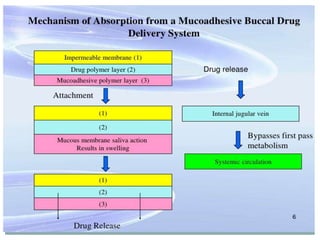
Mechanism of bioadhesion
 The bioadhesion mainly depends upon nature of
bioadhesive polymer.
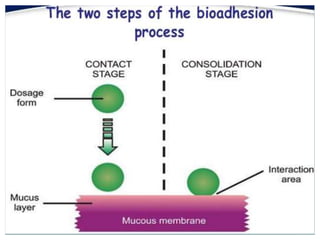
 First stage involves an intimate contact between
abioadhesive and a membrane.
 Second stage involves penetration of the bioadhesive
into tissue.
 Drug released
 bypasses first pass metabolism
 Enters systemic circulation.
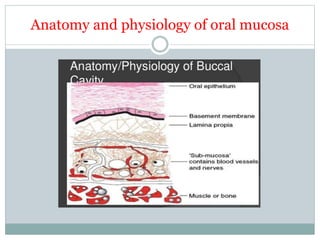
Anatomy and physiology of oral mucosa
 The oral cavity is lined by thick dense and multilayered
mucous membrane of highly vascularized nature.
 Drug penetrating into the membrane pass through net of
capillaries and arteries and reaches the systemic
circulation.
 There are mainly three functional zones of oral mucosa:
 Masticatory mucosa
 Mucous secreting region
 Specialized mucosa
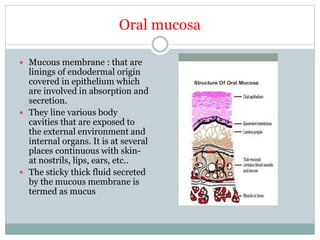
Oral mucosa
 Mucous membrane : that are
linings of endodermal origin
covered in epithelium which
are involved in absorption and
secretion.
 They line various body
cavities that are exposed to
the external environment and
internal organs. It is at several
places continuous with skin-
at nostrils, lips, ears, etc..
 The sticky thick fluid secreted
by the mucous membrane is
termed as mucus
Functions of mucus
 Protective: particularly from its hydrophobicity
 Barrier: in tissue absorption of the drugs and
influence bioavailability
 Adhesion: mucus has strong cohesion properties
 Lubrication: keep mucosal membrane moist.
Buccal environment
 It has 4 parts and is 500-800nm thick and 150sq cm
 Epithelium: 40-50 cell thick and is major barrier for
lipophilic drug. It has initially square shaped cells which
further grows in the elliptical cells which are permeable for
hydrophilic drugs.it may be keratinized or non-keratinized.
 Mostly, non-keratinised epithilium is permeable to
drug very easily due to absence of acylceramides and
only small amounts of ceramides. Also they contain
small amounts of neutral but polar lipids
Routes of drug transport
 2 routes of drug transport
Para cellular
Trans cellular
Para cellular route: primary
route for hydrophilic drugs,
intercellular spaces is the
preferred route
Transcellular route: route for
lipophilic drugs. They passes
through lipid rich plasma
membranes of epithelial cells.
Formulation of BDDS-patch/film/adhesive tape
The basic components of buccal drug delivery system-
Drug substance
Bioadhesive polymers
Backing membrane
Permeation enhancers
Drug selection
 Dose of the drug should be small
 Half life between 2- 8 hours
 Exhibit first pass effect or presystemic drug
elimination
 Absorption should be passive when given orally
 Eg: nicotine, nifedipine, propranolol, diclofenac
sodium.
Permeability enhancers
 Definition: substances added to pharmaceutical
formulation in order to increase the membrane
permeation rate or absorption rate of coadministered
drug.
 Eg: by using di and tri-hydroxy bile salts the
permeability of buccal mucosa to fluorescein
isothiocynate increased by 100-200 fold compared to
FITC alone
Backing membrane
 Ability to attachment of adhesive device to mucus
membrane
 Inert in nature and impermeable to the drug
 Such impermeable membrane prevent drug loss and
good patient compliances
 examples- carbapol, magnesium stearate,
polycarbapol
Bioadhesive polymer
 Ideal characteristics
 Non-toxic, non-irritable, free from leachable
impurities.
 Polymer pH should be biocompatible
 Quick adherence and sufficient mechanical strength
 Acceptable shelf life
 Optimum molecular weight
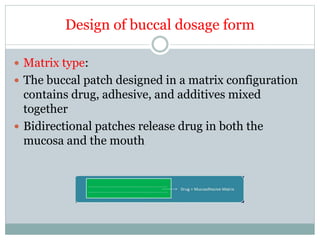
Design of buccal dosage form
 Matrix type:
 The buccal patch designed in a matrix configuration
contains drug, adhesive, and additives mixed
together
 Bidirectional patches release drug in both the
mucosa and the mouth
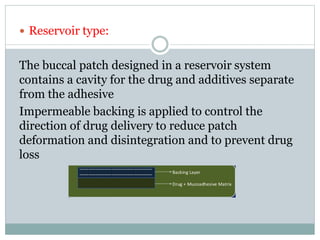
 Reservoir type:
The buccal patch designed in a reservoir system
contains a cavity for the drug and additives separate
from the adhesive
Impermeable backing is applied to control the
direction of drug delivery to reduce patch
deformation and disintegration and to prevent drug
loss
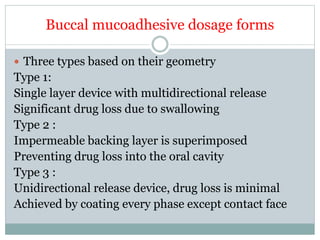
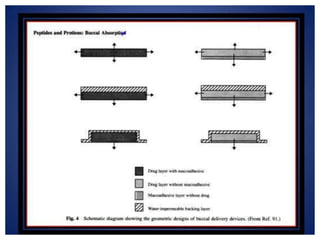
Buccal mucoadhesive dosage forms
 Three types based on their geometry
Type 1:
Single layer device with multidirectional release
Significant drug loss due to swallowing
Type 2 :
Impermeable backing layer is superimposed
Preventing drug loss into the oral cavity
Type 3 :
Unidirectional release device, drug loss is minimal
Achieved by coating every phase except contact face
Theories of mucoadhesion
 Electronic theory
 Wetting theory
 Adsorption theory
 Diffusion theory
 Fracture theory
1)Electronic theory
Attractive forces between glycoprotein mucin
network and the bioadhesive material.
2)Fracture theory
Analyses the maximum tensile stress develop during
detachment of the BDDS from material surfaces.
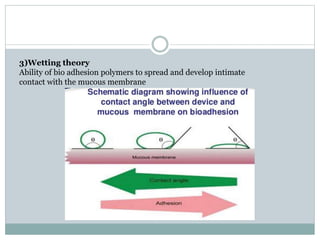
3)Wetting theory
Ability of bio adhesion polymers to spread and develop intimate
contact with the mucous membrane
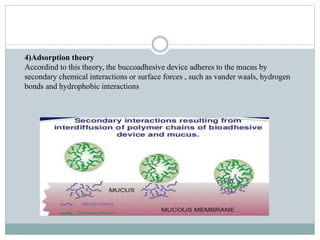
4)Adsorption theory
Accordind to this theory, the buccoadhesive device adheres to the mucus by
secondary chemical interactions or surface forces , such as vander waals, hydrogen
bonds and hydrophobic interactions
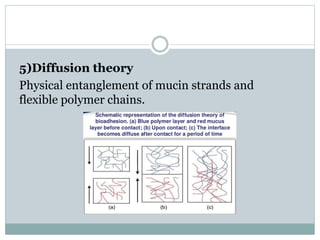
5)Diffusion theory
Physical entanglement of mucin strands and
flexible polymer chains.
Mechanism of mucoadhesion
 The mechanism responsible in the formation of
mucoadhesive bond
 Step1: wetting and swelling of the polymer (contact
stage)
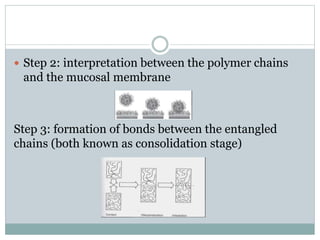
 Step 2: interpretation between the polymer chains
and the mucosal membrane
Step 3: formation of bonds between the entangled
chains (both known as consolidation stage)
Factors affecting buccal adsorption
 Polymer related factors
i. Molecular weight
ii. Concentration of polymer
iii. Flexibilityof polymer chains
iv. Swelling
 Physiological factor
i. Mucin turn over
ii. Disease state
 Environmental factor
i. pH of polymer-substrate inter face
ii. Applied strength
iii. Initial contact time
1.Polymer related factors
 Molecular weight:
 Atleast 1,00,000 molecular weight
 Buccaladhesiveness increses with increasing molecular
weight.
 Concentration of polymer:
 More concentrated buccoadhesive dispersion retain on
mucus membrane for longer period of time
 Flexibility of polymer chains :
 As water soluble polymers become cross linked,the
mobility of individual polymer chain decreases .
 Swelling:depends on concentration and presence of
water
2. Environment- related factors
 pH of polymer- substrate interface:
The pH of the medium is important for the degree of
hydration.
 Applied strength:
The adhesion strength increases with the applied
strength.
 initial contact time:
Buccoadhesive strength increases as the initial contact
time increases.
3, physiological factors
 Mucin turn over:
Important because of two reasons;
To limit the residence time of the buccoadhesives on
the mucus layer
Substantial amounts of soluble mucin molecule
 Disease states:
Disease states where the mucosa is damaged would
also be expected to chaange in permeability.
 EVALUATIONS OF BUCCAL PATCH:
1.Surface pH: Buccal patches are left to swell for
2 hrs on the surface of an agar plate. The surface
pH is measured by means of a pH paper placed on
the surface of the swollen patch
2. Thickness measurements: The thickness of
each film is measured at five different locations
(centre and four corners) using an electronic
digital micrometer
 3. Swelling study: Buccal patches are weighed
individually (designated as W1), and placed separately in
2% agar gel plates, incubated at 37°C ± 1°C, and examined
for any physical changes. At regular 1- hr time intervals
until 3 hours, patches are removed from the gel plates and
excess surface water is removed carefully using the filter
paper[46] . The swollen patches are then reweighed (W2)
and the swelling index (SI) is calculated using the following
formula.
SI=W2-W1 × 100
W1
4. Folding endurance: The folding endurance of patches is
determined by repeatedly folding 1 patch at the times without
breaking
5. Thermal analysis study: Thermal analysis study is performed
using differential scanning calorimeter (DSC)
6. Morphological characterization: Morphological characters
are studied by using scanning electron microscope (SEM)
7. Permeation study of buccal patch: The receptor compartment
is filled with phosphate buffer pH 6.8, and the hydrodynamics in
the receptor compartment is maintained by stirring with a
magnetic bead at 50 rpm. Samples are withdrawn at
predetermined time intervals and analyzed for drug content
 7. Water absorption capacity test: Circular Patches, with a
surface area of 2.3 cm2 are allowed to swell on the surface of agar
plates prepared in simulated saliva (2.38 gNa2HPO4, 0.19
gKH2PO4, and 8 g NaCl per litter of distilled water adjusted with
phosphoric acid to pH 6.7),and kept in an incubator maintained at
37°C ± 0.5°C. At various time intervals (0.25, 0.5, 1, 2, 3, and 4
hours),samples are weighed (wet weight) and then left to dry for 7
days in a desiccators over anhydrous calcium chloride at room
temperature then the final constant weights are recorded. Water
uptake (%) is calculated using the following equation.
 Water uptake (%)= (Ww – Wi )/Wf x 100
Where, Ww is the wet weight and Wf is the final weight. Theswelling
of each film is measured
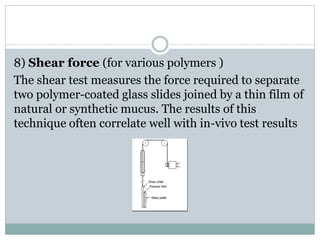
8) Shear force (for various polymers )
The shear test measures the force required to separate
two polymer-coated glass slides joined by a thin film of
natural or synthetic mucus. The results of this
technique often correlate well with in-vivo test results
Buccal drug delivery system

Buccal drug delivery system

  • 1.
    P R ES E N T E D B Y J . S A M A T H A B . C H A I T H A N Y A BUCCAL DRUG DELIVERY SYSTEM
  • 2.
    Contents  Introduction  Advantages Disadvantages  Structure of oral mucosa  Anatomy and physiology of oral mucosa  Routes of drug transport  Formulation of BDDS  Theories of mucoadhesion  Mechanism of mucoadhesion  Factors affecting buccal absorbtion  Evaluation  conclusion
  • 3.
    Introduction What is BDDS? Deliveryof drug through buccal mucosa of oral cavity is called BDDS. The buccal mucosa lines the inner cheek  It is placed between the upper gingivae and cheek  Treat local and systemic conditions  An ideal dosage regimen in the drug therapy of any disease
  • 4.
    Advantages  Termination oftherapy is possible  Permits localization of drug to the oral cavity for extended period of time  Ease of administration  Avoids first pass metabolism  Reduction in dose can be achieved selective use of therapeutic agents like peptides, proteins and ionised species can be achieved.
  • 5.
     Drugs whichare unstable in acidic environment of stomach or destroyed by the alkaline environment of the intestine can be given by this route  Administration of drugs with poor bioavailability  It follows passive diffusion  Dissolution of drug is easy unlike in case of rectal and transdermal route.  administration of drugs with short half life  Prolongation of contact time with mucosa.  Flexibility in shifting the position of the drug in buccal cavity.
  • 6.
    Disadvantages  Over hydration Eating and drinking may be restricted  By mistake tablet can be swallowed  Saliva takes some drug into the git  Only drug with small dose requirement can be administered  Drugs which irritate mucosa or have bitter or unpleasant taste or an obnoxious odour cannot be administered by this route  Drugs which are unstable ay buccal pH cannot be administered by this route  Only those drugs which are adsorbed by passive diffusion can be administered by this route
  • 7.
    Mechanism of bioadhesion The bioadhesion mainly depends upon nature of bioadhesive polymer.  First stage involves an intimate contact between abioadhesive and a membrane.  Second stage involves penetration of the bioadhesive into tissue.  Drug released  bypasses first pass metabolism  Enters systemic circulation.
  • 8.
    Anatomy and physiologyof oral mucosa
  • 9.
    Anatomy and physiologyof oral mucosa  The oral cavity is lined by thick dense and multilayered mucous membrane of highly vascularized nature.  Drug penetrating into the membrane pass through net of capillaries and arteries and reaches the systemic circulation.  There are mainly three functional zones of oral mucosa:  Masticatory mucosa  Mucous secreting region  Specialized mucosa
  • 10.
    Oral mucosa  Mucousmembrane : that are linings of endodermal origin covered in epithelium which are involved in absorption and secretion.  They line various body cavities that are exposed to the external environment and internal organs. It is at several places continuous with skin- at nostrils, lips, ears, etc..  The sticky thick fluid secreted by the mucous membrane is termed as mucus
  • 11.
    Functions of mucus Protective: particularly from its hydrophobicity  Barrier: in tissue absorption of the drugs and influence bioavailability  Adhesion: mucus has strong cohesion properties  Lubrication: keep mucosal membrane moist.
  • 12.
    Buccal environment  Ithas 4 parts and is 500-800nm thick and 150sq cm  Epithelium: 40-50 cell thick and is major barrier for lipophilic drug. It has initially square shaped cells which further grows in the elliptical cells which are permeable for hydrophilic drugs.it may be keratinized or non-keratinized.  Mostly, non-keratinised epithilium is permeable to drug very easily due to absence of acylceramides and only small amounts of ceramides. Also they contain small amounts of neutral but polar lipids
  • 13.
    Routes of drugtransport  2 routes of drug transport Para cellular Trans cellular Para cellular route: primary route for hydrophilic drugs, intercellular spaces is the preferred route Transcellular route: route for lipophilic drugs. They passes through lipid rich plasma membranes of epithelial cells.
  • 14.
    Formulation of BDDS-patch/film/adhesivetape The basic components of buccal drug delivery system- Drug substance Bioadhesive polymers Backing membrane Permeation enhancers
  • 15.
    Drug selection  Doseof the drug should be small  Half life between 2- 8 hours  Exhibit first pass effect or presystemic drug elimination  Absorption should be passive when given orally  Eg: nicotine, nifedipine, propranolol, diclofenac sodium.
  • 16.
    Permeability enhancers  Definition:substances added to pharmaceutical formulation in order to increase the membrane permeation rate or absorption rate of coadministered drug.  Eg: by using di and tri-hydroxy bile salts the permeability of buccal mucosa to fluorescein isothiocynate increased by 100-200 fold compared to FITC alone
  • 17.
    Backing membrane  Abilityto attachment of adhesive device to mucus membrane  Inert in nature and impermeable to the drug  Such impermeable membrane prevent drug loss and good patient compliances  examples- carbapol, magnesium stearate, polycarbapol
  • 18.
    Bioadhesive polymer  Idealcharacteristics  Non-toxic, non-irritable, free from leachable impurities.  Polymer pH should be biocompatible  Quick adherence and sufficient mechanical strength  Acceptable shelf life  Optimum molecular weight
  • 20.
    Design of buccaldosage form  Matrix type:  The buccal patch designed in a matrix configuration contains drug, adhesive, and additives mixed together  Bidirectional patches release drug in both the mucosa and the mouth
  • 21.
     Reservoir type: Thebuccal patch designed in a reservoir system contains a cavity for the drug and additives separate from the adhesive Impermeable backing is applied to control the direction of drug delivery to reduce patch deformation and disintegration and to prevent drug loss
  • 22.
    Buccal mucoadhesive dosageforms  Three types based on their geometry Type 1: Single layer device with multidirectional release Significant drug loss due to swallowing Type 2 : Impermeable backing layer is superimposed Preventing drug loss into the oral cavity Type 3 : Unidirectional release device, drug loss is minimal Achieved by coating every phase except contact face
  • 25.
    Theories of mucoadhesion Electronic theory  Wetting theory  Adsorption theory  Diffusion theory  Fracture theory
  • 26.
    1)Electronic theory Attractive forcesbetween glycoprotein mucin network and the bioadhesive material. 2)Fracture theory Analyses the maximum tensile stress develop during detachment of the BDDS from material surfaces.
  • 27.
    3)Wetting theory Ability ofbio adhesion polymers to spread and develop intimate contact with the mucous membrane
  • 28.
    4)Adsorption theory Accordind tothis theory, the buccoadhesive device adheres to the mucus by secondary chemical interactions or surface forces , such as vander waals, hydrogen bonds and hydrophobic interactions
  • 29.
    5)Diffusion theory Physical entanglementof mucin strands and flexible polymer chains.
  • 30.
    Mechanism of mucoadhesion The mechanism responsible in the formation of mucoadhesive bond  Step1: wetting and swelling of the polymer (contact stage)
  • 31.
     Step 2:interpretation between the polymer chains and the mucosal membrane Step 3: formation of bonds between the entangled chains (both known as consolidation stage)
  • 33.
    Factors affecting buccaladsorption  Polymer related factors i. Molecular weight ii. Concentration of polymer iii. Flexibilityof polymer chains iv. Swelling  Physiological factor i. Mucin turn over ii. Disease state
  • 34.
     Environmental factor i.pH of polymer-substrate inter face ii. Applied strength iii. Initial contact time
  • 35.
    1.Polymer related factors Molecular weight:  Atleast 1,00,000 molecular weight  Buccaladhesiveness increses with increasing molecular weight.  Concentration of polymer:  More concentrated buccoadhesive dispersion retain on mucus membrane for longer period of time  Flexibility of polymer chains :  As water soluble polymers become cross linked,the mobility of individual polymer chain decreases .  Swelling:depends on concentration and presence of water
  • 36.
    2. Environment- relatedfactors  pH of polymer- substrate interface: The pH of the medium is important for the degree of hydration.  Applied strength: The adhesion strength increases with the applied strength.  initial contact time: Buccoadhesive strength increases as the initial contact time increases.
  • 37.
    3, physiological factors Mucin turn over: Important because of two reasons; To limit the residence time of the buccoadhesives on the mucus layer Substantial amounts of soluble mucin molecule  Disease states: Disease states where the mucosa is damaged would also be expected to chaange in permeability.
  • 38.
     EVALUATIONS OFBUCCAL PATCH: 1.Surface pH: Buccal patches are left to swell for 2 hrs on the surface of an agar plate. The surface pH is measured by means of a pH paper placed on the surface of the swollen patch 2. Thickness measurements: The thickness of each film is measured at five different locations (centre and four corners) using an electronic digital micrometer
  • 39.
     3. Swellingstudy: Buccal patches are weighed individually (designated as W1), and placed separately in 2% agar gel plates, incubated at 37°C ± 1°C, and examined for any physical changes. At regular 1- hr time intervals until 3 hours, patches are removed from the gel plates and excess surface water is removed carefully using the filter paper[46] . The swollen patches are then reweighed (W2) and the swelling index (SI) is calculated using the following formula. SI=W2-W1 × 100 W1
  • 40.
    4. Folding endurance:The folding endurance of patches is determined by repeatedly folding 1 patch at the times without breaking 5. Thermal analysis study: Thermal analysis study is performed using differential scanning calorimeter (DSC) 6. Morphological characterization: Morphological characters are studied by using scanning electron microscope (SEM) 7. Permeation study of buccal patch: The receptor compartment is filled with phosphate buffer pH 6.8, and the hydrodynamics in the receptor compartment is maintained by stirring with a magnetic bead at 50 rpm. Samples are withdrawn at predetermined time intervals and analyzed for drug content
  • 41.
     7. Waterabsorption capacity test: Circular Patches, with a surface area of 2.3 cm2 are allowed to swell on the surface of agar plates prepared in simulated saliva (2.38 gNa2HPO4, 0.19 gKH2PO4, and 8 g NaCl per litter of distilled water adjusted with phosphoric acid to pH 6.7),and kept in an incubator maintained at 37°C ± 0.5°C. At various time intervals (0.25, 0.5, 1, 2, 3, and 4 hours),samples are weighed (wet weight) and then left to dry for 7 days in a desiccators over anhydrous calcium chloride at room temperature then the final constant weights are recorded. Water uptake (%) is calculated using the following equation.  Water uptake (%)= (Ww – Wi )/Wf x 100 Where, Ww is the wet weight and Wf is the final weight. Theswelling of each film is measured
  • 42.
    8) Shear force(for various polymers ) The shear test measures the force required to separate two polymer-coated glass slides joined by a thin film of natural or synthetic mucus. The results of this technique often correlate well with in-vivo test results