WELCOME
PRESENTED BY
Majid Rashid
Registration No. 2020-1058-D
Course No. -:VSC-691
Title
SPICE CROPS:
Production, Breeding & Biotechnological
Techniques for growth of
Indian Spice Industry to compete in
International market
Spice
A Spice is a dried seed, fruit, root, bark, or vegetative substance primarily used for
flavouring, coloring or preserving food. Sometimes a spice is used to hide other flavors.
Department of Horticulture and Plantation
Crops, Tamil Nadu, 2021
Small cardamom Turmeric
Black pepper Ginger
Chilli Large Cardamom
Cumin
Cinnamon Nutmeg
Coriander Fennel Fenugreek
Saffron Garlic Tamarind
Vanilla
Curry leaf
Bay Leaf
Important Landmarks in the History of Spices:
The ancient Egyptians were using various spices for flavoring food, in cosmetics,
and for embalming their dead.
3500 BC
Pyramid age remarks about spices in Egyptian history and the use of spices in
'Mummies' as preservative.
6000-2100 BC
Vasco de Gama discovered the sea route to India and arrived at Calicut. 1498
Establishment of the British East India Company for trading in spices. British
landed in India on 24 August 1600 at Surat.
1600
America entered the pepper trade 1800
First research station for pepper established in India at Panniyur Kerala 1952
Establishment of International Pepper Community at Jakarta (Indonesia) 1972
Establishment of Spices Board of India 1986
Establishment of National Research Centre for Spices (NRCS) 1986
NRCS Upgraded as Indian Institute of Spice Research. (IISR) 1996
Spices Board of India
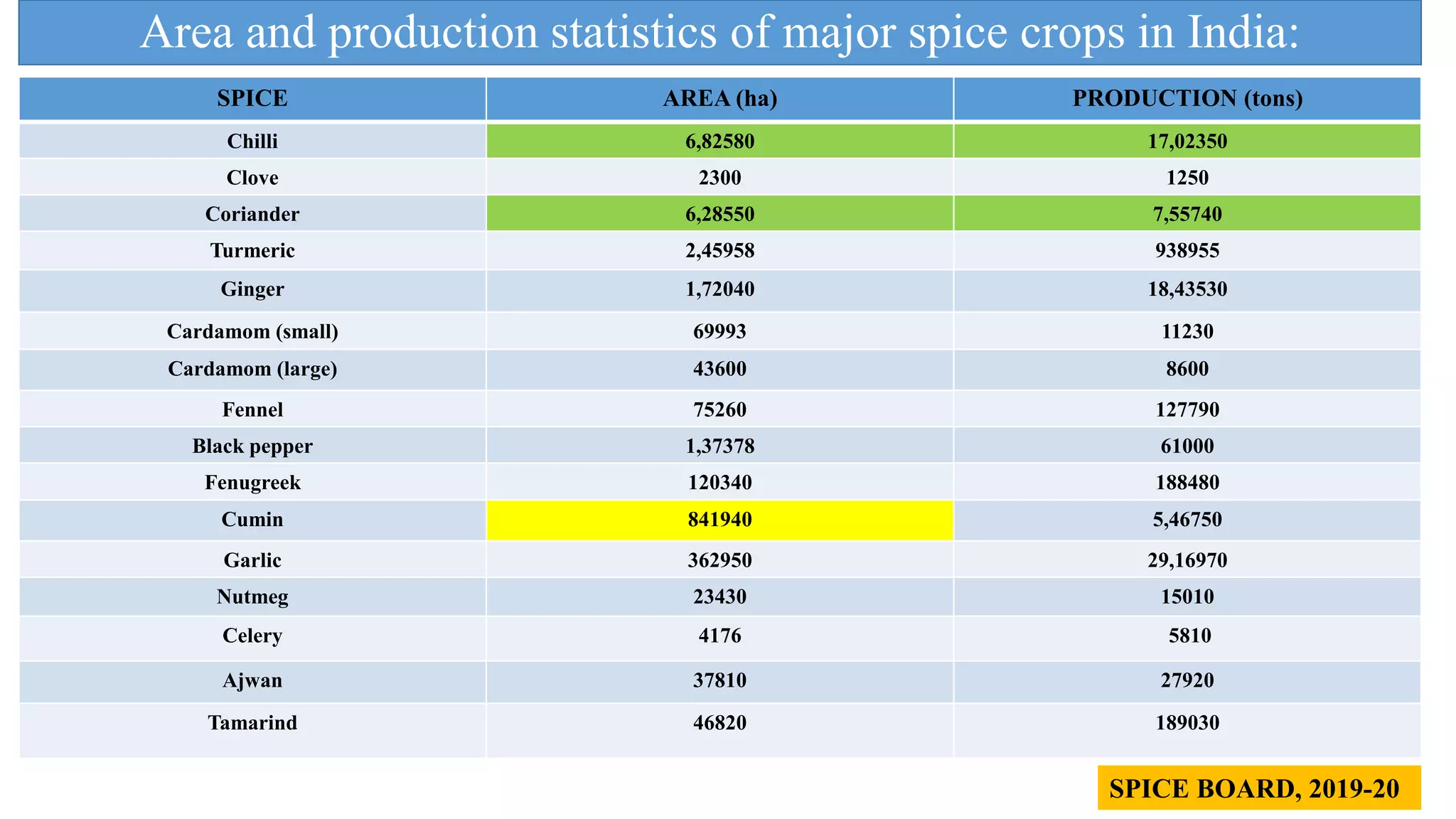
Area and production statistics of major spice crops in India:
SPICE AREA (ha) PRODUCTION (tons)
Chilli 6,82580 17,02350
Clove 2300 1250
Coriander 6,28550 7,55740
Turmeric 2,45958 938955
Ginger 1,72040 18,43530
Cardamom (small) 69993 11230
Cardamom (large) 43600 8600
Fennel 75260 127790
Black pepper 1,37378 61000
Fenugreek 120340 188480
Cumin 841940 5,46750
Garlic 362950 29,16970
Nutmeg 23430 15010
Celery 4176 5810
Ajwan 37810 27920
Tamarind 46820 189030
SPICE BOARD, 2019-20
Area and production statistics of major spice growing states in India:
State Major Spice Area (ha) Production
(tons)
Rajasthan Chilli, Coriander, Cumin, Fennel, Fenugreek, Garlic, Ajwan 8,73,270 9,30,860
Andhra Pradesh Turmeric, Ginger, Chilli, Coriander, Tamarind, Ajwan 179100 7,65260
Gujarat Chilli, Ginger, Turmeric, Cumin, Fennel, Fenugreek, Ajwan, Garlic 522820 8,37600
Telangana Chilli, Ginger, Turmeric, Ajwan, Tamarind 124720 6,40910
Karnataka Black pepper, Small Cardamom, Chilli, Ginger, Turmeric, Tamarind, Cloves,
Nutmeg
225990 7,12400
Maharashtra Chilli, Turmeric, Garlic, Tamarind 36360 211490
West Bengal Large Cardamom, Chilli, Ginger, Turmeric, Coriander, Fennel, Fenugreek,
Garlic
120140 3,41610
Uttar Pradesh Chilli, Coriander, Garlic 385450 285810
Orissa Chilli, Ginger, Turmeric, Coriander, Garlic 147670 293850
Kerala Black pepper, Small cardamom, Tamarind, Cloves, Nutmeg 163740 191330
Tamil Nadu Black pepper, Small Cardamom, Chilli, Turmeric, Tamarind, Cloves 104790 172620
Madhya Pradesh Garlic, Chilli, Ginger, Coriander, Fennel, Fenugreek, Ajwan 6,39,695 30,10,170
Total (inlc. Others) 38,58,921 94,13,474
SPICE BOARD, 2019-20
Status of seed spices in J&K
 Vast agricultural potential of the state can be utilized for seed spice cultivation.
 Present Area (Ha) : 1070 seed spices & 4000 ha saffron
 Production : 1227 MT + 15 MT
 Potential Area :1.5 lac ha (0.5 l ha sole + 1.0 l ha intercropping)
 Production potential :1.00 lac tonnes
•In FY20, spices worth US$ 3.65 billion were exported.
Value of Spices Exported from India
2020 (In Billion Indian Rupees)
Uses and Medicinal Properties of Major Spices
Spices Uses Medicinal Properties
Chilli
It is a main ingredient used for adding hot flavour
to the food.
The antioxidants present in chilli help to cope with
cholesterol. It also helps burning calories.
Clove
It is used as a cooking ingredient mainly for
seasoning or preparing Masalas.
Clove oil is beneficial for coping with tooth ache and
sore gums. It is also beneficial remedy for chest
pains, fever, digestive problems, cough and cold.
Garlic
It is used for cooking as well as for the medicinal
purpose.
It is useful for coping with cough and cold. It also has
antibiotic properties.
Cinnamon It is used mainly for seasoning food and preparing
masalas.
It supports natural production of insulin and reduces
blood cholesterol.
Coriander
Coriander leaves as well as coriander seeds are
used in cooking.
It can be used externally on aching joints and
rheumatism. It is also good for coping with soar
throat, allergies, digestion problems, hay fever etc.
Uses and Medicinal Properties of Major Spices
Spices Uses Medicinal Properties
Cardamom
Mostly in all Indian and other sweet dishes to impart
a good flavour and smell. It is also used widely in
pharmaceutical sector.
Helps to control bad breath and digestive disorder. A
whole cardamom chewed is good for coping with
diabetes.
Turmeric
It is used in cooking and skin care products. It has
wide range of medicinal uses.
It helps deal with skin problems. Turmeric powder
can
be used for healing cuts and wounds.
Cumin
It is used for cooking and it also possesses medicinal
properties.
It is a good source or iron and keeps immune system
healthy. Water boiled with cumin seeds is good for
coping with dysentery.
Curry leaves It is used as a main ingredient for seasoning in some
countries.
These leaves are beneficial for reducing blood sugar.
The dried leaves are extensively used in herbal
medicines.
Fenugreek
It is mainly used as a green leafy vegetable and seeds
are used for seasoning and preparing Masalas.
Fenugreek seed tea or sweet fudge is good for
increasing breast milk. It also helpful for treating
diabetes and lowering cholesterol
Uses and Medicinal Properties of Major Spices
Spices Uses Medicinal Properties
Bay leaf
It is used in cooking to add a specific flavour to food.
It also has
some medicinal properties.
Bay leaf oil possesses antifungal and anti bacterial
properties.
Ginger
It is used for giving a specific flavour to food and has
many
medicinal uses.
Helps to avoid digestive problems. It is beneficial for
coping with cough and cold.
Saffron
It is used for cooking as well as in beauty products. It
is mainly
used in sweet dishes. It has good medicinal
properties.
It helps to cope with skin diseases. It is a good remedy
for cough, cold and asthma.
Nutmeg
It is used in powdered form for garnishing and also
for masala preparation. It is used in soaps, perfumes
and shampoos.
It is beneficial for the treatments of asthma, heart
disorder and bad breath.
Pepper
It is extensively used in cooking, especially for
garnishing.
It helps coping with cold, cough, infections etc. It
helps
to deal with muscle pains and digestive problems.
Sachan et al., 2018
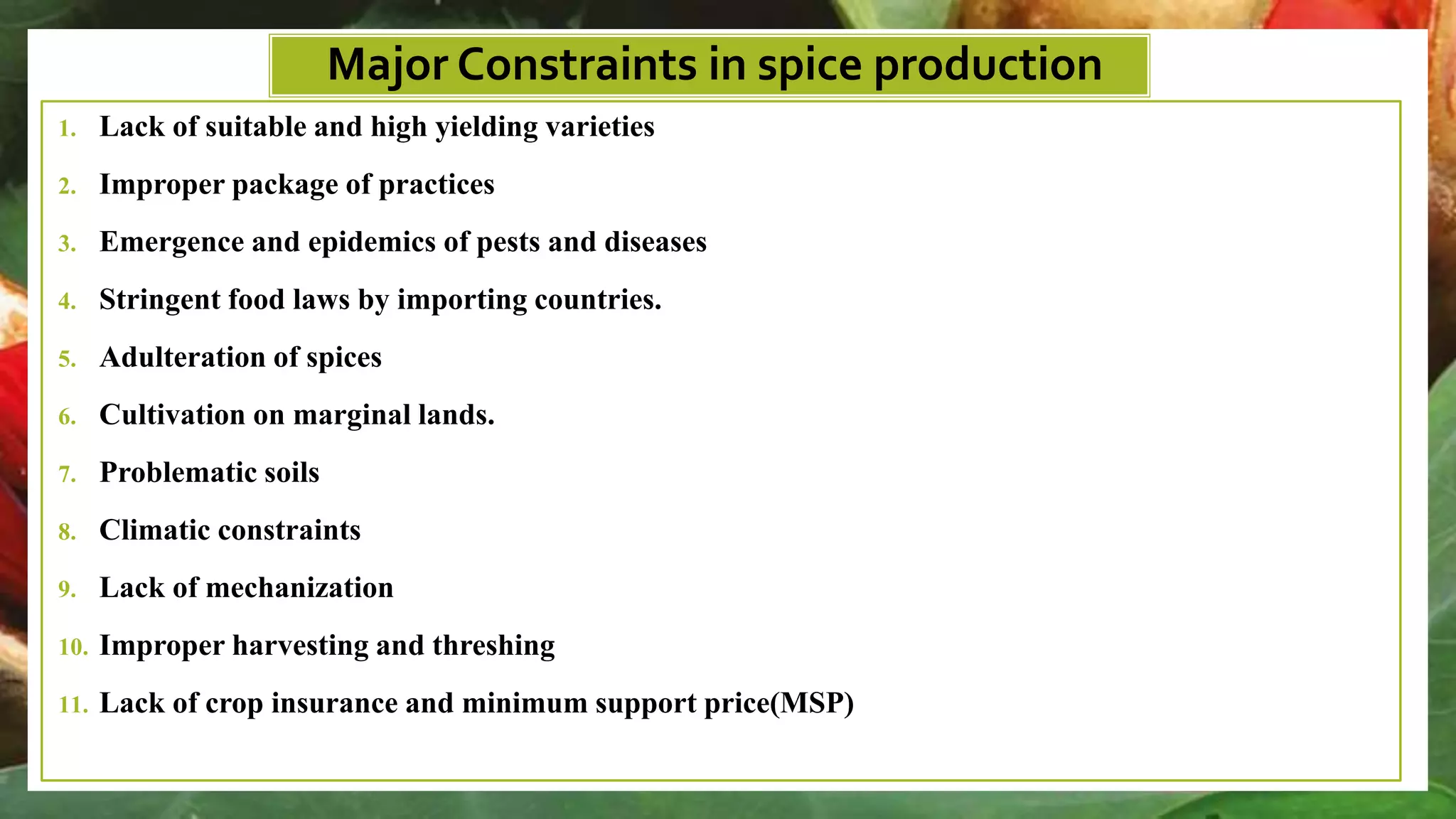
Major Constraints in spice production
1. Lack of suitable and high yielding varieties
2. Improper package of practices
3. Emergence and epidemics of pests and diseases
4. Stringent food laws by importing countries.
5. Adulteration of spices
6. Cultivation on marginal lands.
7. Problematic soils
8. Climatic constraints
9. Lack of mechanization
10. Improper harvesting and threshing
11. Lack of crop insurance and minimum support price(MSP)
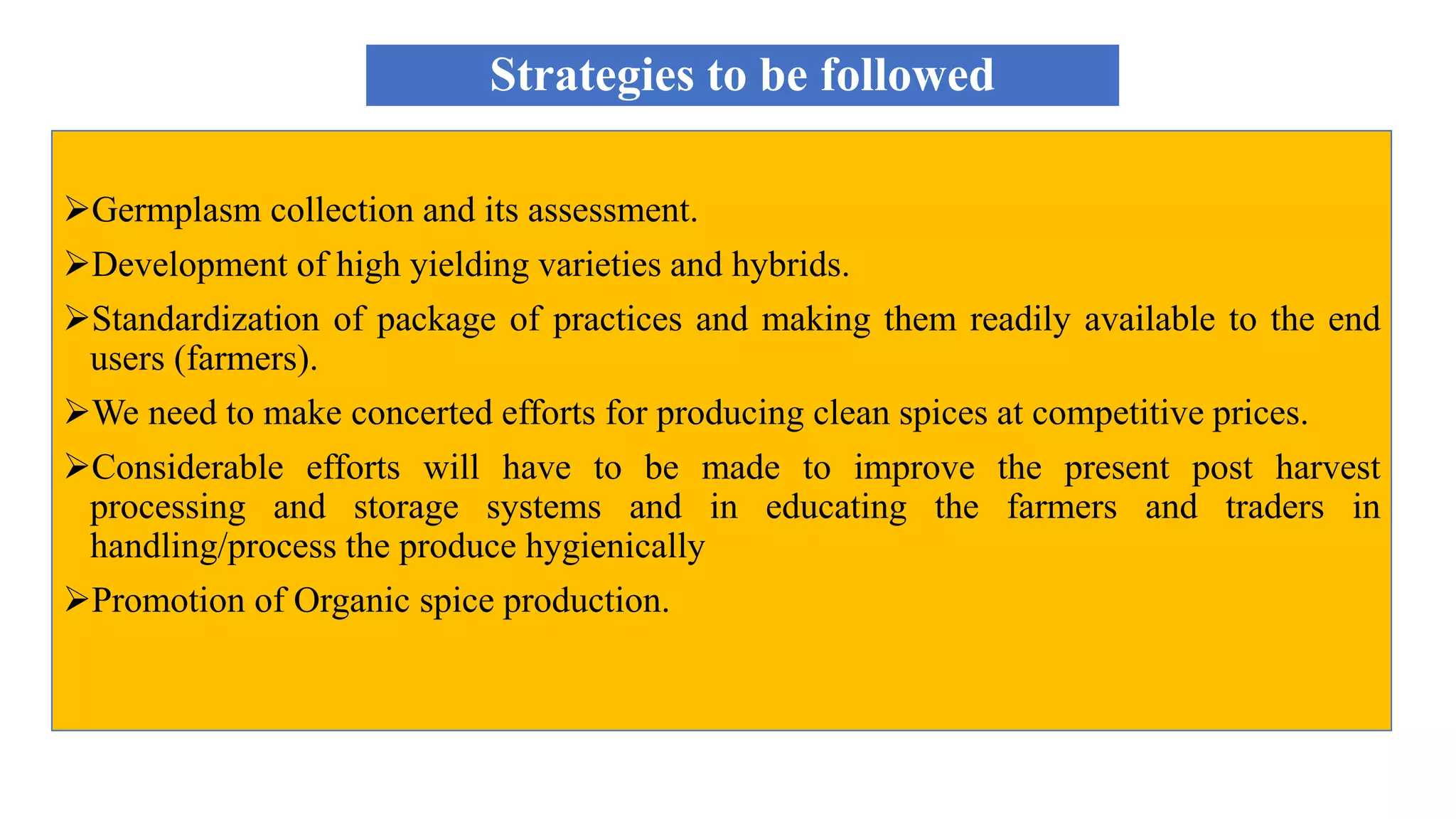
Strategies to be followed
Germplasm collection and its assessment.
Development of high yielding varieties and hybrids.
Standardization of package of practices and making them readily available to the end
users (farmers).
We need to make concerted efforts for producing clean spices at competitive prices.
Considerable efforts will have to be made to improve the present post harvest
processing and storage systems and in educating the farmers and traders in
handling/process the produce hygienically
Promotion of Organic spice production.
SOME IMPORTANT SPICE CROPS
SPICE BOTANICAL NAME Chromosome No. FAMILY
Black pepper Piper nigrum L. 2n=52 Piperaceae
Small Cardamom Elettaria cardamomum 2n=48 Zingiberaceae
Large Cardamom Amomum subulatum 2n=24 Zingiberaceae
Ginger Zingiber officinale 2n=22 Zingiberaceae
Turmeric Curcuma longa 2n=63 Zingiberaceae
Cinnamon Cinnamomum verum 2n=24 Lauraceae
Nutmeg Myristica fragrans 2n=38 Myristicaceae
Coriander Coriandrum sativum L. 2n=22 Apiaceae
Cumin Cuminum cyminum 2n=14 Apiaceae
Fennel Foeniculumvulgare 2n=22 Apiaceae
Fenugreek Trigonella foenum graecum L.. 2n=16 Fabaceae
Chilli Capsicum annum L.) 2n=24 Solanaceae
Clove Syzigium aromaticum L. 2n=22 Myrtaceae
Saffron Crocus sativus L. 2n=24 Iridaceae
Garlic Allium sativum 2n=16 Alliacea
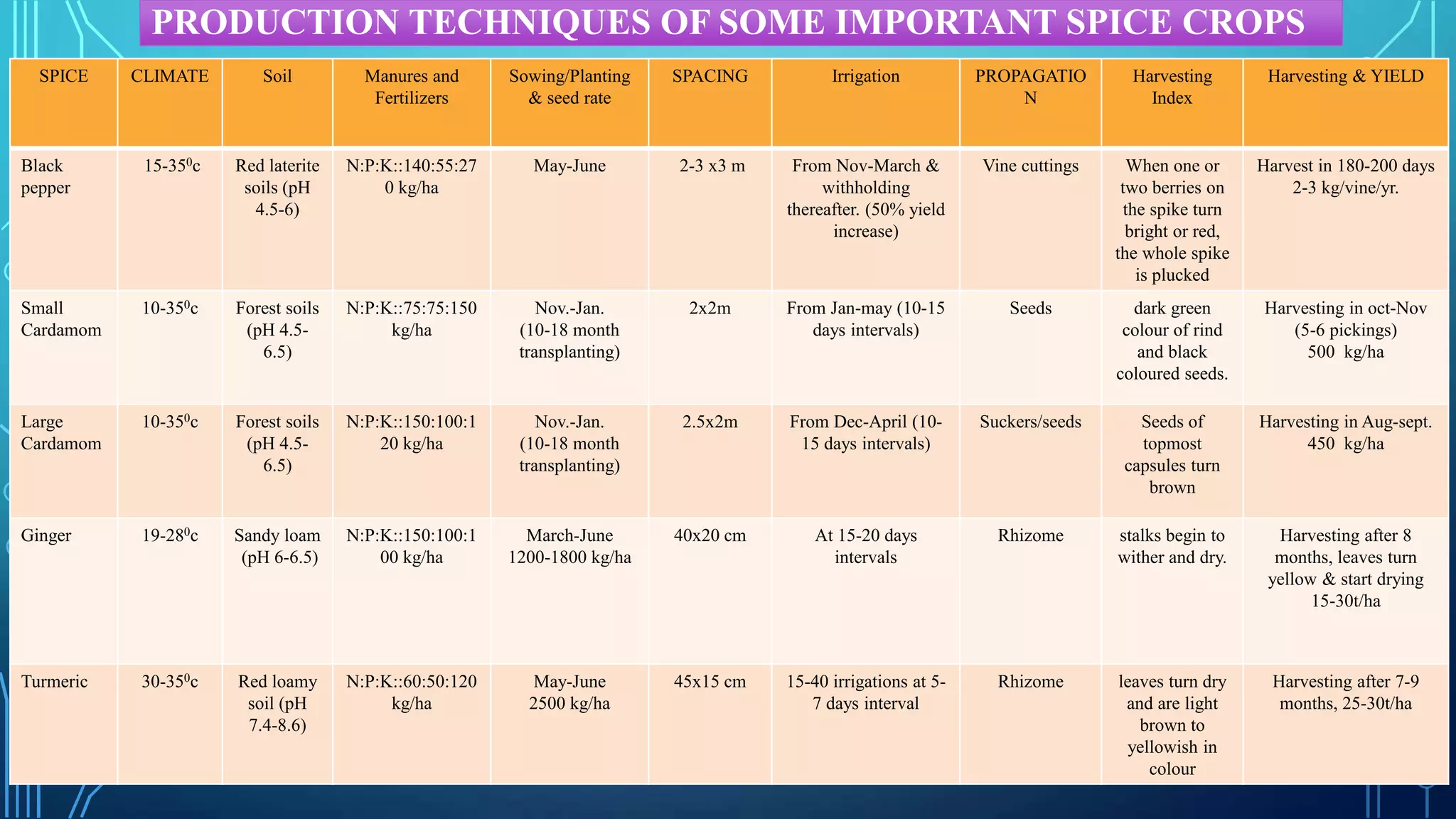
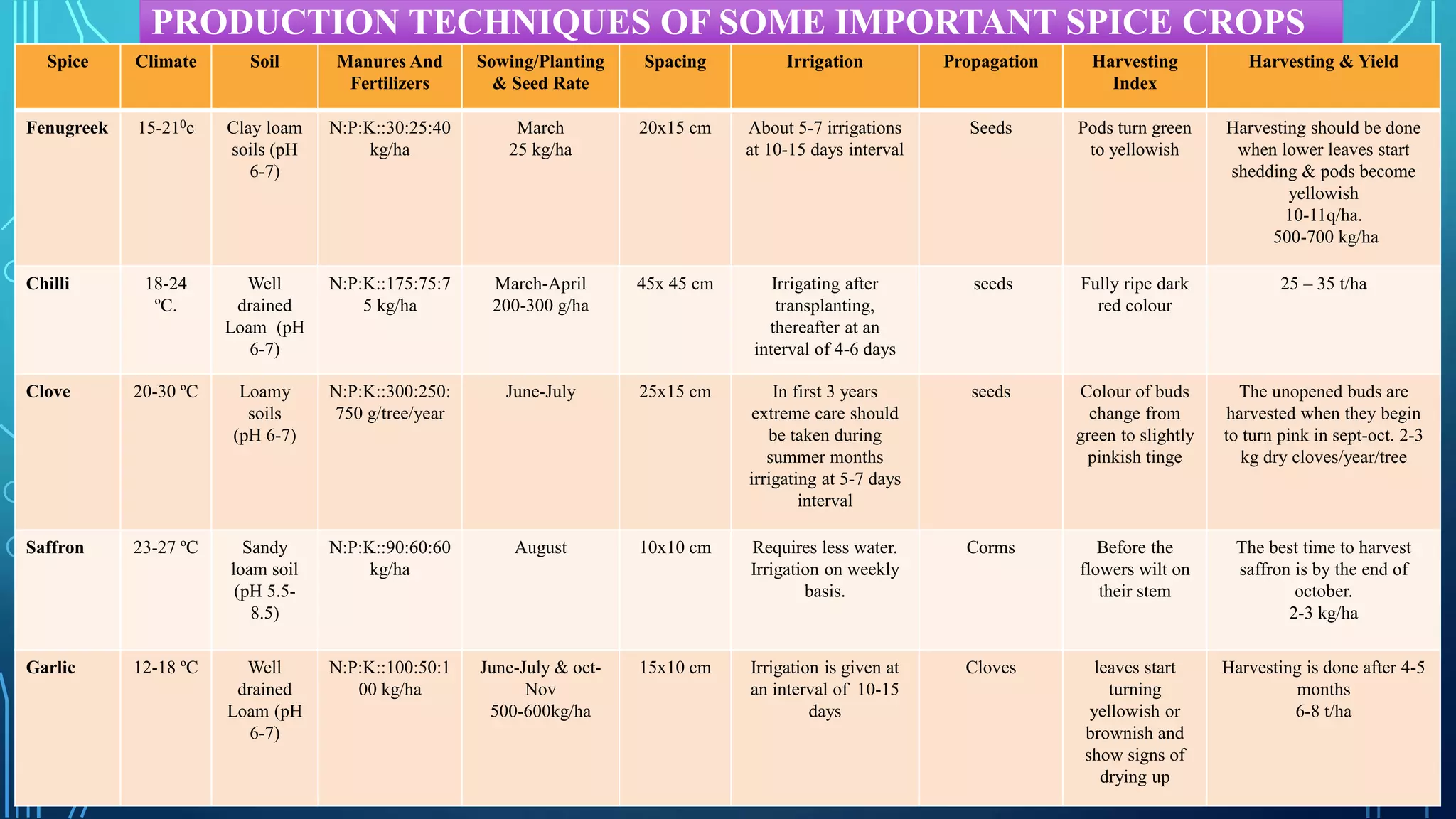
PRODUCTION TECHNIQUES OF SOME IMPORTANT SPICE CROPS
SPICE CLIMATE Soil Manures and
Fertilizers
Sowing/Planting
& seed rate
SPACING Irrigation PROPAGATIO
N
Harvesting
Index
Harvesting & YIELD
Black
pepper
15-350c Red laterite
soils (pH
4.5-6)
N:P:K::140:55:27
0 kg/ha
May-June 2-3 x3 m From Nov-March &
withholding
thereafter. (50% yield
increase)
Vine cuttings When one or
two berries on
the spike turn
bright or red,
the whole spike
is plucked
Harvest in 180-200 days
2-3 kg/vine/yr.
Small
Cardamom
10-350c Forest soils
(pH 4.5-
6.5)
N:P:K::75:75:150
kg/ha
Nov.-Jan.
(10-18 month
transplanting)
2x2m From Jan-may (10-15
days intervals)
Seeds dark green
colour of rind
and black
coloured seeds.
Harvesting in oct-Nov
(5-6 pickings)
500 kg/ha
Large
Cardamom
10-350c Forest soils
(pH 4.5-
6.5)
N:P:K::150:100:1
20 kg/ha
Nov.-Jan.
(10-18 month
transplanting)
2.5x2m From Dec-April (10-
15 days intervals)
Suckers/seeds Seeds of
topmost
capsules turn
brown
Harvesting in Aug-sept.
450 kg/ha
Ginger 19-280c Sandy loam
(pH 6-6.5)
N:P:K::150:100:1
00 kg/ha
March-June
1200-1800 kg/ha
40x20 cm At 15-20 days
intervals
Rhizome stalks begin to
wither and dry.
Harvesting after 8
months, leaves turn
yellow & start drying
15-30t/ha
Turmeric 30-350c Red loamy
soil (pH
7.4-8.6)
N:P:K::60:50:120
kg/ha
May-June
2500 kg/ha
45x15 cm 15-40 irrigations at 5-
7 days interval
Rhizome leaves turn dry
and are light
brown to
yellowish in
colour
Harvesting after 7-9
months, 25-30t/ha
PRODUCTION TECHNIQUES OF SOME IMPORTANT SPICE CROPS
Spice Climate Soil Manures and
Fertilizers
Sowing/Planting
& seed rate
Spacing Irrigation Propagation Harvesting
Index
Harvesting & YIELD
Cinnamon 27 0c Sandy loam
(pH 6-6.5)
N:P:K::20:18:25
g/plant
June-July 3x3m Twice a week during
summer months
cuttings A test cut is
given with a
sharp knife on
stem, if the bark
separates
readily the
cutting can be
commenced
Harvesting from sept-Nov.
shoots having finger
thickness & uniform brown
colour are ideal for bark
extraction
200-300 kg/ha
Nutmeg 28-30 0c Deep
Sandy
loam
(pH 5.5-
7.5)
N:P:K::20:18:
50 g/plant
June-Dec. 8x8 m At 15-20 days
intervals
Cutting,
grafting
Fleshy rind of
the nut splits
open
Fruits are harvested 9
months after flowering
2000-3000 fruits/tree/yr
Coriander 15-20 0c Heavy soils
(pH 6.5-
7.5)
N:P:K::60:40:40
kg/ha
Oct.-Nov.
25-30kg/ha
30x10 cm 4-5 irrigations at 10-
15 days interval
seeds Central umbels
are about to
attain yellow
colour
Leaf plucking 75 DAS
12-25q/ha
Cumin 25-30 0c Loamy
soils
(pH 4.5-
8.3)
N:P::30:20
Kg/ha
Nov-Dec
12-15 kg/ha
20x30cm Light irrigation at
15-25 days interval.
Last heavy irrigation
at seed formation
seeds Stems become
yellow & leaves
fall
Harvesting is done by
cutting the plants with sickle
and then threshed after
drying
5-6 q/ha
Fennel 21-24 0c Black
cotton &
loamy soils
(pH 5.5-
6.8)
N:P::25:10
Kg/ha
May-june (hills)
Oct-Nov. (plains)
10-12 kg/ha
45x20 cm Irrigation at 15-25
days interval
seeds fruits
turn to yellow
colour cut the
stems along
with
umbel.
Harvested in 170-180 days.
(2-3 plucking at 10 days
interval)
9-10q/ha
PRODUCTION TECHNIQUES OF SOME IMPORTANT SPICE CROPS
Spice Climate Soil Manures And
Fertilizers
Sowing/Planting
& Seed Rate
Spacing Irrigation Propagation Harvesting
Index
Harvesting & Yield
Fenugreek 15-210c Clay loam
soils (pH
6-7)
N:P:K::30:25:40
kg/ha
March
25 kg/ha
20x15 cm About 5-7 irrigations
at 10-15 days interval
Seeds Pods turn green
to yellowish
Harvesting should be done
when lower leaves start
shedding & pods become
yellowish
10-11q/ha.
500-700 kg/ha
Chilli 18-24
ºC.
Well
drained
Loam (pH
6-7)
N:P:K::175:75:7
5 kg/ha
March-April
200-300 g/ha
45x 45 cm Irrigating after
transplanting,
thereafter at an
interval of 4-6 days
seeds Fully ripe dark
red colour
25 – 35 t/ha
Clove 20-30 ºC Loamy
soils
(pH 6-7)
N:P:K::300:250:
750 g/tree/year
June-July 25x15 cm In first 3 years
extreme care should
be taken during
summer months
irrigating at 5-7 days
interval
seeds Colour of buds
change from
green to slightly
pinkish tinge
The unopened buds are
harvested when they begin
to turn pink in sept-oct. 2-3
kg dry cloves/year/tree
Saffron 23-27 ºC Sandy
loam soil
(pH 5.5-
8.5)
N:P:K::90:60:60
kg/ha
August 10x10 cm Requires less water.
Irrigation on weekly
basis.
Corms Before the
flowers wilt on
their stem
The best time to harvest
saffron is by the end of
october.
2-3 kg/ha
Garlic 12-18 ºC Well
drained
Loam (pH
6-7)
N:P:K::100:50:1
00 kg/ha
June-July & oct-
Nov
500-600kg/ha
15x10 cm Irrigation is given at
an interval of 10-15
days
Cloves leaves start
turning
yellowish or
brownish and
show signs of
drying up
Harvesting is done after 4-5
months
6-8 t/ha
TRENCH METHOD IN BLACK
PEPPER PROPOGATION In this method, a trench of
45 cm depth, 30 cm width
and of convenient length is
made and filled with
rooting medium.
Split halves of bamboo or split
halves of PVC pipes are fixed at
45° angle by keeping split
portion facing upward
Rooted cuttings are planted in the
trench at the rate of one cutting for
each bamboo split. The growing
vine is tied to the bamboo in such
a way as to keep the nodes
pressed in the rooting medium.
After 3-4 months the terminal bud
is nipped off & the vine is crushed
at about 3 nodes above the base
to activate axillary buds
After ten days each vine is cut
at the crushed point and
removed from the rooting
medium and each node is
separated. Such cuttings with
the bunch of roots intact are
planted in polythene bags filled
with fumigated potting mixture.
The buds start developing in
about three weeks and then the
poly bags can then be removed
and kept in shade till main field
planting. The advantages of this
method of propagation are;
1. rapid multiplication rate (1:40)
2. well developed root system
3. higher field establishment and
4. vigorous growth as a result of
better root system
SERPENTINE METHOD
IN BLACK PEPPER PROPOGATION Three noded cuttings are
planted in polythene bags.
The method requires
grown up rooted cuttings
in 20 x 10 cm poly bags.
When the plant develops two
leaves they are trailed
horizontally in polythene
bags containing potting
mixture.
Each node will be pressed
into the mixture in polythene
bags with `V' shaped
midribs of coconut leaves.
As new shoots arise these
will be trailed horizontally
in polythene bags containing
potting mixture
Once twenty nodes get rooted
first 10 bags in the rooted nodes
will be separated by cutting at
the inter nodes..
After three months it will be ready
for planting in the main field. On an
average 60 cuttings will be obtained
in a year by this method from each
mother cutting. Recommended in
black pepper nurseries for large
scale multiplication.
 The B:C ratio for
marketable black pepper
propagule by soil mound
method was the best
(2.13:1)
Explicating proper multiplication method for black pepper propagation
GROWTH PERFORMANCE OF BLACK PEPPER VINES
UNDER DIFFERENT MULTIPLICATION METHODS
Treatment Length of
vine (m)
Node/vine
(no)
Roots/node(no) Branches/vine
(no)
Bamboo split
method
1.65 13.50 4.12 1.00
Soil Mound
Method
2.10 17.60 4.56 2.30
Serpentine
Method
1.24 9.40 2.90 1.05
Conventional
Method
_ _ _ _
Bhuyan and Sarkar, 2015
Single Bud Rhizome Technique of Turmeric for Seedlings
Production in Protrays
Advantages:
1.Reduction in the requirement of
seed rhizome quantity by 25 per
cent.
2.Reduction in the cost of planting
material.
3.Saving land usage 1-2 months
from normal duration period of the
crop.
5.Overcoming the disease
incidence by screening for disease
infected materials.
Malhotra et al.,2013
Growing Phase Direct Planting
Method (whole seed)
Transplanting
Method (Single bud
rhizome)
1 Month after planting 2-3 leaves per plant 6-7 leaves per plant
Tillering Stage 3 MAP 1.5-2 MAP
Rhizome Development
Phase
Starts from 5 MAP Starts from 3 MAP
Rhizome Maturation
Phase
7-9 MAP 6-7 MAP
In vitro mini-rhizome production in turmeric (Curcuma longa L.) cultivar Alleppey Supreme.
Yield was nearly three times higher in mini-rhizome seed
material (526.67) compared to the conventional rhizome.
Archana et al.,2014
Material % of
germination
No. of shoots Length of shoots Weight/clump (g)
Conventional
rhizomes
100% 2.4 38.62 183
Minirhizomes 89% 1.0 47.00 526
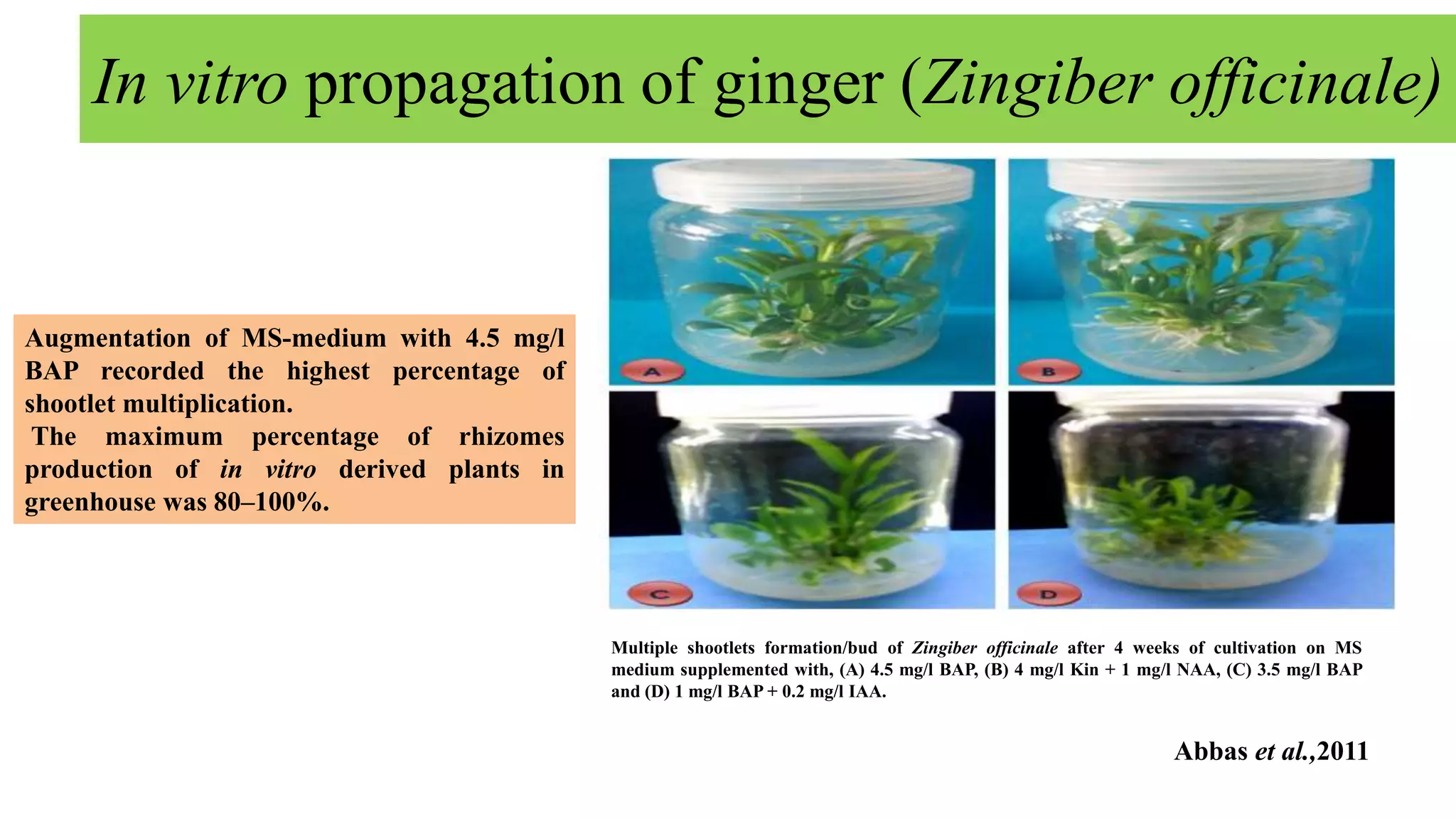
In vitro propagation of ginger (Zingiber officinale)
Augmentation of MS-medium with 4.5 mg/l
BAP recorded the highest percentage of
shootlet multiplication.
The maximum percentage of rhizomes
production of in vitro derived plants in
greenhouse was 80–100%.
Multiple shootlets formation/bud of Zingiber officinale after 4 weeks of cultivation on MS
medium supplemented with, (A) 4.5 mg/l BAP, (B) 4 mg/l Kin + 1 mg/l NAA, (C) 3.5 mg/l BAP
and (D) 1 mg/l BAP + 0.2 mg/l IAA.
Abbas et al.,2011
Effect of drip irrigation and mulch on Chilli
Treatments Yield improvement
Drip irrigation 28%
Polythene mulch 13%
Drip irrigation + mulch (polythene mulch) 57%
Paul et al., 2013
Technologies developed by IISR
• A novel method of storing and delivering PGPR/Microbes through
bio-capsules.
• Micronutrient mix for spice crops (Ginger, Turmeric, Black Pepper,
Cardamom)
• Seed coating technology for seed spices
Enhancing
germplasm
collection,
evaluation
and
conservation.
Population
Improvement
Mutations
Heterosis
Breeding
Breeding for
Disease
Resistance
Improvement
of Quality
Germplasm Collection
Crop Quantity
Black pepper
468 accessions including 398 wild and 70 cultivated types were collected The germplasm
conservatory consists of 1075 wild, 1282 cultivar accessions and 9 exotic species, besides 1375
hybrids
Cardamom 416
Clove 223
Cinnamon 408
Turmeric 899
Vanilla 79
Ginger 700
Nutmeg 482
Paprika 130 ( 96 indigenous & 34 exotic)
Allspice 180
IISR
Genetic Enhancement
Crop Genetic resources with important traits
Coriander Wilt resistant ( ACr -01-250), stem gall resistant ( ACr -01-256), dual Purpose
(leaf and seed) (Acr-01-256)
Cumin Wilt resistance (AC-01-3, AC-01- 167), drought tolerance (AC-01-3), high oil
content (AC-01-167)
Fennel Ramularia blight (Sel 01-87), high oil content ( Sel 01-119), early season (Sel
01-119),
Fenugreek Downy mildew (AM-01-10), root rot (AM-01-10), early & large podded (AM-
01-35), dual Purpose (leaf and seed) (AM-01-35)
Ajowan Powdery mildew (AA-01-19, AA01-61), high oil content (AA-01-19), drought
tolerance (AA-01-19, AA01-61), early and bold seeded (AA01-61)
Dill Powdery mildew resistant (AD-01- 32), high oil content (AD-01- 32), drought
tolerance (AD-01- 6)
Nigella High essential oil (AN-01-1)
NRCSS Ajmer
Varieties released in Black Pepper
Variety Pedigree/Parent Av. Yield
(kg/ha)
Essential oils (%) Salient feature
Panniyur 2 Selection from
Balankotta
2570 3.4 Shade tolerant, rich in oleoresin and piperine
Panniyur 6 Clonal selection from
Karimunda
2127 1.33 Steady and stable yielder tolerant to drought and adverse climatic
conditions. Suitable for open condition as well as partial shade
Sreekara Clonal selection from
Karimunda
2677 7 Suitable for all pepper growing regions.
Panchami Clonal selection from
Aimpiriyan
2828 3.4 Late maturing variety with excellent fruit set.
Pournami Clonal selection from
Ottaplackal
2333 3.4 High yielding variety, tolerant to root knot nematode.
IISR
Thevam
Clonal selection of
Thevamundi,
2481 3.1 Vines grow vigorously,stable yielding field tolerant to Phytophthora
IISR Sakthi Open pollinated progeny
of Perambramundi.
2253 3.7 Tolerant to Phytophthora capsici
Subhakara Clonal selection from
Karimunda
2352 6 High quality line (12.4% oleoresin), with wider adaptability to all pepper
growing regions.
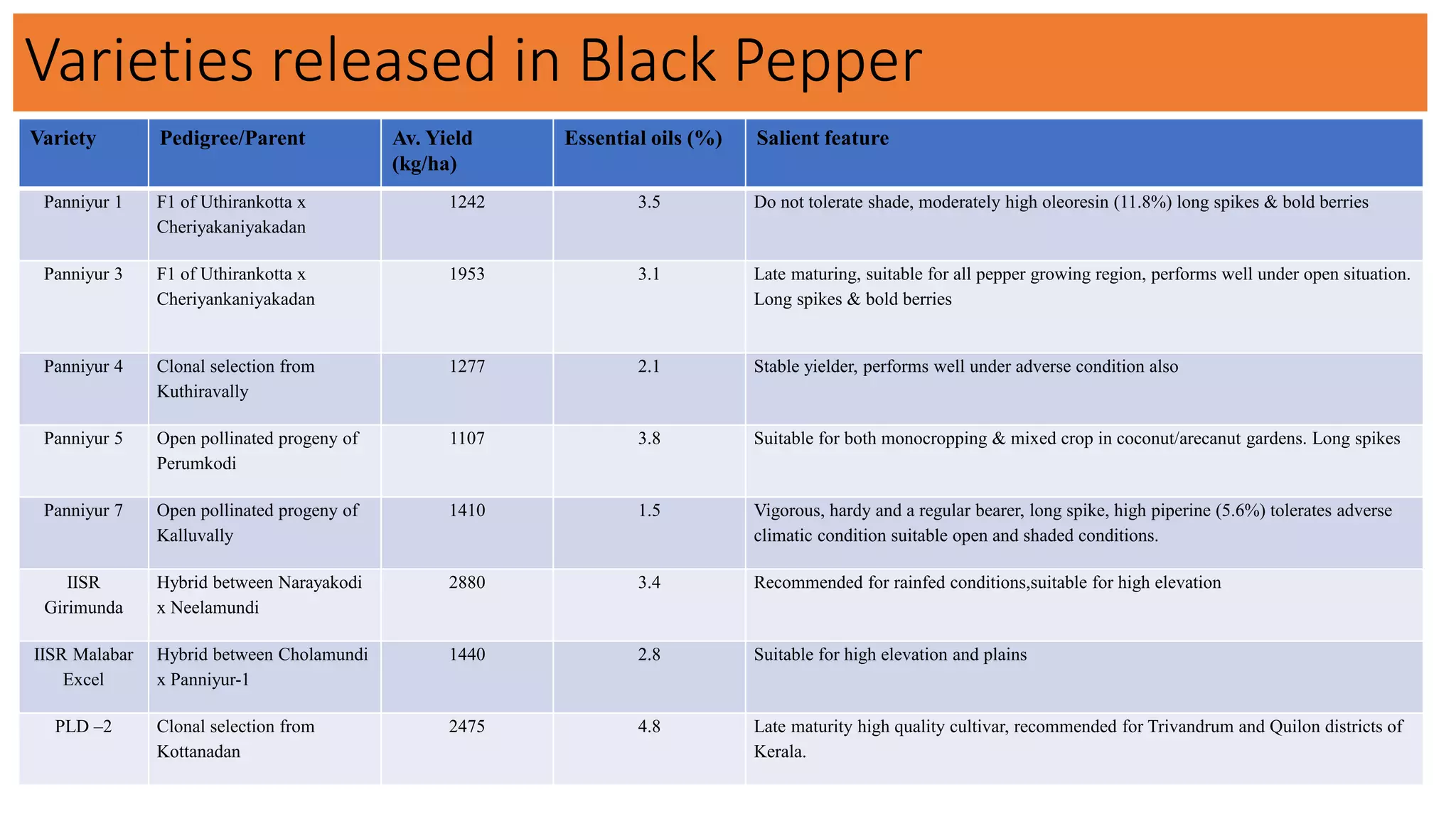
Varieties released in Black Pepper
Variety Pedigree/Parent Av. Yield
(kg/ha)
Essential oils (%) Salient feature
Panniyur 1 F1 of Uthirankotta x
Cheriyakaniyakadan
1242 3.5 Do not tolerate shade, moderately high oleoresin (11.8%) long spikes & bold berries
Panniyur 3 F1 of Uthirankotta x
Cheriyankaniyakadan
1953 3.1 Late maturing, suitable for all pepper growing region, performs well under open situation.
Long spikes & bold berries
Panniyur 4 Clonal selection from
Kuthiravally
1277 2.1 Stable yielder, performs well under adverse condition also
Panniyur 5 Open pollinated progeny of
Perumkodi
1107 3.8 Suitable for both monocropping & mixed crop in coconut/arecanut gardens. Long spikes
Panniyur 7 Open pollinated progeny of
Kalluvally
1410 1.5 Vigorous, hardy and a regular bearer, long spike, high piperine (5.6%) tolerates adverse
climatic condition suitable open and shaded conditions.
IISR
Girimunda
Hybrid between Narayakodi
x Neelamundi
2880 3.4 Recommended for rainfed conditions,suitable for high elevation
IISR Malabar
Excel
Hybrid between Cholamundi
x Panniyur-1
1440 2.8 Suitable for high elevation and plains
PLD –2 Clonal selection from
Kottanadan
2475 4.8 Late maturity high quality cultivar, recommended for Trivandrum and Quilon districts of
Kerala.
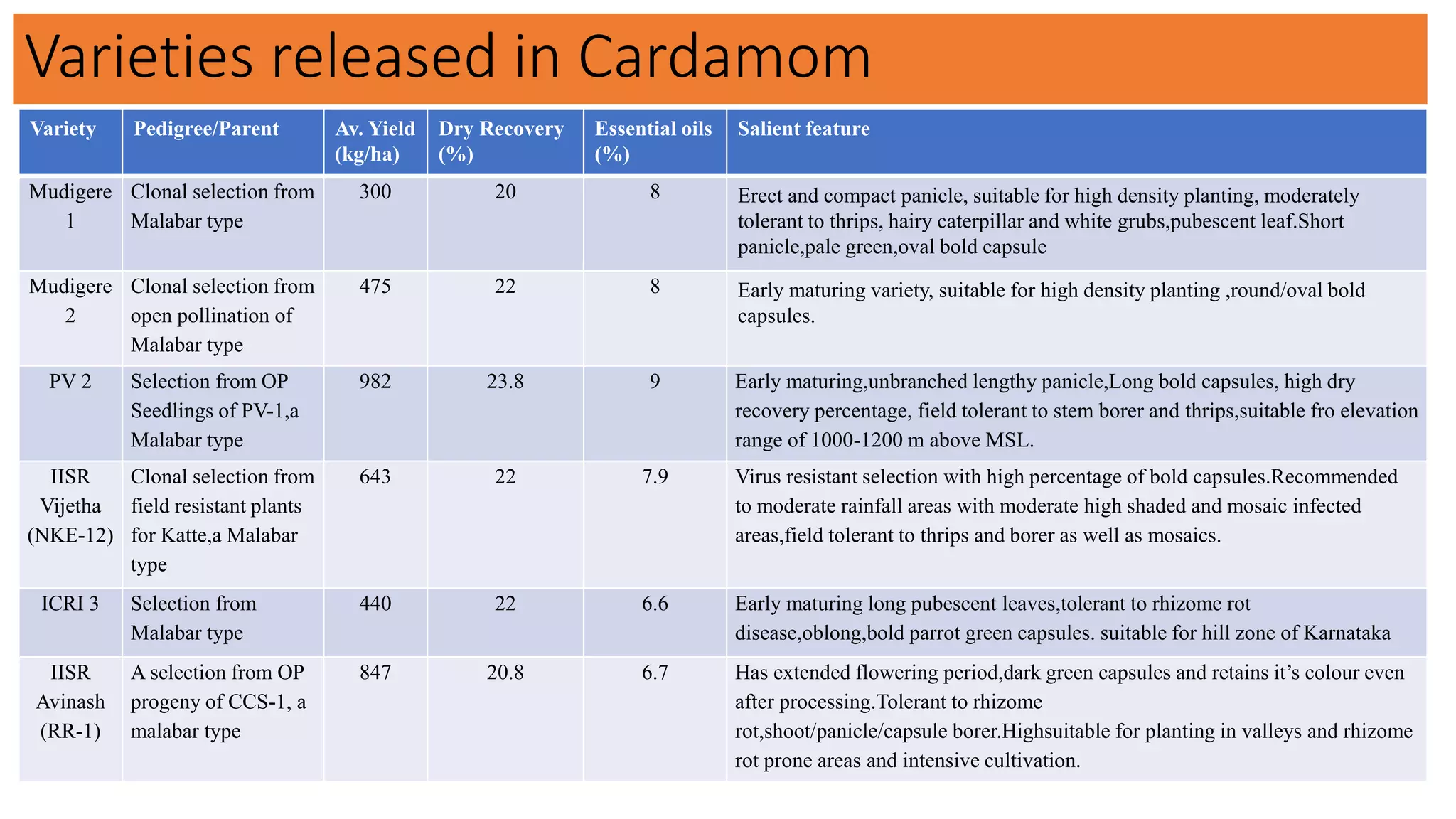
Varieties released in Cardamom
Variety Pedigree/Parent Av. Yield
(kg/ha)
Dry Recovery
(%)
Essential oils
(%)
Salient feature
Mudigere
1
Clonal selection from
Malabar type
300 20 8 Erect and compact panicle, suitable for high density planting, moderately
tolerant to thrips, hairy caterpillar and white grubs,pubescent leaf.Short
panicle,pale green,oval bold capsule
Mudigere
2
Clonal selection from
open pollination of
Malabar type
475 22 8 Early maturing variety, suitable for high density planting ,round/oval bold
capsules.
PV 2 Selection from OP
Seedlings of PV-1,a
Malabar type
982 23.8 9 Early maturing,unbranched lengthy panicle,Long bold capsules, high dry
recovery percentage, field tolerant to stem borer and thrips,suitable fro elevation
range of 1000-1200 m above MSL.
IISR
Vijetha
(NKE-12)
Clonal selection from
field resistant plants
for Katte,a Malabar
type
643 22 7.9 Virus resistant selection with high percentage of bold capsules.Recommended
to moderate rainfall areas with moderate high shaded and mosaic infected
areas,field tolerant to thrips and borer as well as mosaics.
ICRI 3 Selection from
Malabar type
440 22 6.6 Early maturing long pubescent leaves,tolerant to rhizome rot
disease,oblong,bold parrot green capsules. suitable for hill zone of Karnataka
IISR
Avinash
(RR-1)
A selection from OP
progeny of CCS-1, a
malabar type
847 20.8 6.7 Has extended flowering period,dark green capsules and retains it’s colour even
after processing.Tolerant to rhizome
rot,shoot/panicle/capsule borer.Highsuitable for planting in valleys and rhizome
rot prone areas and intensive cultivation.
Varieties released in Cardamom
Variety Pedigree/Parent Av. Yield
(kg/ha)
Essential oils
(%)
Salient feature
PV 1 A selection from Walayar
collection ,Malabar type
260 6.8 An early maturing type,short panicle,elongated slightly ribbed light green capsules,Long, bold capsule
ICRI 1 Selection from
Chakkupalam collection, a
Malabar type
325 8.7 An early maturing type globose,round and extra bold dark green capsules ; medium sized panicle with
profusely flowering , early maturing type, round and bold capsule.
ICRI 2 Clonal selection from
germplasm
collection,Mysore type
375 Performs well under high altitude and irrigated condition,medium long panicles,oblong bold and parrot
green capsules, tolerant to azhukal disease
ICRI
4 TDK4
Clonal selection from
Vadagaraparai area of lower
pulleys,a Malabar type
455 6.4 Early maturity,medium sized panicles,Globose bold capsules.Suitable for low rainfall areas, relatively
tolerant to rhizome rot and capsule borer
IISR Kodagu
Suvasini
(CCS-1)
Selection from OP progeny
of CL-37 from RRS
Mudigere,Malabar type
745 8.7 Early maturing,suitable for high density planting,long panicle.tolerant to rhizome
rot,thrips,shoot/panicle/capsule borer.
Varieties released in Ginger
Variety Pedigree/Parent Av.
Yield
(ton/ha)
Essential
oils (%)
Salient feature
Suprabha Clonal selection from
Kunduli local
16.6 1.9 Plumpy rhizome, less fibre,wide adaptability,suitable for both early and late sowing.
Himgiri Clonal selection from
Himachal collection
13.5 6.05 Best for green ginger less susceptible to rhizome rot disease, suitable for rainfed
condition.
IISR Varada Selection from germplasm 22.66 1.7 High yielder,high quality bold rhizome,low fibre content.Wide adaptability and tolerant to
diseases.
IISR
Mahima
Selection from germplasm 23.2 1.72 High yielder,plumpy extra bold rhizomes, resistant to M. incognita and M.
javanicapathotype 1
Suravi Induced mutant of
Rudrapur local
17.5 2.1 Plumpy rhizome, dark skinned yellow fleshed,suitable for both irrigated and rainfed
conditions.
Suruchi Clonal selection from
Kunduli local
11.6 2 Profuse tillering,bold rhizome, early maturing, suitable for both rainfed and irrigated
condition.
IISR
Rejatha
Selection from germplasm 22.4 High yielder,plumpy and bold rhizome
Varieties released in Turmeric
Variety Pedigree/Parent Av. Yield
(ton/ha)
Essential
oils (%)
Salient feature
CO.1 Vegetative mutant by x-ray
irradiation of Erode local
30.5 3.7 Bold and orange yellow rhizomes, suitable for drought prone areas, water logged, hilly areas
saline and alkaline areas
BSR.1 Clonal selection from Erode local
irradiated with x rays
30.7 3.7 Bright yellow rhizome suitable for problem soils and drought prone areas of Tamil Nadu.
BSR.2 Induced mutant from Erode local 32.7 A high yielding short duration variety with bigger rhizomes, resistant to scale insects
Ranga Clonal selection from Rajpuri
local
29.0 4.4 Bold and spindle shaped mother rhizome, suitable for late sown condition and low lying
areas. Moderately resistant to leaf blotch and scales
Megha
turmeric 1
Selection form Lakadong type 23.0 High curcumin content and bold rhizomes,suitable for North east hilla and North west Bengal.
Suranjana
(TCP-2)
Clonal selection from local types
of west Bengal suitable for open
and shaded condition
29.0 4.1 Tolerant to rhizome rot and leaf blotch; resistant to rhizome scales and moderately resistant to
shoot borer
Pant Peetabh Clonal selection from local type 29.0 1 Resistant to rhizome rot
Varieties released in Turmeric
Variety Pedigree/Parent Av. Yield
(ton/ha)
Essential
oils (%)
Salient feature
Krishna Clonal selection from Tekurpeta
collection
9.2 3.8 Plumpy rhizomes, moderately resistant to pests and diseases
Sugandham Clonal selection from germplasm 15.0 2.7 Thick, round rhizomes with short internodes. Moderately tolerant to pest and diseases
Roma Clonal selection from T.Sunder 20.7 4.2 Suitable for both rainfed and irrigated condition. Ideal for hilly areas and late sown season.
Suroma Clonal selection from T. Sunder
by x- rayirradiation
20.0 4.4 Round and plumpy rhizome, field tolerance to leaf blotch, leaf spot and rhizome scales.
Rasmi Clonal selection from Rajpuri
local
32.0 4.4 Bold rhizomes, suitable for both rainfed and irrigated condition, early and late sown season
Rajendra
Sonia
Selection from local germplasm 42.0 5 Bold and plumpy rhizome
Megha
turmeric 1
Selection form Lakadong type 23.0 High curcumin content and bold rhizomes,suitable for North east hilla and North west Bengal.
Suvarna Selection from
germplasm,collected from Assam
17.4 7 Bright orange coloured rhizome with slender fingers,field tolerant to pest and diseases.
Varna Clonal selection from local
germplasm
21.89 4.56 Bright orange yellow rhizome,medium bold with closer internodes,territory fingers
present.suited to central zone of Kerala. Field tolerant to leaf blotch
Varieties released in Turmeric
Variety Pedigree/Parent Av. Yield
(ton/ha)
Essential
oils (%)
Salient feature
Suvarna Selection from germplasm,collected
from Assam
17.4 7 Bright orange coloured rhizome with slender fingers,field tolerant to pest and diseases.
Suguna Selection from germplasm, collected
from AP
29.3 6 Early maturing, field tolerant to rhizome rot.
Sudarsana Selection from germplasm, collected
from Singhat, Manipur
28.8 7 Early maturing, field tolerant to rhizome rot.
IISR Prabha Open pollinated progeny selection 37.0 6.5 High yielding varitey
IISR
Prathibha
Open pollinated progeny selection 39.1 6.2 High yielding varitey
IISR Kedaram Clonal selection from germplasm 34.5 - Resistant to leaf blotch.
IISR Alleppey
Supreme
Selection from Alleppey Finger turmeric 35.4 - Tolerant to leaf blotch.
Kanthi Clonal selection from Mydukur variety
of Andhra Pradesh
37.65 5.15 Erect leaf with broad lamina, big mother rhizomes with medium bold fingers and closer
internodes
Sobha Clonal selection from local type 35.88 4.24 High Yielding Varitey with high curcumin content (7.39%), Erect leaves with narrow
lamina. Mother rhizome big with medium bold figures and closer internodes. Inner core of
rhizomes is dark orange like Alleppey. More territory rhizomes.
Varieties released in Cinnamon
Variety Pedigree/Parent Av. Yield
(kg/ha)
Salient feature
PPI (C) -1 Selection from OP
seedlings progeny
introduced from Sri
Lanka
980 Suitable for cultivation in high rainfall zones and hill regions of tamil Nadu at an altitude range
of 100-500 m MSL.
Sugandhini(O
DC-130)
Single tree selection
from Wayanadu local
collection.A Sri Lankan
type
640 Recommended for cultivation for leaf oil production,cinnamaldehyde in bark oil 45%, eugenol in
leaf oil 93.7%;released mainly for leaf oil purpose.densly foliage.
IISR
Navashree
Selection from Op
seedling progeny of Sri
Lankan collection
200 High quality line,good bark recovery with good aroma and taste,grow well in plains and high
elevations.High cinnamaldehyde content (73%) in bark oil,medium quality High shoot
regeneration.Bark oleoresin 8%, cinnamaldehyde in leaf oil 15%,eugenol in bark oil 6%,eugenol
in leaf oil 62%.
IISR
Nithyashree
Clonal selection from OP
seedling progeny
200 Good regeneration capacity,bark and leaf oleoresin contents are high.Good bark recovery with
good aroma and taste.Bark oleoresin-10.0%.
Varieties released in Cinnamon
Variety Pedigree/Parent Av. Yield
(kg/ha)
Salient feature
YCD.1 Clonal selection from op
seedings progenies of Sri
Lankan type
360 Good bark recovery adopted to wide range of soil and rainfed conditions.Recommended for high ranges at 500-
1000m above MSL.
PPI (C) -1 Selection from OP seedlings
progeny introduced from Sri
Lanka
980 Suitable for cultivation in high rainfall zones and hill regions of tamil Nadu at an altitude range of 100-500 m
MSL.
RRL(B) C-6 Selection from germplasm
collection-OP seedling
progenies
250 High quality,sweet and pungent bark with 83% cinnaldehyde content in bark oil,94.0% eugenol in leaf oil,leaf oil
0.8% .Spreading,branching,nature.
Konkan Tej Seedling selection from
progenies of Sri Lankan
accessions
334 Superior qualities with 3.2% bark oil with bark recovery 29.16%,cinnamaldehyde in bark oil
70.23,eugenol in bark oil 6.93%,eugenol in leaf oil 75.5%,yields 4.10kg fresh bark.
Varieties released in Nutmeg
Variety Pedigree/Parent Av. Yield
(kg/ha)
Salient feature
Konkan
Sugandha
Single plant selection from
local seedling population
200- 526
fruits/ tree
Adaptable in Konkan region. Tree canopy is conical and compact. No incidence of major pests / disease
Konkan Swad Selection from nutmeg
seedling from Ratnagiri
district
761.38
fruits/tree
Adapted in Konkan region with warm,humid condition as well as shade provision.canopy erect,conical
shape.contain 39.85 essential oil in seed and 10.9 % in mace. No incidence of major pests / disease are noticed
IISR Viswasree Clonal selection from elite
germplasm
1000
fruits/tree
Bushy and compact canopy, low incidence of fruit rot. Nut recovery 70%,mace recovery 35%,oil, 7.14% mace oil
,oleoresin 2.48% and mace 13.85 respectively,butter 30.9%,myristicin 12.48% and mace 20.03% respectively.
Especially suitable under mixed cropping system
Varieties released in Coriander
Variety Pedigree/Parent Av. Yield
(kg/ha)
Essential
oils (%)
Salient feature
Shalimar
Dhania -1
Selection 740 The variety is high yielding, exhibits early to medium maturity, superior nutritional,
cooking, garnish, aroma qualities and suitable for growing under temperate conditions of
Kashmir.
Guj. Cor.1 Selection from
germplasm
1100 0.35 Suitable for early sowing, erect plant, round bold grains, moderately tolerant to wilt and
powdery mildew
Guj.Cor.2 Reselection from Co.2 1450 0.40 Semi spreading type, suitable for early sowing, moderately tolerant to powdery mildew,
grains oblong, lodging and shattering resistant.
Rajendra
Swathi
Pureline selection from
Muzaffarpur collection
1300 0.65 Medium sized plant with fine, aromatic round grains, Suitable for intercropping, field
tolerance to aphids
CIMPOS-33 Selection from
germplasm introduced
from Bulgaria
2100 1.3 Tall erect, compact, profusely branching and flowering, grains small and bold. Mainly
recommended for oil production
Hisar
Surabhi
Mass selection from
local germplasm
1800 0.4-0.5 Bushy erect plant type, seed medium, oblong; tolerant to frost, less susceptible to aphids,
medium duration
Azad Dhania-
1
Mass selection from
Kalyanpur germplasm
collection
1000 0.29 Erect, early branching, number of umbellates per umbel 5, tolerant to moisture stress, powdery mildew and
aphids.
Varieties released in Coriander
Variety Pedigree/Parent Av. Yield
(kg/ha)
Essential
oils (%)
Salient feature
Co.1 Selection from Koilpatti
local
440 0.27 A variety with small statuted plant, suitable for rainfed areas and for greens and grains, small grain
Co.2 Reselection from culture
P2 of Gujarat
520 0.40 A dual purpose variety, suitable for saline, and alkaline and drought prone areas seeds oblong,medium.
Co.3 Reselection from Acc.695
of IARI, New Delhi type
650 0.41 A dual purpose variety, good yielder, medium sized grains, suitable for both rainfed and irrigated
condition, rabi as well as kharif season. Field tolerant to powdery mildew, wilt and grain mould.
Sadhana Mass selection from local
Alur collection
1025 0.20 A dual purpose,semi-erect variety ; Suitable for rainfed condition field tolerance to white fly, mites and
aphids. A mid-late variety withstands moisture stress, responded well to input management under optimum
moisture level.
Swathi Mass selection from
Nandyal germplasm
855 0.30 Plants medium size semi-erect type, early maturing variety, suitable for rainfed condition, and late sown
season. Field tolerant to white fly,moderately tolerant to disease. Suits well to the areas where the soil
moisture retentiveness in compariably less, being early maturity. It escapes powdery mildew disease.
CS 287 Reselection from Guntur
collection
600 - Early maturing variety, suitable for both rainfed and irrigated condition. Field tolerant to wilt and grain mould.
Sindhu Mass selection
germplasm,Warangal
local
1000 0.40 Oval medium breakable grains, suitable for rainfed areas, tolerant to wilt, powdery mildew as well as drought
condition,medium duration.
Hisar Anand Mass selection from
Haryana collection
1400 0.35 A medium tall dual purpose variety,oval medium sized seeds, wider adaptability to different soil
conditions.Resistant to lodging due to spreading habit.
Varieties released in Coriander
Variety Pedigree/Parent Av. Yield
(kg/ha)
Essential
oils (%)
Salient feature
Hisar Sugandh Mass selection from
indigenous germplasm
1400 - Suitable for irrigated conditions.Resistant to stem gall diseases.
Pant haritima Selection from local type
Pant Dhania
1200 0.4 Tall erect plant, a dual purpose type, good yielder of leaves, smaller seeds with high oil. Resistant to stem
gall..
DWA 3 Purelineselection from
Karnataka collection
400 0.27 A dual purpose variety and for seed production in rabi crop, moderately tolerant to powdery mildew, black
clay soils are best suited
ACR- 01-
256(NRCSS
ACR-1)
Reselection from EC-
467683 from Russia
1100 0.35-5 Dual purpose variety, long duration, resistant to stem gall and wilt.
RCr 435 Recurrent selection from
local germplasm from
Jalore
1000 0.33 Plants are bushy, erect, bold seeds, medium sized, medium maturing variety, adapted for irrigated condition
moderately resistant to root knot and powdery mildew.
RCr 684 Mutation breeding of
gamma rays. Induced
mutant of Rcr-20
990 0.32 A variety, resistant to stemgall and less susceptible the powdery mildew .Adapted to medium heavy textured
soil and sandy loam soil under irrigation.Seeds of the variety are bold.Plants are toleran and erect with higher
number of seeds per umbel,medium maturity.
Varieties released in Cumin
Variety Pedigree/Parent Av. Yield
(kg/ha)
Essential
oils (%)
Salient feature
Mc.43 Selection from germplasm 580 2.7 Plant semi spreading, grains bold lustering withstand lodging and shattering, moderately tolerant resistant
to Fusarium wilt, Alternaria blight & powdery mildew.
Guj. Cumin 1 Selection from local
germplasm (Vijaypur -5)
550 3.6 Plants bushy and spreading, grains bold , linear oblong; Withstand shattering and lodging, moderately tolerant
to wilt, powdery mildew and blight.
RZ-19 Recurrent selection from
UC.19
500 - Erect plant, bold, lustrous grain, tolerant to wilt and blight suitable for late sowing season.
Guj Cumin 2 Pure line selection from
M2 irradiated seeds from
MC-43
620 4 Bushy plant, good branching habit, grains bold, medium sized, lustrous grain, tolerant to wilt and blight
suitable for late sowing season
Guj. Cumin 3 Recurrent selection
derived from W.German
entry EC-232689
620 4.4 Bushy dwarf plant, fruit medium sized, frost wilt resistant variety suitable for winter season in limited
irrigation. Higher essential oil content, seed pungent with good aroma
RZ-19 Recurrent single plant
progeny selection from
Ajmeer
560 Erect plant, pink flowers, bold, lustrous grain, gray pubescent, tolerant to wilt and blight suitable for late
sowing season.
5-404 Selection from local
germplasm
350 2.2 An erect plant, medium sized fruit, moderately tolerant to powdery mildew.
RZ-209 Recurrent single plant
progeny selection from
Jore
650 A variety shown some resistance with blight and wilt disease
RZ-223 Mutation breeding in UC-
216
600 3.0-3.5 Wider adaptability, resistant to wilt, superior in yield and seed quality over RZ-19.Plants bushy, semi-erect,
long bold attractive seeds, medium duration.
Varieties released in Fennel
Variety Pedigree/Parent Av. Yield
(kg/ha)
Salient feature
PF – 35 Selection from local
germplasm
1280 Plant tall and spreading moderately tolerant to leaf spot, leaf blight and sugary diseases
Co.1 Reselection from PF 35 570 Medium statured, diffuse branching, Suitable for intercropping and border cropping with chilli and turmeric.Suitable
for drought prone, water logged, saline and alkaline conditions
Guj Fennel 1 Pure line selection from
Vijaypur local
1695 Plant tall and bushy, shattering and lodging, suitable for early sowing and rabi crop, reasonably tolerant to drought,
moderately tolerant to sugery disease, oblong, medium bold and dark green seeds.
Guj fennel 2 Pedigree selection from
local germplasm
1940 Plants bushy, bold grains, rich in volatile oil and suitable for both rain fed and irrigated condition
RF 101 Recurrent half sib selection
from local germplasm
collection from Jobner
1400 Errect medium tall nature,medium maturity type with long bold grains, most suitable for loamy and black cotton soil.
Guj Fennel II Selection based on
individual plant progeny
performance from local
germplasm
2489 A medium maturity type adopted to rabi season un der irrigation; seeds medium bold.
Hisar Sawrup Mass selection from
indigenous germplasm of
Haryana
1600 Plants grow up right, spreading, gives a bushy appearance. A late maturity type grain long and bold, resistant to
lodging, no shattering of grains.
Azad Sanuf-1 Selection from germplasm 1500 Medium plants, resistant to blight and root rot desases. Escapes attack of aphids due to early maturity, seeds are bold
green.
Pant Madhurika Pure line selection from
local germplasm
1700 Tall robust eruct plant with big umbels having bold seeds with green fine ridgs sweet in taste, medium maturity.
Varieties released in Fenugreek
Variety Pedigree/Parent Av. Yield
(kg/ha)
Salient feature
Co.1 Reselection from TG-2356
introduced for North India
680 A quick growing, dual purpose , early maturing variety tolerant to root rot disease. Seeds contain 21.7% protein.
Co 2 Selection from CF 390 480 Short duration dual purpose variety , field tolerant to Rhizoctonia root rot disease, suitable for both kharif and rabi
season.Early maturity,short duration.
Rajendra kanti Pure line selection from
Reghunathpur collection
1300 Medium sized bushy plant; early maturity, suitable for intercropping in both kharif and rabi season, field tolerant
to cercospora leaf spot, powdery mildew and aphids.
RMt.1i Pure line selection from
Nagpur local
1400 Vigorous semi erect medium sized,moderately branched growth habit, medium sized,bold and attractive typically yellow
coloured grains, moderately resistant to root knot nematode and powdery mildew and aphids
Lam sel.1 Selection from germplasm
collection of Uttar Pradesh
740 Dual purpose varieties, early muturing, bushy type and medium height940cm0, more number of branches and green
matter. When cultivated for green leaf purpose it gives an average green yield of 12 tonnes per hectare. Field tolerant to
major pests and ases.
Hisar Sonali Pure line selection from
germpalsm
1700 Tall and bushy vigorous growing variety, dual purpose variety, late maturity (140-145 days), suitable for cultivation under
irrigated condition.Moderately resistant to root rot and aphids.
Hisar suvarna Pureline selection from local
germplasm
1600 A quick growing, erect and tall, dual purpose, medium maturity (130-140days) , moderately resistant to percospora and
powdery mildew.Wider adaptability,suitable for cultivation throughout the country.
Hisar Muktha Pureline selection natural
green seed coated mutant
line from UP
2000 A quick growing seedtype variety, medium maturity (135-140days) , moderately resistant to powdery mildew and to
downy mildew.Erect and tall plants.Wide adaptability.Suitable for both irrigated and rainfed condition
Varieties released in Fenugreek
Variety Pedigree/Parent Av. Yield
(kg/ha)
Salient feature
RMt 303 Mutation breeding from
variety RMt 1
1900 Medium maturity variety (145- 150 days) seeds bold ,with typical yellow colour ,less susceptible to powdery mildew
RMt305 Mutation breeding from
variety RMt 1
1300 First determinant type, multipodant, early maturing, wider adaptability, resistant to powdery mildew and rootknot
nematodes .Seeds bold, attractive and yellow, duration 120-125 days.
Guj Methi 1 Recurrent selection based on
pure line selection from J.
Fenu 102
1864 The first variety from Gujarat released for the state.Plant dwarf.
RMt143 RMt143 1600 Moderately resistant to powdery mildew , seeds bold yellow colour,suitable for heavier soils.
Pant Ragini Selection from local
germplasm
1200 A dual purpose tall bushy type resistant to downy mildew and root rots, medium maturity. Seed contain 2-2.5% essential
oil
AM-01-35 Selection from local
germplasm
1720 Dual purpose, tolerant to powdery mildew
Hisar Madhavi Pureline selection from local
germplasm of UP
1900 A quick growing, erect and tall, dual purpose, medium maturity (130-140days) , moderately resistant to powdery
mildew and to downy mildew .A variety with under adaptability suitable for both irrigated and rainfed condition.
Shalimar
Methi-1
Selection 99.73 q/ha This variety is early to medium maturing, exhibits superior nutritional, cooking, garnish, and aroma properties and is
high yielding under temperate conditions of Kashmir.
Varieties released in Chilli
Variety Pedigree/Parent Av. Yield
(ton/ha)
Salient feature
Arka Lohit Pureline selection from IIHR 324 3.5 Tolerant to moisture stress, suitable for rainfed condition. Fruits are dark green with a
capsaicin content of 0.21 per cent, fruits are highly pungent
Arka Abhir Pureline selection from Dyevanur
dabba
2 Plants tall, fruits light green, wrinkled turning deep red on maturity and less pungent.
Konkan Kirti F1 Hybrid (NP 46-1 x JCA 154)
10
Dwarf, compact with dark green foliage and dark green lustrous fruits with mild pungency.
Suitable for export.
Kashi
Surukh
F1 Hybrid (CCA 4261 x Pusa Jwala) 14 Plants are semi determinate (1-1.2 m), erect and nodal pigmentation on stem. Fruits are
light green, straight, length 11-12 cm, suitable for green as well as red fruit production
Co-3
Selection from
SriLankan introduction
3.5 Plants are dwarf and less spreading. Suitable for very close planting.
Arka
Meghana
F1 Hybrid 5 Resistant to Powdery mildew and viruses
Arka sweta F1 Hybrid 6 Plants medium tall(95cm)&spreading(82.5cm). Fruits long (13.2 cm) with 1.3 cm width.
Punjab Lal Hybridization 8 Rich in capsaicin, Multiple disease resistant variety (TMV, CMV, Leaf curl, Anthracnose)
Pusa Jawala Hybridization
NP-46A x Puri Red
8 Tolerant to thrips, mites and aphids
Arka Harita F1 Hybrid 6 Resistant to Powdery mildew and viruses
Varieties released in Chilli
Variety Source Av. Yield
(ton/ha)
Salient feature
VNR-332 VNR Seeds Pvt. Ltd 17-20 Tolerant to Fusarium wilt and LCV
VR-338
(Kashi
Gaurav)
ICAR-IIVR, Varanasi 15 Tolerant to anthracnose, thrips & mites
HH-41786 Syngenta Seeds Pvt, Ltd
10-13
Long fruited
BSS-378
(Garima)
Bejo Sheetal Seeds Pvt. Ltd. 15 Long fruits 14-16 cm, yellowish green
Vidya VNR Seeds Ltd., Raipur 20-22 Tolerant to Fusarium wilt
LCA-620 Dr YSRHU, RS, Lam, 13 Excellent dry fruit colour
CH-27 PAU, Ludhiana, 14.5 resistant to leaf curl virus, fruit rot and root knot nematodes.
Identified Resistant/Tolerant source against major pests of chilli
Biotic stress and causal organism Name of Variety/line Reference
Anthracnose
(Colletotrichum spp.)
Bhut Jolokia Garg et al., 2013
PBC80 (VI046804), PBC81 (VI046805), PBC932
(VI047018); LLS, Breck-1, Breck-2, Jaun Kaur et al., 2011
Chilli leaf curl virus
(ChiLCV)
CHUH-4 Mondal, 2013
Bhut Jolokia, GKC-29 and BS-35 Rai et al., 2014
Chilli veinal mottle virus
(ChiMoV)
Individual plant selections from: PBC495 (VI037455),
PBC569 (VI046889), PBC371 (VI039369), Tiwari (Erect),
9852-131 (AVPP9807), Punjab Gucchedar, Perennial,
Punjab Surkh, Pusa Sadabahar, Pant C1, Perennial HDV
Reddy and Reddy,
2010
Cucumber mosaic
virus (CMV)
PBC495 (VI037455), VC246, VR42, VR55 Reddy and Reddy,
2010
Somatic embryogenesis and transgenic development in black pepper
for delayed infection and decreased spread of foot rot caused by
Phytophthora capsici
Agrobacterium tumefaciens strain PGV 2260 carrying recombinant plasmid having a resistant gene
osmotin was used as vector for transformation.
About 50 transgenic plants were obtained and planted in the green house. The gene transfer was
confirmed by polymerase chain reaction (PCR) using osmotin specific primers.
Infection with P. capsici on detatched leaves of putative transgenics showed delayed infection and
decreased rate of disease spread indicating differential expression of osmotin.
Stem and leaf inoculated plants showed survival.
Sinoj et al., 2013
Regeneration of somatic hybrids of ginger via
chemical protoplast fusion
Ginger (Zingiber officinale ) somatic hybridization was attempted by using polyethylene
glycol (PEG)-mediated protoplast fusion.
Protoplasts of three ginger cultivars were fused with each other.
The highest binary fusion rate [13.5% in the fusion of ginger ‘Lushan Zhangliang
jiang’(LZ) and ‘Chenggu Huang Jiang’ (CH) was observed with the treatment of 30%
PEG6000 for 15 minutes to regenerate plantlets.
Approximately in 15 months there was regeneration of whole plants, and 15 shoots were
obtained from the fusion of LZ and CH.
Three plantlets were identified as hybrids by using RAPD.
Guan et al., 2010
Development of CMV and TMV resistant
transgenic chili pepper:
• Both cucumber mosaic virus (CMV) and tobacco mosaic virus (TMV) coat protein
(CP) genes have been transferred to chili pepper (Capsicum annuum var. Longunt)
cultivar 8212 by Agrobacterium tumefaciens-mediated transformation using hypocotyl
as the explant.
• PCR analysis revealed the presence of both CMV and TMV CP genes in at least 11
primary transformants out of 49 chili pepper plants.
• The transgenic plants displayed delayed symptom development and significantly
milder disease severity in field conditions when compared to untransformed chili
pepper plants, resulting in 47 % increase in pepper fruit yield in surveys conducted.
Cai et al., 2003
CONCLUSION
1. A huge gap between demand and production demands more scope
for production and improvement.
2. Modern technologies like marker assisted selection, CRISPR-CAS9,
somatic hybridization etc can be used for high yielding varieties.
3. Less work is done on improvement of spices despite being high value
crops therefore require more attention.
4. Introduction into new temperature regimes can be done.
5. More focus should be given on exploitation of medicinal properties.
SPICE CROPS:   Production, Breeding & Biotechnological Techniques for growth of  Indian Spice Industry

SPICE CROPS: Production, Breeding & Biotechnological Techniques for growth of Indian Spice Industry

  • 1.
  • 2.
    PRESENTED BY Majid Rashid RegistrationNo. 2020-1058-D Course No. -:VSC-691
  • 3.
    Title SPICE CROPS: Production, Breeding& Biotechnological Techniques for growth of Indian Spice Industry to compete in International market
  • 4.
    Spice A Spice isa dried seed, fruit, root, bark, or vegetative substance primarily used for flavouring, coloring or preserving food. Sometimes a spice is used to hide other flavors. Department of Horticulture and Plantation Crops, Tamil Nadu, 2021 Small cardamom Turmeric Black pepper Ginger
  • 5.
    Chilli Large Cardamom Cumin CinnamonNutmeg Coriander Fennel Fenugreek
  • 6.
  • 7.
    Important Landmarks inthe History of Spices: The ancient Egyptians were using various spices for flavoring food, in cosmetics, and for embalming their dead. 3500 BC Pyramid age remarks about spices in Egyptian history and the use of spices in 'Mummies' as preservative. 6000-2100 BC Vasco de Gama discovered the sea route to India and arrived at Calicut. 1498 Establishment of the British East India Company for trading in spices. British landed in India on 24 August 1600 at Surat. 1600 America entered the pepper trade 1800 First research station for pepper established in India at Panniyur Kerala 1952 Establishment of International Pepper Community at Jakarta (Indonesia) 1972 Establishment of Spices Board of India 1986 Establishment of National Research Centre for Spices (NRCS) 1986 NRCS Upgraded as Indian Institute of Spice Research. (IISR) 1996 Spices Board of India
  • 8.
    Area and productionstatistics of major spice crops in India: SPICE AREA (ha) PRODUCTION (tons) Chilli 6,82580 17,02350 Clove 2300 1250 Coriander 6,28550 7,55740 Turmeric 2,45958 938955 Ginger 1,72040 18,43530 Cardamom (small) 69993 11230 Cardamom (large) 43600 8600 Fennel 75260 127790 Black pepper 1,37378 61000 Fenugreek 120340 188480 Cumin 841940 5,46750 Garlic 362950 29,16970 Nutmeg 23430 15010 Celery 4176 5810 Ajwan 37810 27920 Tamarind 46820 189030 SPICE BOARD, 2019-20
  • 9.
    Area and productionstatistics of major spice growing states in India: State Major Spice Area (ha) Production (tons) Rajasthan Chilli, Coriander, Cumin, Fennel, Fenugreek, Garlic, Ajwan 8,73,270 9,30,860 Andhra Pradesh Turmeric, Ginger, Chilli, Coriander, Tamarind, Ajwan 179100 7,65260 Gujarat Chilli, Ginger, Turmeric, Cumin, Fennel, Fenugreek, Ajwan, Garlic 522820 8,37600 Telangana Chilli, Ginger, Turmeric, Ajwan, Tamarind 124720 6,40910 Karnataka Black pepper, Small Cardamom, Chilli, Ginger, Turmeric, Tamarind, Cloves, Nutmeg 225990 7,12400 Maharashtra Chilli, Turmeric, Garlic, Tamarind 36360 211490 West Bengal Large Cardamom, Chilli, Ginger, Turmeric, Coriander, Fennel, Fenugreek, Garlic 120140 3,41610 Uttar Pradesh Chilli, Coriander, Garlic 385450 285810 Orissa Chilli, Ginger, Turmeric, Coriander, Garlic 147670 293850 Kerala Black pepper, Small cardamom, Tamarind, Cloves, Nutmeg 163740 191330 Tamil Nadu Black pepper, Small Cardamom, Chilli, Turmeric, Tamarind, Cloves 104790 172620 Madhya Pradesh Garlic, Chilli, Ginger, Coriander, Fennel, Fenugreek, Ajwan 6,39,695 30,10,170 Total (inlc. Others) 38,58,921 94,13,474 SPICE BOARD, 2019-20
  • 10.
    Status of seedspices in J&K  Vast agricultural potential of the state can be utilized for seed spice cultivation.  Present Area (Ha) : 1070 seed spices & 4000 ha saffron  Production : 1227 MT + 15 MT  Potential Area :1.5 lac ha (0.5 l ha sole + 1.0 l ha intercropping)  Production potential :1.00 lac tonnes
  • 11.
    •In FY20, spicesworth US$ 3.65 billion were exported. Value of Spices Exported from India 2020 (In Billion Indian Rupees)
  • 12.
    Uses and MedicinalProperties of Major Spices Spices Uses Medicinal Properties Chilli It is a main ingredient used for adding hot flavour to the food. The antioxidants present in chilli help to cope with cholesterol. It also helps burning calories. Clove It is used as a cooking ingredient mainly for seasoning or preparing Masalas. Clove oil is beneficial for coping with tooth ache and sore gums. It is also beneficial remedy for chest pains, fever, digestive problems, cough and cold. Garlic It is used for cooking as well as for the medicinal purpose. It is useful for coping with cough and cold. It also has antibiotic properties. Cinnamon It is used mainly for seasoning food and preparing masalas. It supports natural production of insulin and reduces blood cholesterol. Coriander Coriander leaves as well as coriander seeds are used in cooking. It can be used externally on aching joints and rheumatism. It is also good for coping with soar throat, allergies, digestion problems, hay fever etc.
  • 13.
    Uses and MedicinalProperties of Major Spices Spices Uses Medicinal Properties Cardamom Mostly in all Indian and other sweet dishes to impart a good flavour and smell. It is also used widely in pharmaceutical sector. Helps to control bad breath and digestive disorder. A whole cardamom chewed is good for coping with diabetes. Turmeric It is used in cooking and skin care products. It has wide range of medicinal uses. It helps deal with skin problems. Turmeric powder can be used for healing cuts and wounds. Cumin It is used for cooking and it also possesses medicinal properties. It is a good source or iron and keeps immune system healthy. Water boiled with cumin seeds is good for coping with dysentery. Curry leaves It is used as a main ingredient for seasoning in some countries. These leaves are beneficial for reducing blood sugar. The dried leaves are extensively used in herbal medicines. Fenugreek It is mainly used as a green leafy vegetable and seeds are used for seasoning and preparing Masalas. Fenugreek seed tea or sweet fudge is good for increasing breast milk. It also helpful for treating diabetes and lowering cholesterol
  • 14.
    Uses and MedicinalProperties of Major Spices Spices Uses Medicinal Properties Bay leaf It is used in cooking to add a specific flavour to food. It also has some medicinal properties. Bay leaf oil possesses antifungal and anti bacterial properties. Ginger It is used for giving a specific flavour to food and has many medicinal uses. Helps to avoid digestive problems. It is beneficial for coping with cough and cold. Saffron It is used for cooking as well as in beauty products. It is mainly used in sweet dishes. It has good medicinal properties. It helps to cope with skin diseases. It is a good remedy for cough, cold and asthma. Nutmeg It is used in powdered form for garnishing and also for masala preparation. It is used in soaps, perfumes and shampoos. It is beneficial for the treatments of asthma, heart disorder and bad breath. Pepper It is extensively used in cooking, especially for garnishing. It helps coping with cold, cough, infections etc. It helps to deal with muscle pains and digestive problems. Sachan et al., 2018
  • 15.
    Major Constraints inspice production 1. Lack of suitable and high yielding varieties 2. Improper package of practices 3. Emergence and epidemics of pests and diseases 4. Stringent food laws by importing countries. 5. Adulteration of spices 6. Cultivation on marginal lands. 7. Problematic soils 8. Climatic constraints 9. Lack of mechanization 10. Improper harvesting and threshing 11. Lack of crop insurance and minimum support price(MSP)
  • 16.
    Strategies to befollowed Germplasm collection and its assessment. Development of high yielding varieties and hybrids. Standardization of package of practices and making them readily available to the end users (farmers). We need to make concerted efforts for producing clean spices at competitive prices. Considerable efforts will have to be made to improve the present post harvest processing and storage systems and in educating the farmers and traders in handling/process the produce hygienically Promotion of Organic spice production.
  • 17.
    SOME IMPORTANT SPICECROPS SPICE BOTANICAL NAME Chromosome No. FAMILY Black pepper Piper nigrum L. 2n=52 Piperaceae Small Cardamom Elettaria cardamomum 2n=48 Zingiberaceae Large Cardamom Amomum subulatum 2n=24 Zingiberaceae Ginger Zingiber officinale 2n=22 Zingiberaceae Turmeric Curcuma longa 2n=63 Zingiberaceae Cinnamon Cinnamomum verum 2n=24 Lauraceae Nutmeg Myristica fragrans 2n=38 Myristicaceae Coriander Coriandrum sativum L. 2n=22 Apiaceae Cumin Cuminum cyminum 2n=14 Apiaceae Fennel Foeniculumvulgare 2n=22 Apiaceae Fenugreek Trigonella foenum graecum L.. 2n=16 Fabaceae Chilli Capsicum annum L.) 2n=24 Solanaceae Clove Syzigium aromaticum L. 2n=22 Myrtaceae Saffron Crocus sativus L. 2n=24 Iridaceae Garlic Allium sativum 2n=16 Alliacea
  • 18.
    PRODUCTION TECHNIQUES OFSOME IMPORTANT SPICE CROPS SPICE CLIMATE Soil Manures and Fertilizers Sowing/Planting & seed rate SPACING Irrigation PROPAGATIO N Harvesting Index Harvesting & YIELD Black pepper 15-350c Red laterite soils (pH 4.5-6) N:P:K::140:55:27 0 kg/ha May-June 2-3 x3 m From Nov-March & withholding thereafter. (50% yield increase) Vine cuttings When one or two berries on the spike turn bright or red, the whole spike is plucked Harvest in 180-200 days 2-3 kg/vine/yr. Small Cardamom 10-350c Forest soils (pH 4.5- 6.5) N:P:K::75:75:150 kg/ha Nov.-Jan. (10-18 month transplanting) 2x2m From Jan-may (10-15 days intervals) Seeds dark green colour of rind and black coloured seeds. Harvesting in oct-Nov (5-6 pickings) 500 kg/ha Large Cardamom 10-350c Forest soils (pH 4.5- 6.5) N:P:K::150:100:1 20 kg/ha Nov.-Jan. (10-18 month transplanting) 2.5x2m From Dec-April (10- 15 days intervals) Suckers/seeds Seeds of topmost capsules turn brown Harvesting in Aug-sept. 450 kg/ha Ginger 19-280c Sandy loam (pH 6-6.5) N:P:K::150:100:1 00 kg/ha March-June 1200-1800 kg/ha 40x20 cm At 15-20 days intervals Rhizome stalks begin to wither and dry. Harvesting after 8 months, leaves turn yellow & start drying 15-30t/ha Turmeric 30-350c Red loamy soil (pH 7.4-8.6) N:P:K::60:50:120 kg/ha May-June 2500 kg/ha 45x15 cm 15-40 irrigations at 5- 7 days interval Rhizome leaves turn dry and are light brown to yellowish in colour Harvesting after 7-9 months, 25-30t/ha
  • 19.
    PRODUCTION TECHNIQUES OFSOME IMPORTANT SPICE CROPS Spice Climate Soil Manures and Fertilizers Sowing/Planting & seed rate Spacing Irrigation Propagation Harvesting Index Harvesting & YIELD Cinnamon 27 0c Sandy loam (pH 6-6.5) N:P:K::20:18:25 g/plant June-July 3x3m Twice a week during summer months cuttings A test cut is given with a sharp knife on stem, if the bark separates readily the cutting can be commenced Harvesting from sept-Nov. shoots having finger thickness & uniform brown colour are ideal for bark extraction 200-300 kg/ha Nutmeg 28-30 0c Deep Sandy loam (pH 5.5- 7.5) N:P:K::20:18: 50 g/plant June-Dec. 8x8 m At 15-20 days intervals Cutting, grafting Fleshy rind of the nut splits open Fruits are harvested 9 months after flowering 2000-3000 fruits/tree/yr Coriander 15-20 0c Heavy soils (pH 6.5- 7.5) N:P:K::60:40:40 kg/ha Oct.-Nov. 25-30kg/ha 30x10 cm 4-5 irrigations at 10- 15 days interval seeds Central umbels are about to attain yellow colour Leaf plucking 75 DAS 12-25q/ha Cumin 25-30 0c Loamy soils (pH 4.5- 8.3) N:P::30:20 Kg/ha Nov-Dec 12-15 kg/ha 20x30cm Light irrigation at 15-25 days interval. Last heavy irrigation at seed formation seeds Stems become yellow & leaves fall Harvesting is done by cutting the plants with sickle and then threshed after drying 5-6 q/ha Fennel 21-24 0c Black cotton & loamy soils (pH 5.5- 6.8) N:P::25:10 Kg/ha May-june (hills) Oct-Nov. (plains) 10-12 kg/ha 45x20 cm Irrigation at 15-25 days interval seeds fruits turn to yellow colour cut the stems along with umbel. Harvested in 170-180 days. (2-3 plucking at 10 days interval) 9-10q/ha
  • 20.
    PRODUCTION TECHNIQUES OFSOME IMPORTANT SPICE CROPS Spice Climate Soil Manures And Fertilizers Sowing/Planting & Seed Rate Spacing Irrigation Propagation Harvesting Index Harvesting & Yield Fenugreek 15-210c Clay loam soils (pH 6-7) N:P:K::30:25:40 kg/ha March 25 kg/ha 20x15 cm About 5-7 irrigations at 10-15 days interval Seeds Pods turn green to yellowish Harvesting should be done when lower leaves start shedding & pods become yellowish 10-11q/ha. 500-700 kg/ha Chilli 18-24 ºC. Well drained Loam (pH 6-7) N:P:K::175:75:7 5 kg/ha March-April 200-300 g/ha 45x 45 cm Irrigating after transplanting, thereafter at an interval of 4-6 days seeds Fully ripe dark red colour 25 – 35 t/ha Clove 20-30 ºC Loamy soils (pH 6-7) N:P:K::300:250: 750 g/tree/year June-July 25x15 cm In first 3 years extreme care should be taken during summer months irrigating at 5-7 days interval seeds Colour of buds change from green to slightly pinkish tinge The unopened buds are harvested when they begin to turn pink in sept-oct. 2-3 kg dry cloves/year/tree Saffron 23-27 ºC Sandy loam soil (pH 5.5- 8.5) N:P:K::90:60:60 kg/ha August 10x10 cm Requires less water. Irrigation on weekly basis. Corms Before the flowers wilt on their stem The best time to harvest saffron is by the end of october. 2-3 kg/ha Garlic 12-18 ºC Well drained Loam (pH 6-7) N:P:K::100:50:1 00 kg/ha June-July & oct- Nov 500-600kg/ha 15x10 cm Irrigation is given at an interval of 10-15 days Cloves leaves start turning yellowish or brownish and show signs of drying up Harvesting is done after 4-5 months 6-8 t/ha
  • 23.
    TRENCH METHOD INBLACK PEPPER PROPOGATION In this method, a trench of 45 cm depth, 30 cm width and of convenient length is made and filled with rooting medium. Split halves of bamboo or split halves of PVC pipes are fixed at 45° angle by keeping split portion facing upward Rooted cuttings are planted in the trench at the rate of one cutting for each bamboo split. The growing vine is tied to the bamboo in such a way as to keep the nodes pressed in the rooting medium. After 3-4 months the terminal bud is nipped off & the vine is crushed at about 3 nodes above the base to activate axillary buds After ten days each vine is cut at the crushed point and removed from the rooting medium and each node is separated. Such cuttings with the bunch of roots intact are planted in polythene bags filled with fumigated potting mixture. The buds start developing in about three weeks and then the poly bags can then be removed and kept in shade till main field planting. The advantages of this method of propagation are; 1. rapid multiplication rate (1:40) 2. well developed root system 3. higher field establishment and 4. vigorous growth as a result of better root system
  • 24.
    SERPENTINE METHOD IN BLACKPEPPER PROPOGATION Three noded cuttings are planted in polythene bags. The method requires grown up rooted cuttings in 20 x 10 cm poly bags. When the plant develops two leaves they are trailed horizontally in polythene bags containing potting mixture. Each node will be pressed into the mixture in polythene bags with `V' shaped midribs of coconut leaves. As new shoots arise these will be trailed horizontally in polythene bags containing potting mixture Once twenty nodes get rooted first 10 bags in the rooted nodes will be separated by cutting at the inter nodes.. After three months it will be ready for planting in the main field. On an average 60 cuttings will be obtained in a year by this method from each mother cutting. Recommended in black pepper nurseries for large scale multiplication.
  • 25.
     The B:Cratio for marketable black pepper propagule by soil mound method was the best (2.13:1) Explicating proper multiplication method for black pepper propagation GROWTH PERFORMANCE OF BLACK PEPPER VINES UNDER DIFFERENT MULTIPLICATION METHODS Treatment Length of vine (m) Node/vine (no) Roots/node(no) Branches/vine (no) Bamboo split method 1.65 13.50 4.12 1.00 Soil Mound Method 2.10 17.60 4.56 2.30 Serpentine Method 1.24 9.40 2.90 1.05 Conventional Method _ _ _ _ Bhuyan and Sarkar, 2015
  • 26.
    Single Bud RhizomeTechnique of Turmeric for Seedlings Production in Protrays Advantages: 1.Reduction in the requirement of seed rhizome quantity by 25 per cent. 2.Reduction in the cost of planting material. 3.Saving land usage 1-2 months from normal duration period of the crop. 5.Overcoming the disease incidence by screening for disease infected materials. Malhotra et al.,2013 Growing Phase Direct Planting Method (whole seed) Transplanting Method (Single bud rhizome) 1 Month after planting 2-3 leaves per plant 6-7 leaves per plant Tillering Stage 3 MAP 1.5-2 MAP Rhizome Development Phase Starts from 5 MAP Starts from 3 MAP Rhizome Maturation Phase 7-9 MAP 6-7 MAP
  • 27.
    In vitro mini-rhizomeproduction in turmeric (Curcuma longa L.) cultivar Alleppey Supreme. Yield was nearly three times higher in mini-rhizome seed material (526.67) compared to the conventional rhizome. Archana et al.,2014 Material % of germination No. of shoots Length of shoots Weight/clump (g) Conventional rhizomes 100% 2.4 38.62 183 Minirhizomes 89% 1.0 47.00 526
  • 28.
    In vitro propagationof ginger (Zingiber officinale) Augmentation of MS-medium with 4.5 mg/l BAP recorded the highest percentage of shootlet multiplication. The maximum percentage of rhizomes production of in vitro derived plants in greenhouse was 80–100%. Multiple shootlets formation/bud of Zingiber officinale after 4 weeks of cultivation on MS medium supplemented with, (A) 4.5 mg/l BAP, (B) 4 mg/l Kin + 1 mg/l NAA, (C) 3.5 mg/l BAP and (D) 1 mg/l BAP + 0.2 mg/l IAA. Abbas et al.,2011
  • 29.
    Effect of dripirrigation and mulch on Chilli Treatments Yield improvement Drip irrigation 28% Polythene mulch 13% Drip irrigation + mulch (polythene mulch) 57% Paul et al., 2013
  • 30.
    Technologies developed byIISR • A novel method of storing and delivering PGPR/Microbes through bio-capsules. • Micronutrient mix for spice crops (Ginger, Turmeric, Black Pepper, Cardamom) • Seed coating technology for seed spices
  • 32.
  • 33.
    Germplasm Collection Crop Quantity Blackpepper 468 accessions including 398 wild and 70 cultivated types were collected The germplasm conservatory consists of 1075 wild, 1282 cultivar accessions and 9 exotic species, besides 1375 hybrids Cardamom 416 Clove 223 Cinnamon 408 Turmeric 899 Vanilla 79 Ginger 700 Nutmeg 482 Paprika 130 ( 96 indigenous & 34 exotic) Allspice 180 IISR
  • 34.
    Genetic Enhancement Crop Geneticresources with important traits Coriander Wilt resistant ( ACr -01-250), stem gall resistant ( ACr -01-256), dual Purpose (leaf and seed) (Acr-01-256) Cumin Wilt resistance (AC-01-3, AC-01- 167), drought tolerance (AC-01-3), high oil content (AC-01-167) Fennel Ramularia blight (Sel 01-87), high oil content ( Sel 01-119), early season (Sel 01-119), Fenugreek Downy mildew (AM-01-10), root rot (AM-01-10), early & large podded (AM- 01-35), dual Purpose (leaf and seed) (AM-01-35) Ajowan Powdery mildew (AA-01-19, AA01-61), high oil content (AA-01-19), drought tolerance (AA-01-19, AA01-61), early and bold seeded (AA01-61) Dill Powdery mildew resistant (AD-01- 32), high oil content (AD-01- 32), drought tolerance (AD-01- 6) Nigella High essential oil (AN-01-1) NRCSS Ajmer
  • 35.
    Varieties released inBlack Pepper Variety Pedigree/Parent Av. Yield (kg/ha) Essential oils (%) Salient feature Panniyur 2 Selection from Balankotta 2570 3.4 Shade tolerant, rich in oleoresin and piperine Panniyur 6 Clonal selection from Karimunda 2127 1.33 Steady and stable yielder tolerant to drought and adverse climatic conditions. Suitable for open condition as well as partial shade Sreekara Clonal selection from Karimunda 2677 7 Suitable for all pepper growing regions. Panchami Clonal selection from Aimpiriyan 2828 3.4 Late maturing variety with excellent fruit set. Pournami Clonal selection from Ottaplackal 2333 3.4 High yielding variety, tolerant to root knot nematode. IISR Thevam Clonal selection of Thevamundi, 2481 3.1 Vines grow vigorously,stable yielding field tolerant to Phytophthora IISR Sakthi Open pollinated progeny of Perambramundi. 2253 3.7 Tolerant to Phytophthora capsici Subhakara Clonal selection from Karimunda 2352 6 High quality line (12.4% oleoresin), with wider adaptability to all pepper growing regions.
  • 36.
    Varieties released inBlack Pepper Variety Pedigree/Parent Av. Yield (kg/ha) Essential oils (%) Salient feature Panniyur 1 F1 of Uthirankotta x Cheriyakaniyakadan 1242 3.5 Do not tolerate shade, moderately high oleoresin (11.8%) long spikes & bold berries Panniyur 3 F1 of Uthirankotta x Cheriyankaniyakadan 1953 3.1 Late maturing, suitable for all pepper growing region, performs well under open situation. Long spikes & bold berries Panniyur 4 Clonal selection from Kuthiravally 1277 2.1 Stable yielder, performs well under adverse condition also Panniyur 5 Open pollinated progeny of Perumkodi 1107 3.8 Suitable for both monocropping & mixed crop in coconut/arecanut gardens. Long spikes Panniyur 7 Open pollinated progeny of Kalluvally 1410 1.5 Vigorous, hardy and a regular bearer, long spike, high piperine (5.6%) tolerates adverse climatic condition suitable open and shaded conditions. IISR Girimunda Hybrid between Narayakodi x Neelamundi 2880 3.4 Recommended for rainfed conditions,suitable for high elevation IISR Malabar Excel Hybrid between Cholamundi x Panniyur-1 1440 2.8 Suitable for high elevation and plains PLD –2 Clonal selection from Kottanadan 2475 4.8 Late maturity high quality cultivar, recommended for Trivandrum and Quilon districts of Kerala.
  • 37.
    Varieties released inCardamom Variety Pedigree/Parent Av. Yield (kg/ha) Dry Recovery (%) Essential oils (%) Salient feature Mudigere 1 Clonal selection from Malabar type 300 20 8 Erect and compact panicle, suitable for high density planting, moderately tolerant to thrips, hairy caterpillar and white grubs,pubescent leaf.Short panicle,pale green,oval bold capsule Mudigere 2 Clonal selection from open pollination of Malabar type 475 22 8 Early maturing variety, suitable for high density planting ,round/oval bold capsules. PV 2 Selection from OP Seedlings of PV-1,a Malabar type 982 23.8 9 Early maturing,unbranched lengthy panicle,Long bold capsules, high dry recovery percentage, field tolerant to stem borer and thrips,suitable fro elevation range of 1000-1200 m above MSL. IISR Vijetha (NKE-12) Clonal selection from field resistant plants for Katte,a Malabar type 643 22 7.9 Virus resistant selection with high percentage of bold capsules.Recommended to moderate rainfall areas with moderate high shaded and mosaic infected areas,field tolerant to thrips and borer as well as mosaics. ICRI 3 Selection from Malabar type 440 22 6.6 Early maturing long pubescent leaves,tolerant to rhizome rot disease,oblong,bold parrot green capsules. suitable for hill zone of Karnataka IISR Avinash (RR-1) A selection from OP progeny of CCS-1, a malabar type 847 20.8 6.7 Has extended flowering period,dark green capsules and retains it’s colour even after processing.Tolerant to rhizome rot,shoot/panicle/capsule borer.Highsuitable for planting in valleys and rhizome rot prone areas and intensive cultivation.
  • 38.
    Varieties released inCardamom Variety Pedigree/Parent Av. Yield (kg/ha) Essential oils (%) Salient feature PV 1 A selection from Walayar collection ,Malabar type 260 6.8 An early maturing type,short panicle,elongated slightly ribbed light green capsules,Long, bold capsule ICRI 1 Selection from Chakkupalam collection, a Malabar type 325 8.7 An early maturing type globose,round and extra bold dark green capsules ; medium sized panicle with profusely flowering , early maturing type, round and bold capsule. ICRI 2 Clonal selection from germplasm collection,Mysore type 375 Performs well under high altitude and irrigated condition,medium long panicles,oblong bold and parrot green capsules, tolerant to azhukal disease ICRI 4 TDK4 Clonal selection from Vadagaraparai area of lower pulleys,a Malabar type 455 6.4 Early maturity,medium sized panicles,Globose bold capsules.Suitable for low rainfall areas, relatively tolerant to rhizome rot and capsule borer IISR Kodagu Suvasini (CCS-1) Selection from OP progeny of CL-37 from RRS Mudigere,Malabar type 745 8.7 Early maturing,suitable for high density planting,long panicle.tolerant to rhizome rot,thrips,shoot/panicle/capsule borer.
  • 39.
    Varieties released inGinger Variety Pedigree/Parent Av. Yield (ton/ha) Essential oils (%) Salient feature Suprabha Clonal selection from Kunduli local 16.6 1.9 Plumpy rhizome, less fibre,wide adaptability,suitable for both early and late sowing. Himgiri Clonal selection from Himachal collection 13.5 6.05 Best for green ginger less susceptible to rhizome rot disease, suitable for rainfed condition. IISR Varada Selection from germplasm 22.66 1.7 High yielder,high quality bold rhizome,low fibre content.Wide adaptability and tolerant to diseases. IISR Mahima Selection from germplasm 23.2 1.72 High yielder,plumpy extra bold rhizomes, resistant to M. incognita and M. javanicapathotype 1 Suravi Induced mutant of Rudrapur local 17.5 2.1 Plumpy rhizome, dark skinned yellow fleshed,suitable for both irrigated and rainfed conditions. Suruchi Clonal selection from Kunduli local 11.6 2 Profuse tillering,bold rhizome, early maturing, suitable for both rainfed and irrigated condition. IISR Rejatha Selection from germplasm 22.4 High yielder,plumpy and bold rhizome
  • 40.
    Varieties released inTurmeric Variety Pedigree/Parent Av. Yield (ton/ha) Essential oils (%) Salient feature CO.1 Vegetative mutant by x-ray irradiation of Erode local 30.5 3.7 Bold and orange yellow rhizomes, suitable for drought prone areas, water logged, hilly areas saline and alkaline areas BSR.1 Clonal selection from Erode local irradiated with x rays 30.7 3.7 Bright yellow rhizome suitable for problem soils and drought prone areas of Tamil Nadu. BSR.2 Induced mutant from Erode local 32.7 A high yielding short duration variety with bigger rhizomes, resistant to scale insects Ranga Clonal selection from Rajpuri local 29.0 4.4 Bold and spindle shaped mother rhizome, suitable for late sown condition and low lying areas. Moderately resistant to leaf blotch and scales Megha turmeric 1 Selection form Lakadong type 23.0 High curcumin content and bold rhizomes,suitable for North east hilla and North west Bengal. Suranjana (TCP-2) Clonal selection from local types of west Bengal suitable for open and shaded condition 29.0 4.1 Tolerant to rhizome rot and leaf blotch; resistant to rhizome scales and moderately resistant to shoot borer Pant Peetabh Clonal selection from local type 29.0 1 Resistant to rhizome rot
  • 41.
    Varieties released inTurmeric Variety Pedigree/Parent Av. Yield (ton/ha) Essential oils (%) Salient feature Krishna Clonal selection from Tekurpeta collection 9.2 3.8 Plumpy rhizomes, moderately resistant to pests and diseases Sugandham Clonal selection from germplasm 15.0 2.7 Thick, round rhizomes with short internodes. Moderately tolerant to pest and diseases Roma Clonal selection from T.Sunder 20.7 4.2 Suitable for both rainfed and irrigated condition. Ideal for hilly areas and late sown season. Suroma Clonal selection from T. Sunder by x- rayirradiation 20.0 4.4 Round and plumpy rhizome, field tolerance to leaf blotch, leaf spot and rhizome scales. Rasmi Clonal selection from Rajpuri local 32.0 4.4 Bold rhizomes, suitable for both rainfed and irrigated condition, early and late sown season Rajendra Sonia Selection from local germplasm 42.0 5 Bold and plumpy rhizome Megha turmeric 1 Selection form Lakadong type 23.0 High curcumin content and bold rhizomes,suitable for North east hilla and North west Bengal. Suvarna Selection from germplasm,collected from Assam 17.4 7 Bright orange coloured rhizome with slender fingers,field tolerant to pest and diseases. Varna Clonal selection from local germplasm 21.89 4.56 Bright orange yellow rhizome,medium bold with closer internodes,territory fingers present.suited to central zone of Kerala. Field tolerant to leaf blotch
  • 42.
    Varieties released inTurmeric Variety Pedigree/Parent Av. Yield (ton/ha) Essential oils (%) Salient feature Suvarna Selection from germplasm,collected from Assam 17.4 7 Bright orange coloured rhizome with slender fingers,field tolerant to pest and diseases. Suguna Selection from germplasm, collected from AP 29.3 6 Early maturing, field tolerant to rhizome rot. Sudarsana Selection from germplasm, collected from Singhat, Manipur 28.8 7 Early maturing, field tolerant to rhizome rot. IISR Prabha Open pollinated progeny selection 37.0 6.5 High yielding varitey IISR Prathibha Open pollinated progeny selection 39.1 6.2 High yielding varitey IISR Kedaram Clonal selection from germplasm 34.5 - Resistant to leaf blotch. IISR Alleppey Supreme Selection from Alleppey Finger turmeric 35.4 - Tolerant to leaf blotch. Kanthi Clonal selection from Mydukur variety of Andhra Pradesh 37.65 5.15 Erect leaf with broad lamina, big mother rhizomes with medium bold fingers and closer internodes Sobha Clonal selection from local type 35.88 4.24 High Yielding Varitey with high curcumin content (7.39%), Erect leaves with narrow lamina. Mother rhizome big with medium bold figures and closer internodes. Inner core of rhizomes is dark orange like Alleppey. More territory rhizomes.
  • 43.
    Varieties released inCinnamon Variety Pedigree/Parent Av. Yield (kg/ha) Salient feature PPI (C) -1 Selection from OP seedlings progeny introduced from Sri Lanka 980 Suitable for cultivation in high rainfall zones and hill regions of tamil Nadu at an altitude range of 100-500 m MSL. Sugandhini(O DC-130) Single tree selection from Wayanadu local collection.A Sri Lankan type 640 Recommended for cultivation for leaf oil production,cinnamaldehyde in bark oil 45%, eugenol in leaf oil 93.7%;released mainly for leaf oil purpose.densly foliage. IISR Navashree Selection from Op seedling progeny of Sri Lankan collection 200 High quality line,good bark recovery with good aroma and taste,grow well in plains and high elevations.High cinnamaldehyde content (73%) in bark oil,medium quality High shoot regeneration.Bark oleoresin 8%, cinnamaldehyde in leaf oil 15%,eugenol in bark oil 6%,eugenol in leaf oil 62%. IISR Nithyashree Clonal selection from OP seedling progeny 200 Good regeneration capacity,bark and leaf oleoresin contents are high.Good bark recovery with good aroma and taste.Bark oleoresin-10.0%.
  • 44.
    Varieties released inCinnamon Variety Pedigree/Parent Av. Yield (kg/ha) Salient feature YCD.1 Clonal selection from op seedings progenies of Sri Lankan type 360 Good bark recovery adopted to wide range of soil and rainfed conditions.Recommended for high ranges at 500- 1000m above MSL. PPI (C) -1 Selection from OP seedlings progeny introduced from Sri Lanka 980 Suitable for cultivation in high rainfall zones and hill regions of tamil Nadu at an altitude range of 100-500 m MSL. RRL(B) C-6 Selection from germplasm collection-OP seedling progenies 250 High quality,sweet and pungent bark with 83% cinnaldehyde content in bark oil,94.0% eugenol in leaf oil,leaf oil 0.8% .Spreading,branching,nature. Konkan Tej Seedling selection from progenies of Sri Lankan accessions 334 Superior qualities with 3.2% bark oil with bark recovery 29.16%,cinnamaldehyde in bark oil 70.23,eugenol in bark oil 6.93%,eugenol in leaf oil 75.5%,yields 4.10kg fresh bark.
  • 45.
    Varieties released inNutmeg Variety Pedigree/Parent Av. Yield (kg/ha) Salient feature Konkan Sugandha Single plant selection from local seedling population 200- 526 fruits/ tree Adaptable in Konkan region. Tree canopy is conical and compact. No incidence of major pests / disease Konkan Swad Selection from nutmeg seedling from Ratnagiri district 761.38 fruits/tree Adapted in Konkan region with warm,humid condition as well as shade provision.canopy erect,conical shape.contain 39.85 essential oil in seed and 10.9 % in mace. No incidence of major pests / disease are noticed IISR Viswasree Clonal selection from elite germplasm 1000 fruits/tree Bushy and compact canopy, low incidence of fruit rot. Nut recovery 70%,mace recovery 35%,oil, 7.14% mace oil ,oleoresin 2.48% and mace 13.85 respectively,butter 30.9%,myristicin 12.48% and mace 20.03% respectively. Especially suitable under mixed cropping system
  • 46.
    Varieties released inCoriander Variety Pedigree/Parent Av. Yield (kg/ha) Essential oils (%) Salient feature Shalimar Dhania -1 Selection 740 The variety is high yielding, exhibits early to medium maturity, superior nutritional, cooking, garnish, aroma qualities and suitable for growing under temperate conditions of Kashmir. Guj. Cor.1 Selection from germplasm 1100 0.35 Suitable for early sowing, erect plant, round bold grains, moderately tolerant to wilt and powdery mildew Guj.Cor.2 Reselection from Co.2 1450 0.40 Semi spreading type, suitable for early sowing, moderately tolerant to powdery mildew, grains oblong, lodging and shattering resistant. Rajendra Swathi Pureline selection from Muzaffarpur collection 1300 0.65 Medium sized plant with fine, aromatic round grains, Suitable for intercropping, field tolerance to aphids CIMPOS-33 Selection from germplasm introduced from Bulgaria 2100 1.3 Tall erect, compact, profusely branching and flowering, grains small and bold. Mainly recommended for oil production Hisar Surabhi Mass selection from local germplasm 1800 0.4-0.5 Bushy erect plant type, seed medium, oblong; tolerant to frost, less susceptible to aphids, medium duration Azad Dhania- 1 Mass selection from Kalyanpur germplasm collection 1000 0.29 Erect, early branching, number of umbellates per umbel 5, tolerant to moisture stress, powdery mildew and aphids.
  • 47.
    Varieties released inCoriander Variety Pedigree/Parent Av. Yield (kg/ha) Essential oils (%) Salient feature Co.1 Selection from Koilpatti local 440 0.27 A variety with small statuted plant, suitable for rainfed areas and for greens and grains, small grain Co.2 Reselection from culture P2 of Gujarat 520 0.40 A dual purpose variety, suitable for saline, and alkaline and drought prone areas seeds oblong,medium. Co.3 Reselection from Acc.695 of IARI, New Delhi type 650 0.41 A dual purpose variety, good yielder, medium sized grains, suitable for both rainfed and irrigated condition, rabi as well as kharif season. Field tolerant to powdery mildew, wilt and grain mould. Sadhana Mass selection from local Alur collection 1025 0.20 A dual purpose,semi-erect variety ; Suitable for rainfed condition field tolerance to white fly, mites and aphids. A mid-late variety withstands moisture stress, responded well to input management under optimum moisture level. Swathi Mass selection from Nandyal germplasm 855 0.30 Plants medium size semi-erect type, early maturing variety, suitable for rainfed condition, and late sown season. Field tolerant to white fly,moderately tolerant to disease. Suits well to the areas where the soil moisture retentiveness in compariably less, being early maturity. It escapes powdery mildew disease. CS 287 Reselection from Guntur collection 600 - Early maturing variety, suitable for both rainfed and irrigated condition. Field tolerant to wilt and grain mould. Sindhu Mass selection germplasm,Warangal local 1000 0.40 Oval medium breakable grains, suitable for rainfed areas, tolerant to wilt, powdery mildew as well as drought condition,medium duration. Hisar Anand Mass selection from Haryana collection 1400 0.35 A medium tall dual purpose variety,oval medium sized seeds, wider adaptability to different soil conditions.Resistant to lodging due to spreading habit.
  • 48.
    Varieties released inCoriander Variety Pedigree/Parent Av. Yield (kg/ha) Essential oils (%) Salient feature Hisar Sugandh Mass selection from indigenous germplasm 1400 - Suitable for irrigated conditions.Resistant to stem gall diseases. Pant haritima Selection from local type Pant Dhania 1200 0.4 Tall erect plant, a dual purpose type, good yielder of leaves, smaller seeds with high oil. Resistant to stem gall.. DWA 3 Purelineselection from Karnataka collection 400 0.27 A dual purpose variety and for seed production in rabi crop, moderately tolerant to powdery mildew, black clay soils are best suited ACR- 01- 256(NRCSS ACR-1) Reselection from EC- 467683 from Russia 1100 0.35-5 Dual purpose variety, long duration, resistant to stem gall and wilt. RCr 435 Recurrent selection from local germplasm from Jalore 1000 0.33 Plants are bushy, erect, bold seeds, medium sized, medium maturing variety, adapted for irrigated condition moderately resistant to root knot and powdery mildew. RCr 684 Mutation breeding of gamma rays. Induced mutant of Rcr-20 990 0.32 A variety, resistant to stemgall and less susceptible the powdery mildew .Adapted to medium heavy textured soil and sandy loam soil under irrigation.Seeds of the variety are bold.Plants are toleran and erect with higher number of seeds per umbel,medium maturity.
  • 49.
    Varieties released inCumin Variety Pedigree/Parent Av. Yield (kg/ha) Essential oils (%) Salient feature Mc.43 Selection from germplasm 580 2.7 Plant semi spreading, grains bold lustering withstand lodging and shattering, moderately tolerant resistant to Fusarium wilt, Alternaria blight & powdery mildew. Guj. Cumin 1 Selection from local germplasm (Vijaypur -5) 550 3.6 Plants bushy and spreading, grains bold , linear oblong; Withstand shattering and lodging, moderately tolerant to wilt, powdery mildew and blight. RZ-19 Recurrent selection from UC.19 500 - Erect plant, bold, lustrous grain, tolerant to wilt and blight suitable for late sowing season. Guj Cumin 2 Pure line selection from M2 irradiated seeds from MC-43 620 4 Bushy plant, good branching habit, grains bold, medium sized, lustrous grain, tolerant to wilt and blight suitable for late sowing season Guj. Cumin 3 Recurrent selection derived from W.German entry EC-232689 620 4.4 Bushy dwarf plant, fruit medium sized, frost wilt resistant variety suitable for winter season in limited irrigation. Higher essential oil content, seed pungent with good aroma RZ-19 Recurrent single plant progeny selection from Ajmeer 560 Erect plant, pink flowers, bold, lustrous grain, gray pubescent, tolerant to wilt and blight suitable for late sowing season. 5-404 Selection from local germplasm 350 2.2 An erect plant, medium sized fruit, moderately tolerant to powdery mildew. RZ-209 Recurrent single plant progeny selection from Jore 650 A variety shown some resistance with blight and wilt disease RZ-223 Mutation breeding in UC- 216 600 3.0-3.5 Wider adaptability, resistant to wilt, superior in yield and seed quality over RZ-19.Plants bushy, semi-erect, long bold attractive seeds, medium duration.
  • 50.
    Varieties released inFennel Variety Pedigree/Parent Av. Yield (kg/ha) Salient feature PF – 35 Selection from local germplasm 1280 Plant tall and spreading moderately tolerant to leaf spot, leaf blight and sugary diseases Co.1 Reselection from PF 35 570 Medium statured, diffuse branching, Suitable for intercropping and border cropping with chilli and turmeric.Suitable for drought prone, water logged, saline and alkaline conditions Guj Fennel 1 Pure line selection from Vijaypur local 1695 Plant tall and bushy, shattering and lodging, suitable for early sowing and rabi crop, reasonably tolerant to drought, moderately tolerant to sugery disease, oblong, medium bold and dark green seeds. Guj fennel 2 Pedigree selection from local germplasm 1940 Plants bushy, bold grains, rich in volatile oil and suitable for both rain fed and irrigated condition RF 101 Recurrent half sib selection from local germplasm collection from Jobner 1400 Errect medium tall nature,medium maturity type with long bold grains, most suitable for loamy and black cotton soil. Guj Fennel II Selection based on individual plant progeny performance from local germplasm 2489 A medium maturity type adopted to rabi season un der irrigation; seeds medium bold. Hisar Sawrup Mass selection from indigenous germplasm of Haryana 1600 Plants grow up right, spreading, gives a bushy appearance. A late maturity type grain long and bold, resistant to lodging, no shattering of grains. Azad Sanuf-1 Selection from germplasm 1500 Medium plants, resistant to blight and root rot desases. Escapes attack of aphids due to early maturity, seeds are bold green. Pant Madhurika Pure line selection from local germplasm 1700 Tall robust eruct plant with big umbels having bold seeds with green fine ridgs sweet in taste, medium maturity.
  • 51.
    Varieties released inFenugreek Variety Pedigree/Parent Av. Yield (kg/ha) Salient feature Co.1 Reselection from TG-2356 introduced for North India 680 A quick growing, dual purpose , early maturing variety tolerant to root rot disease. Seeds contain 21.7% protein. Co 2 Selection from CF 390 480 Short duration dual purpose variety , field tolerant to Rhizoctonia root rot disease, suitable for both kharif and rabi season.Early maturity,short duration. Rajendra kanti Pure line selection from Reghunathpur collection 1300 Medium sized bushy plant; early maturity, suitable for intercropping in both kharif and rabi season, field tolerant to cercospora leaf spot, powdery mildew and aphids. RMt.1i Pure line selection from Nagpur local 1400 Vigorous semi erect medium sized,moderately branched growth habit, medium sized,bold and attractive typically yellow coloured grains, moderately resistant to root knot nematode and powdery mildew and aphids Lam sel.1 Selection from germplasm collection of Uttar Pradesh 740 Dual purpose varieties, early muturing, bushy type and medium height940cm0, more number of branches and green matter. When cultivated for green leaf purpose it gives an average green yield of 12 tonnes per hectare. Field tolerant to major pests and ases. Hisar Sonali Pure line selection from germpalsm 1700 Tall and bushy vigorous growing variety, dual purpose variety, late maturity (140-145 days), suitable for cultivation under irrigated condition.Moderately resistant to root rot and aphids. Hisar suvarna Pureline selection from local germplasm 1600 A quick growing, erect and tall, dual purpose, medium maturity (130-140days) , moderately resistant to percospora and powdery mildew.Wider adaptability,suitable for cultivation throughout the country. Hisar Muktha Pureline selection natural green seed coated mutant line from UP 2000 A quick growing seedtype variety, medium maturity (135-140days) , moderately resistant to powdery mildew and to downy mildew.Erect and tall plants.Wide adaptability.Suitable for both irrigated and rainfed condition
  • 52.
    Varieties released inFenugreek Variety Pedigree/Parent Av. Yield (kg/ha) Salient feature RMt 303 Mutation breeding from variety RMt 1 1900 Medium maturity variety (145- 150 days) seeds bold ,with typical yellow colour ,less susceptible to powdery mildew RMt305 Mutation breeding from variety RMt 1 1300 First determinant type, multipodant, early maturing, wider adaptability, resistant to powdery mildew and rootknot nematodes .Seeds bold, attractive and yellow, duration 120-125 days. Guj Methi 1 Recurrent selection based on pure line selection from J. Fenu 102 1864 The first variety from Gujarat released for the state.Plant dwarf. RMt143 RMt143 1600 Moderately resistant to powdery mildew , seeds bold yellow colour,suitable for heavier soils. Pant Ragini Selection from local germplasm 1200 A dual purpose tall bushy type resistant to downy mildew and root rots, medium maturity. Seed contain 2-2.5% essential oil AM-01-35 Selection from local germplasm 1720 Dual purpose, tolerant to powdery mildew Hisar Madhavi Pureline selection from local germplasm of UP 1900 A quick growing, erect and tall, dual purpose, medium maturity (130-140days) , moderately resistant to powdery mildew and to downy mildew .A variety with under adaptability suitable for both irrigated and rainfed condition. Shalimar Methi-1 Selection 99.73 q/ha This variety is early to medium maturing, exhibits superior nutritional, cooking, garnish, and aroma properties and is high yielding under temperate conditions of Kashmir.
  • 53.
    Varieties released inChilli Variety Pedigree/Parent Av. Yield (ton/ha) Salient feature Arka Lohit Pureline selection from IIHR 324 3.5 Tolerant to moisture stress, suitable for rainfed condition. Fruits are dark green with a capsaicin content of 0.21 per cent, fruits are highly pungent Arka Abhir Pureline selection from Dyevanur dabba 2 Plants tall, fruits light green, wrinkled turning deep red on maturity and less pungent. Konkan Kirti F1 Hybrid (NP 46-1 x JCA 154) 10 Dwarf, compact with dark green foliage and dark green lustrous fruits with mild pungency. Suitable for export. Kashi Surukh F1 Hybrid (CCA 4261 x Pusa Jwala) 14 Plants are semi determinate (1-1.2 m), erect and nodal pigmentation on stem. Fruits are light green, straight, length 11-12 cm, suitable for green as well as red fruit production Co-3 Selection from SriLankan introduction 3.5 Plants are dwarf and less spreading. Suitable for very close planting. Arka Meghana F1 Hybrid 5 Resistant to Powdery mildew and viruses Arka sweta F1 Hybrid 6 Plants medium tall(95cm)&spreading(82.5cm). Fruits long (13.2 cm) with 1.3 cm width. Punjab Lal Hybridization 8 Rich in capsaicin, Multiple disease resistant variety (TMV, CMV, Leaf curl, Anthracnose) Pusa Jawala Hybridization NP-46A x Puri Red 8 Tolerant to thrips, mites and aphids Arka Harita F1 Hybrid 6 Resistant to Powdery mildew and viruses
  • 54.
    Varieties released inChilli Variety Source Av. Yield (ton/ha) Salient feature VNR-332 VNR Seeds Pvt. Ltd 17-20 Tolerant to Fusarium wilt and LCV VR-338 (Kashi Gaurav) ICAR-IIVR, Varanasi 15 Tolerant to anthracnose, thrips & mites HH-41786 Syngenta Seeds Pvt, Ltd 10-13 Long fruited BSS-378 (Garima) Bejo Sheetal Seeds Pvt. Ltd. 15 Long fruits 14-16 cm, yellowish green Vidya VNR Seeds Ltd., Raipur 20-22 Tolerant to Fusarium wilt LCA-620 Dr YSRHU, RS, Lam, 13 Excellent dry fruit colour CH-27 PAU, Ludhiana, 14.5 resistant to leaf curl virus, fruit rot and root knot nematodes.
  • 55.
    Identified Resistant/Tolerant sourceagainst major pests of chilli Biotic stress and causal organism Name of Variety/line Reference Anthracnose (Colletotrichum spp.) Bhut Jolokia Garg et al., 2013 PBC80 (VI046804), PBC81 (VI046805), PBC932 (VI047018); LLS, Breck-1, Breck-2, Jaun Kaur et al., 2011 Chilli leaf curl virus (ChiLCV) CHUH-4 Mondal, 2013 Bhut Jolokia, GKC-29 and BS-35 Rai et al., 2014 Chilli veinal mottle virus (ChiMoV) Individual plant selections from: PBC495 (VI037455), PBC569 (VI046889), PBC371 (VI039369), Tiwari (Erect), 9852-131 (AVPP9807), Punjab Gucchedar, Perennial, Punjab Surkh, Pusa Sadabahar, Pant C1, Perennial HDV Reddy and Reddy, 2010 Cucumber mosaic virus (CMV) PBC495 (VI037455), VC246, VR42, VR55 Reddy and Reddy, 2010
  • 57.
    Somatic embryogenesis andtransgenic development in black pepper for delayed infection and decreased spread of foot rot caused by Phytophthora capsici Agrobacterium tumefaciens strain PGV 2260 carrying recombinant plasmid having a resistant gene osmotin was used as vector for transformation. About 50 transgenic plants were obtained and planted in the green house. The gene transfer was confirmed by polymerase chain reaction (PCR) using osmotin specific primers. Infection with P. capsici on detatched leaves of putative transgenics showed delayed infection and decreased rate of disease spread indicating differential expression of osmotin. Stem and leaf inoculated plants showed survival. Sinoj et al., 2013
  • 58.
    Regeneration of somatichybrids of ginger via chemical protoplast fusion Ginger (Zingiber officinale ) somatic hybridization was attempted by using polyethylene glycol (PEG)-mediated protoplast fusion. Protoplasts of three ginger cultivars were fused with each other. The highest binary fusion rate [13.5% in the fusion of ginger ‘Lushan Zhangliang jiang’(LZ) and ‘Chenggu Huang Jiang’ (CH) was observed with the treatment of 30% PEG6000 for 15 minutes to regenerate plantlets. Approximately in 15 months there was regeneration of whole plants, and 15 shoots were obtained from the fusion of LZ and CH. Three plantlets were identified as hybrids by using RAPD. Guan et al., 2010
  • 59.
    Development of CMVand TMV resistant transgenic chili pepper: • Both cucumber mosaic virus (CMV) and tobacco mosaic virus (TMV) coat protein (CP) genes have been transferred to chili pepper (Capsicum annuum var. Longunt) cultivar 8212 by Agrobacterium tumefaciens-mediated transformation using hypocotyl as the explant. • PCR analysis revealed the presence of both CMV and TMV CP genes in at least 11 primary transformants out of 49 chili pepper plants. • The transgenic plants displayed delayed symptom development and significantly milder disease severity in field conditions when compared to untransformed chili pepper plants, resulting in 47 % increase in pepper fruit yield in surveys conducted. Cai et al., 2003
  • 60.
    CONCLUSION 1. A hugegap between demand and production demands more scope for production and improvement. 2. Modern technologies like marker assisted selection, CRISPR-CAS9, somatic hybridization etc can be used for high yielding varieties. 3. Less work is done on improvement of spices despite being high value crops therefore require more attention. 4. Introduction into new temperature regimes can be done. 5. More focus should be given on exploitation of medicinal properties.