S U B M I T T E D T O - E R N I T I N
S U B M I T T E D B Y - A N U H A R S H G A U R ( 1 5 - I F T -
0 1 1 ) A R P A N R A Y ( 1 5 - I F T - 0 1 7 ) V I K A S H
K U M A R ( 1 5 - I F T - 0 2 1 )
Application of Steam Distillation In
Spice Oil Extraction
Introduction
 Plant or plant’s parts that are used to enhance the
flavour/taste of human food are popularly termed as
spices.
 Used for flavour, colour and preservation of food and
food products.
 Important spices are vanilla, pepper, cumin etc.
 India is considered as home of spices.
Spice extract are of three types-
Essential oil
Oleoresin
Derivative of oil
and oleoresin
Essential oil
 Spice oils are the volatile components present in
most spices.
 They provide the characteristic aroma of the spices.
 Mostly used in food, cosmetics, perfumes and
personal hygiene products
Spice Oleoresins
 Spice oleoresins represent the complete flavour
profile of the spice.
 It contains the volatile as well as non volatile
constituents of spices.
 Oleoresins can be defined as the true essence of the
spices.
 Spice oleoresins guarantee superior quality of
flavour and aroma.
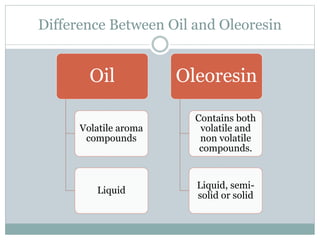
Difference Between Oil and Oleoresin
Oil
Volatile aroma
compounds
Liquid
Oleoresin
Contains both
volatile and
non volatile
compounds.
Liquid, semi-
solid or solid
IN INDIA
 With the discovery of the New World came new
spices, including allspice, chili peppers, vanilla,
and chocolate.
 It is the main reason why the BRITISHERS and
PORTUGESE rule us more than 200 years
 A context of spices is seen in early Vedas and
RAMAYANA and is considered as old as human
civilization
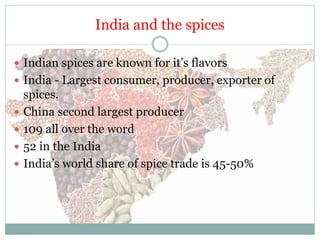
India and the spices
 Indian spices are known for it’s flavors
 India - Largest consumer, producer, exporter of
spices.
 China second largest producer
 109 all over the word
 52 in the India
 India’s world share of spice trade is 45-50%
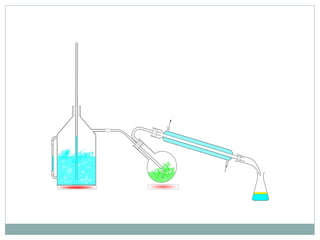
Steam Distillation Process
 Steam distillation is a special type
of distillation (a separation process) for temperature
sensitive materials like
natural aromatic compounds.
 Some organic compounds tend to decompose at
higher temperature and normal distillation does not
suit the purpose.
 It is a unit operation more or less a physical
separation process.
Principle
 It is a way of separating two immiscible liquid based
on their volatilities .
 The boiling points of liquids are minimized ,
permitting the liquids to be vaporized at lower
temperature then their boiling point.
 The liquids are then condensed and we get the
component we wanted to extracted.
Procedure
 The industrial process is widely used in extracting
out the organic matter by passing out steam through
plant materials.
 Temperature sensitive components which would
otherwise decompose through simple distillation
vaporize at lower temper in distillation tube.
 This allows separation of essential oils which tends
to less soluble than other complex materials.
 When steam is passed through organic material, tiny
pockets holding the essential oil release the oil
without damaging it.
 The distillate contains water vapors along with the
oils which condenses into respective liquid in
condensing apparatus.
 Then they are separated using a Florentine
separator.
Applications
 Steam distillation is employed in the isolation
of essential oils.
 Steam distillation is also widely used in petroleum
refineries and petrochemical plants.
 Steam distillation also is an important means of
separating fatty acids from mixtures.
Setback
 The disadvantage of having a higher initial cost for
investment in the equipment needed to execute the
process successfully.
 You'll need some initial training in order to operate
the equipment.
 A final hidden cost to the process is the cost of
maintaining and repairing your equipment.
Note- Due to these fallback of steam distillation
evolution of new processes took place.
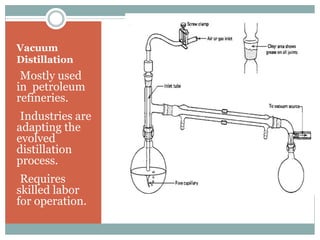
Vacuum Distillation
 The evolved form of steam distillation process.
 Vacuum distillation is a method
of distillation performed under reduced pressure.
 As with distillation, this technique separates
compounds based on differences in boiling points.
 A reduced pressure decreases the boiling point of
compounds.
Vacuum
Distillation
•Mostly used
in petroleum
refineries.
•Industries are
adapting the
evolved
distillation
process.
•Requires
skilled labor
for operation.
Solvent Extraction
 Liquid–liquid extraction (LLE), also known
as solvent extraction and partitioning.
 It is a method to separate compounds or metal
complexes, based on their relative solubilities in two
different immiscible liquids, usually water (polar)
and an organic solvent (non-polar).
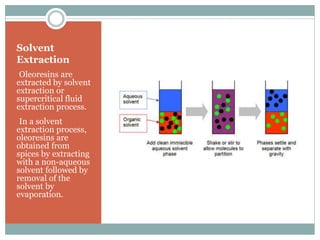
Solvent
Extraction
•Oleoresins are
extracted by solvent
extraction or
supercritical fluid
extraction process.
•In a solvent
extraction process,
oleoresins are
obtained from
spices by extracting
with a non-aqueous
solvent followed by
removal of the
solvent by
evaporation.
Conclusion
 Despite being the cost of instrumentation and
operation high it is still considered as best way for oil
extraction in current era.
 Lower boiling point provides no viable loss of flavor
and aromatic volatile compounds.
 Manual liability is less.
References
 https://www.leaf.tv/articles/advantages-disadvantages-of-steam-
distillation/
 http://www.lalaessentialoils.com/steam-distillation.html
 https://www.youtube.com/watch?v=pwHFxXRl-Ig
 https://en.wikipedia.org/wiki/Steam_distillation
 https://sciencing.com/principles-steam-distillation-6129502.html
 https://en.wikipedia.org/wiki/Vacuum_distillation#Industrial-
scale_applications
 http://www.metacafe.com/watch/506986/how_to_perform_a_vac
uum_distillation/
 https://en.wikipedia.org/wiki/Liquid%E2%80%93liquid_extractio
n
 http://www.organicspices.com/organicextracts/
Thank you

Application steam distillation in spice oil extraction

  • 1.
    S U BM I T T E D T O - E R N I T I N S U B M I T T E D B Y - A N U H A R S H G A U R ( 1 5 - I F T - 0 1 1 ) A R P A N R A Y ( 1 5 - I F T - 0 1 7 ) V I K A S H K U M A R ( 1 5 - I F T - 0 2 1 ) Application of Steam Distillation In Spice Oil Extraction
  • 2.
    Introduction  Plant orplant’s parts that are used to enhance the flavour/taste of human food are popularly termed as spices.  Used for flavour, colour and preservation of food and food products.  Important spices are vanilla, pepper, cumin etc.  India is considered as home of spices.
  • 3.
    Spice extract areof three types- Essential oil Oleoresin Derivative of oil and oleoresin
  • 4.
    Essential oil  Spiceoils are the volatile components present in most spices.  They provide the characteristic aroma of the spices.  Mostly used in food, cosmetics, perfumes and personal hygiene products
  • 5.
    Spice Oleoresins  Spiceoleoresins represent the complete flavour profile of the spice.  It contains the volatile as well as non volatile constituents of spices.  Oleoresins can be defined as the true essence of the spices.  Spice oleoresins guarantee superior quality of flavour and aroma.
  • 6.
    Difference Between Oiland Oleoresin Oil Volatile aroma compounds Liquid Oleoresin Contains both volatile and non volatile compounds. Liquid, semi- solid or solid
  • 7.
    IN INDIA  Withthe discovery of the New World came new spices, including allspice, chili peppers, vanilla, and chocolate.  It is the main reason why the BRITISHERS and PORTUGESE rule us more than 200 years  A context of spices is seen in early Vedas and RAMAYANA and is considered as old as human civilization
  • 8.
    India and thespices  Indian spices are known for it’s flavors  India - Largest consumer, producer, exporter of spices.  China second largest producer  109 all over the word  52 in the India  India’s world share of spice trade is 45-50%
  • 9.
    Steam Distillation Process Steam distillation is a special type of distillation (a separation process) for temperature sensitive materials like natural aromatic compounds.  Some organic compounds tend to decompose at higher temperature and normal distillation does not suit the purpose.  It is a unit operation more or less a physical separation process.
  • 11.
    Principle  It isa way of separating two immiscible liquid based on their volatilities .  The boiling points of liquids are minimized , permitting the liquids to be vaporized at lower temperature then their boiling point.  The liquids are then condensed and we get the component we wanted to extracted.
  • 12.
    Procedure  The industrialprocess is widely used in extracting out the organic matter by passing out steam through plant materials.  Temperature sensitive components which would otherwise decompose through simple distillation vaporize at lower temper in distillation tube.  This allows separation of essential oils which tends to less soluble than other complex materials.
  • 13.
     When steamis passed through organic material, tiny pockets holding the essential oil release the oil without damaging it.  The distillate contains water vapors along with the oils which condenses into respective liquid in condensing apparatus.  Then they are separated using a Florentine separator.
  • 15.
    Applications  Steam distillationis employed in the isolation of essential oils.  Steam distillation is also widely used in petroleum refineries and petrochemical plants.  Steam distillation also is an important means of separating fatty acids from mixtures.
  • 16.
    Setback  The disadvantageof having a higher initial cost for investment in the equipment needed to execute the process successfully.  You'll need some initial training in order to operate the equipment.  A final hidden cost to the process is the cost of maintaining and repairing your equipment. Note- Due to these fallback of steam distillation evolution of new processes took place.
  • 17.
    Vacuum Distillation  Theevolved form of steam distillation process.  Vacuum distillation is a method of distillation performed under reduced pressure.  As with distillation, this technique separates compounds based on differences in boiling points.  A reduced pressure decreases the boiling point of compounds.
  • 18.
    Vacuum Distillation •Mostly used in petroleum refineries. •Industriesare adapting the evolved distillation process. •Requires skilled labor for operation.
  • 19.
    Solvent Extraction  Liquid–liquidextraction (LLE), also known as solvent extraction and partitioning.  It is a method to separate compounds or metal complexes, based on their relative solubilities in two different immiscible liquids, usually water (polar) and an organic solvent (non-polar).
  • 20.
    Solvent Extraction •Oleoresins are extracted bysolvent extraction or supercritical fluid extraction process. •In a solvent extraction process, oleoresins are obtained from spices by extracting with a non-aqueous solvent followed by removal of the solvent by evaporation.
  • 21.
    Conclusion  Despite beingthe cost of instrumentation and operation high it is still considered as best way for oil extraction in current era.  Lower boiling point provides no viable loss of flavor and aromatic volatile compounds.  Manual liability is less.
  • 22.
    References  https://www.leaf.tv/articles/advantages-disadvantages-of-steam- distillation/  http://www.lalaessentialoils.com/steam-distillation.html https://www.youtube.com/watch?v=pwHFxXRl-Ig  https://en.wikipedia.org/wiki/Steam_distillation  https://sciencing.com/principles-steam-distillation-6129502.html  https://en.wikipedia.org/wiki/Vacuum_distillation#Industrial- scale_applications  http://www.metacafe.com/watch/506986/how_to_perform_a_vac uum_distillation/  https://en.wikipedia.org/wiki/Liquid%E2%80%93liquid_extractio n  http://www.organicspices.com/organicextracts/
  • 23.