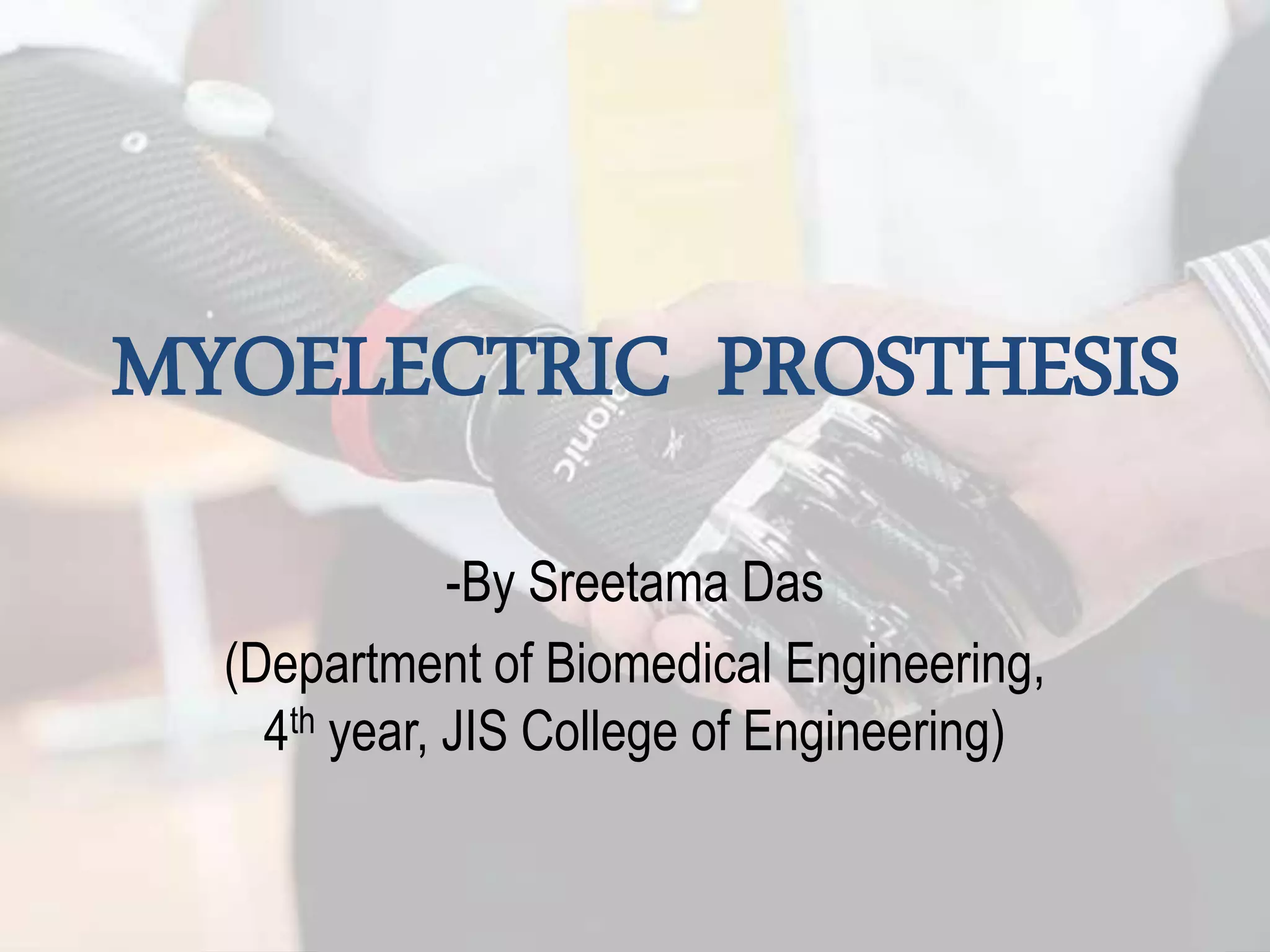
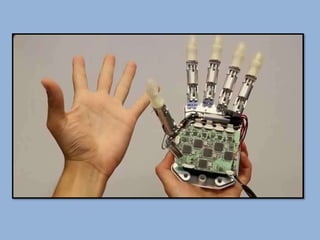
MYOELECTRIC PROSTHESIS
-By Sreetama Das
(Department of Biomedical Engineering,
4th year, JIS College of Engineering)
What is a prosthesis?
In medicine, a prosthesis (plural: prostheses; from Ancient
Greek prósthesis, "addition, application, attachment") is an
artificial device that replaces a missing body part, which
may be lost through trauma, disease, or congenital
conditions. Prosthetic amputee rehabilitation is primarily
coordinated by a prosthetist.
Prosthesis formers:
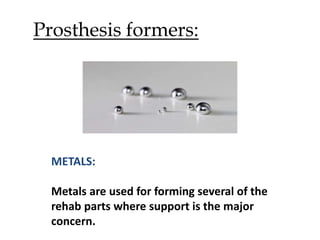
METALS:
Metals are used for forming several of the
rehab parts where support is the major
concern.
Prosthesis formers(cont.)
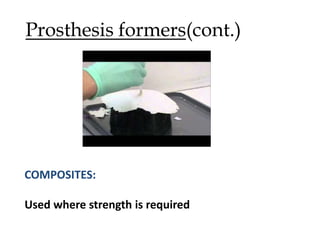
COMPOSITES:
Used where strength is required
Prosthesis formers(cont.)
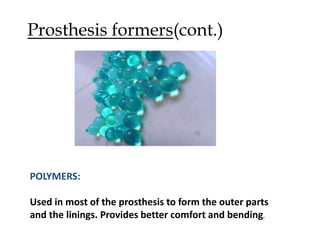
POLYMERS:
Used in most of the prosthesis to form the outer parts
and the linings. Provides better comfort and bending.
What is a myoelectric prosthesis?
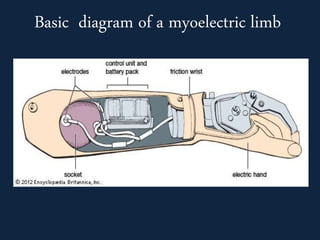
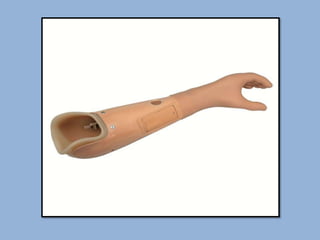
Basic diagram of a myoelectric limb
The working:
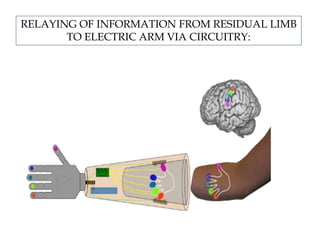
A myoelectric prosthesis uses the existing muscles in your
residual limb to control its functions. One or more sensors
fabricated into the prosthetic socket receive electrical signals
when you intentionally engage specific muscles in your residual
limb. Sensors relay information to a controller, which translates
the data into commands for the electric motors and moves your
joints. If muscle signals cannot be used to control the prosthesis,
you may be able to use switches with a rocker or pull-push or
touch pad.
RELAYING OF INFORMATION FROM RESIDUAL LIMB
TO ELECTRIC ARM VIA CIRCUITRY:
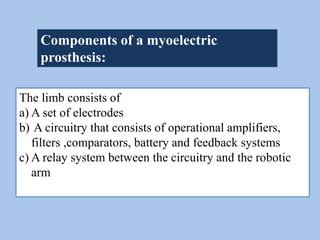
Components of a myoelectric
prosthesis:
The limb consists of
a) A set of electrodes
b) A circuitry that consists of operational amplifiers,
filters ,comparators, battery and feedback systems
c) A relay system between the circuitry and the robotic
arm
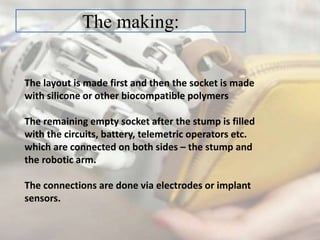
The making:
The layout is made first and then the socket is made
with silicone or other biocompatible polymers
The remaining empty socket after the stump is filled
with the circuits, battery, telemetric operators etc.
which are connected on both sides – the stump and
the robotic arm.
The connections are done via electrodes or implant
sensors.
Working principles of other types of
myoelectric arms:
1)Implanted myoelectric
sensors system:
These work with implants
instead of electrodes, that
attach to the residual limb.
The information regarding
motor impulses are
transferred via a transmitter
and a telemetry controller.
Working principles of other types of myoelectric
arms(cont..)
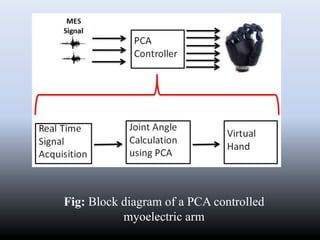
2)Real-time myoelectric control of a multi-fingered hand prosthesis using
PCA:
The controller here reverted the PCA algorithm and allowed to drive a multi-
DoF hand by combining a two-differential channels EMG input with these two
PCs. Hence, the novelty of this approach stood in the PCA application for
solving the challenging problem of best mapping the EMG inputs into the
degrees of freedom (DoFs) of the prosthesis.
Fig: Block diagram of a PCA controlled
myoelectric arm
Working principles of other types of myoelectric
arms(cont..)
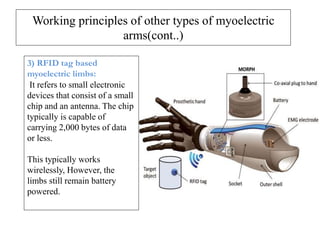
3) RFID tag based
myoelectric limbs:
It refers to small electronic
devices that consist of a small
chip and an antenna. The chip
typically is capable of
carrying 2,000 bytes of data
or less.
This typically works
wirelessly, However, the
limbs still remain battery
powered.
Models of myoelectric prosthesis
•Deka Arm System (DEKA Integrated Solutions)
• Dynamic Arm (Advanced Arm Dynamics)
• Dynamic Mode Control hand Electrohand 2000 for children (Otto
Bock)
•ErgoArm hybrid system (Otto Bock)
• i-LIMB™ (Touch Bionics)
•LTI Boston Digital™ Arm Systems-various upper limb devices and
components (Liberating Technologies Inc.)
• Michelangelo® Hand (Otto Bock)
•ProDigits™ (Touch Bionics)
• SensorHand™(Advanced Arm Dynamics)
•Utah Arm Systems (Motion Control)
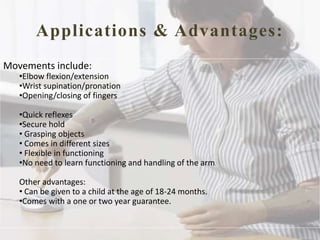
Applications & Advantages:
Movements include:
•Elbow flexion/extension
•Wrist supination/pronation
•Opening/closing of fingers
•Quick reflexes
•Secure hold
• Grasping objects
• Comes in different sizes
• Flexible in functioning
•No need to learn functioning and handling of the arm
Other advantages:
• Can be given to a child at the age of 18-24 months.
•Comes with a one or two year guarantee.
Disadvantages:
1) Motor and drive last about two to three years.
2) With heavy use, the entire prosthesis may need to
be replaced after only four or five years.
3) When used on a child, the sockets need to be
replaced every year due to growth.
4) The material used in making it may result in skin
irritations, inflammations, infections in the initial
days.
5) Relatively expensive.
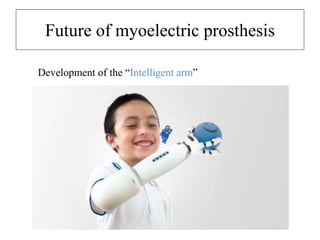
Future of myoelectric prosthesis
Development of the “Intelligent arm”
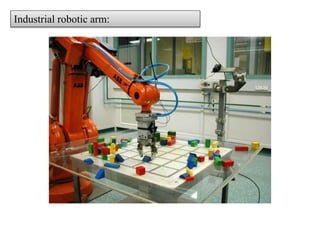
Industrial robotic arm:
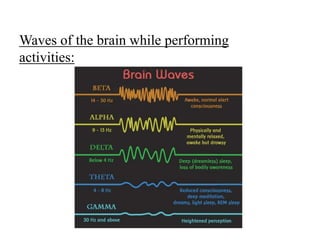
Waves of the brain while performing
activities:
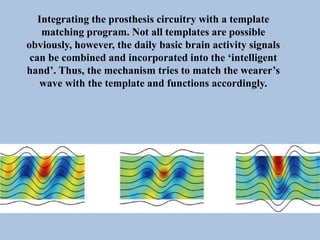
Integrating the prosthesis circuitry with a template
matching program. Not all templates are possible
obviously, however, the daily basic brain activity signals
can be combined and incorporated into the ‘intelligent
hand’. Thus, the mechanism tries to match the wearer’s
wave with the template and functions accordingly.
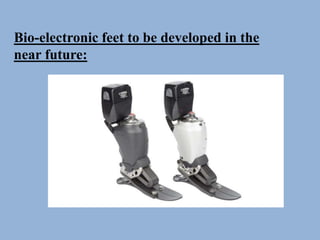
Bio-electronic feet to be developed in the
near future:
References:
• http://www.ottobockus.com
• http://openprosthetics.org
• http://www.myoelectricprosthesis.com
• Wikipedia
• https://pdfs.semanticscholar.org
• Journal of Neuro-engineering and Rehabilitation by Biomed
central
Thank you
Questions?

Myoelectric prosthesis

  • 1.
    MYOELECTRIC PROSTHESIS -By SreetamaDas (Department of Biomedical Engineering, 4th year, JIS College of Engineering)
  • 2.
    What is aprosthesis? In medicine, a prosthesis (plural: prostheses; from Ancient Greek prósthesis, "addition, application, attachment") is an artificial device that replaces a missing body part, which may be lost through trauma, disease, or congenital conditions. Prosthetic amputee rehabilitation is primarily coordinated by a prosthetist.
  • 3.
    Prosthesis formers: METALS: Metals areused for forming several of the rehab parts where support is the major concern.
  • 4.
  • 5.
    Prosthesis formers(cont.) POLYMERS: Used inmost of the prosthesis to form the outer parts and the linings. Provides better comfort and bending.
  • 6.
    What is amyoelectric prosthesis?
  • 7.
    Basic diagram ofa myoelectric limb
  • 8.
    The working: A myoelectricprosthesis uses the existing muscles in your residual limb to control its functions. One or more sensors fabricated into the prosthetic socket receive electrical signals when you intentionally engage specific muscles in your residual limb. Sensors relay information to a controller, which translates the data into commands for the electric motors and moves your joints. If muscle signals cannot be used to control the prosthesis, you may be able to use switches with a rocker or pull-push or touch pad.
  • 9.
    RELAYING OF INFORMATIONFROM RESIDUAL LIMB TO ELECTRIC ARM VIA CIRCUITRY:
  • 10.
    Components of amyoelectric prosthesis: The limb consists of a) A set of electrodes b) A circuitry that consists of operational amplifiers, filters ,comparators, battery and feedback systems c) A relay system between the circuitry and the robotic arm
  • 11.
    The making: The layoutis made first and then the socket is made with silicone or other biocompatible polymers The remaining empty socket after the stump is filled with the circuits, battery, telemetric operators etc. which are connected on both sides – the stump and the robotic arm. The connections are done via electrodes or implant sensors.
  • 14.
    Working principles ofother types of myoelectric arms: 1)Implanted myoelectric sensors system: These work with implants instead of electrodes, that attach to the residual limb. The information regarding motor impulses are transferred via a transmitter and a telemetry controller.
  • 15.
    Working principles ofother types of myoelectric arms(cont..) 2)Real-time myoelectric control of a multi-fingered hand prosthesis using PCA: The controller here reverted the PCA algorithm and allowed to drive a multi- DoF hand by combining a two-differential channels EMG input with these two PCs. Hence, the novelty of this approach stood in the PCA application for solving the challenging problem of best mapping the EMG inputs into the degrees of freedom (DoFs) of the prosthesis.
  • 16.
    Fig: Block diagramof a PCA controlled myoelectric arm
  • 17.
    Working principles ofother types of myoelectric arms(cont..) 3) RFID tag based myoelectric limbs: It refers to small electronic devices that consist of a small chip and an antenna. The chip typically is capable of carrying 2,000 bytes of data or less. This typically works wirelessly, However, the limbs still remain battery powered.
  • 18.
    Models of myoelectricprosthesis •Deka Arm System (DEKA Integrated Solutions) • Dynamic Arm (Advanced Arm Dynamics) • Dynamic Mode Control hand Electrohand 2000 for children (Otto Bock) •ErgoArm hybrid system (Otto Bock) • i-LIMB™ (Touch Bionics) •LTI Boston Digital™ Arm Systems-various upper limb devices and components (Liberating Technologies Inc.) • Michelangelo® Hand (Otto Bock) •ProDigits™ (Touch Bionics) • SensorHand™(Advanced Arm Dynamics) •Utah Arm Systems (Motion Control)
  • 19.
    Applications & Advantages: Movementsinclude: •Elbow flexion/extension •Wrist supination/pronation •Opening/closing of fingers •Quick reflexes •Secure hold • Grasping objects • Comes in different sizes • Flexible in functioning •No need to learn functioning and handling of the arm Other advantages: • Can be given to a child at the age of 18-24 months. •Comes with a one or two year guarantee.
  • 20.
    Disadvantages: 1) Motor anddrive last about two to three years. 2) With heavy use, the entire prosthesis may need to be replaced after only four or five years. 3) When used on a child, the sockets need to be replaced every year due to growth. 4) The material used in making it may result in skin irritations, inflammations, infections in the initial days. 5) Relatively expensive.
  • 21.
    Future of myoelectricprosthesis Development of the “Intelligent arm”
  • 22.
  • 23.
    Waves of thebrain while performing activities:
  • 24.
    Integrating the prosthesiscircuitry with a template matching program. Not all templates are possible obviously, however, the daily basic brain activity signals can be combined and incorporated into the ‘intelligent hand’. Thus, the mechanism tries to match the wearer’s wave with the template and functions accordingly.
  • 25.
    Bio-electronic feet tobe developed in the near future:
  • 26.
    References: • http://www.ottobockus.com • http://openprosthetics.org •http://www.myoelectricprosthesis.com • Wikipedia • https://pdfs.semanticscholar.org • Journal of Neuro-engineering and Rehabilitation by Biomed central
  • 27.