Advanced
Encryption
Standard Algorithm
HD
TABLE OF CONTENT
01 03
Encryption and
Decryption
02 Demo
04
Cryptography AES
CRYPTOGRAPHY
Cryptography is the science
and study of methods of
protecting data in computer
and communication systems
from unauthorized disclosure
and modification.
QUOTE
Here’s a quote from
a famous person
“Cryptography is the ultimate form of
nonviolent direct action”
—Julian Assange
What is
Encryption
and
Decryption?
★ Encryption is the process of translating
plain text data (plaintext) into
something that appears to be random
and meaningless (ciphertext).
★ Decryption is the process of converting
ciphertext back to plaintext.
Why use Encryption ?
Encryption is important because it allows you to
securely protect data that you don't want anyone
else to have access to.
DEFINITION OF CONCEPTS
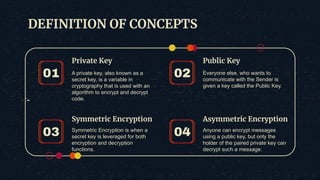
Private Key
A private key, also known as a
secret key, is a variable in
cryptography that is used with an
algorithm to encrypt and decrypt
code.
Public Key
Everyone else, who wants to
communicate with the Sender is
given a key called the Public Key.
Symmetric Encryption
Symmetric Encryption is when a
secret key is leveraged for both
encryption and decryption
functions.
Asymmetric Encryption
Anyone can encrypt messages
using a public key, but only the
holder of the paired private key can
decrypt such a message.
01
03
02
04
Advanced
Encryption Standard
It is a symmetric block cipher algorithm
chosen by the U.S. government to protect
classified information and is implemented in
software and hardware throughout the world
to encrypt sensitive data.
It was intended to be easy to
implement in hardware and software,
as well as in restricted environments.
CREDITS: This presentation template
was created by Slidesgo, including
icons by Flaticon, and infographics &
images by Freepik
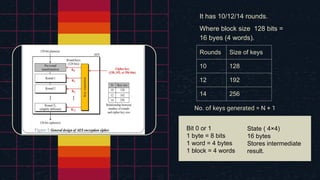
Bit 0 or 1
1 byte = 8 bits
1 word = 4 bytes
1 block = 4 words
State ( 4×4)
16 bytes
Stores intermediate
result.
Rounds Size of keys
10 128
12 192
14 256
It has 10/12/14 rounds.
Where block size 128 bits =
16 byes (4 words).
No. of keys generated = N + 1
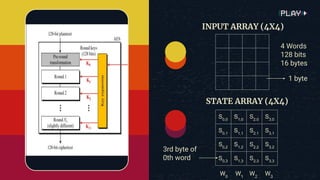
INPUT ARRAY (4X4)
4 Words
128 bits
16 bytes
1 byte
STATE ARRAY (4X4)
S0,0
S1,0
S2,0
S3,0
S0,1
S1,1
S2,1
S3,1
S0,2
S1,2
S2,2
S3,2
S0,3
S1,3
S2,3
S3,3
3rd byte of
0th word
W0
W1
W2
W3
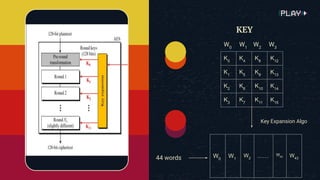
KEY
K0
K4
K8
K12
K1
K5
K9
K13
K2
K6
K10
K14
K3
K7
K11
K15
W0
W1
W2
W3
W0
W1
W2 …… W42 W43
Key Expansion Algo
44 words
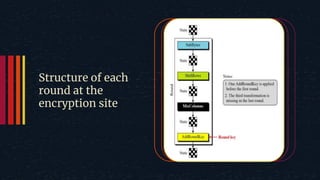
Structure of each
round at the
encryption site
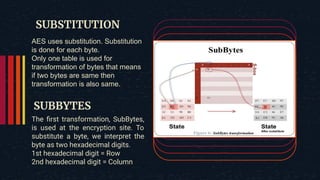
SUBSTITUTION
AES uses substitution. Substitution
is done for each byte.
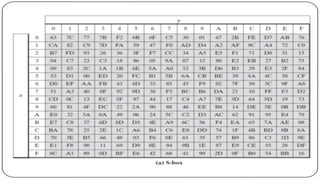
Only one table is used for
transformation of bytes that means
if two bytes are same then
transformation is also same.
SUBBYTES
The first transformation, SubBytes,
is used at the encryption site. To
substitute a byte, we interpret the
byte as two hexadecimal digits.
1st hexadecimal digit = Row
2nd hexadecimal digit = Column
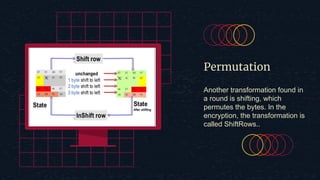
Permutation
Another transformation found in
a round is shifting, which
permutes the bytes. In the
encryption, the transformation is
called ShiftRows..
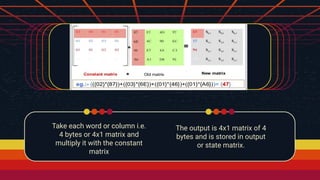
MIXING
Take each word or column i.e.
4 bytes or 4x1 matrix and
multiply it with the constant
matrix
The output is 4x1 matrix of 4
bytes and is stored in output
or state matrix.
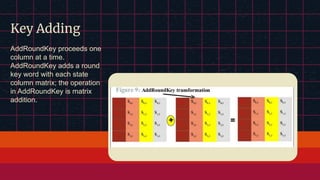
Key Adding
AddRoundKey proceeds one
column at a time.
AddRoundKey adds a round
key word with each state
column matrix; the operation
in AddRoundKey is matrix
addition.
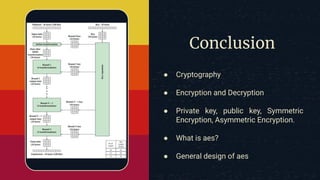
Conclusion
● Cryptography
● Encryption and Decryption
● Private key, public key, Symmetric
Encryption, Asymmetric Encryption.
● What is aes?
● General design of aes
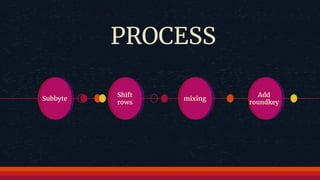
PROCESS
Add
roundkey
Subbyte
Shift
rows
mixing
● Cryptography and network
security (fifth edition) by
William Stallings.
● wikipedia
References
ThankYou

Advanced Encryption Standard Algorithm

  • 1.
  • 2.
    TABLE OF CONTENT 0103 Encryption and Decryption 02 Demo 04 Cryptography AES
  • 3.
    CRYPTOGRAPHY Cryptography is thescience and study of methods of protecting data in computer and communication systems from unauthorized disclosure and modification.
  • 4.
    QUOTE Here’s a quotefrom a famous person “Cryptography is the ultimate form of nonviolent direct action” —Julian Assange
  • 5.
    What is Encryption and Decryption? ★ Encryptionis the process of translating plain text data (plaintext) into something that appears to be random and meaningless (ciphertext). ★ Decryption is the process of converting ciphertext back to plaintext.
  • 6.
    Why use Encryption? Encryption is important because it allows you to securely protect data that you don't want anyone else to have access to.
  • 7.
    DEFINITION OF CONCEPTS PrivateKey A private key, also known as a secret key, is a variable in cryptography that is used with an algorithm to encrypt and decrypt code. Public Key Everyone else, who wants to communicate with the Sender is given a key called the Public Key. Symmetric Encryption Symmetric Encryption is when a secret key is leveraged for both encryption and decryption functions. Asymmetric Encryption Anyone can encrypt messages using a public key, but only the holder of the paired private key can decrypt such a message. 01 03 02 04
  • 8.
    Advanced Encryption Standard It isa symmetric block cipher algorithm chosen by the U.S. government to protect classified information and is implemented in software and hardware throughout the world to encrypt sensitive data. It was intended to be easy to implement in hardware and software, as well as in restricted environments.
  • 9.
    CREDITS: This presentationtemplate was created by Slidesgo, including icons by Flaticon, and infographics & images by Freepik Bit 0 or 1 1 byte = 8 bits 1 word = 4 bytes 1 block = 4 words State ( 4×4) 16 bytes Stores intermediate result. Rounds Size of keys 10 128 12 192 14 256 It has 10/12/14 rounds. Where block size 128 bits = 16 byes (4 words). No. of keys generated = N + 1
  • 10.
    INPUT ARRAY (4X4) 4Words 128 bits 16 bytes 1 byte STATE ARRAY (4X4) S0,0 S1,0 S2,0 S3,0 S0,1 S1,1 S2,1 S3,1 S0,2 S1,2 S2,2 S3,2 S0,3 S1,3 S2,3 S3,3 3rd byte of 0th word W0 W1 W2 W3
  • 11.
  • 12.
    Structure of each roundat the encryption site
  • 13.
    SUBSTITUTION AES uses substitution.Substitution is done for each byte. Only one table is used for transformation of bytes that means if two bytes are same then transformation is also same. SUBBYTES The first transformation, SubBytes, is used at the encryption site. To substitute a byte, we interpret the byte as two hexadecimal digits. 1st hexadecimal digit = Row 2nd hexadecimal digit = Column
  • 15.
    Permutation Another transformation foundin a round is shifting, which permutes the bytes. In the encryption, the transformation is called ShiftRows..
  • 17.
  • 18.
    Take each wordor column i.e. 4 bytes or 4x1 matrix and multiply it with the constant matrix The output is 4x1 matrix of 4 bytes and is stored in output or state matrix.
  • 19.
    Key Adding AddRoundKey proceedsone column at a time. AddRoundKey adds a round key word with each state column matrix; the operation in AddRoundKey is matrix addition.
  • 21.
    Conclusion ● Cryptography ● Encryptionand Decryption ● Private key, public key, Symmetric Encryption, Asymmetric Encryption. ● What is aes? ● General design of aes
  • 22.
  • 23.
    ● Cryptography andnetwork security (fifth edition) by William Stallings. ● wikipedia References
  • 24.