Transplantation
immunology
Submitted By-
Ashutosh Sharma
Roll no. 11081
M.Sc. biotechnology
Submitted to
Dr. Menu Goyal
Assistant professor
Central university of Haryana
Content
โ€ข Introduction and major events
โ€ข Laws of transplantation
โ€ข Basis of Graft rejection
โ€ข Immunosuppressive therapy
โ€ข Immune tolerance to allograft
โ€ข Clinical transplantation
Introduction
โ€ข Transplantation is the act of transferring cells,
tissues, or organs from one site to another.
โ€ข Implantation of non-self tissues into the body.
โ€ข Donor is from which the graft is taken and recipient
is to whom graft is implanted.
Major Events
โ€ข The first successful identical twin transplant of a
human kidney was performed by Joseph E. Murray
in 1954 in Boston.
โ€ข The first successful liver transplant by Dr. Thomas E.
Starzl in 1967.
โ€ข The first heart transplantation by Christian Barnard
in 1967.
โ€ข The first successful bone marrow transplant by E.
Donnall Thomas in 1968.
Laws of transplantation
โ€ข Transplantation within inbread strains will succeed.
โ€ข Transplantation between inbread strains will fail.
โ€ข Transplants from a member of an inbread parental
strain to an F1 offspring will succeed but those in
the reverse direction will fail.
Continued...
โ€ข Transplants from F2 and all subsequent generations
to F1 animals will succeed.
โ€ข Transplants from inbread parental strain to F2
generation will usually, but not always,fail.
Basis of graft rejection
Types of graft
โ€ข Autograft:is self tissue transfer from one body part
to another.
โ€ข Isograft:is tissue transfer between genetically
identical individuals.
โ€ข Allograft:is tissue transfer between genetically
different members of same species.
โ€ข Xenograft:is tissue transfer between different
species.
Graft
acceptance and
rejection
(a) acceptance of an allograft
occurred within 12-14 days
(b)first-set of allograft rejection
begin within 7-10 days and
completed by 10-14days
(c) second-set of rejection begin
with 3-4 days, with full rejection
by 5-6 days.
Role of T-cell
โ€ข In 1950s, Avrion Mitchison showed in adaptive
transfer experiment that lymphocytes , but not
serum antibody could transfer allograft immunity.
โ€ข In other studies, T-cells derived from an allograft-
primed mouse were shown to transfer second set
allograft rejection to an unprimed genetically
identical recipient , as long as that recipient was
grafted with same allogeneic tissue.
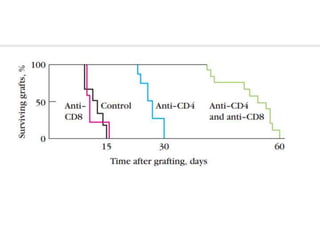
โ€ข Analysis of T-cell subpopulations involved in allograft
rejection has implicated both CD4+ and CD8+
population.
โ€ข Mice were injected with monoclonal antibodies to
deplete one or both T-cell and rate of rejection was
measured.
MHC
โ€ข MHC(major histocompatibility complex) is a tightly
linked cluster of genes that are inherited as a
complete set, called haplotype.
โ€ข The organisation of MHC is called H-2 in mice and
HLA(human leucocyte antigen) in humans.
โ€ข Class I MHC
โ€ข Class II MHC
โ€ข Minor histocompatibility complex
Role of RBC and MHC antigens
โ€ข Differences in the blood group and major
histocompatibility antigens are responsible for the
intense graft-rejection.
โ€ข Blood group antigens are expressed on RBCs,
epithelial cells, endothelial cells.
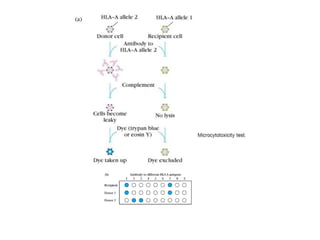
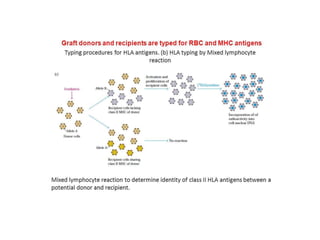
โ€ข HLA typing is performed majorly by two methods:
1.Microcytoxicity test
2.MLR(mixed-lymphocyte reactions)
Cell mediated Graft rejection
โ€ข Gtaft rejection is caused principally by cell
mediated immune response to alloantigens
(primarily MHC molecules) expressed on cells of
the graft.
โ€ข The process is divided into 02 stages:
โ€ข Sensitization stage
โ€ข Effector stage
Sensitization stage
โ€ข CD4+ and CD8+ T-cell recognise alloantigens and
proliferate in response.
โ€ข Minor histocompatibility antigens are weak, but
sometimes combined effects can vigorous.
โ€ข Major histocompatibility antigens recognise both
MHC molecule and protein bound to it.
Effector stage
โ€ข Immune Destruction of graft takes place.
โ€ข A variety of effector mechanism participate in
allograft rejection. The most common are cell
mediated reactions involving DTH and CTL
mediated cytotoxicity.
โ€ข Recognition of foreign class ll alloantigens o the
graft y host CD8+ cells canclead to CTL mediated
killing.
โ€ข Cytokines secreted by TH cells play main role
โ€ข IL-2 IFN-ษฃ and TNF-ษฃฮฒ ate important mediator of
graft rejection.
โ€ข IL-2 promotes T-cell proliferation and generally is
required to the generation of effector CTLs.
Types of rejection reaction
โ€ข Graft rejection reaction have various time courses
depending upon the type of tissue grafted and the
immune response involved
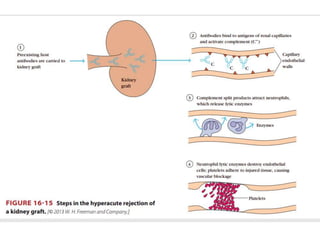
โ€ข Hyperacute rejection
โ€ข These reactions occur within first 24 hrs of
transplantation.
โ€ข Caused by pre-existing host serum antibodies
specific for antigen of Graft.
Continued....
โ€ข Acute rejection
โ€ข Begin in about 10days after transplantation
โ€ข T-cell mediated response is generated
โ€ข Chronic rejection
โ€ข Occurs from months to years after transplantation
โ€ข Includes both humoral and cell mediated response.
Immunosuppressive therapy
โ€ข General immunosuppressive therapy
โ€ข Specific immunosuppressive therapy
General immunosuppressive therapy
โ€ข Azathioprine (imuran), is a mitotic inhibitor which
diminish T-cell and B-cell proliferation by blocking
inosinic acid synthesis in S phase.
โ€ข Corticosteroids eg. Prednisone and dexamethasone
are used as anti-inflammatory agents.
โ€ข fungal metabolites like Cyclosporine A,
FK506(tacrolimus) inhibit transcription of IL-2 thus
blocking T-cell activation.
โ€ข Rapamycin blocks the proliferation and
differentiation of activated T-helper cells in G1
phase.
โ€ข Rapamycin and FK506 are 10-100 times stronger
than cyclosporine A.
โ€ข Lymphocytes are sensitive to X-rays thus X-
irradiation can be used to eliminate them in the
recipient before grafting.
โ€ข Specific immunosuppressive therapy
โ€ข Monoclonal antibodies can suppress graft-
rejection response
โ€ข Blocking co-stimulatory signals can induce
anergy
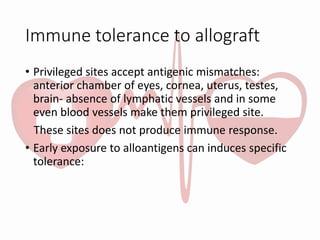
Immune tolerance to allograft
โ€ข Privileged sites accept antigenic mismatches:
anterior chamber of eyes, cornea, uterus, testes,
brain- absence of lymphatic vessels and in some
even blood vessels make them privileged site.
These sites does not produce immune response.
โ€ข Early exposure to alloantigens can induces specific
tolerance:
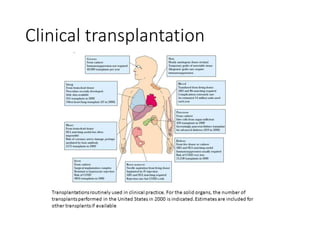
Clinical transplantation
Transplantation immunology(11081)

Transplantation immunology(11081)

  • 1.
    Transplantation immunology Submitted By- Ashutosh Sharma Rollno. 11081 M.Sc. biotechnology Submitted to Dr. Menu Goyal Assistant professor Central university of Haryana
  • 2.
    Content โ€ข Introduction andmajor events โ€ข Laws of transplantation โ€ข Basis of Graft rejection โ€ข Immunosuppressive therapy โ€ข Immune tolerance to allograft โ€ข Clinical transplantation
  • 3.
    Introduction โ€ข Transplantation isthe act of transferring cells, tissues, or organs from one site to another. โ€ข Implantation of non-self tissues into the body. โ€ข Donor is from which the graft is taken and recipient is to whom graft is implanted.
  • 4.
    Major Events โ€ข Thefirst successful identical twin transplant of a human kidney was performed by Joseph E. Murray in 1954 in Boston. โ€ข The first successful liver transplant by Dr. Thomas E. Starzl in 1967. โ€ข The first heart transplantation by Christian Barnard in 1967. โ€ข The first successful bone marrow transplant by E. Donnall Thomas in 1968.
  • 5.
    Laws of transplantation โ€ขTransplantation within inbread strains will succeed. โ€ข Transplantation between inbread strains will fail. โ€ข Transplants from a member of an inbread parental strain to an F1 offspring will succeed but those in the reverse direction will fail.
  • 6.
    Continued... โ€ข Transplants fromF2 and all subsequent generations to F1 animals will succeed. โ€ข Transplants from inbread parental strain to F2 generation will usually, but not always,fail.
  • 7.
    Basis of graftrejection
  • 8.
    Types of graft โ€ขAutograft:is self tissue transfer from one body part to another. โ€ข Isograft:is tissue transfer between genetically identical individuals. โ€ข Allograft:is tissue transfer between genetically different members of same species. โ€ข Xenograft:is tissue transfer between different species.
  • 9.
    Graft acceptance and rejection (a) acceptanceof an allograft occurred within 12-14 days (b)first-set of allograft rejection begin within 7-10 days and completed by 10-14days (c) second-set of rejection begin with 3-4 days, with full rejection by 5-6 days.
  • 10.
    Role of T-cell โ€ขIn 1950s, Avrion Mitchison showed in adaptive transfer experiment that lymphocytes , but not serum antibody could transfer allograft immunity. โ€ข In other studies, T-cells derived from an allograft- primed mouse were shown to transfer second set allograft rejection to an unprimed genetically identical recipient , as long as that recipient was grafted with same allogeneic tissue.
  • 12.
    โ€ข Analysis ofT-cell subpopulations involved in allograft rejection has implicated both CD4+ and CD8+ population. โ€ข Mice were injected with monoclonal antibodies to deplete one or both T-cell and rate of rejection was measured.
  • 14.
    MHC โ€ข MHC(major histocompatibilitycomplex) is a tightly linked cluster of genes that are inherited as a complete set, called haplotype. โ€ข The organisation of MHC is called H-2 in mice and HLA(human leucocyte antigen) in humans. โ€ข Class I MHC โ€ข Class II MHC โ€ข Minor histocompatibility complex
  • 15.
    Role of RBCand MHC antigens โ€ข Differences in the blood group and major histocompatibility antigens are responsible for the intense graft-rejection. โ€ข Blood group antigens are expressed on RBCs, epithelial cells, endothelial cells. โ€ข HLA typing is performed majorly by two methods: 1.Microcytoxicity test 2.MLR(mixed-lymphocyte reactions)
  • 18.
    Cell mediated Graftrejection โ€ข Gtaft rejection is caused principally by cell mediated immune response to alloantigens (primarily MHC molecules) expressed on cells of the graft. โ€ข The process is divided into 02 stages: โ€ข Sensitization stage โ€ข Effector stage
  • 19.
    Sensitization stage โ€ข CD4+and CD8+ T-cell recognise alloantigens and proliferate in response. โ€ข Minor histocompatibility antigens are weak, but sometimes combined effects can vigorous. โ€ข Major histocompatibility antigens recognise both MHC molecule and protein bound to it.
  • 20.
    Effector stage โ€ข ImmuneDestruction of graft takes place. โ€ข A variety of effector mechanism participate in allograft rejection. The most common are cell mediated reactions involving DTH and CTL mediated cytotoxicity. โ€ข Recognition of foreign class ll alloantigens o the graft y host CD8+ cells canclead to CTL mediated killing.
  • 21.
    โ€ข Cytokines secretedby TH cells play main role โ€ข IL-2 IFN-ษฃ and TNF-ษฃฮฒ ate important mediator of graft rejection. โ€ข IL-2 promotes T-cell proliferation and generally is required to the generation of effector CTLs.
  • 22.
    Types of rejectionreaction โ€ข Graft rejection reaction have various time courses depending upon the type of tissue grafted and the immune response involved โ€ข Hyperacute rejection โ€ข These reactions occur within first 24 hrs of transplantation. โ€ข Caused by pre-existing host serum antibodies specific for antigen of Graft.
  • 24.
    Continued.... โ€ข Acute rejection โ€ขBegin in about 10days after transplantation โ€ข T-cell mediated response is generated โ€ข Chronic rejection โ€ข Occurs from months to years after transplantation โ€ข Includes both humoral and cell mediated response.
  • 25.
    Immunosuppressive therapy โ€ข Generalimmunosuppressive therapy โ€ข Specific immunosuppressive therapy
  • 26.
    General immunosuppressive therapy โ€ขAzathioprine (imuran), is a mitotic inhibitor which diminish T-cell and B-cell proliferation by blocking inosinic acid synthesis in S phase. โ€ข Corticosteroids eg. Prednisone and dexamethasone are used as anti-inflammatory agents. โ€ข fungal metabolites like Cyclosporine A, FK506(tacrolimus) inhibit transcription of IL-2 thus blocking T-cell activation.
  • 27.
    โ€ข Rapamycin blocksthe proliferation and differentiation of activated T-helper cells in G1 phase. โ€ข Rapamycin and FK506 are 10-100 times stronger than cyclosporine A. โ€ข Lymphocytes are sensitive to X-rays thus X- irradiation can be used to eliminate them in the recipient before grafting.
  • 28.
    โ€ข Specific immunosuppressivetherapy โ€ข Monoclonal antibodies can suppress graft- rejection response โ€ข Blocking co-stimulatory signals can induce anergy
  • 29.
    Immune tolerance toallograft โ€ข Privileged sites accept antigenic mismatches: anterior chamber of eyes, cornea, uterus, testes, brain- absence of lymphatic vessels and in some even blood vessels make them privileged site. These sites does not produce immune response. โ€ข Early exposure to alloantigens can induces specific tolerance:
  • 30.