Chimeric antigen
receptor(CAR) T cell
therapy
Presented by: Preetika Pradhan
Molecular medicine
Introduction
• CAR’s also known as chimeric immunoreceptor, chimeric T cell receptors, artificial T cell receptor.
• Chimeric antigen receptors (CAR) are recombinant receptors for antigen, which, in a single molecule,
redirect the specificity and function of T lymphocytes and other immune cells.
• CAR T-cell therapy is a promising new way to get immune cells called T cells to fight cancer by changing
them in the lab so they can find and destroy cancer cells.
• CAR T-cell therapies are sometimes talked about as a type of gene or cell therapy, or an adoptive cell
transfer therapy.
CAR
T-Cell
Therapy:
How it
Works?
http://www.lls.org/sites/default/files/National/USA/Image/get_support/CART_Process_Jan2018.JPG
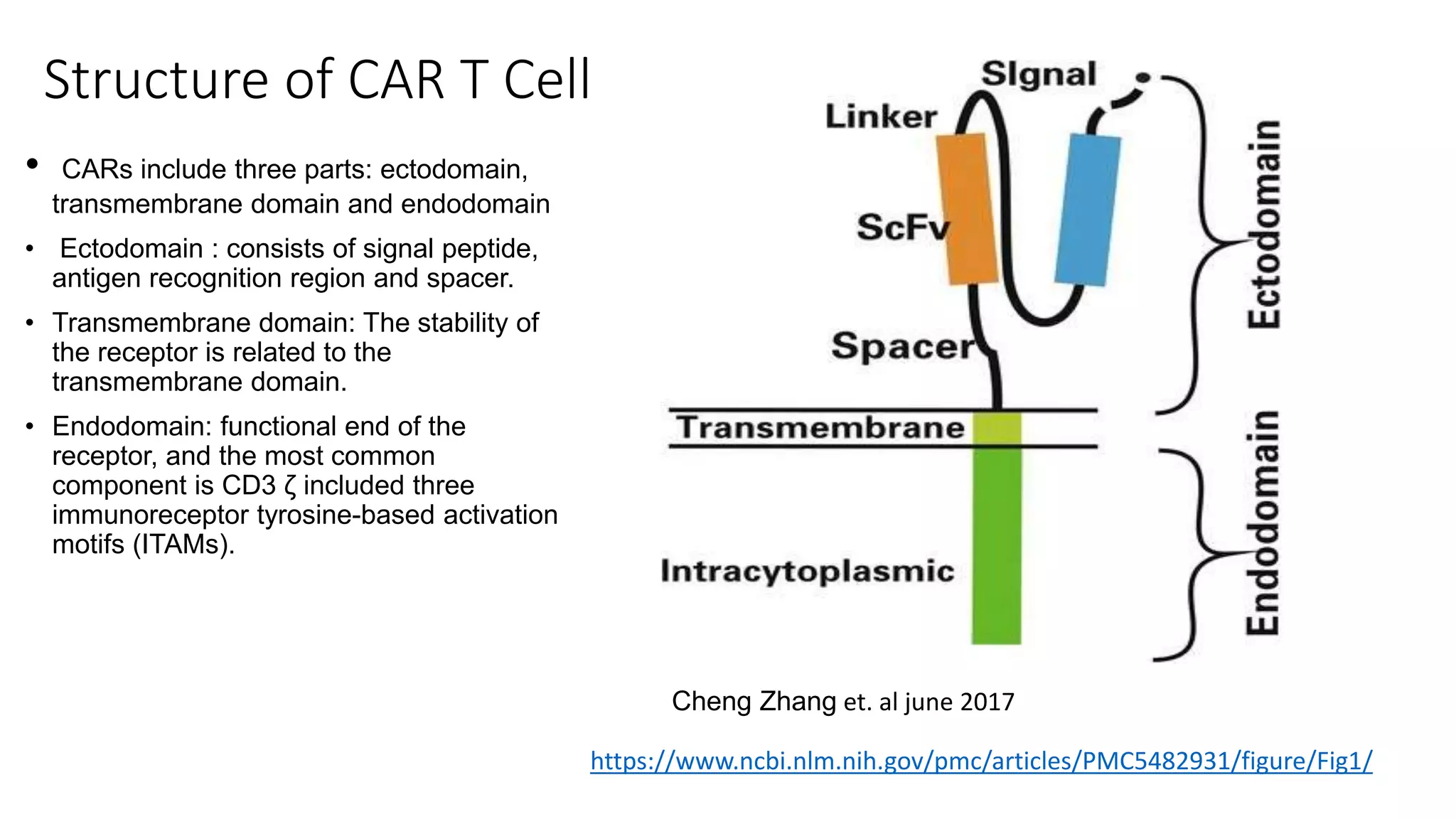
Structure of CAR T Cell
• CARs include three parts: ectodomain,
transmembrane domain and endodomain
• Ectodomain : consists of signal peptide,
antigen recognition region and spacer.
• Transmembrane domain: The stability of
the receptor is related to the
transmembrane domain.
• Endodomain: functional end of the
receptor, and the most common
component is CD3 ζ included three
immunoreceptor tyrosine-based activation
motifs (ITAMs).
Cheng Zhang et. al june 2017
https://www.ncbi.nlm.nih.gov/pmc/articles/PMC5482931/figure/Fig1/
CAR Targeting
• Unlike the physiologic TCR, which engages
HLA-peptide complexes, CARs engage
molecules that do not require peptide
processing or HLA expression to be recognized.
• CARs therefore recognize antigen on any HLA .
• Furthermore, CARs can target tumor cells that
have downregulated HLA expression or
proteasomal antigen processing, mechanisms
that contribute to tumor escape from TCR-
mediated immunity.
• CARs has their ability to bind not only to
proteins but also to carbohydrate and glycolipid
structures, again expanding the range of
potential targets.
Rimas J Orentas et. al Jan 2012
Evolving architecture of CAR
• Since the initial development of CARs in 1989, CAR-T cells can be divided into four generations
according to the structure of the endodomain
• The initial CAR of the first generation provides a proof of concept of the targeting and activation of T
cells.
• The CAR of the second and third generations have been developed by addition of dual or triple co-
stimulatory signaling domains in order to increase their cytotoxicity.
• The most important function of multiple signaling receptors is to enhance signaling strength and
persistence, subsequently increasing in their overall potency.
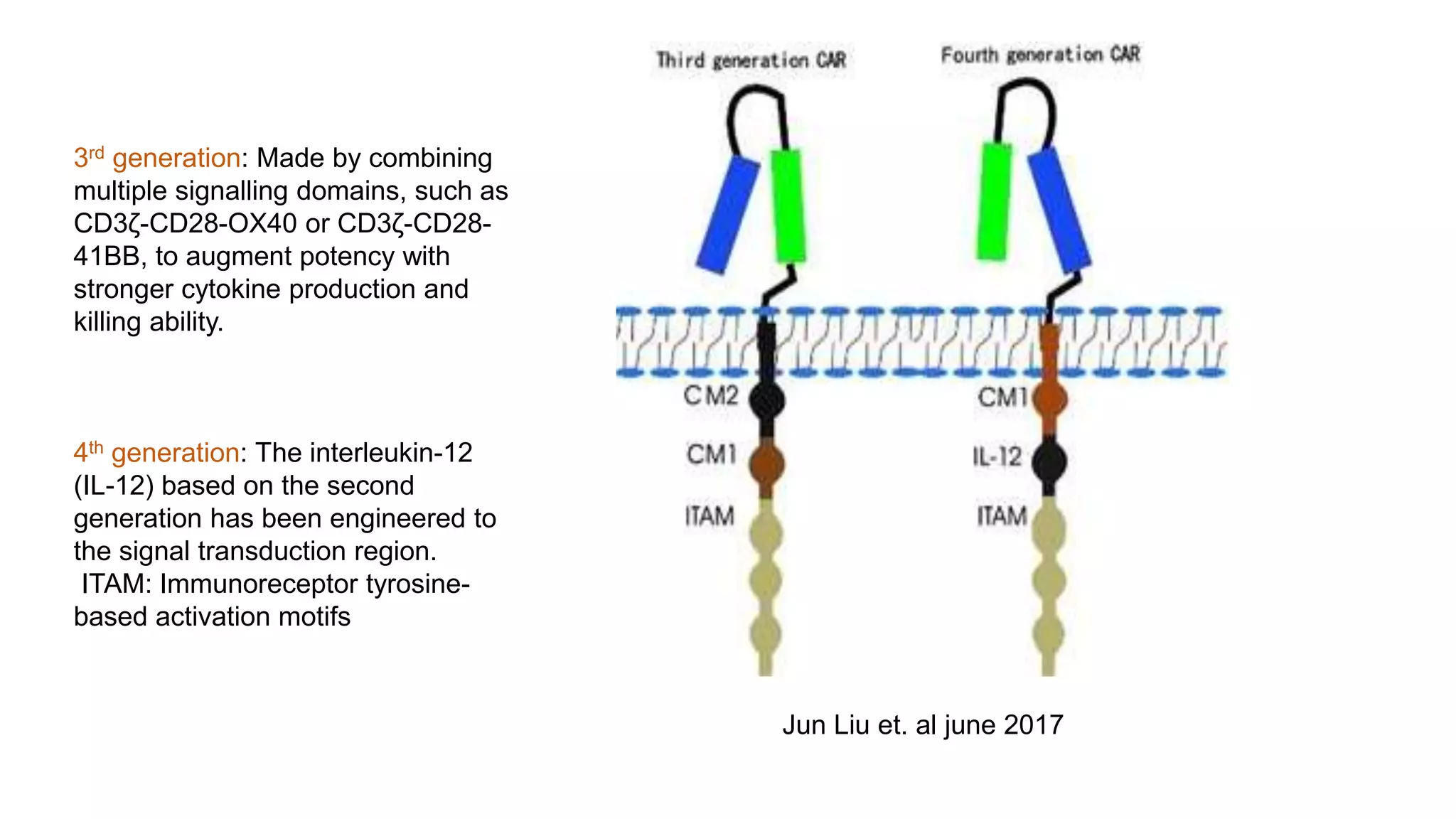
Evolution of chimeric antigen receptor
(CAR) from the first generation to the
fourth generation.
1st generation : Single chain antibody
(CD3ζ) links the ITAM at
transmembrane region
could not produce sufficient IL-2
2nd generation: Costimulatory molecule
(CM1), such as CD28 or CD137(4-1BB
and CD134(OX40)), , has been
engineered to the signal transduction
region. Improved than 1st generation.
Jun Liu et. al june 2017
3rd generation: Made by combining
multiple signalling domains, such as
CD3ζ-CD28-OX40 or CD3ζ-CD28-
41BB, to augment potency with
stronger cytokine production and
killing ability.
4th generation: The interleukin-12
(IL-12) based on the second
generation has been engineered to
the signal transduction region.
ITAM: Immunoreceptor tyrosine-
based activation motifs
Jun Liu et. al june 2017
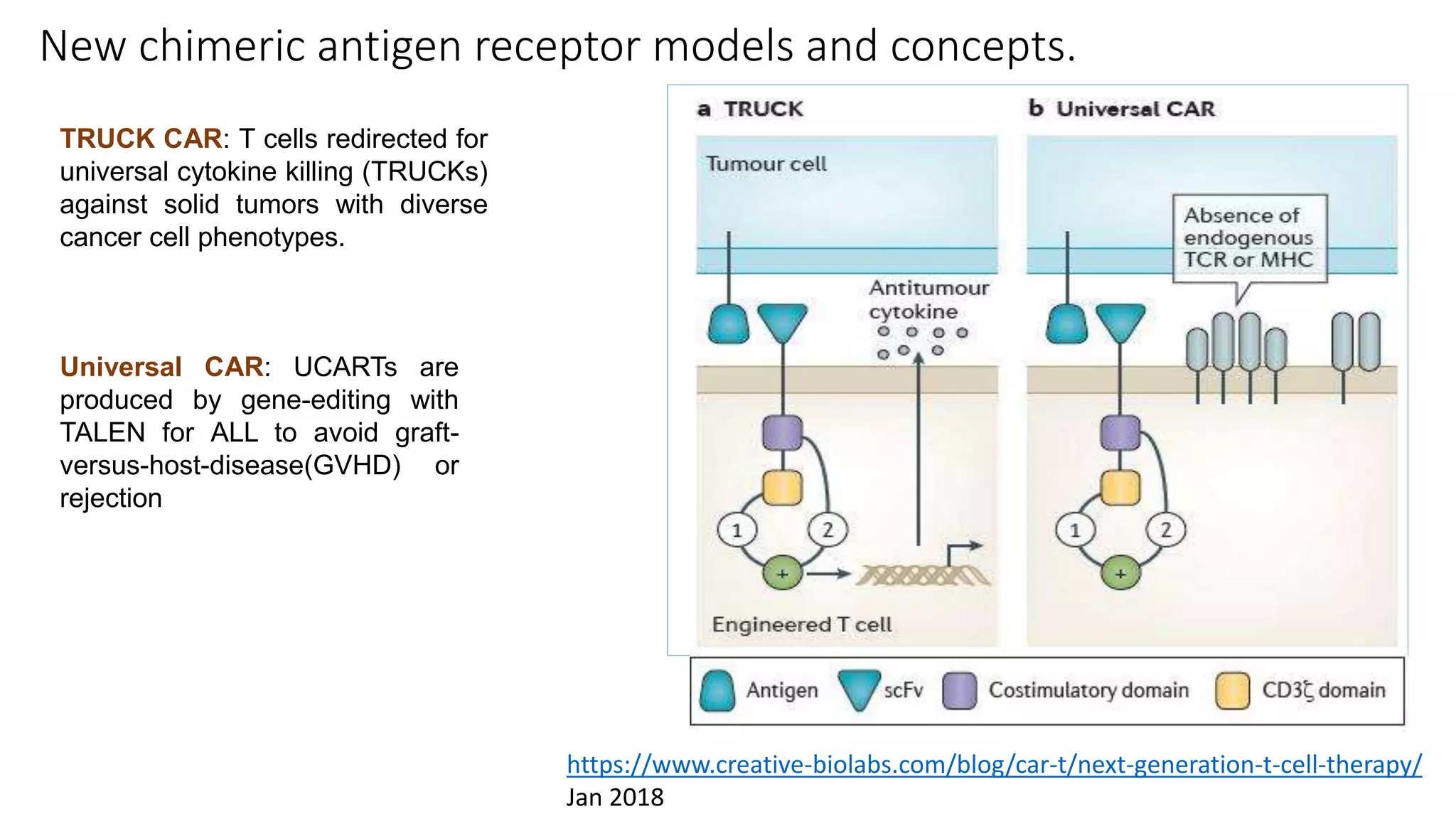
New chimeric antigen receptor models and concepts.
TRUCK CAR: T cells redirected for
universal cytokine killing (TRUCKs)
against solid tumors with diverse
cancer cell phenotypes.
Universal CAR: UCARTs are
produced by gene-editing with
TALEN for ALL to avoid graft-
versus-host-disease(GVHD) or
rejection
https://www.creative-biolabs.com/blog/car-t/next-generation-t-cell-therapy/
Jan 2018
Self-driving CAR: It comprises of
CARs and chemokine receptor to
enhance trafficking into tumor tissue &
tumor homing(chemokine bind to tumor
ligand.
(for example, C-C motif chemokine
receptor 2 (CCR2)–C-C motif chemokine
ligand 2 (CCL2))
Armored CAR: resistant to
immunosuppression genetically
modified to no longer express various
immune checkpoint molecules (for
example, cytotoxic T lymphocyte-
associated antigen 4 (CTLA4) or
programmed cell death protein 1
(PD1))
https://www.creative-biolabs.com/blog/car-t/next-generation-t-cell-therapy/
Jan 2018
Self-destruct CAR: molecular switch
control. preclinical trails in mesothelioma
and advanced leukemia. HSV-TK(off
switch suicide gene)induced by
gangciclovir & clear CAR T cells during &
after gene therapy trials. Self destruction is
done by RNA electroporation & viral
transduction. To avoid CRS,TLS.
Conditional CAR: conditionally
activate only in the presence of an
exogenous molecule. A conditional
CAR T cell is by default unresponsive,
or switched ‘off’, until the addition of a
small molecule to complete the circuit,
enabling full transduction of both signal
1 and signal 2, thereby activating the
CAR T cell.
https://www.creative-biolabs.com/blog/car-t/next-generation-t-cell-therapy/
Jan 2018
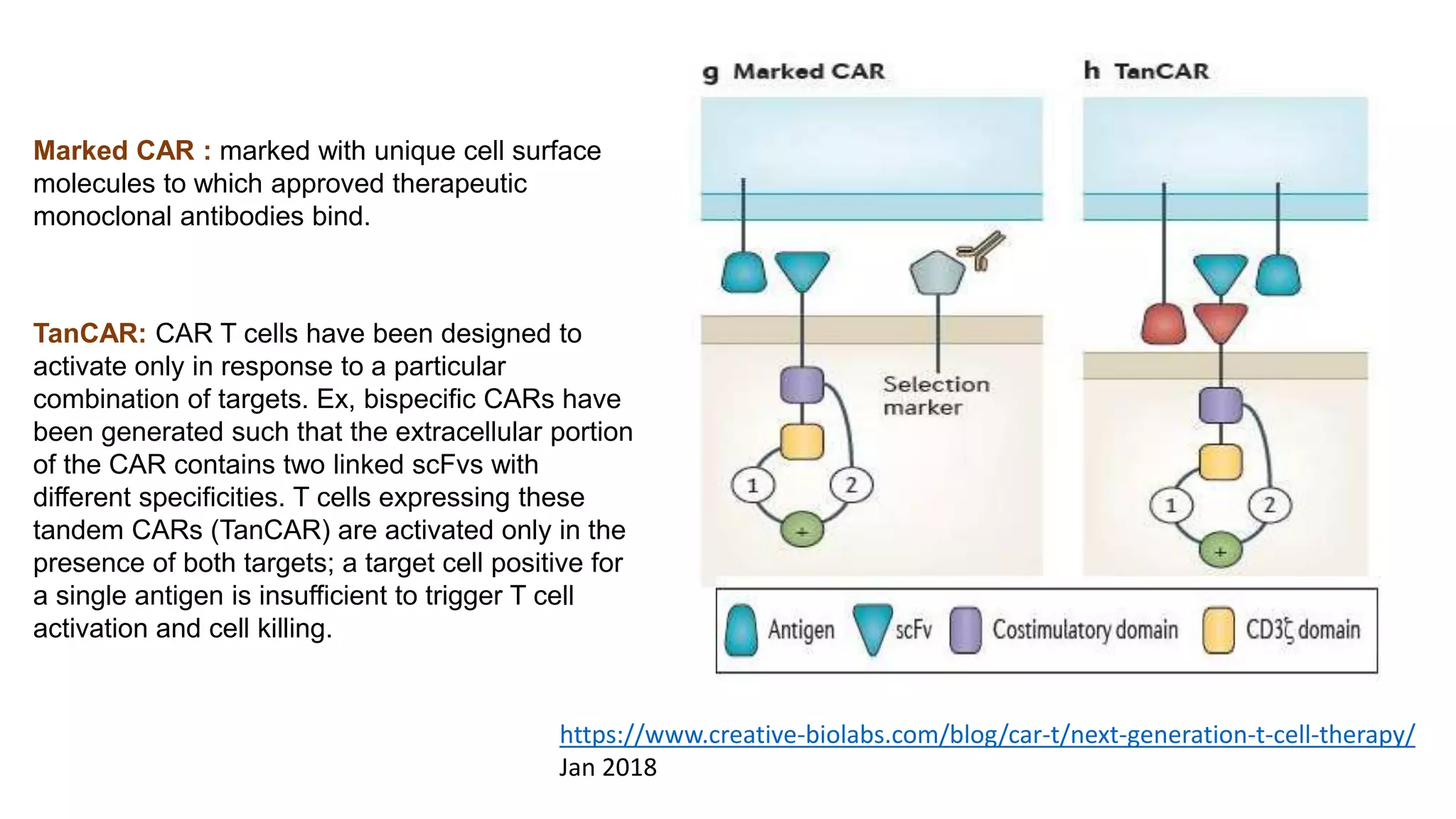
Marked CAR : marked with unique cell surface
molecules to which approved therapeutic
monoclonal antibodies bind.
TanCAR: CAR T cells have been designed to
activate only in response to a particular
combination of targets. Ex, bispecific CARs have
been generated such that the extracellular portion
of the CAR contains two linked scFvs with
different specificities. T cells expressing these
tandem CARs (TanCAR) are activated only in the
presence of both targets; a target cell positive for
a single antigen is insufficient to trigger T cell
activation and cell killing.
https://www.creative-biolabs.com/blog/car-t/next-generation-t-cell-therapy/
Jan 2018
Dual CAR: A dual CAR T cell expresses two
separate CARs with different ligand binding targets;
one CAR includes only the CD3ζ domain and the
other CAR includes only the co-stimulatory
domain(s). In this approach, a single T cell
expressing a CD3ζ-only CAR against the first target
and a co-stimulatory domain-only CAR against a
second target will become fully activated only in the
presence of both targets.
sCAR: A safety CAR (sCAR) consists of an
extracellular scFv fused to an intracellular
inhibitory domain (for example, CTLA4 or PD1).
These inhibitory signals enable protection of cells
with particular immunophenotype from CAR T cell
killing. sCAR T cells co-expressing a standard
CAR become activated only when encountering
target cells. https://www.creative-biolabs.com/blog/car-t/next-generation-
t-cell-therapy/
Jan 2018
Antitumor mechanism of CAR-T cells
TCR recognizes TAAs depending on the MHC presentation.
TCR could recognize intracellular and extracellular antigens.
While tumor cells often downregulate MHC expression to
escape the killer T cells
CAR-T cells can specifically recognize the tumor antigens in a MHC-independent
manner. And then, the T cells were activated through the phosphorylation of ITAMs
followed by enhanced cytokine secretion, T cell proliferation, and cytotoxicity. IL-12
could recruit and reinforce the functions of marophages & NK cells.
Activated T and CAR-T cells perform cytotoxicity mainly through secretion of perforin and granzyme granules, also through the death receptor
pathway such as Fas/Fas-L. Due to added co-stimulatory signal to endodomain, antitumor activity mediated by CARs is stronger than TCRs
Shengnan Yu et al. December 2017 Journal of Hematology & Oncology
CARs in the Clinic
FDA-APPROVED CAR T CELL THERAPY FOR ACUTE
LYMPHOBLASTIC LEUKEMIA (ALL)
• Tisagenlecleucel (KymriahTM) is the 1st FDA approved for the treatment of patients up to 25 years
of age with B-cell precursor acute lymphoblastic leukemia (ALL) that is refractory or in second or
later relapse. It is a CD19-directed genetically modified autologous T cell immunotherapy.
• Axicabtagene ciloleucel (YescartaTM) is the 2nd FDA approved for the treatment of adult patients
with relapsed or refractory large B-cell lymphoma after two or more lines of systemic therapy,
including diffuse large B-cell lymphoma (DLBCL) not otherwise specified, primary mediastinal large
B-cell lymphoma, high-grade B-cell lymphoma, and DLBCL arising from follicular lymphoma.
Yescarta is not indicated for the treatment of patients with primary central nervous system
lymphoma. It is a CD19-directed genetically modified autologous T cell immunotherapy.
FDA-APPROVED CAR T CELL THERAPY FOR NON-
HODGKIN LYMPHOMA
• The U.S. Food & Drug Administration (FDA) recently approved a new form of CAR T cell therapy for
for adult patients with certain types of large B-cell lymphoma who have not responded to or who
have relapsed after at least two other kinds of treatment. This is the second gene therapy approved
by the FDA and the first for certain types of non-Hodgkin lymphoma (NHL).
City of Hope is one of the first medical centers in the nation to provide this therapy, axicabtagene
ciloleucel (Yescarta), for adult patients with refractory aggressive non-Hodgkin lymphoma.
Axicabtagene ciloleucel targets the antigen CD19, a protein found on the cell surface of NHL as well
as other lymphomas and leukemias.
ONGOING TRIALS
• Solid tumors
• Brain cancer (glioblastoma) - uses “memory” T cells which remain in the body after attacking the cancer. The
hope is that they then grow into an active reservoir of cancer-killing cells capable of stopping future.
• Sarcoma - A Pilot Study of Genetically Engineered NY-ESO-1 Specific NY-ESO-1ᶜ259T in HLA-A2+ Patients
With Synovial Sarcoma (NY-ESO-1)
• Ovarian - CT Antigen TCR-redirected T Cells for Ovarian Cancer
• Lung - MAGE A10ᶜ⁷⁹⁶T for Advanced non small cell lung cancer [NSCLC]
• Blood cancers
• AML and Blastic Plasmacytoid Dendritic Cell Neoplasm [BPDCN]
Lymphoma
• Mantle cell lymphoma
• Multiple myeloma -NY-ESO-1ᶜ259T Alone and in Combination With Pembrolizumab for Multiple Myeloma
• Pediatric acute lymphoblastic leukemia - A Multi-Center Study Evaluating KTE-C19 in Pediatric and
Adolescent Subjects With Relapsed/Refractory B-precursor Acute Lymphoblastic Leukemia (ZUMA-4)
NEW TRIALS
• Solid tumors
• HER2-positive breast cancer that has metastasized to the
brain
• Prostate cancer
• Blood cancers
• Multiple myeloma
• The rare disease amyloidosis
Possible Side Effects of CAR T-Cell Therapy
• Cytokine-Release Syndrome (CRS)
Tocilizumab (Actemra®)-FDA approved drug
• Neurologic Toxicities
• B-Cell Aplasia
• Tumor Lysis Syndrome (TLS)
• Anaphylaxis (Life-threatening Allergic Reaction)
Conclusion
CAR-T treatment for patients with tumors has shown promising outcomes;
however, many remaining challenges need to be considered. The high quality
of CAR-T products needs to be ensured through optimization of protocols, and
the long-term safety requires further study.
References
• https://www.cancer.org/treatment/treatments-and-side-effects/treatment-types/immunotherapy/car-t-
cell1.html
• http://cancerdiscovery.aacrjournals.org/content/3/4/388
• http://www.lls.org/treatment/types-of-treatment/immunotherapy/chimeric-antigen-receptor-car-t-cell-therapy
• https://www.ncbi.nlm.nih.gov/pmc/articles/PMC5482931/
• https://www.researchgate.net/figure/Chimeric-antigen-receptors-provide-for-expanded-targeting-
opportunities-compared-to-T_fig1_225074817
• https://jhoonline.biomedcentral.com/articles/10.1186/1756-8722-6-47
• https://www.creative-biolabs.com/blog/car-t/next-generation-t-cell-therapy/
• https://clinicaltrials.gov/ct2/show/record/NCT02208362?term=13384&rank=1&view=record
• https://www.cityofhope.org/research/car-t-cell-therapy/all-car-t
Thank you

Car tcell therapy

  • 1.
    Chimeric antigen receptor(CAR) Tcell therapy Presented by: Preetika Pradhan Molecular medicine
  • 2.
    Introduction • CAR’s alsoknown as chimeric immunoreceptor, chimeric T cell receptors, artificial T cell receptor. • Chimeric antigen receptors (CAR) are recombinant receptors for antigen, which, in a single molecule, redirect the specificity and function of T lymphocytes and other immune cells. • CAR T-cell therapy is a promising new way to get immune cells called T cells to fight cancer by changing them in the lab so they can find and destroy cancer cells. • CAR T-cell therapies are sometimes talked about as a type of gene or cell therapy, or an adoptive cell transfer therapy.
  • 3.
  • 4.
    Structure of CART Cell • CARs include three parts: ectodomain, transmembrane domain and endodomain • Ectodomain : consists of signal peptide, antigen recognition region and spacer. • Transmembrane domain: The stability of the receptor is related to the transmembrane domain. • Endodomain: functional end of the receptor, and the most common component is CD3 ζ included three immunoreceptor tyrosine-based activation motifs (ITAMs). Cheng Zhang et. al june 2017 https://www.ncbi.nlm.nih.gov/pmc/articles/PMC5482931/figure/Fig1/
  • 6.
    CAR Targeting • Unlikethe physiologic TCR, which engages HLA-peptide complexes, CARs engage molecules that do not require peptide processing or HLA expression to be recognized. • CARs therefore recognize antigen on any HLA . • Furthermore, CARs can target tumor cells that have downregulated HLA expression or proteasomal antigen processing, mechanisms that contribute to tumor escape from TCR- mediated immunity. • CARs has their ability to bind not only to proteins but also to carbohydrate and glycolipid structures, again expanding the range of potential targets. Rimas J Orentas et. al Jan 2012
  • 7.
    Evolving architecture ofCAR • Since the initial development of CARs in 1989, CAR-T cells can be divided into four generations according to the structure of the endodomain • The initial CAR of the first generation provides a proof of concept of the targeting and activation of T cells. • The CAR of the second and third generations have been developed by addition of dual or triple co- stimulatory signaling domains in order to increase their cytotoxicity. • The most important function of multiple signaling receptors is to enhance signaling strength and persistence, subsequently increasing in their overall potency.
  • 8.
    Evolution of chimericantigen receptor (CAR) from the first generation to the fourth generation. 1st generation : Single chain antibody (CD3ζ) links the ITAM at transmembrane region could not produce sufficient IL-2 2nd generation: Costimulatory molecule (CM1), such as CD28 or CD137(4-1BB and CD134(OX40)), , has been engineered to the signal transduction region. Improved than 1st generation. Jun Liu et. al june 2017
  • 9.
    3rd generation: Madeby combining multiple signalling domains, such as CD3ζ-CD28-OX40 or CD3ζ-CD28- 41BB, to augment potency with stronger cytokine production and killing ability. 4th generation: The interleukin-12 (IL-12) based on the second generation has been engineered to the signal transduction region. ITAM: Immunoreceptor tyrosine- based activation motifs Jun Liu et. al june 2017
  • 10.
    New chimeric antigenreceptor models and concepts. TRUCK CAR: T cells redirected for universal cytokine killing (TRUCKs) against solid tumors with diverse cancer cell phenotypes. Universal CAR: UCARTs are produced by gene-editing with TALEN for ALL to avoid graft- versus-host-disease(GVHD) or rejection https://www.creative-biolabs.com/blog/car-t/next-generation-t-cell-therapy/ Jan 2018
  • 11.
    Self-driving CAR: Itcomprises of CARs and chemokine receptor to enhance trafficking into tumor tissue & tumor homing(chemokine bind to tumor ligand. (for example, C-C motif chemokine receptor 2 (CCR2)–C-C motif chemokine ligand 2 (CCL2)) Armored CAR: resistant to immunosuppression genetically modified to no longer express various immune checkpoint molecules (for example, cytotoxic T lymphocyte- associated antigen 4 (CTLA4) or programmed cell death protein 1 (PD1)) https://www.creative-biolabs.com/blog/car-t/next-generation-t-cell-therapy/ Jan 2018
  • 12.
    Self-destruct CAR: molecularswitch control. preclinical trails in mesothelioma and advanced leukemia. HSV-TK(off switch suicide gene)induced by gangciclovir & clear CAR T cells during & after gene therapy trials. Self destruction is done by RNA electroporation & viral transduction. To avoid CRS,TLS. Conditional CAR: conditionally activate only in the presence of an exogenous molecule. A conditional CAR T cell is by default unresponsive, or switched ‘off’, until the addition of a small molecule to complete the circuit, enabling full transduction of both signal 1 and signal 2, thereby activating the CAR T cell. https://www.creative-biolabs.com/blog/car-t/next-generation-t-cell-therapy/ Jan 2018
  • 13.
    Marked CAR :marked with unique cell surface molecules to which approved therapeutic monoclonal antibodies bind. TanCAR: CAR T cells have been designed to activate only in response to a particular combination of targets. Ex, bispecific CARs have been generated such that the extracellular portion of the CAR contains two linked scFvs with different specificities. T cells expressing these tandem CARs (TanCAR) are activated only in the presence of both targets; a target cell positive for a single antigen is insufficient to trigger T cell activation and cell killing. https://www.creative-biolabs.com/blog/car-t/next-generation-t-cell-therapy/ Jan 2018
  • 14.
    Dual CAR: Adual CAR T cell expresses two separate CARs with different ligand binding targets; one CAR includes only the CD3ζ domain and the other CAR includes only the co-stimulatory domain(s). In this approach, a single T cell expressing a CD3ζ-only CAR against the first target and a co-stimulatory domain-only CAR against a second target will become fully activated only in the presence of both targets. sCAR: A safety CAR (sCAR) consists of an extracellular scFv fused to an intracellular inhibitory domain (for example, CTLA4 or PD1). These inhibitory signals enable protection of cells with particular immunophenotype from CAR T cell killing. sCAR T cells co-expressing a standard CAR become activated only when encountering target cells. https://www.creative-biolabs.com/blog/car-t/next-generation- t-cell-therapy/ Jan 2018
  • 15.
    Antitumor mechanism ofCAR-T cells TCR recognizes TAAs depending on the MHC presentation. TCR could recognize intracellular and extracellular antigens. While tumor cells often downregulate MHC expression to escape the killer T cells CAR-T cells can specifically recognize the tumor antigens in a MHC-independent manner. And then, the T cells were activated through the phosphorylation of ITAMs followed by enhanced cytokine secretion, T cell proliferation, and cytotoxicity. IL-12 could recruit and reinforce the functions of marophages & NK cells. Activated T and CAR-T cells perform cytotoxicity mainly through secretion of perforin and granzyme granules, also through the death receptor pathway such as Fas/Fas-L. Due to added co-stimulatory signal to endodomain, antitumor activity mediated by CARs is stronger than TCRs Shengnan Yu et al. December 2017 Journal of Hematology & Oncology
  • 16.
  • 17.
    FDA-APPROVED CAR TCELL THERAPY FOR ACUTE LYMPHOBLASTIC LEUKEMIA (ALL) • Tisagenlecleucel (KymriahTM) is the 1st FDA approved for the treatment of patients up to 25 years of age with B-cell precursor acute lymphoblastic leukemia (ALL) that is refractory or in second or later relapse. It is a CD19-directed genetically modified autologous T cell immunotherapy. • Axicabtagene ciloleucel (YescartaTM) is the 2nd FDA approved for the treatment of adult patients with relapsed or refractory large B-cell lymphoma after two or more lines of systemic therapy, including diffuse large B-cell lymphoma (DLBCL) not otherwise specified, primary mediastinal large B-cell lymphoma, high-grade B-cell lymphoma, and DLBCL arising from follicular lymphoma. Yescarta is not indicated for the treatment of patients with primary central nervous system lymphoma. It is a CD19-directed genetically modified autologous T cell immunotherapy.
  • 18.
    FDA-APPROVED CAR TCELL THERAPY FOR NON- HODGKIN LYMPHOMA • The U.S. Food & Drug Administration (FDA) recently approved a new form of CAR T cell therapy for for adult patients with certain types of large B-cell lymphoma who have not responded to or who have relapsed after at least two other kinds of treatment. This is the second gene therapy approved by the FDA and the first for certain types of non-Hodgkin lymphoma (NHL). City of Hope is one of the first medical centers in the nation to provide this therapy, axicabtagene ciloleucel (Yescarta), for adult patients with refractory aggressive non-Hodgkin lymphoma. Axicabtagene ciloleucel targets the antigen CD19, a protein found on the cell surface of NHL as well as other lymphomas and leukemias.
  • 19.
    ONGOING TRIALS • Solidtumors • Brain cancer (glioblastoma) - uses “memory” T cells which remain in the body after attacking the cancer. The hope is that they then grow into an active reservoir of cancer-killing cells capable of stopping future. • Sarcoma - A Pilot Study of Genetically Engineered NY-ESO-1 Specific NY-ESO-1ᶜ259T in HLA-A2+ Patients With Synovial Sarcoma (NY-ESO-1) • Ovarian - CT Antigen TCR-redirected T Cells for Ovarian Cancer • Lung - MAGE A10ᶜ⁷⁹⁶T for Advanced non small cell lung cancer [NSCLC] • Blood cancers • AML and Blastic Plasmacytoid Dendritic Cell Neoplasm [BPDCN] Lymphoma • Mantle cell lymphoma • Multiple myeloma -NY-ESO-1ᶜ259T Alone and in Combination With Pembrolizumab for Multiple Myeloma • Pediatric acute lymphoblastic leukemia - A Multi-Center Study Evaluating KTE-C19 in Pediatric and Adolescent Subjects With Relapsed/Refractory B-precursor Acute Lymphoblastic Leukemia (ZUMA-4)
  • 20.
    NEW TRIALS • Solidtumors • HER2-positive breast cancer that has metastasized to the brain • Prostate cancer • Blood cancers • Multiple myeloma • The rare disease amyloidosis
  • 23.
    Possible Side Effectsof CAR T-Cell Therapy • Cytokine-Release Syndrome (CRS) Tocilizumab (Actemra®)-FDA approved drug • Neurologic Toxicities • B-Cell Aplasia • Tumor Lysis Syndrome (TLS) • Anaphylaxis (Life-threatening Allergic Reaction)
  • 24.
    Conclusion CAR-T treatment forpatients with tumors has shown promising outcomes; however, many remaining challenges need to be considered. The high quality of CAR-T products needs to be ensured through optimization of protocols, and the long-term safety requires further study.
  • 25.
    References • https://www.cancer.org/treatment/treatments-and-side-effects/treatment-types/immunotherapy/car-t- cell1.html • http://cancerdiscovery.aacrjournals.org/content/3/4/388 •http://www.lls.org/treatment/types-of-treatment/immunotherapy/chimeric-antigen-receptor-car-t-cell-therapy • https://www.ncbi.nlm.nih.gov/pmc/articles/PMC5482931/ • https://www.researchgate.net/figure/Chimeric-antigen-receptors-provide-for-expanded-targeting- opportunities-compared-to-T_fig1_225074817 • https://jhoonline.biomedcentral.com/articles/10.1186/1756-8722-6-47 • https://www.creative-biolabs.com/blog/car-t/next-generation-t-cell-therapy/ • https://clinicaltrials.gov/ct2/show/record/NCT02208362?term=13384&rank=1&view=record • https://www.cityofhope.org/research/car-t-cell-therapy/all-car-t
  • 26.